




Abstract
Artificial intelligence techniques provide more possibilities for supply chain transformations in the face of global warming and environmental degradation. This study examines the Cournot game model of two competing supply chains with various carbon emission technologies as well as the possibility of upgrading machine learning technology. The investment risk of a supply chain's technology upgrade is either symmetric or asymmetric information. In the case of symmetric information, results show that the machine learning technology upgrade risk does not affect the market equilibrium outcomes of the duopoly model. However, in the case of asymmetric information, technology upgrade risk is vital in determining the quantities and prices of competition equilibrium. To achieve the goal of green supply chain transformation, the government should provide more technology and financial support to traditional supply chains to upgrade their machine learning technology on carbon emissions.
Keywords
Introduction
The transformation from traditional to green supply chains seems to be an inevitable process designed to promote economic growth and maintain sustainable societies. Artificial intelligence (AI) techniques, such as machine learning, may provide further opportunities for the green transformation of supply chains. By reducing the cost of carbon emissions, supply chains could gain more market share if they can invest in machine learning technology and upgrade their carbon emission technology successfully. Hence, more policy measures should be proposed to facilitate the machine learning technology easily employed in the green transformation of traditional supply chains.
Among the huge amount of studies in the areas of green supply chain management (SCM), Beamon, 1 Srivastava, 2 Carter and Rogers, 3 Seuring and Müller, 4 Sarkis et al., 5 Seuring, 6 and Eskandarpour et al. 7 are the representatives on the design and management theory of green supply chains. Cases of green supply chain management (GSCM) specific to country studies were analyzed by Zhu et al., 8 Zhu et al., 9 Lee, 10 and Varsei and Polyakovskiy. 11 Some theoretical studies have provided mathematical models of supply chain competition with risk.12–20 However, few existing studies have employed the game model to study the green transformation of competitive supply chains and considered the prospect of applying machine learning in this process.
Machine learning might be a powerful tool in carbon emission and green transformation of the supply chain. Because a supply chain may contain many upstream and downstream firms which adopt different technologies for carbon emissions, there also exists a lot of competition between supply chains. In such a complex system of competing supply chains, any firm that wants to upgrade its carbon emission technology may face the difficulty of finding an optimal upgrade strategy. However, by using machine learning, firms could find the optimal solution based on the big data of supply chains and green transformation.
As early as 1959, Samuel, who was an IBM engineer, creatively proposed the concept of machine learning (ML). Over the past two decades, research on ML has increased due to the advancement of computer technology. Jordan and Mitchell 21 defined ML as a method of improving a computer's ability through the learning experience and the core of AI. Many scholars focused on the application of ML to forecasting, which encompasses a vast array of applications,22,23 such as yield forecasting, 24 disease forecasting, 25 stock price forecasting, 26 poverty prediction, 27 and SCM. 22 In the face of global warming and environmental degradation, ML provides more opportunities for protecting the environment and is used to predict air quality 28 as well as sort waste. 29 Additionally, supply chains have a significant impact on the environment. In 1999, a study proposed an extended (green) supply chain that would include recycling, remanufacturing, and reuse activities to the traditional supply chain. 1 GSCM integrates the concept of environmental protection throughout the entire SCM process, 30 and it is also a technique to improve environmental performance. Through empirical research, it was discovered that AI is an effective tool for optimizing GSCM.31,32 What role does ML, as the core of AI, play in GSCM?
Literature indicates that ML is the most prevalent AI technique in SCM and is widely used in supply chain processes.33,34 These studies were reviewed using two scholarly studies.35,36 Based on various ML algorithms, most studies focus on supplier selection,37–39 whereas others focus on supply chain risk management. 40 Moreover, few authors have focused on inventory management, 41 and few authors center on demand forecasting. 42 These studies fully revealed the positive significance of ML in SCM. While ML has the potential for power supply chain transformation, its potential has not been completely realized. 33 ML excels in SCM research and bleaks in GSCM research. Liu et al. 43 reviewed relevant research on the use of big data analysis technology for GSCM and discovered that the role of ML in GSCM has not been thoroughly studied. The application of ML to green procurement is the main issue in that literature. Utilizing ML algorithms has facilitated the selection of low-carbon suppliers. Moreover, Shabanpour et al. 44 used artificial neural networks (ANNs) and dynamic data envelopment analysis (DEA) to predict green supplier efficiency. In addition, Singh et al. 45 used machine learning and optimization to select low-carbon beef supplies, Zhang et al. 46 constructed an evaluation model of the power supply chain using principal component analysis and SVM, and Liou et al. 47 proposed a hybrid multi-criteria decision-making model that integrates technologies, such as SVM for the effective evaluation of green suppliers. Moreover, ML has been well integrated into inventory management; Selukar et al. 48 used deep reinforcement learning techniques to manage perishable goods better. Additionally, ML assesses and monitors the risk level of green supply chains, hence enabling companies to implement more effective SCM strategies that maximize profits and sustainable development.49–51
Our study's main contribution involves the introduction of machine learning into the technology upgrade and green transformation of supply chains. The new setting provides insights into the influence of competition strategies on market equilibrium if some chains adopt machine-learning technology to reduce carbon emissions. Our study examines the duopoly competition with asymmetric risk in one chain's investment in machine learning technology. The investment risk of machine learning technology upgrade is symmetric or asymmetric information for the other. The effects of machine learning investment and its risk on the supply chain competition are analyzed and the equilibria outcomes in both cases are compared.
In our study, we pay special attention to the asymmetric competition between a traditional supply chain and a transformed supply chain that is willing to adopt machine-learning technology to reduce its carbon emission. The key information of the game is the machine learning technology upgrade risk of one supply chain, which could be observed or not by its opponent chain. Then we need to analyze two possible cases of symmetric or asymmetric information.
The structure of our paper is organized as the following sections. We show the baseline game model for the two supply chains bearing asymmetric carbon emission costs. Section 3 presents the main game model of green transformation possibility for one supply chain in cases of symmetric and asymmetric information regarding the outcome of machine learning technology upgrade. Section 4 provides the conclusions and policy implications based on our analysis.
The baseline model
Following Wu et al.,52,53 a Cournot duopoly game model for supply chains is presented, while there are an upstream wholesaler firm and a downstream retailer firm in each chain. Some carbon emissions occur during each supply chain's production. First, the upstream and downstream firms in two supply chains determine the wholesaling price of the intermediate commodity simultaneously through some bargaining process,
The manufacturing process of every product is characterized by carbon emissions
We denote



To determine their respective profit shares, the firms in each supply chain negotiate the intermediate commodity's price,

The inverse demand function that two supply chains are facing is as follows:

We also assume that upstream firms have sufficient capacity in our baseline model, that is,

In the sub-game perfect equilibrium (SPE) of supply chain Cournot model with asymmetric carbon emissions, the optimal profits of two chains, upstream firms, and downstream firms are as follows:


In equilibrium, we refer to the difference of carbon emission technology as
In the SPE of supply chain Cournot model with asymmetric carbon emissions, the difference in price,
As the difference of carbon emission technology between chains become larger, supply chain 2 will experience an increase in equilibrium price, but a decrease in equilibrium quantity, and finally chain 2's profit will reduce. In such a situation, supply chain 2 may consider using machine learning technology to resolve the cost disadvantage in future competition.
The main model with technology upgrade risk
Technology upgrade risk on machine learning
Based on the baseline model, we examine the case that if supply chain 2 has the opportunity to invest in machine learning technology and transforms into a green supply chain. In this scenario, supply chain 2 tries to cut per-product carbon emissions,
The timing of the game according to the supply chain competition model of asymmetric technology upgrading risk in machine learning investment is as follows:
Upstream firm 2 in supply chain 2, which is presented with the opportunity to upgrade machine learning technology, makes an investment, The upstream and downstream firms in each chain simultaneously negotiate and determine the intermediate commodity's price, Both supply chain's upstream and downstream firms concurrently determine the needed quantity of the intermediate commodity The retailing price of the final commodity,
We should notice that this technology upgrade risk on machine learning could be symmetric or asymmetric information, which implies that the machine learning technology upgrade risk of one supply chain could be observed or not by its opponent chain. The result of this observation is given by nature.
The case of symmetric information
First, we examine the case of symmetric information, in which upstream firm 1 may receive the information about the outcome of technology upgrade in supply chain 2. In this model, there are two possible outcomes of technology upgrade: (1) if the technology upgrade of machine learning succeeds, the carbon emission technology of upstream firm 2 upgrades to a higher level; in this scenario, we denote the quantities and prices of the two supply chains as
The following are the ex-ante expected optimal profit of chain 2:

Furthermore, upstream firm 1 has no opportunity to upgrade its carbon emission technology, and then the expected optimal profit of chain 1 is as follows:


When upstream firm 2 succeeds in the technology upgrade of machine learning, solving equations (12) and (14), we can derive the optimal quantities as follows:


Then, we can substitute equations (15)–(18) into equation (5), and derive the optimal prices of two chains in the two possible scenarios as follows:




In the SPE of supply chain Cournot model with asymmetric upgrade risk of machine learning, the optimal expected profits are


Comparing the optimal profits in (23) and (24) with those in (7) in the baseline model,

In the SPE of supply chain Cournot model with asymmetric upgrade risk of machine learning, supply chain 1's profit decreases and supply chain 2's profit increases, respectively, as the technology upgrade probability of chain 2,
In this instance of symmetric information, the traditional supply chain can increase the probability of successful carbon emission technology upgrade and have a stronger incentive to transfer to a green supply chain if it receives more technical support for machine learning. What happens to the equilibrium of supply chain completion if the information on machine learning technology upgrade risk is asymmetric?
The case of asymmetric information
Upstream firm 1 cannot distinguish which type of upstream firm 2 it faces, whether a successful or a failed one, if the technology upgrade risk of upstream firm 2 is asymmetric information to its competitor. Hence, supply chain 1 can only choose one optimal quantity,


In the perfect Bayesian equilibrium (PBE) of the supply chain Cournot model with asymmetric information on the technology upgrade of machine learning, the equilibrium quantity of chain 1 is
By comparing the results of Proposition 3 with Proposition 2, we can conclude that both
The following proposition regarding the optimal profits of the asymmetric information case is given:
The optimal expected profits in the PBE of supply chain Cournot model with asymmetric information on the technology upgrade of machine learning are

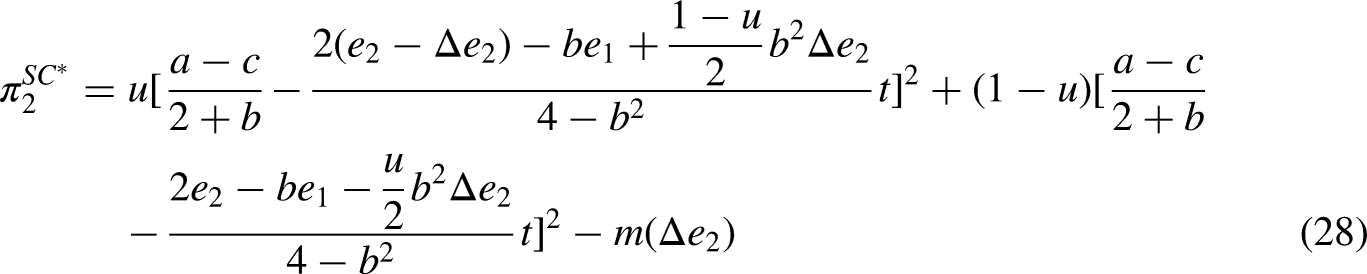
In the equation (42), the amount of chain 2's technology upgrade,

In the PBE of the supply chain Cournot model with asymmetric information on the technology upgrade of machine learning, there must exist a positive amount of technology upgrade for chain 2, and it is given by equation (29).
Note that Lemma 3 shows that there must exist an optimal technology upgrade level on machine learning when the result of the technology upgrade is asymmetric. In fact, one supply chain may choose to disturb the process of information spreading by paying an extra cost. In such a situation, we need to consider the optimal information disturbing strategy of one chain and how the information disturbing strategy affects the Bayesian belief updating of the other chain. To keep things simple, we just focus on two possible observation results of technology upgrade risk.
Conclusions
In this study, we presented the Cournot game model of two competing supply chains with various carbon emission technologies as the baseline model, and then introduce the possibility of upgrading machine learning technology to reduce carbon emission for one supply chain in the main model. The investment risk of a supply chain's technology upgrade is either symmetric or asymmetric information to its competitor. In the case of symmetric information, we find that the technology upgrade risk of machine learning does not affect the market equilibrium outcomes, because all participants in the game receive the information of the technology upgrade result. However, in the case of asymmetric information, technology upgrade risk is vital in determining the competitive equilibrium and the supply chain is better off if its success probability of technology upgrade becomes higher.
To achieve the goal of green supply chain transformation, the government should provide more technology and financial support to traditional supply chains to upgrade their machine learning technology on carbon emissions. In reality, traditional supply chains may lack the incentive to initiate a green transformation when the success probability of technology upgrades is relatively low. Then the government should encourage universities and research institutions to conduct more research on machine learning of carbon emission and provide more technical support for machine learning to supply chains because the knowledge of machine learning technology is public good and the growth and dissemination of knowledge may provide huge positive externalities to supply chains and increase their incentives to fulfill the transformation of the green supply chain by machine learning. However, this study only provides the theoretical analysis of green supply chain transformation and emission reduction based on machine learning. In the future research, one could collect more data related and test the results of the theoretical model.
Footnotes
Declaration of conflicting interests
The author(s) declared no potential conflicts of interest with respect to the research, authorship, and/or publication of this article.
Funding
The author(s) disclosed receipt of the following financial support for the research, authorship, and/or publication of this article. This research was funded by the National Natural Science Foundation of China, grant numbers 41861042, 71864013, and 71974084.
