



Abstract
Developing blend membrane material is one feasible and effective route for improving the gas separation efficiency and commercial attractiveness of membrane technologies. Here, free-standing membranes were prepared by casting method using Pebax-1074 as continuous polymer matrix and poly(ethylene glycol) (PEG) as dispersive organic fillers. The morphology, surface functional groups, microstructure and thermal stability of the membranes were characterized by scanning electron microscopy, Fourier transform infrared spectroscopy, X-ray diffraction, thermogravimetric analysis and differential scanning calorimetry, respectively. The effects of preparation variables including average molecular weight and dosage of PEG on the microstructure, morphology and properties of the blend membranes were investigated. In addition, the effects of operation conditions including permeation temperature and permeation pressure on the gas separation performance of the blend membranes were also examined. The results showed that the addition of PEG can obviously modify the structure-properties and significantly improve the separation performance of resultant membranes. Under the conditions of 30°C and 0.25 MPa, the optimal CO2 permeability and CO2/N2 selectivity respectively reached to 124.3Barrer and 115.8 for the blend membranes made by PEG600 with a content of 20% in Pebax-1074 matrix. In brief, the as-prepared blend membranes are proved to be promising for CO2/N2 separation application.
Introduction
Since the beginning of the 21st century, the excessive emission of greenhouse gases (e.g. CO2) has greatly hastened the climate change, resulting into a series of disasters, such as sea level rise, global warming, extreme weather, and ecological and environmental deterioration. 1 Meanwhile, it would also be a kind of loss for the underutilized CO2 that is an important resource for medical treatment, bioengineering and many other fields. Therefore, it is of great significance to efficiently capture CO2 from flue gas, which is mainly discharged by numerous boilers daily. 2 Although traditional separation technologies are quite mature and widely available, for example pressure swing adsorption, they are frequently suffered from the drawbacks of complex process, high energy consumption, and so forth.3,4
Membrane gas separation technology has been attracted much interest owing to the supreme advantages of simple process, high efficiency, environmentally friendly, energy-saving, low fabrication cost, flexible operation, etc.5–7 Recently, Pebax polymer has been identified as one of the most promising membrane materials for efficiently distinguishing polar CO2 from other non-polar gases.8,9 The molecular chains of Pebax are constituted by rigid polyamide (PA) and flexible polyether (PEO) segments, which can provide excellent bulk free fractional volume, and gas solubility and diffusivity favorable for CO2 permeation. 9 In particular, one of the commercial Pebax products, Pebax-1074 comprised of 45 wt% PA and 55 wt% PEO exhibits more outstanding general properties in relation to CO2 separation membranes.9,10 Nevertheless, similar to all the other membranes, Pebax is also subjected to the “trade-off” relationship between gas permeability and selectivity, that is Robeson's upper bound.11,12 Therefore, it is an utmost challenge for gas separation membranes to surpass the well-known Robeson's upper bound in pursuit of more commercial attractiveness. 13
To this end, incorporation with organic or inorganic fillers is generally believed as one of the most feasible strategies to improve the separation performance of Pebax membranes. 14 In common, the fillers are silica (SiO2), 15 carbon nanotubes (CNTs), 16 titanium dioxide (TiO2),17,18 graphene oxide (GO),19–21 polyvinyl alcohol (PVA),5,22 polyurethane (PU), 23 polyethylene glycol (PEG), 24 and so on. Noroozi et al. 25 prepared nanocomposite membranes by Pebax-1657 blended with tetraethylene pentamine functionalized titanium oxide nanotubes (TiNTs-TEPA) and polyethylene glycol (PEG). The CO2 permeability and ideal selectivity of the membranes were increased by 67.7% and 11.7%, respectively, compared with the neat Pebax membrane. Previously, our team adopted NaY zeolites and SAPO-23 as additives to modify Pebax membranes that substantially improved the CO2 permeability and CO2/N2 selectivity to 131.8 Barrer and 178.1, respectively.7,26 Unfortunately, the controllability of membrane fabrication is not satisfactory enough due to the inferior compatibility and dispersivity of inorganic fillers with the membrane matrix.9,17 Besides, the introduction of inorganic fillers might also greatly weaken the flexibility and applicability of ultimate membranes.11,14 Therefore, organic fillers have gained much interest for the preparation of Pebax-based membranes, which includes PVA, 22 PEG-MEA, 24 ion liquid,27,28 PEG, 11 and so forth. Among them, PEG has been attracted much interest due to its outstanding merits. Zhu et al. found that PEG could act as both a CO2 solubility enhancer and an interfacial morphology manipulator when it was utilized to synthesize Pebax-1657 based membranes. 29 Feng et al. fabricated Pebax-1074/PEG1500 blend membranes. The gas permeation behavior of N2, H2 and CH4 is mainly influenced by the hydrostatic pressure at high temperature, but for the polar gas CO2, it is dominated by CO2-induced plasticization effect and the hydrostatic pressure simultaneously. 30 Most likely, the larger molecular weight of PEG1500 is not the optimum modifier for matching Pebax-1074 in the preparation of blend membranes. 31
Regarding this, PEG400 and PEG600 were attempted to modify Pebax-1074 membranes in this work for improving the CO2 separation performance. To the best of our knowledge, no work has been conducted on this so far. Our motivations are illustrated in Figure 1. First, PEG is expectant to present a quite good compatibility with Pebax because of their similar molecular groups and frameworks. 32 Second, PEG contains abundant of hydroxyl (–OH) groups that can disrupt the accumulation of Pebax macromolecular chains and decrease the crystallinity of membranes, so as to increase the free volume fraction and the mobility of polymer chains. Especially, the great affinity of hydroxyl groups towards CO2 can improve the gas diffusivity of resultant blend membranes. 33 Finally, PEG possesses good membrane-forming properties, which is conducive to Pebax membrane-forming. 23 In brief, those factors are favorable for resultant Pebax/PEG blend membranes to effectively separate CO2 from gas mixture. The present work is expected to enrich the fabrication techniques and theories for laying a good foundation of industrial application in the future.

Schematic illustration of Pebax/PEG blending membranes.
Experimental
Raw materials
Oval Pebax-1074 particulates with diameter of 3–5 mm were purchased from Arkema Inc. of France. PEG (average molecular weight of 400 and 600) with chemical purity (CP) and n-butanol with analytical pure (AR) grade were purchased from Sinopharm Chemical Reagent Co., Ltd. and Tianjin Fuyu Fine Chemical Co., Ltd., respectively.
Membrane preparation
The procedure for Pebax-1074/PEG membrane preparation was classical casting method as illustrated in Figure 2.11,34 First of all, a solution of PEG in n-butanol was prepared in advance at 90°C with the aid of stirring for more than 1 h. Then, Pebax-1074 beads were added into the above-formed solution. Under magnetically stirring at 90°C for more than 7 h, uniform transparent solution was obtained after gradual swelling and dissolution. Subsequently, the solution was set aside to natural degassing at 90°C for 30 min with ultrasonication. Membranes were formed by casting the solution into several horizontal clean Petri dishes, followed by solvent evaporation at ambient condition for 3 h and drying at 60°C for 24 h, then going on drying at 60°C for another 24 h in vacuum. At last, free-standing plate membranes were obtained by detaching from Petri dishes. In addition, neat Pebax membranes were also prepared as control sample by the same procedures and conditions of blend membranes. The average sizes of membranes were around 9 cm in diameter and 50 μm in thickness.

Preparation process of Pebax-1074/PEG blend membranes.
The as-prepared membranes were labeled as MPx-y, Where, x and y refer to the molecular weight of PEG (400 and 600), the mass percentage of PEG over Pebax in starting solution (y: 10%, 20%, 30%, 40%).
Characterization
The morphology of membranes was observed by Hitachi SU8010 high resolution cold field emission TM-3000 scanning electron microscope (SEM) under acceleration voltage of 10 kV and 5 kV and discharge mode. The membranes were fractured with tweezers in liquid nitrogen.
The surface functional groups of membranes were detected by a total reflection Fourier transform infrared (FT-IR) spectrometer, Bruker TEMSOR II, with scanning 15 times in a range of 4000–400 cm−1.
The microstructure of membranes was monitored by PANalytical X’Pert Powder X-ray diffractometer (XRD) at an operating voltage of 30 KV and a current of 100 mA, copper target, in a scanning range of 5–60°, at a scanning speed of 10°/min, and wavelength of 0.1541 nm. According to the diffraction angle of XRD patterns and Bragg equation (1), the interlayer spacing d002 values can be obtained.
11

The thermal stability of membranes were studied by a Perkin Elmer TGA-4000 thermogravimetric analyzer, under the condition of 20 mL/min flowing nitrogen, the pyrolysis temperature of 30–800°C and a heating rate of 20°C/min.
The thermal melting behaviors of membrane samples were assessed by a differential scanning calorimetry, Mettler DSC 822e equipment, at a heating rate of 10°C/min with purging nitrogen of 200 mL/min.
Gas separation performance test
The gas separation performance of membranes was measured by single-component highly purified gases (≥99.999%), that is CO2 and N2, through the traditional constant-pressure and variable-volume technology. 34 Figure 3 is the schematic chart of measurement device.

Schematic of the gas permeation device.
The tested membranes were housed in stainless steel membrane cells by gaskets and bolts. In advance, the pipeline was checked for avoiding gas leakage and swept with detected gas from compressed gas cylinders. The test conditions were investigated within the scope of permeation pressure difference at 0.1–0.25 MPa and permeation temperature at 30–60°C. During the test, the downstream of the membrane was maintained at normally atmospheric pressure. The tested gas steadily permeated from the upper stream to the downstream, of which the flow rate was recorded by an intelligent electronic soap film flowmeter with a full calibrated scope of 0.1 mL). The gas permeability (PCO2, PN2) and selectivity (αCO2/N2) of membranes were calculated by equations (2) and (3), respectively.


Results and discussion
Morphology observation
Figure 4 shows the SEM images of the as-prepared blend membranes. For neat membrane, the surface is smooth, dense, flat, uniform and regular, without any visible defects, like pinholes or cracks from the views of surface and cross-section. Differently, the morphology of blend membranes has changed significantly due to the PEG addition. In another word, some distinctly dispersed platelet-like or block-like heterophase structures can be seen in the matrix from the surface images. Undoubtedly, this is due to the introduction of PEG into the Pebax membrane. Azizi et al. also found similar phenomenon that some irregular and convoluted structures emerged in membrane morphology due to the decrease in crystallinity of the membranes by PEG incorporation. 35 As such, it can be anticipated that the gas separation performance of membranes would be enhanced as the result of improvement of amorphous proportion and free fractional volume. 36

SEM images of the prepared blend membranes from surface and cross-section views. (a) Neat Pebax; (b) MP600-10%; (c) MP600-40%; (d) MP400-10%; (e) MP400-40%. Insets are cross-sectional images.
With the increase of PEG content, the morphology of the membrane surface further changes significantly, that is, the number and size of the heterophase structure decrease for PEG600-doped membranes, while that for PEG400-doped membranes appear a large number of oval sheet-like heterogeneous phases. This suggests that the number of hydroxyl groups in PEG molecules and the ratio of PEG molecules to Pebax molecules affect the microscopic compatibility and the orientation of molecular arrangement of Pebax. Thus, it would inevitably affect the molecular chains spacing of the membrane material and the resistance to gas permeation and diffusion. 37 It can be seen from the cross-section view of membranes that the microscopic morphology and structure of the membranes are not completely uniform along the thickness direction. Especially, the phenomenon of wrinkled structure and even an obvious cortex appears near the membrane surface layer.
In short, the additives eliminate the intermolecular interactions among Pebax molecules by interrupting with more hydrogen bonds, which is favorable for gas penetration due to the reduction of the crystallinity of the membrane and increment of the amorphous structure.
FT-IR analysis
Figure 5 shows the FT-IR spectra of membrane samples. For neat membrane, the characteristic peaks can be identified as the stretching vibration of the flexible segment ether group (C–O–C) at 1095 cm−1, the carbonyl group of the rigid segment H–N–C=O at 1640 cm−1, the carbonyl group of the free radical group O–C=O at 1732 cm−1, and the PA segment of the N–H and N–H groups at 3293 cm−1 and 1542 cm−1, respectively. The asymmetrical and symmetrical stretching vibrations of aliphatic chain C–H also appear near 2867 cm−1.28,38

FT-IR spectra of membranes with variable PEG content: (a) MP600 and (b) MP400.
For PEG-blended Pebax membranes, the peaks are stretching vibration of hydroxyl (–OH) at 844 cm−1, the symmetrical stretching vibration of ether base (–C–O–) at 1094 cm−1 and C–H (–CH2–) at 2864 cm−1, the stretching and bending vibrations of hydrogen bonds at 944 cm−1 and 3458 cm−1.33,39–42 In comparison, almost all the peaks in the FT-IR spectra of the blend membranes are consistent with the neat one. Moreover, with the increase of PEG content, the position of some peaks slightly shifts to lower wave numbers, including the carbonyl group of H–N–C=O and the N–H group. It is the addition of PEG that causes the hydrogen bonds between the polymer molecular chains to break and reduce membrane crystallinity.18,43 Simultaneously, the ether peaks in PEG and ether (C–O–C) bonds at 1095 cm−1 become sharper with the increase of PEG content. It has found that the interaction force between ether groups and CO2 can increase the solubility of CO2 so as to benefit the gas permeation. 44 The double peaks for the symmetrical and asymmetrical stretching vibrations of C–H bonds in aliphatic chains increase in intensity at 2867 cm−1, along with a slight change for the peak between 1500 cm−1 and 1200 cm−1. Nevertheless, no new peaks appear for PEG-doped Pebax membranes, implying that the interaction of PEG and Pebax molecules is based on physical bonds rather than chemical ones.
In brief, the results have verified that PEG is successfully introduced into the Pebax membrane matrix, which is beneficial for facilitating CO2 transporting through membranes by the abundant polar oxygen-containing groups.
XRD analysis
In Figure 6, the characteristic diffraction peaks are designated to the PE flexible segments of Pebax-1074 at 12° and 21°, and the rigid PA segments of Pebax-1074 at 24°. The flexible PE segments exhibit a weak characteristic diffraction peaks, while the rigid PA segments present a strong characteristic diffraction peak due to the formation of a semi-crystalline structure with hydrogen bonding. 45 It is closely related to the gas permeability and selectivity in terms of the variation of amorphous state proportion and free volume fraction in membrane matrix. The change tendency can be reflected by the indicator d002 values as shown in the latter section of this work.

XRD patterns of Pebax/PEG blend membranes: (a) MP600 and (b) MP400.
With the increase of PEG content, the intensity of all the characteristic diffraction peaks is obviously reduced. More importantly, the peak position at 24° gradually shifts to the higher degree. 16 This implies that more small PEG molecules have been incorporated in the membrane matrix, which could destroy the hydrogen bonding among PA segments and diminish the interactions between polymeric Pebax chains. Consequently, the proportion of crystalline phase of Pebax decreases in the membrane matrix with the increment of amorphous degree and fractional free volume. Notably, several sharp new peaks appear in the XRD patterns for blend membranes containing high content of PEG400 or PEG600, for example 40%. It is ascribed to the probable formation of another type of PEO crystalline induced by PEG in membrane matrix during membrane preparation. 46
In contrast to PEG400, incorporating PEG600 yields a larger offset for the peak position. This is because a higher molecular weight of PEG would lead to a greater steric hindrance for Pebax molecular movement in membrane matrix, thereby reducing the cohesive energy and increasing the FFV of membranes, which is more beneficial for improving the permeability and diffusivity of gas molecules. 46
On the basis of Bragg formula, it shows that the calculated d002 values of the crystallite parameters remarkably increase with PEG content in membranes. This confirms that the molecular chain spacing of the blend membranes is increased. As the consequence, the gas permeability would be improved.
Thermogravimetric analysis
Figure 7 is the TGA and DTG curves of membranes. Overall, all the membranes have similar profiles with only one weight loss interval at 350–550°C. For neat membrane, the weight loss range is mainly attributed to the thermal degradation of the Pebax molecular backbone, of which the maximum thermal weight loss rate is located at 457°C. 21

TGA and DTG curves of membranes: (a and b) Pebax/PEG600 blend membranes; (c and d) Pebax/PEG400 blend membranes.
There is no additional thermal weight loss stage for Pebax/PEG blending membranes although PEG is a well-known thermally labile polymer.18,39,43 This result suggests that the PEG and Pebax molecules surely generate a relatively uniform mixing matrix structure at molecular level by some interactions like hydrogen bonds. Moreover, as the content of the PEG increases from 10% to 40%, the temperatures at the maximum weight loss rate successively decrease. At the same time, the temperatures of Pebax/PEG400 are obviously lower about 3–10°C than those of Pebax/PEG600. As expected, PEG addition disrupts the stacking state of Pebax molecular chains by diminishing the intermolecular cohesive forces among Pebax chains, resulting in a decrease in the thermal stability of the blend membranes.32,39 This is consistent with the results of XRD and FT-IR analyses.
Differential scanning calorimetric analysis
In Figure 8, it shows that the DSC plots of Pebax/PEG membranes. For neat membrane, there are two distinct peaks centering at 6.3°C and 157.5°C corresponding to the melting peaks of PEO and PA, respectively. 11 In contrast, the melting temperatures for PEO segments of Pebax/PEG membranes are significantly increased due to the contribution of added PEG. Meanwhile, the melting temperatures for PA segments are slightly decreased. These results are common for block copolymer systems as the additive acts as a “solvent” for the block copolymer matrix. 47 It indicates that PEG and Pebax have a well compatibility by forming a relatively homogeneous phase. Besides, PEG mainly affects the melting behavior of Pebax in a low temperature range due to its intrinsically thermal property. 16 Overall, the addition of PEG results in a slight crystallization of the membrane and increases the melting point, which is consistent with the XRD analysis results.

DSC plots of Pebax/PEG membranes: (a) MP600 and (b) MP400.
Gas separation performance of blend membranes
Influence of PEG content
Figure 9 shows the effects of PEG contents on the gas separation performance of the Pebax/PEG blend membranes. On the whole, all the blended membranes are superior to the neat one in association with both gas permeability and selectivity. Since the gas permeation through polymeric membrane is mainly governed by a dissolution–diffusion mechanism, the PEG addition is actually both favorable for the improvement of the abovementioned two aspects. First, the abundant polar oxygen-containing groups in PEG could greatly improve the solubility of CO2 in membrane matrix due to its peculiarly polar attractiveness and a kind of plasticizer role for enhancing the overall flexibility of polymeric chains.
48
Simultaneously, PEG could also increase the diffusivity of CO2 by enlarging the molecular spacing and reducing the crystalline proportion via a role of dopant spacer in membrane matrix among Pebax molecular chains.24,44 The previous XRD results have also confirmed that

Gas separation performance of blend membranes at various loading contents (30°C and 0.2 MPa): (a) MP600 and (b) MP400.
In Figure 9, it also can be found that the CO2 permeability of the membranes roughly presents an increased trend with elevating the PEG content. At the same time, the CO2/N2 selectivity first increases then decreases. In another word, the membranes modified either by PEG600 or PEG400 show the highest selectivity at the addition content of 20%. This reason can be attributed to the enhanced contribution of PEG to the diffusivity and solubility of CO2 gas as has summarized above. Actually, XRD results have also demonstrated that the decrease in crystallinity caused an increase in FFV. It is beneficial for the improvement of gas diffusivity. Compared with CO2 (3.30 Å), the molecular dynamic diameter of N2 (3.64 Å) is much larger, along with a lower solubility and incompressibility, resulting in a decrease in N2 permeability and a significant increase in CO2/N2 selectivity. 48 However, the CO2/N2 selectivity would be reduced as the molecular chain gap and FFV are too large to effectively recognize the difference between CO2 and N2 gas when the PEG content is extremely high.
In contrast, PEG600 is more superior to PEG400 as fillers to prepare blend membranes in terms of enhancing CO2/N2 selectivity. This comes down to the former with larger molecular weight that endows the modified Pebax membranes with higher FFV and rigidity. Consequently, PEG600 is more beneficial to improve the CO2/N2 selectivity. In conclusion, at the optimum PEG600 content of 20wt%, the CO2 permeability and CO2/N2 selectivity are 124.3 Barrer and 92.5, respectively.
Effect of permeation pressure
Figure 10 gives the influence of permeation pressure on gas permeation of blend membranes MP600-20% and MP400-20%.

Effect of permeation pressure on the gas separation performance at 30°C: (a) MP600-20% and (b) MP400-20%.
Permeation pressure is closely linked to CO2 permeability in the rubbery polymer matrix. 49 It shows in Figure 10(a) that the permeability of CO2 increases significantly with elevating permeation pressure. This is ascribed to the quadrupole dipole moment force of the ether groups in the blend membranes towards to CO2 and the self-compressible characteristics of CO2. Moreover, higher permeation pressure tends to increase the driving force and the solubility of CO2, as well as a probable densification of the membrane matrix. 50 The former is favorable for the CO2 permeation, while the latter is adverse to CO2 permeation. At the same time, increasing the pressure would also be likely to reduce the free volume fraction, so as to weaken the gas diffusivity. Therefore, the CO2/N2 selectivity increases linearly with increasing pressure.
In Figure 10(b), it shows that the change tendency of CO2 permeability for MP400-20% is similar to that of MP600-20% with permeation pressure, while the CO2/N2 selectivity first increases then decreases. The former increase trend CO2/N2 selectivity can be well interpreted by the same reasons of MP600-20% aforementioned in this work. Meanwhile, the latter decrease in CO2/N2 selectivity is probably due to the weaker resistance to pressure-induced densification in contrast to MP600-20%. The finding is consistent with literature reports. 51 Overall, PEG600-modified and PEG400-modified Pebax membranes have close CO2 gas permeability, but the former has better CO2/N2 selectivity.
Effect of permeation temperature
Supposedly, the gas permeation through membrane materials is regarded as a temperature-activated process.
11
Therefore, during the temperature scope within investigation, the relationship between gas permeability and temperature was correlated by the following Arrhenius equation (5):

Through this formula, the permeability and temperature can be linearly fitted, of which the apparent activation energy of gas permeation could be obtained by the slope of regressed linear equation. As shown in Figure 11, the EP of CO2 and N2 for MP600-20% and MP400-20% are 2.59 kJ/mol, 11.89 kJ/mol and 2.25 kJ/mol, 7.13 kJ/mol, respectively. The results are comparable to the reports. 28

Effect of permeation temperature on gas permeability of membranes at 0.2 MPa: (a) MP600-20% and (b) MP400-20%.
That means that the permeability of CO2 and N2 increases with the increase of temperature. As the temperature increases, the thermodynamic energy of gas molecules, the mobility of gas molecules, and the diffusion energy increase, respectively, which in turn facilitates the increase in permeability. 27 In addition, the higher temperature would increase the flexibility of the polymer chain, the free volume fraction so as to enhance the transfer of molecules. 52 It also shows that the permeability of N2 is more sensitive to temperature than CO2, suggesting that N2 is more dependent on temperature for permeation.
Therefore, permeation at relatively low temperature is more beneficial to exert the gas separation performance of the blend membranes.
Comprehensive evaluation of gas performance
Table 1 lists the gas separation performance of present blend membranes and some modified membranes made by different fillers and polymer matrices for CO2/N2 system. In contrast, the gas separation performance of the present Pebax-1074/PEG blend membranes are comparable to most the membranes in reports.29,30,53–57
Gas separation performances of blend membranes for CO2/N2 system.
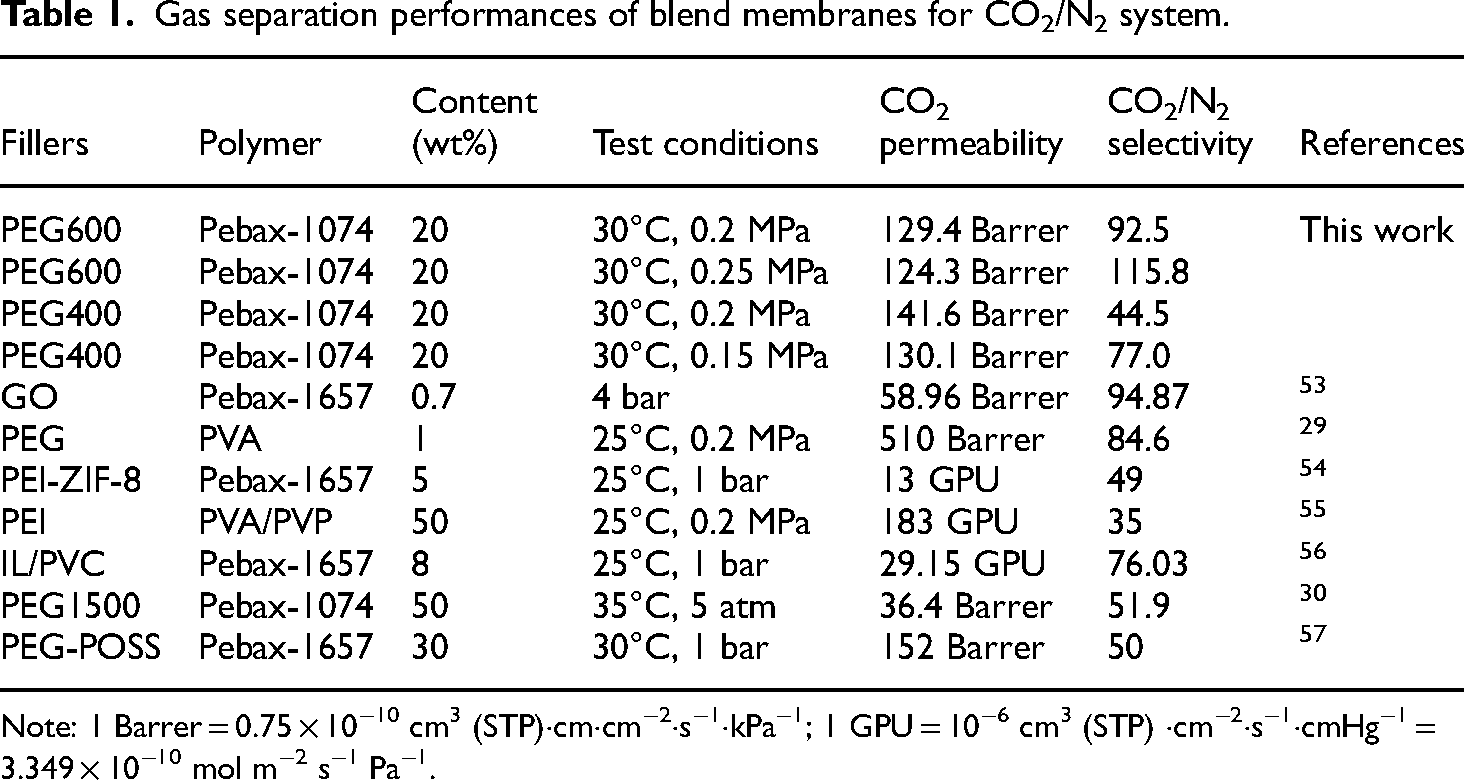
Note: 1 Barrer = 0.75 × 10⁻¹⁰ cm3 (STP)·cm·cm−2·s−1·kPa−1; 1 GPU = 10−6 cm3 (STP) ·cm−2·s−1·cmHg−1 = 3.349 × 10⁻¹⁰ mol m−2 s−1 Pa−1.
Figure 12 also gives the Robeson's upper bound plot for intuitive comparison of different membranes involved in commercial attractiveness. It shows that almost all the data in literature reports locate below the upperbound line. Excitingly, some data of the PEG-modified Pebax-1074 membranes in this work have exceeded the 2008 Robeson upper limitation and reached to the right corner of the plot with more commercial attractiveness. Especially, PEG600-modified Pebax membranes are more promising in comparison to PEG400. The results have verified our previous speculation that the PEG addition surely strengthened the solubility and diffusivity of CO2. Depending on the solution–diffusion mechanism, it facilitates the transport of CO2 throughout the blend membranes.

Comparison of gas separation performance of Pebax/PEG blend membranes with the Robeson upper bound.
In conclusion, the Pebax-1074/PEG blend membranes have excellent CO2/N2 separation performance and are anticipated to be a potential alternative membrane material for the related separation system.
Conclusions
Pebax blend membranes were prepared by mixing organic dopants (PEG400 or PEG600) into the polymer matrix. With the increase of PEG content, the surface of the blend membranes became more compact, uniform, rough and free of obvious defects. Moreover, the PEG addition offers more abundant hydroxyl (–OH) groups, amorphous structure and free fractional volume in polymer matrix. Within the investigation scope, the effect of pressure is minor on the gas permeability. In comparison to CO2, N2 is more positively sensitive to temperature in terms of permeability. With the increase of PEG content, CO2 permeability and CO2/N2 selectivity increase. In addition, temperature and pressure also have significant effects on the gas separation performance of the blend membranes. Especially the separation performance of prepared membranes has exceeded the Robeson upper bound in 2008, with most attractive region. In brief, this work has successfully developed a kind of Pebax-1074/PEG blend membrane that is promising and feasible for separating CO2.
Highlights
Pebax-1074-based gas separation membranes were modified by blending PEG.
PEG addition improves the gas permeability and selectivity of membranes.
CO2 permeability and CO2/N2 selectivity reach to 124.3 Barrer and 115.8, respectively.
Supplemental Material
sj-docx-1-sci-10.1177_00368504231156295 - Supplemental material for Improved CO2/N2 separation performance of Pebax-1074 blend membranes containing poly(ethylene glycol)
Supplemental material, sj-docx-1-sci-10.1177_00368504231156295 for Improved CO2/N2 separation performance of Pebax-1074 blend membranes containing poly(ethylene glycol) by Xin Guan, Yonghong Wu, Yingfei Zheng and Bing Zhang in Science Progress
Footnotes
Acknowledgments
This work was financially supported by the Natural Science Foundation of Liaoning Province of China (No. 2021-MS-238), the Liaoning BaiQianWan Talents Program (No. 2018921046), the Scientific Research Project of Liaoning Provincial Department of Education (No. LJGD2020002), and the Shenyang Youth Science and Technology Project (No. RC200325).
Declaration of conflicting interests
The author(s) declared no potential conflicts of interest with respect to the research, authorship, and/or publication of this article.
Funding
The author(s) disclosed receipt of the following financial support for the research, authorship, and/or publication of this article: This work was supported by the Scientific Research Project of Liaoning Provincial Department of Education, Natural Science Foundation of Liaoning Province of China, Liaoning BaiQianWan Talents Program, Shenyang Youth Science and Technology Project (grant number LJGD2020002, 2021-MS-238, 2018921046, RC200325).

Supplemental material
Supplemental material for this article is available online.
Author biographies
Xin Guan is currently pursuing his MS degree with chemical engineering in Shenyang University of Technology.
Yonghong Wu is an associated professor with the School of Petrochemical Engineering, Shenyang University of Technology. She has published more 50 scientific papers.
Yingfei Zheng is a postgraduate student with a major of chemical engineering in the School of Petrochemical Engineering, Shenyang University of Technology.
Bing Zhang is a senior professor in the School of Petrochemical Engineering, Shenyang University of Technology. He has published more than 100 journal papers and 30 conference papers.
References
Supplementary Material
Please find the following supplemental material available below.
For Open Access articles published under a Creative Commons License, all supplemental material carries the same license as the article it is associated with.
For non-Open Access articles published, all supplemental material carries a non-exclusive license, and permission requests for re-use of supplemental material or any part of supplemental material shall be sent directly to the copyright owner as specified in the copyright notice associated with the article.
