




Abstract
Considering the current situation that it's difficult to quantify the discrimination of rockburst hazard, an analytical solution for the softening zone energy of surrounding rock under rockburst in a circular roadway is obtained theoretically based on the elastoplastic softening model of a circular roadway. The critical softening zone energy, critical softening zone radius, critical roadway shrinkage displacement, and critical roadway shrinkage rate are determined. An energy extreme value discrimination method of softening zone for bursting hazard is proposed. The critical softening zone energy is taken as the evaluation basis of the bursting liability of the coal seam where the roadway (a full coal roadway) is located. The uniform energy index, which is the ratio of the external disturbance energy of the surrounding rock softening zone to the critical softening zone energy, is used as the evaluation basis for bursting hazards. Theoretical analysis shows that the smaller the critical softening zone energy of the roadway surrounding rock is, the stronger the bursting liability of the coal seam is, and the greater the uniform bursting hazard index is, the stronger the bursting hazard of the roadway. Subsequently, based on the critical softening zone energy and the uniform energy index, a classification standard of bursting liability and an evaluation method of bursting hazard are proposed. The reliability of the softening zone energy extremum criterion, the bursting liability classification standard, and the bursting hazard evaluation method was verified through indoor and field tests. The energy extreme value discrimination method of softening zone for bursting hazard considers the internal and external factors of roadway rockburst comprehensively and can judge the rockburst risk through field real-time observation, which is a more scientific and reasonable method to predict the risk of roadway rockburst. The research work has important theoretical guiding significance for the prevention and control of roadway rockbursts.
Keywords
Introduction
Rockburst is one of the most serious disasters associated with coal mining.1–3 And for the mine with rockburst risk, rockburst prediction becomes the premise of safety production. At present, bursting liability identification and bursting hazard assessment are the most basic and universal methods for rockburst prediction.4–9 Therefore, the rationality and reliability of bursting liability identification and bursting hazard assessment are very important for the prediction and prevention of rockbursts. In recent years, scholars have conducted extensive research on the bursting liability and hazard of coal seams.
Bieniawski et al. 10 proposed two bursting liability indexes: the coal and rock elastic strain energy index and the bursting energy index. Kidybinski 11 proposed that the elastic strain energy index of coal and rock mass should be considered as the bursting liability index. Singh12–14 and Sears and Heasley 15 proposed a method to judge the bursting liability of coal and rock based on an energy release index and analyzed the relationship between the energy release index and the physical and mechanical properties of coal and rock. Tang et al. 16 used the residual energy index, obtained from the difference between the elastic strain energy stored before reaching the peak strength and the energy consumed after reaching the peak strength, to judge the bursting liability of coal and rock. Pan et al. 17 and Zhu et al. 18 proposed three new indexes including the bursting energy velocity index, critical softening zone coefficient and critical stress coefficient by considering the time effect. Qi et al. 19 proposed using the uniaxial compressive strength of coal as a new index to evaluate the bursting liability of coal seams. In China, the current bursting liability indexes for coal seams mainly include the elastic strain energy index, bursting energy index, dynamic destruction time, and uniaxial compressive strength.
The bursting liability can only describe the properties of the coal seam and reflect the degree of bursting liability of the coal seam. However, the bursting hazard reflects the degree of bursting hazard of a rockburst area. An accurate assessment of bursting hazard is the basis of targeted rockburst prevention and control. Bardet 20 and Larsson 21 proposed a safety evaluation index method for coal mines. Kornowski 22 proposed a comprehensive assessment method for bursting hazard. Dou and Drzezia 23 and Dou et al.24–26 proposed the ground-sound method and the superposition method of the relative stress concentration coefficient for bursting hazard evaluation and established vibration wave computed tomographic detection technology for the dynamic prediction and evaluation of bursting hazard. Jiang et al. 27 proposed a fuzzy evaluation method for the bursting hazard of a coal mass by using the ratio of vertical stress to the uniaxial compressive strength of the coal mass and the elastic strain energy index. The current coal mine safety regulations in China stipulate that “the comprehensive index method is preferred to determine the risk of rockburst.”
To sum up, the existing evaluation methods and indicators of bursting liability and bursting hazard have achieved a lot of research results in practice, but there are still some deficiencies. On the one hand, the current bursting liability index is proposed by considering a single influence factor respectively, which is relatively independent, so the evaluation results are often inconsistent and discrete. On the other hand, the present comprehensive index evaluation method is to calculate a comprehensive index based on the analysis of engineering geological and mining technical conditions, which lacks a certain theoretical basis for the selection of influencing factors, value range and weight. In the view of this, based on the mechanism of roadway rockbursts, a new discriminant method of rockburst hazard will be proposed by considering the influencing factors of the bursting liability and hazard of coal seams in a unified manner. Furthermore, a new bursting liability index and bursting hazard index will be proposed, which will be verified based on actual rockburst cases.
Theoretical study of energy extreme value discrimination method of softening zone for bursting hazard
Limitations of the current bursting liability index
At present, measurement of the uniaxial compressive strength Uniaxial compressive strength
The uniaxial compressive strength,

Calculation of uniaxial compressive strength.
2. Elastic strain energy index and bursting energy index
The elastic strain energy index, WET, is the ratio of the elastic strain energy to the plastic strain energy as the coal specimen unloads when the stress reaches a certain value (before failure) under uniaxial compression. A schematic of the calculation of this parameter is shown in Figure 2. In fact, the coal seam is not loaded from zero, but part of the plastic strain energy is consumed because it has been subjected to in situ stress and tectonic stress. When a rockburst occurs, the load on the coal seam exceeds the value of

Calculation of elastic strain energy index.
The bursting energy index, KE, is the ratio of the strain energy accumulated before reaching the peak value to the strain energy dissipated after reaching the peak in the entire stress–strain curve of the coal specimen under uniaxial compression, and the schematic representation of the calculation of this parameter is shown in Figure 3. Here, AS and AX represent the strain energy before and after reaching the peak value, respectively. However, in practical scenarios, the coal seam is not loaded from zero, as it is already subjected to in-situ stress and tectonic stress. Figures 2 and 3 show that AS does not account for all the strain energy accumulated before the peak and that some of this energy has been dissipated. Therefore, the strain energy before reaching the peak value should not be calculated from the beginning of loading, instead, the dissipated energy should be excluded.
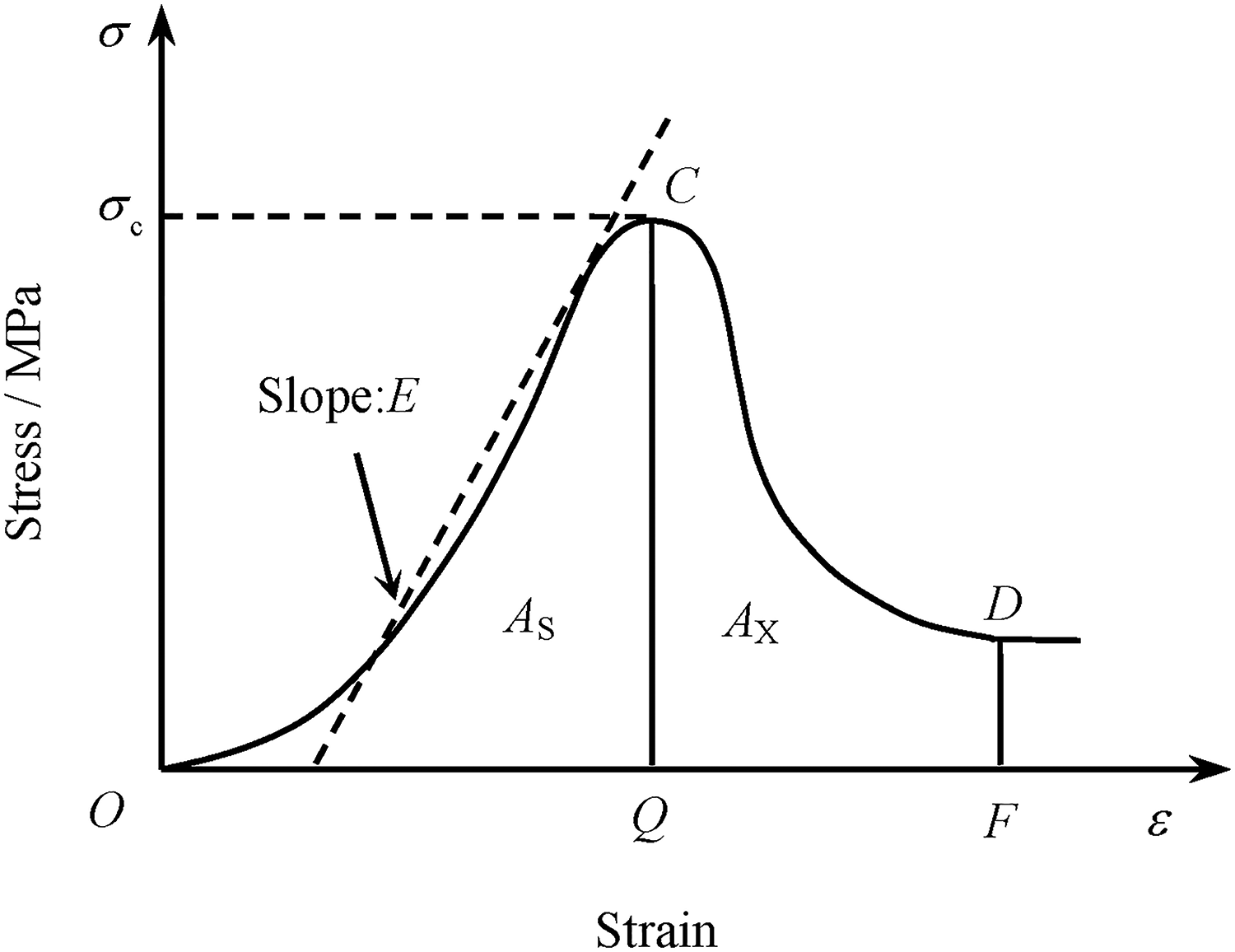
Calculation of bursting energy index.
Therefore, the existing measurement method can be modified to determine the elastic strain energy index and bursting energy index simultaneously. First, the coal specimen is subjected to uniaxial compression. When loaded to 75%–85% of the average failure load, it is unloaded to 1%–5% of the average failure load and then loaded up to any point after the residual strength is reached. Thus, the entire stress–strain curve is obtained. The schematic of the calculation of the modified elastic strain energy index and the bursting energy index is shown in Figure 4, where

Calculation of modified elastic strain energy index and bursting energy index.
3. Dynamic destruction time DT
The dynamic destruction time, DT, is the time taken for the complete failure of the coal specimen after its ultimate strength is reached under uniaxial compression. The schematic representation of the calculation of this parameter is depicted in Figure 5. However, the measurement of dynamic destruction time in the laboratory is affected by the stiffness of the testing machine. If an ordinary testing machine is used, the coal specimen directly fails after reaching the ultimate strength, without any appreciable dynamic destruction time. If a rigidity testing machine is used, the dynamic destruction time changes with the loading rate. However, the existing dynamic destruction time measurement method does not account for the stiffness of the testing machine. This also affects the determination of bursting liability.
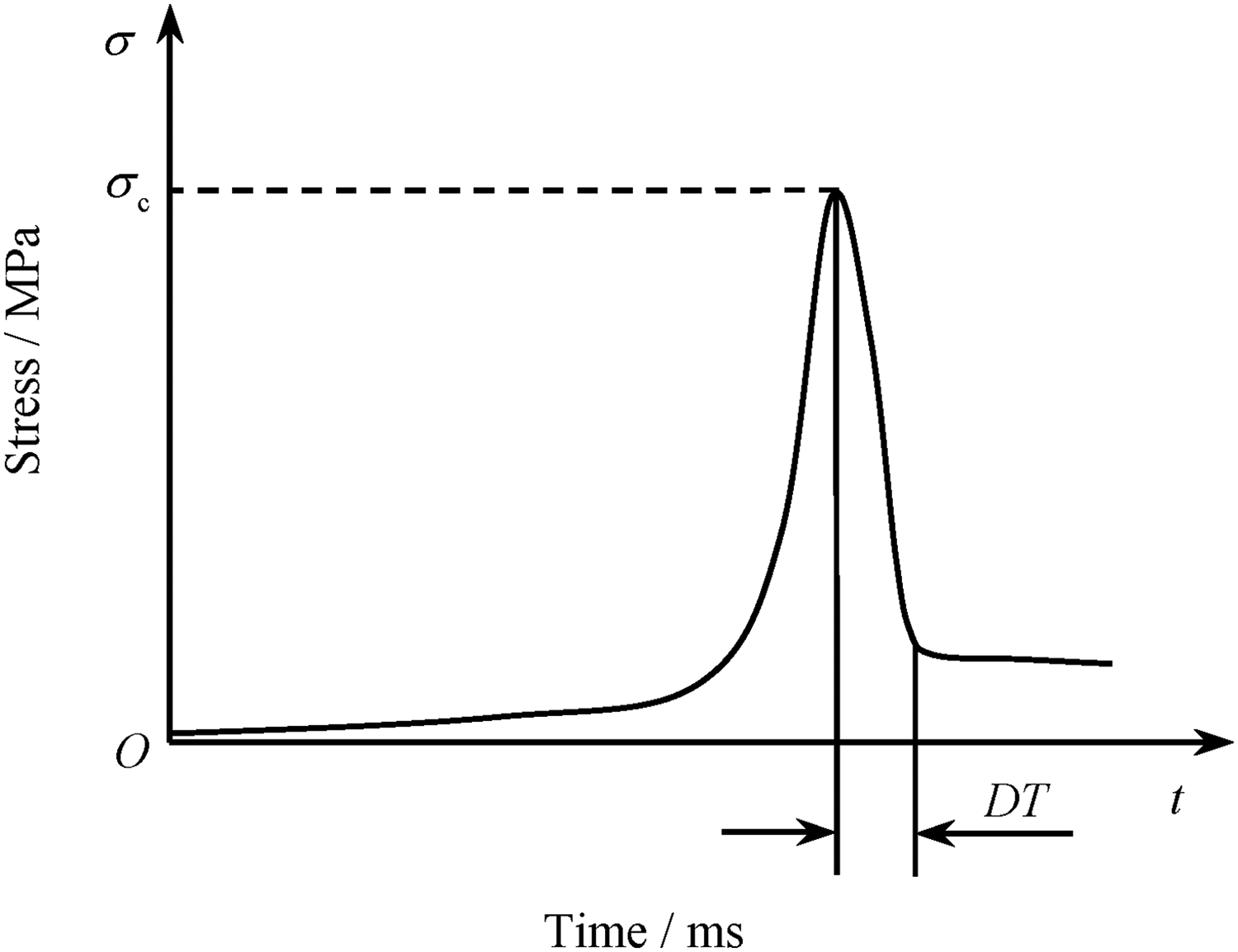
Calculation of dynamic destruction time.
Therefore, it is evident that the limitations in the existing measurement and classification approaches have a significant influence on the accurate determination of coal seam bursting liability. Additionally, the existing bursting liability indexes were developed by considering individual influencing factors. This can lead to differences or inconsistent results when judging coal seam bursting liability based on several indexes.
Proposal of the constitutive model
As discussed in the “Limitations of the current bursting liability index” section, a reasonable constitutive model of coal should exclude the influence of the plastic strain energy lost before the peak value is reached and the residual strength after the peak value. Therefore, a bilinear constitutive relation (as shown in Figure 6) is selected in this study. In other words, the maximum slope of the curve during the loading phase after unloading, which is before the peak value, is selected as the elastic modulus E. The slope absolute value (maximum) of the curve removed the residual strength after the peak value is selected as the softening modulus

Calculation of bursting liability indexes.
Analytical solution for the softening zone energy of roadway surrounding rock
The development and occurrence of rockbursts are physical processes involving coal and rock mass loading, energy storage, energy dissipation, sudden deformation and failure, and a large amount of energy instantaneous release. Under the action of the far-field stress, stress concentration develops in the area surrounding the roadway, and the coal masses are broken to form a softening zone when the stress exceeds the peak intensity. In contrast, the surrounding rock not reaching its peak value remains in the elastic zone. As the far-field stress increases, the energy in the elastic zone is gradually released into the softening zone and the deformation of the roadway surrounding rock increases. When the softening zone energy reaches an extremely high value, the surrounding rock deformation system of the roadway is in a critical stable equilibrium state. At this time, in the case of any disturbance, the surrounding rock deformation system of the roadway becomes unstable. And the energy exceeding the extreme energy value of the softening zone makes the coal masses in the softening zone be destroyed quickly. Thereafter, these coal masses in the softening zone are driven into the roadway, resulting in the occurrence of a rockburst.
For the convenience of analysis, the roadway is simplified into a circular roadway with radius a, which is subjected to a hydrostatic pressure P in the far field, and the effect of gravity is neglected. A unit width is taken along the roadway axis for subsequent analysis. Thus, the roadway rockburst is simplified into an axisymmetric plane strain problem. This roadway analysis model is shown in Figure 7.
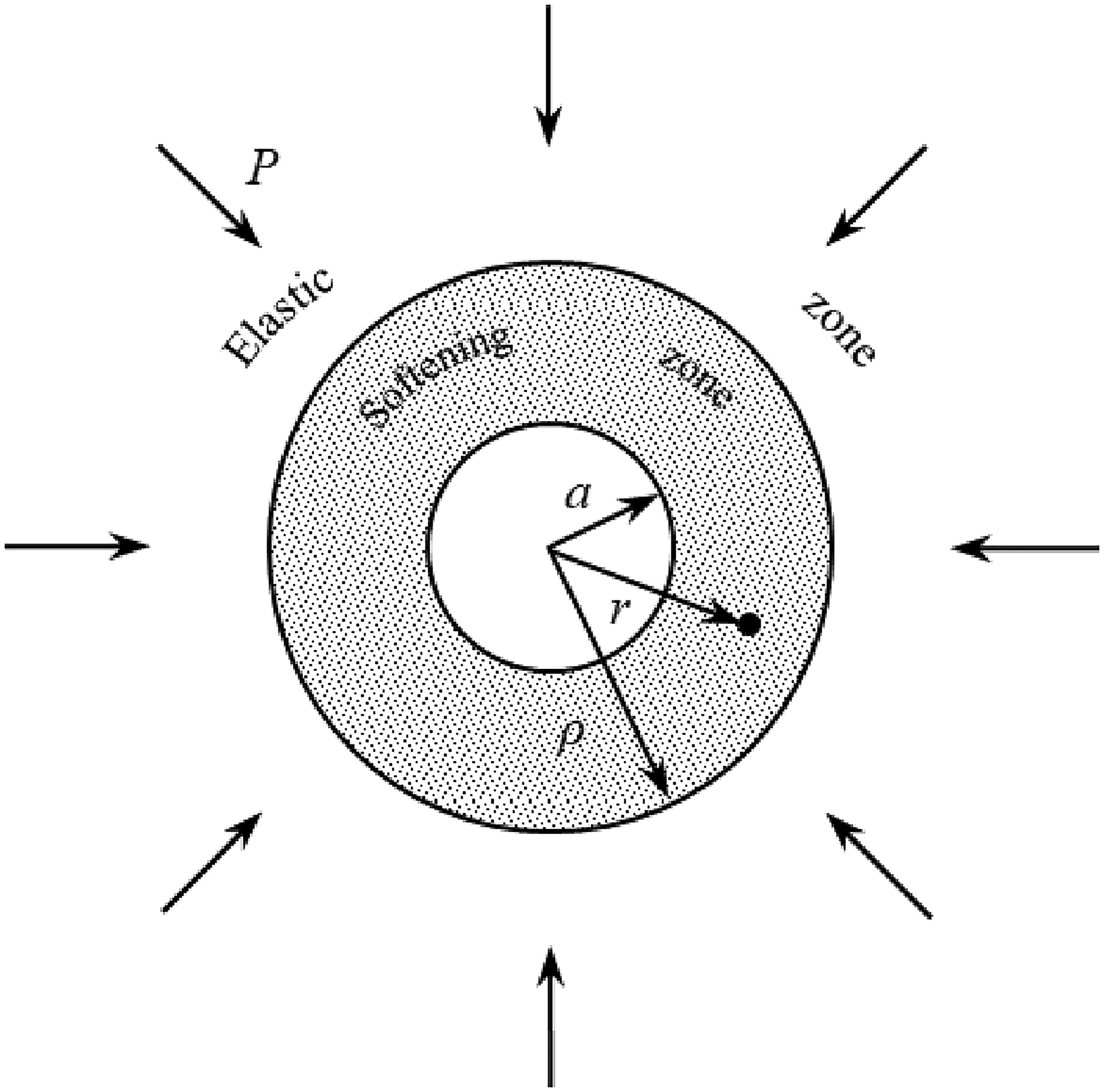
Roadway analysis model.
The coordinate conversion of the bilinear constitutive relation in Figure 6 is carried out and

According to Figure 6, the constitutive relation of the softening stage is

The yield criterion of coal in the softening zone is the Mohr-Coulomb criterion.

On substituting m = 3 into equation (3), we obtain



As the roadway analysis model is an axisymmetric plane strain problem,




If

At the junction of the softening and elastic zones, i.e. when

Then,

Furthermore,



On substituting equations (4) and (14) into equation (5), we obtain

The radial stress,


At the roadway boundary, i.e. when r = a,

If equation (20) is substituted into equations (18) and (19), we obtain


Thus, the strain energy of the softening zone is

Assuming that the roadway shrinkage displacement corresponds to the radial displacement at r = a, it is considered a basic quantity for describing the deformation state of the roadway. On substituting this into equation (15), the roadway shrinkage rate is obtained as follows:



Analysis of critical softening zone energy
On taking the derivative of equation (26) with respect to

When


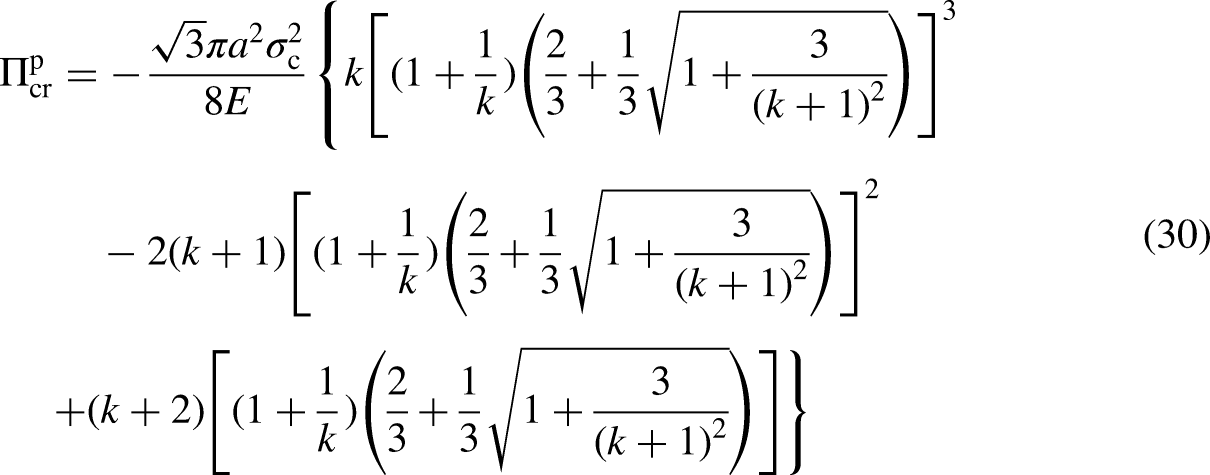
Let


In order to analyze the influence of roadway radius a, elasticity modulus E, uniaxial compressive strength
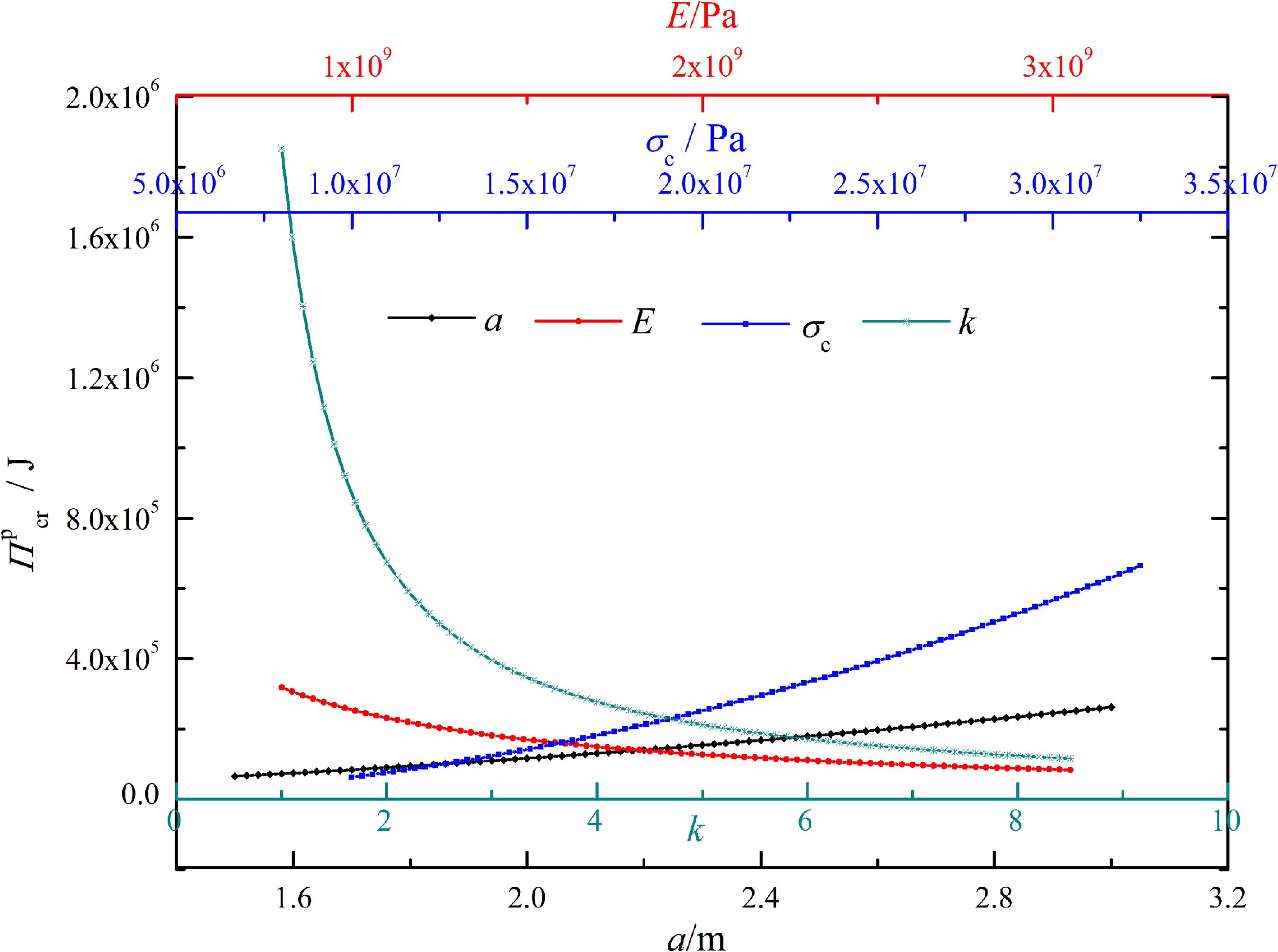
Relation curves of roadway radius, elasticity modulus, uniaxial compressive strength, deformation modulus index and critical softening zone energy, respectively.
According to equation (31) and Figure 8, the critical softening zone energy reflects the rockburst tendency. The lower the critical softening zone energy
Analysis of uniform energy index
The uniform energy index for the occurrence of roadway rockbursts is defined as


Under the action of the rockburst, the coal in the crushing zone expands rapidly and breaks into the roadway.
Assuming that the dilatancy coefficient is


Equations (32)–(35) show that the uniform energy index represents the hazard of rockbursts. The larger the uniform energy index
In summary, the critical softening zone energy is proposed by comprehensively considering the relationship among the stress, elasticity modulus, and softening modulus of surrounding rock. This can be used to characterize the bursting liability of surrounding rock. The uniform energy index combines the critical softening zone energy, external load, and structural parameters of the roadway to reflect the bursting hazard of the roadway. In actual mining engineering, the mining conditions, geological structure, coal and rock properties, and mining methods are various. Thus, the bursting hazard of the coal seam does not remain the same; it varies with the mining process. Therefore, from equations (31) and (32), the advantage of bursting hazard evaluation based on energy is that this approach prevents contradictory results between bursting liability classification and bursting hazard evaluation under a single influencing factor, and also guides on-site, real-time tracking, monitoring, and evaluation to ensure the safety of roadways.
Classification of bursting liability and bursting hazard
In equation (31),
Classification of bursting liability.

The classification of bursting hazard uses the bursting liability classification results in Table 1 as the reference point, combined with the energy transmitted from the source to the outer boundary of the softening zone of the roadway surrounding rock and the roadway failure caused by the residual energy released into the roadway. When
Classification of bursting hazard.

Analysis on influencing factors of critical softening zone energy
According to the “Analysis of critical softening zone energy” section, the parameters that affect the critical softening zone energy
The main aggregate materials selected in the similarity simulation test include sand and gypsum. By adding a certain proportion of rosin to a mixture of sand, gypsum, and water, composite materials with low material strength and certain brittle failure characteristics are prepared. These materials are suitable for simulating roadway rockbursts. Seven groups of similar material models were created. The rosin was dissolved in alcohol, and then added to the mixture of sand, gypsum, and water, according to pre-set proportions. The material proportions and mechanical parameters of the similarity model are shown in Table 3, and the results retain three valid digits. The similarity ratio between the model and the actual roadway surrounding rock was 1:100; the dimensions of the model were 400 × 400 × 200 mm, and the roadway was excavated relative to the center of the model. The section of the roadway was

Schematic representation of roadway rockburst simulation test system.
Material proportions and mechanical parameters of similarity model.
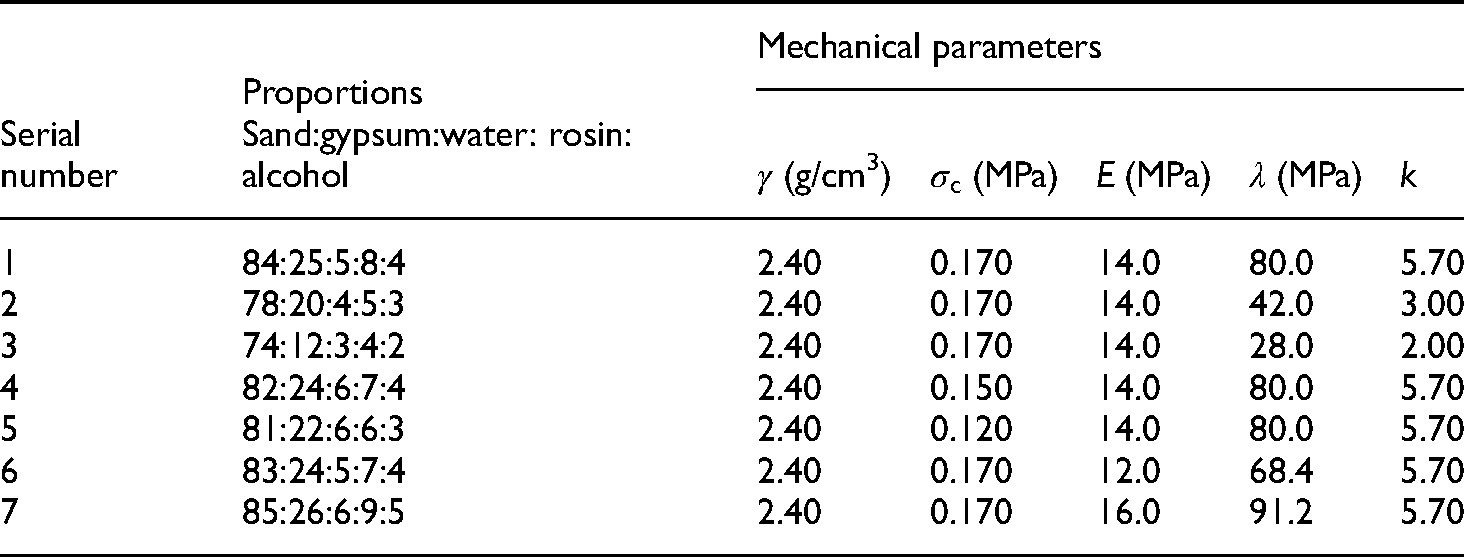
Figure 10 shows a diagram of roadway deformation and failure. Figure 10 (a) is the model diagram of the roadway surrounding rock at the initial loading stage. During the loading process of the model, cracks are generated around the roadway, and a softening zone is formed, as shown in Figure 10 (b). With an increase in the loading, these cracks further expand, and the range of the softening zone expands. When the range of the softening zone expands to a certain limit, the roadway is destroyed suddenly, and a roadway rockburst occurs. Figure 10 depicts the roadway failure after impact.
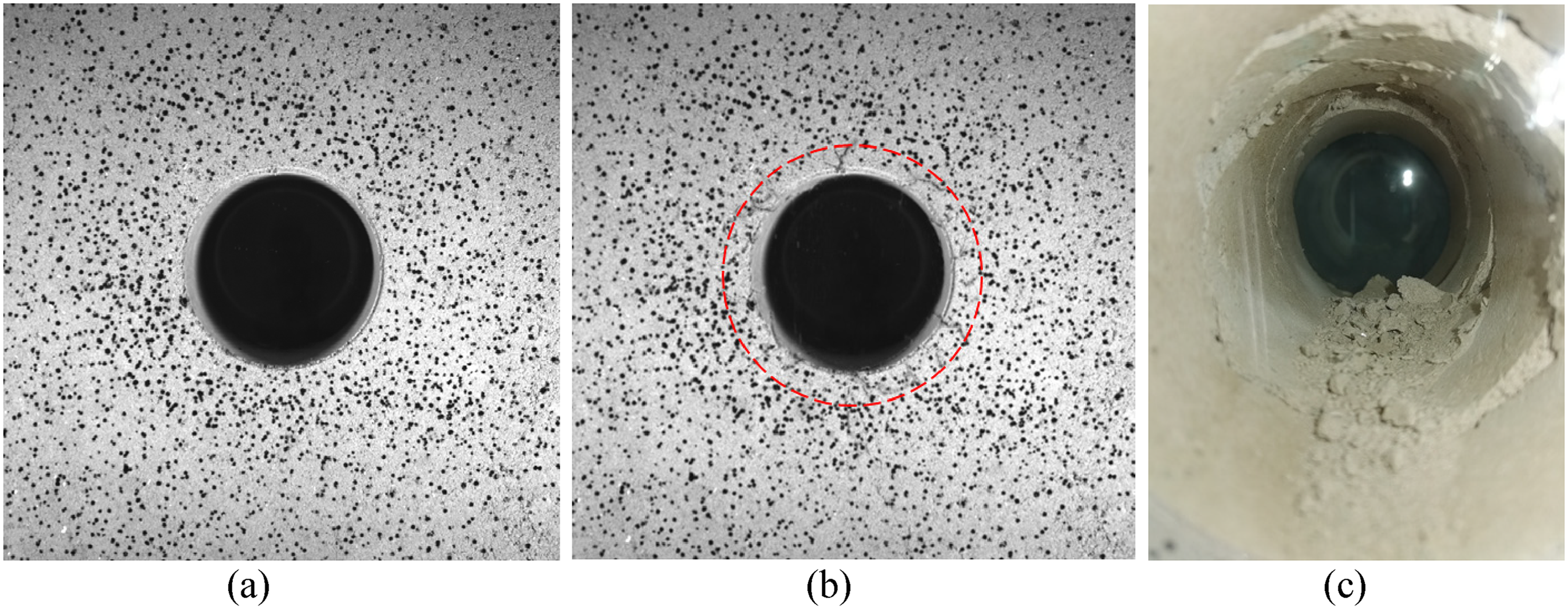
Deformation and failure of roadway. (a) initial loading (b) roadway deformation diagram during loading (c) sudden shrinkage failure of roadway.
Figures 11–13 show the roadway shrinkage rate–time curves under various k,

Roadway shrinkage rate–time curves under various deformation modulus indexes.

Roadway shrinkage rate–time curves under various uniaxial compressive strengths.

Roadway shrinkage rate–time curves under various elasticity moduli.
Comparison of theoretical and experimental results.

As indicated by the roadway shrinkage rate–time curves in Figures 11–13, the roadway shrinkage rate increases almost linearly with the loading. A sudden increase is observed when the roadway shrinkage rate reaches a certain value, and a significant catastrophe point appears on the curve. This catastrophe point denotes the rockburst failure of the roadway, and the roadway shrinkage rate at this point is the critical roadway shrinkage rate. Figure 11 depicts the results of the tests on Groups 1–3. According to the results of Groups 1–3, as shown in Figure 11 and Table 4, when
Figure 12 depicts the results of the tests on Groups 1, 4, and 5. According to the results of Groups 1, 4, and 5, as shown in Figure 12 and Table 4, when k and E are fixed, the theoretical calculation results show that the critical roadway shrinkage rates are 0.0125, 0.0110, and 0.00880 when
Figure 13 presents the results of the tests on Groups 1, 6, and 7. According to the results of Groups 1, 6, and 7, as shown in Figure 13 and Table 4, when k and
In summary, the roadway failure and the trends in the roadway shrinkage rate–time curve observed in the similarity simulation tests are consistent with the theoretical results, proving that a critical value of roadway rockburst exists. When
Tests on bursting liability identification and bursting hazard evaluation
A case study of a rockburst mine in Henan province was adopted to verify the rationality of the theoretical analyses.
Bursting liability identification
Coal samples from the 13190, 13210, and 13230 working faces of a coal mine in Henan province were selected for the uniaxial compression test, in order to determine the critical softening zone energy. Raw coal retrieved from the field was cut into coal specimens with dimensions of 50 mm× 50 mm× 100 mm. The uniaxial compressive strength
Test and calculated results.

Table 5 shows that the critical softening zone energies of the roadway surrounding rock at the 13190, 13210, and 13230 working faces are 1.82 × 10⁵, 1.78 × 10⁵, and 1.79 × 10⁵ J, respectively. Additionally, Table 1 indicates that all three working faces have strong bursting liability.
Bursting hazard evaluation
According to the event with the largest residual energy (that is, the event causing the most serious damage to the roadway) among the three working surface rockburst events recorded by a microseismic monitoring system, the mine earthquake energy
Results of bursting hazard assessments.

As shown in Table 6, the maximum source energies of the rockburst events at the 13190, 13210, and 13230 working faces were 6.00 × 10⁷, 9.00 × 10⁶, and 6.40 × 10⁶ J, respectively. The energies propagated to the outer boundary of the roadway softening zone reduced to 2.90 × 10⁵, 2.02 × 10⁵, and 2.72 × 10⁵ J, respectively. Furthermore, they were divided by the corresponding critical softening zone energies, and the unified energy indexes obtained were 1.59, 1.13, and 1.52, respectively. According to the classification standard of a bursting hazard, as shown in Table 2, the sampling points of the 13190 and 13230 working faces exhibited a strong bursting hazard, whereas the sampling points of the 13210 working face exhibited a medium bursting hazard.
Therefore, greater source energy in the far field does not necessarily indicate more severe roadway damage, and stronger bursting liability does not necessarily indicate a stronger bursting hazard. The bursting hazard and degree of roadway damage are determined by the critical softening zone energy and the energy of the softening zone outer boundary of the roadway surrounding rock that is transmitted from the far-field source. In other words, even if the source energy is considerably high, a rockburst will not occur if the energy of softening zone outer boundary that is transmitted from the far-field source does not reach the critical softening zone energy. However, if the energy of softening zone outer boundary that is transmitted from the far-field source is considerably larger than the critical softening zone energy, a severe rockburst will occur. In addition, a uniform energy index is obtained based on historical rockburst events and the critical softening zone energy. Hence, the bursting hazard varies for different regions of the same coal seam or even for different mining stages in the same region. This is also in line with the actual conditions of underground mining. Therefore, it is necessary to perform real-time monitoring during mining and provide the dynamic evaluation results of bursting hazards, which can serve as the basis for rockburst predictions.
In addition, the theoretical values of the roadway rapid shrinkage displacement for the three rockburst events are 0.780, 0.170, and 0.690 m, while the measured values are 0.780, 0.180, and 0.660 m, respectively. Hence, the corresponding errors are 2.50%, 5.90%, and 4.30%, respectively. As is evident, the errors between the theoretical and measured values are less than 10%, which are within the allowable range of errors. Therefore, the calculation results obtained using the critical softening zone energy and uniform energy indexes are deemed correct and reasonable.
Conclusions
Based on the mechanism of roadway rockbursts and by considering the influencing factors of the bursting liability and hazard of a coal seam, an elastoplastic softening mechanical model was established. In addition, a softening zone energy extremum criterion for roadway rockbursts was proposed. The analytical solution of the softening zone energy for a rockburst in a circular roadway was obtained. The critical roadway shrinkage displacement, the critical roadway shrinkage rate, and the critical softening zone radius of the roadway rockburst were determined. In addition, an energy extreme value discrimination method of the softening zone for bursting hazards was proposed.
It was proposed that the critical softening zone energy can be used as a judgment basis for bursting liability, and the analytical solution was determined. The analyses show that the smaller the critical softening zone energy is, the stronger the bursting liability is. Thereafter, the bursting liability of the coal seam was classified according to the corresponding critical softening zone energy. The advantage of using the critical softening zone energy is that all the influencing factors of bursting liability are considered in a unified manner, which helps prevent contradictory results compared to bursting liability index classification using a single influencing factor.
It was proposed that the uniform energy index can be used as a bursting hazard index, and an analytical solution was determined. The analyses show that the larger the uniform energy index is, the greater the roadway rapid shrinkage displacement when a rockburst occurs, i.e. the stronger the bursting hazard is. The classification of bursting hazards was conducted according to the uniform energy index. The uniform energy index was obtained based on previous rockburst events and the corresponding critical softening zone energy. This approach considers all the influencing factors of the bursting hazard, conforms with the actual conditions of the field, and affords dynamic evaluation results for the bursting hazard.
Through a similarity simulation test of the rockbursts in circular roadways, it was proved that a critical value of the rockburst in a circular roadway exists; the obtained law was found to be consistent with theoretical analyses. Through a field test, the bursting liabilities of three working faces in a mine were classified, and a uniform energy index was obtained based on the critical softening zone energy and the previous rockburst events that occurred at each working face. Subsequently, a bursting hazard evaluation of the working faces was conducted, and the results were proved to be reasonable and reliable.
Footnotes
Acknowledgments
The authors gratefully acknowledge the support for this study granted by the Ministry of Science and Technology of the People's Republic of China, and State Key Laboratory of Efficient Mining and Clean Utilization of Coal Resources, and Collaborative Innovation Center for Coal Mine Major Dynamic Disaster Prevention and Control. The technical assistance provided by the workshop staff at Chinese Institute of Coal Science and Liaoning University is also gratefully acknowledged.
Author contributions
All authors contributed to the study conception and design. Xiaojing Zhu Carried out all the material preparation, data collection and analysis, advised by Qingxin Qi and Yonghui Xiao. The first draft of the manuscript was written by Xiaojing Zhu under the guidance of Yonghui Xiao. All authors read and approved the final manuscript.
Declaration of conflicting interests
The author(s) declared no potential conflicts of interest with respect to the research, authorship, and/or publication of this article.
Funding
The author(s) disclosed receipt of the following financial support for the research, authorship, and/or publication of this article: This work was supported by the China Coal Technology and Engineering Group Co., Ltd. Science and Technology Innovation and Entrepreneurship fund special key project, National Natural Science Foundation of China, Innovation and Entrepreneurship Science and Technology Special Project of Chinese Institute of Coal Science (grant numbers 2022-2-QN002, 2020-2-ZD001, 52104087, 2021-KXYJ-002).

Author biographies
Xiaojing Zhu is an associate researcher of Chinese Institute of Coal Science. Area of interest is prediction and prevention of rockburst and mine disaster mechanics.
Qingxin Qi is a researcher of Chinese Institute of Coal Science. Area of interest is mine dynamic disaster prevention.
Yonghui Xiao is an associate professor of the School of Physics, Liaoning University. Area of interest is prevention and control of rockburst and rockburst preventing support technology.