



Abstract
Young people are increasingly using social networking site (SNS) smartphone applications (apps), necessitating research on the effects of such use on the users’ emotional health. The present study recruited 360 college students across mainland China and recorded their smartphone usage for one week using an automatic tracking app. Surveys assessing social support perception and emotional health were subsequently conducted. The study examined the relationship between SNS smartphone app usage (frequency and duration) and emotional health, as well as the moderating role of perceived social support in SNS smartphone usage and emotional health. Among individuals with high social support, SNS smartphone use was more strongly associated with better emotional health. These results suggest conditional benefits of using SNS smartphone apps, depending on the user's perceived social support. The implications for designing and using SNS smartphone apps are also discussed.
Keywords
Introduction
With advances in technology, social networking sites (SNSs) are easily accessible on smartphones, resulting in the widespread adoption of social networking smartphone applications (hereinafter apps). Such apps are particularly popular among young users. In China, approximately 340 million individuals aged below 30 use WeChat Moments, and around 145 million users of Weibo are below 30 years of age. 1
The SNS smartphone apps enable users to establish and maintain their social networks, obtain information, and have entertainment options. 2 App users can easily use direct messaging or various chat messengers to talk to their friends, family members, and coworkers to obtain information, share emotions, and develop interpersonal bonds. SNS users can also update their profiles; share their photographs; and view, and comment on the photographs or profiles of others. This has become an important way to share information, gain support from others, and feel validated.3,4
The present study contributes to the existing literature in the following ways. First, while previous works have measured SNS use via self-reported surveys that present recall bias, 5 the present study employed an automatic tracking system to accurately measure an individual's SNS app use at the behavioral level, thus providing a clear description of usage patterns. Second, this study provided a close examination of the relationships between SNS app use and emotional health among Chinese college students. While many prior studies focused on English-speaking countries, the present study contributes empirical evidence from an Asian cultural population. Third, the moderating role of perceived social support in SNS use and emotional health was also examined. Previous studies have examined the relationship between SNS use and emotional health, focusing only on the direct benefits and drawbacks of using SNSs or the relationships between SNS use and the user's perception of social support,6,7 while how this perceived social support moderates the relationship between SNS use and emotional health remains unclear.
Measurement of SNS smartphone app use
It is critical to use accurate measurement of SNS use when studying the impact of SNS use on people's emotional health. Frequency and duration are quantitative dimensions that describe the amount of SNS app use taking place during a given time frame (e.g. 1 day and 1 week). Frequency refers to the number of occasions of activity in the given time frame (e.g. once a day and once a week). Duration refers to the time over which the SNS app use takes place. This can vary from very short bouts of only a few seconds (e.g. checking replies), to many hours of continuous activity (e.g. watching video clips). Self-reported SNS use frequency6,8 and the time spent on SNSs9,10 are two important indicators of the extent of SNS use. Previous works have mostly measured SNS use frequency by querying SNS users regarding the number of times they checked SNSs within a period of time (e.g. a day or a week).6–8,11 Prior studies measuring the time spent on SNS did so by asking the participants to recall the amount of time they spent on SNS.12,13
Previous studies were also often based on self-reported data, which may not be accurate in reflecting the amount of SNS use due to recall bias and social desirability.5,14 It might be difficult for respondents to accurately remember the number of times and the minutes they spent on SNSs. For SNS activity, expecting users to accurately recall app usage frequency and the time spent on an app is impractical. Previous works have reported discrepancies between users’ self-reported SNS use frequency and time spent and their actual use.5,15
Such inaccuracy in reporting SNS use may be significant in studying associations with well-being. Prior studies found that self-reported SNS data may be systematically biased by use patterns, such as the volume of smartphone use,15,16 which are crucial to the phenomenon under investigation. Indeed, a recent study found that the correlations between estimated use and depression, loneliness, and life satisfaction were consistently stronger than the correlations between reported actual use and these outcomes. 17
This issue could be resolved by the use of smartphone monitoring software, which accurately records the SNS smartphone app usage. An app usage tracker is a smartphone monitoring tool that records the duration of usage for apps running in the foreground. The tracker log data include usage start date, start time, end date, end time, and the name of the apps; this information offers objective behavioral-level data for measuring the SNS use.
SNS use and emotional health
To date, the relationship between SNS smartphone app use and the emotional health of young people remains inconclusive. Accumulating evidence suggests that SNS use is advantageous to young people, providing an increased sense of community, 7 reducing anxiety, 6 increasing life satisfaction, 7 and decreasing psychological distress. 18 A few previous works have reported no link between SNS use and mental health,8,19 while others have reported a negative association between SNS use and emotional health.20,21 A recent meta-analysis reported that the time spent on SNSs has a weak association with depression, while no association with self-esteem and life satisfaction was observed. 22
Individuals who perceive they gain diverse information, entertainment, and emotional support,4,23 and feel social connectedness and bonding with others 7 tend to have better emotional health. However, a few previous works have reported that SNS activities potentially cause stress and negative emotions in users. For instance, following the profiles of other people (e.g. browsing others’ posts and pictures) may elicit upward social comparison,20,21 decrease self-esteem, 20 increase envy and subsequent depression,21,24 and reduce subjective well-being. 25 Moreover, SNS users may not receive a response (e.g. likes and comments) or may even receive negative responses when they express their emotions, inner thoughts, or problems on SNSs. It is reported that when SNS users’ express negative emotions online, they are less likely to receive supportive comments and likes. 26 Lack of response 27,28 may lead to feelings of loneliness, while negative responses on SNSs are reported to be associated with anxiety, 28 unhappiness, 29 and feelings of disconnectedness30,31 in users. However, SNS users may mitigate the envy and feelings of inadequacy that arise due to comparison with their idealized peers upon viewing their images on SNS if they perceive that they have family, friends, and others on whom to rely.
An SNS user may have enjoyable or stressful SNS use experiences, and this may partly vary depending upon individual users’ interpretation. For instance, when viewing others’ profiles on SNS apps, individuals can interpret this as positive, as they get information and gain a feeling of connectedness with others.4,7,32 Individuals can also interpret this as a negative experience, as they feel envy and feelings of being inadequate.20,21
Social support, SNS use, and emotional health
Perceived social support describes whether individuals believe that they have people (e.g. family, friends, and relatives) to turn to when they require support.3,33 The social support hypothesis suggests that social support is independently helpful for people's emotional health, regardless of stress level, 34 or serves as a “buffer” between stressors and negative emotions. 35 Several studies have reported that perceived social support is generally linked to improved health and self-efficacy, 23 fewer episodes of depression, 36 and reduced negative effects. 37 Social support can prevent people from appraising an event as a stressor or provide resources for individuals to cope with stressful events, which can inhibit the occurrence of negative emotions. 38 Traditionally, research has examined the buffering role of social support in stressful situations (e.g. cancer diagnoses and substance relapse).39,40 However, much research on social support has found that it also enhances positive effects on general behavior and emotional health, including fruit and vegetable intake, 41 exercise, 42 and emotional health. 43 For instance, social support can enhance the positive association between autonomous motivation and the intake of vegetables and fruits. 41 College freshmen who have stronger adaptability and perceive more social support are more likely to have better emotional health. 43
In the context of SNS app use, perceived social support may help SNS users interpret their SNS use experience in a neutral, less negative—or even positive—way. 35 For instance, when browsing others’ posts and pictures, users may come to believe that other people have better lives than theirs due to them making an upward social comparison. 44 Scholars suggest that users with high perceived social support define situations like this as less threatening and are able to effectively cope with it. 45 Indeed, individuals with high perceived social support are less likely to make an upward social comparison when they use SNS. 46 Therefore, when browsing others’ profiles, users can obtain information and feel socially connected with others; they meet their needs for information and social interaction, which are beneficial for emotional health. On the other hand, they may be also protected by social support from negative feelings derived from upward social comparisons.
Moreover, perceived social support may counterbalance the negative emotions and loneliness associated with SNS use. Prior studies among participants who had an upward comparison with their coworkers have shown that those with high social support experienced less emotional exhaustion and cynicism compared to those with low social support. 47 In the context of SNS app use, users may feel lonely and experience low self-esteem due to unfavorable feedback or a lack of feedback. 48 Perceived social support can help users to increase their feeling of belonging and bolster their self-esteem. 49 Therefore, social support buffers the negative feelings derived from SNS app use. Thus, the negative feeling is less among those SNS users who perceive more social support from their networks.
While many prior studies on SNS social support have focused on the support perceived or actually obtained from SNS use, 50 that the user's perceived social support may come from other sources has been neglected. Moreover, prior studies have often focused on the buffering effect of social support on stressful SNS experiences, which overlooks that perceived social support may also play a protective role in general SNS experience. In other words, it is unclear the extent to which perceived social support plays a moderating role in the relationship between SNS use and emotional health. The present study thus used actual smartphone SNS usage data to examine the relationship between SNS use (frequency and duration) and emotional health, while also assessing the moderating role of social support in this context.
Hypotheses and research questions
The relationship between SNS smartphone app use and emotional health was assessed. While some studies have shown a negative association between the time spent on SNSs and emotional health,10,51 recent studies have reported no such link.
52
We therefore raised the following question: RQ1a: Is there an association between SNS smartphone app use duration and emotional health?
Previous studies have reported that SNS use frequency may be positively associated with emotional health,
32
while others have reported that SNS use frequency has no link with emotional health.
53
We, therefore, asked the following question: RQ1b: Is there an association between SNS smartphone app usage frequency and emotional health?
Finally, the potential moderating role of perceived social support in the relationship between SNS use and emotional health was analyzed. The mechanism through which perceived social support may strengthen social connectedness and offset negative emotions was outlined, indicating that SNS users who perceive more social support may exhibit better emotions compared to those with low perceived social support. Social support will moderate the relationship between SNS use and emotional health. That is, social support may buffer the negative influence of SNS use on emotional health. In this context, the following hypotheses were proposed: H1a: Individuals who use SNSs (duration) with greater levels of social support exhibit better emotional health than those with lower levels of social support.
H1b: Individuals who use SNSs (frequency) with greater levels of social support exhibit better emotional health than those with lower levels of social support.
Methods
Participants
Data from 372 college students across mainland China were collected between May 2019 and November 2020 (Table 1). All of the participants were (1) college students and (2) Android smartphone users. The participants were asked to download an application named “App Usage Tracker” on their smartphone and to keep the app tracker running throughout the data collection period. Two graduate students pre-tested the tracker app on each participant's smartphone and assisted in transmitting the smartphone app tracker data after use for 1 week (Monday–Sunday). All of the log data were transmitted via email and stored in a database on the working computer of one of the researchers (i.e. the correspondent author). After transmitting the smartphone app tracker data, the participants were asked to respond to an online survey. The log data and survey data were merged with the participant's unique identifier, which was recorded in all data files. The participants were rewarded $7.00 upon completion of the study. Twelve participants were excluded from the study due to days missing in the app tracker data. In total, 360 participants were included in the study. The present study was approved by the Institutional Review Board (for anonymous review, we will update with university's name after review).
Participants’ demographic characteristics.

Zero-Order correlation matrix for variables.

Note. *p < 0.05; **p < 0.01; ***p < 0.001.
Almost half (48.1%) of the participants were freshmen, 46.4% were male, and 85.8% were Han Chinese. Regarding expenditure on food and non-essentials, 28.3% of the participants spent less than $140 per month, 62.2% spent $141–$334 per month, and 9.4% spent over $334 per month (Table 1a).
SNS app log data
The tracking app automatically recorded app usage in the usage logs. The log data included (a) the name of the app running in the foreground, (b) app start date and time, and (c) app use duration in seconds. A total of 1128 apps were used by 360 participants. To categorize the apps into social networking apps and non-social networking apps, two graduate students were asked to review the apps’ descriptions in the Google Play store using the app names and check their function. After training and pilot coding, the interrater reliability was high, with a Cohen's Kappa of 0.96. Two graduates coded all apps into SNS apps and non-SNS apps. For each user, the total minutes spent on SNS apps and the number of times they used the SNS apps were summed.
Survey data
Emotional health
The participants were asked to rate the extent to which they had experienced each mood state during the previous week. The six-item questions included positive (joy, affection, and pride) and negative (anger, sadness, and anxiety) states, 54 on a seven-point scale (1 = very slightly or not at all, a little; 7 = very much) (M = 4.55, SD = 0.83; Cronbach's α = 0.72).
Perceived social support
The perceived social support scale (PSSS) 55 was used to measure each participant's perceived level of social support from family, friends, and others (e.g. “I can talk about my problem with my family”). The participants responded using a seven-point Likert scale (1 = Almost never; 7 = Very often) containing 12 items (M = 4.93, SD = 0.88; Cronbach's α = 0.92).
The participants’ demographic information, including gender, race, the year of college they were in, and the expenditure on food and non-essentials per month, was recorded through an online survey. Prior studies suggested that: (1) Gender was associated with SNS use 56 and emotional health. 57 (2) Income was positively associated with SNS use. 56 (3) Age was negatively associated with emotional health 58 and positively associated with SNS use. 59 (4) Race was associated with emotional health. 60 Therefore, we treated these demographic variables as control variables. The zero-order correlations among study variables are presented in Table 1b.
Analysis
A series of hierarchical regression analyses were performed to assess (1) the relationships between smartphone SNS usage (frequency and duration) and emotional health; (2) the moderating role of perceived social support in the relationships between smartphone SNS usage (frequency and duration) and emotional health. SNS usage (frequency and duration) and emotional health were centered first. The interaction variable is constructed by multiplying the values of two centered variables. We used the methods suggested by Aiken et al. 61 to estimate simple slopes, which describe the relations between SNS use and emotional health at multiple levels of social support. High and low social support was designated as one SD above the mean and one SD below the mean, respectively.
Results
SNS app usage
On average, the participants used 4.5 different SNS apps during the study period, and the three most frequently used SNS apps were QQ (48.1%), WeChat (35.1%), and Weibo (5.4%) 1 . The SNS apps on which the most time was spent were QQ (mean = 42.00 min per day, median = 26.40 min per day); WeChat (26.06 min per day, median = 13.90 min per day); and Douyin (11.31 min per day, median = 14.84 min per day). On average, participants used their smartphone 152.10 times a day (SD = 112.85), and the SNS applications were used 82.02 times a day (SD = 72.22 times), accounting for 53.92% of total smartphone use. The average smartphone use was 189.71 min a day (SD = 152.45 min), and SNS applications were used for 100.16 min a day (SD = 89.60 min), accounting for 52.80% of the total time spent on the smartphone.
Main effect
SNS app usage frequency and duration were not associated with emotional well-being (Table 2a and Table 2b).
Hierarchical regression model assessing effects of time spent on SNS smartphone apps on emotional health.
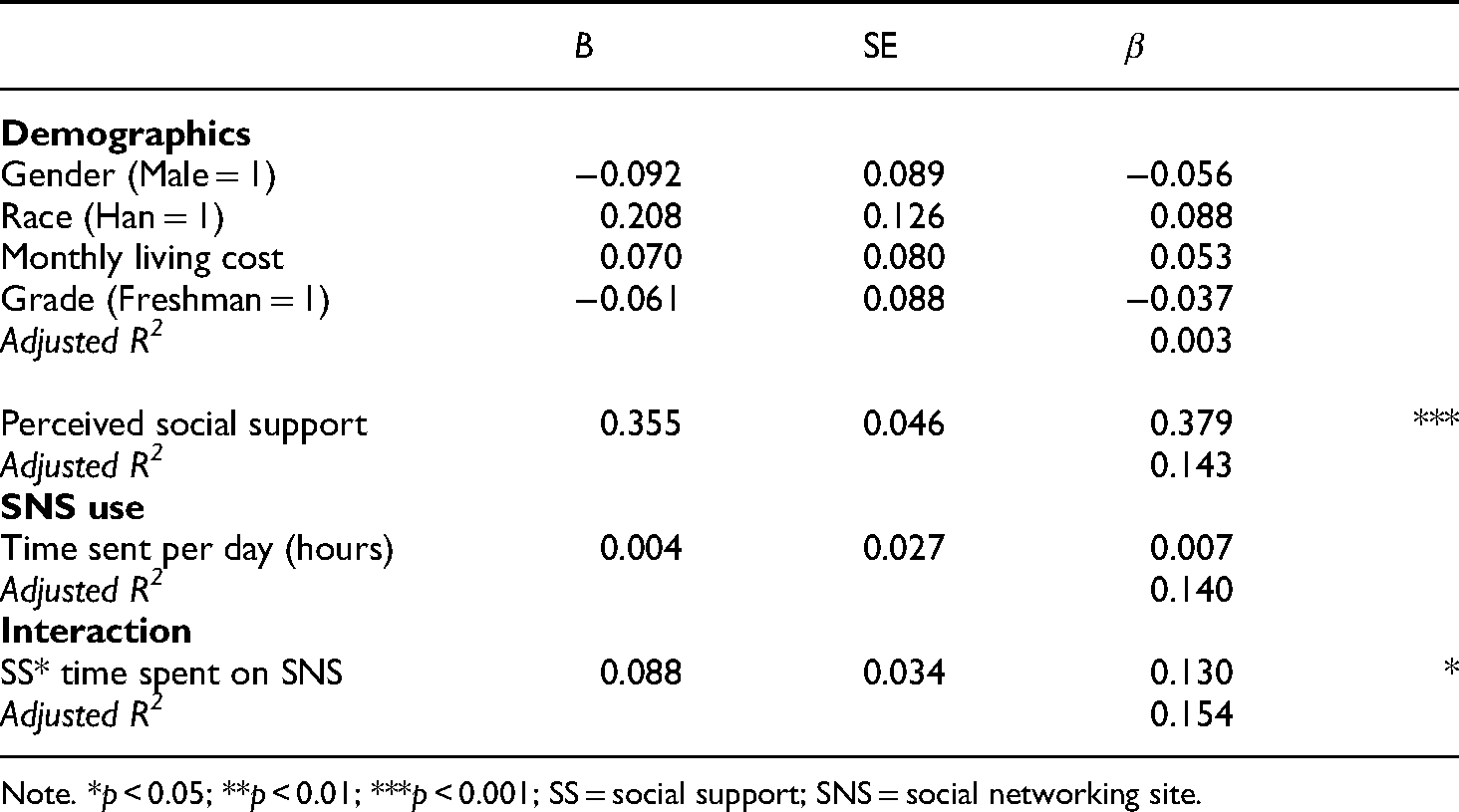
Note. *p < 0.05; **p < 0.01; ***p < 0.001; SS = social support; SNS = social networking site.
Hierarchical regression model assessing effects of SNS smartphone app usage frequency on emotional health.

Note. *p < 0.05; **p < 0.01; ***p < 0.001; SS = social support; SNS = social networking site.
Interaction effects
The interaction effect between SNS use and social support on emotional health was significantly positive (B = 0.088, SE = 0.034, β = 0.130, p = 0.011 for duration; B = 0.184, SE = 0.074, β = 0.120, p = 0.013 for frequency) (Table 2a and 2b), indicating that the effect of SNS use on emotional health depends on social support. Simple slope tests demonstrated, for SNS app usage (duration) and emotional health, associations were B = .074 (95% confidence interval = [−.002, .150], SE = . 038, p = .055) when social support was high, and B = − .080 (95% confidence interval = [ − .166, .006], SE = .043, p = .059) when social support was low (Figure 1(a)). The relation between SNS app use (frequency) and emotional health was significantly positive when social support was high (B = .21, 95% confidence interval = [.05, .37], SE = .08, p = .015), and was negative when social support was low (B = − .12, 95% confidence interval = [ − .30, .06], SE = .09, p = .181) (Figure 1(b)). These results demonstrate that social support moderated the relationship between SNS app use and emotional health, thus supporting our hypotheses.

Effect of interaction between time spent on social networking smartphone applications and perceived social support on emotional well-being. SS = perceived social support. SNS = social networking smartphone apps.

Effect of interaction between social networking smartphone application usage frequency and perceived social support on emotional well-being. SS = perceived social support. SNS = social networking smartphone apps.
Discussion and conclusion
The present study used actual measures of application usage and accurately recorded SNS app usage among Chinese college students. The results revealed SNS app usage to be a major category of smartphone usage. In particular, the results revealed that QQ, WeChat, Weibo, and Douyin were found to be the most-used SNS smartphone apps.
We did not find an association between SNS smartphone app usage and emotional health. These findings are consistent with recent studies showing no link between actual SNS use and life satisfaction and loneliness.17,52 While traditional studies rely on self-reported data, a limited but increasing number of studies have employed behavioral data. Our study provides empirical data for this emerging field of usage behavioral data research. This contributes to a very important line of research that promotes the understanding of SNS usage and emotional health.
Perceived social support plays a significant moderating role in the relationship between SNS use and emotional health. In particular, greater SNS app usage (frequency and duration) is associated with greater emotional health for those who reported higher perceived social support. The findings are consistent with those of previous works concerning the social support buffering model, 35 and show that perceived social support may mitigate the negative emotions derived from SNS usage. Moreover, the findings also extend the social support literature by suggesting that perceived social support may not only be beneficial for stressful SNS usage, but it may also be beneficial for other non-stressful SNS usage. When people spend much time on or check SNSs frequently, they may benefit more from SNS use, as it provides entertainment, leisure, and feeling of connectedness.4,7,62 Perceived social support may reinforce this effect on emotional health by adding the beneficial effect of perceived social support.
Limitations and future directions
The present study has certain limitations. First, conclusions regarding the causal relationships among the measured variables cannot be drawn. Second, our study sample comprised university students who had Android phones, and iPhone users were excluded as tracking their usage data would have required downloading a separate app specific for iPhone users. It would thus be beneficial to replicate this study in other locations and include iPhone users. In 2019, Android smartphone sales accounted for approximately 91% of the total volume of smartphone sales in mainland China. 63 Third, further investigation is required to distinguish the different patterns of SNS smartphone app usage that may predict emotional health in different ways. In the present study, the focus was only on usage duration and frequency, although a previous study has reported that the quality and types of SNS activities also play a role in affecting the users’ emotional health. 6 Fourth, the tracking app recorded participants’ SNS usage via smartphone. People may access SNSs via multiple devices. According to the 45th Statistical Report on China's Internet Development, 1 among people who use the internet, 99.7% of these users used the internet via their smartphones in 2021, 35% via a desktop, and 33% through laptops. Future studies could also monitor SNS usage on web-based desktops or laptops as well to track total usage. Finally, the log tracker data recorded actual SNS usage but did not capture whether the SNS usage experience was stressful or enjoyable. Future studies could employ other research methods (e.g. instant surveys after each instance of SNS use) to distinguish between positive and negative SNS usage. Future studies could also consider whether different SNSs may be differently related to emotional health. For instance, video- and text-based SNSs may provide different levels of gratification, which could lead to varying effects on emotional health.
Our findings have practical implications for individual users and for colleges. Given the association of SNS usage and perceived social support, it may be worthwhile to assess users’ perception of social support to recommend ways of deriving maximum benefit from SNS smartphone app use. It would be beneficial for individual users to increase their digital literacy regarding the relationship between perceived social support and SNS smartphone app usage. For individuals with low perceived social support, increasing their social support (either online or offline) and decreasing their SNS use would be beneficial for their emotional health. One way they could this would be by joining a self-help group to control their SNS use and obtain peer support. 64 Colleges and universities could implement on-campus campaigns to increase students’ awareness of campus services that are available to offer support and intervention programs to decrease student SNS use.
Footnotes
Declaration of conflicting interests
The author(s) declared no potential conflicts of interest with respect to the research, authorship, and/or publication of this article.
Funding
The author(s) disclosed receipt of the following financial support for the research, authorship, and/or publication of this article: This work was supported by the Ministry of Education of the People’s Republic of China (19YJC860029) and SHANGHAI PUJIANG PROGRAM(2020PJC056).
Data availability statement

Notes
Author biographies
Yan Liu is an assistant professor at the School of Journalism & Communication, Shanghai University. Her research focuses on the communication patterns on social media platforms and their effects on individual users in various health contexts.
Hongfa Yi is an associate professor at the School of Journalism & Communication, Shanghai University. Research fields: computational communication and text mining.