




Abstract
Low-severity multiple damage detection relies on sensing minute deviations in the vibrational or dynamical characteristics of the structure. The problem becomes complicated when the reference vibrational profile of the healthy structure and corresponding input excitation, is unavailable as frequently experienced in real-life scenarios. Detection methods that require neither undamaged vibrational profile (baseline-free) nor excitation information (output-only) constitute state-of-art in structural health monitoring. Unfortunately, their efficacy is ultimately limited by non-ideal input excitation masking crucial attributes of system response such as resonant frequency peaks beyond first (few) natural frequency(ies) which can better resolve the issue of multiple damage detection. This study presents an improved frequency response function curvature method which is both baseline-free and output-only. It employs the cepstrum technique to eliminate
Keywords
Introduction
The modern world is full of complex structures ranging from automated machines to skyscrapers which need regular costly inspections to ensure safety and maintenance. Structural health monitoring (SHM) attempts to resolve likely damage location by sensing subtle changes in dynamical characteristics of the structure such as minute drift in resonance peaks in the frequency response. Intuitively some template is required for drawing an accurate comparison with the response of undamaged structure for given excitation. Unfortunately, in several practical scenarios, the knowledge of excitation and/or reference response of undamaged structure may be either missing or infeasible to obtain in real-time. Output-only and baseline-free SHM schemes require neither piece of information for damage detection/localization. Unfortunately, despite showing promising results,1–4 most of these schemes have fallen short of identifying multiple damages particularly of low severity typical in many real-life cases. A common problem is the undesirable filtration of higher frequency modes when the structure is excited by a non-ideal impulse of non-zero finite duration (e.g. hammer blow). The time spread leads to the decaying power spectrum density (PSD) envelope adversely diminishing resonant peaks beyond the first natural frequency which alone may fail to discern multiple damage locations.5,6 Accurate damage detection for miscellaneous damage locations and severity levels requires high fidelity recovery of structure's frequency exhibiting adequate PSD in higher natural frequencies.6,7
In this study, the frequency response function (FRF) recovery tool – the cepstrum technique – customized for the FRF curvature method is reported. Figure 1 indicates a comparison between the original FRF obtained directly from the response signal and the regenerated FRFs by applying cepstrum pre-processing. The regenerated FRFs are not (just) amplitude scaled version of the original FRF otherwise the amplitude of the first peak should have been much higher (which is not the case). In actual, the decaying frequency envelope of the non-ideal input suppresses high natural frequency peaks which are then resurrected in cepstrum generated FRF as shown in Figure 1. The main contribution primarily built upon the pioneering work in cepstrum methods for structure health profiling 8 reveals an interesting use-case of this approach. At the same time, it highlights the unforeseen merits of cepstrum pre-processed FRF, namely its ability to accurately discern multiple damage locations. It has been shown in this work that full recovery of FRF is not critical for this purpose as long as only a few certain high-frequency peaks, falling in the coherence range 5 are adequately resurrected. The obtained results show that even low severity multiple damages can be detected and accurately localized by using a wide range comprising of the first four natural frequencies.

Comparison of the original response frequency response function (FRF) with the cepstrum regenerated FRFs.
Literature review
Vibration-based damage detection methods have been widely used in SHM applications. These methods detect damage by measuring the change in modal parameters of the structure, such as frequency, mode shape, curvature, damping etc. Most of these methods require data from healthy structures as a baseline to identify damage in the structure.9,10 Sampaio et al.11,12 utilize the FRF curvature method to detect and localize damage in beam-type structures. Instead of relying just on modal information, the method works over a broadband frequency range and proved that curvature-based methods are more efficient than conventional frequency and mode shape-based methods. The main limitation of the FRF curvature method, however, is that its effectiveness is strongly dependent on the frequency range on which it is applied. Various researchers have explored the most suitable range to be used in the FRF curvature method, for example, frequency range below the first anti-resonance or first resonance peak (depending on whichever comes first is suggested by Sampaio et al. 11 and broadband frequency range was implemented by Ratcliffe 7 ). Recently, the effectiveness of the conventional FRF curvature method was enhanced by considering the high coherence range. 5 The method was able to detect single and multiple damages in steel beams. However, for smaller damage, the spacing of measurement points was recommended to be smaller than the size of the damage, which is not easier to achieve in practical applications. Moreover, the data from the healthy structure is also required here.
Gapped smoothing method (GSM)13,14 is one of the baseline-free methods that employs a smoothing polynomial on the data from the existing structure. Thus, it does not require data from a healthy structure. However, as the method is based on modal curvatures of the structure, hence, it also suffers from the same limitations of its sensitivity to measurement noise. Many researchers worked on minimizing noise by developing noise suppression methods based on damage indices and FRF.15,16 One of the noise suppression methods was developed by using the Bayesian approach on damage indices generated from the GSM. The other method reduces noise by convolving FRF with the Gaussian kernel. The methods were investigated using simulated models and validated experimentally. Both noise suppression methods worked successfully, however, identification of multiple damages in a beam or any other structure is still an issue to highlight, especially when the damage size is very small.17–23
Most conventional methods previously described, require information on the excitation force to process the responses for detection and localization of damage. Structural responses, mostly in the form of FRF, incorporating the measured force are used to infer the anomalies. However, the incapability of measuring excitation force in full-scale structures or in-service areas, demands output-based damage detection procedures. These techniques can provide FRF, containing information about the damage without using input information either by using power spectral density or frequency domain decomposition.24–30 In addition to Operational Deflection Shape (ODS) FRF, many researchers also used Random Decrement (RanDec) signatures as an output-only damage detection method.31–33 The RanDec signature is almost identical to the impulse response of the system. The fast Fourier transform (FFT) of the RanDec signature is less noisy than that of the raw random response. Changes in structural integrity have been shown to affect the random decrement signatures (RDSs) which can be readily detected. Roy et al. 34 employed different techniques to obtain damage-sensitive features using output-only measurements.
Kordestani et al. 1 utilize RDS, to localize the crack-type damage in an I-shaped steel beam under moving load. For this purpose, Arias Intensity (AI) was used to calculate the energy content of each RDS and to substitute each acceleration signal with a scalar invariant value. However, the proposed method is restricted to single damage detection under noisy conditions. Similarly, Chang et al. 35 suggest using the RDS technique along with self-Green's functions (GFs) to find out the damage index. This is achieved by comparing the differences between the damaged and pristine plates. The author claims damage detection with less computational time and high accuracy, but for a single damage zone. In the same category, another method that is quite common in rotary machines is cepstrum analysis. In 1996, Gao and Randall, 36 for the very first time made use of cepstrum analysis for the determination of FRF from response measurements. The researchers used the non-linear least squares method (NLLS) and Ibrahim time-domain method (ITD) to extract poles and zeros from response cepstra. A steel beam with progressive damage was used for analysis, which was further used for regeneration of FRFs from the extracted poles and zeros. 37 Later work in cepstrum analysis was more focused on fault detection in rotary machine elements, such as bearings, gears etc.38–41 Also, some of the studies have dealt with improving the efficacy of the method and, to enhance the modal properties and regenerated frequency response signals.8,42
More recently, a cepstrum-based damage detection for progressive damage was used in a four-girder, timber bridge structure. 43 A residual FRF approach is used to estimate the severity of the damage in the structure by using an artificial neural network. This residual FRF is obtained by subtracting the regenerated FRFs from the baseline FRF either damaged/undamaged and is further used to produce two damage indicators. The combination of cepstrum with AI provides a good estimate of damage location and severity in some other literature.44–47 Although, they said research addresses multiple damage detection, still baseline is required for the comparison and ultimately for the generation of residual FRF. The limitation of baseline requirement was overcome by using a moving average filter under noisy conditions for a single damage case. 2 The method successfully detected the single damage in beam-type structures by taking the acceleration signals under noisy conditions. However, the method was not tested with noise for multiple damage cases. In another work, the output-only damage detection was accomplished by a two-stage process termed, Savitzky–Golay random decrement signatures (SG-RDSs). 3 Each SG-RDS demonstrated a specific energy content along the length of the beam. The irregularity in the energy pattern depicted the location of the damage. Although the method provides good noise robustness for single damage cases, however, it was not tested for multiple damage cases in a noisy environment and needed to be validated by experimentation. The Savitzky–Golay filters were also used to develop an output-only trend line-based damage detection method. 4 The method was able to detect single and multiple damages with 30% and 40% severity, respectively. However, the method still needs to be validated through experimentations. This study presents a baseline-free and output-only method that can detect multiple damages even of less severity. The efficacy of the proposed method is tested on simulated as well as on experimental data of three steel beams having single and multiple damages with severities high to low under different boundary conditions and modes of excitation.
Cepstrum-based damage identification
The main objective of cepstrum-based techniques is the deconvolution of two signal types: the fundamental (basic) wavelet and a train of impulses (excitation function), that is, to separate the transmission path and source effects from time-domain signals. Cepstrum de-convolves the response signal and separates the input and transmission path effects in a relatively distinguishable domain termed quefrency. The relation between input and transmission path effects becomes additive, due to which non-ideal excitation can be eliminated by liftering. However, liftering may also put down some resonant peaks of the structure's response. This is tolerable as long as some peaks survive in the broad frequency range. After liftering, curve-fitting attempts to attain relative scaling of frequency peaks. Hence, through liftering and then curve-fitting, cepstrum minimizes the unwanted effects in the regenerated FRFs by eliminating the influence of input excitation. With resurrected correct frequency peaks, accurate detection and localization of damage(s) become possible.
Cepstrum is an inverse Fourier transform of the logarithm of a spectrum

For linear time-invariant (LTI) systems, the time response signal





Long-pass liftering. –, cepstrum signal; ---, lifter.
The liftered cepstrum signal is further improved by the curve fitting process, that is, poles and zeros extraction from the original signal. A standard non-linear least square method (Levenberg Marquardt) is used to obtain a regenerated signal in the quefrency domain. Equation (6) is used for poles and zeros extraction (curve-fitting), in which


Original and regenerated cepstrum signal (curve-fitting) for a 25% severe single damage scenario.
Researchers have used artificial intelligence techniques in conjunction with cepstrum to access faults in structures.
43
In this study, a new amalgam is established between an output-only method (cepstrum) with a well-known conventional damage detection method. This combined process of damage detection uses the regenerated FRFs in the baseline-free FRF curvature method
6
to obtain damage index, as can be seen in a flowchart in Figure 4. The vibration response as the time-domain signal is extracted from the test structure which serves as input for the proposed algorithm. In the first step, the input signal is split into two parts, that is, magnitude and phase. The magnitude of the input signal is converted into the quefrency domain, to obtain an additive relation between source and transmission path effects. The non-ideal excitation (source effect) is removed through liftering leaving a signal that contains transmission path effects only. The liftered cepstrum signal is more enhanced by the curve fitting process, that is, poles and zeros extraction from the original signal. The regenerated cepstrum is converted back into the frequency domain to obtain a regenerated amplitude spectrum

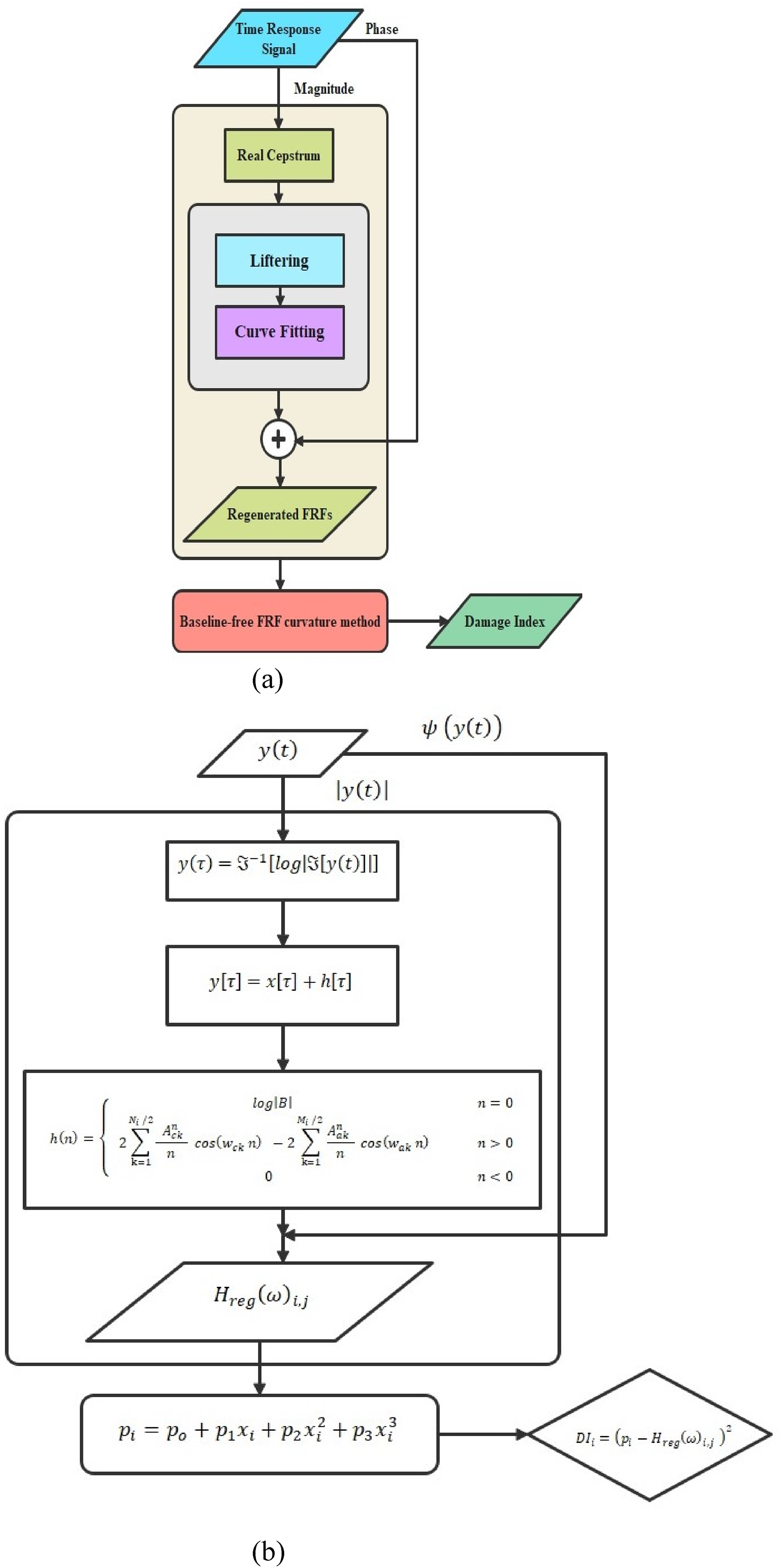
Flow chart of the proposed method: (a) conceptual and (b) mathematical.
Since the effectiveness of the FRF curvature method greatly depends on the selected frequency range, therefore the proposed method is investigated for different frequency ranges suggested in the literature.5,7,11,12 The ranges considered in this work are
Numerical simulations
A cantilever steel beam with length L, width w and height h (

Cantilever beam with single and multiple damage scenarios.
Various damage scenarios comprising single damage (
Damage scenarios for simulated beam experiments.

For each case, transient analysis is then performed in ANSYS with the following settings: response time = 4 s, time-step = 9.765 × 10⁻⁵ s, and sampling frequency 10,240 Hz. The transient response is in the form of displacement which is small on the nodes near the fixed end (support) of the beam, while it increases around the middle and becomes maximum at the free end of the beam, as illustrated in Figure 6.

(a) Time response at different points of the beam with a zoomed view and (b) frequency response.
Results and discussions – simulated experiments
The proposed FRF curvature method is then applied to obtain damage indices (
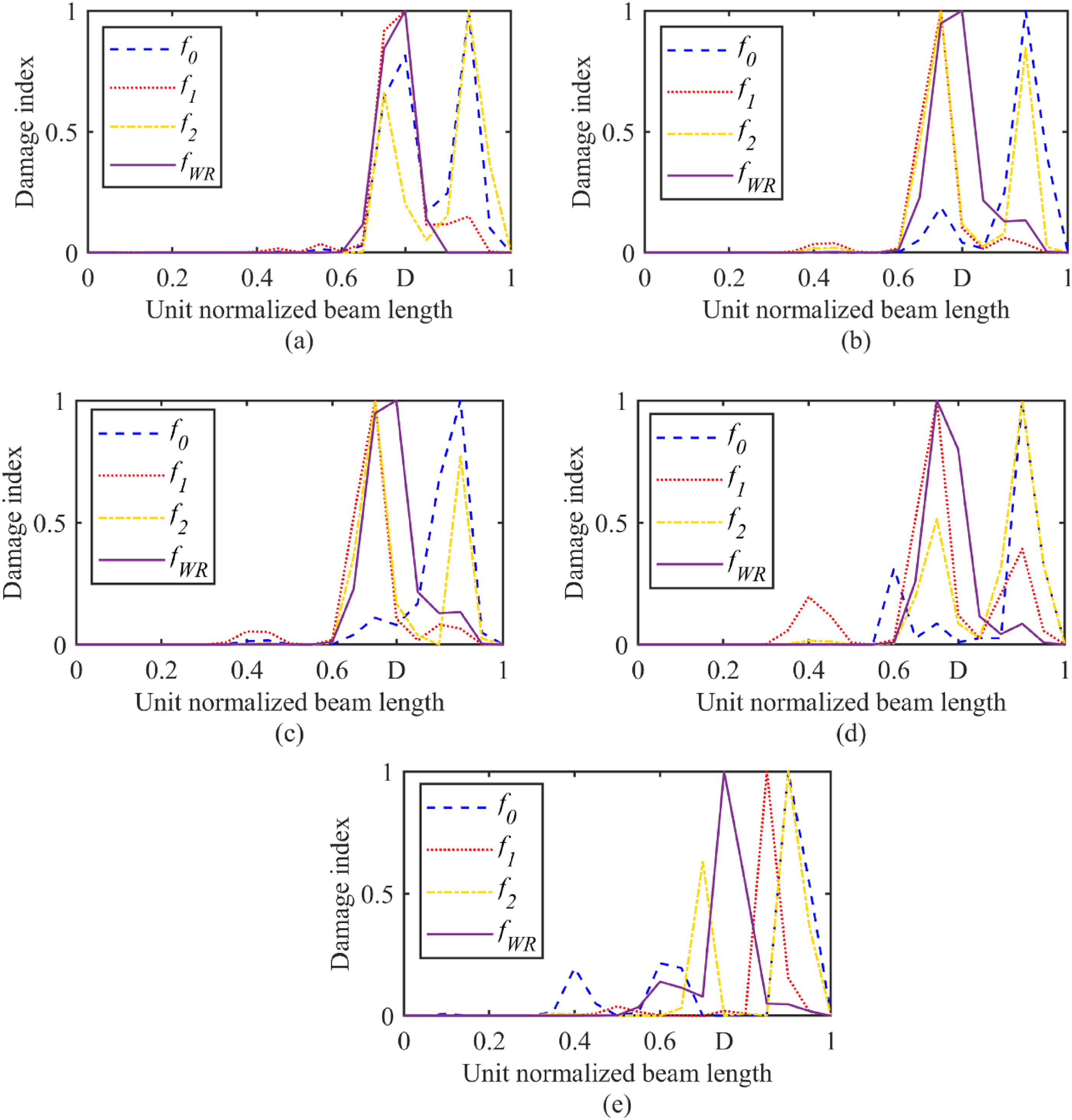
DI for scenario (a)
Next for

DI for
The effectiveness of the proposed method is then examined for multiple damage scenarios as well

DI for
Effect of measurement noise
Since the errors in any developed algorithm depend on the signal length and obviously on the noise level,
48
therefore, to check the effectiveness of the proposed hybrid method under noisy conditions, white Gaussian noise of different levels are added in the aforementioned damage scenarios. Noise is added directly in the time-domain signal using the following equation
17

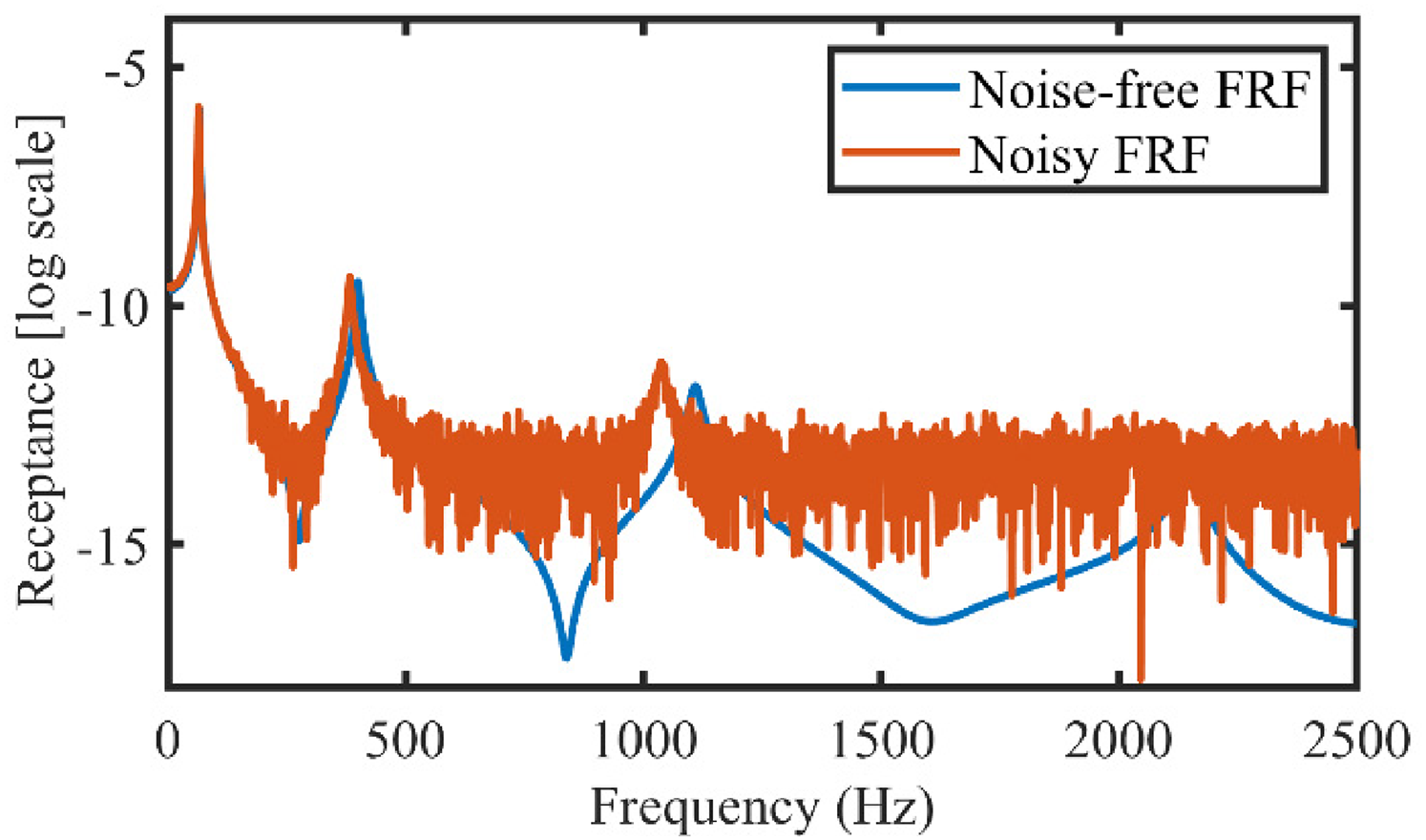
Noisy (3%) and noise-free FRF for
To investigate the effectiveness of the method, various noise levels as low as 1% and as high as 70% are added in the time-domain responses of single damage cases
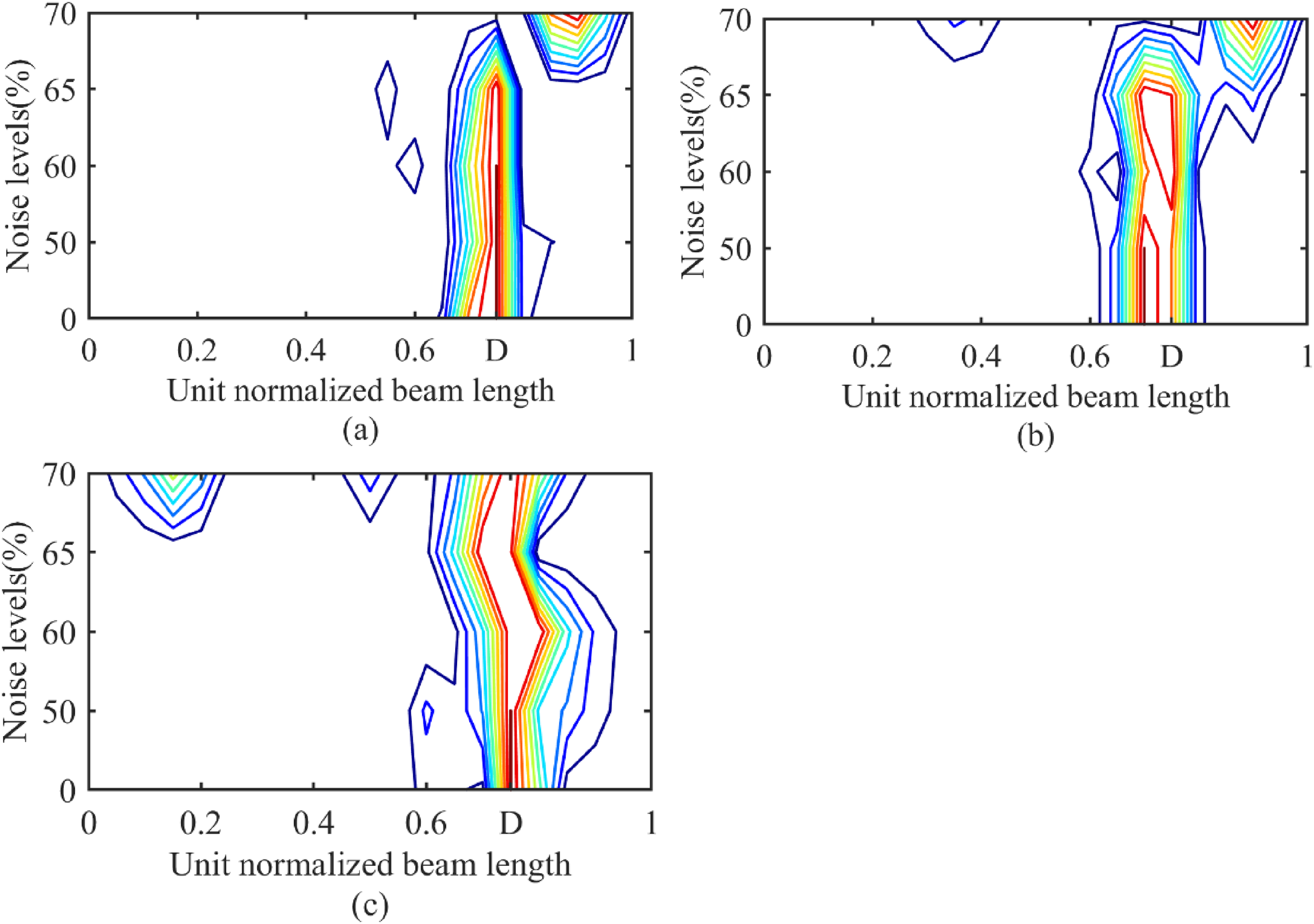
Noisy DI for selected single damage scenarios (a)
For all damage severities (50%, 25% and 5%), the damage is accurately detected and properly localized up to the noise level of 65%, as depicted in Figure 11(a) to (c). For noise levels exceeding 65%,
another false peak appears at the free end of the beam for in addition to a false peak at the free end of a beam, there is another smaller false peak near the middle length of the beam for other than the actual true peak, there are more false peaks on the right of the actual damage location and near the fixed end of the beam for
It is then inferred from these results that the proposed method is efficient up to the noise level of 65% for single damage scenarios irrespective of the damage severity. Now to check the efficacy of the proposed method for multiple damage cases
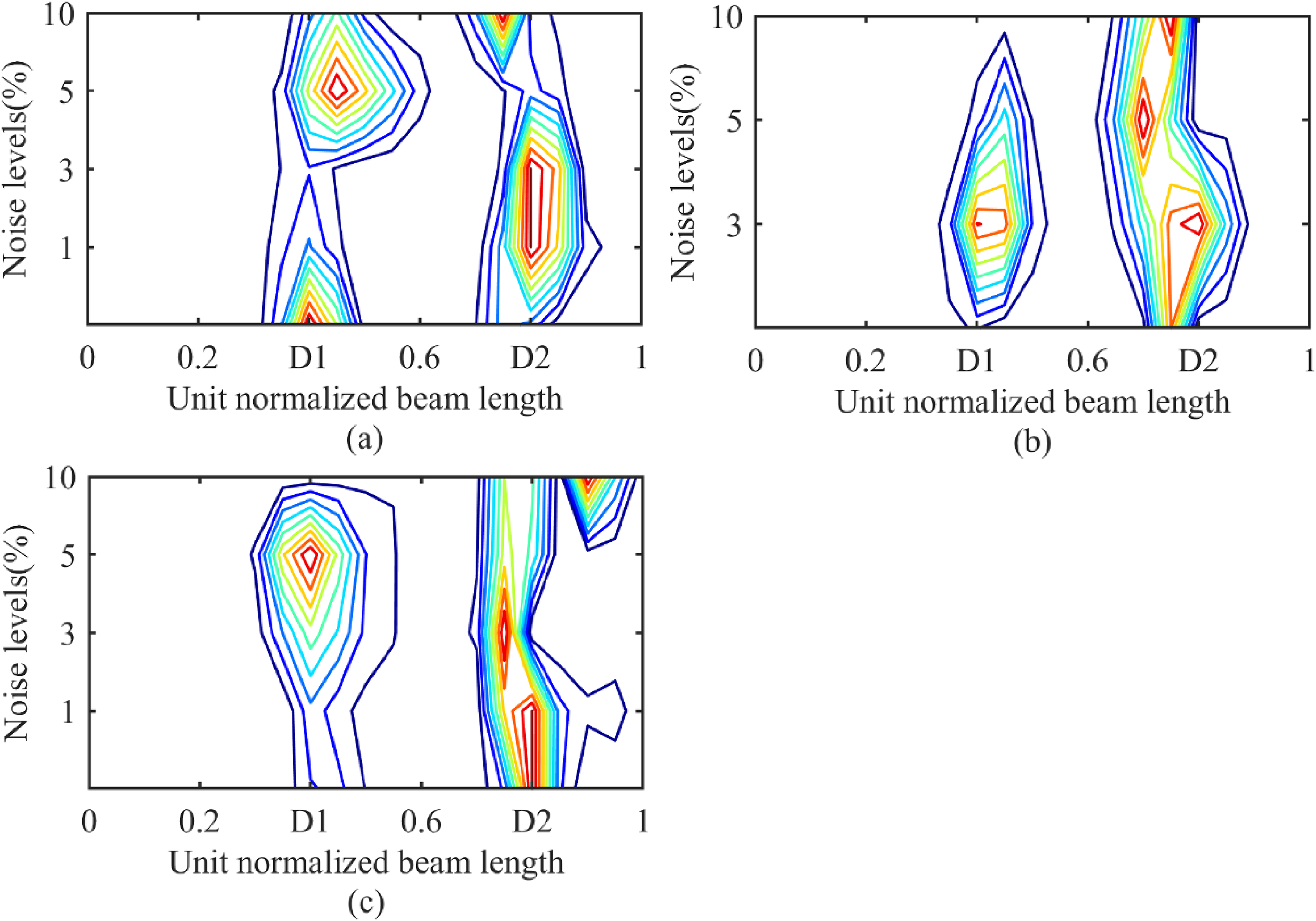
Noisy DI for (a)
For
All these results are generated without considering the input force and without using the data of healthy structure. A comparison of the method employed in this work (output-only and baseline-free) and a simple baseline-free FRF curvature method is drawn based on two aspects:
Tolerant to measurement noise: The damage indices from Figures 11 and 12 are compared with the baseline-free FRF curvature method,
6
as shown in Table 2. It implies that when the cepstrum technique is employed along with the baseline-free FRF curvature method, it enhances the effectiveness of the method against noise. The range of
Comparison of the methods against additive Gaussian noise.

ND – not detected.
Experimental results
The experimental setup shown in Figures 13 and 14, comprises three mild steel beams with dimensions and boundary conditions as:
BEAM-1 and BEAM-3 are elastically supported beams with dimensions BEAM-2 is a cantilever beam with dimensions

Schematic diagram of the experimental setup for BEAM-1 at UNSW, Australia.

Schematic diagram of the experimental setup for BEAM-2 at IST, Pakistan.
Several single and multiple damages with varying severities are introduced at different locations in beams as detailed in Table 3. In this table, the locations are in terms of beam length L. BEAM-1 is excited by means of an electromagnetic shaker at a fixed point on the beam and the responses are measured at 21 equidistant points along the beam length, as can be seen in Figure 13. In a different set-up for BEAM-2, the shaker excites the fixed-support of the beam by swept-sine excitation and the responses are measured at 24 equidistant points by using accelerometers as shown in Figure 14. Swept-sine excitation is chosen because it has been proved by Mituletu et al. 49 that it is the most effective excitation method to precisely extract the natural frequencies. BEAM-3 is excited by an impact hammer and responses are measured at 21 equidistant points along beam length.
Damage scenarios in experimental beams.

The measured acceleration responses and identified FRF as an example are shown in Figure 15, to understand how many vibration modes are recognized. Figure 15 comprises of acceleration response at 22nd and 23rd points of BEAM-2.

Acceleration response for BEAM-2 is directly taken from the system software, that is, vibration view, highlighting natural frequencies 1–7.
The results of BEAM-1 against different frequency ranges are shown in Figure 16. For S1 in BEAM-1, it can be seen in Figure 16(a), that there is a clear dominant peak at the damage location for

DI at different frequency ranges for (a) S1 and (b) M1.
The severity of the single/multiple damages is further reduced ranging from 25% to 5% in the case of BEAM-2. The single damage even as small as 5% severity is clearly detected by considering
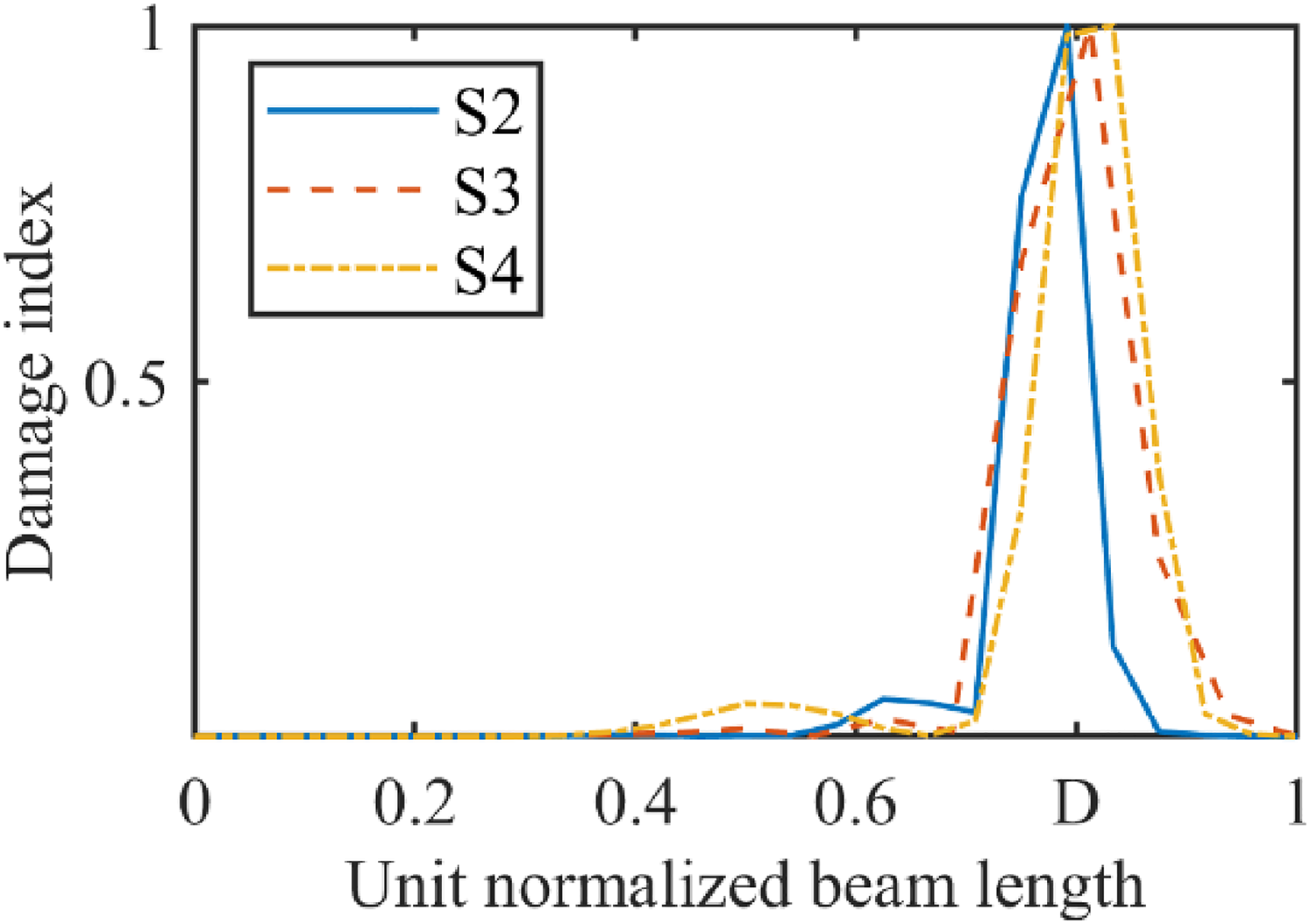
DI for S2, S3 and S4 considering
For multiple damage cases M2 and M3, there are two prominent peaks clearly indicating the two damages, as shown in Figure 18. For the smallest damage case M4, D2 is clearly detected while the peak at D1 is slightly shifted to the right of the damage location. Despite that, the peak still indicates the vicinity of the damage. Interestingly, these results are comparable to the simulated results described in Figure 9. In the similar manner, the results for single and multiple damages for BEAM-3 clearly indicate the damage location/s, as can be seen in Figure 19. These experimental results distinctly validate the simulated results and demonstrate the effectiveness of

DI for M2, M3 and M4 considering

DI at
The proposed hybrid method considering four frequency ranges is investigated and validated with varying attributes of the test specimen regarding damage size, single/multiple damages, boundary conditions and mode of excitation. The efficacy of the method considering
Comparison
The major contribution of this work is that in real-life structural health monitoring experiments, imperfect input excitation is the main agent of masking structure natural frequency response, more so than any other source of noise and disturbances. Once decoupled from excitation by using the cepstrum technique, recreated frequency response profile can be used to accurately detect and localize multiple damages of low severity, as evidenced by our numerical and experimental results.
The proposed hybrid method enhances state-of-art in the following tabulated aspects (Table 4).
Comparison with some state-of-the-art output-only methods.

Conclusion
This paper presented an output-only and baseline-free damage detection method that utilized the cepstrum technique to regenerate FRFs from the original vibration response signal and combined with the FRF curvature method for succeeding valuation of multiple damage locations in steel beams. Cepstrum acts as a prevailing tool to remove non-ideal input effects from the response signal which in turn resolves the higher frequencies decay problem and minimizes noise. This hybrid method is proficient for single and multiple damage detection as severe as 50% and as small as 5%. Another aspect of this paper is the investigation of recommended frequency ranges for the FRF curvature method. In agreement to the previous work,
6
the results proved
Footnotes
Acknowledgements
Most of the experiments were performed in the Center for Vibration Testing and Condition Monitoring in the Institute of Space and Technology (IST), Islamabad, Pakistan. Some of the experiments were completed in the Vibration and Acoustics lab in School of Mechanical and Manufacturing Engineering, UNSW during PhD studies of the second author. The authors are deeply obliged to both of the institutes for providing the facility for data collection.
Declaration of conflicting interests
The authors declared no potential conflicts of interest with respect to the research, authorship, and/or publication of this article.
Funding
The authors received no financial support for the research, authorship and/or publication of this article.
