



Abstract
In the wider spectrum of Taiwanese public service spheres, the herculean services and dedication of its committed Police personnel have long been recognized, respected, and admired. However, regrettably, question marks concerning their conduct, discipline, and abuse of power have surfaced on intermittent occasions. A classic example that lingers in the public memory is the bribing of Taiwanese video game companies to some unscrupulous elements of the police department, in the closing decades of the 20th century that triggered public outrage and called for scrutiny concerning serious lapses in the discipline and conduct of Police personnel. This research paper endeavors to understand, analyze and address some of those issues based on empirical data on the police personnel of certain specific work zones/areas taking into account holistically both the sentenced police officers vis-à-vis the law-abiding police officers. This module looks into and sieves through available data for seven critical variables, including their degree of variation through the Identification and Analysis Method to develop a Predictive Model on Police Ethics and the important factors that affect Police Ethics. Concretely based on the integrated research, it is proposed that this Predictive Model has good applicability as well as accurate predictive ability in addressing the core issues that affect Police Ethics. It is hoped that through this Early Warning Predictive Model—all the stakeholders that are Policy and Decision-makers, Regulatory Police Agencies but more importantly the Police personnel themselves would effectively address the criticality of the issues that affect the Police Ethics so as to undertake competent and effective measures to erase/lessen the menace and provide an early rehabilitative care/assistance to build a strong, constructive and visionary Taiwanese Police Force to meet the challenges of 21st century and beyond.
Keywords
Introduction
The current research endeavors to establish a model for police officers’ conduct to prevent the occurrence of incidents/events arising out of indiscipline, immoral/bad habits that are capable of harming the standing, repute, and morale of police personnel. The research studies conducted by Gershon et al. 1 are a clear pointer towards various issues that lead to work stress among the police and its consequent fallouts on the professional standing of its personnel.
Thinking through this article, anti-corruption law enforcement is what the government should do. The outstanding performance of moral cases may not necessarily win the people's trust and affirmation of the government. What people want to see is not the results of subsequent investigations by the government, but to further reflect on why the corruption case is so happen. The people's pursuit is to treat the symptoms rather than the root cause. Therefore, seeking practical actions and gaining the people's trust in law enforcement is a top priority for the government's integrity departments.
Research background and objectives
Unbridled and creepy indiscipline in the law enforcement and regulatory agencies in particular and polity, in general, has the innate potential of causing negative effects such as—government policy deviations, reduction in cumulative public expenditures, corrupt and inefficient civil services, low and slumberous administrative responses with increased government-civilian disputes—eventually leading to reduced government prestige and misplaced social resources. Most importantly, it can lead to rampant unhealthy practices in society. Therefore, there is an urgent need to understand the various facets of corruption and the issues related to it so as to deal firmly and decisively to establish and uphold a clean government image, as exemplified by Bayley. 2
The purpose of this research endeavor is multifold. Essentially, it seeks to understand the actual historical data on record concerning the instances/events related to indiscipline in the police personnel, analyze critically the factors behind those and then propose a predictive model that has good applicability as well as accurate predictive ability in addressing the core issues that affect the police ethics:
To discuss critically the important factors related to the issue of indiscipline and the type of cases involved. To take into account and analyze the empirical data of a certain area/zone to identify the factors and thereby construct a predictive model for forecasting well in advance. To help ready and provide requisite supervision units; basis for pre-judgment; and pre-control and responsive management measures.
Literature discussion
In the following paragraphs, relevant literature has been reviewed to understand the factors that affect Police morale, its symptoms and characteristics, ways to predict, mitigate and prevent the occurrence of such cases on the basis of a dynamic theoretical Predictive Model based on the discriminant analysis.
Documents related to police officers’ conduct
Based on comprehensive research, scholar Ji 3 brings forth and summarizes the criminal characteristics as noted below: dereliction of duty and corruption regulations. The criminal law's dereliction of duty mainly regulates the illegality of civil servants in performing their duties. Compared with the law of corruption and crimes, which emphasizes the illegality of civil servants to obtain benefits, the two The values of concern are different, but when public servants commit crimes for their duties, most of them use illegal performance of their duties to obtain illegal benefits, and the crimes of civil servants regulated by the Corruption Crimes Regulations also limit those related to their duties. The above crimes are generally referred to as civil servants and their accomplices (see Table 1).
The characteristics of crime.

Source courtesy: Ji 3 [Collated with current Authors’ research].
Factors affecting police discipline
Shi 4 critically acclaimed research compiles describes and sums up both the external as well as the internal environmental systems that affect the discipline of the police personnel in the following ways (see Tables 2 and 3).
Affect external environmental system.

Source courtesy: Shi 4 [Collated with current Authors’ research].
Affect internal environmental system.

Source courtesy: Shi 4 [Collated with current Authors’ research].
External environmental system
See Table 2.
Internal environmental system
See Table 3.
Personal attributes
According to Muscari, 8 personal and individual idiosyncrasies are the key factors leading to indiscipline in the police personnel, and those personal/idiosyncratic factors are described in Table 4.
Personal attributes that affect policemanship.

Violation of discipline by the police often involves crimes on duty, which are mainly civil and discipline; police conduct crimes are relatively serious cases in the national administrative system. The people's hope for the police is not only whether they can solve a case when a case occurs, but also whether the quality of the police can be improved, and a living environment for the people to live and work in peace and contentment can be provided for the people.
Relevant literature for identification analysis
Noted below are some of the select important works that discuss the issues under reference and point towards important criteria that are helpful in the identification analysis (see Table 5).
Scholarly literature on identification analysis.

Source courtesy: Shi 4 [Collated with current Authors’ research].
Research methodology
In the current research endeavor, methodically and critically several aspects of the available relevant historical data were sieved through to understand the complexities involved in understanding the core and peripheral issues related to indiscipline in the police personnel, as outlined below:
Data collection
The requisite and relevant data collection process undertaken is shown in the below noted schematic diagram (see Figure 1).

Research architecture diagram. Source courtesy: compiled from the outcomes of current research.
Research scope and objectives
The empirical data utilized in the current research endeavor is gathered from authentic sources ranging in a period from January 2016 to December 2017. It relates to two categories of Police personnel from a certain area/zone of Taiwan, totaling 14 cases: 1. Police officers committing duty crimes or corruption and; 2. Law-abiding police personnel.
Research design
The research design was carefully contemplated and intended to thoroughly understand insightfully the demeanor of the police personnel based on critical independent variables, such as age, education, rank, position, seniority, bad habits, and the service area complexity of the police personnel
Research results
The outcome of this focused research endeavor is based on analyzed sample data related to duty or corruption-related crimes against the law-abiding police personnel of a certain area/zone of Taiwan, totaling 14 specific cases.
Research variable descriptive statistics
According to the research analysis under reference, the sentenced police personnel are averagely among the older ones—those with lower academic qualifications and ranks. More specifically, it is the criminal police who are susceptible to problems of ethics. It is older among them who face more ethical problems and it was noticed that most of those who come under this category have more than one vice. The study also clearly exemplified that the majority of those police personnel (working in the complex service areas), who have bad habits are more prone to moral and ethical problems (see Table 6).
Descriptive statistics of sentenced police personnel.
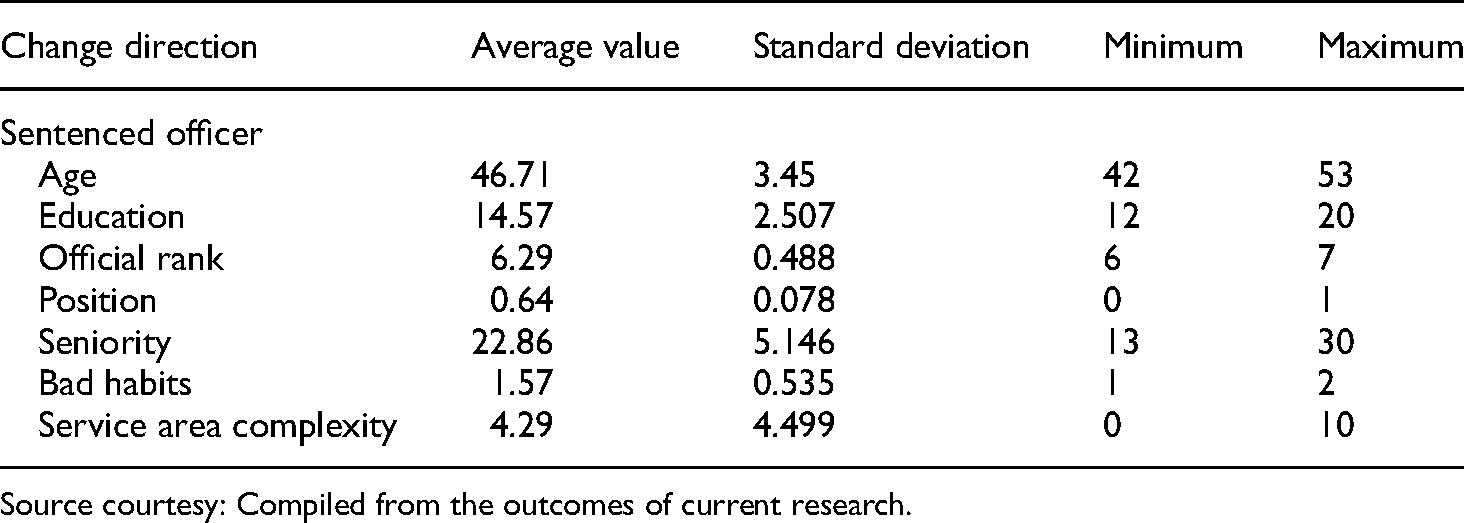
Source courtesy: Compiled from the outcomes of current research.
As illustrated in the following table, the law-abiding police personnel are on an average 38 years old and are graduated from a professional police training college. Those with higher ranks are less likely to have problems with the discipline as also those with the Administrative Police. It is also observed that the younger the seniority—their living habits are the simpler; the area is simpler with fewer moral problems (see Table 7).
Descriptive statistics of law-abiding police personnel.

Source courtesy: Compiled from the outcomes of current research.
Correlation analysis
When the absolute value of the correlation coefficient reaches 0.7–0.8, it is highly correlated; if it is above 0.8, it is highly correlated (see Table 8).
Correlation analysis of research variables.

Source courtesy: Compiled from the outcomes of current research.
According to Table 9, this study used the KMO sampling appropriateness test The KMO value is 0.835, which also indicates that the analytical effect is valuable. The Chi-square value is 50.445, and the significance is 0.000 <α = 0.05, indicating that it is suitable for follow-up research (see Table 9).
Personnel Kaiser-Meyer-Olkin (KMO) and Bartlett certification.

Discriminant analysis
According to Table 10, the overall Wilks’ Lambda value is 0.132, and the significance is 0.013 <α = 0.05 reaching a significant level (see Table 10).
Eigenvalues and Wilks’ Lambda value of personnel discipline model.

Source courtesy: Compiled from the outcomes of current research.
It can be noticed from the above analytical observations that the Police personnel who have been under excessive pressure continually for a long time are more prone to vices and fall into bad habits such as drinking, pornography, and borrowing (see Table 11).
Structure matrix.

Source courtesy: Compiled from the outcomes of current research.
Thus, using the discrimination probability function to perform discriminant analysis successfully helped predict possibilities of moral problems, their degree, and acuteness. The ethics of machine learning is an important tool. 15 And, our current research endeavor demonstrates and furthers the idea of the ethics of machine learning, its applicability as well as utility.
Predictive model
This study uses SAS (Statistics Analysis System) statistical analysis software to construct the police officer's predictive style model for this study. This study will describe the predictive model in detail as follows.
INPUT NO Discipline age education rank position year habit area; CARDS; 1 0 39 20 9 0 5 0 0 2 0 33 20 8 0 5 0 0 3 0 54 14 7 0 31 0 5 4 0 41 20 10 0 19 0 0 5 0 32 16 9 1 9 0 0 6 0 25 12 6 0 3 0 10 7 0 48 14 7 0 25 0 5 8 1 45 14 6 0 22 2 0 9 1 48 14 7 0 25 1 10 10 1 45 14 6 0 22 2 5 11 1 46 12 6 0 23 1 0 12 1 53 14 7 0 30 2 0 13 1 42 20 6 0 13 1 5 14 1 48 14 6 0 25 2 10 15 . 35 16 8 0 10 1 0 16 . 48 14 6 0 25 1 10 17 . 43 16 10 0 19 1 0 18 . 42 16 8 0 18 3 0 19 . 47 14 6 0 22 1 5 20 . 33 14 7 1 11 1 0 21 . 41 12 7 1 18 1 0
TITLE1 ‘ Forecast of Police Discipline Model ‘;
TITLE2 ‘ Data required for identification analysis ‘;
VAR Discipline age education rank position year habit area;
ID NO;
TITLE2 ‘Verification of Discriminant Function–Application of the Regular Law‘;
CLASS Discipline;
VAR age education rank position year habit area;
TITLE2 ‘Prediction of Disciplinary Issues–The Application of Tacit Method‘;
CLASS Discipline;
VAR age education rank position year habit area;
ID NO;
PRIORS ‘0’ = 0.95 ‘1’ = 0.05;
Conclusions
The current research study under reference successfully used the available relevant empirical data—effectively employing the discriminant analysis—to explore the main factors that are linked to police indiscipline and then build a solid premise for a predictive model to address the issues related to morality, ethics, and indiscipline.
This study unambiguously revealed that a number of unhealthy lifestyle habits and the complexity of the service area are important factors affecting the issue of morals. The nature of police work stands on a delicate premise that is interdependent on both external and internal systems; and, when there is excessive work pressure, it often leads to and makes them susceptible to various bad habits. Another important point to be noted here is the salary of grassroots’ level police personnel which is generally inadequate and unfavorable. As they grow older, they are not promoted and are unable to hold on to themselves with the discipline. Consequently, such cumulative reasons cause and have all the potential to develop into cases of collective corruption and gross indiscipline.
Recommendations
These empirically derived research results reveal that while implementing discipline-related policies and performance duties, there are ways and means to reduce the chances of potential corruption offenders. To prevent the occurrence of unethical practices in the vitally important police organization system—policy and decision-makers, inspectors and regulators, institutions delving with crime prevention mechanisms can make use of the discriminant analysis as also this predictive model to accurately study those sections of the police personnel who are susceptible to bad habits/lifestyle and work in more complicated service areas. Such precautions are absolutely necessary not only in carrying out healthy management of the police forces but most importantly in firmly placing an early warning system in the national interests of the vibrant Taiwanese polity and society.
Footnotes
Acknowledgements
This work was supported by the Kuang-Tai teacher encouraged to participate in this research.
Authors’ contributions
LK and YL designed this experimental study and wrote the manuscript. LK and MX conducted the statistical analysis. The three authors read and approved the final manuscript.
Declaration of conflicting interests
The authors declared no potential conflicts of interest with respect to the research, authorship, and/or publication of this article.
Funding
The authors received no financial support for the research, authorship, and/or publication of this article.
Availability of data and materials
The datasets used and/or analyzed during the current study are available from the corresponding author on reasonable request.
