




Abstract
The generator is the most popular mobile power device and backup power device in the world. It is very important for human life. Therefore, it is important to develop more efficient combustion technology in order to save energy and reduce air pollution. In this paper, a novel technology of hydrogen and oxygen compound gasoline fuel is developed. Hydrogen and oxygen gases are produced from an electrolytic cell and then mixed with the intake gasoline and air. The compound fuel is sucked into the engine combustion chamber. The hydrogen and oxygen gases can be produced immediately without any storage device of hydrogen. The experimental results show that this technology can increase the power generation and decrease emission pollution due to promoting combustion efficiency. In addition, the spark plug seat temperature increases due to higher heat value of hydrogen. This technique can reduce carbon monoxide and HC, but increase carbon dioxide. The research and development of this technique can achieve the goals of energy saving, emission reduction, relative safety, easy refitting and low refitting expense. Moreover, this research possesses academic innovation and industrial application.
Introduction
As global warming and energy shortage caught the world's attention, saving energy and reducing air pollution become major global issues. The generator is the most popular mobile power device and backup power device in the world. It is very important for human life. So far, generators are widely used in many fields. In addition to the new generators that are manufactured, there are still many old generators still in use; the old generators have been consuming energy and polluting the environment. The combustion gases from generator exhaust emission are harmful to the human body. Therefore, novel combustion technology is necessary to save energy and reduce air pollution.
Many methodologies including butane–air reformer for hydrogen (H2) gas generation, 1 low temperature plasma methanol fuel reformer for enriched H2 gas generation, 2 gasoline–H2 compound fuel, 3 micro-plasma reformer to generate enriched hydrogen gas,4,5 plasma fuel converter to generate hydrogen gas,6,7 alumina for production of H2 reformate (hydrogen-rich exhaust gas recirculation: H2EGR) in an indigenous catalytic reactor, 8 have been reported to generate H2 gas; however, it is a challenge for scholars to safely apply H2 gas into vehicles at a low cost.
Karagöz et al. 9 investigated the hydrogen and oxygen (O2) gas mixture that was produced by an electrolyser and consumed simultaneously to eliminate the necessity of a storage device. The H2 and O2 gas mixture used as secondary fuel in the spark ignition (SI) engine was generated by an electrolyser under optimized operating conditions. The brake power and brake thermal efficiency were increased by means of H2 addition. The hydro carbon (HC) and carbon monoxide (CO) emissions decreased, whereas the NO x emission increased. Schastlivtsev et al. 10 presented a H2–O2 gas generator where H2 was combusted in O2, the produced steam was mixed with air and the gas mixture was used in a conventional gas turbine. This technology can reduce NO x . Boretti 11 used a numerical method to analyze a diesel direct injection heavy duty truck engine converted to H2. The engine adjusted some devices and operating parameters so as to optimize H2 combustion. The conversion is obtained by replacing the diesel injector with a H2 injector and the glow plug with a jet ignition device. The H2 engine operates under different modes of combustion depending on the relative phasing of the main injection and the jet ignition. Boretti and Lappas 12 first examined the flaws of the current laboratory procedures and additional on-road tests. They gave a suite of cycle laboratory tests to solve the issues of repeatability, representability and reliability. They suggest the definition of new emission rules should be universally applicable to all alternative vehicles ranging from electric cars to vehicles powered by H2 fuels.
This research developed a green technology of compound fuels for traditional generators. Gasoline mixed with H2 and O2 gases generated using an electrolysis cell is sucked into the engine and then combusted. R & D of this technique can achieve the goals of air pollution reduction, relative safety, easy refitting and low refitting expense. This research technology can also be used in hydrogen–gasoline compound fuel motorcycles and vehicles. This research produces hydrogen and oxygen using an electrolytic technique, and then they and a gasoline fuel mixture are injected into engines for combustion.
Electrolysis reaction
Pure water and sodium hydroxide (NaOH) were electrolyzed to produce hydrogen and oxygen. The anode and cathode in the electrolyte react as follows:
Anode:

Cathode:

Total response:

This research aims to alter the carburettor and integrate the entire experimental system in a HONDA SHX1000 49cc gasoline generator. The experimental processes are described as follows: The H2 and O2 gases are generated using an electrolysis cell. The flow meter is connected to measure the flow rate of H2 and O2 gases. The check valve is connected to prevent the engine backfiring. The H2 and O2 gases are guided from the air cleaner to the engine manifold, and then they are mixed with gasoline to be sucked into engine combustion chamber. The experimental instruments in this research include an electrolysis cell, a liquid gas separator, a power supply, a flow meter, a check valve and a searchlight as shown in Figures 1–6. The schematic illustration of experimental processes is shown in Figure 7. The experiment conditions are full throttle position (TP = 100%), half throttle position (TP = 50%), voltage (V), current (A), power (w), fuel consumption (cc/min), plug temperature (oC), engine rotating speed (rpm), CO, HC (ppm), and carbon dioxide (CO2).

Photo of generator (HONDA SHX1000).
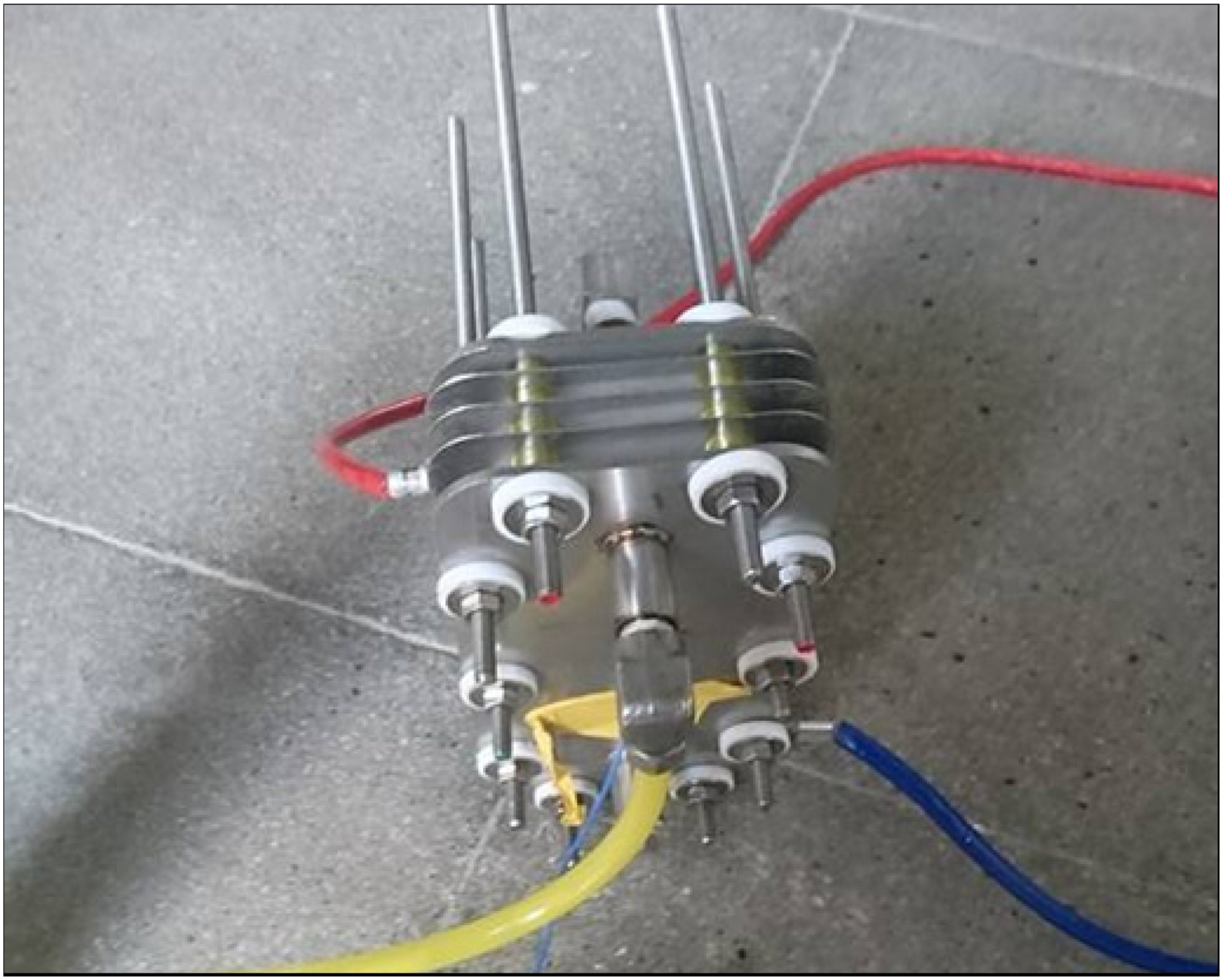
Photo of electrolysis cell.
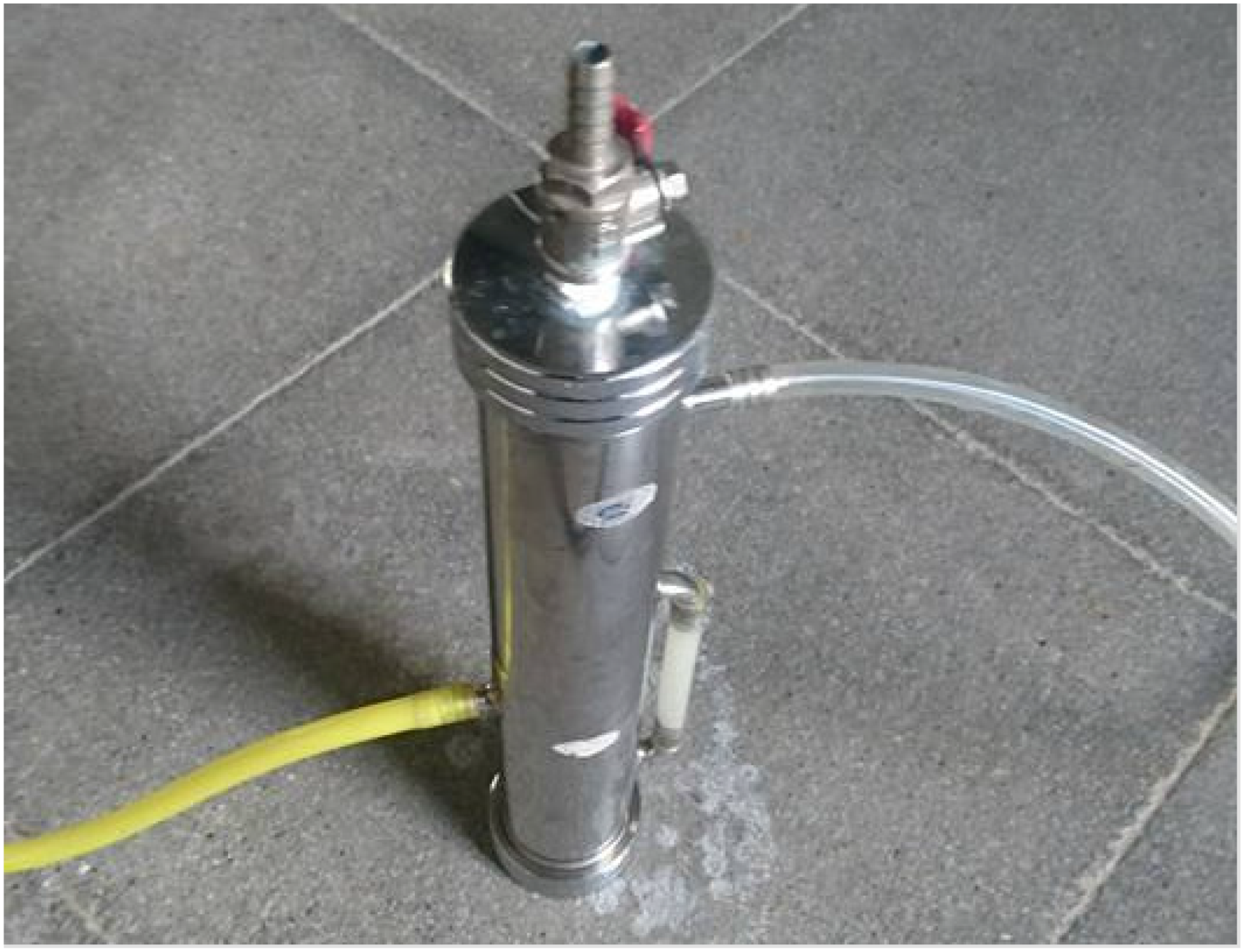
Photo of liquid gas separator.

Photo of check valve (prevent backfire).

Photo of exhaust gas analyzer (Horiba MEXA-584L).

Photo of H2 + O2 + gasoline compound fuel generator system.

Schematic illustration of H2 + O2 + gasoline compound fuel generator system.
For energy saving and environmental protection, this paper aim to conduct a performance test, exhaust emission and temperature measurement of full TP(100%) and half-TP (50%) for a generator power system. H2 has a higher heat value and O2 has a combustion-supporting effect; so the H2, O2, and gasoline compound fuel can promote combustion efficiency.
The experimental results show that the 370 cc/min of the H2 and O2 gases are added to 300 cc gasoline for combustion. The voltage value is 120.2 V, the current value is 3.8 A, the power is 456.76 W, the fuel consumption is 5.17 cc/min, and the electric power generation time is 58 min. For gasoline combustion, the voltage is 120.1 V, the current value is 3.6 A, the power is 432.36 W, the fuel consumption is 7.23 cc/min, and the electric power generation time is 41.5 min. The electric power generation time of a generator engine fuelled with compound fuel (H2 + O2 + gasoline) is longer than that fuelled with gasoline fuel. The average increment of power generation time is 39.76%.
Figure 8 shows the relationship between the spark plug seat temperature (Tplug) and the electric power generation time. The Tplug of a generator engine fuelled with compound fuel is higher than that fuelled with gasoline fuel. The compound fuel can promote combustion efficiency. For 100% TP, the maximum Tplug is 161.1°C, and the average increment of Tplug is 0.55%. For 50% TP, the maximum Tplug is 116.0°C, and the average increment of Tplug is 3.10%.

Plug temperature versus time using different fuels.
Figure 9 shows the relationship between the exhausted CO gas and the electric power generation time. The exhausted CO gas of a generator engine fuelled with compound fuel is 3.6% for 100% TP. The exhausted CO gas of a generator engine fuelled with gasoline fuel is 4.4% for 100% TP. The compound fuel can promote combustion efficiency. The exhausted CO gas is a product of incomplete combustion. Therefore, the exhausted CO gas decreased. The exhausted CO gas of the generator engine fuelled with compound fuel is lower than that fuelled with gasoline fuel. The average decrement of exhausted CO gas is 17.9%. The exhausted CO gas of a generator engine fuelled with compound fuel is 2.5% for 50% TP. The exhausted CO gas of a generator engine fuelled with gasoline fuel is 4.1% for 50% TP. The average decrement of exhausted CO gas is 39.7% for 50% TP. The average decrement of exhausted CO gas for 100% TP is smaller than the average decrement of exhausted CO gas for 50% TP.

CO versus time using different fuels.
Figure 10 shows the relationship between the exhausted HC gas and the electric power generation time. The exhausted HC gas of a generator engine fuelled with compound fuel is 166 ppm for 100% TP. The exhausted HC gas of a generator engine fuelled with gasoline fuel is 380 ppm for 100% TP. The compound fuel can promote combustion efficiency. The exhausted HC gas is a product of non-combustion. Therefore, the exhausted HC gas of a generator engine fuelled with compound fuel is lower than that fuelled with gasoline fuel. The average decrement of exhausted HC gas is 56.3%. The exhausted HC gas of a generator engine fuelled with compound fuel is 109 ppm for 50% TP. The exhausted HC gas of generator engine fuelled with gasoline fuel is 345 ppm for 50% TP. The average decrement of exhausted HC gas is 68.4%. The average decrement of exhausted HC gas for 100% TP is smaller than the average decrement of exhausted HC gas for 50% TP.
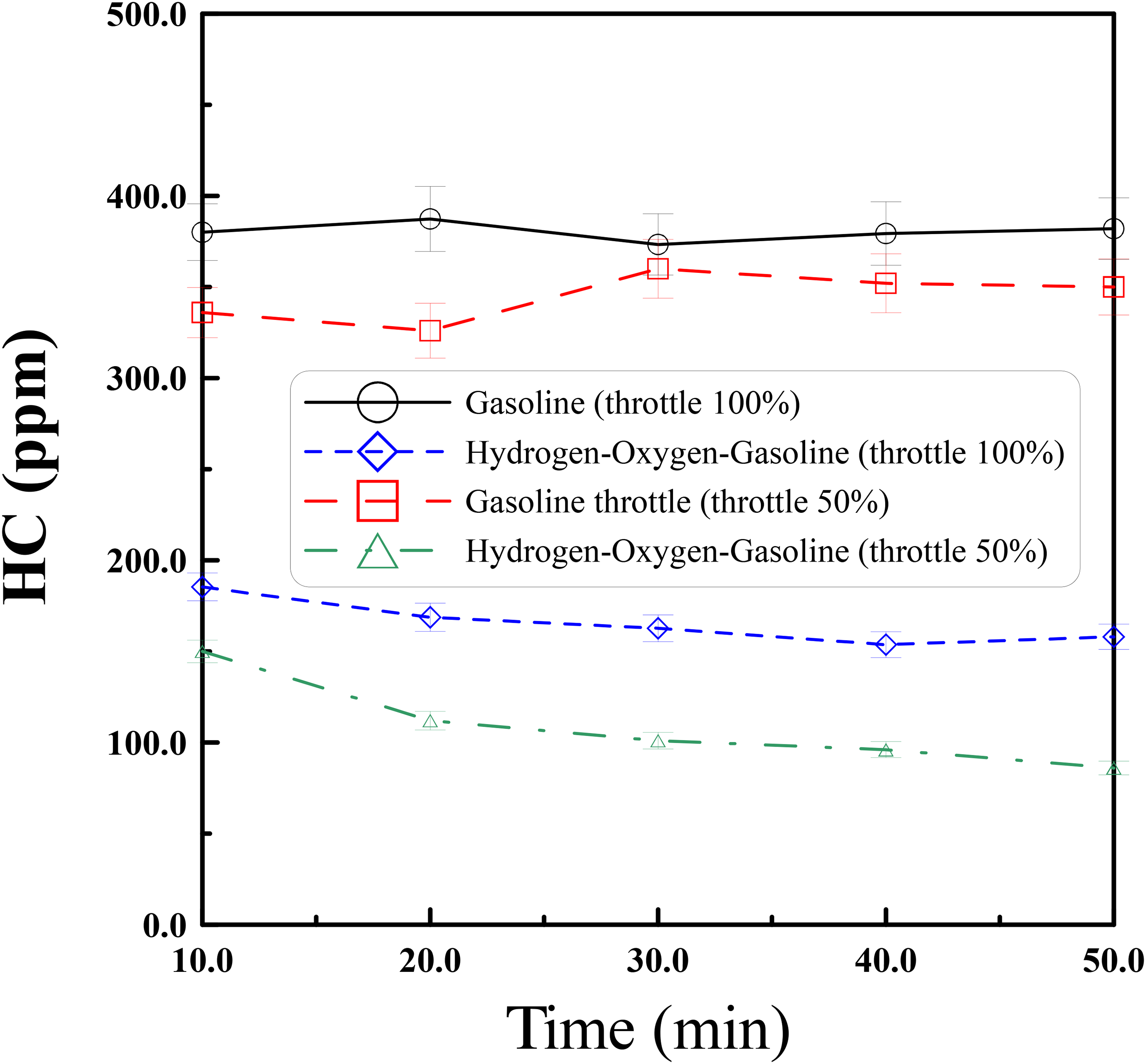
HC versus time using different fuels.
Figure 11 shows the relationship between the exhausted CO2 gas and the electric power generation time. The exhausted CO2 gas of a generator engine fuelled with compound fuel is 8.4% for 100% TP. The exhausted CO2 gas of a generator engine fuelled with gasoline fuel is 6.0% for 100% TP. The compound fuel can promote combustion efficiency. The exhausted CO2 gas is a product of complete combustion. Therefore, the exhausted CO2 gas increased. The exhausted CO2 gas of a generator engine fuelled with compound fuel is higher than that fuelled with gasoline fuel. The average increment of exhausted CO2 gas is 40.0%. The exhausted CO2 gas of a generator engine fuelled with compound fuel is 2.3% for 50% TP. The exhausted CO2 gas of a generator engine fuelled with gasoline fuel is 4.3% for 50% TP. The average increment of exhausted CO2 gas is 86.9% for 50% TP. The average increment of exhausted CO2 gas for 100% TP is smaller than the average increment of exhausted CO2 gas for 50% TP.
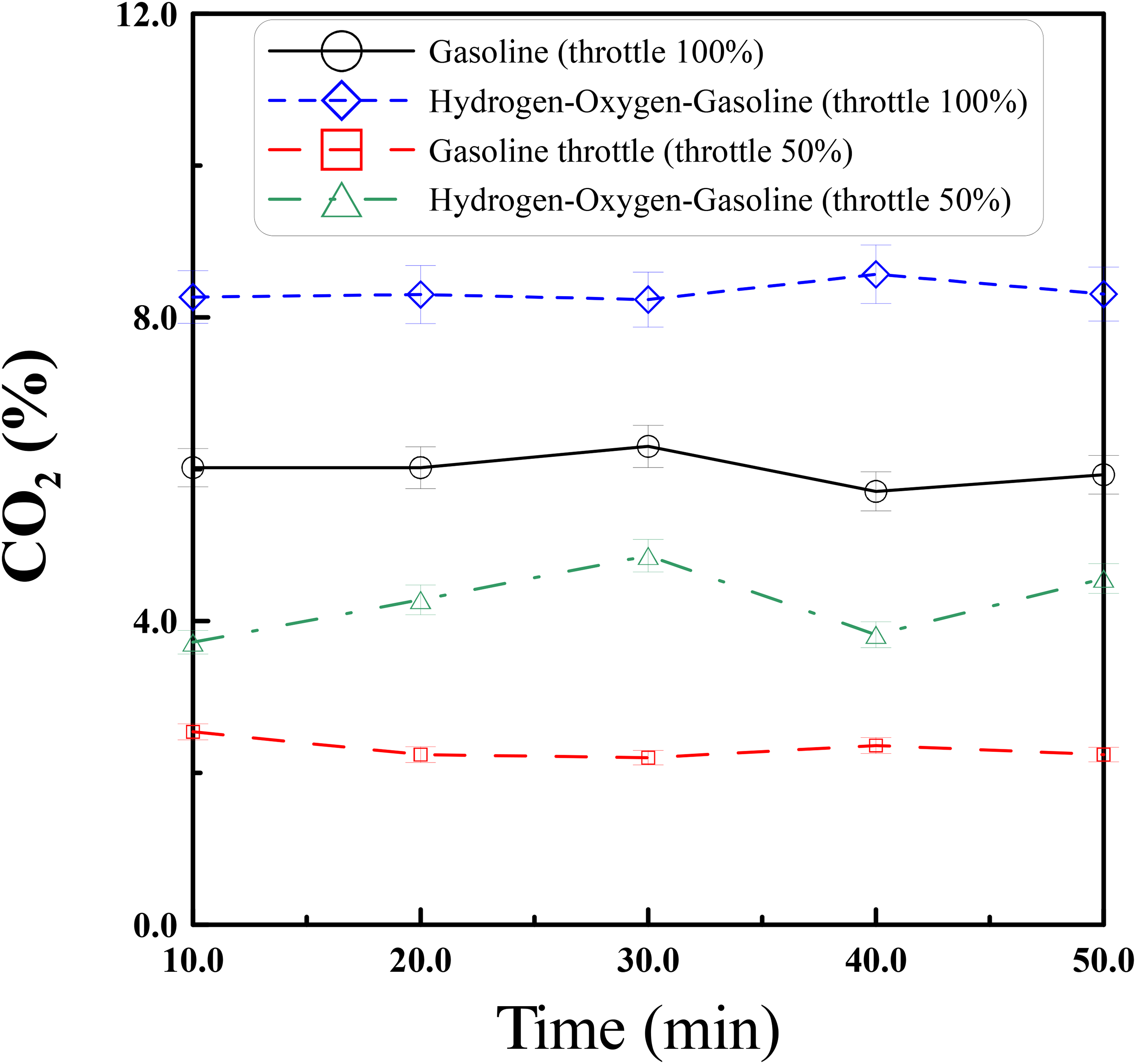
CO2 versus time using different fuels.
In this paper, H2 and O2 gases are produced from an electrolytic cell and then mixed with the intake gasoline and air. The compound fuel is sucked into generator engine combustion chamber. The H2 and O2 gases can be produced immediately without any storage device of H2. The experimental results can be summarized as follows:
The electric power generation time is improved using compound fuel. The average increment of electric power generation time is 39.76%. The Tplug is increased using compound fuel. The average increment of Tplug is 0.55% for 100% TP and 3.10% for 50% TP, respectively. The CO and HC gases are effectively reduced by using compound fuel. The average decrement of CO is 17.9% for 100% TP and 39.7% for 50% TP, respectively. The average decrement of CO gas increased with decreasing TP. The average decrement of HC is 56.3% for 100% TP and 68.4% for 50% TP, respectively. The average decrement of HC gas increases with decreasing TP. The CO2 gas is increased using compound fuel. The average increment of CO2 is 40.0% for 100% TP and 86.9% for 50% TP, respectively. The average increment of CO2 gas increases with decreasing TP.
Footnotes
Acknowledgments
The authors would like to express their appreciation to the Ministry of Science and Technology (MOST-107-2221-E-143-006) in Taiwan, R. O. C. for financial support.
Author Contributions
Li-Ming Chu was involved in experiment design and plan, experiments equipment setup, experimental data analysis and discussion and writing the paper.
Hsiang-Chen Hsu took part in conceptual design, theoretical derivation, data analysis and discussion, initial draft and revision.
Yong-Song Huang, Wei-Ya Su, and Jyun-Yao Hong conducted the experiment, was a part of data collection.
Shih-Han Wu was involved in equipment setup, data collection, figure plotting and discussion.
Declaration of conflicting interests
The authors declared no potential conflicts of interest with respect to the research, authorship and/or publication of this article.
Funding
The authors received no financial support for the research, authorship and/or publication of this article.
