



Abstract
Due to the high-quality development of the Chinese economy, the improvement of environmental efficiency in Chinese industries has become a significant task. Understanding the environmental efficiency of the logistics industry is essential for implementing effective environmental policies. This study aims to explore the impacts of economic growth, foreign direct investment (FDI), and innovation on the environmental efficiency of the logistics industry. In this paper, we apply the undesirable SBM model to calculate the environmental efficiency of the logistics industry and use the Tobit model to analyze the impacts of economic growth, foreign direct investment (FDI), and innovation on the environmental efficiency of the logistics industry in provinces along the Belt and Road in China from 2009 to 2018. Based on the results indicate the average environmental efficiency of the logistics industry in Chinese provinces along the Belt and Road is 0.7880, indicating that the environmental efficiency of the logistics industry was generally low in some regions along the belt and road. Innovation and FDI were found have a significant impact on the environmental efficiency, while economic growth fails to significantly impact on the environmental efficiency of the logistics industry in provinces along the Belt and Road. Therefore, we should encourage improvement of the level of environmental efficiency of the logistics industry. It is necessary to realize the co-ordinated development of the logistics industry and the environment through optimization of the development of innovation and transforming the FDI model in provinces along the Belt and Road.
Introduction
Over the past 20 years, many efforts have been made to assess environmental efficiency problems.1,2 With the development of the Chinese economy, large amounts of energy in many industries are inevitably consumed and the negative impact of energy consumption on the environment has become more and more obvious. Therefore, the energy crisis and environmental efficiency issues need to be solved with great urgency in China. 3 At present, it is well-known that the Chinese government has gradually become more and more concerned about environmental problems. They have formally proposed the five major development concepts of “co-ordination, green, innovation, openness, and sharing,” which have become a guide for high-quality development in various industries. However, the results of the Chinese government’s efforts on the environmental issues have not yet become significant. Therefore, it is clear that the Chinese government needs to put forth much greater efforts to improve industrial environmental efficiency.
Based on these conclusions, this paper selects the provinces along the Belt and Road as the research object, for the following reasons: Firstly, in response to the development of economic and trade globalization, the Belt and Road Initiative was initiated successively by the Chinese government in 2013, which was conducive to developing economic co-operative relationships with countries along the planned Belt and Road routes which share interests. Secondly, the definition of the Belt and Road has been issued according to the “Vision and Action for Promoting the Construction of the Silk Road Economic Belt and the 21st Century Maritime Silk Road” jointly issued by the China National Development and Reform Commission, the Ministry of Foreign Affairs, and the Ministry of Commerce in March 2015. The Chinese provinces that form part of the “21st Century maritime Silk Road” include Shanghai, Zhejiang, Fujian, Guangdong, and Hainan, while the “Silk Road Economic Belt” provinces include Shangxi, Gansu, Qinghai, Ningxia, Xinjiang, Guangxi, Chongqing, Sichuan, and Yunnan. Thirdly, the provinces along the Belt and Road cover more than 60% of the total land area in China, and the proportion of the GDP in this area is more than 40% of the whole country; furthermore, the area has rich resources and land transportation, and plays an essential role in promoting the environmental efficiency development in the logistics industry. Finally, most existing studies have focused on energy efficiency in China or in a single province, but research on energy efficiency in provinces along the Belt and Road is still lacking. Therefore, this study explore the environmental efficiency for an logistics enterprise, or a region from an environmental perspective and provides references for government decision makers to formulate environmental policies to delay the trend of environmental degradation it is of significance to explore the level of environmental efficiency in the logistics industry in provinces along the Belt and Road.
This study aims to explore the impacts of economic growth, foreign direct investment (FDI), and innovation on the environmental efficiency of the logistics industry in provinces along the Belt and Road. It is clear that the Chinese logistics industry is a major energy consumer, the energy consumption of which was second only to that of the manufacturing industry in 2014, consuming 315,247,100 tons of standard coal and accounting for 8.7% of the country’s total energy consumption. 4 The environmental efficiency of the logistics industry plays an important role in implementing high-quality development. However, an important question therefore must be asked: how can we improve the environmental efficiency of the logistics industry in provinces along the Belt and Road? It is necessary to evaluate and explore the effects of economic growth, FDI, and innovation on the environmental efficiency of the logistics industry in provinces along the route accurately and objectively, in order to judge their environmental quality. On the basis of improving the environmental efficiency of the logistics industry, it is necessary to strengthen the construction of its environment in provinces along the Belt and Road, in order to realize the co-ordinated development of the logistics industry, resources, and the environment. Therefore, in this context, it is of great practical significance to understand the environmental efficiency of the logistics industry in provinces along the Belt and Road.
The rest of this paper is structured as follows: Section 2 presents a literature review, summarizing existing methods and indicators in the literature. Section 3 introduces the research hypotheses of the environmental efficiency of the logistics industry. In Section 4, details of the environmental efficiency calculation methods and data sources are given. Section 5 measures the environmental efficiency of the logistics industry in provinces along the Belt and Road. In Section 6, an analysis of the effect of economic growth, FDI, and innovation on the environmental efficiency of the logistics industry in provinces along the Belt and Road is presented. Finally, Sections 7 and 8 offer the discussion and conclusions, respectively.
Literature review
Domestic and foreign scholars have used many different research methods and perspectives to discuss the environmental efficiencies of different industries. Research on the industrial environmental efficiency in the literature is divided into two areas: calculation of industrial environmental efficiency and influential factor analysis.
Research on industrial environmental efficiency
Industrial environmental efficiency has always been a hot issue in academic circles. In recent years, scholars have been increasingly studying the environmental efficiency of different industries, such as agricultural environmental efficiency, transportation environmental efficiency, and so on. This study reviewed the literature on the most relevant methods for estimating environmental efficiency, and then summarize certain analytical perspectives and techniques related to our research. Some examples from the existing literature are given in Table 1.
A summary of related studies on industry environmental efficiency.
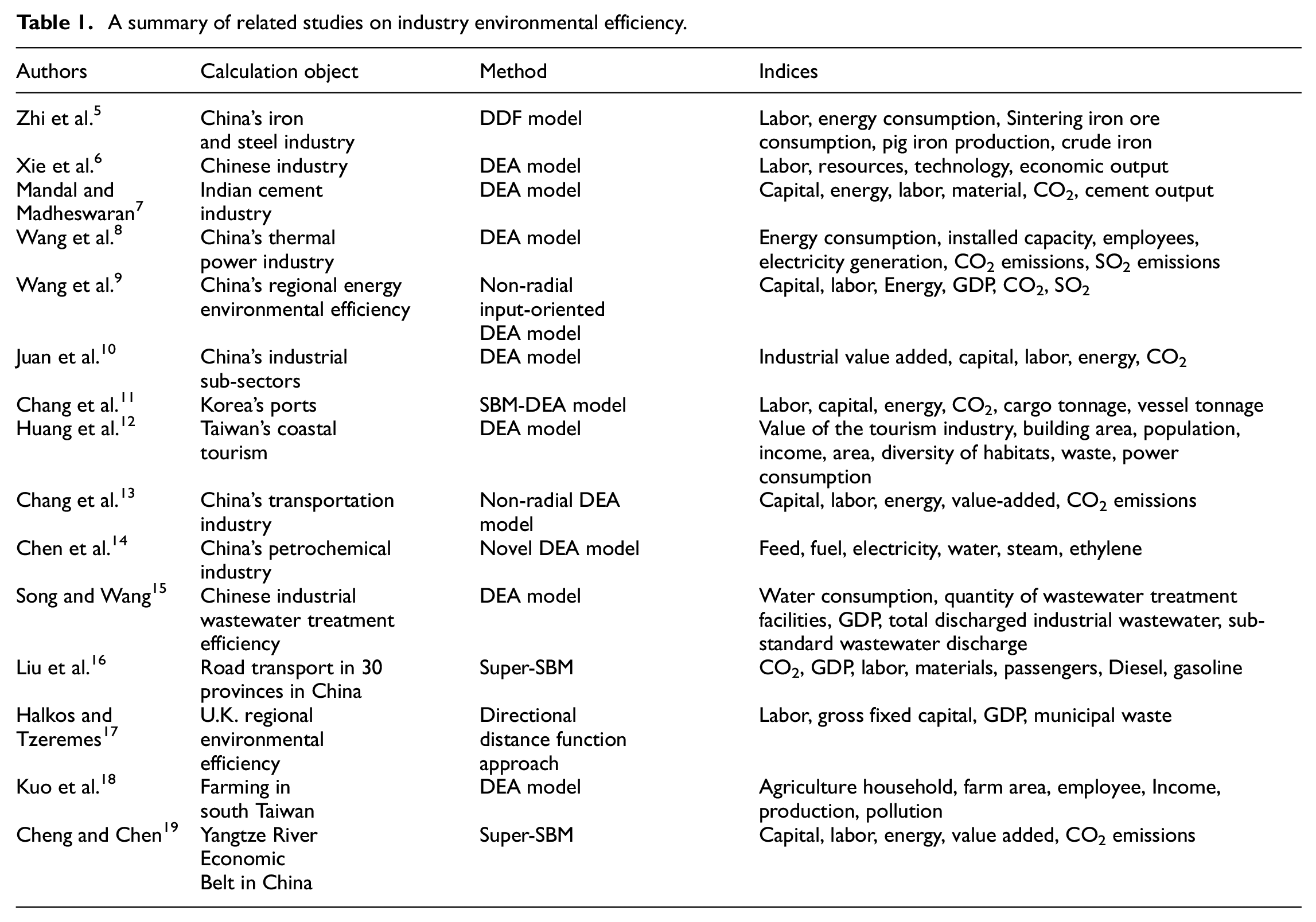
The above literature shows that there exist many methods to calculate industrial environmental efficiency, mostly based on the data envelope analysis (DEA) model.6–8,10,12,15 However, there is clear evidence that the actual production process may have undesirable outputs. It is difficult to calculate the undesired output with traditional DEA models, which is contrary to the original efficiency evaluation. Hence, Tone20,21 proposed a non-radial and non-oriented slacks-based measure (SBM) approach to solve this problem. The undesirable SBM model directly introduces slack variables into the objective function, which addresses the problems of undesirable outputs and relaxation at the same time. In addition, the undesirable SBM model can avoid the deviation of different radial and angle selections and is more effective than other models. Besides, the existing literature on the calculation of industrial environmental efficiency has failed to involve the study of environmental efficiency in the logistics industry. Therefore, in this study, we apply the undesirable SBM model to calculate the environmental efficiency of the logistics industry in Chinese provinces along the Belt and Road.
Research on influencing factors of industrial environmental efficiency
Although the above results are helpful in understanding the factors that affect the industrial environmental efficiency, there are some shortcomings. First, at present, the potential factors that affect the industrial environmental efficiency of the logistics industry in provinces along the Belt and Road are still unclear. Moreover, analyses of the relationships between economic growth, FDI, and innovation and the environmental efficiency of the logistics industry in provinces along the Belt and Road are still lacking. Given this, it is necessary to make up for the study gap of the above-mentioned relationships and to enrich the results of the environmental efficiency of the logistics industry in provinces along the Belt and Road (Table 2).
A summary of related studies on the influencing factors of industrial environmental efficiency.
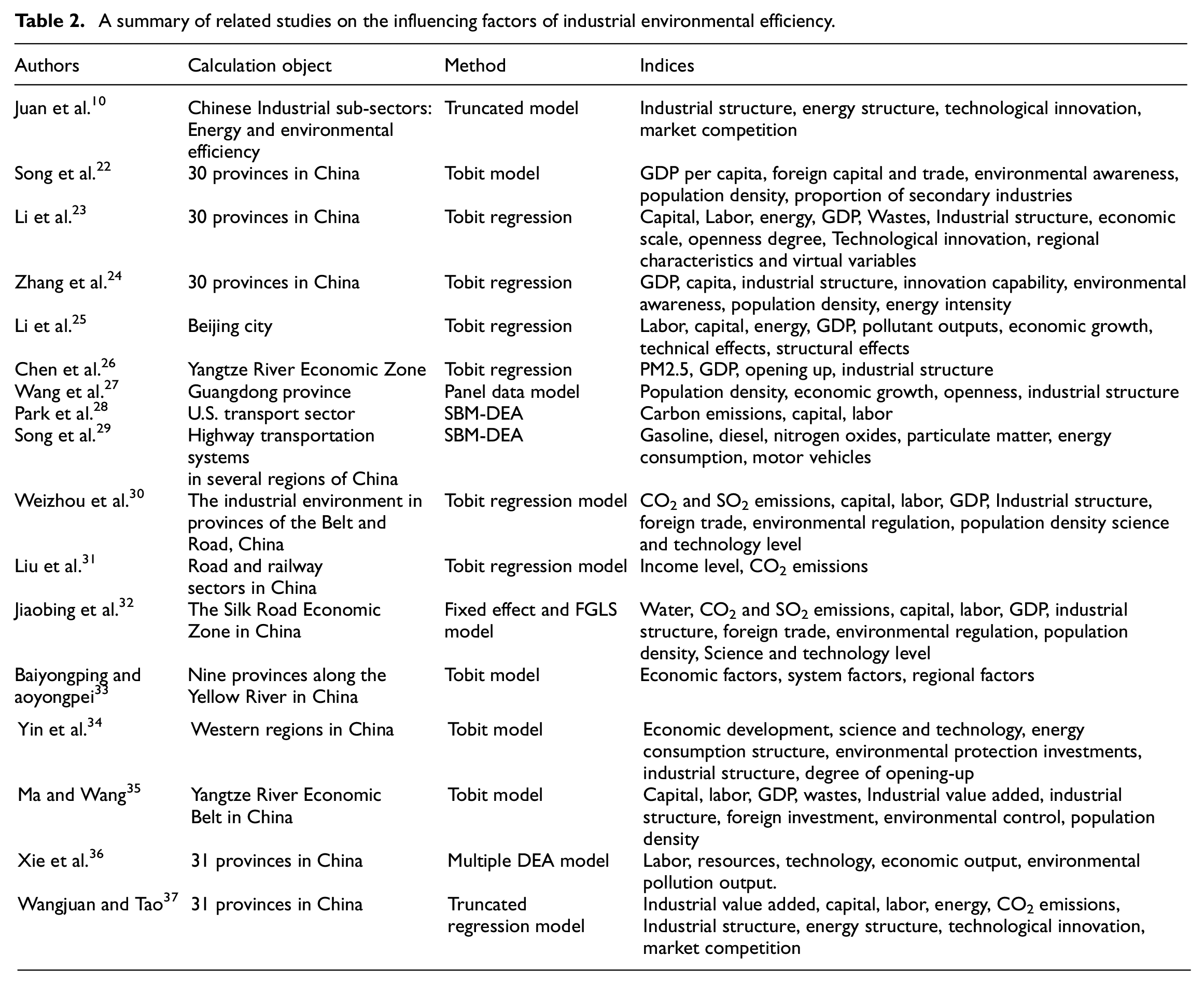
Based on the existing literature, there are several study highlights: First, the environmental efficiency of the logistics industry in provinces along the Belt and Road remains unclear at this stage; therefore, the undesirable SBM model is applied to calculate the environmental efficiency of the logistics industry, which is more effective than traditional DEA models. Second, based on the high-quality development aims of the Chinese economy and the five major development concepts of “co-ordination, green, innovation, openness, and sharing”, perspectives of the relationships between economic growth, FDI, innovation, and the environmental efficiency of the logistics industry in provinces along the Belt and Road are still lacking. Hence, this study applies the Tobit model to analyze the effects of economic growth, industrial structure, FDI, environmental regulation, and innovation on the environmental efficiency of the logistics industry. Third, the existing literature on the calculation of industrial environmental efficiencies has not studied the factors affecting the environmental efficiency of the logistics industry. This paper optimizes some variables. Thus, this research provides guidance for the co-ordinated development of the environmental efficiency of the logistics industry in provinces along the Belt and Road.
Research hypotheses
According to observed previous literature and China have formally proposed the five major development concepts of “co-ordination, green, innovation, openness, and sharing”, which have become a guide for high-quality development in various industries economic growth, Innovation, FDI, industrial structure, and environmental regulations may affect the environmental efficiency of the logistics industry.
Environmental efficiency and economic growth
The level of economic growth of a region represents the comprehensive strength of the commodity scale and may lead to more logistics market demand, which has impacts on the logistics environment. With the development of the Chinese logistics industry, income levels have raised and people have become more willing to support environmental protection measures. 38 When people have an awareness of environmental protection, those consuming logistics services will make environmentally friendly choices. In this context, logistics companies have been trying to launch green logistics service processes, in order to meet consumer needs for environmental friendliness. The environmental consciousness of people has a positive promotion function on the development of the logistics industry, which is not only advantageous to its environmental quality improvement, but also to its environmental efficiency enhancement. 39 Therefore, we propose the following research hypothesis:
Hypothesis 1 (H1). The higher the level of regional economic growth, the higher the environmental efficiency of the logistics industry.
Environmental efficiency and industrial structure
The environmental efficiency of the logistics industry differs greatly with the scale of the logistics industry and energy emissions. 40 Adjustment of the industrial structure proportion may cause a change of logistics environmental quality. This leads to a change in energy demand and consumption intensity in logistics, which has an influence on the development of both the logistics industry and the environment. Ma et al. 41 noted that the proportion of industrial structure has an important impact on the environmental efficiency of the logistics industry. From this point of view, a high proportion of secondary sectors in the industry leads to a likelihood of consuming more resources, which has a restraining effect on the environmental efficiency of the logistics industry. An empirical study also proved the above point of view. 42 It has been considered that the proportion of this industrial structure will inevitably affect the environmental efficiency of the logistics industry. 43 Therefore, we propose the following research hypothesis:
Hypothesis 2 (H2). The higher the proportion of secondary industries in the industrial structure, the lower the level of environmental efficiency of the logistics industry.
Environmental efficiency and innovation
Innovation is the source of development in the logistics industry. 44 Innovation mainly affects the environmental efficiency of the logistics industry from the following two views: Firstly, more advanced technology applied to vehicles can strongly reduce vehicle energy consumption, improving environmental efficiency. 45 For example, the application of new energy sources in vehicles can promote the development of the logistics industry and are a new way to upgrade logistics and improve its environmental efficiency. Secondly, Technological innovation can reduce carbon emissions, as well as promote energy conservation, the application of new energy sources, and reduce pollution, which all improve the environmental efficiency. 46 This can not only alleviate various resource constraints and environmental pressures, but also reduce waste emissions. Therefore, we propose the following research hypothesis:
Hypothesis 3 (H3). The stronger the innovation capabilities, the higher the environmental efficiency of the logistics industry.
Environmental efficiency and opening to the outside world
More openness to the outside world provides sufficient financial support for the development of the Chinese logistics industry. At the same time, it can also facilitate absorption of advanced logistics management methods, improving environmental efficiency. 47 Over the past decade, the proportion of FDI utilized by Chinese industries has steadily increased. 48 As a result, foreign direct investment has become one of the driving forces for the development of the Chinese logistics industry. Therefore, the following hypothesis is stated:
Hypothesis 4 (H4). The higher the level of opening up to the outside world economically, the higher the environmental efficiency of the logistics industry.
Environmental efficiency and environmental regulation
Reasonable environmental regulation may improve the environmental efficiency of the logistics industry by providing impetus for the sustainable development of the entire logistics industry. 49 Based on an Organization for Economic Co-operation and Development (OECD) study, 50 environmental policies are an important way to promote green development. From the point of view of preventing environmental pollution, environmental regulation is comprised of policies restricting economic activities, through a series of management means such as legal provisions and market guidance. 51 Some experts have suggested assisting the transformation and development of logistics enterprises by increasing capital investment and reducing taxes. 52 Such policies provide positive and negative standardizing effects on the behavior of the main body of the logistics industry and, at the same time, have an important impact on environmental quality. 53 From this perspective, the following hypothesis was formed:
Hypothesis 5 (H5). The more perfect the environmental regulation, the higher the environmental efficiency of the logistics industry.
Research method and data
The undesirable SBM model
The DEA model has been used by many scholars to evaluate environmental efficiencies.54–57 The DEA model, proposed by Tone, 58 is an efficiency evaluation method. This method evaluates the relative effectiveness of decision-making units (DMUs) through linear programming. Based on this, the DEA model evaluation method has become a relatively mature relative efficiency evaluation method. With the development of the logistics industry in China, more and more scholars have begun to incorporate the negative effects of the environmental efficiency of the logistics industry into the output index. During estimation of environmental efficiency of the logistics industry, multiple input (including capital investment, energy, labor ) and output indexes have to be included into the evaluation system, including the desired outputs(logistics industry value )and undesirable output (CO2 emissions). In the logistics industry, CO2 emissions were selected as undesirable output indicators. Thus, constructing an undesirable output-oriented SBM model, we were able to evaluate of the environmental efficiency of the logistics industry in provinces along the Belt and Road. The construction undesirable SBM model is introduced as follows:
Assuming that the logistics environmental efficiency decision-making unit DMU0 has M inputs and S outputs in provinces along the Belt and Road, the model is as follows (1):

where
Tobit model
The environmental efficiency value for the logistics industry, as measured by SBM model, is in the range from 0 to 1. If the regression estimate using the ordinary least squares (OLS) model is used to calculate the parameter of the environmental efficiency, then the estimation coefficient may be deviated and the data truncated. 59 Therefore, in this paper, we adopt the Tobit model to analyze the influencing factors of the environmental efficiency of the logistics industry in provinces along the Belt and Road:

Using the Tobit model in equation (3), we can find the expression of the factors influencing the environmental efficiency of the logistics industry in provinces along the Belt and Road:

where Xit indicates an interpretation variable that represents the value of the indicator affecting the environmental efficiency, Yit indicates the interpreted variable, βit indicates the regression coefficient, and μit indicates a random perturbation term. Therefore, we set up the Tobit regression model to analyze the related factors of the environmental efficiency of the logistics industry, which provides a useful toolkit for the development of the logistics industry in provinces along the Belt and Road.
Data sources
Based on the relevant literature, we select the calculation method for CO2 emissions presented in “the 2006 IPCC National Greenhouse Gas Inventory Guide lines” and calculate the data of environmental efficiency coefficients for the logistics industry in provinces along the Belt and Road. The original data comes from the “China Statistical Yearbook” and “China Energy Statistics Yearbook” from 2010 to 2019 in the corresponding years.60,61
Measurement of the environmental efficiency of the logistics industry
Variable selection
According to the relevant research literature,5–19 we selected input and output indicators for the environmental efficiency of the logistics industry in provinces along the Belt and Road. The indicators are defined as follows:
2. Capital investment
Capital investment is expressed as the “total fixed investment” in the logistics industry in provinces along the Belt and Road, where the actual value of the corresponding year is reduced by the fixed-asset investment price index.
3. Energy input
We select the total energy consumption of the logistics industry as the energy input in provinces along the Belt and Road. The energy consumption of the logistics industry is calculated using seven major energy consumption sources, and the energy consumption is converted into standard coal consumption.
4. Labor input
We select the “average number of years of employment” as a labor input index for the logistics industry in provinces along the One Belt and One Road routes.
5. CO2 emissions
In the logistics industry, CO2 emissions is an undesirable output. As China’s statistical agencies have not separately assessed the CO2 emissions of the logistics industry, they are calculated based on the energy consumption of the logistics industry. According to China’s energy statistical caliber, the sources of energy consumption in the logistics industry mainly include fossil energy, such as raw coal, crude oil, and natural gas.62–64 We use the IPCC National Greenhouse Gas Inventory to calculate the CO2 emissions of the logistics industry in provinces along the Belt and Road. 65
6. Logistics industry value
Logistics industry value is a desirable output. We select logistics industry output as the desirable output in provinces along the Belt and Road. Descriptive statistics of the environmental efficiency of the logistics industry are shown in Table 3.
Descriptive statistics of environmental efficiency of the logistics industry.

Results of the environmental efficiency of the logistics industry
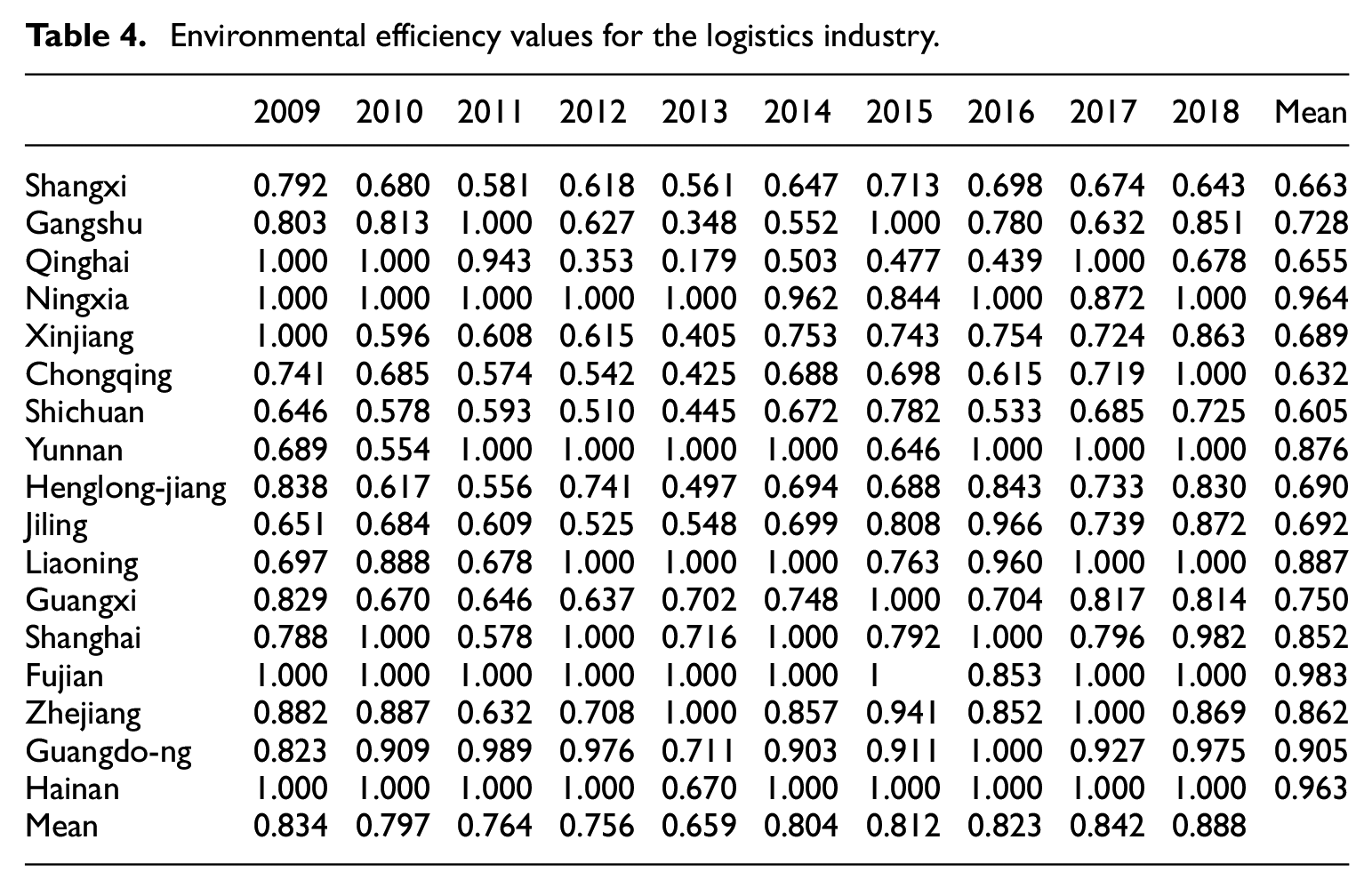
Based on the above-mentioned input/output indicators, we measure the environmental efficiency value of the logistics industry. The results are summarized in Table 4 and visualized in Figures 1 and 2.
Environmental efficiency values for the logistics industry.
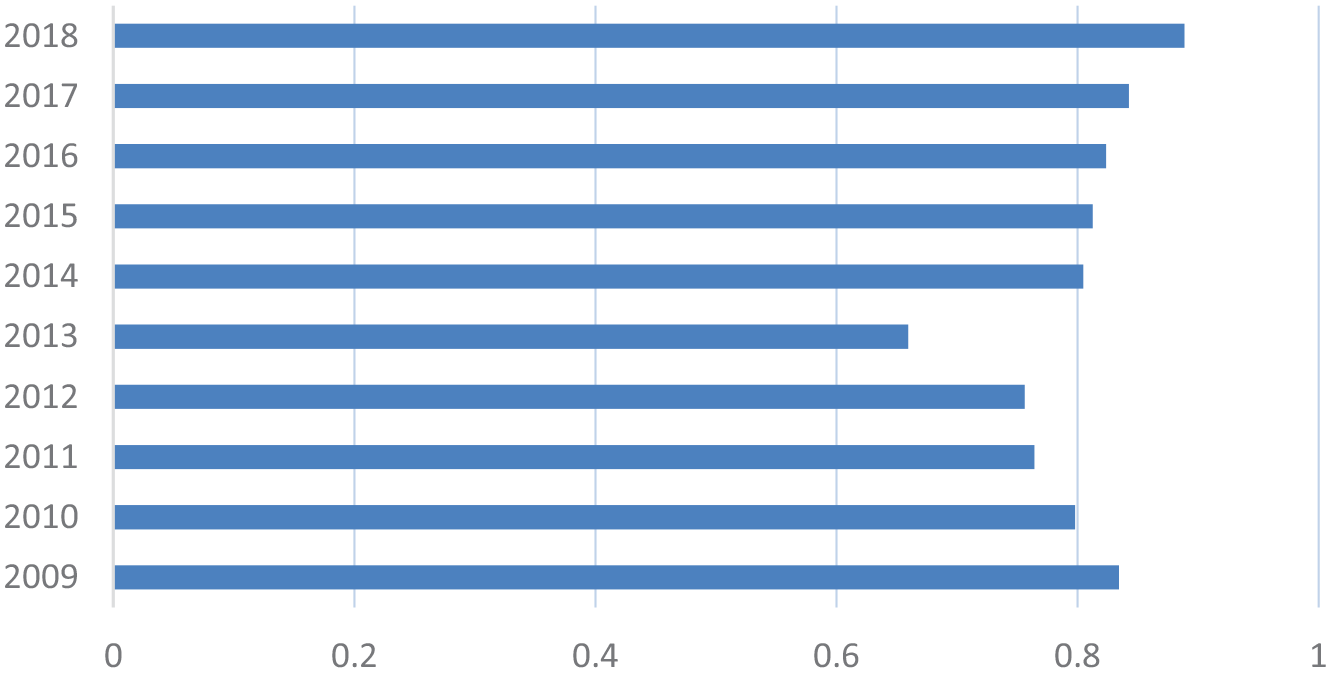
Mean environmental efficiency values for the logistics industry.

Mean environmental efficiency values for the logistics industry by province.
From Figure 1, it is easy to see that the environmental efficiency of the logistics industry in provinces along the Belt and Road showed a trend of first decreasing and then increasing slowly, with an overall u-shaped change from 2009 to 2018. From the results of Figure 2, it can be seen that the environmental efficiency of the logistics industry in each province along the Belt and Road fluctuated irregularly, indicating that there were great differences in the environmental efficiencies of provinces along the Belt and Road.
As can be seen from Table 4, the maximum value of the environmental efficiency of the logistics industry was 1.0 and the minimum value was 0.3487; therefore, the value of the environmental efficiency was between 0.3487 and 1.0 in provinces along the belt and road. Fujian, Hainan, and Ningxia were at the forefront of environmental efficiency, in terms of the logistics industry, over the past 10 years, which means that the environmental efficiency in these regions has been developing through co-ordination with each other. Jilin, Chongqing, and Fujian were at the forefront of environmental efficiency for many years, which shows that the logistics industry in these places was more co-ordinated and that the environmental costs of logistics growth were not high. Liaoning, Shangxi, Gansu, Qinghai, and Yunnan had low environmental efficiencies, demonstrating great potential for energy conservation and emissions reduction. Since 2009, Heilongjiang and Xinjiang have been separated from the effective frontier of environmental efficiency. In these provinces, the environmental efficiency of the logistics industry has continued to decline and, so, the co-ordination of development of the logistics industry and the environment has been in decline. Chongqing has been separated from the effective frontier of logistics technology since 2013. This may be due to the rapid growth of the logistics industry under the high-quality development of the Chinese economy, which has incurred more environmental costs. Shangxi had a high environmental efficiency, but with a changing trend, showing an inverted U-shaped curve with a turning point in 2013.
The results of Tobit regression
Variables selection
For research hypothesis 3, we analyzed the environmental efficiency of the logistics industry in provinces along the Belt and Road as the dependent variable and the factors affecting its environmental efficiency as the independent variable. Definitions of all variables and their associated explanations are listed in Table 5.
Definitions and explanations of variables.

Tobit regression model
In this study, the regression model for influencing factors is as follows:

where y*it represents the environmental efficiency of the logistics industry, RGDP represents the per capita GDP, FDI represents the opening level to the outside world, ZL represents innovation, IS represents the industrial structure, ER represents environmental regulations, βi represents the undetermined coefficients, εit represents a random error term which obeys a normal distribution; i = 1, 2, 3, …, N; and t is the time (t = 1, 2, …, T).
The results
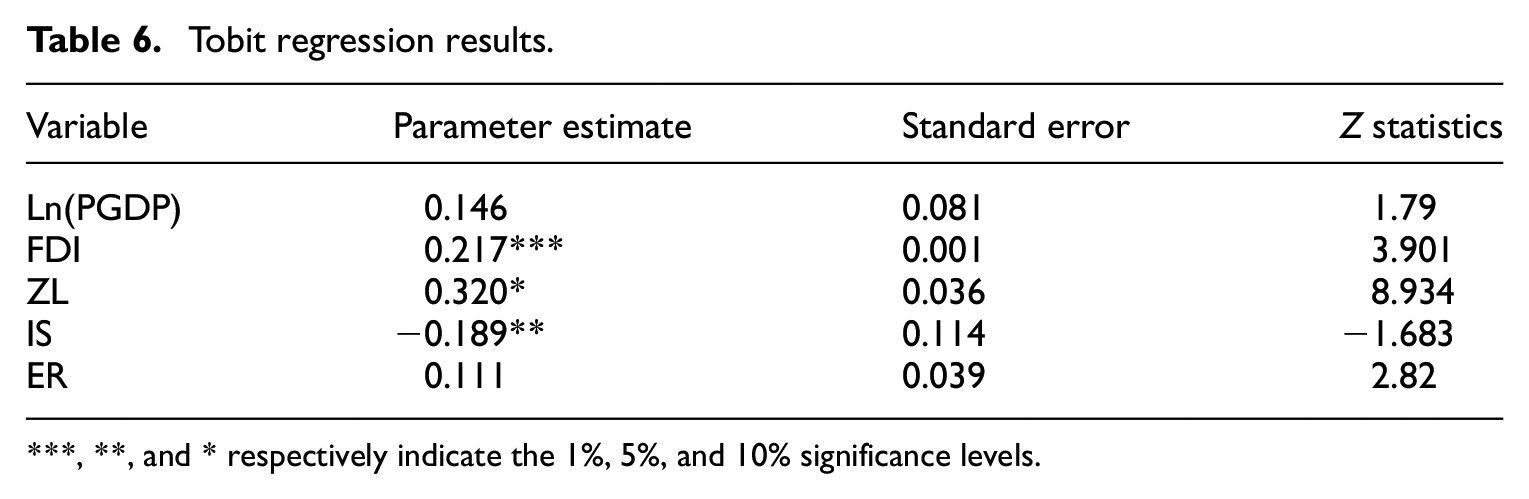
In this paper, the stata 15.0 software was used to evaluate the effects of different factors on the environmental efficiency of the logistics industry in provinces along the Belt and Road. The estimated results are shown in Table 6. All test results confirm that the Tobit models performed reasonably for our purposes. Furthermore, the results of the Hausman test also show that the fixed-effect Tobit model is valid.
Tobit regression results.
***, **, and * respectively indicate the 1%, 5%, and 10% significance levels.
Table 6 shows that the coefficients of the variables FDI, ZL and IS were significant. and, thus, had an effect on the environmental efficiency of the logistics industry. The coefficients of the ln(PGDP) and ER were insignificant. indicating that they had no impact on the environmental efficiency of the logistics industry in provinces along the belt and road. Based on the empirical results, the following conclusions can be drawn:
There was a correlation between the level of development of the logistics industry and its environmental efficiency. the regression results were not significant. The results showed that there was no obvious correlation between PGDP and environmental efficiency.
The results showed that the correlation coefficient between foreign direct investment (FDI) and the environmental efficiency of the logistics industry was 0.217, which was significant at 0.01 level. Thus, foreign direct investment in provinces along the Belt and Road can promote the improvement of the environmental efficiency of the logistics industry.
In the regression analysis, the ZL parameter estimate was 0.320, which was significant at 0.1 level. Thus, the results indicate that innovation is positively correlated with the environmental efficiency of the logistics industry, indicating that the improvement of innovation capability has a positive impact on the environmental efficiency of the logistics industry.
The regression result of the industrial structure parameter was -0.189, which was significant at 0.05 level. The industrial structure was, therefore, negatively correlated with the environmental efficiency of the logistics industry in provinces along the belt and road.
The results show that environmental regulation had no effect on the environmental efficiency; that is, the pollution control investment characterized by environmental regulation had no effect on the environmental efficiency of the logistics industry in provinces along the Belt and Road.
Discussions
Based on the above empirical results, some interesting phenomena can be noted.
Firstly, the above research shows that the average value of the environmental efficiency was 0.7880, indicating that the environmental efficiency of the logistics industry is generally low in some regions along the Belt and Road. These results are in agreement with the research conclusions of Song et al. 22 and Jiaobing. 32 This may be due to the relatively weak economic base and limited environmental governance capacity in provinces along the Belt and Road. Although the implementation of strategies for the high-quality development of the Chinese economy has stimulated the development of the logistics industry in these regions, the development of the logistics industry has not brought about an improvement in the environment. Therefore, under the high-quality development of the Chinese economy, improving the environmental efficiency of the logistics industry is still a challenge in some provinces along the Belt and Road. Therefore, relevant government departments need to make great efforts to solve the problem of co-ordinated development of the logistics industry and the environment.
Secondly, we obtained the impacts of five variables on the environmental efficiency of the logistics industry in provinces along the Belt and Road. In terms of economic growth, the regression results showed that there was no correlation between PGDP and the environmental efficiency. This finding is consistent with the literature,30,67 and indicates that the value of the logistics industry value may only be a small proportion of the total economic scale in provinces along the Belt and Road, meaning that there is no direct relationship between the environmental efficiency of the logistics industry and PGDP. In contrast, FDI had a positive impact on the environmental efficiency of the logistics industry in provinces along the Belt and Road. This research result is consistent with many other papers in the literature.26,32,35 China’s Belt and Road Initiative involves opening up more to the outside world and, so, many logistics companies have been attracted from all over the world to participate in the logistics industry in Chinese provinces along the Belt and Road. Therefore, the degree of FDI has enhanced the environmental efficiency of the logistics industry in provinces along the Belt and Road.
Similarly, the empirical results showed that innovation had a positive impact on the environmental efficiency of the logistics industry in provinces along the Belt and Road, which is an important driving force for improving environmental efficiency. The results of this paper are consistent with the related theories of logistics.10,24,66 As is well-known, the logistics industry is a large energy consumer, consuming a large amount of energy sources such as gasoline. From this perspective, the current secondary sector of the economy has a higher proportion of demand for logistics in provinces along the Belt and Road, which restricts the improvement of the environmental efficiency of the logistics industry.
The control variables of environmental regulation and industrial structure in the Tobit model are the empirical information. First, considering the impact of industrial structure on the environmental efficiency of the logistics industry, we can see that the industrial structure was negatively correlated with the its environmental efficiency in provinces along the Belt and Road. The above results are inconsistent with previously reported empirical results. 30 An increasing share of the secondary sector in the economy reduces the level of environmental efficiency of the logistics industry, which may be due to an increased demand for logistics as a result of the rapid growth of secondary sectors of the economy in provinces along the belt and road. In addition, environmental regulation had no effect on the environmental efficiency of the logistics industry. This result is consistent with the literature. 67 Hence, there was no direct relationship between the environmental efficiency of the logistics industry and environmental regulations in provinces along the Belt and Road.
Conclusions
Based on the above empirical results and discussions, this paper may draw the following main conclusions and recommendations, and point out the lack of research and research prospects.
Based on panel data in provinces along the Belt and Road from 2009 to 2018, we calculated the environmental efficiency of the logistics industry using the undesirable SBM model. Furthermore, we used the Tobit model to analyze the impacts of economic growth, FDI, and Innovation on the environmental efficiency of the logistics industry in provinces along the Belt and Road. The results showed that the average value of environmental efficiency was 0.7880, indicating that the environmental efficiency of the logistics industry was generally low in some regions along the belt and road.
At the same time, the regression parameter of ln(PGDP) was 0.146, but the factor did not significant; that is, economic growth failed to have a significant impact on the environmental efficiency of the logistics industry. The correlation coefficient between foreign direct investment and environmental efficiency was 0.217, therefore, the level of FDI positively impacted on the environmental efficiency of the logistics industry in provinces along the Belt and Road. The regression parameter of ZL was 0.320, which indicates that stronger innovation capabilities improved the environmental efficiency of the logistics industry. Therefore, it was confirmed that the environmental efficiency of the logistics industry may be improved vast room in provinces along the belt and road.
Based on the above conclusions, in the context of strategies for the high-quality development of the Chinese economy and the high energy consumption and environmental pressures in provinces along the Belt and Road, the following policies are recommended:
We believe that the local governments of provinces along the Belt and Road need to adjust the transformation of the logistics industry model to the issue of rational investment and effective allocation of energy resources. It is important to optimize the industrial structure, in order to improve the environmental efficiency of the logistics industry, to develop regional science and technology, and to transform the FDI model. This approach provides support to the existing concepts of environmental efficiency, with an empirical standing to formulate more effective measures and promote the environmental efficiency of the logistics industry in provinces along the Belt and Road (as well as other regions).
The environmental efficiency of the logistics industry is of great significance in the revitalization of the logistics industry, playing an important guiding role in promoting development in provinces along the Belt and Road. Therefore, in the context of the strategies for the high-quality development of the Chinese economy, we should encourage improvement of the level of environmental efficiency of the logistics industry in China.
Energy-saving measures in logistics enterprises have been lagging behind and the situation is grim. This needs to be brought to the attention of stakeholders and requires the Chinese central and provincial governments to actively take a series of measures to change this situation in provinces along the Belt and Road. It is necessary to realize the co-ordinated development of the logistics industry and the environment through optimization of the development of innovation and transforming the FDI model in provinces along the Belt and Road.
Thus, this research provides guidance for the co-ordinated development of the environmental efficiency of the logistics industry in provinces along the Belt and Road.
While this study provides insights, the research has also limitations. Firstly, the more research is needed to confirm our findings. Secondly, this paper only research of the logistics industry’s to study the impact of economic growth, FDI, and innovation on environmental efficiency in provinces along the Belt and Road. The future studies may also consider logistics industry subsectors in China or elsewhere to compare existing research findings. This research is conducted in the context of China, and the future study may is extended to other regional contexts.
Footnotes
Author Contributions
Mingde Guo contributed to the conception and design. Hong Li contributed to the computation. Wen Lin revised the manuscript. All of the authors drafted and revised the manuscript and approved its final publication.
Declaration of conflicting interests
The author(s) declared no potential conflicts of interest with respect to the research, authorship, and/or publication of this article.
Funding
The author(s) disclosed receipt of the following financial support for the research, authorship, and/or publication of this article: This research has been supported by “National natural science foundation of China, No:71562033 .
