



Abstract
The environmental scientist has been playing an important role in preventing and mitigating environmental pollution. Individuals’ images of the environmental scientist will likely impact and meditate their interest and attitudes toward environmental science as well as their willingness to take up an environmental science profession. However, prior studies focusing on the image of a professional are primarily of the general scientist. The environmental scientist and the image thereof remains out of the limelight of environmental science community and has been under-researched. In this article, on the basis of the retrospect on the stereotypical images of the general and environmental scientist and the gaps in previous studies, we attempted to report young individuals’ images of the environmental scientist in an alternative context. Drawing technique was employed and administered to 127 junior students aged from 13 to 15 year-old from a junior high school. The individuals’ image of environmental scientists can be generally abstracted as a male with environmental protection knowledge and commitment to environmental protection who does work more like a green chemist, ecology restorer, or plant protector and observes or cleans outdoors, primarily in forest, jungle, and/or by riverside.
Introduction
Global environmental problems have been becoming more acute as a consequence of the insatiable exploitation of natural resources, the uncontrolled sprawling of urbanization as well as the unrestrained discharge of pollutants from production and consumption. The resultantly deteriorated and polluted environment, especially air and water pollution, poses a serious threat to the health of human beings.1,2 Multiple measures are entailed to tackle the escalating environmental deterioration and to address the growing environmental concerns. One of the measures is to foster environmental scientists whose work in some part involves the prevention and mitigation of environmental problems. However, the shortage occupations lists in some countries indicate that there is a lack of environmental scientists.3–5 Although various factors can contribute to the supply shortage of environmental scientists, one factor is likely associated with individuals’ images of environmental scientists which can influence their option for an environmental science profession as prior studies suggest that stereotypical images about a professional play an important role in impacting individuals’ interest and attitudes toward learning professional skills and study of that profession.6–8 Improper or negative images, if unfortunately formed in early years, will translate into impairment and detrimental enactment in future engagement in related careers.9–11 In that case, individuals will improbably consider environmental science-related careers. As a result, the sustainable supply of human resource with environmental knowledge and skills will dry up and ultimately the development of environmental science community will be hampered in the long run.
The environmental science community largely focuses on the study of various finely divided and specialized fields of environmental science. Research into the image of the environmental scientist is not abundant. As such, there is a need for knowing the images of environmental scientist that individuals possess. The present study endeavors to unfold individuals’ image of the environmental scientist with the hope to inform environmental science community. Specifically, the purpose of this study is to seek to answer the following questions: (1) what is the general image that young individuals hold of environmental scientists? (2) what are the similarities and dissimilarities between the present and past studies? (3) what are the problems relating to their image and their implications?
Previous images and gaps
Previously, the majority of studies focusing on the image of a professional are primarily of the general scientist.12–20 The seminal study by Mead and Metraux showed that the scientist was seen as an elderly or middle aged male with facial hair and eyeglasses in a white coat, working alone in a lab and surrounded by various equipment. 21 This image was more or less echoed in later studies.18,22,23 A limited number of studies had been conducted on the image of the environmental scientist.24–26 Carter et al. 24 investigated pre-service teachers’ images of the environmental scientist, finding that the environmental scientist is characteristically portrayed as purely collecting data outdoors. The study participants hardly perceived process skills such as analyzing, interpreting, and making generalizations. Thomas and Hairston 25 researched students’ images of the environmental scientist in the United States and found that the environmental scientist was perceived as a mosaic figure having features of the general scientist as well as emerging characteristics denoting the specific work that the environmental scientist involves in. Their images of the environmental scientist are somewhat discrepant with the image of a white male scientist as early studies suggest. Another study on Turkish students’ images of the environmental scientist revealed that the environmental scientist was described as persons engaging in research, observations, data collection, and experiments relating to environmental issues. 26 The images are arguably the cumulative result of the cultural and educational factors which impact individuals’ images through school teaching, textbooks, media, learning experiences, and prior understandings.17,25,27 The socioeconomic level can also factor in individuals’ images of the scientist. For instance, individuals in industrialized countries tended to perceive negative or unfavorable images 28 such as weirdness and eccentricity,29,30 whilst those in undeveloped countries were more likely to have positive perceptions like being heroic and intelligent.31–33
Prior studies devoted to the image of the environmental scientist were mainly conducted in the western or developed contexts; there is a dearth of studies reporting teenage individuals’ images of the environmental scientist in an alternative context. It is believed that the results from this study will be useful for environmental science community to take preventive measures against individuals’ misperceptions so as to entice individuals’ interest in environment science and related careers.
Methods
Participants
The participants in the present study were composed of 78 female and 49 male junior student individuals aged 13 to 15 years old from a Chinese junior high school. Convenience sampling strategy was adopted because access to these participants was available. With the consent of the school directors, the student individuals of three whole classes attending the first, second, and third grade of the junior high schools were invited without discriminating academic performance or other variables. In the context, students show their respect to teachers by submission and obedience to what teachers tell. 34 The teenage students were willing to participate after being briefed by their teachers. The environmental knowledge learned by the participants was scattered in various courses. In exchanging with the teachers, it was learned that the participants’ familiarity with real environmental scientists was limited because they had never visited or been visited in person by a real environmental scientist.
Drawing instrument
Drawing technique is widely employed to extract individuals’ images of a professional because of its less demand on reading and writing skills.32,35–37 Chambers’ 12 Draw-A-Scientist Test (DAST) is arguably the most popular drawing tool to assess individuals’ mental images of scientists. The drawn figures are evaluated in terms of a few indicators, that is, laboratory coat, spectacles, facial hair, research symbols (e.g. equipment and instrument), knowledge symbols (e.g. books), technology product (e.g. computers). 12 The drawing approach can be employed not only to assess the images of scientists, but also to investigate images of other professionals. Some previous studies have proved the approach valid in studying the images of other specialists and technologists.37,38 In this study, we followed Chambers’ approach and designed a Draw the Environmental Scientist Test (DET) which requests the student individuals to render their mental images of the environmental scientist by drawing. The drawings of the environmental scientist would be evaluated by the following indicators: research symbol, knowledge symbol, technological product symbol. For more information, some additional elements were also included, namely: gender, work setting, activity, type, and attribute. Open-ended questions were attached to allow the student individuals to freely describe and supplement extra information of their images of the environmental scientist in written form so that they would not be limited by the drawing technique.
Administration
The instrument of DET was administered to the student individuals after class in the school. They were told that what they had drawn would be confidential. There were no right or wrong for what they had drew and responded. And they could express, write and draw freely. To avoid possible ambiguity, they were also requested to complete the attached questions about certain indicators and elements and to express any additional opinion about the environmental scientist in the blank if necessary. No timeframe for completing the DET was predetermined. In the collecting stage in the school, it was found that some returned test papers were left blank or partially completed. After removing those unfinished DET papers, we obtained a total of 127 relatively well-completed DET.
Drawings analysis
The authors worked together to carry out a pilot study for building a coding system in terms of the indicators and elements. The recognizable descriptors or items of the indicators or elements in all the drawings were thoroughly examined, classified, and noted down. Multiple examples of descriptor or item would be counted only once. For example, if a drawing contains more than one book (descriptor), only one count would be awarded to the knowledge symbol. If a descriptor, though absent in a drawing, could be identified in the written responses in the drawings, it would also be recorded. Some elements, for example attribute, were identified, extracted, and sorted largely on the basis of the written responses. The authors listed the individual descriptors or items under the respective indicators or elements in a table and calculated the number and frequency of them. Each of the authors performed this analysis process separately to ensure accuracy and reliability of our analysis. If inconsistency occurred, we would re-examine the drawings in question until the inter–rater reliability exceeded 90%. In general, a high appearance of descriptor or item of indicators and elements in the drawings constitutes a typical image of the environmental scientist.
Results
Research, knowledge, and technology product
The instruments of testing tubes, balance, microscope, breaker, graduated cylinder, curved tube were presented in 15.7% of their drawings as the research symbol. About 16.5% and 18.9% of their depictions presented the technology product symbol and the knowledge symbol respectively. The indicators of the research symbol, knowledge symbol, and technology product are all very lower in frequency than those found in previous studies,25,26,32 suggesting their images are less related to lab research activities and less knowledgeable of environmental science technology.
Gender
The junior individuals are more prone to perceive the sex of the environmental scientist same with their own. Male individuals tended to draw more male than female environmental scientists (36.2% vs 2.4%), while female individuals inclined to depict more female than male ones (37.0% vs 25.2%). This resonates well with the previous study. 39 Overall, the drawn male environmental scientists outnumber the female ones by wide margin (61% vs 39%), suggesting the image of the environmental scientist is gendered. This fits in with previous studies.25,26,30,32,40 Such a masculine stereotype of the environmental scientist may dismiss female individuals’ intention for an environment-related career.
Work setting
As shown in Table 1, fewer indoor than outdoor settings were imaged. Most of the work settings are various outdoors. This is dissimilar to the dominant indoor lab setting found in Mead and Metraux’s 21 study, suggesting the work of the environmental scientist is more outdoor field-related. In general, the junior individuals are more likely to perceive the environmental scientist’s work as going outdoor than studying indoor.
Work settings (%).

Activities
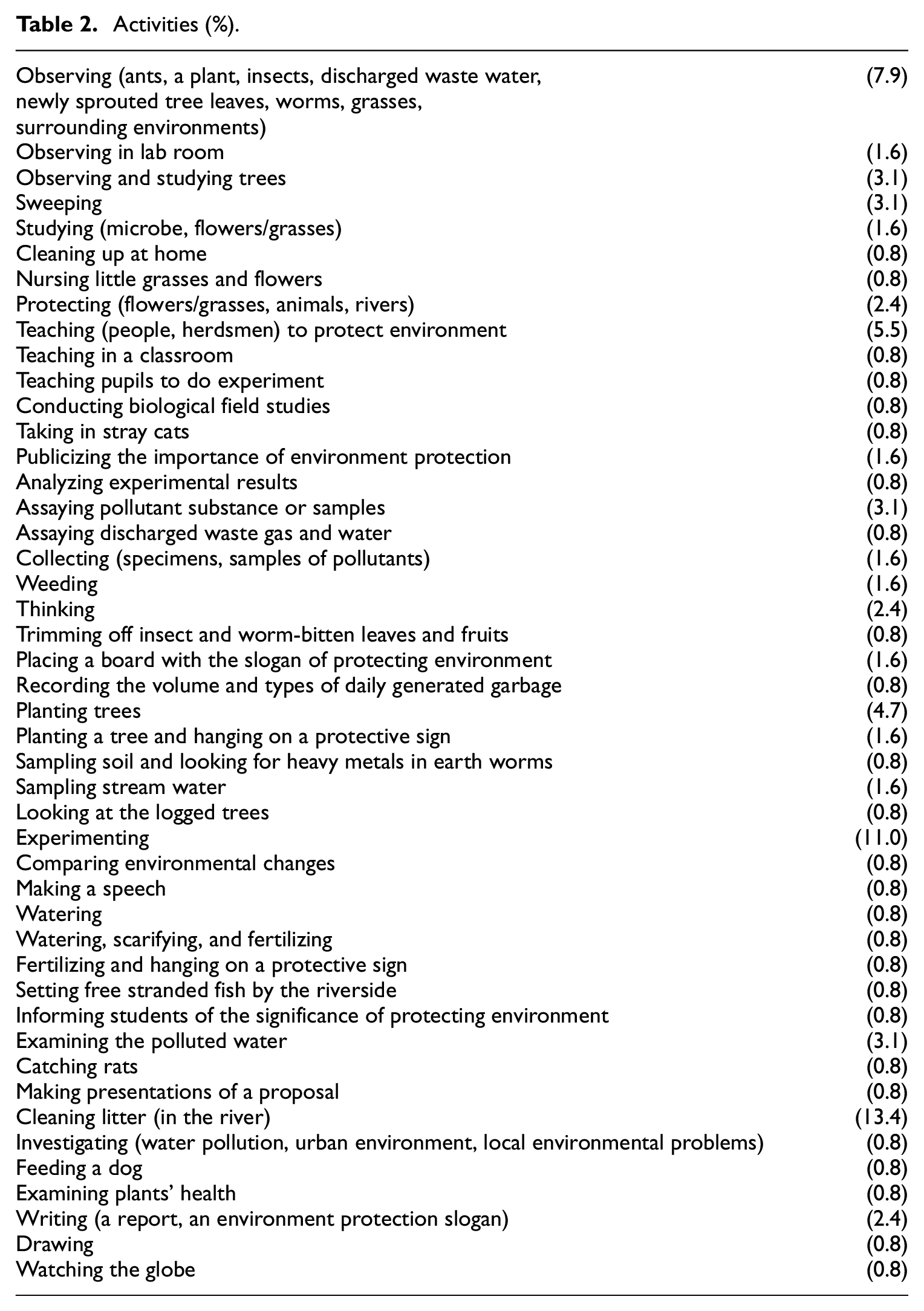
Different from the previous similar study, 25 the activities of “observing,”“experimenting” and “cleaning” tend to be imaged in the light of the percentages in Table 2. According to the depictions and written descriptions, observing activity denotes the nature of work involves monitoring environmental changes through watching insects, water, vegetation, and etc (Figure 1). Cleaning activity relates to taking actions to keep environment better by foresting or removing pollutants. Experimenting activity is more associated with environmental research. Overall, the activities are diverse, but the junior individuals are more likely to connect the environmental scientist’s work with monitoring environment, improving environment, and researching environment. According to prior studies,41–45 environmental problems can be classified into traditional pollution, natural disasters, human-induced disasters, human activities-induced ecological systems degradation, resource shortage, and global environmental issues. From the depicted and described activities, the individuals are more likely to perceive the traditional pollution and ecological degradation.
Activities (%).

A saddened environmental scientist is observing pollution by the riverside.
Environmental scientist type
The images on the kind of the environmental scientist are various and tend to include more images of green chemist, ecology restorer, plant protector, and conservationist (Table 3). Some images are immediate and simple. For example, a sweeper or a sanitary worker was seen as an environmental scientist, suggesting the individuals’ images are linked with their understanding of how the work of those encountered persons in daily contexts could be immediately translated as environment-related.
Type (%).

Distinct attribute
Distinct attribute helps assess whether the environmental scientist was perceived to possess stand-out qualities or characteristics. Prior studies indicates that scientists can be perceived as having less favorable attributes such as ineptness, eccentricity, and anti-sociality.30,46 However, the present study shows that there are no negative attributes attached to the environmental scientist. As shown in Table 4, the articulated attributes are sundry, but the junior individuals tend to describe the distinct attributes as knowledgeable of environmental or the Earth protection and the dedicative to protecting the environment and the Earth, suggesting that the professional knowledge and zeal for environmental protection tend to distinguish the environmental scientist from other professionals. Notably, a few descriptions of no distinct attributes (15.7%) may be indicative of neither positiveness nor negativeness, probably suggesting a dearth of knowledge regarding the environmental scientist.
Distinct attribute (%).

Discussion
The work of the environmental scientist entails both indoor and field-related aspects, even though the proper proportion of both aspects is difficult to quantify. From many outdoor settings in their pictorial representations, it can be inferred that indoor work is less likely to be perceived. This finding is similar to the images revealed in the study by Carter et al., 24 but inconsistent with the results in the study by Dikmenli et al. 26 which shows more indoor work. The present study suggests that the teenage individuals’ perceptions regarding the work of environmental scientists are outdoor-biased.
The experimental instruments or equipment often suggest the theoretical or experimental aspect. 30 In this study, the research and knowledge symbols are minor and mainly represented as experimental instruments or equipment, suggesting the theoretical, or experimental aspect is less likely to be perceived. This disaccords with Thomas and Hairston’s 25 study in which research and knowledge symbols are relatively prevalent. In this study, the instruments and apparatuses in their pictorial representations were mostly conventional and traditional, for example binocular telescope, denoting the individuals are not well informed about the modern and advanced technology employed in environmental science.
A majority of the drawn environmental scientists are male, suggesting their gendered stereotypes of the environmental scientist. This finding agrees with the study by Dikmenli et al. 26 which also demonstrated a male dominant image of environmental scientists. The masculine image may mislead young individuals into the perception that environment science-related occupation is reserved for males, which will likely taper off female individuals’ aspiration for engaging in environmental science in the future. However, the gendered images can be mitigated if individuals are exposed to role model of female scientists as some prior studies suggest.47,48
The work setting was diverse, but the majority of the drawn environmental scientists were depicted performing outdoor field work, mostly in forest, jungle, and by riverside. This is inconsistent with the study of Dikmenli et al. 26 which revealed that the most popular work settings were parks and gardens in the city and laboratory. The difference between the findings of the present and previous study probably stems from the different teaching content and living environments.
In the past studies, Carter et al. 24 found that observing and data collecting were the mostly mentioned activities of environmental scientists, whereas Thomas and Hairston 25 and Dikmenli et al. 26 indicated that observing and researching were the frequently described activities. The activities in this study are partially different from the past studies, according to the frequencies the more common activities were about observing, cleaning and experimenting. The activities of observing and cleaning are more afferent and action-related, probably involving less high order thinking of analysis and synthesis. The individuals’ images of the activities are confined to the traditional pollution and ecological degradation, in some extent reflecting their knowledge of the content and scope of the environmental work is limited. The reference to the activities relating to the application of cutting-edge knowledge and sophisticated technology is scant.
Prior studies showed that the type of environmental scientists was primarily generic, and a small proportion was related to a chemist and a biologist.25,26 The type of environmental scientists in this study is different from that in prior studies. The primary type is of a green chemist in terms of the percentages. The junior individuals largely associated the environmental scientist with a chemist conducting chemical research and treatment to green the environment. A few junior individuals would grant any person, a sweeper for example, whom are seen improving living environments as an environment scientist, implying their inability to realize the environmental scientist is a highly specialized professional requisitioning long time training and accumulation of comprehensive knowledge and skills. The images about the type are a bit narrow and simple, indicating the lack of knowledge about the specialized and divisive areas of environmental science.
The individuals’ responses demonstrate that their feeling and projection about the attributes of the environmental scientist are neutral or positive. The pronounced attributes of commanding the knowledge about protection and committing to protection are mostly described. According to their responses, their images of the attributes mainly derive from the mass media, the Internet, the textbooks, and teaching. This result is inconsistent with the study by Dikmenli et al. 26 which showed that the most important source was environmental science journals.
Individuals’ images can be mediated by their cultural experiences. 49 According to the participants’ responses, in the local culture, the environmental scientist is regarded as a contributive professional with rich expertise who cures, tames, and treats the more acute environment pollution. This cultural context contributes to their positive perceptions of the environmental scientist. The educational factor influencing the images mainly involves teaching, textbooks, and curriculum. Research shows that individuals’ perceptions can be impacted by teaching and textbooks. 23 For instance, individuals’ lack of understanding of new frontiers and forefront areas of environmental science is likely associated with the absence of modern progress and specialized and divided areas of environmental science in teaching. In addition, the disintegration of environmental knowledge into various other subjects in local curriculum may hardly facilitate the individuals to develop holistic and clear images of comprehensive conceptions, content, and range of environmental science. The written descriptions by a few junior individuals also suggest that their intentions for environmental science-related career can be regulated by socio-economic concerns. Some individuals tended to opt out of an environmental science-related career because the career is not in the high rung of the pay scale.
Conclusions
This study explores the individuals’ images of environmental scientists by examining several aspects of their pictorial representations. By aggregating the prominent aspects with high frequencies, the individuals’ image of environmental scientists can be generally abstracted as a male with environmental protection knowledge and commitment to environmental protection who does work more like a green chemist, ecology restorer, or plant protector and observes or cleans outdoors, primarily in forest, jungle, and/or by riverside. The individuals’ image of environmental scientists displays both similarities and dissimilarities in comparison with those reported elsewhere. This study exhibits similar patterns regarding gender and outdoor fieldwork. However, some different patterns are also observed. In their pictorial representations, the settings of forest, jungle and riverside, the activities of observing and cleaning and the type of green chemist and ecology restorer are the new images which are somewhat contradictory to the stereotype of environmental scientist reported by prior studies. Moreover, the perceived distinct attributes of professional knowledge and zeal for environmental protection are new and haven’t been reported in early studies.
There are several implications for environmental science community and educators: First, individuals tend to perceive the field-related than theoretical or experimental side of the environmental work and to set it in outdoor settings. School teachers could introduce and expose the teenage individuals to more theoretical and experimental side as well as richer work settings so that they can realize that environmental scientific work can be conducted in multiple places, including indoor and outdoor field settings. Second, the teenage individuals are aware of more conventional and traditional than modern and advanced instruments, equipment and technology, suggesting their view of the environmental work is not updated. Environmental science community and educators could promote individuals to learn and know modern environmental science content, instruments and technology in their future teaching. Third, the images of the environmental scientist are virtually perceived as being masculine. This may attenuate female individuals’ enthusiasm for embarking on an environmental scientist career. Individuals should be exposed to the roles and contributions that have been played and made by women environmental scientists as possible so that they can recognize that women can do as well in environmental science and that there are aspects of environmental science fitting women. Fourth, the perceptions of the activities and type of the environmental scientist suggest their knowledge about the rich content and scope of the environmental work, the technologically sophisticated activities and the specialized and divided areas in environmental science is simple, generic and limited. Environmental science community and educators should promote junior individuals to perceive a variety of environmental issues and environmental science content that entails more diverse types and sophisticated activities of the environmental scientist. Educators should inform individuals the current trends and progress in the specialized areas of environmental science as possible. Individuals’ images of environmental scientists’ type and the activities could be broadened by visiting various specific positions or professions of real environmental scientists in society as well as multiple activities that environmental scientists involves with in different specialized environmental areas. Finally, from the written responses, the individuals’ intentions for the environmental scientist may be affected by a paucity of exposure to detailed career information, for example misperception of pay scale of environmental scientists. As such, more information such as prospects and pay scale regarding environmental science-related careers should be provided in schools as possible to better inform young individuals. If the environmental science community and educators can take concerted efforts, young individuals could form a better informed image of the environmental scientist which probably transform into a career path.
This study has two limitations. The number of schools and teenage students was relative small, so the results are limited to this population and may not be representative. An additional limitation is the drawing method which, although being widely used, may not have reflected all aspects of their images of environmental scientists. Therefore, future studies can be conducted using the drawing method with other data collecting techniques. As found in this study the teenage individuals’ images are not proper and some interventions are needed to remedy their images. As such, further studies can adopt experimental designs to find out which interventional way is the most effective to facilitate teenage individuals to develop a better understanding of environmental scientists as well as how formal in-school and informal out-school learning interacts and which plays a bigger role in shaping the teenage individual’s images of environmental scientists.
Footnotes
Acknowledgements
We are beholden to the anonymous reviewers for their enlightening comments on the early draft of the article and the junior students from Biaoli Central School for their participation in the DET.
Declaration of conflicting interests
The author(s) declared no potential conflicts of interest with respect to the research, authorship, and/or publication of this article.
Funding
The author(s) received no financial support for the research, authorship, and/or publication of this article.
