



Abstract
Tree shrew (Tupaia belangeri) is a promising experimental animal in biomedical research, but the equivalent doses of drugs between tree shrew and human and other animals has not been explored, which hinders its further application in a wider scope. The main objective of this article is to provide a method of equivalent dose conversion between tree shrews and other species based on body surface area (BSA). BSA of tree shrews were measured by Image J software, and then the average Km value of tree shrews was figured out based on the body weights and BSA, then the conversion coefficients of equivalent dose among tree shrew and other species of experimental animals were calculated based known data. The Km value of tree shrews was 0.105 ± 0.001. Through BSA conversion, the equivalent dose for tree shrews (D-ts) relative to rats was obtained by formula: D-ts = 1.36 × D-a (rats weighing 200g as example), and the error was less than 10% when the BW of the tree shrew was 0.09 kg–0.15 kg. The coefficients of equivalent dose transferring from tree shrews to human and other species were calculated in article. These parameters could be used to determine a suitable dosing strategy for tree shrew studies.
Introduction
The tree shrew (Tupaia belangeri) is a small mammal widely distributed in South Asia, southeast Asia, and southwest China. As an experimental animal, it has many advantages, such as a high brain-mass ratio, fast reproduction and low cost, but more importantly, it is closely related to primates1,2; and therefore the tree shrew is considered to be an ideal experimental animal and has shown great potential in replacing primates in biomedical research and drug safety evaluations.3–6 The conversion of equivalent doses of drugs between experimental animals and humans and other animals is an important basic data and prerequisite for the use of experimental animals for pharmacological research. However, the equivalent doses of tree shrew is poorly understood, which hinders its further application in a wider scope. Only dose of anesthesiology as an example, in the absence of appropriate references, even for the same drugs and routes of administration (sodium pentobarbital through intraperitoneal injection), there was considerable variability with respect to dosages of these experimental reports.7–10 This practice often results in an excessive or insufficient amount of the drug being administered in the actual operation, and may even lead to tree shrew death, which seriously harms the welfare of experimental animals and violates the “3R” principle of animal experiments. 11 Therefore, it is urgently needed to determine the appropriate drugs dosage in tree shrews.
The body surface area (BSA) has an obvious correlation with physiological functions and related metrics, such as the cardiac index, basal metabolic rate, and liver and kidney function, and is thus an appropriate parameter with which to infer the drug dosage for different species.12–15 Since 1950, Meeh formula, 16 which allows translation between body weight (BW) based doses in animals and doses in humans on a body surface area (BSA) equivalent basis, has been widely used in clinical work and pharmacological research.17–21 This study measured the BSA of tree shrews by image analysis, and the Meeh constant (Km = BSA/BW2/3) was determined to facilitate equivalent dose conversion between tree shrews and other species.
Materials and methods
The tree shrews used in this part of the experiment were fresh cadavers that had been euthanized in another study by our research group (Investigation on Blood Volume of Adult Tree Shrew). A total of 40 tree shrews (24 males and 16 females; average age, 1 year ± 3 months; average BW, 119.1 ± 16.1 g) were purchased from the Kunming Institute of Zoology, Chinese Academy of Sciences. Before sacrifice, the tree shrews were reared in a single cage (35 cm × 25 cm × 30 cm, length, width, height, respectively), with a rest room set up in each cage for sleeping (15 cm × 12 cm × 12 cm, length, width, height, respectively). The tree shrews were housed under controlled conditions of temperature (23°C–25°C) and relative humidity (40%–50%) and a light/dark cycle of 12 h.
Tree shrews were euthanized at the end of other, primary, studies by the intraperitoneal injection of lethal dose of sodium pentobarbital (Solarbio Science and Technology Company, Beijing, China) anesthesia at 120 mg/kg. The cadavers were dissected as follows: the two forelimbs and two hindlimbs were cut through the ventral midline to the intersection of the medioventral line, and then, an incision was made along the ventral midline from the top of the mandible to the end of the anus. Skin was carefully removed from muscle except for skin surrounding the paws, which was left in place. The ears and tail were removed from the pelt and these tissues were laid flat, along with a metric ruler, for imaging with a digital camera (Figure 1(a)).

Analysis of body surface area: (a) tree shrew skin was positioned flat for imaging; tissues were collected from a male. The parts separated from the body (the six pictures in the middle) are ears, front paws and hind paws from top to bottom and (b) skin surface area was computed in software; areas for the ears and paws and tail were doubled to compute both sides.
The BSA was calculated by ImageJ software, version 1.6.0 (NIH, USA), traces were made of the skin (Figure 1(b)). The total area was computed (converting the scale from pixels to cm) by subtracting the eye holes and adding the ears and paws and tail, doubled to account for two surfaces (Figure 1(b)).
Statistical analysis
The BSA and BW were fitted using OriginPro 2019 software.
Results
We first calculated the BSA of 40 tree shrews using ImageJ software (see Supplemental Appendix 1 for details), and then, according to the Meeh formula, linear fitting was carried out between the BSA value and the 2/3 power of the BW value using OriginPro 2019, with successful results (Figure 2). There was a significant positive correlation (Pearson correlation coefficient, r = 0.998, p < 0.01). The slope of the fitting curve for Km was 0.105 ± 0.001. Therefore, we obtained the formula for conversion between the BSA and BW of tree shrews (Formula 1).

Linear fitting of the BSA and the 2/3 power of the BW using OriginPro 2019 software.
Through the direct BSA conversion algorithm (Formula 3), we accurately obtained equivalent doses in tree shrews and different animals, but the calculation process was complicated, especially in the case of a large number of experimental animals. In fact, for experimental animals that have been widely used (such as rats, mice, and rabbits), animals with a BW range around the standard BW are usually selected for experiments to facilitate better comparison and repeat results. Therefore, the ratio of the BSA to the standard BW between two species can be calculated in advance, that is, the conversion coefficient W (Formulas 5). This algorithm for obtaining the conversion coefficient based on the standard BW is simple and fast, and the results are reliable within a certain range of standard BW values, which is more suitable for nonpharmacological research.
At present, there is no consensus on the standard BW of tree shrews, so we conducted a retrospective analysis of 101 articles published in PubMed between 2000 and 2020 (inclusion criteria: adult tree shrews, including the number and weight of animals used, see Supplemental Appendix 2 for details). Adult tree shrews with a weight of approximately 120 g were used most frequently (Figure 3). Based on this standard BW, we made a conversion coefficient table to determine equivalent doses (Table 1) in tree shrews and humans and other common experimental species.22,23 The dose can be directly converted to the equivalent dose for other species according to this conversion coefficient when using tree shrews with a standard BW in experiments.

Body weight distribution of adult tree shrews in 101 studies.
Conversion coefficients for equivalent doses in tree shrews compared with humans and other experimental animals.
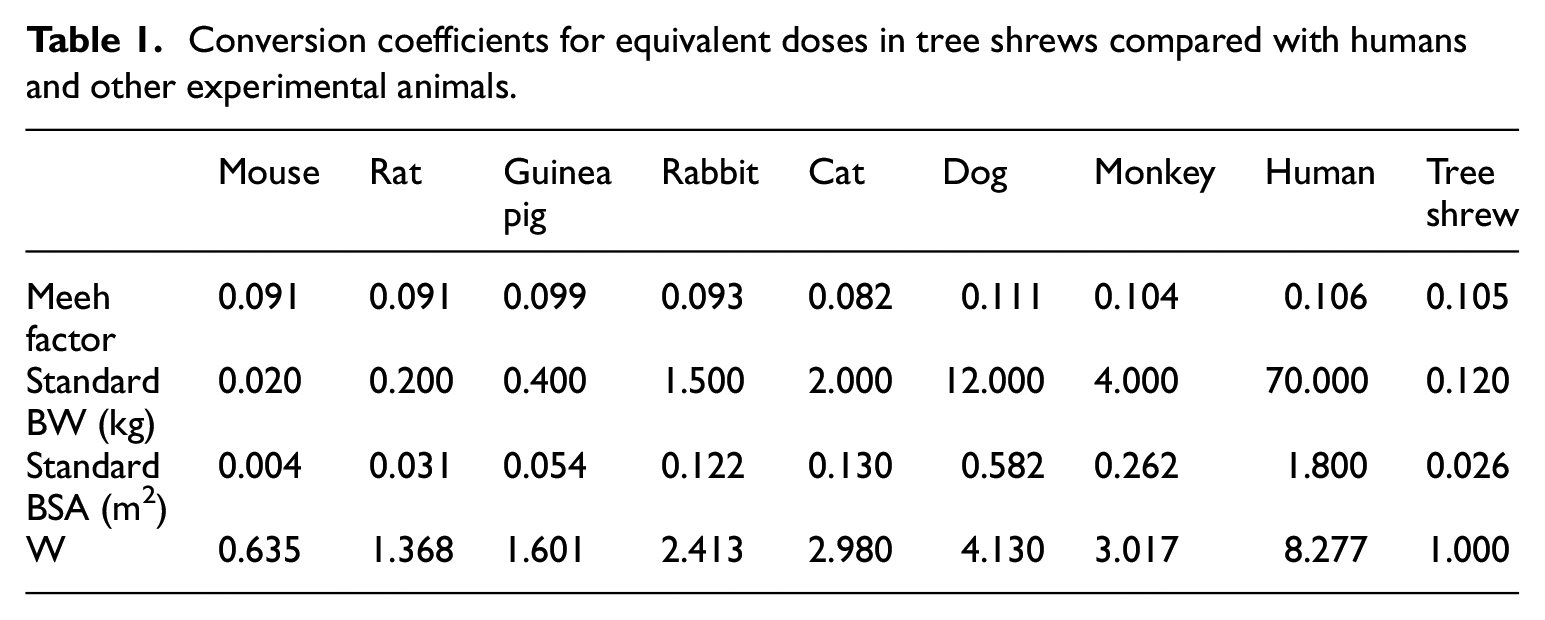
The conversion coefficient (W) is calculated by formula (5) based on the standard BW. When the dosage of a drug in humans or other experimental animals is known, the dosage in tree shrews can be quickly calculated according to formula (6) by querying the corresponding conversion coefficient in this table. BW, body weight. BSA, body surface area. W is the conversion coefficient for equivalent dose conversion from species A to the tree shrew.
However, it is inevitable that there is deviation between the actual BW and the standard BW in practical work. To further evaluate the applicable weight range of the conversion coefficient within acceptable error ranges, we took the direct BSA conversion algorithm as a reference and calculated the variation in error with BW based on the standard BW conversion algorithm (Figure 4). The results showed that when the BW of tree shrews was 0.12 kg, the error between the two methods was 0. When the BW was greater than 0.12 kg, with the increase in BW, the dose obtained using the conversion coefficient for the standard BW would be higher than the dose that was directly determined based on the BSA. When the BW was less than 0.12 kg, with the decrease in BW, the dose obtained using the conversion coefficient for the standard BW would be lower than the dose that was directly determined based on the BSA (Figure 4(a)). The specific error values of the two algorithms are shown in Figure 4(b). When the BW was greater than 0.12 kg, the error value was positive; when the BW was less than 0.12 kg, the error value was negative. When the BW was from 0.09 to 0.15 kg, the error between the dose obtained from the standard BW conversion coefficient algorithm and the actual dose was less than 10%, which is acceptable in nonpharmacological experiments.

Error analysis based on the standard BW conversion algorithm relative to the direct BSA conversion algorithm: (a) dose variation trend with BW based on the standard BW conversion algorithm and the direct BSA conversion algorithm. Taking the equivalent dose in humans and the tree shrew as an example, two algorithms were used to calculate and construct the corresponding functions. The red line represents the function Y1: the dosage for the tree shrew was obtained based on the standard BW conversion algorithm. The black line represents the function Y2: the dosage for the tree shrew obtained by the direct BSA conversion algorithm. The parameter U (mg/kg) in the function is the drug dosage in humans, X (kg) is the actual weight of the experimental tree shrew. The standard BW of a person is 70 kg, and the Km is 0.106. The standard BW of the tree shrew is 0.12 kg, and the Km is 0.105. The function Y1 can be obtained according to formulas (1), (2), (5) and (6); the function Y2 can be obtained according to formulas (1), (2), (3) and (4); and the functions Y1 and Y2 coincide at X = 0.12 and (b) the black line represents the error of Y1 relative to Y2, which is calculated by [(Y1−Y2)/Y2] × 100%. The overlap of the vertical and horizontal shadows indicates that within this weight range, the error between Y1 and Y2 is <±10%.
Formulas:




The dosage of a drug in species A is D-a (mg/kg), while that in the tree shrew is D-ts; the Km of species A is K-a, and that of the tree shrew is 0.105; the BW of species A is BW-a (kg), and that of the tree shrew is BW-ts (kg); the BSA of species A is BSA-a (m2), and that of the tree shrew is BSA-ts (m2); W is the conversion coefficient of for equivalent dose conversion from species A to the tree shrew. Formulas (1) and (2) are for calculating the BSA of the tree shrew and species A, respectively. Formula (3) is for direct conversion of the BSA. Formula (4) is for calculating the equivalent dose conversion for another species based on the direct BSA conversion algorithm obtained from formula (3). Formula (5) is for calculating the conversion coefficient based on the standard BW. Formula (6) is for calculating the equivalent dose based on the standard BW conversion coefficient algorithm.
Discussion
This study provides a practical suggestion for the drug dosage used in tree shrews. We obtained the equivalent dose for tree shrews relative to those for other species through BSA conversion (Formula 4) and calculated the conversion coefficient of the drug dose for tree shrews and other species based on the standard BW for rapid estimation (Formula 6), and the error was less than 10% when the BW of the tree shrew was 0.09–0.15 kg. In fact, based on the standard BW calculation, the error of the conversion coefficient between tree shrews and other species is derived from the fact that the BW and BSA are not linearly related but are related by the 2/3 power of the BW. Using the formula ([(6)–(4)]/(4) × 100%) in this paper, the error function (2.063(X)1/3−1) of the dose based on the standard BW conversion coefficient relative to the dose converted directly by the BSA can be obtained, and the corresponding functions are shown in Figure 4(b). Therefore, as the actual weight of the tree shrew deviates from the standard BW, the error also increases.
The appropriate drug dosage is not only an important premise for achieving the objective of the experiment, but also the guidelines for care and welfare of experimental animals. 24 Traditional experimental animals have already studied equivalent dose conversion.12,14,15,17–20 This study provided valuable data for the conversion of equivalent doses of drugs between tree shrews and humans and other animals. Of course, these data still need to be tested in actual experiments to show their validity.
Conclusion
This study provided a method of equivalent dose conversion through BSA conversion and a rapid estimation method based on the standard BW for tree shrews. We hope that our research can provide reference for the related research of tree shrews in the future.
Supplemental Material
sj-xlsx-1-sci-10.1177_00368504211016935 – Supplemental material for Body surface area-based equivalent dose calculation in tree shrew
Supplemental material, sj-xlsx-1-sci-10.1177_00368504211016935 for Body surface area-based equivalent dose calculation in tree shrew by Wei Xia, Zong-Jian Huang, Yi-Wei Feng, An-Zhou Tang and Lei Liu in Science Progress
Supplemental Material
sj-xlsx-2-sci-10.1177_00368504211016935 – Supplemental material for Body surface area-based equivalent dose calculation in tree shrew
Supplemental material, sj-xlsx-2-sci-10.1177_00368504211016935 for Body surface area-based equivalent dose calculation in tree shrew by Wei Xia, Zong-Jian Huang, Yi-Wei Feng, An-Zhou Tang and Lei Liu in Science Progress
Footnotes
Acknowledgements
We thank the members of our research groups for providing technical Assistance and participating in discussions.
Declaration of conflicting interests
The author(s) declared no potential conflicts of interest with respect to the research, authorship, and/or publication of this article.
Funding
The author(s) disclosed receipt of the following financial support for the research, authorship, and/or publication of this article: This study was supported by the National Natural Science Foundation of China (Grant No. 81760189 and Grant No. 81760188 ) and the Innovation Project of Guangxi Graduate Education (Grant No. YCBZ2020050). We thank the Kunming zoology institute, Chinese Academy of Science for providing experiment animal sources and the Experimental Animal Center of Guangxi Medical University for providing technical support for animal feeding.
Compliance with ethics requirements
All Institutional and National Guidelines for the care and use of animals were followed.

Supplemental material
Supplemental material for this article is available online.
Author biographies
References
Supplementary Material
Please find the following supplemental material available below.
For Open Access articles published under a Creative Commons License, all supplemental material carries the same license as the article it is associated with.
For non-Open Access articles published, all supplemental material carries a non-exclusive license, and permission requests for re-use of supplemental material or any part of supplemental material shall be sent directly to the copyright owner as specified in the copyright notice associated with the article.
