



Abstract
On January 30, 2020, the World Health Organization (WHO) declared SARS-CoV-2 a global pandemic, based on a high infection rate and a high case fatality rate (CFR). The combination of these two points led WHO to forecast a high expected mortality rate of approximately 2% of the population. The phenomenon of Simpson’s paradox teaches us that we should be careful when we combine two variables together. Indeed, despite the high mortality rate in several places, this forecast seems to have collapsed. We believe one of the reasons for the erroneous forecasts is that combining the above points ignored a confounding variable – many of the virus carriers are asymptomatic and therefore not diagnosed.
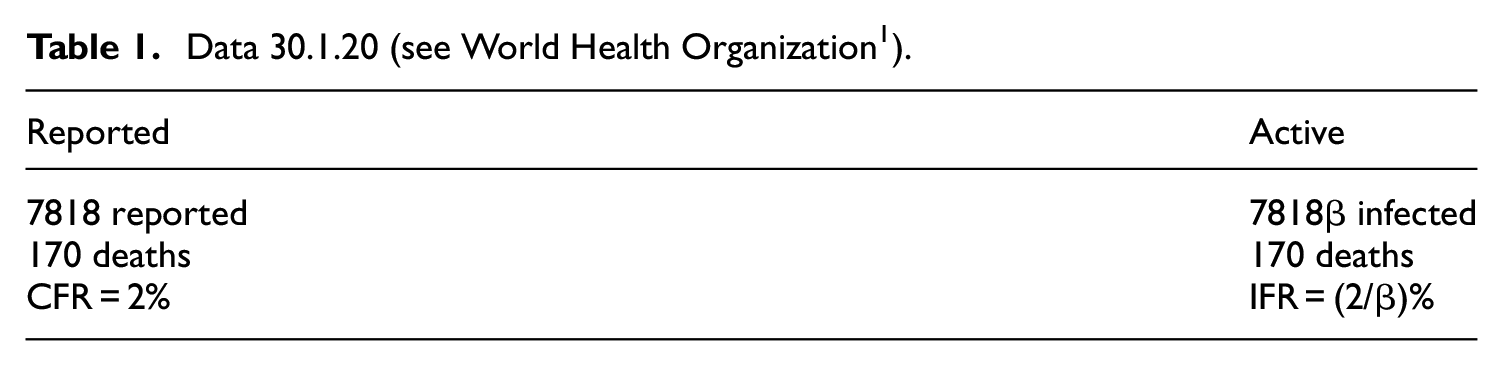
On January 30, 2020, the World Health Organization declared (WHO) SARS-CoV-2 a global pandemic, based on (1) a hypothetical model that assumed that with at a high infection rate the entire population would eventually become ill, (2) a very high case fatality rate (CFR), namely, a high mortality rate among the diagnosed cases, about 2% (see the left side of Table 1 below). The combination of these two points led WHO to forecast a high expected mortality rate of approximately 2% of the population.
Data 30.1.20 (see World Health Organization 1 ).
The global fight against SARS-CoV-2 is hurting the world economy and individual freedom, among other things. Hence, accurately predicting is important in making efficient and public decisions. The above prediction, based on a combination of high infection rate and high CFR, seems simple and compelling and is, in fact, not the case. In statistics, there is a well-known phenomenon called ‘Simpson’s paradox’, where a particular trend reflected in various variables reverses when different variables are combined. For this reason, we should be careful when we combine two variables. Indeed, despite the high mortality rate in several places, this forecast seems to have collapsed. We believe one of the reasons for the erroneous forecasts is that combining the above points ignored a confounding variable – many of the virus carriers are asymptomatic and therefore not diagnosed.
The lack of SARS-CoV-2 symptoms in most cases of infection means that the number of infected people is greater by an unknown factor β than the number of infected cases reported (see right side of Table 1 below). Estimates of factor β at different points in time and locations were found. For example, Sood et al. 2 (references therein), estimated antibody seroprevalence in Los Angeles County and obtained an estimation of β = 43, approximately. It is worth noting that the common (PCR) tests do not reveal the true number of SARS-CoV-2-infected people since the onset of the pandemic, but only those who have an infection at the time of the test.
On the other hand, death from SARS-CoV-2 is caused by the appearance of the disease symptoms; therefore, the number of reported deaths is close to the actual number of deaths from SARS-CoV-2. In fact, WHO and hospitals define the cause of death as SARS-CoV-2, even if mildly suspected 3 and even in situations where there are some other causes of death. 4
Hence, the fatality rate from among the reported case fatality rate (CFR) is greater than the actual infection fatality rate (IFR) by factor β; therefore, the overall projected mortality of infected people is should be less, as is the case.
Footnotes
Declaration of Conflicting Interests
The author declared no potential conflicts of interest with respect to the research, authorship, and/or publication of this article.
Funding
The author received no financial support for the research, authorship, and/or publication of this article.
