




Abstract
Field studies by squeezing rock deformation have shown that large deformation slips can occurs in tunnels in squeezing rock, the tunnels may be partially or completely broken. This article proposed two schemes for controlling the deformation of squeezing rock, which are “resistance combine release” Scheme 1 and “strong support” Scheme 2, the deformation characteristics and deformation mechanism of squeezing rock is researched by Zhongyi Tunnel. The results show that Scheme 2 is superior to Scheme 1 in terms of deformation rate, cumulative deformation, and monthly construction footage. Research results can provide a reference for similar projects.
Introduction
With the construction of traffic tunnels in complex mountainous areas in China, tunnels in squeezing rock are constantly emerging. For example, Lanzhou-Chongqing railway is affected by high ground stress and strong geological structure, 1 which causes the maximum extrusion deformation of more than 1 m during construction, seriously endangering the safety of equipment and personnel. In Qingfeng Tunnel of Gucheng-Zhuxi Expressway, 2 there have been many large deformation phenomena, such as spray layer cracking and peeling, steel frame breaking, even collapse and secondary lining cracking and falling off, the maximum deformation of the initial support is 2.4 m. Due to large deformation of soft rock, Yuntunbao tunnel construction progress is very slow, 3 the main large deformation phenomenon is that the steel arch is seriously deformed and twisted, the concrete of the vault and side wall is cracking, peeling, and falling, the maximum settlement of the vault is 596 mm, and the deformation duration is more than 60 days. The large deformation behavior that occurs during tunneling in soft rock explains what is squeezing. 4 Research shows that most soft rock tunnels need to be repaired for several times to ensure their stability. 5 Therefore, tunnels in squeezing rock are one of the urgent problems to be solved at home and abroad.6–8
We know that there is no uniform international standard for large deformation, and we can get a preliminary understanding of the large deformation through the cognition of the relevant researchers. For example, Yu 9 thought that the large deformation means that the displacement of single-track tunnel exceeds 25 cm and that of double-track tunnel is 50 cm. In order to avoid large deformation of the tunnel, it is a useful method to provide reservation deformation for different levels of surrounding rock. 10 However, if the surrounding rock pressure is too large, the support cannot bear the huge pressure, and the tunnel may still have large deformation. In the aspect of studying the factors influencing large deformation, González-Nicieza et al. 11 used the numerical method to analyze these factors, the convergence and constraint process of different buried depths and section shapes are studied. In addition, it has been proposed that the most typical feature of soft rock is long-term creep phenomenon. 12 Bai et al. 13 studied the changed behavior of deformation rate and stress of rock with time, and used creep numerical model to study the influence of closure time and in-situ stress on creep. In the aspect of stress redistribution in surrounding rock during excavation, Schwingenschloegl and Lehmann 14 thought that the strength of surrounding rock is lower than the stress redistribution after excavation, which is the direct cause of large deformation. Li and Tan 15 argued that the main cause of in-situ surrounding rock is shear failure, and the multilayer support can resist the shear failure and control the deformation of surrounding rock effectively. In general, the support principle of squeezing rock has been put forward for a long time, the yielding principle and the resistance principle, in the paper of Mezger et al., 16 the validity and limitation of these methods are studied when the tunnel passes through the squeezing rock. In addition, compared with single support measures, the combined support scheme has the advantage of coping with complex geographic environment under the condition of large deformation of squeezing rock. 17 According to new Austrian tunneling method, Dai et al. 18 adopted the support scheme of “first yielding and then resisting,” and constitute a combined support program. Cui et al. 19 carried out field test research on three kinds of construction control technical measures for large deformation of surrounding rock, and put forward a new combined support scheme.
These research results have solved part of the problem of tunnel in squeezing rock. However, due to different geological, hydrogeology, buried depth, and other objective factors, as well as different excavation methods, support systems and other subjective factors, the influencing factors and mechanisms of deformation of squeezing surrounding rocks are different, and the measures for the control of the large deformation of the surrounding rock that are taken are also different. As a result, the support method should be changed according to the different geology conditions of squeezing rock.20,21 In order to further accumulate the experience of large deformation control of tunnel with squeezed surrounding rock, this article chooses the parallel pilot tunnel project of Zhongyi Tunnel of Lijiang-Shangrila Railway as the research object, study on the deformation control technology of squeezing rock. It has proposed two kinds of surrounding rock deformation control schemes, first scheme is “release while resisting, resistance combine release” (double initial support) and the second scheme is “strong support” (single initial support). The validity of the support scheme is verified, and the deformation control mechanism of the new support method is obtained.
Background
The total length of Zhongyi tunnel is 14.745 km, and it is located in Yunnan province and it is a control project for Lijiang-Shangrila Railway. The Zhongyi Tunnel is divided into three sections: No. 1 Horizontal hole, No. 2 Horizontal hole, and Exit Parallel pilot tunnel. The total length of parallel pilot tunnel is 6.095 km. The parallel pilot tunnel from PDK50+625 enters the fracture zone of the western foot fault of the Yulong Snow Mountain (PDK50+625∼PDK49+725) (Figure 1).
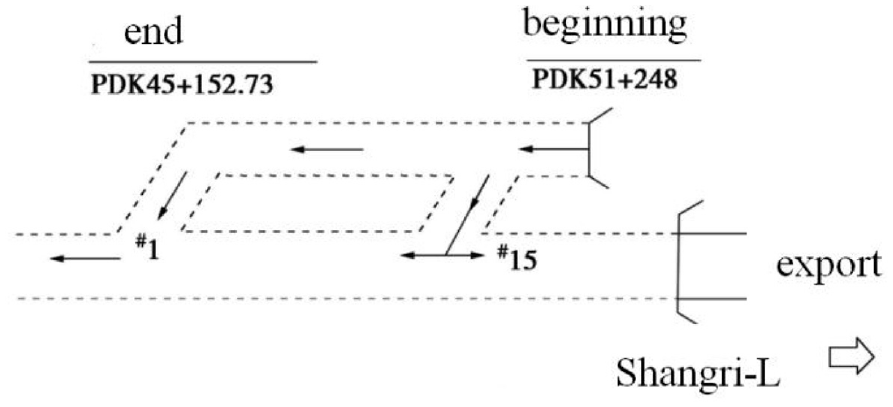
Parallel pilot tunnel plane.
The geological structure of the Zhongyi tunnel exit section is complex, there are regional faults in the western foot of Yulong snow mountain, the fracture intersects with the export parallel pilot tunnel at PDK50+625∼PDK49+725, the tunnel depth of the fracture zone is between 600 and 1050 m. The lithology of fault fracture zone is dominated by schistositized basalt. Most schistosed basalt are shear joints; when the tunnel is excavated, the schistositized basalt is usually open, and its joint surface is weak and prone to dislocation.
Export parallel pilot tunnel of the original design adopts IV class surrounding rock Type I support by rockbolt and shotcrete. The cave shape of the export parallel pilot tunnel type is straight wall+arc arch, span of 5.3 m, wall height 3.65 m, the radius of arch half circle is 2.65 m. The initial support is 15 cm thick C25 shotcrete. φ6 steel mesh and its grid spacing is 25 cm × 25 cm, steel arch frame using I18 I-beam and its spacing is 0.8 m, the system anchor bolt adopts φ22 mortar bolt, and its length is 2.5 m, spacing is 1.2 m × 1.0 m (Figure 2).

Cross-sectional structure design.
Deformation characteristics and failure mechanismof squeezing rock
Deformation characteristics of surrounding rock
When the original design is adopted in the fractured zone at the foot of Yulong Snow Mountain of parallel pilot tunnel project, the surrounding rock deformation is large, the large deformation disaster of surrounding rock at the side wall is particularly serious. Its surrounding rock deformation has the following characteristics.
The predominant part of deformation is obvious
The horizontal convergence of the side wall is far greater than the settlement of the vault; The inverted arch has a small amount of floor heave disasters and the heave displacement is less than the settlement of the vault. Disaster of large deformation of the side wall in section PDK50+575∼PDK50+560 is serious (Figure 3).
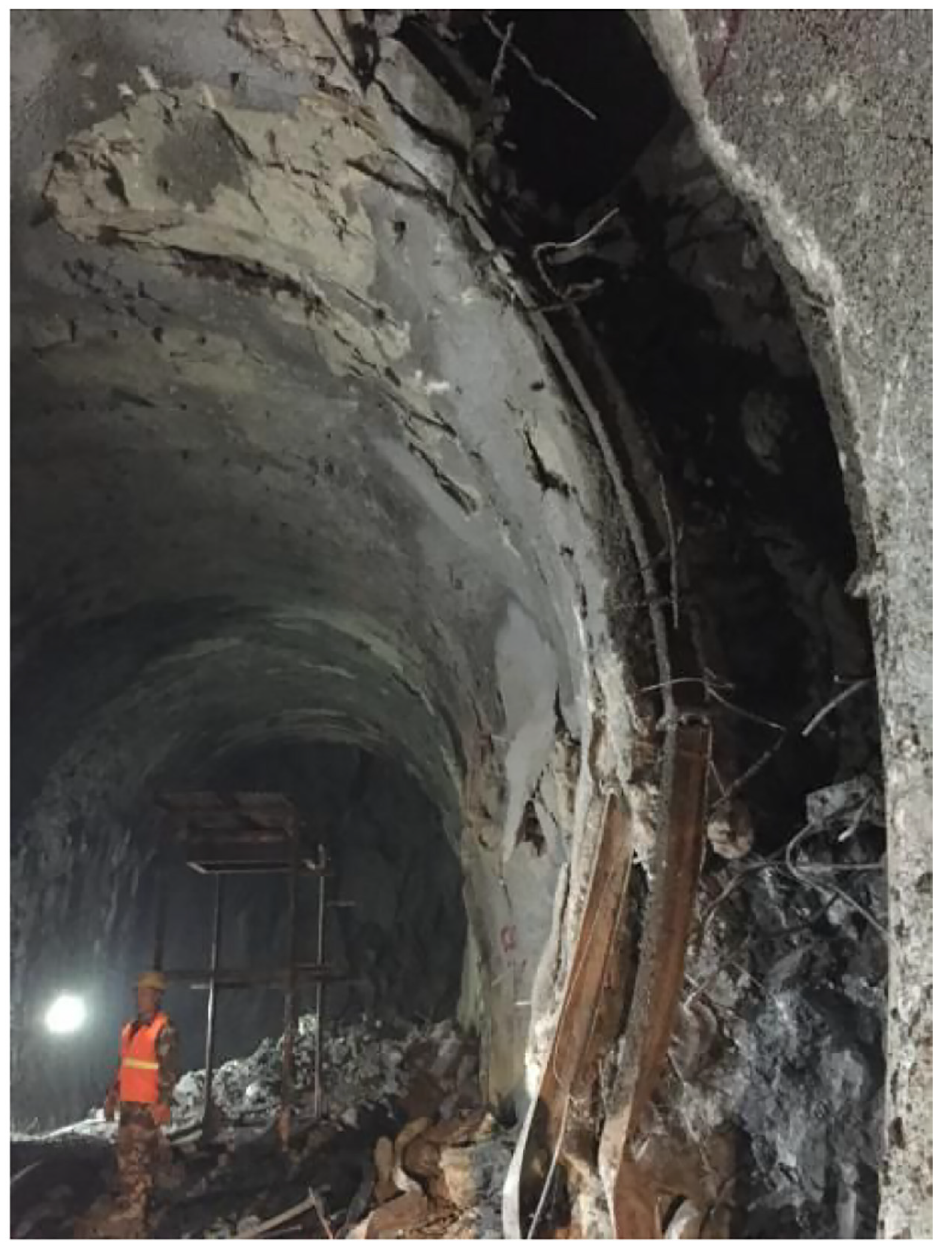
Large deformation of PDK50+575∼PDK50+560 Section side wall.
Large deformation value and high deformation rate
The deformation of the side wall is above 15 cm, and the maximum deformation is nearly 100 cm. The maximum deformation rate is 14.3 cm/d, general deformation rate is 4–8 cm/d. With the original design, replacement of arch in the whole length construction section because of invasion exceeding the limit, part of the construction section carried out a second arch replacement (Figure 4).
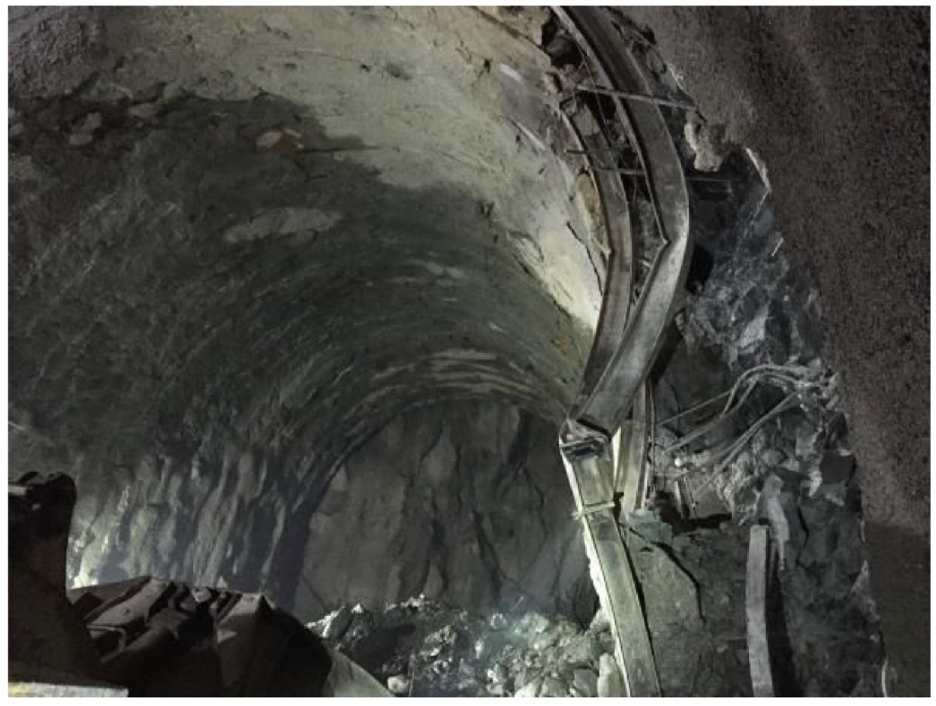
PDK50+535~PDK50+520 segment secondary arching.
Long duration
The deformation rate of surrounding rock is restrained after supporting; however, after 35–50 days, the deformation of surrounding rock gradually appears convergence trend.
Influence factors of large deformation of surrounding rock
Deep burial and strong neotectonic movement
The average burial depth of the fracture zone at the foot of Yulong Snow mountain of parallel pilot tunnel project is about 780 m, and the maximum burial depth is 1050 m. The tunnel site is located in the western Yunnan seismic belt. Its geological structure is extremely complex and neotectonic movement is strong.
The measured in-situ stress side pressure coefficient of this section is 1.74 on average, and the maximum is 1.94. The average maximum in-situ stress is 23.45 Mpa, and the maximum is 28.25 Mpa.
Surrounding rock is fractured and weak, and groundwater is more developed
The surrounding rock of this section is mainly basalt, with developed joints and fissures, weak joints, and the structural plane is filled with chlorite and montmorillonite, the strength of surrounding rock is V-grade. The crevice water in the surrounding rock is relatively developed, the chlorite in the surrounding rock is seriously softened by water, and the strength–stress ratio of surrounding rock is less than 0.12.
Unreasonable design of the support structure
The originally designed as grade IV bolt + shotcrete Type I support and the shape of the tunnel with a straight wall and circular arch, all these are not conducive to the deformation control of the squeezing rock.
Deformation mechanism
Under the condition of high in-situ stress and low strength–stress ratio of surrounding rock, large deformation of squeezing rock occurred in the fracture zone of the western foot of Yulong snow mountain in Zhongyi parallel pilot tunnel project, the deformation mechanism is as follows:
According to the analysis of deformation history curves of many mileage sections in this section, there is basically no jump growth phenomenon, which indicates that the large deformation of surrounding rock in this section is the extrusion deformation under the action of deformation pressure.
After tunnel excavation, tangential stress concentration occurs around the tunnel. Because of the weak surrounding rock, the development of groundwater (when chlorite and montmorillonite in the joint surface of surrounding rock meet groundwater, they soften seriously), high in-situ stress, unreasonable support structure design and the improper timing of construction of on-site support structure, all these factors eventually lead to the plastic zone around the hole, and the plastic zone radius of the side wall is larger, the thickness of plastic zone ranges from 4.5 to 5.0 m by loosened rock circles test. Along the depth direction of surrounding rock, the plastic zone continuously transfers stress to the elastic zone; along the direction of the tunnel, the plastic zone deforms continuously to reduce the stress it bears.
The process of stress redistribution in plastic zone of surrounding rock is also the process of extrusion deformation of surrounding rock. After the excavation of this section of tunnel, the shear slip tendencies occur on both sides of the sidewalls. In addition, the shape of the tunnel with a straight wall and circular arch, and the surrounding rock joints and fissures is relatively developed, so the shear slip path of surrounding rock at the side wall is very easy to form. As the horizontal in-situ stress of the tunnel in this section is large, it has the greatest impact on the side wall, and the stress–strength relationship of the surrounding rock at the side wall is the weakest, the extrusion deformation first appears at the side wall. The shear dilatation of surrounding rock also plays an important role in the process of extrusion deformation, which makes the deformation of surrounding rock present a large deformation in the initial stage.
Control scheme of large deformation of squeezing rock
Control scheme selection considerations
The control of large deformation of squeezing rock can be considered from the following two aspects:
Improve the self-supporting capacity of surrounding rock and reduce the plastic radius. When excavating, the surrounding rock should be protected as much as possible from the aspects of optimizing construction method, excavation footage, supporting time and closed-loop time; after excavation, reinforcement measures such as surrounding rock grouting and bolting are adopted to improve surrounding rock lithology.
Optimizing the support system which deals with the deformation characteristics of surrounding rock, it can be considered from the aspects of excavation shape, support stiffness, and allowable deformation range.
Control scheme
By analyzing the surrounding rock deformation characteristics, influencing factors, and deformation mechanism of the fracture zone the foot of Yulong Snow Mountain of parallel pilot tunnel project, the two large deformation control schemes were jointly developed by the organization of scientific research, design, and construction. The shape of the excavation cave changed from straight wall arch to curved wall invert. The anchor bolts in the side wall are replaced with 6.5 m long anchor bolts, and the other parts are replaced with 4 m anchor bolts. The parameters of the anchor bolts are bar whorl-steel bolt and the diameter are 25 mm, and distance is 700 mm × 700 mm in an interlaced pattern.
Scheme 1: double initial support
The scheme uses double initial support, reserved deformation is 0.4 m (Figure 5). Excavation of upper and lower bench and inverted arch, respectively. The first initial support uses 25 cm thick C25 sprayed concrete, adopts I-steel 20 arch support; the second initial support uses 22 cm thick C25 sprayed concrete, and adopts I-steel 18 arch support. When the convergence deformation value of the side wall of the first initial support reaches 0.25–0.3 m, implementing the second initial support. The initial support ring is no more than 12 m from the tunnel face. The scheme belongs to the constructive measures of “release while resisting, resistance combine release.”

Scheme 1 cross-sectional view.
Scheme 2: single initial support
The scheme uses single initial support, reserved deformation is 0.4 m (Figure 6). Excavation of upper and lower bench and inverted arch, respectively, reserved space for umbrella arch. The first initial support uses 27 cm thick C25 sprayed concrete, adopts H-steel 175 arch support. The umbrella arch uses 22 cm thick C25 sprayed concrete, and adopts I-steel 18 arch support. When the convergence deformation value of the side wall of the singlet initial support reaches 0.25–0.3 m, the umbrella arch support is implemented. This scheme belongs to “strong support” constructive measures.
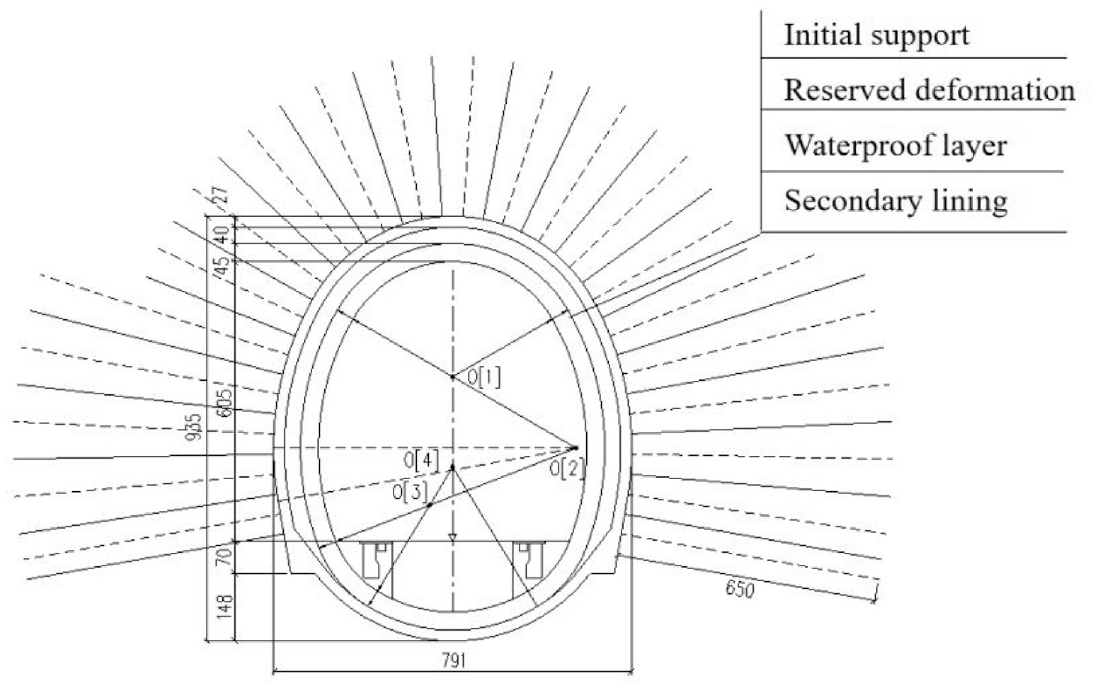
Scheme 2 cross-sectional view.
Optimum selection of large deformation control schemefor squeezing rock
Optimum selection of numerical calculation
Based on the background of PDK50+460–PDK50+195 segment of the fracture zone at the western foot of Yulong Snow Mountain of parallel pilot tunnel project, the model was established by the finite-element software ANSYS (Figure 7). As it shows in Figure 7, on the basis of saint venant principle, the size of the numerical simulation model as followed: the length, width, and height of the model are in X direction, Y direction, and Z direction, respectively. The size of the model in X direction, Y direction, and Z direction are 50, 50, and 10 m, respectively. The simulation depth is 800 m. The model is simulated by solid element, and the bolt is simulated by cable element in Flac3D software. The mesh was done in the ANSYS, then the model was imported into the software Flac3D.

Flac3D model: (a) the model front view, (b) the anchor Bolt model, and (c) the steel arch model.
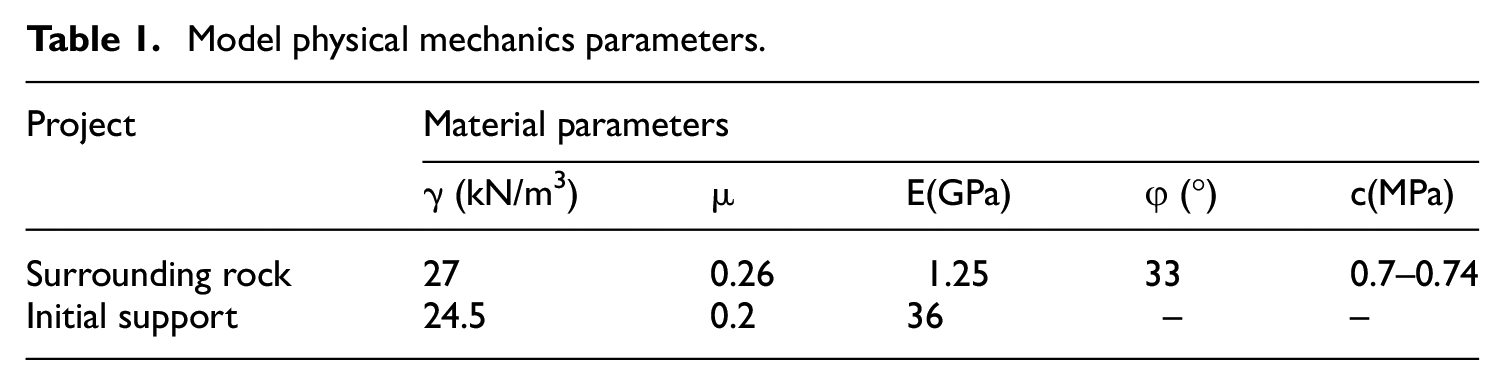
The surrounding rock of the model is considered as an ideal elastic–plastic model, and the yield criterion is Mohr–Coulomb criterion. Numerical simulation of creep of surrounding rock using cpow creep model which is suitable for underground engineering, material parameter A1 takes 1 × e−23, n1 takes 2, maximum time step 25 s. The physical and mechanical parameters of the model are provided by the field test (Table 1).
Model physical mechanics parameters.
Monitoring arrangement
In order to study the deformation of surrounding rock and initial support during construction period, a settlement measuring point is set at the vault and a horizontal convergence measuring line is set on the upper and lower bench (Figure 8).

Section monitoring arrangement: (i) vault settlement point, (ii) lower bench horizontal convergence line, and (iii) upper bench horizontal convergence line.
Field test optimization
In order to optimize the deformation control scheme, field tests of two deformation control construction schemes were carried out in the parallel pilot tunnel project site, and the test mileage was as follows: PDK50+460∼PDK50+285 is the first test section of the scheme, and PDK50+285∼PDK50+195 is the second test section. In the test, the monitoring section spacing is set at 5m. The larger the deformation of surrounding rock, the denser the monitoring section. The monitoring arrangement is shown in Figure 8.
Comparative analysis of results
Scheme 1
The scheme was used for the field test, and the whole length of the test section did not appear as the beyond-limit deformation to replace the arch, deformation control effect was obvious. Due to the initial support of the two layers, the construction progress was seriously affected. The monthly advance of the test section was between 40 and 50 m.
Model calculation results extract the monitoring data of the vault sinking and horizontal convergence of the upper and lower bench. The test results extract the monitoring data of the typical section PDK50+335 vault sinking and horizontal convergence of the upper and lower bench (Figure 9). The results reveal that the numerical calculation is basically consistent with the deformation law of the vault settlement and the horizontal convergence of the upper and lower steps in the field test. The rate of vault settlement and horizontal convergence of upper and lower bench decreases significantly after the second initial support is applied. When the inverted arch is filled, the deformation is basically stable. The cumulative horizontal convergence of both numerical calculation and field test is less than 70 cm, and there is no beyond-limit deformation, so there is no need to change the arch.

Scheme 1 deformation curve: (a) numerical calculation and (b) field test.
Scheme 2
The scheme was used for the field test, surrounding rock deformation of the test section was effectively controlled, and there did not appear the beyond-limit deformation to replace the arch, PDK50+280∼270 and PDK50+250∼240 section. After initial support, the convergence deformation value of lower bench exceeded 35 cm, and when the pre-set support measures were used, the surrounding rock deformation was well controlled by using the umbrella arch. Most sections of the field test section of this scheme did not use the reserved support measures but only applied first initial support, which improved the construction progress. The monthly advance was between 80 and 90 m.
Model calculation results extract the monitoring data of the vault sinking and horizontal convergence of the upper and lower bench. The test results extract the monitoring data of the typical section PDK50+244 vault settlement and horizontal convergence of the upper and lower bench (Figure 10). The results reveal that the numerical calculation is basically consistent with the deformation law of horizontal convergence of the lower bench in the field test, and the deformation trend of the vault settlement and horizontal convergence of the upper bench is consistent. The measured value of the field test is relatively small, which is mainly caused by the less water content of surrounding rock in the upper half of the field face, and the groundwater in the lower half of the field face is gushing water. After the excavation of the lower bench, the deformation rate increases sharply, and the convergent deformation value of the lower bench exceeds 35 cm after 4 days, field test set umbrella arch in time and the deformation of the surrounding rock is effectively controlled. The cumulative horizontal convergence of both numerical calculation and field test is less than 70 cm, and there is no beyond-limit deformation, so there is no need to change the arch.

Scheme 2 deformation curve: (a) numerical calculation and (b) field test.
Comparative analysis
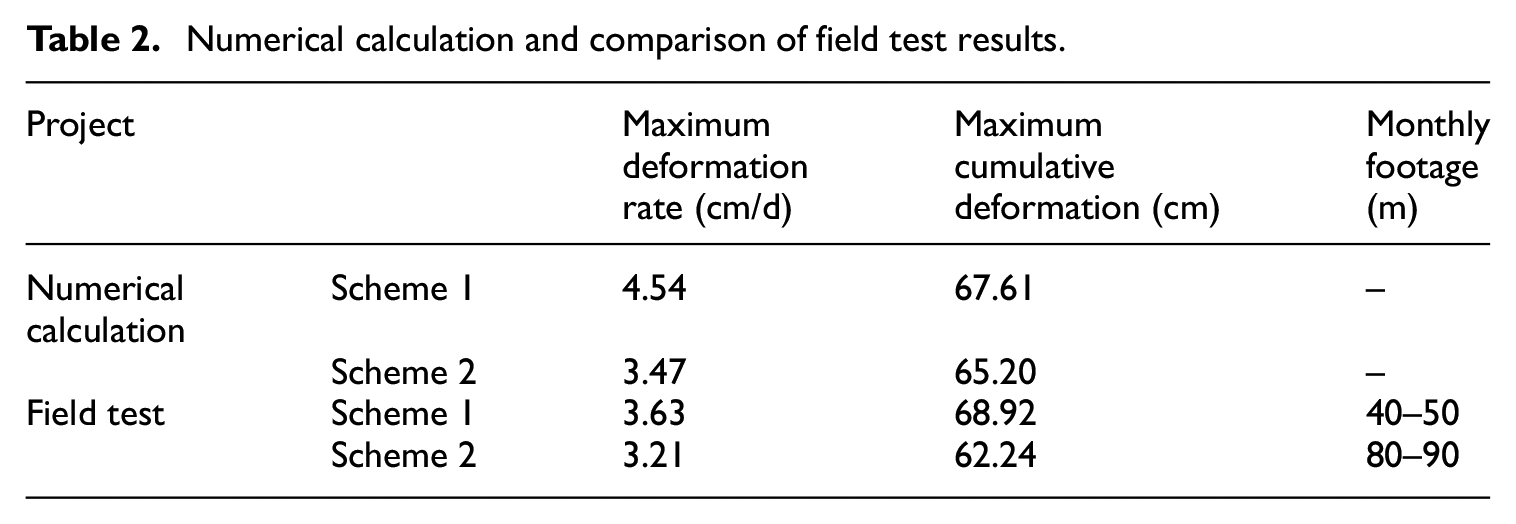
The numerical calculation and field test results of two deformation control schemes are compared (Table 2), and results show that:
Both the numerical calculation and field test results show that: in terms of maximum deformation rate and cumulative maximum deformation, Scheme 1 (double initial support) is greater than Scheme 2 (single initial support). The main reason is that: Scheme 1 (double initial support) is the surrounding rock deformation control scheme of “release while resisting, resistance combine release,” the first initial support is a flexible support, allowing a certain deformation, and the insufficient stiffness of the support system is supplemented by the second initial support; Scheme 2 (single initial support) is the surrounding rock deformation control scheme of “strong support.” After initial support is applied, although some deformation of surrounding rock is allowed, it belongs to controllable deformation of surrounding rock. The ultimate trend is convergence and stability of deformation.
The maximum value of the horizontal convergence cumulative of the two deformation control schemes is less than 80 cm of the reserved deformation of the side wall (deformation reserved for 40 cm each side wall), and the surrounding rock deformation is successfully controlled.
Because the first scheme needs two initial supports, the process is more complicated than the second scheme, and the construction cycle takes a long time, the monthly advance is between 40 and 50 m, which is much less than the second scheme.
Numerical calculation and comparison of field test results.
Considering the construction safety, construction progress and cost control, and giving full play to the advanced role of the parallel pilot tunnel project, it is recommended that Scheme 2 be adopted for the construction of the fracture zone at the West foot of Yulong Snow Mountain, Zhongyi Tunnel.
Conclusion
Through the comprehensive analysis of the large deformation of the squeezing rock in the fracture zone at the Western foot of Yulong Snow Mountain parallel pilot tunnel project, the following conclusions are drawn:
Deformation characteristics: the deformation at the side wall is the dominant part of large deformation; the deformation value is large and rate is high; the deformation lasts longer.
Deformation mechanism: the large deformation of surrounding rock in this section is the extrusion deformation under the action of deformation pressure, and the large deformation of surrounding rock is the result of shear slip and shear dilatation interaction.
Two kinds of surrounding rock deformation control schemes are proposed, which are, respectively “release while resisting, resistance combine release” Scheme 1 (double initial support) and “strong support” Scheme 2 (single initial support).
The results of numerical calculation and field test show that Scheme 2 is superior to Scheme 1 in terms of maximum deformation rate of surrounding rock, maximum cumulative deformation and monthly construction footage. Considering the construction safety, construction progress and cost control, and giving full play to the advanced role of the parallel pilot tunnel project, it is recommended that Scheme 2 be adopted for the construction of the fracture zone at the West foot of Yulong Snow Mountain, Zhongyi Tunnel.
Footnotes
Author contributions
Conceptualization, G.C. and J.Q.; methodology, G.C. and D.W.; investigation, G.C. and J.Q.; data curation, G.C. and D.W.; writing—original draft preparation, G.C. and J.Q.; writing—review and editing, J.Q.; project administration, G.C.; funding acquisition, G.C. and D.W
Data availability
The data used to support the findings of this study are included within the article.
Declaration of conflicting interests
The author(s) declared no potential conflicts of interest with respect to the research, authorship, and/or publication of this article.
Funding
The author(s) disclosed receipt of the following financial support for the research, authorship, and/or publication of this article: The authors appreciate the support from the National Natural Science Foundation of China (grant nos. 51408008 and 51478277).
