



Abstract
As an important transportation equipment, belt conveyor plays an important role in underground coal mine production and is an indispensable component. In this article, taking the intermediate drive belt conveyor of Shanxi Tongmei Group Tongxin Mine as an example, the continuous dynamic method is adopted to comprehensively consider the non-uniform load distribution of the belt conveyor, and mathematical modeling of the intermediate drive belt conveyor is performed. The dynamic characteristics of the conveyor belt are analyzed. The MATLAB software is used to analyze the change of the conveyor belt tension under different starting accelerations. Based on the analysis results, the starting acceleration is optimized, and the new combined parabolic acceleration curve presented here is more suitable for the actual working condition of the belt conveyor. In this article, the startup timing of the head and middle motors of the belt conveyor is also discussed in depth. The start timing design of the belt conveyor is described, which provides a reference for the design of the belt conveyor with an intermediate drive.
Keywords
Introduction
Belt conveyors play an important role in transportation in coal production. Due to the complex terrain of the mine, the harsh environment, and the emergence of some special curved roadways, there is an urgent need for belt conveyors that can provide high productivity and efficiency. In view of the outdated design of the main parameters of the belt conveyor, the considerations are too small and the running performance is not improved; hence, it is necessary to modernize and efficiently direction long distance, large load and high speed, and the development of cascading non-linear, multi-functional multi-mode conveying direction.1–3 With the increase in coal mine production, the demand for large-capacity and long-distance belt conveyors is increasing, especially for intermediate drive belt conveyors. As shown in Figure 1(a) and (b), the two driving methods distribute the excessively concentrated head drive power well. It reduces the maximum tension at the head drive and the maximum strength limit of the conveyor belt. Therefore, the intermediate drive technology not only realizes longer transportation distance of the conveyor, but also facilitates installation and maintenance management and reduces the manufacturing cost of the conveyor.

Belt conveyor with intermediate driver: (a) liner friction type belt conveyor with an intermediate driver; (b) roller dump type belt conveyor with an intermediate driver.
The operation of the belt conveyor closely influences the safe and efficient production in the coal mine. In order to ensure the reliable and stable operation of the conveyor, it is necessary to investigate the dynamic characteristics, control strategy, condition monitoring, and comprehensive protection. In actual production, there are obvious differences between the static calculation results of the belt conveyor and the actual operating conditions. To this end, the full system dynamics analysis of the belt conveyor must be carried out on the basis of full consideration of the influencing factors of the dynamic characteristics, so that the dynamic design can be reasonably carried out, and the static characteristics can be combined to ensure its efficient and safe operation. 4
In the 1960s, former Soviet scholars began to study the dynamics of belt conveyors. First, a more complete dynamic equation of the conveyor belt was derived, and the simplified mechanical model and wave theory were used to solve the problem. Nordell and Ciozda 5 built a four-parameter model based on the Voigt model. They added Coulomb frictional resistance and external viscous drag to the conveyor belt model, which improved the accuracy of the belt conveyor system model. Zur discussed the viscoelastic model of conveyor belts used at that time. According to the practicability of the model, the influence of each model on the simulation accuracy of the conveyor was analyzed. 6 The main research problems in the 1990s were related to the establishment of computer models, that is, according to the parameters of the belt conveyor, conveyor belts, and other conditions, the known models were used for processing and analysis. Lodewijks 7 used a finite element method to model the solution and applied a four-parameter model to the finite element analysis of the conveyor belt.
Mao 8 made a systematic theoretical analysis of the dynamic design of the belt conveyor and discussed the selection of parameters and the optimization of components. Hou 9 carried out a systematic dynamic analysis of the belt conveyor, including acceleration and dynamic stress changes, and starting conditions under different load conditions. Li10,11 and Song and collegues12,13 also discussed the design theory of belt conveyors. Li et al.14,15 established a continuous dynamic model of the belt conveyor, which provides a powerful tool for the dynamic design and experimental research of the belt conveyor.
The intermediate drive belt conveyor is provided with an unloading drum in the middle to disperse the power. However, in the case of improper control of the unloading drum, there may be problems such as drum slippage, belt bounce, belt slack, material accumulation, and imbalance of power load between the middle and head motors. 16 The belt is viscoelastic and the long-distance belt conveyor cannot meet the requirements of the conveyor using the standard static design method. 17 The dynamic characteristics of the entire belt conveyor should be considered, especially the startup and shutdown processes. 18 During the operation of the belt conveyor, due to the sudden change of the inclination angle of the conveyor, the braking process of the conveyor, the coal mining situation, and so on, the load distribution on the conveyor belt is uneven (as shown in Figure 2), so that the dynamic analysis of the conveyor belt becomes complicated. However, when the belt conveyor is subjected to dynamic analysis, the material load on the conveyor belt is generally considered to be uniformly distributed, and the uneven load distribution has a great influence on the dynamic tension of the conveyor belt, so the load is evenly distributed. The results obtained for the belt conveyor are thus not accurate. Therefore, in the dynamic analysis of the belt conveyor, the actual situation of uneven load distribution on the conveyor belt should be considered.

Uneven distribution of cargo load on the conveyor belt.
In this article, the continuous dynamics method is used to model and analyze the belt conveyor. The influence of different load distributions on the dynamic tension of the conveyor belt is simulated by the MATLAB software, and the starting acceleration is optimized, which is safe and efficient for the belt conveyor. The operation provides a theoretical basis. At the same time, the driving part is added to the middle part of the belt conveyor, which reduces the head driving load and disperses the tension of the conveyor belt while ensuring the transportation volume, thereby greatly reducing the occurrence of accidents. In the process of designing an intermediate drive belt conveyor, it is also necessary to pay attention to the head and middle motor start timings.
Establishment of a dynamic model
Figure 3 presents a schematic view showing the structure of the intermediate drive belt conveyor. The belt conveyor is an intermediate drive belt conveyor, belonging to a drum unloading belt conveyor, wherein the head drive portion has two drive rollers and the intermediate drive portion has three drive rollers. The belt conveyor has a total length of 4601 m, a height difference of 365 m, a conveyor belt length of 9850 m, a normal running speed of 5 m/s, and a conveying bandwidth of 1.8 m. There is a disk hydraulic brake in each of the head and the intermediate drive, and the hydraulic automatic tensioning device is mounted on the head drive.

Schematic diagram of the structure of the intermediate drive belt conveyor.
The entire belt conveyor is divided into two independent conveyors with the intermediate drive as the boundary. The first section (the first half) can be seen as a belt conveyor with the head and tail driving, the head tensioned, and the second section (the lower half) can be regarded as a belt conveyor with the head driving and head tensioned.
Modeling the head-to-tail drive belt conveyor
The length of the conveyor belt of the belt conveyor is
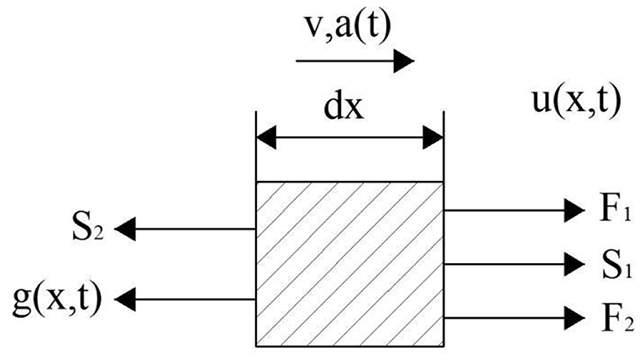
Schematic diagram of the force state of the conveyor belt unit.
The equilibrium relationship of the forces on the conveyor belt unit is

which is

Let
Bearer branch

Return branch

Boundary conditions
Drive roller

Tensioning device

or

Initial conditions

where
Solving the model when the load distribution is uneven
The load on the conveyor belt is shown in Figure 5.

Load diagram of the belt conveyor.
This article uses the following formula to describe the load distribution on the conveyor belt 21

According to the separation variable method, the generalized coordinate method, and the Lagrange equation, the transport tension equation is obtained

In the formula

It can be seen that the dynamic tension of the belt obtained by the model is related to the load distribution.
Influence of load distribution on dynamic characteristics of the belt conveyor
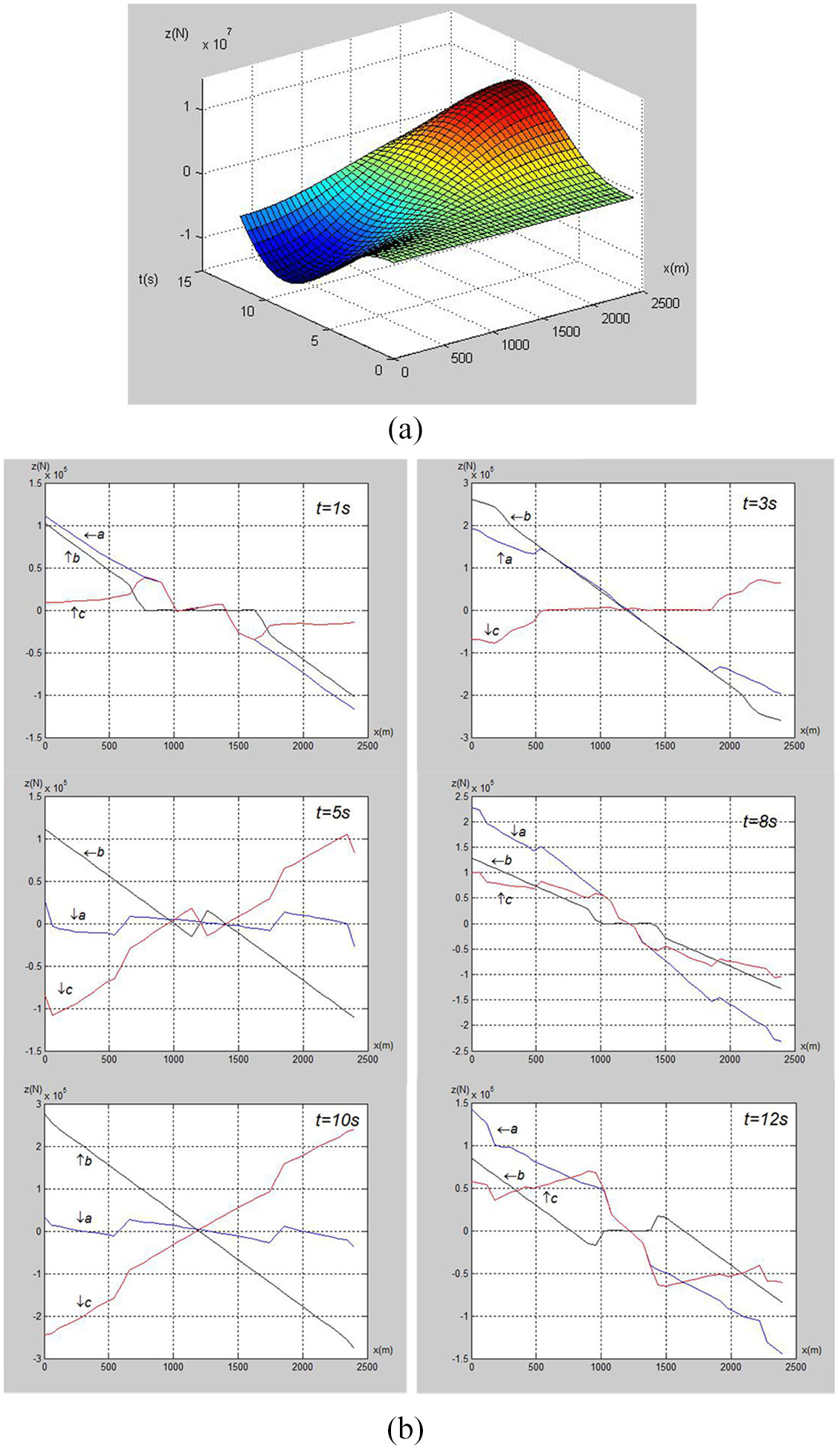
Assume that the belt conveyor has a total length of 2400 m and a full load of 266.67 kg/m. The MATLAB software is used to simulate the dynamic tension of the conveyor belt. The dynamic tension curves are drawn according to the following two methods and compared:
Non-uniform load. The belt conveyor is divided into five sections, and the corresponding length and load of each section are shown in Table 1. The curve drawn by the non-uniform load method is shown as curve a in the figure.
Uniform load. Calculation and analysis were performed according to the load on the conveyor belt at full load q = 266.67 kg/m. The curve drawn by the uniform load method is shown as curve b in the figure.
Belt conveyor segment length and the corresponding load.

The difference between the values obtained by the above two methods is shown by the curve c.
Analysis of dynamic characteristics of the conveyor belt in emergency braking condition
The belt conveyor performs emergency stop according to the rectangular acceleration and the period T = 12 s and obtains the tension diagram, as shown in Figure 6.
Dynamic tension under braking condition: (a) graphic model of dynamic tension and (b) contrastive analysis.
According to the analysis, since the emergency braking cycle is very short, in the emergency braking phase, the uniform distribution of the load has a great influence on the dynamic tension of the conveyor belt. As time increases, the change in the tension of the conveyor belt increases and the difference between the results obtained by the two methods increases cumulatively (Table 2). The conveyor belt is excessively shaken at this stage, and the belt conveyor is prone to accidents. Therefore, in the dynamic analysis of the belt conveyor, attention should be paid to the influence of the load distribution on the tension of the conveyor belt, thereby improving the operational reliability of the belt conveyor.
Difference between the two methods.

Analysis of dynamic characteristics of the conveyor belt in starting condition
According to the parabolic acceleration of the period T = 120 s, the tension–displacement diagram of the conveyor is obtained, as shown in Figure 6. The difference between the two methods is shown in Table 3.
Comparison of the difference between the two methods.

It can be seen from Figure 7 that since the starting period is relatively longer than the emergency braking period, in the initial stage of starting, the uniform distribution of the load has little effect on the dynamic tension of the conveyor belt. However, the change in the tension of the conveyor belt increases with time, and the uneven load affects the tension of the conveyor belt. The difference between the results obtained by the two methods is cumulatively increased, which brings a safety hazard to the operation of the belt conveyor.

Dynamic tension diagram under starting condition: (a) graphic model of dynamic tension and (b) contrastive analysis.
Comparison of conveying tension under different load distribution conditions
The uneven distribution of the load on the conveyor belt influences the tension of the conveyor belt, according to different distributions of the load on the conveyor belt. Starting with a parabolic acceleration of period T = 120 s, the dynamic tension of the conveyor belt under the following different load distributions of the belt conveyor is analyzed:
Load distribution 1. The belt conveyor head is full, the middle is loaded, and the tail is empty.
Load distribution 2. The belt conveyor head is loaded, the middle is full, and the tail is loaded.
Load distribution 3. The belt conveyor head is empty, the middle is loaded, and the tail is full.
According to the above three load distribution conditions, the dynamic tension diagram of the conveyor belt under emergency braking conditions is obtained, as shown in Figure 8.

Conveyor belt tension diagram under different load distribution conditions: (a) head full-load dynamic tension diagram, (b) intermediate full-load dynamic tension diagram, and (c) tail full-load dynamic tension diagram.
It can be seen from the analysis that the load distribution state has a great influence on the dynamic tension change of the conveyor belt, and the more concentrated the load, the greater the dynamic tension of the conveyor belt. When the load is concentrated, the belt conveyor vibrates considerably.
Optimization of starting acceleration
Several starting acceleration curves commonly used in belt conveyors are traditional rectangular curve, sinusoidal acceleration curve proposed by Harrison, Australia, triangular acceleration curve proposed by Nordell, and parabolic acceleration curve, which are given as follows: 22
Traditional rectangular curve

Sinusoidal acceleration curve

Triangular acceleration curve

Parabolic acceleration curve

Combined acceleration curve

According to the non-uniform distribution of the load on the conveyor belt, a three-dimensional diagram of the dynamic tension of the belt conveyor starting condition is drawn for different acceleration curves, as shown in Figure 9.

Starting dynamic tension diagram under various accelerations: (a) triangular acceleration curve, (b) sinusoidal acceleration curve, (c) parabolic acceleration curve, and (d) combined acceleration curve.
It can be seen from Figure 9 that, if the conveyor is started with a parabolic or combined parabolic acceleration, the transmission tension fluctuation frequency is small and the peak tension of the conveyor belt is reduced by the combined parabolic acceleration curve. However, the dynamic tension fluctuation frequency is larger than the parabolic acceleration dynamic tension fluctuation frequency. It can be seen from Figure 9(d) that there are two peaks in the tension of the conveyor belt, and the smoothness of the dynamic tension is not good.
Since the parabolic acceleration and the sinusoidal acceleration can basically meet the requirements of the ideal acceleration curve, the two are added together and the corresponding coefficients are adjusted. Analysis and simulations are carried out on the intermediate drive belt conveyor of the Tongxin Mine, and a new acceleration curve is obtained. Its speed and acceleration expressions are as follows


The comparison of the acceleration curves is shown in Figure 10. In the figure, a is a triangular acceleration curve, b is a sinusoidal acceleration curve, c is a parabolic acceleration curve, d is a combined parabolic acceleration curve, and e is a new combined parabolic acceleration curve (K = 7). The maximum acceleration of the various acceleration curves is shown in Table 3.

Various acceleration curves.
It can be analyzed from Table 4 that the maximum acceleration of the new parabola is similar to the maximum value of the combined parabolic acceleration. Dynamic tension analysis is performed on a pair of conveyor belts according to the load distribution scheme in the previous section, and thus Figure 10 is obtained.
Maximum acceleration of various acceleration curves.

Comparing Figure 11 with Figure 9, the peak value of the conveyor belt tension obtained by the new acceleration start is similar to the peak value of the conveyor belt tension obtained by the combined parabolic acceleration and is the minimum of the peak value of the starting conveyor belt tension under the six kinds of accelerations. When starting under the new acceleration, the tension of the conveyor belt changes smoothly, the fluctuation frequency is very low, and the belt conveyor jitter is reduced. Therefore, the new combined parabolic acceleration of equation (11) is an ideal starting acceleration for the conveyor belt.

New combined parabolic acceleration dynamic tension diagram.
Control of start timing
Since the conveyor belt is a viscoelastic body, it takes a certain time for the dynamic tension to propagate, especially for a long-distance belt conveyor, and the propagation time is long. If this period of time is short, the roller and the conveyor belt are prone to slip; if this period of time is long, the tension of the conveyor belt return section will be large, causing damage to the conveyor belt. When the intermediate drive belt conveyor is started, the head drive motor is started first, and when the conveyor belt tension wave is transmitted to the intermediate drive portion, the intermediate drive motor is restarted.
According to the literature,23,24 the elastic modulus of the conveyor belt is

where
The force balance equation of the conveyor belt unit is

where
If the friction is ignored and assuming

Then

According to the vibration equation of the string

where
Substituting equation (16) into equation (15)

Because

The elastic wave broadcast speed can be obtained by combining equations (16) and (18)

According to the parameters of the middle drive belt conveyor of Tongyu Mine, lg = 1.5 m, E = 2.925 N/m, B = 1.8 m, and Sa = 15,000 N. Then, elastic wave propagation velocity at no load (q = 95.4 kg/m)

and elastic wave propagation speed under load (q = 150 kg/m)

It can be seen that the elastic wave broadcasting speed is different due to the different loads on the conveyor belt. Since the distance between the head drive and the intermediate drive is 2300 m, the motor at the intermediate drive should start 5.05 s later than the head drive motor when there is no load. When there is load, the motor start time should be determined according to the actual situation of the load.
Conclusion
Taking the intermediate drive belt conveyor of Tongxin Mine of Shanxi Datong Tongmei Group as an example, this article analyzes the dynamics of load non-uniformity of the conveyor belt and obtains the following conclusions:
This article provides a mathematical modeling method for the belt conveyor with an intermediate drive, that is, the belt conveyor is divided into two sections and calculated in stages. Using the continuous dynamics method, considering the uneven distribution of the load, the dynamic model of the belt conveyor is established and solved.
According to the actual working conditions, the dynamic characteristics of the conveyor belt are analyzed under the emergency braking and starting conditions of the belt conveyor. Since the emergency braking period is short, the uniform distribution of the load has a great influence on the dynamic tension of the conveyor belt. The conveyor belt is shaken at this stage, and the belt conveyor is prone to accidents. Since the starting period is relatively long compared to the emergency braking period, the uniform distribution of the load has little effect on the dynamic tension of the conveyor belt. However, the change of the tension of the conveyor belt gradually increases with the increase of time, and the influence of the uneven load on the dynamic tension of the conveyor belt is increasingly obvious. Therefore, in the dynamic analysis of the belt conveyor, attention should be paid to the influence of the load distribution on the tension of the conveyor belt, thereby improving the operational reliability of the belt conveyor.
According to the actual working conditions, the influence of different load states on the belt conveyor is analyzed. According to the non-uniform distribution analysis of the load, the load distribution state has a great influence on the dynamic tension change of the conveyor belt. When the load is concentrated, the dynamic tension of the conveyor belt is large and fluctuates considerably. Therefore, in the dynamic analysis of the belt conveyor, the influence of uneven load distribution on the tension of the conveyor belt should be considered. In the practical scenario, the amount of coal to be supplied should be strictly controlled to eliminate the safety hazard caused by the non-uniform distribution of load of the belt conveyor.
A new starting acceleration curve is established—a combined parabolic acceleration curve. The traditional starting acceleration curve cannot meet the requirements of the belt conveyor working conditions. In this article, a new starting acceleration curve is obtained by applying superposition and contrast. Through comparison analysis, the starting acceleration curve suitable for the belt conveyor is determined.
According to the actual working conditions, the starting time of the belt conveyor motor is analyzed. Based on the actual conditions of the load, a reasonable motor starting sequence is derived. Reasonable motor starting sequence makes the belt conveyor more stable when starting, solves the problem of stability of the starting link, and provides a reference for designing the belt conveyor with an intermediate drive.
Footnotes
Declaration of conflicting interests
The author(s) declared no potential conflicts of interest with respect to the research, authorship, and/or publication of this article.
Funding
The author(s) disclosed receipt of the following financial support for the research, authorship, and/or publication of this article: This research was funded by the National Key Research and Development Program of China (Grant No. 2016YFC0600900).
