




Abstract
The growing demand for food and the unstable price of fossil fuels has led to the search for environmentally friendly sources of energy. Energy is one of the largest overhead costs in the production of greenhouse crops for favorable climate control. The use of wind–solar renewable energy system for the control of greenhouse environments reduces fuel consumption and so enhances the sustainability of greenhouse production. This review describes the impact of solar–wind renewable energy systems in agricultural greenhouses.
Introduction
Currently, the demands of agriculture aim toward modernization and efficiency to compete in a globalized market, and among the issues which must be addressed is the rising energy costs. Greenhouse cultivation is a growing industry in many countries, and although the method provides an alternative and additional means to satisfy the global demand for food, it is hampered by the loss of competitiveness that is driven by the rising price of fossil fuels. 1 The major energy demands associated with food production in greenhouses are for heating and cooling processes. Heating is usually provided by burning fossil fuels (coal, diesel, fuel oil, wood fuel, liquefied petroleum, and liquefied natural gas) which increase carbon dioxide (CO2) emissions, or using electric heaters, which consume even more primary energy. 2 The cooling processes for the greenhouses are of growing interest, especially in Latin American countries where conventional cooling methods cannot provide the optimum conditions required for crop growth during summer. Hence, it is important to find better heating–cooling technologies that also allow a reduced use of energy and/or the use of renewable energy sources. The major challenge for agricultural greenhouses is to increase energy efficiency and reduce CO2 emissions. 3 Solar and wind energy are the two most viable renewable energy resources in the world due to their availability and topological advantages, that is, for local power generations in remote and isolated areas, even though the promotion of renewable energy sources is to some extent disadvantaged, for example, by the introduction of feed-in tariffs (FITs). 4 However, these problems can be overcome by integrating two or more different energy sources (so-called hybrid systems) with appropriate energy storage. The major advantage of the solar–wind system lies in the enhanced system reliability that is obtained. Moreover, the necessary capacity of a storage battery bank can be reduced, in comparison with that of a single power production method. 5 In greenhouse-based production, heating and cooling systems are needed, where heating the greenhouses in winter seasons accounts for 70% of the total production cost. However, when renewable energy is used in the form of solar–wind systems, an overall significant reduction in the amount of conventional energy consumption has been reported. 6 Thus, passive solar greenhouses are often a viable option because they provide a cost-effective means for farmers to extend the growing season. For climates that are colder, or where the weather tends to be cloudy, it may be necessary to supplement solar heating with another renewable source or with a conventional heating system, in order to protect plants against cold. 7
Use of the electrical energy in greenhouses
A combination of the relentlessly rising world population and the industrialization of developing nations drive a dramatic increase in overall energy demand. Several researchers have focused to provide a sufficient amount of food by using alternative technology with a different energy source. Moreover, poor water resources and the lack of proper water distribution together with the effects of climate change have revealed that protected cultivation in greenhouses is the most favorable way to develop the agricultural sector. Greenhouses can be designed to take advantage of proper climate (air temperature, relative humidity, and lighting) and thereby to achieve good production with a lower cost.8,9 Tong et al. 10 conducted an experiment in Japan and reported that the hourly energy consumption for heating from January to March in the greenhouse with heat pumps was in the range of 0.22 to 0.56 MJ m−2, while heating with a kerosene heater was in the range of 0.42–0.76 MJ m−2. Concurrently, the hourly CO2 emissions in the greenhouse with heat pumps were in the range of 9.5–24 g m−2, while that in the greenhouse with the kerosene heater was in the range of 31–55 g m−2. Energy is the backbone of the modern world in terms of economic growth, and solar energy is the main source of other renewable energies applied in both agricultural and industrial sectors. Subsequently, concerns over energy security are mandating the use of green energy, such as solar energy sources, to reduce both CO2 emissions and heating costs. For example, several researchers have suggested ground-coupled heat pump systems (GCHPSs) combined with solar collectors. The solar-assisted ground heat pump could maintain stable system performance. 11 On the other hand, paying more attention to food, environment, and energy sustainability is more urgent than ever for sustainable greenhouse crop production itself. In the last few decades, solar energy has been developed intensively due to both technological improvements and government policies supportive of renewable energy development and utilization.12,13
Today the maximum power consumed worldwide is about 18 trillion Watts. 14 The energy consumption in agriculture has increased with the introduction of high-yielding plant varieties and mechanized crop production practices.
After the costs of labor, energy is typically the largest overhead cost in the production of greenhouse crops, even in temperate climates. Of the required total energy, about 75% is consumed by heating, 15% by electricity, and 10% for vehicle transportation. 15 In order to provide better conditions for crop growth, adequate lighting, temperature, humidity, and gas composition or concentration regulated in greenhouse cultivation using electricity are required.
Solar energy
Sun is the most abundant source of energy for Earth. Naturally available solar energy falls on the surface of the Earth at the rate of 120 petawatts, which means that the amount of energy received from the Sun in just one day can satisfy the whole world’s energy demand for more than 20 years. 16 The solar energy is the cleanest and most abundant renewable source and is widely available. Greenhouses are designed to transmit the required sunlight for plant photosynthesis up maintaining the temperature. This solar energy could be converted into electrical energy using photovoltaic (PV) devices. The generated electrical energy could be used for environmental-control equipment in the greenhouse. 17
Solar cell
As far as renewable energy sources are concerned, solar energy is that most abundant and is available directly or indirectly. The Sun emits energy at a rate of 3.8 × 10²³ kW, of which approximately 1.8 × 10¹⁴ kW is intercepted by the Earth. Therefore, there is a large amount of solar energy available for thermal applications. 18
In the last decade, problems related to energy are becoming more important because they involve the use of resources, the environmental impact due to the emission of pollutants, and consumption of conventional energy resources. 19 PV solar cells represent an option to produce clean electricity, as these devices directly convert light energy into electricity through physical processes that occur inside the device. These processes do not involve the emission of pollutants.
Silicon solar cells are the most used in space and terrestrial applications. The PV system is a promising source of electricity generation to save energy resources and the reduction of CO2 emissions. 20
Nowadays, bulk silicon is the undisputed leader in the PV area, despite its indirect band of 1.1 eV with a relatively low light-absorption coefficient of 103 cm−1. This is due to the use of well recognized and reliable silicon technologies together with large mass productivity, which makes it possible to use layers that are 10 times thicker than a conventional thin-film solar cell in their manufacture. There are other PV devices based on semiconductor thin films such as amorphous silicon (a-Si), cadmium telluride (CdTe), copper indium selenide (CIS), and copper-indium-gallium-selenium (CIGS). Between the ternary and quaternary semiconductor compounds, sulfur compounds and selenides Copper (Cu) Tin (Sn) and zinc (Zn), such as Cu2ZnSn (S, Se)4, CZTS, and CZTSe emerge as a major and less expensive alternative for efficient energy conversion. In particular, the quaternary materials (CZTSe) represent an important alternative means to combine appropriate optoelectronic properties using materials that are abundant in the Earth’s crust and to develop low-cost devices with efficiencies of around 11%. Hence, one of the proposals in this project is the development of quaternary materials CZTSe and CZTS and incorporating inexpensive manufacturing technologies. All these materials have as a common feature, that is, a relatively higher absorption coefficient than crystalline silicon, whereby only a thin layer of about 1–10 μm is required for PV devices. 21 However, these devices have a strong disadvantage because they use certain elements, such as indium (In), gallium (Ga), and tellurium (Te), which are scarce metals on earth and thus limit the feasibility of large-scale production. Since Indium is present in a natural elemental abundance of just 0.05 ppm or less, Thumm et al. 22 have estimated that 30 metric tons of indium would be needed to produce 1 GW power in a thin-film PV device of CIS.
In addition, the increased use of PV cells and the employment of indium in other optoelectronic devices will cause its price to increase. There are also concerns about the toxicity of heavy metals, especially if they are used on a large-scale. Cadmium is another toxic element which is associated with many environmental and health problems. 23
These problems increase the production costs of solar panels, when really they need to be reduced to make solar energy more economically competitive with conventional energy resources. These drawbacks have led to the search for new materials that are abundant in the earth and nontoxic, some options being CZTS materials and CZTSe. These materials have received greater attention in the previous decade for their application in PV devices. 24 Theoretical calculations have shown that the conversion efficiency can be as much as 32.2% in CZTS solar cells, and the thin layer thickness can be just a few micrometers. 25
Much research has been developed for solar PV cells to supply electricity in greenhouses. Urena-Sanchez et al. 26 investigated greenhouse tomato production with electricity generated by roof-mounted flexible solar panels. The flexible solar panels were mounted on two parts of the roof in different arrangements, which covered 9.8% of the roof area of the greenhouse. The energy production from the solar panels was 2766 kWh. The presence of the solar panels did not affect either the yield or the price of the tomatoes grown. Al-Shamiry et al. 27 reported a study on the installation and test of a complete PV hybrid system for cooling a tropical greenhouse. A hybrid PV system consisting of two PV sub-systems were connected to each other. This system includes 48 PV solar panels with 18.75 W each, one inverter, one charge controller, and a battery bank (including 12 batteries). The total energy per day, given by the PV modules to the battery bank was 2.8 kWh. From the load data, consumption of energy per day was 2.6 kWh, which is about 92.86% of the energy supplied by PVs.
Solar cell and the Sun
PV systems represent the dominant type of renewable energy technologies (Figure 1 schematic diagram), mainly because this energy is unlimited and clean. Studies show that PV systems will have an important role in future electricity production. 28
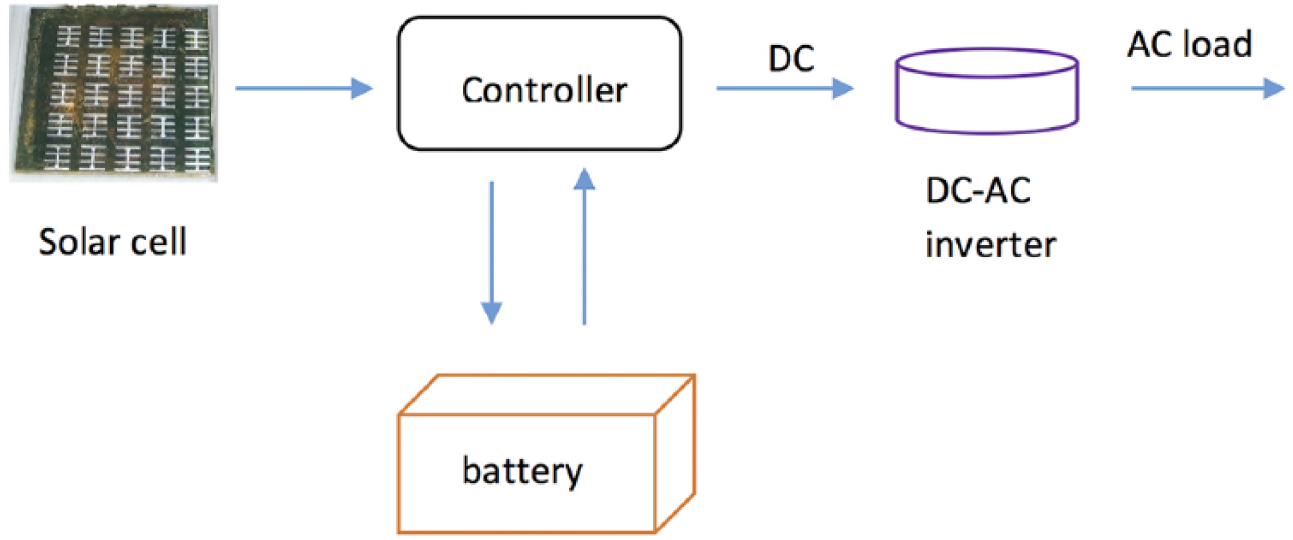
Image of solar cell board renewable energy unit system.
Solar radiation is usable in direct and diffuse components or the sum of both. Direct radiation is where the sunlight is absorbed directly without the use of intermediate reflections or refractions. Diffuse radiation is emitted by the daytime sky due to multiple reflection and refraction phenomena in the atmosphere by clouds and other atmospheric and terrestrial elements. Direct radiation can be reflected and concentrated for use, while it is not possible to concentrate diffused light, since it is received from all directions. The so-named solar constant is the amount of solar radiation energy that is received per unit time (flux of radiation) and per unit area on a surface normal to the Sun’s rays, given the mean Sun–Earth distance, for which the current accepted value is 1367 W/m2. 29 The theoretical potential of solar energy is defined as the energy achieved on the Earth surface and is the maximum possible amount of renewable energy. However, due to the Earth’s axial tilt, the planet orbits the Sun on a slant which means different areas of Earth point toward or away from the Sun at different times of the year and is influenced by geographic factors. 30 In addition, the world is subject to increasing effects of climate change. It is necessary for a number of different countries to identify and work together in addressing this subject. Thus, countries must divest from the fossil fuel sources and instead promote the efficient use of renewable energy, through research, development, and innovation, of which solar energy has the greatest potential. Electricity from solar energy is an advantageous option, because it does not increase the emissions of carbon dioxide and nor does it damage the environment, 28 and moreover, it can be generated in hard to access rural zones where the food production in greenhouses is limited due to a lack of available electricity.
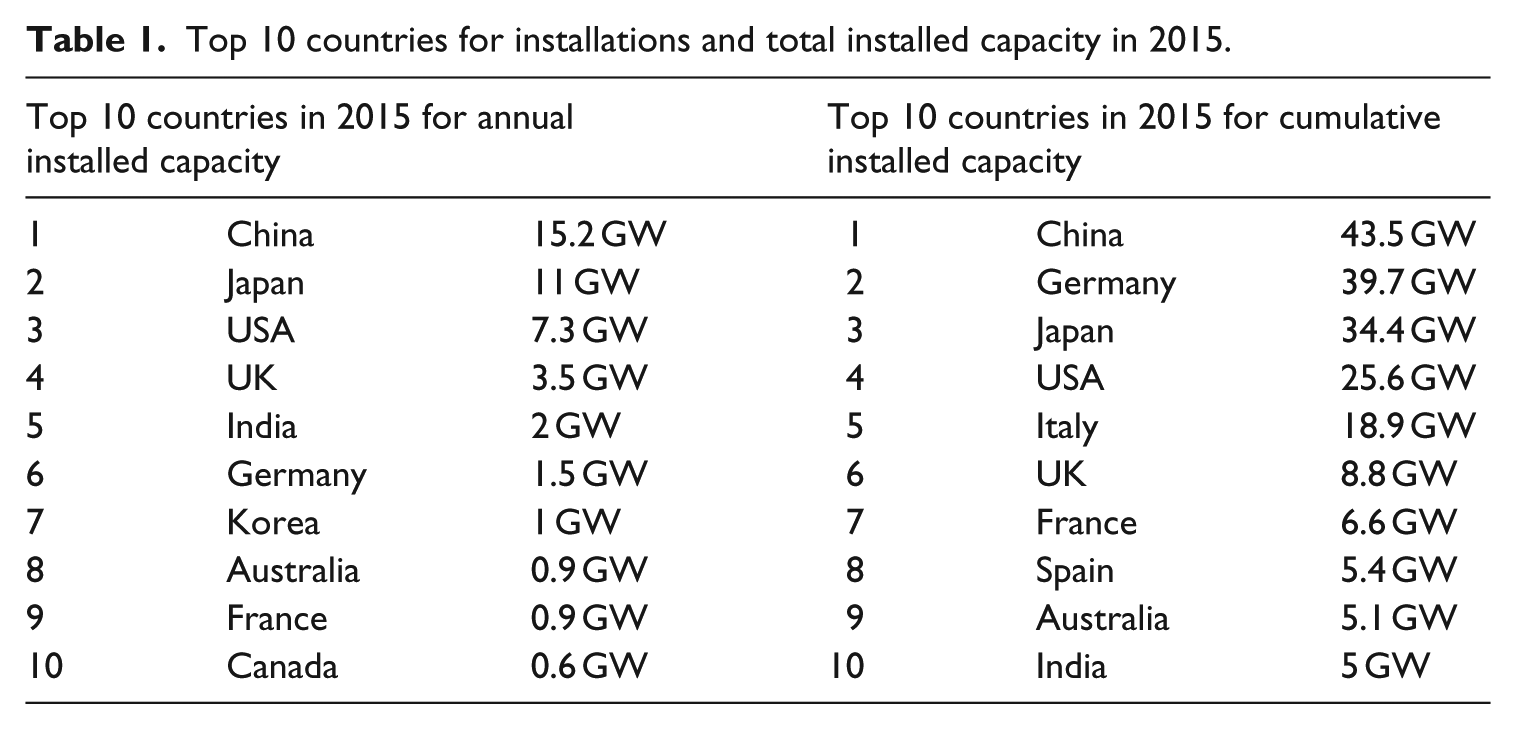
Most countries in the intertropical zone between the tropics of Cancer and Capricorn experience a large degree of solar irradiance and hence have a significant potential for solar energy generation. 31 The increase of the production and use of solar PV modules (Table 1) has met a record of 15.2 GW in 2015 at China. 32 The output from the eight greatest regions for PV solar cell and module manufacture has increased from 21,922 to 28,881 MW from 2014 to 2015, which amounts to an increment of 31% 33 and an annual global production of more than 50 GW during 2015.
Top 10 countries for installations and total installed capacity in 2015.
Studies of PV panels in buildings have focused on building integrated photovoltaics (BIPV)34–36 as a useful building components for power generation, although one of the main problems is the tendency of BIPV panels to overheat. 37
Ordóñez et al. 38 determined the potential of solar energy in Andalusia for PV systems connected to the grid, installed on residential rooftops, and developed a methodology to this end, involving initially a description of the characteristics of the building, followed by calculations of the useful surface of the roof, where solar panels could be installed. In the next phase, the average characteristics of solar radiation were defined and the results showed that the energy produced was 78.89% of the total required, meaning that it was only necessary to provide 21.02% of demand from external power. By reducing overall energy consumption, the dependency on the external power supply could be reduced further.
Moharil and Kulkarni 39 determined the average hourly solar radiation and standard deviation as inputs to simulate solar radiation over a year. The simulation used a Monte Carlo technique, and software was developed in MATLAB to analyze the reliability of small isolated power in the form of PV solar energy, the results of which predicted a deviation of ±10% of the actual values during non-monsoon months (January–May and October–December). The deviation that occurred in the months of monsoon (June–September) was due to cloudiness.
Wang and Koch 30 determined the benefits of integrating solar energy with remote sensing data: the optimal placement of PVs and the base price of electricity resulting from solar energy. A set of data was taken experimentally in five European countries (Austria, France, Germany, Italy, and Switzerland), and the results indicated that Germany is the only region where optimum PV systems could be installed to meet its electricity demand. Kadir et al. 40 have described the various existing solar technologies, and details of each technology and related problems, which will provide an adequate basis for recognizing the advantages and disadvantages in its application in Malaysia. 41
Efficiency of solar cell
When the solar cells are exposed to light, photons are absorbed in the p-n junction, where the electron-hole pairs are generated by the excited electrons from the valence to the conduction band. 13 The photo-generated electrons and holes are simultaneously separated in the junction formed by p- and n-type materials. To simplify the mathematical model of the solar cells under illumination, it is assumed that the rate of generation of electron-hole pairs by the light-absorption is uniform throughout the device. The current drawn from the solar cell under illumination is simply the sum of the diode current and constant photocurrent (JL). 42 The photocurrent JL has a value which depends on the photo-carriers generated by the light in the depletion region of the diode and the diffusion length of the minority carriers on each side. Therefore, it can be concluded that increasing amounts of photocurrent can be generated as a result of longer lifetimes of the minority carriers and large depletion regions. The current–voltage characteristics of solar cells in dark and under illumination are illustrated in Figure 2.
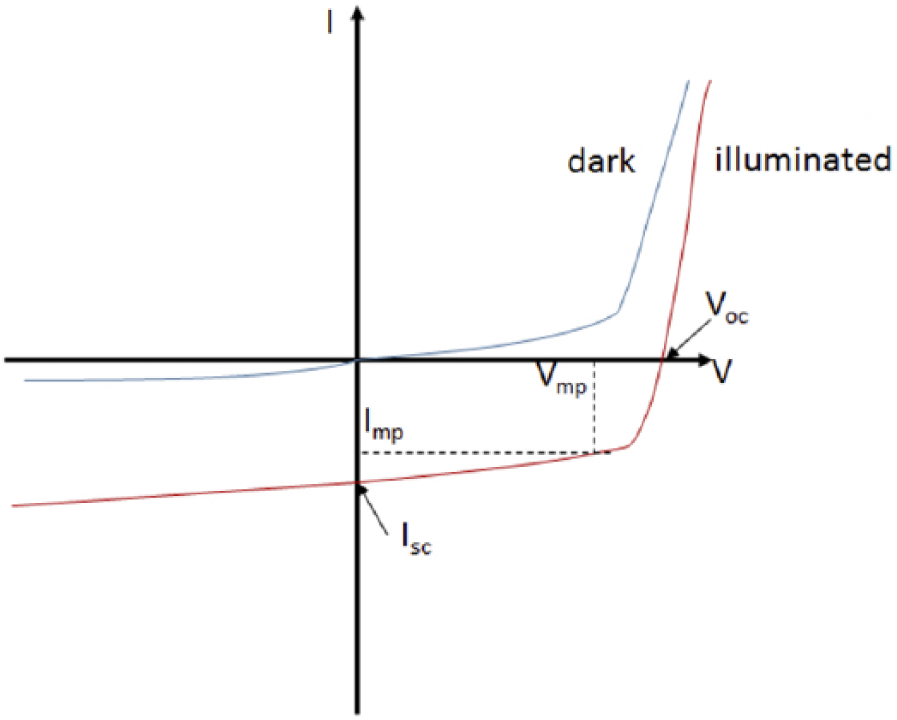
I–V of solar cell when non-illuminated (dark) and illuminated.
Wind energy
Wind energy is related to the movement of air masses from areas of high atmospheric pressure to adjacent areas of low pressure, with velocities proportional to the pressure gradient. During daytime, the air masses over the oceans, seas, and lakes remain cool compared to neighboring masses located over land-areas. Wind power, for now, is a reliable and established technology that can produce electricity at a cost that is competitive with coal and alternative energy such as nuclear, which has been installed during approximately the past 10 years since 2005. 43
Although the amount of wind power is presently economically insignificant in many parts of the world, humanity has long benefited from its use, for various purposes, and the windmills in the Netherlands provide an example of the most widespread application of wind energy.
Araujo-Lima and Bezerra-Filho 44 provided an assessment of wind and a simulation of wind farms in the city of Triunfo, in the state of Pernambuco in northeastern Brazil. Wind data were obtained from the SONDA (Sistema de Organização Nacional de Dados Ambientais) project meteor station (wind speed, wind direction, and temperature), at a height of 50 m over a period of 30 months. The economic model shows a payback of 3 years.
Ouammi et al. 45 investigated the monthly and seasonal variations of wind characteristics in terms of wind power potential using wind speed data collected between 2002 and 2008 for four weather stations in the region of Liguria in northwestern Italy: Capo Vado, Casoni, Fontana Fresca, and Settepani Monte. The results show that Capo Vado is the best site with a monthly average wind speed between 2.80 and 9.98 m/s at a height of 10 m and a monthly wind power density between 90.71 and 1177.97 W/m2, with a maximum energy production being achieved in December with a value of 3800 MWh.
The current challenges to increased penetration of wind power are grid integration, forecasting of wind availability, public attitudes, and reaction to the visual impact of wind turbines. Offshore wind energy tends to be more expensive, and a major challenge for expanding this technology lies in cutting its costs. The variable nature of wind makes it difficult for electricity generated from wind energy to fully displace other electricity sources. 46
Renewable energy in agriculture
Agriculture is an industry that can take advantage of many financial and environmental benefits that can be reaped by applying renewable energy technology. 47 However, there are enormous barriers to the adoption of new technologies with which to harvest and unconventional forms of energy. 48
Renewable energy as a technology application in agriculture is not a new issue. Dvoskin 49 studied the use of socio-economic sources of renewable energy such as wind, solar, and geothermal energy in agriculture. Their results suggest that as initial investment is large and has a high financial risk to those involved in these projects, this is therefore likely to be the main obstacle to the widespread application of these energy sources. Nowadays, renewable energy technologies employ different materials which make them more efficient and cheaper, and there have been several studies made of the use of renewable energy for greenhouse agriculture. Meah et al. 50 have discussed some of the policies to devise a solar PV water-pumping system as an appropriate technology for the region. This is a profitable application in remote locations in developing countries, where the low costs economy and reliability of solar power made an excellent choice for pumping water from a distance. Hanada et al. 51 studied the possibility to implement wind power generation for an agricultural region in Japan, which was presented based on the research topic from the Japanese Ministry of Higher Education COE program. The work focused on the use and benefit of wind power in the region, related to low wind speed as most areas around Tokyo and also mentioned special uses of the wind in the breeding of fish and water pumping.
Sanz et al. 52 analyzed the optimal integration of wind and water energy in a pumping station for irrigation. The size and energy of the pumping station is also optimized to match watering needs for traditional crops and for a thistle crop (Cynara cardunculus). Yano et al. 53 developed a side vent controller for a greenhouse which was powered by PVs. The opening and closing of the vents were set to maintain a temperature between 20°C and 25°C, and the lateral ventilation system is adjustable in several steps according to the temperature in the greenhouse. The ventilation controller was operated by an independent power system comprising an a-Si PV module of 0.78 m2 with a maximum power of 32 W and a battery capacity of 28 Ah at a rate of 5 h (12 V). These results indicate that PV systems are applicable for greenhouse climate control. The production of electric energy in agriculture with PV panels has been stand-alone in most of the systems and mainly used for water-pumping applications.
Vilela et al. 54 simulated an irrigation system for PV pumping in vineyards; these systems have contributed to the water provision for rural communities in remote areas. The production of fruits, with water supplied by PV systems, could become an effective alternative in terms of local economic activities. The viability of this proposal depends largely on the market value of the crop. 54
Wind and solar energy can be used to power the greenhouse to produce fresh water without the support of energy sources from fossil fuels. 55 Nowadays, most of the water desalination uses fossil fuels, and therefore, it contributes to rising levels of greenhouse gases (GHGs). Mahmoudi et al. 6 developed the idea of using solar energy, PV, and wind energy to power a seawater greenhouse equipped with systems for humidification and dehumidification that create the right climate to grow at the same time and to produce fresh water from the saltwater. A greenhouse with a dimension of 16 m wide and 60 m long, produces 297 L/day of fresh water. In just 8 h (between 9:00 and 17:00 h) the greenhouse produces up to 98% of the total fresh water; this interval corresponds to the duration of solar insolation. Andrade et al. 56 proposed in the Brazilian Amazon area the effective electricity supply, considered part of generating wealth and employment plan for the inhabitants of the region while preserving the environment. The solutions offered to each community should take into account the need to manage renewable energy sources, which also should be developed together with a local people.
Different models are presented57,58 to approach a measure to reduce GHGs emissions from agriculture. Smith et al. 59 describe how some countries have initiated climate and non-climate policies that have direct effects or synergistic effects on mitigating GHG emissions from agriculture.
Renewable resources have a huge potential for the agriculture industry. Farmers should be encouraged by subsidies to use renewable energy technology. The concept of sustainable agriculture lies on a delicate balance of maximizing crop productivity and maintaining economic stability, while minimizing the utilization of natural resources and environmental degradation. There is a need for promoting the use of renewable energy systems for sustainable agriculture, for example, solar PV water pumps and electricity, greenhouse technologies, and solar hot water heaters. In remote agricultural lands, the underground submersible solar PV water pump is economically viable and also an environmentally friendly option as compared to a diesel generator set. Renewable energy applied to greenhouse is very important for maintaining the optimum plant ambient temperature conditions for the growth of plants and vegetables. 60
Feasibility of the use of renewable energy in protected agriculture
Agricultural systems are subject to a wide range of risks and uncertainties in most parts of the world. Climatic risks have been historically responsible for widespread droughts, floods, migration, famines, and poverty. While increasing climatic risks in the future would further compound the problem, 61 there is a great opportunity to integrate renewable energy systems in protected agriculture. However, this depends on many factors such as cost of energy, installation and availability of an adequate grid, and all the incentives/subsidies provided by governments to introduce renewable energy, but the intermittent nature of some renewable energy resources impacts on their reliability, operations, and market prices, which in turn affects all market participants. Meeting renewable energy goals may require coordination among many market players. 62 Liao et al. 63 have presented research which shows that the countries that adopt more renewable energy policies appear to generate more renewable energy products. Among those instruments, incentives/subsidies for production are common and decisive to the popularization of renewable energy products. Recently, the primary renewable energy policy goal for governments is to promote renewable energy products by removing various barriers. However, the energy market should be broadened to make renewable energy products ubiquitous and able to compete with fossil products.
Pretty et al. 64 identified three mechanisms by which positive actions can be taken by farmers: by increasing carbon sinks in soil organic matter and above-ground biomass; avoiding carbon dioxide or other GHG emissions from farms by reducing direct and indirect energy use; and increasing renewable energy production from biomass that either substitute for consumption of fossil fuels or replace inefficient burning of fuel wood or crop residues and so reduce carbon emissions.
Rhodes 65 reported the current state of agriculture, emphasizing issues of soil erosion and dependence on fossil fuels, in regard to achieving food security for a relentlessly enlarging global population. He described soil as “the fragile, living skin of the Earth,” and yet both its aliveness and fragility have all too often been ignored in the expansion of agriculture across the face of the globe.
Future trends
At present, there are several technologies for renewable energy generation, for example, wind, solar, hydro, and biomass, but the solar and wind energy particularly are of increasing importance in the analysis, design, and manufacture of new products. The implementation of multi-junction PV devices has made it possible to obtain a higher conversion efficiency due to a reduction of thermodynamic losses, which are associated with the absorption of photons with energies that are higher than the bandwidth of the active layers. Theoretically, triple-junction cells have an efficiency of 50% and to date, triple-junction cells made of III–V materials have achieved efficiencies exceeding 40%. Although high efficiency in the multi-junction is beneficial for reducing the cost of solar energy conversion, the further impact of this technology in the energy market could be hampered somewhat by the high manufacturing costs, in part, due to the high vacuum techniques that are used for growing high-purity semiconductor crystals. Incorporating thin-film technology significantly reduces the cost of production of the multi-junction devices. However, from an environmental standpoint, the technology is limited by the toxic elements that are used in its manufacture. Under this proposal, significant contributions were made in the area of PV materials, with emphasis on those that are suitable for use as a large-area absorbent layer, made using thin-film technology. It is intended to produce PV materials with an absorbent layer of the second and third generation type, using economic techniques such as spray pyrolysis. In addition, there is a further objective, which is to test the multi-junction concept. The application of techniques for manufacturing low-cost multi-junction cells with high efficiency can result in new thin-film deposition technology, at similar or lower costs, but with a conversion efficiency much higher energy than is possible with single junction devices. There is also the issue of the high cost and scarcity of many of the elements used in the production of semiconductor materials with bandwidths (Eg) that are most appropriate for effective absorption of solar radiation; hence, it is necessary to develop new compounds for PV applications, from materials that are inexpensive, easily obtained and that can be fabricated into large-area solar panels.
Globally, there has been a growing trend in the share of wind power in electricity markets by 2009. Last year, however, a decline of 5.8% was recorded, which is mainly due to the contraction in the North American and European markets. Nonetheless, the demand for installing further wind energy contributes to grow, and at the end of 2010, there was 194.5 GW of wind power installed worldwide. The most important contributor in this field of renewable energy production is Europe, with a share of 44.3%, where the main producers are Germany and Spain with 27,214 and 20,676 MW, respectively.
Footnotes
Acknowledgements
The authors would like to thank all participants of this study but mainly to Ing. L.D. Guerrero-García and Ing. R.E. Aguilera-Perez and especially to the members of the Nanobiotechnology Laboratory at Campus Airport of the Autonomous University of Querétaro.
Declaration of conflicting interests
The author(s) declared no potential conflicts of interest with respect to the research, authorship, and/or publication of this article.
Funding
The author(s) received no financial support for the research, authorship, and/or publication of this article.