




Abstract
Strategies for tackling educational inequality take many forms, though perhaps the argument most often invoked is school integration. Yet whatever the promise of integration may be, its realization continues to be hobbled by numerous difficulties. In this paper we examine what many of these difficulties are. Yet in contrast to how many empirical researchers frame these issues, we argue that while educational success in majority-minority schools will depend on a variety of material and non-material resources, the presence of these resources does not require school integration; indeed sometimes the most crucial resources are easier to foster in its absence. To that end, we briefly canvass the evidence from the United States on high performing majority-minority schools serving poor and minority students. Yet because these debates are so contentious in the American context, we pivot away from the U.S. to consider a different country, the Netherlands. We invite the reader to consider an analogous case where racial injustice and educational inequality are just as serious, yet where differences in the state school system might prove instructive concerning how some majority-minority schools choose to respond to existing segregation, but more importantly how educational success can occur in the absence of integration.
The Brown decision, as far as the law is concerned, is truly dead and beyond resuscitation. The question is why on its fiftieth anniversary Brown is not only remembered, but hailed as a landmark?-Derrick Bell (2005), p. 1053
Over the past 60 years a virtual avalanche of studies has documented educational inequalities that track closely with socioeconomic, racial and ethnic status, first language advantage, gendered differences, and (dis)ability (Attewell & Newman, 2010; Carter & Welner, 2013; Downey & Condron, 2016; Duncan & Murnane, 2011; Lewis & Diamond, 2015). The features of educational inequality include, but are not limited to: school financing, chronic teacher shortages, discrepancies in instructional quality, early selection for high school tracks, biased teacher expectations and recommendations, high teacher and administrator attrition rates, disproportionate learning disability labeling and low track assignment for stigmatized minority groups (black males in particular), inequitable rates of discipline and suspension, and much else besides (Berliner, 2013; Diamond & Lewis, 2019; Domina et al. 2019; Gregory et al., 2010; Liu, 2018; Schmidt et al., 2015).
Arguments for tackling educational inequality take many forms. In the United States and elsewhere, massive state investiture is the standard approach. For example, Title I of the 1965 Elementary and Secondary Education Act (ESEA) led to the allocation of federal monies to combat poverty. Later, additional federal funding for the Individual with Disabilities Education Act (IDEA), combined with other state categorical grants, further helped to facilitate the distribution of other resources to schools across the nation: free breakfast and lunch programs, school nurses, physical education equipment, computers, translators, security, enrichment and after-school programs. Further, a wide variety of special education staff, over time, has been added to the local school's list of provisions.
Still other studies zoom in on curricular and pedagogical reforms, for example the importance of focusing on the learning needs of historically underserved students. Many of these studies suggest that a central element is valuing student culture and background (Au, 2011; Lee, 2007). Carter and Darling-Hammond (2016) identified several practices and dispositions that might constitute a typology of traits characterized as culturally responsive pedagogy. These include cultural competency; an ethic of deep care, which Noddings (1988) describes as a teacher's caring disposition to assist children as they develop and grow; awareness of knowledge socially constructed in historical, social, cultural, and political contexts (Villegas & Lucas, 2002); a sense of efficacy (Irvine, 2003); and having an awareness of the social, cultural, and political contexts of education (Howard & Aleman, 2008).
Yet perhaps the argument most often touted for reducing educational inequality is school integration. To garner support for the idea of school integration, a number of studies have purported to document “resegregation” occurring, fueling renewed calls for the urgency of integrating schools (Clotfelter, 2006; Johnson, 2019; Minow, 2010). Some critics argue that schools integrated by race/ethnicity, and especially social class, will improve the peer effects, which means that children can learn at least as much from each other as they do from their teachers (Kahlenberg, 2004, 2007). These peer effects are also taken to address “civic deficits” that, some argue, will fail to materialize for the poor and marginalized unless children learn, from an early age, to interact with others different from themselves (Levinson, 2012).
Other proponents of integration argue that the presence of more middle-class children in the school translates into greater overall parental involvement, network ties and informational resources, and these benefits will redound to families with less social capital (Clotfelter et al. 2006, 2007; Hanushek & Rivkin, 2012). A related belief is that schools with more middle-class children will assist in retaining teachers, which contributes to the stability of the school and produces better outcomes for all. Economist Rucker Johnson's recent book, Children of the Dream (2019) advances this point through critical findings from a longitudinal study of a cohort of adults who were children in the 1960s and 70s who either attended segregated or more racially and economically diverse schools. Across the United States, Johnson found, adults with the best life outcomes, on average, are those who attended more economically and racially balanced schools.
Inspiring though these accounts may be, the integration story remains beset by numerous difficulties. For instance, concerning Johnson's audacious claim about the alleged benefits of attending “integrated” schools, the first half of this paper will be devoted to canvasing a large empirical literature that, perhaps inconveniently, adduces the opposite. Indeed the preponderance of empirical sociological research consistently demonstrates that structural level forces, such as historically entrenched racial hierarchies and the cross-generational socioeconomic features of communities and families, profoundly influence both the opportunities and long-term economic impact of children and youth.
In light of these and other difficulties, in this paper we will examine some of the reasons why school integration, assuming it does not merely reduce to desegregation, i.e., spatial mixing, continues to be an elusive—though undeniably attractive—ideal. However, in contrast to how many empirical researchers frame these issues, we argue that while educational success in majority-minority schools—where poverty is salient and “minority” correlates strongly with stigma 1 —will depend on a variety of material and non-material resources, the presence of these resources does not require school integration, where integration implies “economically and racially balanced’. Indeed sometimes the most crucial resources are easier to foster in its absence. To that end, we briefly canvass the American evidence on high performing majority-minority schools, i.e., schools serving a majority of poor and ethnic and/or racialized minority students. Given the improbable demographic and institutional changes in many neighborhoods and schools, we suggest that we ignore the successes of majority-minority schools to our detriment.
Yet because these debates are so often politicized and polemicized within the American context—often narrowly framed as a debate about “privatization” or “school choice”—in the second half of the paper we will pivot away from the U.S. to consider a different national context, the Netherlands. We invite the reader to consider an analogous case involving poor Muslim minority students attending state-funded Islamic schools, which are majority-minority schools by definition. Doubly burdened with both poverty and racial stigma, Muslim parents must navigate a school system in which racial injustice and structural inequality are endemic to its design. At the same time, however, we suggest that the institutional plurality of the school system allows these parents to select state-funded Islamic schools, thereby turning otherwise de facto school segregation to advantage.
Difficulties with the Integration Narrative
As was noted in the introduction, the integration narrative continues to face many difficulties. Certainly one difficulty concerns the tendency many have to conflate desegregation or spatial mixing with the more demanding conditions of true integration, which presumably would ensure real equality of opportunity (Carter, 2012; Lewis et al., 2015; powell, 2005). And for equality of opportunity to get any traction at all, there first would need to be equality of recognition, status and treatment. Equality of recognition and status would require that all children are seen as having the same intrinsic value irrespective of personal traits, cultural or socioeconomic background, or racialized identity. Meanwhile, equality of treatment points toward equity concerns, i.e., that students be educated in ways commensurate to need. However, in what follows we demonstrate that most school systems remain at a considerable distance from this ideal, irrespective of how much state funding schools may receive.
Also noted in the previous section, the standard integrationist account maintains that mixed schools will—or are likely to—produce more equitable outcomes for poor and minority students. Yet this belief is difficult to reconcile with virtually everything empirical research has reported for the past several decades (Coleman, 1966; Downey & Condron, 2016) concerning structural inequality, which, most studies continue to show, is prevalent in school systems in most countries to one degree or another (Domina et al., 2019; Schmidt et al. 2015; Shavit & Blossfeld, 1993; Van de Werfhorst, 2019). Even in schools exhibiting “economic and racial balance” there is very little evidence to support the claim that either peer groups or high school classrooms are very heterogeneous with respect to race/ethnicity, social class background or ability, no matter how mixed the school population as a whole might be (Angrist & Lang, 2004; Conger, 2005; Darity & Jolla, 2009; Fiel, 2013; Vasquez-Heilig & Holme, 2013).
Where we do have evidence of mixed classrooms, much of the evidence points toward differentiated treatment owing to teacher bias and stereotype threat (Castro Atwater, 2008; Harry & Klingner, 2014; Steele, 1997). Indeed studies consistently show how the practices of “integration” in the U.S. and elsewhere effectively renders select groups of ethno-racial minoritized students as second-class citizens (Bell, 1987; Carter, 2012; Francis & Darity, 2021; Lewis & Diamond, 2015; Tyson, 2011). Consequently, we find that the reduction of the relative gaps between Whites, African Americans, Latinx, and Native Americans has moved at a snail's pace. And that is because stratification within diverse schools generally fails to approximate what advocates presumably mean by “integration’. Even magnet schools, whose purpose by design was to mitigate segregation, continue to be organized in ways that often benefit the more privileged students (Davis, 2014; Vopat, 2011), in large part because of how more educated and affluent parents insist on their own children being advantaged in these and other mixed school settings (Brantlinger, 2003; Calarco, 2018; Dumont et al., 2019; Kelly & Price, 2011; Posey-Maddox, 2014; Saatcioglu & Skrtic, 2019).
Indeed empirical research continues to show that school features often compound the problems historically disadvantaged ethno-racial and poor or low-income communities already face. Sorting and selection procedures via ability grouping and tracking (Francis & Darity, 2021; Tyson, 2011); restricted access to informational networks and social capital (Stanton-Salazar & Dornbusch, 1995); a culture of deficit thinking (Garcia & Guerra, 2004; Gilborn, 2010), low teacher expectations (Castro Atwater, 2008; Verkuyten et al., 2019), curricular erasure (Cornbleth & Waugh, 2012; St. Denis, 2011) and zero-tolerance behavioral policies (Browne-Dianis, 2011; Martinez, 2009) serve to further penalize those whose prospects were already dim, the outcome of which is all too often a familiar tale of educational failure (Downey & Condron, 2016; Duncan & Murnane, 2011; Liu, 2018; Payne, 2008; Schmidt et al., 2015).
Yet perhaps the most formidable difficulty with the integrationist account is the immovably high segregation index in a majority of neighborhoods and schools, and not only in the United States (e.g., Bakker et al. 2011; Johnson et al., 2007). Indeed, given existing levels of residential segregation on all continents—urban, suburban, and rural—it is also not practically possible (and almost always politically impossible) to redraw the lines that determine attendance in ways that would produce more “integration’. And efforts to mix schools are not even feasible in many cities—from Santiago to San Francisco to Stockholm—where the school population in many catchment areas either is overwhelmingly middle-class and “white’, or poor and “non-white’. 2
Thus despite what Johnson (2019) and other researchers (Chetty et al. 2018; Reardon, 2016) hold to be true about the critical importance of “opportunity-rich” schools and neighborhoods (and opportunity-rich schools and neighborhoods are also tacitly understood as “integrated’), the enduring ideological and political resistance to racial and ethnic segregation in the United States since the legal mandates of the much-discussed Brown decision (Brown v. Board of Education of Topeka 347 U.S. 483 [1954]) have led to the most anemic forms of implementation of school integration. Indeed, federal and district court decisions in the United States have virtually dismantled any widespread existence of de jure “integration” (Cf. Milliken v. Bradley 418 U.S. 717 [1974]; Parents Involved in Community Schools v. Seattle School District No. 1, 551 U.S. 701 [2007]).
While the respective legal histories and demographics differ per location, similar patterns can be seen on every continent and in every country where the issue has been studied (Jamil, 2017; Krüger, 2014; Treviño et al. 2018; Van de Werfhorst, 2019; Windle, 2022; Yang Hansen & Gufstafsson, 2016). Importantly, too—and quite irrespective of the historical causes—these patterns seem unlikely to change given both (1) the role that voluntary association (i.e., the freedom to be with others of one's choosing) plays in liberal democratic societies, as well as (2) constitutional guarantees in most countries that ensure parents have the right to select an education they think “best” for their own child, both of which generally pull toward—rather than away from—homophily.
None of this is to deny that occasional integration “successes” occur, or that any number of individuals may have greatly profited from a transfer program or mixed educational setting. From time to time, encouraging evidence of this sort comes to light (Schneider et al., 2021; Wells, 2009). Nor is there any reason to disavow the ideal of integration, one denoting real—versus rhetorical—equality of status, opportunity and power-sharing, rather than merely the formal removal of discriminatory barriers. Neither do we oppose the ideal of learning, living and working together with folks who are different from oneself; indeed, the very idea of education itself depends upon meaningful encounters with a rich diversity of thought and experience. But one can embrace these truths and still take issue with the doctrinaire belief that “integration” will somehow naturally produce equal status and treatment to historically marginalized groups incorporated in mixed educational environments, from K-12 to tertiary education, particularly when these environments often are not designed to foster these outcomes.
Bell (1980) argued several decades ago that in the rush to embrace the promise of the 1954 Brown decision, the (white) liberal establishment adopted a patronizing attitude toward the urban (non-white) poor, coupled with a naïve belief in “school integration” as a social panacea; accordingly, he argued, the liberal establishment belied its denial of the “permanence of racism”. Repudiating both racist treatment and liberal paternalism are certainly reasons that disadvantaged groups may have for rejecting “integration”; indeed for decades the integrationist thesis has been openly questioned by many black scholars (Bell, 1992, 2005; Brooks, 1996; Carmichael & Hamilton, 1967; Cone, 1970; Darity & Jolla, 2009; Diette et al., 2021; DuBois, 1935; Francis & Darity, 2021; Gaines, 2004; Shelby, 2016), many of whom have argued instead for educational alternatives for those trapped in bad schools, in part simply as a strategy for mitigating the racist mistreatment of one's own children in school.
But tepid support for liberal notions of school integration go beyond merely avoiding harm, or wishing not to be treated as a hapless victim. There also is compelling evidence to show that a number of benefits are more easily secured by turning homogenous (read: segregated) spaces to advantage (Albritton, 2012; Allen, 2020; Brooks, 1996; Brown, 2003; McGuire & Tokunaga, 2020; Merry, 2013). However, we argue that the success of such endeavors will depend upon the sustained presence of various enabling resources, several of which we describe in the next section.
Majority-minority School Success
In spite of comparatively lower test scores, graduation and/or college-going rates, in a variety of U.S. contexts, educational failure is not the whole story. Indeed not a small number of schools serving mostly minoritized and/or low-income and poor students thrive and produce successful outcomes (Chenoweth, 2007, 2009; Fech, 2009; Kannapel & Clements, 2005; Ladson-Billings, 2000; Scheurich, 1998). Many of these successes—notably the Knowledge is Power Program (KIPP) and the Harlem Children's Zone—have been carefully studied; other studies have compared large samples in several metropolises (e.g., Denver, Houston, Chicago, Boston) serving mostly poor and minority youth. While the outcomes have been mixed, many interventions reported huge gains after implementing a number of interventions over a sustained period of time. The fiscal costs, too, have been modest (the marginal cost of the program in Houston and Denver during 2010–11 was typically less than $2000 per student). More importantly, there has been a sustained commitment to some basic ideas, such as a culture of high expectations, frequent teacher feedback, more time spent on task, and using assessment data to drive instruction (Dobbie & Fryer, 2011, 2012).
Many of the case studies of successful majority-minority schools reveal that their success is at least partly attributable to significantly strong social psychological and cultural support and engagement (Carter, 2012; Chenoweth, 2007; Lee, 2007; Rizga, 2016; Yosso et al., 2022). Their success also results from specific features, notably a better cultural or ethnic/racial match between school staff and the students they serve (Cherng & Halpin, 2016; Gonzalez, 2013; Ladson-Billings, 2000). Further, their success also ensues from certain kinds of interventions: some pedagogic, such as increased, but especially intensive, individualized academic instruction; others benefit from a reduction in class size, or a combination of these approaches (Dee & Penner, 2017; Dobbie & Fryer, 2011; Rivkin et al., 2005). Still others appear to succeed by focusing on regular school attendance, attitudes, behaviors and skills (Bryk et al. 2010; Hampton, 2014), or else on other, organizational supports such as efforts to coordinate instruction, systems for establishing an orderly, structured learning environment, specialized support for students with emotional or behavioral problems, and coordinated efforts to engage parents in shaping their children's attitudes and readiness to learn (Kraft et al., 2015).
Notwithstanding this and other evidence, it is noteworthy that most scholarship focusing on educational inequality is conspicuously silent concerning these impressive outcomes. Whatever the case, the silence concerning the successes of majority-minority schools is curious to observe given, as we have seen, the relative disadvantages for many black, brown, and indigenous students in so-called “integrated” spaces due to well-documented structural and organizational inequalities endemic to many of these schools (Darity & Jolla, 2009; Domina et al., 2019; Francis & Darity, 2021; Lewis & Diamond, 2015). However uncommon the success stories may be, few scholars exhibit the same willingness to dismiss the positive outcomes of “integrated” schools as happenstance. Indeed, more often than not these successes are extolled as evidence of what it is possible to achieve when learning environments are more equitably arranged and the right kinds of resources are present (Johnson, 2019; Kahlenberg, 2004; Minow, 2010; Siegel-Hawley, 2016). So what can account for the ostensible double standard? Is it merely confirmation bias, i.e., dogmatic commitment to integration, or are there other factors?
One reason majority-minority school successes are generally ignored by scholars may concern some methods used in certain school reform experiments (e.g., firings of school principals, cash payments for completing school work) or difficult-to-scale up practices (e.g., high-dosage tutoring using Teach for America volunteers). Other success stories are sidelined in the political battle concerning the expansion of public charter schools, and school choice debates more generally. Partly this can be explained by the fervency of belief driving different priorities in educational funding and policy; accordingly there remains fierce opposition to efforts to expand similar experiments in majority-minority schools, most especially by teacher unions and scholars devoted to the integration ideal.
Another reason may have to do with how some researchers and policy-makers measure school success, the result of which is a general tendency to reproduce harmful narratives about racialized majority-minority schools. For example, one observes among some scholars a tendency to insinuate these majority-minority school successes as non-scalable flukes propagated by “pro-choice advocates” (Scott et al., 2009), byproducts of neoliberalism, racial capitalism and corporate influence on public education (Watkins, 2015), or else as simply undesirable owing to their being tendentiously framed as “hyper-segregated” (Massey, 2020). Yet while scaling up school success is difficult no matter where it occurs, it is doubtful whether the success of these schools can be attributed to chance. Rather, the best evidence suggests that it is the result of years of coordinated effort to foster improvement, fusing general institutional support, culturally specific local support, and catalytic leadership (Chenoweth, 2007, 2009; Hampton, 2014; Klar & Brewer, 2013; Kraft et al. 2015).
Finally, yet another reason why majority-minority educational success in the American context is typically ignored by many scholars concerns the exclusively negative connotations attributed to any kind of (minority) school segregation, and black segregation in particular. In many countries, including the United States, the terminology itself is justifiably freighted with deep historical scars of mistrust given the ways in which institutional racism has done its most insidious work (Bobo, 2011; Rothstein, 2017). Indeed many continue to instinctively associate all forms of black and brown spatial concentration with apartheid, Jim Crow or a Plessy notion of “separate but equal’. This exclusively negative association with segregation is understandable given its historical and structural associations with racist state policies whose design was—and in many countries, still is—to contain poor and usually stigmatized minority groups within specific geographic boundaries, thereby depriving them of crucial resources and opportunities.
Be that as it may, it is both possible and necessary to use the terminology in a less tendentious way. For example, human geographers and demographers more commonly understand segregation to describe spatial concentrations, i.e., the proportion of two or more populations not being homogenous throughout a defined space (Schelling, 1969), quite irrespective of how they came about. Using this descriptive definition, it has been observed that clustering is the norm around the world, quite irrespective of racist efforts to impose it, and hence there is nothing morally objectionable about segregation per se (Nightingale, 2012; Peach, 1996). Indeed philosopher Bernard Boxill (1992, p. 184) reminds us that Fighting and protesting against compulsory segregation does not mean fighting and protesting against every kind of segregation. It means precisely what it says: fighting compulsory segregation. This is quite compatible with permitting, and even urging, black people to voluntarily self-segregate, and I see no reason why voluntary self-segregation cannot be a sufficient means of enabling the race to make its cultural contribution to the world.
Boxill's point is that “self-segregation” can be authentically voluntary, even when involuntary conditions may also be present. 3 In any case, it is not contrary to reason to prefer an educational setting for one's child in which s/he is not racially stigmatized, or where the possibility of low expectations, low track assignment or disciplinary referral is less likely to occur.
An International Comparison
In light of the difficulties highlighted in the previous section, but also the dominance of American scholarship in these discussions, it may be instructive if we step outside of the American educational landscape and consider evidence from a different country—the Netherlands—where schools are segregated not only by social class and ethnicity/race, but also where educational discourse is situated within a highly racialized nomenclature, i.e., “white schools” versus “black schools’, where a “black” school invariably denotes a school to be avoided in the white imagination. The Dutch case may therefore help us to step away from some of the polarizing rhetoric in the United States in order to examine a remarkably similar phenomenon in which both racist stigma and racialized institutional inequality in the school system is the norm, yet where majority-minority educational success can also be found.
State-funded Islamic Schools
Since their establishment in 1988, and following more than 20 years of struggle to make good on their promise to deliver a high quality education, most Dutch Islamic schools have since effectively managed to deliver success both in the form of academic performance as well as non-academic well-being relative to non-Islamic schools serving a comparable population. Remarkably, too, this has been done amidst a great deal of political opposition (shared equally by political liberals and conservatives), not to mention unceasing populist talk about the urgency of “integration’, whether integration is taken to mean spatial mixing, as neighborhood and school integration typically implies, or more likely, inburgering—i.e., literally integrated into the country's mainstream “norms and values’, a rhetoric often couched in terms of “good citizenship” that plays an even bigger part of the integrationist imagination in Europe, and one more often than not directed at racialized Muslim minorities (Kundnani, 2014; Romeyn, 2014).
At present there are 59 state-supported Islamic primary schools serving roughly 12,500 students. On average, these schools are not only doing very well relative to other schools serving similar populations; for the past five years they also are performing better than any other state-managed school on standardized high school entrance exams, despite serving overwhelmingly high concentrations of ethnic minority (mainly Turkish or Moroccan background), low-SES children. Indeed, recent empirical evidence demonstrates that there is a discernible value-added benefit to the relevant demographic by attending an Islamic school versus another school in the same area serving a comparable student composition, again both as this concerns the well-being of students and their academic achievement. 4
As it concerns non-cognitive measures (e.g., task motivation, self-efficacy, overall well-being), one study (Driessen et al., 2016) found that Islamic schools already score highest in an absolute sense, corroborating more recent findings from qualitative researchers studying the social and emotional impacts of Dutch Islamic primary schools (Beemsterboer, 2019; Budak, 2021). This evidence suggests that children attending Islamic schools report more positive feedback concerning their overall experience while being in school. Though there are a number of reasons for this, both the mitigation of stigmatic harm and corresponding sense of belonging would go some distance toward explaining some of the outcome. Yet it is the quantitative analysis of the relevant cognitive measures where we perhaps find the most surprising results.
Quantitative Analysis: A Closer Look
After having corrected for social and ethnic differences in student backgrounds, Driessen, Agirdag & Merry observe that Islamic schools achieve better (though only in one case significantly) than all the other denominational and non-denominational schools on nearly all output measures, especially with regard to math achievement (p = .03). Reading scores, while less impressive, are still rivaled only by Protestant schools, a remarkable achievement considering that many Moroccan and Turkish parents speak little if any Dutch at home, in contrast to their more affluent and white, Dutch Protestant counterparts. In other words, the authors write, “although Islamic schools in an absolute sense achieve lowest on all cognitive measurements, they succeed in raising their students’ achievement more than the other denominational schools” (ibid, p. 476, emphasis added). To avoid misinterpretation, they take pains to clarify: [W]hen net differences in achievement scores are more closely examined, it becomes clear that Islamic schools are by far adding the greatest educational value. In fact, with regard to a number of achievement measures, Islamic schools succeed in improving their position from the most disadvantaged (gross) sector to a sector which does not differ from the other sectors (net) […] these findings suggest that the academic performance of Islamic schools may owe [a great deal] to a better match between the specific circumstances and needs of these pupils and the chosen educational approach that Islamic schools aim to provide (ibid, pp. 477–78).
The study cited is presently the only English language quantitative study of its kind on Dutch Islamic school performance. Moreover, though published recently, their study is based on data that some will now regard as being somewhat dated.
For these reasons, in this study we conducted an original empirical analysis with the most recent available public data of the academic achievement of students in the Netherlands. More specifically, we used the data provided by the high stakes final test (“Eindtoets Basisonderwijs”) results that all students across the entire country are required to take at the end of primary school (grade 8) from the year 2019. 5 This standardized test assesses achievement levels in math, reading and writing. For each of these domains the Dutch Inspectorate of Education identifies two levels, i.e., basic level and target level. According to the Inspectorate, both the basic level of literacy and numeracy and the target level are needed to help facilitate the transition of students’ subsequent phases of education (Inspectie van het Onderwijs, 2021).
Over six thousand schools participated to these final tests, of which 59 were Islamic schools. Here we compared the achievement levels of these Islamic schools with other schools. Two different comparisons were made. First, (1) we compared the attainment level between Islamic schools and all other schools. This is a gross achievement comparison that cannot be regarded as value-added score, as schools differ in their socioeconomic and ethnic composition of the student body. Therefore, secondly and more importantly, (2) we compared the attainment levels in Islamic schools with other similar schools, that is, schools that have a similar socioeconomic and ethnic composition of students. We did this by taking the school composition index (“gewicht”) into account. This is an index that ranges from 19 to 41.5: the larger this composition index is per school, the larger the share of students from socioeconomically deprived and ethnic minority backgrounds in those schools.
While the average school composition index is 30 across all primary schools in the Netherlands, the index is 37 for Islamic schools, a clear indication of a low socioeconomic concentration. Next, we compared the achievement of Islamic schools with other schools that have a similar school composition. These are schools serving children with similar immigrant background and socioeconomic characteristics, often from the same neighborhood. To calculate this, we used regression analysis in which the composition index is entered as a covariate and the variable denoting Islamic school is a dummy variable. Our results can be replicated by anyone, as the data are available for public use.
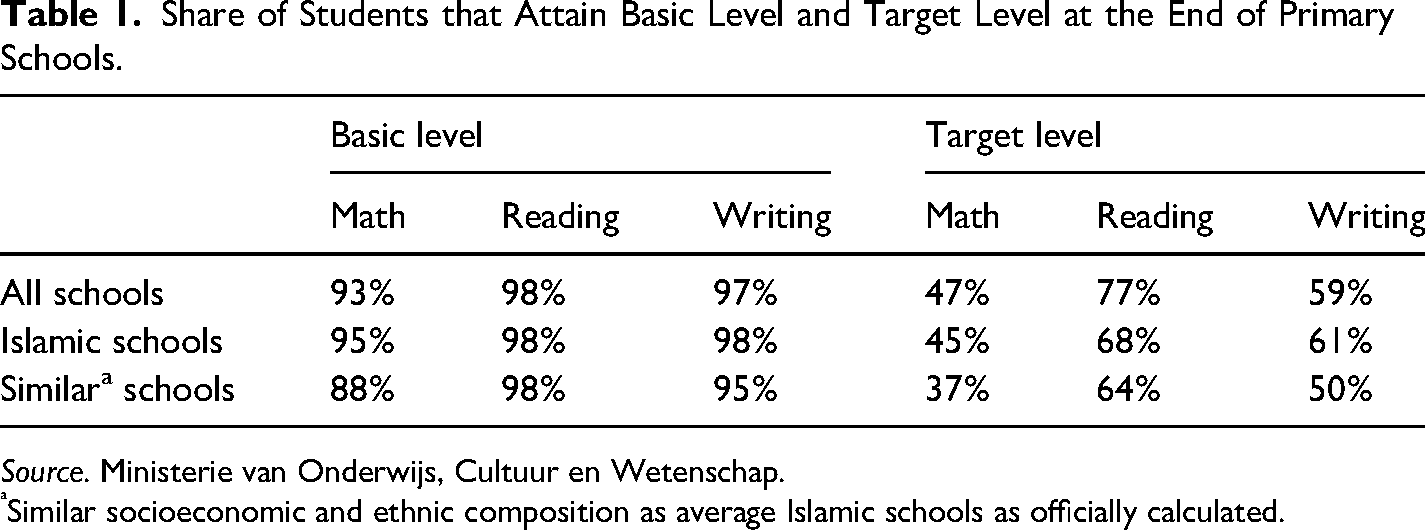
The results shown in Table 1 plainly demonstrate the added value of Islamic schools in terms of the overall academic performance of their students. When compared with schools that have a similar (disadvantaged) student composition, Islamic schools outperform them in all domains (math, reading and writing), both in terms of the basic and target attainment levels. Moreover, these differences are all statistically significant (p < .05). One exception is the basic reading level where there are no differences due to ceiling effect. The difference is most visible regarding math and writing, where Islamic schools outperform schools of similar composition, respectively by an 8% and 9% difference.
Share of Students that Attain Basic Level and Target Level at the End of Primary Schools.
Source. Ministerie van Onderwijs, Cultuur en Wetenschap.
Similar socioeconomic and ethnic composition as average Islamic schools as officially calculated.
Moreover, also when compared to average primary schools in the Netherlands, Islamic schools show tremendous strength. Islamic schools perform slightly better for math and writing as it concerns the basic level, and for writing as it concerns the target levels (even though these differences are not statistically significant). The only domain where average schools outperform Islamic schools is regarding the target level for reading (p < .05), even though 68% percent of students in Islamic schools attain the target levels for reading (which is still 4% higher than in schools with a similar student composition) (Figure 1).
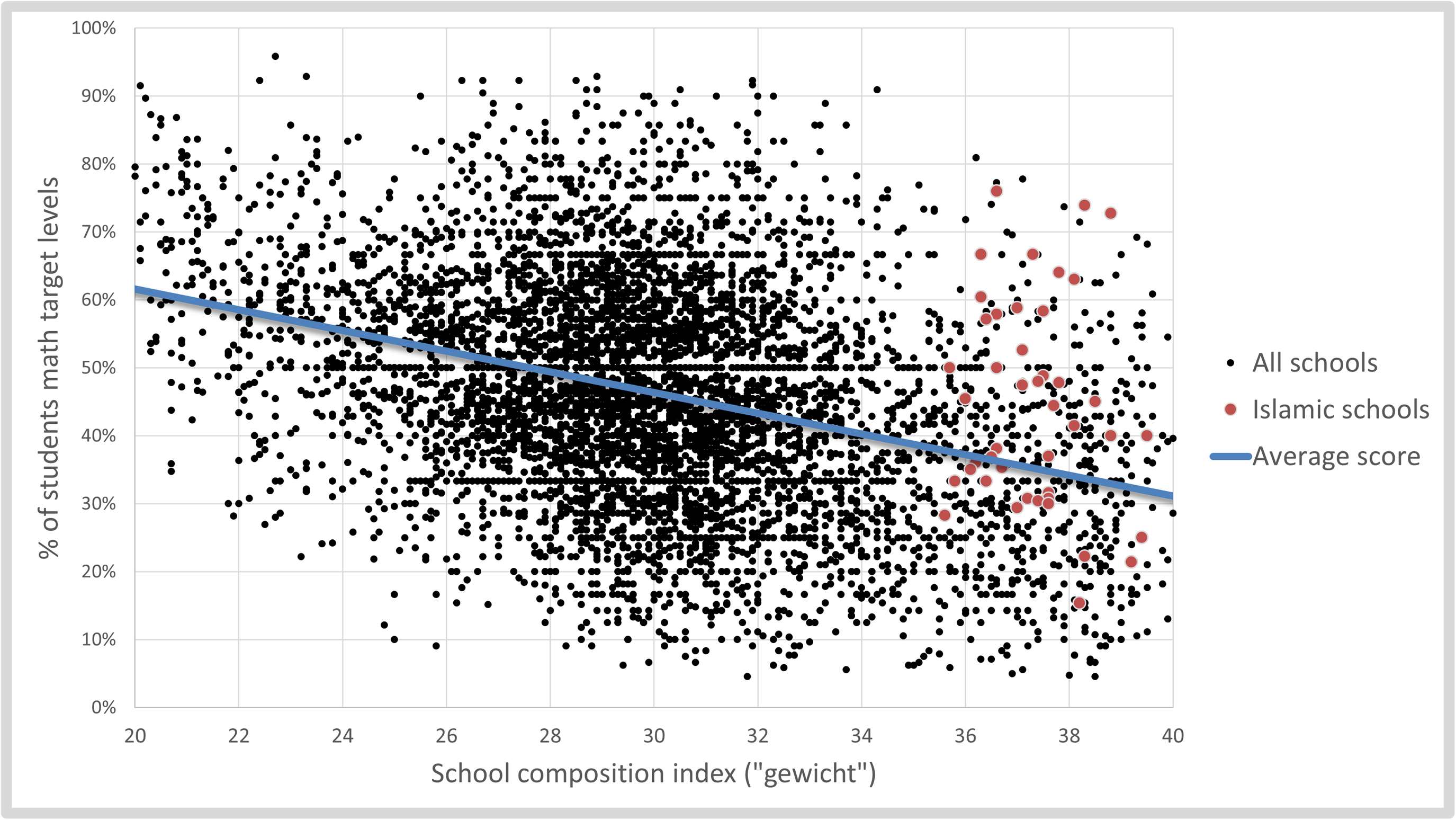
School composition and academic achievement: Islamic schools vs. other schools.
These findings point to some rather remarkable outcomes, especially when one bears in mind: (1) the average low SES status, education attainment, and low level of Dutch language proficiency of most parents who have chosen an Islamic school for their child; (2) the stigma 6 attached to schools with high concentrations of minority children, and Muslim children in particular; and (3) the substandard performance of Islamic schools for roughly the first twenty years of their existence. Indeed between 1998 and 2007 no fewer than nine schools were closed down by the Inspectorate over concerns about quality. In short, the picture since 2012 marks significant improvement, in large part because the focus shifted from expanding the number of Islamic schools to improving quality controls (Merry & Driessen, 2016). In 2019, the last year of test data collection prior to the covid pandemic, no fewer than 3 Islamic primary schools were to be found in the top 38—and hence labeled “excellent schools”—of the more than 6000 primary schools in the entire country (Nederland, 2021).
Significance
While these results were astonishing to many in education policy and research circles, the improvements came as little surprise to those devoted to the continued improvement of Islamic schools. Consequently the demand for Islamic schools has steadily grown, and the number of children now attending them has increased 60% in the past ten years (Broersma, 2019). Tentative plans to open three more Islamic schools are already underway (Soetenhorst, 2021). 7 Also noteworthy is that Dutch Islamic schools do not suffer from a chronic teacher shortage in the way that so many other schools in the larger cities do, in particular those serving a similar—minority and poor—demographic (Boussaid & Merry, 2020).
Consequently, the number of parents interested in their educational services remains high, and understandably so. Indeed what these schools have recognized is that it pays to a have a greater proportion of teachers from the local areas, whose life stories—but also racial/ethnic and cultural features—are similar to those of their students. These features also mean that these teachers are able to serve as role models and academic mentors, a matter of no small importance in a system in which a teacher's advice (coupled with a single standardized test score) all too often steers racialized minority children—and boys in particular—into lower educational tracks, and thus away from university, beginning at a very early age (Crul & Schneider, 2009; Kalmijn & Kraaykamp, 2003; Turcatti, 2018).
And the enabling resources do not stop there: the best functioning Islamic schools have established a strong ethos among teachers, work well with their school boards—in which the local community is also well-represented—and provide a school community where parents feel that they are not only taken seriously, but also are able to feel more involved in their child's education. Thus as it concerns efforts to tackle educational inequality, including the cultural and racial dimensions of this inequality, the impressive success of most Dutch Islamic primary schools illustrates the importance of a local community being in control of its own educational affairs, i.e., of turning de facto segregation to advantage.
There is also empirical evidence suggesting that the role of religious faith and community may provide additional support, which includes aiding in the mitigation of racial inequality (Coleman & Hoffer, 1987; Dronkers & Robert, 2008; Jeynes, 2002, 2010). Taken together, these combined resources serve both to build stronger ties with the parents and community (where trust in the highly stratified school system is otherwise sorely lacking), but also to foster high levels of achievement by protecting primary school age Muslim children from many of the harms of stigma and racism that correlate strongly with teacher bias in a country in which currently more than 95% of teachers are white and middle-class (Inspectie van het Onderwijs, 2019).
Notwithstanding these well-documented successes of Dutch Islamic schools in mitigating educational inequality, both conservative and liberal Dutch politicians and media—similar to elsewhere in Europe—continue to portray devout Muslims as “salafists” and Islamic schools as being merely “segregated” and thus approximating a “parallel society” (Couzy, 2019; Laemers, 2021). But this pejorative framing is curious, considering how hyper-segregated a large percentage of white schools are—white both by virtue of their student concentration but also how they are racially labeled as “white schools” in public discourse. To wit: not only are a majority of Protestant schools hyper-segregated; perhaps mostly especially it is the “free schools” (e.g., Jenaplan, Steiner, Dalton), which typically cater to “progressive” white parents, that are among the most homogenous schools of all (Noort, 2019). Needless to say, no one in the Netherlands (or elsewhere in Europe) raises the alarm about segregation in these cases.
How Apt is the Comparison?
Accustomed to the “wall of separation” discourse that informs legal and political discussions in the United States, many readers will doubtless feel uncomfortable affirming the success of these schools owing to their denominational status, or because the two countries are too dissimilar, or because there is skepticism concerning whether or not achievements in one location are replicable in another, or perhaps simply because of what the findings may portend about segregation.
But the comparison is apt: first, in terms of similarity, non-whites outnumber whites in the four largest Dutch cities; relatedly, school segregation indices in the Netherlands rival the U.S. (Ladd et al., 2010). Second, schools in urban areas deal with many of the same challenges, including a chronic teacher shortage, high-stakes testing, and growing levels of competition between schools competing for the same students (Inspectie van het Onderwijs, 2019). Third, both racial hierarchies (Verkuyten et al., 1996) and socioeconomic inequality 8 are also endemic to Dutch society, and the Dutch school system in particular (Merry & Boterman, 2020), even if few Dutch empirical researchers studying educational inequality pay any attention to stigma, or the institutional features of racism as a relevant variable in the reproduction of this ethnic/racial inequality (Andriessen, 2020).
Moreover, as was mentioned earlier, the Dutch unashamedly continue to invoke labels of “black” and “white” to designate schools on the basis of their ethnic/racial composition, and these labels inform the decision of middle-class parents (both white and non-white) to avoid schools labeled as “black’. 9 Such racialized thinking among parents closely mirrors the situation in the United States (Billingham & Hunt, 2016; Evans, 2021; Krysan, 2002; Norman, 2015; Saporito & Lareau, 1999).
Finally, the comparison is also apt because it shows that a combination of resources is crucial for success: on the one hand these resources certainly include administrative support, weighted student funding and tighter regulatory controls. At the same time, however, other non-material resources seem to matter even more: strong leadership, high teacher expectations, shared academic goals, a value-centered learning environment, empathic care, role-modelling and mentoring, and camaraderie among ethnic and racialized minority peers. Further, as we saw earlier with other successful majority-minority schools, Dutch Islamic schools are able to provide strong social psychological and cultural support and engagement, a better cultural or ethnic/racial match between school staff and the students, and thus generally a more favorable school climate.
There are, of course, important dissimilarities between the U.S. and the Netherlands as well. For example, with the exception of a very small, expensive (yet rapidly growing) private sector, all schools in the Netherlands are fully financed by the state, including denominational (e.g., Hindu, Jewish, Catholic) and other alternative (e.g., Montessori, Steiner, Dalton) schools. In fact, denominational schools constitute more than 70% of the total number of primary schools. Accordingly, Islamic schools also receive 100% of their financing from the state. All Dutch schools must comply with the same standardized learning targets; all schools must teach the state-approved curriculum (with some leeway to accommodate its pedagogical or religious orientation); and finally, all schools are subject to periodic inspection to assess for school quality and performance. Schools failing to meet acceptable standards are given some time to improve, but if and when schools fail in this, they are closed down (Walford, 2001). Other European countries operate similarly. In the final analysis the equal treatment of denominational and non-denominational schools follows from the recognition that the education of every child matters, irrespective of which school the child attends. Thus when viewed in comparative perspective, the American public school system is an anomaly.
This is why it may be helpful to widen the parochial lens and consider the empirical evidence from a different national context. Indeed the penchant for always looking inward, to one's “own” system, to perennially examine the same questions without regard to how other systems operate, leads inexorably to an analysis of educational inequality that yields the same kinds of assumptions, research questions and policy proposals. That is, too often our thinking is circumscribed by the systems in which we find ourselves. Yet if one is willing to learn from other systems, then there is no reason why American education should have such a delimited understanding of “public education’, one only likely to make itself both impervious to critique and incapable of substantive reform.
Of course by suggesting that the Dutch case is instructive, we do not suggest that Islamic schools are popular with a majority of Muslim parents (they are not), or that they are ideal in every respect. As will be the case with any type of school, persons may have a variety of objections: for instance, worries about religious indoctrination or ethnic insularity. Nor is it being suggested that the Dutch education system as such is more egalitarian; as was noted earlier, most evidence points in the opposite direction. Indeed while the Dutch education system may be pluriform, thus offering a more expansive conception of the public, it shares many of the institutionally inequitable features of other European systems (e.g., Austria, Germany, Switzerland) inasmuch as high stakes exams and selection procedures at a very young age (10–12) sort students into rigid secondary school tracks, which are highly segmented by class and ethnicity/race.
When coupled with the liberties provided by the Dutch constitution (article 23) to choose a school for one's own child, the result is a school system that is one of the most institutionally stratified in Europe (Merry & Boterman, 2020). Further, the educational segregation indices concern more than ethnicity/race, religion and social class: PISA scores also indicate that the differences between schools are larger in the Netherlands than elsewhere in Europe. 10 In other words, where one attends school in the Netherlands is causally related both to the kind—but also the quality—of education one receives, as well as to the possibility one has of pursuing both a university degree or a career with influence.
The argument is therefore not that the U.S. ought to adopt wholesale the institutional features of the Dutch education system. Rather, the point is that there are multiple ways to imagine the public and thereby to devise educational strategies whose aim is to respond to existing segregation and mitigate educational inequality. Further, because Islamic schools are incorporated within the state (public) school system, the fiscal resources available to “segregated” schools are often more, not less. Hence for all of its failings, the Dutch case remains instructive.
And because educational provision in the United States is also becoming increasingly diverse, particularly in large urban centers with the proliferation of public charters, American scholarship could learn a great deal by looking beyond its borders to consider alternative institutional arrangements elsewhere. Hence rather than pitting “the public school” against any and all pragmatic alternatives in the pursuit of educational justice, we might expand our conception of public education concerning what it is possible, and perhaps imperative, to do, even if making those changes may require a significant reorientation in our thinking, if not also legislative changes, something that certainly is not without precedent.
For example, legislative changes in the United States at the state (or district / municipal) level occur on a regular basis, as we see with respect to the legalization of marijuana, LGBT protections, proportional voting, death penalty abolition, right-to-die legislation, and many other examples. With respect to education policy, too, many legislative changes have occurred since the 1980s: whether it be chartering laws, disability law, homeschooling laws, or indeed the role that denominational schools can be expected to play in educational provision (e.g., vouchers schemes in Cleveland, Milwaukee, Washington DC and elsewhere), where the non-religious alternatives either do not exist (cf. Carson v. Makin 596 U.S. 20-1088 [2022]), or else consistently fail to deliver better alternatives, something that poor and minority parents have long demanded (Cf. Zelman v. Simmons-Harris 536 U.S. 639 [2002]).
In short, although producing comparable academic outcomes with one's more affluent peers is unquestionably harder to attain for students in mostly low-income, majority-minority schools, it is important to acknowledge and also celebrate quite a significant number of exceptional schools serving minoritized populations. Indeed, their examples serve as compelling counter-narratives to those who continue to believe that poor children cannot succeed in the absence of middle-class children, or to formulate it in terms of racial inequality, that black and brown children cannot succeed in the absence of white children. Yet these are assumptions predicated on deficit thinking about racialized minorities generally, and poor racialized minorities in particular. Both the failure of most “integrated” schools to deliver equal educational opportunity to marginalized students, as well as the success of many majority-minority schools, points toward a need for a broader conversation about ways to promote educational justice.
Conclusions
The integration ideal, where differences no longer matter and all citizens share equally in the bounty of a free and democratic society, has tremendous staying power. So too does the ideal of integrated schools, where children are not educated differently because of their social class background, ethnicity or race but rather with the aim of facilitating true—versus merely rhetorical—equality of opportunity. These ideals resonate as powerfully as they do because they both remind us of the historical injustice of compulsory segregation, as well as point us toward a future in which these injustices might be overcome.
Wherever school integration successes occur they should be celebrated. Yet in celebrating these successes, the larger and more persistent patterns of inequality cannot be ignored. Perhaps in the eagerness to document school integration successes, the harms caused to many children in so-called “integrated” settings have been downplayed, however inadvertently. Indeed, in contrast to the widely shared view that integrated learning spaces can be leveraged for “equal opportunity”—not to mention greater tolerance, understanding and power-sharing—time and again mixed school spaces have been shown to be sites of racist stigma, low expectations and differential treatment. And as many studies continue to remind us (Darby & Rury, 2018; Darity & Jolla, 2009; Francis & Darity, 2021; Lewis & Diamond, 2015), both racist thinking and institutional discrimination in desegregated schools have proven quite resilient. Further, whatever the benefits that may accrue to individuals owing to increased access to “resource rich” environments, often there are very difficult emotional trade-offs that ensue. Indeed far too many children go through their entire school careers without ever receiving the education they deserve, no matter how “integrated” a particular school may be. Thus while integration serves as an attractive ideal, an unyielding “faith in integration” that refuses critique seems—on its own—unlikely to mitigate educational inequality given the volume of empirical evidence concerning the many failings of “integrated” schools.
Meanwhile, segregation indices remain consistently high in many countries, the United States and the Netherlands included. For reasons partly historical, partly constitutional, and partly driven by the prosaic features of homophily, these patterns seem unlikely to change. Lamentable though this may be, the reality may facilitate some unanticipated benefits, provided the relevant resources can be marshaled. Indeed the demand for educational alternatives not dependent on integration can be seen as a means of placing the education of vulnerable populations, to quote historian Carter Woodson (1933, p. 28), back in the hands of those “who understand and continue to sympathize with those whom they instruct.” W.E.B. DuBois (1935, p. 328), who famously abrogated his resolute commitment to integrated schools, expressed similar sentiments: The proper education of any people includes sympathetic touch between teacher and pupil, knowledge on the part of the teacher, not simply of the individual taught, but of his surroundings and background, and the history of his class and group; such contact between pupils, and between teacher and pupil, on the basis of perfect social equality, as will increase this sympathy and knowledge.
The primary obstacle concerning educational success of a majority-minority schools, as these remarks from Woodson and DuBois make clear, is not segregation per se. Indeed these schools—and others like them—demonstrate what a reasonable and pragmatic response to racism and involuntary segregation might look like, when “integration” is either not an option to begin with, or else when “integration” leads to one's permanent subordination within a system whose design virtually ensures that one will be labeled, sorted and segregated from within.
Nor is the principal problem one of adapted preferences, where parents only come to prefer “segregation” because they fail to appreciate what they are missing in an “integrated” school, and therefore settle for less. Many parents know all too well that their children are less likely to be held to the same high standards if and when their child is stigmatized and his or her teachers lack the “sympathetic touch” both Woodson and DuBois speak of. Indeed it is precisely this awareness that drives so many poor and minority parents to search for educational alternatives for their children (Fields-Smith & Williams, 2009; Mazama & Lundy, 2012; Puga, 2019). It is also one of the primary reasons why so many Muslim parents express enthusiasm about Dutch Islamic schools.
But worries concerning the bigger patterns of inequality also apply to majority-minority schools, where too often the crucial non-material resources are absent. And thus it is germane to ask whether or not segregation coincides with extreme deprivation. There is abundant evidence demonstrating how the juxtaposition of poverty with racial segregation entrenches patterns of inequality, whatever the racial dimensions of that inequality may be (Sharkey, 2013). If and when the relevant resources necessary for tackling entrenched inequalities are absent, then the most effective educational response must be reassessed. But in assessing how best to proceed, it will be important to remember that resources take different forms; increased financial expenditure that fails to provide the other non-material resources can only go so far.
In any case, it will not be a foregone conclusion that “integration” is the most desirable—or even feasible—way to provide those resources, let alone address racism or entrenched patterns of educational inequality. To persist in this belief no matter what the evidence says, no matter what the realistic options for “integration” are, and moreover no matter how often poor and minority parents demand alternatives—alternatives that more privileged parents unfailingly have at their disposal—is morally dubious. Indeed it will strike many readers as disingenuous concern to object to a “segregated” school if and when that school may do a better job serving its students, and if and when those most ardently championing integration, where it concerns their own children, avoid schools and classrooms with stigmatized minorities in any case.
Footnotes
Acknowledgements
Warm thanks to Prudence Carter for her important contribution to this research.
Declaration of Conflicting Interests
The author(s) declared no potential conflicts of interest with respect to the research, authorship, and/or publication of this article.
Funding
The author(s) received no financial support for the research, authorship, and/or publication of this article.
