




Abstract
This paper seeks to extend the debate around the contested concept of the ‘reflective practitioner.’ This concept has influenced practice-based learning across a range of disciplines, including social work, nursing and teaching and although assumptions are commonly made about its value to the developing practitioner, it has also been subject to critique. From the perspective of Scottish teacher-education, we propose moving beyond commonly accepted reflective practices to arrive at a reframing of it as a ‘more than human’ (Strom and Viesca, 2021) endeavour, in a way that decentres the practitioner from the process of reflection. We firstly consider some benefits and limitations of commonly used, human-centric models of reflection in teacher education; both in practice and in regulation. We then use two familiar classroom scenarios to demonstrate how these models of reflection can constrain the reflective process, and student-teachers’ agentic possibilities. We explore how a theoretical reframing of the problem through connectivism (Downes, 2007; Siemens, 2005), offers a fresh perspective that challenges the practitioner to reflect in multiple dimensions; on their means of connecting with others and the ‘matter’ of their practices – the material, physical and conceptual objects that are drawn into the orbit of the day-to-day work of teaching and learning. The proposed approach invites student-teachers to decentre themselves from their reality and consider a range of realities, allowing their reflections to more genuinely, critically and authentically reflect the realities of their experiences in the classroom. Although situated in the context of Scottish teacher education, this provocation offers fresh consideration of a problem that is currently of relevance to student-teachers and those involved in teacher education in both a UK-wide and international context.
Introduction
Reflection and its associated derivatives, ‘reflective practice’ and ‘the reflective practitioner’ have been established features in the lexicon of a range of professions, such as nursing, counselling and social work, for some time (Bassot, 2015). Their dominance in the development of teaching and teacher education over recent generations has been significant. Although a heavily contested concept, constituted by ‘the confusing morass of meanings, the treacle that we encounter in the uses of the term, reflection’ (Fendler, 2003: 7), there are assumptions in teacher education and teacher education literature, that reflection in the practice of teaching leads to ‘empowerment’ (Osterman and Kottkamp, 2004); some go as far as to justify it as ‘non-negotiable’ (Atkinson and Irving, 2013) and that to question its value has been, by some, considered ‘disturbing’ as identified in Beauchamp (2015: 126).
Few, if any, educators would argue that unreflective practice is a helpful disposition to hold. However, this is not to suggest that there is a lack of critique around the notion of reflection in teaching; on the contrary, it has been amply and extensively critiqued since as far back as 1994, beginning with Zeichner who called into question its value as an individual, inward-looking pursuit, neglecting consideration of wider influences in teaching and learning processes (Zeichner, 2005). This was further developed by, for example, Moore (2004, in Gillies, 2016) as a superficial exercise in self-evaluation (p 16) and Seaman (2008), who argues that the issue has been simplified and narrowed by the dominance of the slavish adherence to experience-reflect-learn cycles that ‘might now be influencing research and practice in unhelpful ways’ (Seaman, 2008: 15). Nonetheless, the issue of reflection continues to have prominence in teacher education, and there has been considerable emphasis on a small number of models for reflection in practice; this is problematic for several reasons that we shall elaborate in the following discussion.
In this discussion paper, we will examine some models for reflection that are familiar to student -teachers and educators of professional practice. We discuss the perceived benefits and limitations of these models and of the reflective process that student-teachers in particular are typically required to undergo. To illustrate this, we first detail two typical, hypothetical classroom scenarios appropriate for a student-teacher reflective task and highlight how the process can, and often does become an exercise in traducing the reflective task to mere fictionalising of the student-teacher’s experiences in the classroom. We explore how accepted practices can short-circuit possibilities for meaningful reflection when contradictions with what is known through theoretical knowledge become apparent. We interrogate how this, in turn, contrary to guidance and rhetoric, forecloses opportunities for critique and transformation of practice. Finally, in thinking beyond the limitations of current espoused theories and practices in reflection, we draw inspiration from more-than-human theoretical perspectives and suggest a mode of reflection that decentres the student-teacher. Through introducing a more open, networked perspective on the reflective process, we argue that logical truths can be challenged, that reflection can provide a conduit for meaningful interrogation of experiences and ideas and that this alternative approach offers a possible means for how the transformative potential of reflection might be reclaimed, in theory and in practice.
Literature review
Reflection in practice has been extensively reviewed and critiqued in literature in a wide range of ways and it is not our intention to repeat or revisit the issue in a generic way. As our perspective in this paper draws attention to dilemmas and contradictions in the theory and the practice of reflection as a stance that educators are encouraged to adopt, we will discuss some of the models of reflection that are commonly used in teaching practice, their benefits and limitations, and highlight some of the further problematic issues around reflection.
Schön’s model of reflection
Donald Schön is often considered as a canonical source when reflective practice for teachers and student-teachers is concerned, although both his influential 1983 and 1987 texts address the education of professionals in a generic, not teacher-specific sense. Schön’s work sought to foreground the experiences that arise in the moment, during reflection-in-action and derive knowledge from reflecting upon them. This model provided a means by which professionals could learn from their ‘experiences in professional action’ (Russell, 2013: 85). Schön’s work is recognised by Hébert (2015) as signalling a shift of emphasis in the discourse on reflection from the abstraction of experience as rational justification for action to the subjectivity at the heart of the individual’s ‘experiential realm’ (Hébert, 2015: 365).
A problematic and enduring consideration for education that emerged in this work is the theory/practice divide, as it is relevant in teacher education. In Schön’s work, this is characterised by the problematic analogy of two opposing positions: academic, theoretical knowledge and practical knowledge that comes from experience. Schön (1983: 42) referred to the theoretical side of this equation as the ‘high, hard ground,’ while practicum placements require the student (of any professional orientation) to perform in ‘a swampy lowland where situations are confusing ‘messes’ incapable of technical solution’ (Schön, 1983 in Russell, 2013). Not only is this unfortunate in invoking value-laden ideas of superiority and inferiority attributed to each context in unambiguous ways, it is possible to question the fact that swampy uncertainty is exclusively a feature of practical experience; it might also be considered as an aspect of academic practice. To suggest that the ‘hard high ground’ might be abundant with ‘technical solutions’ to messy problems of practice is also open to justified contention.
Kolb’s and Gibbs’ reflective cycles
Building on the ideas developed by Schön on experiential reflection-in-action, Kolb (1984) and Gibbs (1988) contributed cyclical models for reflection. For Kolb, the process involved a cycle of four stages of reflection: reflective observation; abstract conceptualisation, active experimentation and concrete experience (Kolb, 1984) and this is the basis of his highly contested Learning Styles Inventory (Kolb, 2007), which will not be considered in this discussion. For Gibbs, additional steps in the reflective cycle were incorporated to address feelings, resulting in a six-step cycle involving: description; feelings; analysis; evaluation, conclusion and finally, action plan (Gibbs, 1988). These models offer structure to what can be a challenging task for student-teachers who may struggle to identify starting points and ways to develop their reflections, which are mandatory components of coursework in many teacher preparation programmes. The mandating (and assessing) of such a personal and invisible practice such as reflection calls into question issues of performativity, audience, privacy and purpose. It is also questionable what value might be added to the student-teacher’s learning experience with such simplified, prescriptive rubrics (Bolton, 2014).
The closed, cyclical nature of these models gives the impression that finishing points are achievable, experience is decontextualised, logic is inevitable, and problems are solvable within the boundaries of the steps they provide. Inconvenient, messy, ‘un-simple’ (Bolton, 2014: 58), unresolvable, gnarly problems of practice are non-linear and tangled-up in a holistic, multi-faceted and connected range of personal, social, contextual, and sometimes political, factors that might not be immediately obvious to the student –teacher, and are difficult to accommodate within prescriptive, lock-step arrangements. These models encourage student-teachers to mould their reflections, no matter how inconveniently messy, to ‘fit’ within them.
The models mask further problems with reflection in practice, namely, the highly individualised nature of it and the fact that they encourage the focus on singular, discreet events. Seaman (2008) invoking Fenwick (2001) highlights the difficulties of positioning reflection as a ‘bounded object’ (pp. 7–8); an experience that sits apart from its subject. The subject, object and process of reflection are inexorably bound together and any attempt to disentangle these elements from each other traduces the authenticity of each one. The contrived stability of lock-step processes, described by an individual who is positioned at the centre of the process, denies consideration of “subjectivities that are potentially multiple, shifting, transgressive, and spontaneous [and these] are recast as coherent, stable, rational, and self-regulating” (Fenwick, 2001: 32 in Seaman, 2008: 13).
Brookfield’s model of reflection
Brookfield (1995, 2017) breaks out of the cyclical models and offers four ‘lenses’ to challenge the epistemological constraints that are implicit in the notion of the reflective practitioner self-reflecting on practice in isolation, inviting the practitioner to assume different perspectives including theory, the mentor, the self and the pupil.
This is an oft-cited text when supporting student-teachers in developing their own reflective practice. There are many reasons why Brookfield’s work is appealing. Firstly, the four lenses (student eyes; colleagues’ perceptions; personal experience; and learning from theory) are simple and memorable. Secondly, Brookfield’s writing style is accessible, and the narrative is credible, linked to Brookfield’s own experiences. It is also well-considered and balanced.
Yet, when we start to explore Brookfield’s (2017) work more closely, we can see that rather than schools, Brookfield references Higher Education settings in his writing. His personal experience and reflections are centred, not on school children, but on adult learners in university settings. Therefore, there is a tension between whether Brookfield’s ideas are focused on andragogy, the teaching of adults, or pedagogy, the teaching of children. While a distinction is not always drawn between the two, we must be careful not to assume principles for teaching 20-year-olds are also relevant for 5-year-olds.
One of the contentious areas of Brookfield’s (2017) model for us is utilising colleagues’ perception of another’s practice as a lens to review one’s own practice. As we will see, problems arise when a student-teacher observes practice that they would question. An example of this might be centred around ability grouping and setting within the classroom. We will elaborate this example in one of the scenarios in a further section.
Means and ends of reflection
As we can see above, reflection and reflection models are dominated by solutions-focused approaches to problem-solving, that is: enquirers start from a point of doubt, an interruption or an event that gives pause for thought and the work of the reflective task is to turn that doubt into certainty. Reflection here is not an end in itself, but rather a means to a desired end, which is a change or action of some sort. With reference to Schön and Dewey, Hébert (2015) explains: ‘the final goal is the rational exposition of an issue that results in the alleviation of doubt by way of certainty, or at least, as close to certainty as possible’ (p 363). This effectively positions the enquirer in deficit, suggesting reflection should result in some required change, rather than reflection as either the disentangling of a puzzling thought, an opportunity to ponder a question, or the examination of what is going well, should be celebrated, or maintained. Hébert (2015) also points out that this approach to reflection excludes that which might not surprise, shock or interrupt but may still merit scrutiny, such as some societal norms or values, which we will further explore in our scenarios. It can be seen that cyclical models can limit both the way that reflection is conducted and the parameters of what can be considered worthy of reflection.
Problems are identified elsewhere in the failure of these models to show any relationship to improvement in practice. Beauchamp categorises these into four shortcomings: the lack of real reflection; the narrowness of approaches to reflection; problematic ethical considerations; and structural and other limitations on reflection (Beauchamp, 2015: 127). Russell (2013) pins the failure of reflective practice squarely on teacher education, claiming a lack of effective modelling of reflection-in-action, of clear explanation of reflective practice, and clarity of its potential effects on professional learning. This, as well as teacher-educators’ remoteness from classroom practice and their failure to adequately link reflection to professional learning has, according to Russell, contributed to student-teachers’ muddled understanding of the concept of reflection resulting in ‘reflective practice having done more harm than good’ (Russell, 2013: 87).
Pirrie and Day (2019) in critiquing Gillies (2016) note that the separation of the student from ‘the other’ - being the teacher, the academic, or any resource upon which they might reflect – is unhelpful, as it positions the student as ‘part of a process they have played little part in determining’ (Pirrie and Day, 2019: 489).
Taking this idea further, typical reflective tasks can encourage student-teachers to focus on the ‘means’ of teaching, by refining technical aspects of teaching to replicate existing, observed practices in an attempt to ensure that practice conforms to a version of what others think student-teachers should be doing (Zeichner and Liu, 2010). These authors highlight further shortcomings of this limited, individualistic approach to reflection as one which avoids wider moral and ethical questions of practice, pays insufficient attention to sociocultural contexts of education, and spotlights the individual teacher as owner and solver of any problems they might encounter. Mantle (2019) helpfully shifts the spotlight from individual to collective discussion, through advocating the use of Action Learning Sets that allow student-teachers to construct their own oral narrative by reflecting on experiences, actions and decisions through discussion.
Limitations of the techno-rational model of reflective practice are highlighted by McGarr and Emstad (2022) and Hébert (2015). Drawing on Halliday (1998) and Belvis et al. (2013), McGarr and Emstad point out that as a skill for individual performance improvement, reflection can result in superficial and formulaic narratives detailing various combinations of accounts that include the teacher, the task, the interaction of both with children, and the outcome, while narrowing the recognition of what wider contextual factors might influence practice.
In casting reflection as a form of ‘confession’ (McGarr and Emstad, 2022) suggests strong associations with judgement, surveillance, and the ‘normalising’ of the reflective process. According to these authors, this analogy evokes misleading connotations of ‘right ways’ and ‘wrong ways’ of reflecting being imagined by inexperienced student-teachers in practice. MacFarlane and Gourlay (2009, in Beauchamp, 2015) highlight the ‘emotional performativity’ involved in mandatory reflection. Beauchamp (2015) supports Russell (2013) in acknowledging the need for a more nuanced understanding of reflection to be embedded in teacher education; an understanding that reflects the shifting social contexts of schools, the evolving identities of teachers as they explore their emotional and cognitive development, and acknowledgement of a more holistic embodiment of experience.
Fendler (2003) uses Foucauldian governmentality as a lens for analysis and points out how seriously limiting the reflective process can be when positioned as norms and accepted values that have become ‘semi-sacred dogmas’ (p. 22). The concern here is one that we will develop in our scenarios: in the classroom practicum situation, student-teachers work closely with experienced teachers whose role it is to support and mentor them, leading to assessment of their placement. A student may come to observe and ask legitimate, critical questions of certain classroom norms of practice, as exhorted by the professional standards to which they must subscribe (in Scotland) and enact if they are to succeed and transition to professional status as a teacher. However, their theoretical knowledge may contradict some of these observed norms of practice and leave the student in a dilemma: whether to have courage and freedom in decision-taking and acting agentically in the best interests of those they teach (Molla and Nolan, 2020) and expose contradictions arising from what they know and what they observe, or whether to avoid being seen to critique the practices of their school-based mentor who ultimately holds the keys to their success through assessment. In other contexts, such as England, policy decisions have focused teacher education more on ‘craft’ or technical aspects of teaching (Ellis and Spendlove, 2020), making even the contradictions hard to see. In navigating this dilemma, student-teachers risk sacrificing their agency as passive enablers of a status quo; potential conflict, or at worst, failure of placement. The elaboration of such dilemmas in two scenarios will now follow.
Classroom scenarios for reflection; two illustrations of the problem
In this section we present two typical scenarios commonly used by student-teachers as a basis for reflection on their experience of practice in schools. Typically, this is done in an electronic portfolio document that is assessed by both school-based and university-based educators. We will consider how theory can inform the reflections and highlight the limitations and dilemmas student-teachers may encounter in attempting this task, using the individualistic, techno-rational approaches to reflection they are most often directed towards.
Scenario one: The ‘ability grouping’ problem
There are various ways in which student-teachers are encouraged to consider individual learning needs within their teaching. Terms like differentiation and adaptation are commonplace and intermingled with concepts like inclusion, social justice and bridging the attainment gap. Yet, student-teachers will also observe practices that have been empirically proven to have little impact on learning; for example, ability grouping.
Research over time (Francis et al., 2016; Francis and Taylor, 2018; Ireson and Hallam, 1999; McGillcuddy, 2021; Mowat, 2022; Neumann, 2021) reveals that ability grouping does not benefit children, and can actually harm their social interactions, entrenching social divides and increase academic disparity (McGillcuddy, 2021) even within the paradigm of comprehensive education (Neumann, 2021). Yet, ability grouping persists in general educational practice. This is possibly linked to its origins, which were policy-led rather than research-led. Ability grouping, or setting by previous attainment, gained prominence during the early 2000s when England launched its National Numeracy and Literacy Strategies (Department for Education and Skills, 1999) as these documents and the associated lesson plans mandated a specific type of lesson structure, one where there was a starter, a main learning input, group work (where children were in ability groups) and a plenary. While never mandated in countries like Scotland, the ideas and lesson resources permeated and were adopted into practice. Thus, a normative practice of grouping children and teaching them to their prior attainment was established.
This presents a dilemma for student-teachers. If a teacher, supporting the student-teacher uses ability grouping, and suggests a student-teacher should use it, what does a student-teacher do? Do they follow academic theory, as Brookfield (2017) suggests through one lens, or do they follow the guidance of their colleague? Even for an experienced teacher this would be challenging. Let us consider the options.
Firstly, the student-teacher might consider ability grouping from the perspective of the children in the class. They might find the children enjoy being in groups. Some children, categorised as higher ability, might feel that it enables them to be challenged, and children categorised as lower ability might find it provides them with learning support or allows them to work at a comfortable pace (Tereschenko et al., 2019). Yet, McGillcuddy (2021) argues that children in ability grouping start to develop tendencies to restrict themselves to friendships only with other children in their ability group. They form identities of being clever, or not, and disproportionately minority groups are further marginalised (McGillcuddy, 2021). Therefore, through Brookfield’s pupil lens, even when expressed positively, in considering social justice and inclusion, the student-teacher would identify that ability grouping was divisive and antithetical to inclusive pedagogy.
Secondly, personal experience might inform student-teachers’ practice. As learners in schools, they may have possibly been educated in ability groups. They may have been considered as successful student-teachers at school themselves and were possibly in the groups categorised as higher ability. Therefore, their perception of ability grouping might be informed by their own successes. This does not mean that the children they are teaching will benefit from this, as their own view negates the experiences of those in other groups and links back to McGillcuddy (2021) who claims that children categorised as higher ability start to think less of others as they are perceived as needing more help. This can then justify why learning support staff are directed to support children categorised as lower ability (EEF, 2019). Yet the research from the EEF (2019) found that often this resulted in support staff actually doing the work for the children and potentially reinforcing the attainment gap.
If we consider ability grouping from a theoretical perspective, we identify that it can be potentially harmful, not just poorer practice. We can see that children in ability groups struggle to get out of those groups (Allen, 2019) and that those social divisions increase as children get older (Mowat, 2022). Ability grouping mitigates against social justice and inclusion (Ravet, 2017) and perpetuates the attainment gap between privileged and disadvantaged students (Mowat, 2022).
The reflections generated by a student-teacher using three of the four lenses might conclude that ability grouping is ineffective practice and is not something they should do. However, despite this, many will continue to use ability grouping in their practice, and this can be explained by the fourth Brookfield lens.
Colleagues’ perceptions prevail in professional practice. We know from research on mentoring and student placements that if student-teachers do not socialise into their placement context (Johnston, 2021), they are at risk of being failed. Socialisation means ‘fitting in;’ listening to and acting upon feedback and advice and avoiding conflict (Achenstein, 2002) that would make them at odds with their classroom teacher-mentor or school context. A sense of agency is therefore limited for student-teachers; they will, despite all the above information, model observed practice and if this happens to involve ability grouping, their capacity to resist this or honestly and critically reflect on it using the model suggested above is hamstrung: there is no room for critical reflection.
Scenario two: The ‘behaviour management’ problem
It comes as no surprise that the issue of classroom management and behaviour is one that greatly exercises most student-teachers. Kwok (2023) suggests that this represents such a significant preoccupation for them that it should be addressed in teacher education programmes. Teacher educators and mentors will recognise this preoccupation. In Scotland, the language in policy concerning behaviour management has evolved over recent decades to reflect a more child-centred approach and the foregrounding of relationships as key to practice (Ravet, 2017), as opposed to behaviour itself (Scottish Government, 2017). Classroom behaviour management also features in the General Teaching Council’s Standards for Registration under changing guises (see GTCS website). Again, the language that reflects the issue has changed over recent decades. The 2012 category of classroom management conflated classroom organisation, classroom management, the use of behaviour strategies and developing relationships into one category that was expressed as follows: ‘Classroom Organisation and Management [With further expectations to…]: • Create a safe, caring, and purposeful learning environment • Develop positive relationships and positive behaviour strategies’ (GTCS archive website)
This was replaced in 2021 by a much broader reference to simply: ‘The Learning Context [With further expectations to…]: • Effectively organise and manage learning • Effectively utilise learner participation • Build positive relationships for learning ‘(GTCS website).
This shift represents more than a move away from the ‘management’ of behaviour and the development of behaviour strategies; it removes them altogether.
Given the policy directives as detailed above, it would be reasonable to make the assumption that expectations of practice might also reflect this shift from strategies for positive behaviour to a stronger focus on relationships. It is important to note at this point that this policy perspective is unique to Scotland and not necessarily applicable to the UK. In England (and in other countries such as Australia, for example), discourse on classroom behaviour has become highly polemic and now seems to be characterised, at least partly, by the controversial ‘neo-traditional’ movement. This shift has been attributed to the convergence of a number of highly influential actors such as the Michaela Free School Community (MFSC); the ‘Teach like a Champion’ (Lemov, 2015) programme and the English Department for Education’s government appointed ‘Behaviour Tzar,’ all of whom advocate a highly behaviourist approach to student behaviour that is characterised by an authoritarian discipline of ‘ no-excuses’ and ‘zero-tolerance’ (see Cushing, 2021; Graham, 2018 for more information).
Research suggests that behaviourist approaches to managing children have serious limitations. Behaviourist approaches, are understood for this article as rewards systems such as: events whereby children are incentivised by extrinsic rewards like points, stickers, prizes or tokens of any kind; naming children on behaviour (including effort) leader boards or inviting them for privileges, such as social gatherings (tea/hot chocolate afternoons) at the behest of school leaders. Equally, the exclusion from any of these opportunities is also relevant. The issue was critically examined in Alfie Kohn’s seminal work of three decades ago, ‘Punished by Rewards: the problem with gold stars, incentive plans, ‘As’ and other bribes’ (Kohn, 1993). In this text, Kohn points out in detail the potential undermining effects of behaviourist applications in the classroom, including: the ethical concerns about manipulating children’s behaviour; the distorted power-relationship they impose; their diminishing effectiveness over time; their tendency to undermine performance; their failure to outlive changes in behaviour beyond the point where they stop; their failure to understand behaviour beyond a superficial level; the fact that they punish as much as they reward. Although there has been critique of Kohn’s work from the applied behaviourism camp (see, e.g., Reitman, 1998), there is still relevance in Kohn’s work for educators today (Goodman, 2021).
A current incarnation of the gold stars Kohn invokes can be identified in ClassDojo. ClassDojo is a digital classroom application that, among other functions, allows teachers to reward children with electronic points for observed ‘good behaviour.’ A superficial understanding of Class Dojo would define it as a behaviourist mechanism designed to incentivise positive classroom behaviour. However, as it gathers and stores data electronically on children, it also serves ‘to track student behaviours and provide immediate feedback […] about behaviour’ (Manolev et al., 2018: 39). Additionally, the range of data it processes has expanded to include social-emotional data concerning mood, resilience, perseverance and other non-cognitive aptitudes (Williamson, 2017). It can be assumed, therefore, that ClassDojo is more than a system of incentives. In fact, ClassDojo tracks, stores, and shares (with parents) intimate data about children: it ‘reinforces and enacts emerging governmental policies around the psychological surveillance, measurement and modification of children’s social and emotional learning in schools’ (Williamson, 2017: 440), and as such, might be considered as problematic. Anecdotal evidence suggests that it has been banned in a number of local authorities in Scotland, but it continues to be used in others. Some further concerns have been elucidated by Manolev et al. (2018), one such being that it legitimises surveillance of children as nodes of data collection. Robinson (2021) suggests Class Dojo ‘seems to reflect an intensification of panoptic surveillance facilitated through digital technologies in the form of a quasi-social media platform’ (p 604). Data harvested from Class Dojo is stored and tracked within a wide networked system that is both visible and invisible. Although superficially visible in the classroom and to parents, these data are owned and stored in hi-tech multinational enterprises’ data vaults, out of reach and out of sight of those who provide them, potentially used for purposes unknown to them. Further to this, as attractively presented in child-friendly cartoon-type characters, Class Dojo promotes compliance and control ‘through seduction’ (Manolev et al., 2018: 41) as the preferred approach to discipline, rather than an educational one.
Against this backdrop, the shift in focus from behaviour strategies to relationships might provide student-teachers in the classroom with a rich seam of deep, critical reflection on ethics of their own and observed practices. Written reflections are required tasks of student-teachers on most placements in Scotland. As we know student-teachers have anxiety about the issue of behaviour in the classroom, it may be a reasonable assumption to make that they may wish to address the problem in reflections from a range of perspectives, including that of their supporting class teacher, academic theory, or research literature, using models of reflection that have been suggested above. This is where the process of reflection becomes challenging.
The scenario is this and it is entirely hypothetical: a student-teacher on placement might observe the awarding of tokens in a system such as ClassDojo, intended to reinforce positive behaviour in the classroom where they are assigned. The children understand the system and seem to mostly comply with it. They eagerly seek opportunities to earn points, however the student notices the compliance and extrinsic motivation that the system encourages. Following an observation (student-of-teacher), a mentoring conversation ensues on the importance of classroom organisation and behaviour management and the class teacher, having modelled an extrinsic rewards system, makes a suggestion that the student-teacher might devise their own system for managing behaviour in the classroom. The student-teacher uses this experience as the basis of one of their placement reflection tasks.
Through Brookfield’s model of reflection, the following pattern might ensue:
The student-teacher will consider the lesson from the perspectives of children in the class; themselves; their mentor (who assesses them) and finally the theoretical perspectives to which they may have been orientated at university, such as those mentioned above.
Firstly, they might consider from the child’s perspective, the immediate, extrinsic comfort such incentives provide. They might observe that rewards make children feel happy and motivated. Alternatively, they might also question the superficial value an award bestows. Unless they intentionally ask children about their views on the rewarding system, they are reporting perceptions by proxy. Even if they do ask children for their views, the reliability of the responses may be compromised by the seduction referred to by Manolev et al. (2018) above, by compliance or by reluctance on the part of the child to honestly report opinions that may be deemed as unfavourable in the face of perceived authority, such as a teacher or student-teacher.
Secondly, from their own point of view, they might acknowledge and explore the contradictions that play out between what they have learned in theory at university about this issue, and the practice that plays out in the setting, as directed by an experienced mentor, who is also their co-assessor. They might gently interrogate the ethics of rewards systems as a principle based on critical discussion of literature (cited above) in her academic modules.
Thirdly, in conversation with their assessing mentor, they might be reluctant to contradict observed practices and instead support and endorse it. Although they may feel justified in resisting this practice through theoretical knowledge, challenging their supporting teacher in managing classroom organisation is seen as a risk to success. This is because the authoritative, experienced practitioner will contribute to their assessment of placement, and they may not wish to undermine their assessor. Power determines their response: the student-teacher once again sacrifices their sense of agency in avoiding resistance to the views of the class teacher and an honest, critically reflective conversation is closed down before it begins.
Fourthly, using the lens of theory in reflection, contradictions in theory and practice can be explored. However, as is demonstrated above, it takes a brave student-teacher to expose critical reflections on the contradictions between academic literature and practice in this scenario and commit these to written reflection for assessment by the supporting teacher who may feel subjected to critique.
The student is offered the choice of staying true to the values of criticality and honest reflection as is exhorted by their academic programme and the GTCS standards they must enact and achieve, or, of endorsing the practices of their assessing in-school supporter that contradict what they know. The latter action allows them to avoid jeopardising failure through a potential disagreement with their mentor, so their reflective account avoids this challenge and instead reflects what they think the teacher might want to hear. Thus, the fiction of reflection is born.
In the light of these scenarios, we are confronted with the challenging nature of reflection for student-teachers, as it is commonly conceptualised and practised. Accepted practices, though lacking in empirical evidence and contrary to theoretical propositions, are presented as logical truths. Although the student-teacher may be faced with impossible dilemmas as illustrated above, there are alternative approaches to the problem of reflection that can be considered. In the following section, we offer one such alternative.
More-than-human centred reflection
Based on our analysis so far, we can identify that the current processes of reflection in practice for student-teachers can be superficial, descriptive, a source of cognitive tension for the student and performative; reflection just for the sake of evidencing reflection or simply absent altogether. We therefore propose that a new way of thinking about reflection is required. We suggest that more-than-human centred reflection could be a way of enabling more authentic reflection through an ontological shift in the positioning of the student, from one who is at the centre of their reality, to one who navigates a range of realities, each of which might be foregrounded or minimised in different circumstances.
More-than-human centred reflection is required because education is evolving. Technology is increasingly integrated into the educational landscape (Zhao and Watterston, 2021) both visibly, through increasing dependency of teaching and learning on digital hardware and software (e.g. one-to-one devices in schools; programmes and applications for learning tasks in all curricular areas; research, creativity and communication; national intranet networks such as Glow 1 ) and invisibly, with the growing mass of data that is harvested daily within systems on attainment and attendance, for example. For Zhao and Watterston (2021) there is a need to consider how humans interact with these technologies and artificial intelligence, and develop a new set of capabilities to navigate the age of ‘smart machines.’ Downes (2007) suggested that connectivism could utilise technology through the perspectives of knowledge, learning and community. While connectivism is helpful to show the networked dimensions of technology (Driscoll, 2000) we propose that the dynamic nature of knowledge within networks (Siemens, 2005) needs to interlink through interactions of material, physical and conceptual objects (Zhao and Watterston, 2021), in order for reflection to be more effectively enabled. This allows the ‘de-centring’ of the human; in highlighting interactions with external elements, other sources of knowledge from within the student-teacher’s available range of networks can be accessed.
Therefore, our reconceptualization reorganises some familiar elements of existing reflection theory, with the addition of physical, material, and organisational elements in order to provide a more realistic and holistic perspective on reflection, where many elements, not only human, provide a starting point for it. In this more-than-human centred approach, the five external elements would be classified as material (human and more-than-human), physical and conceptual (separated into organisational and conceptual ideas).
Figure 1 depicts a version of the network that can be navigated by the student-teacher. Firstly, we suggest that reflection is an interplay between different components of knowledge and experience. The individual reflects to build professional practice through an interplay of prior experience, present moment and relevant expertise enrichment. The connections in Figure 1 are a figurative visualisation of how connections might exist. Crucially, the relevant expertise, does not need to be human-centric; it can be drawn from sources external to the individual student-teacher, and exists in locations networked to them. Five elements of non-human centred reflection.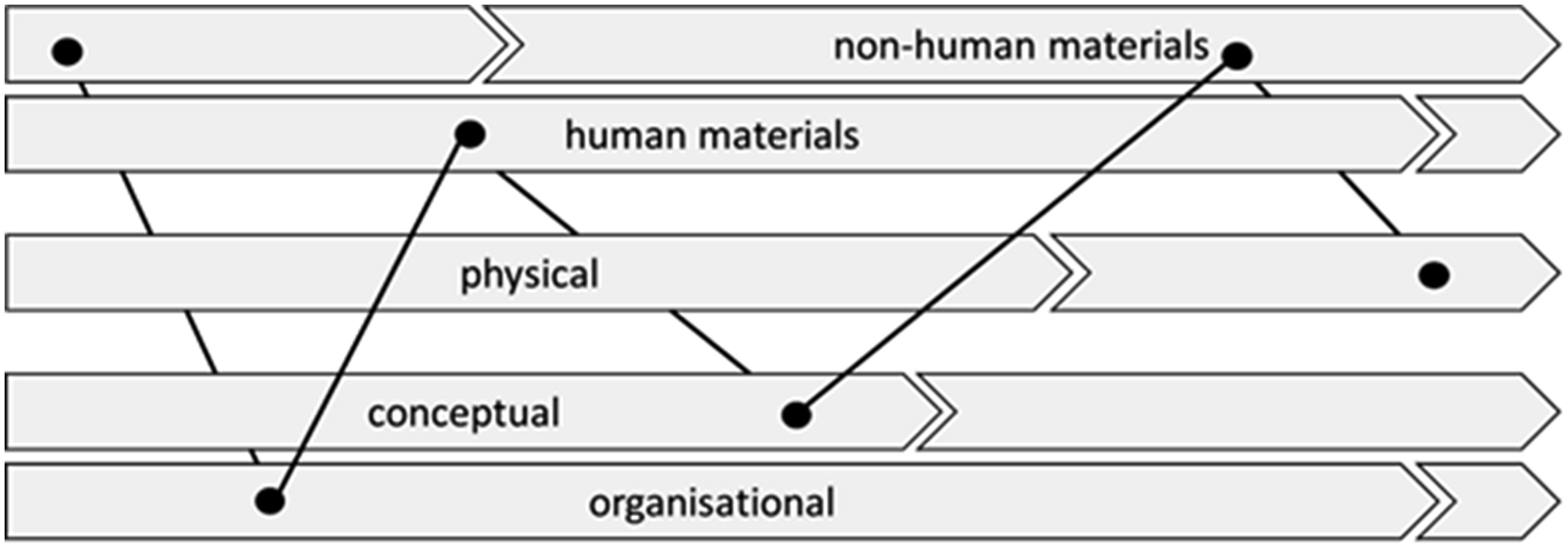
Connectivist theory (Downes, 2007) reminds us that some of the materials in the student-teacher’s network will be human. The class teacher, the children, their colleagues are human elements, and centres of knowledge within a network. Like Brookfield (2017) suggests, the views of these human elements and their knowledge will continue to be important to the student-teacher and their development of reflection. However, the more-than-human materials – resources, forms of technology, course references, policies, external guidance – can also be drawn on to deepen and enhance the reflective process. Siemens (2005) highlights the importance of using networked opportunities to draw from materials beyond an individual. Some more-than-human resources might manifest in a connection to research and professional learning, for example, which again has resonances with the existing orthodoxies of reflection in practice.
The physical space of the context is important, both as an enabling and disabling element in reflection. The layout and design of a classroom will provide fixed, semi-fixed and flexible dimensions to the physical reflection. For example, a south-facing classroom with a wall of glass is likely to heat up on a sunny day, and a student-teacher may reflect that this is causing behaviour to be challenging. The position of the classroom is therefore fixed. A semi-fixed dimension would be the ability to close blinds to prevent heat build-up. A flexible dimension would be the ability to relocate the class to another space if there was a suitable one. The physical dimensions of the classroom, the number of tables, their positioning and who decides layout might also be considered semi-flexible dimensions of a material resource that might impact how a reflection can be enacted.
The last element in our model, the ‘conceptual,’ is best considered in two streams. Firstly, the conceptual, is considered as the ontological and epistemological knowledge (Ashbee, 2021) where the research and networked knowledge of a specific area (Siemens, 2005) is located and can be drawn from. This could be research on differentiation as referenced earlier. This conceptual aspect resonates with the theoretical lens of Brookfield (2017). There is however an organisational element that needs to be considered in relation to reflection. Ashbee (2021) refers to this as the socialisation of knowledge, where ideas have been adapted through fields of practice, and form the organisational knowledge (Evetts, 2009) of a given educational context. This distinction is absent in existing models of reflection, but as both scenarios demonstrate, failure to recognise the contextual aspects of an educational experience can lead to superficial reflection. It denies an individual’s ability to genuinely and holistically reflect on practice due to concerns they will be alienated from the practice context (Johnston, 2021).
Space in this article allows us to return to one of our scenarios only, and in doing so, we can see how using the five elements on more-than-human centred reflection (Figure 1) can enable the student-teacher to develop a more considered reflection through an interplay with the different dimensions in the proposed model. In scenario one (ability grouping), the student-teacher can now consider the difference between conceptual knowledge of ability grouping, that is their knowledge from university learning and reading of research, and the organisational object, that is the points of view or dominant cultures and practices within a context. This can empower the student-teacher to reflect on how, at a classroom level, there is a difference between the ontology and socialisation (Ashbee, 2021) of ability grouping, for example. The student-teacher can also reveal opportunities to explore the interplay of human materials (others, teachers, teaching assistants etc.) and more-than-human materials (e.g. resources, materials and activities) and consider these against the conceptual and organisational dimensions, as well as through exploration of the physical dimension (table layout etc.). The student-teacher is invited to reflect on ability grouping and may identify prevailing physical and organisational dimensions (tables in groups, and school policy on group differentiation) that impact on the decision to use ability grouping. In this more-than-human centred reflection, the focus of the reflection has moved from the contradiction between what the student-teacher knows about research on ability grouping and the practice they are observing in schools. They can now start to consider different influences at play within the orbit of their practice and the alternative possibilities this might bring; avoiding a human-centric approach that focuses reflection on themselves, potentially limiting what can be achieved through the process due to the nature of the human relationships within it.
In this light, more-than-human centred reflection has enabled in our revisiting of scenario one the development of agency. Post-human theories generally have been critiqued for overshadowing human agency (Apostolidou, 2022) and we do not seek to do this. Instead, we propose here that reflection may be enhanced when attention to the interplay between all dimensions of the experience allows different opportunities for each to be foregrounded at different moments. Thus, reality is not singular and static, but multiple, and shifting. If we understand decentring the human in student-teacher reflection in this way, through critical consideration of a fuller range of dimensions in their experience, a deeper reflection might take place where student-teachers can enact agency by evaluating all available choices and alternatives and make critical decisions based upon them. AlDahdouh (2018) argues that reflection is a human property of agency (Bandura, 2006; in AlDahdouh, 2018). In navigating this range of resources and choices that are made in networks of ‘shifting realities’ (Siemens, 2005: 4) possibilities for enhancing student-teachers’ knowledge, insights, interactions (human and other) and experiences within their learning network (Downes, 2007) may be encountered; agentic opportunities to make choices and decisions that can meaningfully shape their practice might emerge.
Conclusion
More-than-human centred reflection removes the onus on the student-teacher to produce answers to problems of practice in their reflection. While arguably this was never the intention of reflection, over time, reflection has become performative, superficial, offers little resistance to accepted orthodoxies and, at times, is far removed from the messy realities of classroom practice that student-teachers are experiencing. Although we have only begun to examine the possibilities of this approach and further refinement and development of our proposed model is certainly required, our more-than-human centred model for reflection invites everyone to access a wider, multi-dimensional networked conceptualisation of education (Siemens, 2005; Zhao and Watterston, 2021). Through making connections between all the resources in the orbit of their day-to-day practices, student-teachers are not removed from the reflective process, nor are they the sole focus of it. They are empowered to distinguish between what they can and cannot influence, what else ‘matters’ in their network, and the ways in which their connection with the wider range of resources within it, might be more authentically reflected in practice.
Footnotes
Declaration of conflicting interests
The author(s) declared no potential conflicts of interest with respect to the research, authorship, and/or publication of this article.
Funding
The author(s) received no financial support for the research, authorship, and/or publication of this article.
