




Abstract
With the rising prevalence of digital data, infrastructures and platforms in education, the challenge of conceptualizing and investigating ‘intermediaries’ has substantially increased. This not only refers to various new types of actors that have been materializing around practices of data infrastructuring (e.g., data management), but equally to the rising empowerment of data infrastructures themselves as intermediaries of policy and governance. The aim of this article is to sharpen our conceptual understanding of this interrelation between intermediaries and data infrastructuring. More specifically, the article suggests to approach intermediaries through a lens on performative contexting, thus shifting the focus towards how ‘intermediary contexting’ is used, by whom and where exactly, rather than seeking to map intermediaries as an object ‘from the outside’. Data infrastructuring, then, can be regarded both as part, and as a result, of such contexting efforts. Using Estonia as a case study, it is shown what we see (differently) when applying such a lens to the digital transformation of education. The findings hereby indicate a gradual emergence of what could be described as ‘governance by intermediarization’: a process in which more and more actors are shifted into the (self)contexting as infrastructural stewards, while the politics of digital transformation become centered – i.e., seemingly depoliticized – around asserting continuous change through digital connection.
Keywords
Introduction: Conceptualizing intermediaries in digital education governance
Over the past decades, education scholars have increasingly studied the (changing) roles of ‘intermediaries’ in the ongoing transformation of education (e.g., Lewis et al., 2022; Sahlberg, 2016). It is thanks to that research that our understanding how policy and governance transformations evolve, and how they are ‘mediated’ into educational institutions, has significantly improved. For instance, studies contributed to a much more critical awareness for – oftentimes hidden – political agendas, influences and effects of intermediary actors and activities, particularly with regard to the growing commodification of education (e.g., Ball, 2018; Hogan and Thompson, 2020). But also the changing role of non-profit actors (such as international networks) or intermediary governmental bodies have attracted growing attention (e.g., Aydarova, 2022). At the same time, the literature clearly indicates that it has become increasingly challenging to disentangle intermediary actors and (public/private) interests, given that policy flows face growing complexity and connectivity (e.g., Akkari, 2013).
With the rising prevalence of digital data, infrastructures and platforms also in the field of education, this challenge of conceptualizing and investigating intermediaries has undoubtedly increased even further (Quintero and Williamson, 2021). On the one hand, various new actors have been materializing around practices of data infrastructuring, such as data management, stewarding or commissioning (Hartong, 2016; Lewis and Hartong, 2022; Williamson et al., 2022), but equally around technical trainings and events (Player-Koro et al., 2022), EdTech consultancy (Ramiel, 2019), or new forms of ‘evidence’ provision (Williamson, 2021). On the other hand, data infrastructures and platforms themselves increasingly operate as powerful (sociotechnical) mediators of reform and governance (see also Decuypere et al., 2021), and seem to do so more and more autonomously (Hartong, 2023).
It is particularly in this conjunction where my interest in this article is situated. That is to say, to sharpen our conceptual understanding of the interrelation between intermediaries and data infrastructuring, as well as the governmental effects this interrelation evokes. To contribute to that understanding, I take up perspectives from Actor-Network Theory and Social Topology, suggesting to approach intermediaries through a lens on performative contexting (Asdal and Moser, 2012), and contexting as labor and strategy of governance. In doing so, the focus is shifted to how intermediary contexting is used, by whom and where exactly, rather than seeking to map intermediaries as an object ‘from the outside’. Data infrastructuring, then, can be regarded both as part, and as a result, of such contexting efforts (see second section).
For empirical application of such an approach, this article engages with Estonian´s transformation into a digital nation (e-Estonia). 1 After its independence from the Soviet Union, Estonia literally reinvented itself as a ‘platform state’, including massive investments in e-government instruments, digital education and citizenship (Savchenko, 2019). Equally in the governing of education, large-scale data infrastructures were implemented to produce and manage educational data, to make that data interoperable with other policy sectors as well as with the overarching personal data management system. The installment of these data infrastructures hereby followed quite distinct ideological frameworks simultaneously, namely aims of nation-building, anti-bureaucracy, democracy and anti-corruption on the one hand, and a clear business, efficiency and performance orientation on the other hand. It is this combination of characteristics, which appeared particularly relevant in terms of investigating not only the actual manifestations of data infrastructures, but equally intermediary contexting in relation to these infrastructures (see third and fourth section).
The analysis, which builds on a multi-sited ethnography consisting of online data collection, webinar observations, platform analyses and interviews with policy and school actors, revealed a number of interesting findings (see fifth section): a) A rising number of policy actors in Estonian education – including actors in the public agencies – contextualize themselves as intermediaries, and, more specifically, as (semi-neutral) mediators in-between different other actors on the one hand, and data infrastructures on the other hand. b) Policy legitimacy hereby becomes increasingly tied to connectiveness to data infrastructures, and to the capacity to contribute to infrastructural expansion. c) Data infrastructures (e.g., platform linkages; data interoperability) are primarily employed as a tool to stabilize, but also to multiply and reinforce contexting efforts. d) As a result, data infrastructures not only continuously expand and thicken, but become equally increasingly authorized to themselves govern through (automatic) contexting.
Altogether, the findings indicate a gradual emergence of what could be described as ‘governance by intermediarization’: a process in which more and more actors are shifted into the role of infrastructural stewards, while the politics of digital transformation become centered – i.e., seemingly depoliticized – around asserting continuous change through digital connection (see also Lury et al., 2012). The paper closes (see last section) by arguing that both the conceptual considerations and empirical insights offer vast potential to inform future studies on the ongoing digital transformation of education more broadly.
Contexting as a theoretical and methodological lens to study intermediaries in digital education governance
The problematization of ‘context’ has always been playing an important role in education (policy) studies. This article particularly builds on works from Actor-Network Theory as well as Social Topology that approach context (e.g., spatial configurations) not as something static or pre-given, but rather as constantly (re)enacted, dynamic, manifold, and performative (Law and Singleton, 2013; McGregor, 2003; Piattoeva et al., 2018). Put differently, when investigating social phenomena, it is always a multiplicity of contexts that performatively affect, and that are simultaneously being (re)made, through these phenomena. Amongst others, Asdal and Moser (2012, p. 301) suggested to use the term ‘contexting’ to capture not only the actual practice of contextualization, but also the strategic (labor) dimension of context-making, which seems particularly relevant for education policy and governance, but equally for the act of researching (see also Hartong and Piattoeva, 2021; Piattoeva and Saari, 2020).
While investigating digital transformation of education through a ‘contexting-lens’ is still rare, initial studies indicate the fruitfulness of applying such a lens to the analysis of data infrastructures. One example is Ratner and Gad´s (2019) multi-sited ethnography on educational data warehouses. The study aimed to understand ‘[…] how data-based governance organizes in spite of, or perhaps even because of, infrastructural flexibility and variation’ (ibid.: p. 550). As a theoretical lens, the study approached the ongoing enactment of data infrastructures as ‘experiments of contextualization’ (ibid.: p. 541), which can be ethnographically traced and contrasted. Experiments of contextualization hereby means that through the building (or breaking, or asserting) of relations, different sites of an infrastructural assemblage create own relational ‘centers’ (ibid.: page 537), that is, they build own contexts in which they construct themselves (and others, including technology) as operating.
Transferring this argument to the study of intermediaries, it is exactly such experiments of contextualization which can equally be found in different, maybe even contesting forms of intermediary (self-)positioning within the same infrastructure (here: the educational data infrastructure of Estonia). Studying intermediaries within a highly datafied environment means, consequently, not to aim for an externally-viewed ‘mapping’ of such intermediaries. Rather, the aim is to identify where in the infrastructure such (aligned or contesting) experiments of intermediary-focused contexting are prominently happening, and with which other elements connections are being built, stabilized, or even cut. Identifying governance by intermediarization, then, would imply that such contexting efforts as intermediaries gradually becomes the default option, which means that the infrastructure increasingly installs borders around alternative forms of contexting.
Piattoeva et al., (2018) work on ‘making and mobilizing contexts’ offers fruitful further inspiration, particularly in terms of the method(olog)ical considerations such a lens implies. Drawing on Michel Callon´s idea of ‘translation’ 2 , they show how contexting in the sense of strategic translation can be operationalized, on the one hand, as problematization which ‘[…] entails crafting the phenomena that demand the attention and involvement of particular actors. In moments of problematization the actors (that is, their interests and wishes) are identified and defined in relation to one another and to the problem’ (Piattoeva et al., 2018: page 205-206), which equally includes making a particular relational ‘self’ of these actors relevant (ibid.). On the other hand, interessement can be understood as a strategy which is, then, more directed at the locking of actors’ relational selves as activated in the problematization (ibid.: page 206), for instance through infrastructural mechanisms of stabilization. Related to the case under investigation here, the analysis of contexting as intermediaries can, hence, be further focused on how exactly actors legitimize their own and other actors’ positions, which specific roles (‘selves’) they hereby assign to themselves and to relational others, and which mechanisms of infrastructural stabilization they use for locking these roles (i.e., the context). Governance by intermediarization, then again, means that, for instance, sharp distinctions between ‘public’ and ‘private’ would become gradually replaced by a primary legitimation of actors based on their fruitful participation in the production and expansion of data-based connections (see also Lewis and Hartong, 2022), that is, their valuation as ‘data infrastructuring selves’.
Still, investigating the interrelation between intermediary contexting and data infrastructuring comes with multiple methodological challenges. On the one hand, these challenges are rooted in the aforementioned deep interwovenness of the researcher with the ongoing (re)making of context, which Piattoeva and Saari (2022) also describe as ‘impossible of exteriority’. In other words, while investigating contexting, researchers themselves also ongoingly (co)create specific contexts. On the other hand, data infrastructures themselves always manifest as relational, highly complex, and ever-changing, which makes it impossible to achieve more than a ‘piecemeal descriptions’ of the myriad platforms and connections (Decuypere and Lewis, 2023: p.40). Hence, researchers are required to not only turn to more inventive methodologies (Gulson et al., 2017), but also to actually turn these characteristics of infrastructures into the analytical point of departure (see also Decuypere and Lewis, 2023: p.26), that is: to focus on practices, including one´s own, that continuously (re)enact relations.
Analytical approach to the study
Guided by this methodological framing, the presented findings build on a multi-sited ethnography (see for an overview Falzon, 2016), which, however, was carried out primarily digitally: firstly, I collected, in multiple rounds, various documents and material available online (e.g., scientific literature on Estonia, policy documents, etc.). The material was analyzed through applying the theoretical lens of intermediary contexting in relation to data infrastructuring, that is: which contexting strategies are exercised by whom and where in the infrastructure; which relational selves, positions of others, and legitimations are being created; how these relations are stabilized infrastructurally and, thus, linked to the data infrastructure. Hence, it was important to not only investigate content of documents, but also their form, frequency, and interfaces of display, which all provide important knowledge about the ‘labor’ of contexting. Secondly, I analyzed available websites and online portals via interface analysis (Decuypere et al., 2021), including data portals such as the Estonian Education Information System (see below), platforms integrated into EdTech, 3 as well as platforms created by different policy actors. As with the documents, of crucial importance was hereby not only the provided content (e.g., the relations and imaginaries mentioned in texts or videos), but also the actual connections in the platform architectures, which can be regarded as one important form of infrastructural ‘fixation’ of context. Thirdly, I registered for multiple online events organized by actors such as e-estonia, Education Estonia, or EdTech Estonia (for explanations of each actor, see below), which covered both more general themes (e.g., overview of the ‘digital nation’) and more specific foci (e.g., expanding Estonian EdTech to international markets), and which equally can be regarded as contexting labor. During the observation of these events, I took fieldnotes and screenshots that were integrated into the analytical corpus. I applied similar strategies for events that I could not attend, but that were stored online (e.g., on the aforementioned platforms). Fourthly, I subscribed to different newsletters of key policy actors, thus frequently receiving emails which included, for instance, notifications about events, or about new policy developments. Lastly, I conducted interviews (both individual and group interviews) with actors such as e-estonia, EdTech Estonia, departments in the Ministry of Education, the Association of Education Technologists, as well as with a school principal in Tallinn. Interview questions were hereby building on the former data collection and analysis.
Overall, data collection and analysis did not happen in a linear manner, but as an ongoing back and forth movement, since, as discussed above, ethnographic research on data infrastructures (and intermediarization herein) can only ‘start in medias res’ (Decuypere and Lewis, 2023), and as a gradual disentanglement of actors and relations while constantly ‘rubbing against’ (Piattoeva and Saari, 2022) practices of infrastructuring oneself.
Setting the scene: a contextual ‘framing’ of Estonia’s reinvention as a digital nation
Estonia – a small country of 1,3 million inhabitants, a size of approx. 45,000 km2, and a central government in Tallinn – gained independence from the Soviet Union in 1991 (Kassen, 2019: p.3). But already before its independence, its orientation was much more European than that of many other Soviet states (Savchenko, 2019: p. 216). It is also due to that history that in the 1990s, Estonia actively pursued its (re-)integration into the western political-economic landscape, including extensive efforts (such as hiring a British consulting agency) to ‘re-brand’ the nation in order to leave the past behind (ibid.: p. 220). Multiple reasons can be found in the literature why Estonia chose the ‘digital nation’ as its future brand, including its former Sovjet experiences as an IT testing ground, the perceived cybersecure threat from Russia, or the high hopes for a more neutral form of ethical identity building (Kassen, 2019; Savchenko, 2019). Indeed, from the beginning, the idea of the ‘digital nation’ was strongly linked to notions of democracy, transparency and anti-corruption in a post-totalitarian context (Kassen, 2019: p. 20), but also and simultaneously to a clear focus on international economic success and efficiency (see also Björklund, 2016). It is this complex historical and ambivalent discursive context which altogether framed the installment of wide-spread data infrastructures since the 1990s.
The infrastructural ‘enactment’ of the digital nation
Over the past three decades, Estonia has implemented a unified data infrastructure of e-government, linked to individual citizens through a national digital identification platform (https://www.eesti.ee/). After having logged in, citizens navigate through their data profile and complete various operations online, whilst data are being transferred between different institutions. To enable data flow, the Nordic Institute for Interoperability Solutions (https://www.niis.org/) has, already since the late 1990s, developed the so-called x-road (formerly x-tee) system, which over the years has gradually formed the data interoperability backbone of the digital nation. However, while this individually centralized data profiling might suggest the existence of one coherent database, Estonian documents clearly emphasize that ‘[…] [o]ne of the biggest threats to the State is an uncontrolled centralization of data’ (Information System Authority, 2021), which is why x-road deliberately relies on decentralized data storage. Put differently, data are only connected on-demand (with no data duplication), only to people who are authorized for that particular data transfer, and always in conjunction with the co-production of log data files. These log data are one of many protection measures which Estonia has installed in and around its data infrastructure in order to (successfully) enhance transparency and trust (e-Estonia, 2020).
While government and public administration have been playing a leading role in the implementation and monitoring of the digital nation, early onwards, businesses and public-private partnerships have become deeply entangled with processes of data infrastructuring. While many innovations were hereby clearly facilitated by Estonia´s small size, it is exactly this interlinkage between state and business which the country has been selling internationally, e.g. through marketing programs (see, e.g., https://www.e-estonia.com/). One prime example here, which simultaneously re-emphasizes the deep entanglement of entrepreneurialism, national branding and data infrastructuring, is the so-called e-residency program (https://www.e-resident.gov.ee/), which invites foreign entrepreneurs to become citizens of the digital nation of Estonia and to enjoy business (e.g., tax) benefits, while excluding territorial access (see also Tammpuu and Masso, 2018).
The platformization of Estonian education
Estonian education operates as a decentralized system, in which municipalities as well as individual schools are granted a high level of (i.a., financial) autonomy. The central ministry, in contrast, provides educational frameworks and general monitoring (Santiago, 2016). While the literature clearly points to governmental ambitions to increase accountability measures to support school effectiveness and success (Lao-Peetersoo, 2014), to date, these ambitions have not resulted in any high-stakes policies or testing regimes. Instead, the high autonomy of Estonian schools – which equally includes large parts of their EdTech usage – is interlinked with a principle of free school choice to foster competition and quality (ibid.: p. 22; 33).
From the beginning, education formed a key area of Estonia´s rebranding strategy. On the one hand, numerous programs were initiated – for instance, the so-called Tiger Leap program – to foster the education of ‘digital citizens’ that are eager to build the digital nation further (Savchenko, 2019: p. 218; Kassen, 2019: p. 42). On the other hand, different infrastructural components within the e-government system became implemented to produce and manage educational data, as well as to make that data interoperable with other policy sectors and the overarching personal data management system. Some of these components have been developed by, and are still administered, by the state, the most prominent being the Estonian Education Information System (EHIS), which includes records of education certificates (available after personal login), overview information on educational institutions, teachers and principals, but also school-aggregated exam results and graduation rates (OECD, 2020). Schools are obliged to ongoingly feed data into EHIS, which, as stated by the OECD (2020: p. 48), is a precondition to receive funding. Already in 2014, x-road connected EHIS to over 20 other information systems and frequently received input from over 2000 education agencies (Lao-Peetersoo, 2014: p. 2). Another platform administered by the state is the so-called Eye of Education platform (Haridussilm.ee), which offers mainly statistical data about ‘education, research and development, language policy and youth’ (https://www.educationestonia.org/data). Such state-provided platforms have, at least so far, mostly focused on macro-level administrative and monitoring data 4 . In contrast, systems used by schools in their daily activities are mostly run by private EdTech companies. Interestingly, despite Estonia´s massive investments in national businesses, it is not only Estonian EdTech providers (e.g., eKool and Stuudium) that have established themselves as market leaders for schools. Instead, many schools in Estonia rely on the product portfolio of large global corporations such as Microsoft or Apple.
In-depth findings: Governance by intermediarization in Estonian digital education
Since I decided to ‘follow’ the data infrastructures and the actors visible on platforms and events around digital education, the result was, by default, that I mostly saw those who are already connected through the infrastructure (and that use infrastructural strategies of context-stabilization). Interestingly, particularly in the interviews, I was frequently pointed to the important distinction between a ‘pioneer community’ (Hepp, 2020) devoted to the ideas and future expansion of digital education, and the broader picture of Estonian education as it is still operating. Furthermore, even though large data infrastructures already exist in Estonia, much of what was reported on was (at the point of data collection) still in a visionary or early policy experimentation stage, driven by the pioneer community. For the conceptual lens of the investigation, it was, consequently, little surprising that other actors – such as reform-resisting forces – were indeed mentioned in the interviews, but almost completely absent on the platforms or in the documents and events. In other words, they were clearly disconnected from the context that was being created and infrastructurally stabilized.
Building on that more general finding, in the following sections, I illustrate three areas from the data analysis in which the close interrelation between intermediary contexting and data infrastructuring was found particularly relevant, yet in each case slightly differently.
Creating and securing an open data infrastructure for continuous EdTech (micro) innovation
What manifests in the general literature on digital Estonia, is equally strongly visible in the case of digital education, namely the high involvement of non-state (e.g., foundations, non-profit associations) and business (e.g., EdTech) actors, and their close relation to parts of the Ministry of Education. This close relation, infrastructurally speaking, is prominently constructed (i.e., strategically contexted) in various materials and by multiple actors, and has been additionally formalized in a memorandum of collaboration in 2022. 5 Yet, it is the nuances of this mutual contexting which are particularly relevant here.
To begin with, in different material, the role of the state for EdTech provision is actively problematized. A first problematization hereby emphasizes that the private sector is ‘better equipped’ to provide useful technology, for example because it is closer to end users, or quicker in development. While this problematization, which implies a mutually exclusive role assignment (that is, it is either the state or the business sector which should provide technology), may be known from other national contexts (Cone et al., 2022), a second, even more prominent problematization manifests somewhat differently. Here, the state is regarded as ‘harmful to the ecosystem’, and not because of potential regulative activities, but because of its logic of project-based funding: ‘[…] [T]he government steps in and pilots, has a project or simply gives out a grant to a third party that's going into that field. In a lot of cases, […] small actors [e.g., two existing EdTechs, S.H.] […] have potential to develop and get customers, whether it be municipal government, school teacher, parents, whoever that is. The third party steps in, the two essentially disappear because there's now a free competitor. […] Then the government program stops. The project-based funding stops and there's nothing. This is what we wanted to achieve that if there's anyone in the ministry of 300 people who has a project or a goal they want to achieve, instead of just going ahead with it, they take a look at what's going on in the market, making sure that there's no one already trying to do their best to provide these services. […] We really don't want to discourage and get this bad blood in the system of stepping in, stepping out and simply crashing the system.’ (INT MoE)
This problematization, which this interviewee also describes as ‘project cemetery’, in the methodological framework of contexting constructs the state as a risk to movement, change and innovation. While one envisioned solution for that risk is, consequently, a stronger limitation of the state´s role to that of a funding provider for self-regulating markets, another role ascription is even more interesting here, namely that of a data mediator. This envisioned role implies that the state becomes the ‘data coordinator of an ecosystem’ in the sense of providing the infrastructure and knowledge to bring data on students and teachers to EdTech providers, to receive data back from them to forward to others, and to use that data also for educational monitoring. Put differently, here we see an emerging contexting in which the state curates and watch guards the infrastructure (securing ‘flowable data’), while not anymore being (that strongly) involved in product development and provision itself.
Simultaneously, this open, state-coordinated data infrastructure is strongly connected to the idea of heterogeneity, namely micro-services that ‘[…] promote the diversity and interconnection of educational technology services and offer the target group freedom of choice’ (memorandum). On the one hand, this emphasis on micro-services – that is, providing small-scale technology for a very specific pedagogical purpose – mirrors the idea of one open data infrastructure on which, then, every actor should be equally dependent and responsible to feed data into. On the other hand, ‘closed’ infrastructures of big (global) corporations necessarily turn into a crucial problem, particularly when corporations’ interests may ‘override the national education policies’ (INT MoE) (even though, as the interviewee clearly stated, corporations’ well-functioning services are, as such, much appreciated). With regard to big corporations, there is, consequently, a somewhat different self-ascribed role by the state, which is indeed sharper contrasted as ‘public versus private’, and which regards the state as securer not only of open data, but equally of the national education interests. At the same time, this clear ‘bordering’ against big corporations – and, in this sense, a cutting of relations to anyone not providing data for the open infrastructure – comes along with a significant problem, since the government cannot easily force these corporations to ‘open up’. The envisioned solution is, consequently, to again make the benefits of the ecosystem stronger, meaning that if every ‘part’ puts data in, everybody will in the end receive more and better data back.
Installing ‘connection hubs’ as promoters of infrastructuring
Closely related to the promotion of an open data infrastructure, the material shows the manifestation of different ‘centers’ that, through the activities of particular actors, infrastructurally stabilize the aforementioned close relations between the state, the non-profit and the business sector. One example is the recently created Education and Youth Board (Harno), a government agency of over 400 people in the Ministry of Education, and a fusion of four pre-existing foundations (see https://www.eduenable.com/). As stated in the material, marketing is one of the core functions of Harno, why an additional actor has been installed: Education Estonia, which inter alia hosts an own online platform (https://www.educationestonia.org/data), a YouTube and Twitter/X channel.
As the platform analyses show, Education Estonia reveals different interesting characteristics regarding its mode of contexting: to begin with, there is a strong international orientation, that is to say, a clear relational ‘outreach’, which, however, primarily ascribes Estonia the role of a knowledge exporter who reports about its data infrastructure to ‘the world’. The provided view on the infrastructure is hereby that of a smooth, functioning system of data flows, which results in personalized, successful education, and which can serve as a role model for others who seek to adopt the system, or to come to Estonia (e.g., for studying). Related to that, another interesting feature of Education Estonia´s platform is a customizable list of ‘solutions’, which not only includes various EdTech providers, but equally courses on digital education offered by universities, mentoring services or study visits. Behind the list – which again presents an infrastructural mechanism of platformized contexting – lies a membership network, which works through condition-based application. Figure 1 illuminates these conditions for ‘education solution providers’, including those from abroad who hold an e-residency status, to join the network. In turn, partners may use the logo ‘Member of Education Estonia’ as a certificate of legitimate connection. Conditions for becoming a member of Education Estonia. Source: https://www.educationestonia.org/members/.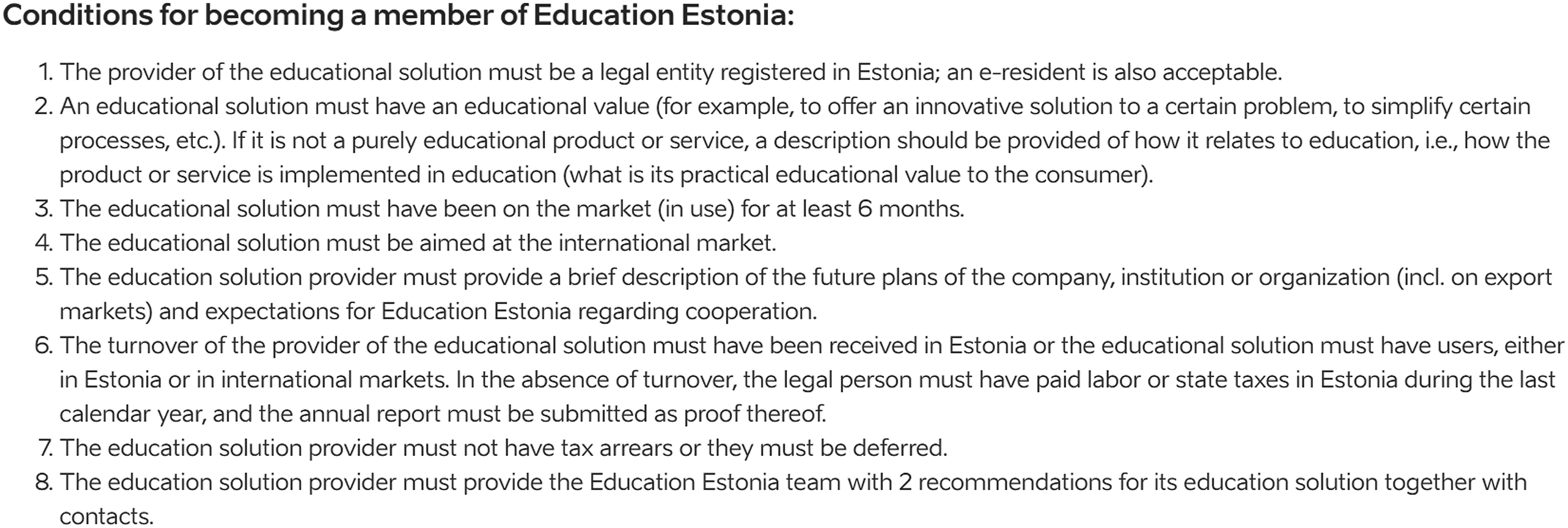
Next to Education Estonia, another key connector in the digital education infrastructure is EdTech Estonia (https://www.edtechestonia.org/), a spin-off of Startup Estonia. EdTech Estonia is, by large parts, funded through the Ministry of Education, but also through membership fees. EdTech businesses registered in Estonia can apply for membership, with membership fees aligned to economic revenue. As Education Estonia, EdTech Estonia hereby positions itself as an intermediary between national (EdTech) members and what they call ‘external organizations’, which are again, to a large extent, actors from other countries (see also memorandum of 2022). In particular, EdTech Estonia has established collaborations with other Nordic countries and similar organizations there. A second self-ascribed intermediary role of EdTech Estonia is bringing together EdTech providers and researchers from universities to provide impact research. Yet, as one interviewee emphasized, the role of EdTech Estonia is hereby limited to initial connection-building, while all further details need to be arranged between the two parties. As a third role, EdTech Estonia brings together established and newcomer EdTech providers through mentoring activities (e.g., hackathons organized by EdTech Estonia, but also individual mentoring programs, pitch trainings, etc.), thus contributing to an atmosphere of knowledge sharing and mutual support. Lastly, EdTech Estonia mediates between its members and the Ministry. Such mediation should not be understood in the sense of ‘lobbying’, but rather as provision of market knowledge to the state (see also last section). In the memorandum, which has recently formalized this relationship, EdTech Estonia is accordingly described as a strategic partner of the Ministry, 6 and it is emphasized that all parties agree on ‘technical standards, including data exchange, and to create a sustainable quality system for the creation and delivery of digital educational services’. As similar reference can be found in the Startup Estonia white paper, which states that decisions required to ‘steer the ecosystem’ are building on ‘cross-sector and systemic data, research, and feedback’ (Startup Estonia, n. d: p. 26).
As all these examples illustrate, both actors, Education Estonia and EdTech Estonia, contextualize themselves as ‘connection hubs’, that is, as spaces where the curation and expansion of the data infrastructure is systematically prepared (e.g., with regard to participating in the open data system, supporting ongoing innovation, etc.), and partly also implemented (e.g., infrastructural integration of research, connectivity through platforms, etc.). Actors’ positions in and around these hubs are hereby primarily legitimized and distributed – i.e., infrastructurally stabilized – through connectivity (e.g., visibility on the platform, certification as member, expectation to members to connect further), which means that contexting substantially builds on infrastructuring as a goal in itself.
Importantly, the analysis equally showed that regarding these characteristics, there is also significant heterogeneity among such mediating associations, depending on where in the infrastructure they are located. For instance, the Association of Education Technologists operates as a connection hub for specialized professionals interested in both EdTech and pedagogy, who have, in many cases, completed a specific training, and who mediate EdTech into educational institutions or even individual classrooms. 7 Their self-proclaimed role is, consequently, less related to policy and more to mediating between teachers, pedagogy and technology, while equally bringing together ‘[…] people who already understand that it's important to share everything you already have done or what are you doing’ (INT AEDT). At the same time, equally this association understands itself as a partner for various other actors, including the Ministry, business people, or university staff, and equally follows the goal of establishing projects for an ongoing digital innovation of the education system.
Creating a governance system of use-based funding and ongoing micro-experiments
The last insight provided here relates to the overall governance system the actors of the ‘pioneer community’ (see above) envision for the long-term future of digital education, namely a future of truly personalized learning. Indeed, the creation of an open data infrastructure as well as the establishment of continuously growing actor connectivity (supported by the hubs) are regarded as important preconditions to establish that future.
Generally speaking, the system is intended to operate through ongoing data flows, machine learning, and a highly individualized, real-time steering of learning processes. Indeed, a first step towards implementation was the recent initiation of the Learning Pathways project within the Ministry, which not only includes a school sample pilot study, but also – and in particular – the gradual transformation of the national curriculum into a machine readable ‘learning output’-format (https://www.youtube.com/watch?v=oigYxLl-2c8). The idea behind is to trace students’ digital activities in a maximally detailed manner, to match these data points with the machine learning algorithm, and to afterwards provide individualized learning recommendations back to students. While this idea clearly mirrors visions as they are nowadays typically promoted by EdTech providers and also governments worldwide (see, e.g., Dataport, 2023, for a recently initiated project in the German context), what is unique here is the intension to install one coherent system which includes every student and every EdTech (for now) within the national borders. At the same time, the idea in Estonia is to deliberately disconnect this personalized learning from location, that is, where student learning and the according monitoring of learning output happen (e.g., in classrooms, at home, in museums, etc.), since all learning experiences would be infrastructurally connected.
However, the material also shows that ‘science-based proof’ about which recommendations, learning material or EdTech work best for particular students is, at least so far, still quite limited. Consequently, the pioneer community envisions the system of data flows as becoming joined up with a system of continuous micro-experiments. In such micro-experiments, particular student groups are targeted with a specific intervention, while changes in the learning output (as visible in the data) are closely monitored. Interestingly, here the material points to a crucial problematization of the EdTech sector in its current form, which is assigned an ongoing lack of substantial engagement with research insights. To respond to this problem, the Ministry of Education has stablished a so-called ‘co creation program’, which brings scientists, EdTech companies, and end users together (one interviewee describes this as the ‘golden triangle’) in order to better understand that ‘[…] every educational experience through an EdTech is an intervention. You can measure, tweak it and have really good data on what this is actually doing. If that’s what we achieve, then that’s already a very good thing because I see a shift in the culture of the EdTech companies’ community. That they’re starting to understand why we’re constantly talking about this, because at the beginning they saw it as a marketing stamp: “This university approved me”, or: “I’ve gone through this process”. But now we’re seeing more of a cultural shift in how they perceive that cooperation. I think that’s fantastic to see.’ (INT MoE)
At the same time, a new funding scheme for EdTechs seeks to align the distribution of money to the actual, digitally tracked interactions between students and products, which – as the micro-experiment idea implies – ultimately rewards those products most that work best (see also memorandum of 2022). The financing model can hereby only work if micro-service providers are equally able to make fitting suggestions to students. This is why, again, the open data infrastructure is crucial.
Similar other initiatives such as Accelerate Estonia (https://accelerateestonia.ee) mirror this turn towards micro-experiments as a mode of governance. As its platform illuminates, Accelerate Estonia´s purpose is to enable collaborative experiments between the public and private sector, in which regulative barriers – i.e., infrastructural barriers that hinder movement – are deliberately removed so that, in case of proven success, new markets can be created. At the same time, the initiative also emphasizes something else, namely the goal of scalability, as the following quote shows: ‘Within the experiment in Accelerate Estonia we aim to prove that education can be scaled. A scalable education system enables personalised education, enabling students to choose what, when and with whom they are learning. […] Hence, our experiment will consist of distance learning courses to prove that high quality education can be delivered even at scale. […] Throughout the pilot and at the end of the course we will measure the quality and results, to see if we can prove our hypothesis that it’s possible to conduct quality studies with one teacher in 10 different schools.’ (https://accelerateestonia.ee/project/personalized-learning-journey)
The notion of scalability can again be regarded as a form of contexting, which shifts the logic of relation-building from traditional borders of classrooms and schools towards digitally mediated learning contexts that are bordered only through limits of data interoperability. Scalability is, consequently, an actually misleading term, since the goal is not to multiply existent teacher-student relations in class, but rather to break up such relations in order to implement something that is not only more connected to the infrastructure, but that instead is fully infrastructured (see also Figure 2
8
). Scalable education. Source: https://accelerateestonia.ee/project/personalized-learning-journey.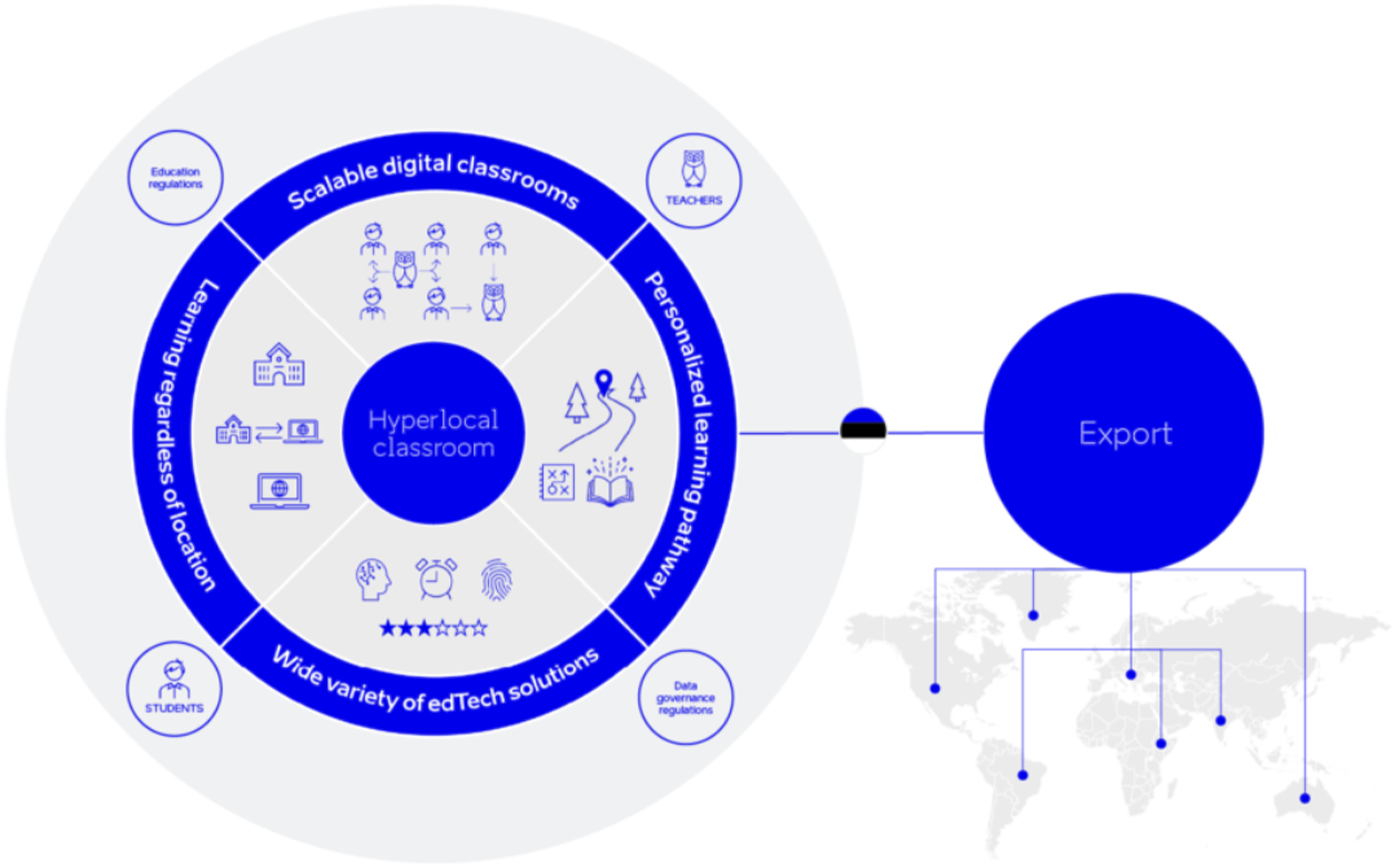
Summary of in-depth findings
All three areas of analysis clearly point to the close interrelation between intermediary contexting strategies and data infrastructuring. While such contexting strategies hereby on the one hand reveal a multitude of self-ascribed roles and forms of relation-making, they on the other hand still indicate a strong directionality of reform. More specifically, it was shown how already the Ministry ascribes different roles to itself (i.e., makes different relational ‘selves’ relevant to specific others), ranging from that of a potentially harmful market influencer, over that of a data mediator within the open data infrastructure, to that of a securer of the national education interests. Similarly, EdTech businesses are not only seen as drivers of innovation, but equally as ‘in need’ of a stronger scientific mindset, that is, operating through micro-experiments based on ongoing data flow. At the same time, all these contexting efforts mirror the same overall trends, which can be summarized as follows: a) A rising number of policy actors in Estonian education – including actors in the public agencies – contextualize themselves as intermediaries, and, more specifically, as (semi-neutral) mediators in-between different other actors on the one hand, and data infrastructures on the other hand. b) Policy legitimacy hereby becomes increasingly tied to connectiveness to data infrastructures, and to the capacity to contribute to infrastructural expansion. c) Data infrastructures (e.g., platform linkages; data interoperability) are hereby commonly employed as a tool to stabilize, but also to multiply and reinforce contexting efforts. d) As a result, data infrastructures not only continuously expand and thicken, but become equally increasingly authorized to themselves govern through (automatic) contexting.
In other words, and despite the aforementioned manifoldness, the findings indicate how ‘governance by intermediarization’ has become increasingly manifest in Estonia, and is affecting more and more (potential) strategies of contexting. In other words, more and more actors are shifted into the role of infrastructural stewarding, while the politics of digital transformation become centered – i.e., seemingly depoliticized – around asserting continuous change through digital connection.
Discussion and outlook
The goal of this article was to provide a contribution to the highly complex and dynamic field of intermediary research, particularly with regard to the digital transformation of education policy and governance. It hereby responded to a still substantial lack of studies that focus on intermediary-making – i.e., intermediarization – and its interlinkage to the empowerment of data infrastructures. It was argued that the contexting lens provides a fruitful starting point to investigate this interlinkage, which was further explored through the case study of Estonian education.
Of course, the design of this single case study comes with substantial limitations regarding potentials of generalization. At the same time, much of what was identified as driving the digital transformation in Estonia, can equally be found elsewhere, thus offering vast options for transferability. For instance, over the last years, the European EdTech landscape underwent significant innovation, with more and more ‘connection hubs’ (similar to those in Estonia) being established. One prominent example is the European EdTech Alliance (https://www.edtecheurope.org/), which not only seeks to ‘[…] bring […] together national trade associations, clusters, incubators, and organisations working with founders and providers of education technology’, but equally to ‘support the domestic and international growth of Edtech and the innovation ecosystem it represents’ (ibid.). But also in terms of the (changing) role of public education agencies, the case of Estonia resonates with developments in other countries. In other words, in many countries around the world, we can find state agencies increasingly emphasizing their role as education data agencies for various stakeholders (e.g., Lewis and Hartong, 2022). In all such cases, it would be interesting to study how not only forms of contexting can be found that mirror the findings from Estonia, but equally how nuances of such contexting may still play out differently.
Beyond such options for transferability, the article also offers a number of broader implications. To begin with, it was shown that, on the one hand, data infrastructures indeed take a more and more active role in shaping education, and they do so because they simultaneously, and continuously, expand and thicken (see also Hartong, 2023). On the other hand, it is not ‘only’ data infrastructures of student monitoring – i.e., the ‘steering’ of learning – that seem important here. Rather, the idea of the digital ecosystem (Ilic, 2020), which also played a key role in the analysis, points to an infrastructural assemblage in which policy, business, and research actors altogether become increasingly centered around platformized connections, that is, dependent on similar logics of (self-)contexting. This, however, implies a different understanding of ‘EdTech ecosystems’ as it has, at least so far, been typically presented in the field (e.g., Williamson, 2021), that is, as primarily private sector strategies to penetrate the education system. In contrast, the results emphasize that agency for change seems to lie less and less in the responsibility of either private or public actors alone, but rather that agency becomes assigned to those who are and/or know how to get infrastructurally connected. This does not mean that sharp distinctions between public and private are not employed anymore, as visible in the Ministry´s self-ascribed role as watch guard of public education interests against the ‘closed system’-logic of big tech corporations. Rather, it means that a more fine-grained understanding of individual parts of the private sector is needed, in order to capture their specific (and distinct) roles in the digital transformation of education. Gradually emerging research on the specific features of the EdTech startup sector (see, e.g., Decuypere et al., forthcoming) can be regarded as an important step here. Lastly, the article also has implications for the conceptual dimension. Building on few existent studies, it was shown how the contexting lens can be used as an analytical device, which, however, necessitates a shift in methodological gaze. This, for instance, includes which ‘forms’ of data are being collected (e.g., frequency rather than only content of documents), but also which types of question are being asked (e.g., when context is not rendered pregiven, but the object of analysis). In all these regards, the article hopes to offer a fruitful starting point for further substantiating, and nuancing, our understanding of the digital transformation of education as a worldwide phenomenon.
Footnotes
Declaration of conflicting interests
The author(s) declared no potential conflicts of interest with respect to the research, authorship, and/or publication of this article.
Funding
The author(s) disclosed receipt of the following financial support for the research, authorship, and/or publication of this article: This work was supported by the Deutsche Forschungsgemeinschaft (423781123).
