




Abstract
This case study investigated to what degree the research skills needed for college based top-up degrees differ from each other. The four academic areas studied ranged from natural and formal science subjects to social science and visual arts. They were explored by means of a thematic analysis of both their individual module handbooks on research skills and interviews with lecturers on these modules. The results were compared against the relevant subject benchmark statements, Biglan’s framework of classifying academic fields and related research. The interviews suggest that the research skills development needs of students at top up degree level can be met through a dedicated module in an effective way. Both the handbooks and the interviews intimated that there is a certain amount of overlap when it came to secondary research, which may be effectively met by a suitable librarian. Furthermore it was found that only two dimensions of Biglan’s framework are necessary to explain the needs of detailed ethics consideration for student projects and the existence of primary research tools and techniques peculiar to a certain field. Further work could include the definition of more generic primary research tools and techniques for academic fields where a paradigm consensus is relatively weak.
Introduction
The 394 regulated higher education institutions (HEIs) in England in 2020 can be divided into these three types: Universities, further education (FE) colleges and other providers. Although over 80% of higher education HE students in England studied at universities, there were more further education colleges that offered HE courses than there were universities, which resulted in an average HE student population of about 530 students per English FE college with HE programmes (Higher and Further Education Group, 2020). As the main thrust of FE colleges is to deliver further education provisions, it is understandable that the HE student numbers at FE colleges is small when compared with the total number of learners registered with FE providers. Nonetheless college-based higher education (CBHE) has received governmental backing so as to implement certain governmental policies (Parry and Thompson, 2002).
Using Biglan’s classification of academic disciplines to examine the types of course offered in CBHE indicates another distinguishing feature. In his seminal paper, Biglan (1973) employed a three dimensional framework to classify academic subject areas with the following axes: Pure versus applied, “hard” science (e.g. physics and engineering) versus “soft” sciences (e.g., humanities) and those concerned with living organisms versus other subjects. Although this classification was based on work done in the US, Simpson (2017) argues that the first two dimensions remain valid in the UK context and points out that less than 10% of research papers using Biglan’s dimensions employ the third one related to living organisms. Bearing the comments by the Higher and Further Education Group (2020) in mind regarding the vocational and technical nature of the courses offered in CBHE and examining the maps provided in Simpson (2017), it is evident that FE colleges in England offer only applied subjects, ranging from hard to soft sciences, with the implication that the first dimension (pure vs applied) can be disregarded for this study.
This is also reflected in foundation degrees (FDs) offered by FE colleges, which are equivalent to the first 2 years of a three-year full-time bachelor’s degree. This type of qualification was introduced in England, Wales and Northern Ireland in 2000 with the purpose of combining academic and work-based learning, and strongly encouraging collaboration between employers and HEIs, as these FDs aim to provide skills and knowledge to satisfy the needs of the local employment market (Gray et al., 2015; QAA, 2020). A further aim of FDs is that of widening participation, i.e. attracting people from under-represented groups into higher education. Although this type of qualification is strongly vocationally oriented, a clear progression route to topping up to a full degree needs to be provided to students successfully finishing their FD studies (Harvey, 2009; QAA, 2020). Statistics indicate that about half of FD students progress to top-up degree programmes, many of them within the same HEI (HEFCE, 2008).
Transitioning into a more theoretically slanted top-up degree may prove challenging for such students. This has been researched for, e.g., early childhood studies (Morgan, 2015), teaching, learning and mentoring (Penketh and Goddard, 2008), and sport and exercise development (Burton and Schofield, 2011; Mytton and Rumbold, 2011) programmes. These papers also mention aspects related to research skills at top-up level. For instance, Penketh and Goddard (2008) encouraged students to read for a broader understanding, rather than just for an assignment. Others refer to a required increase in academic writing and study skills at honours degree level (Finn and Crook, 2003; Morgan, 2015). As many top-up degree students may be working, time management skills to balance various responsibilities could also form part of skills development (Morgan, 2015; Penketh and Goddard, 2008). Furthermore, aspects such as ethical considerations and managing a project supervisor may be new or have a deeper meaning at top-up degree level (Braun, 2019; Wisker, 2009).
It may be argued that the skills mentioned in the previous paragraph are useful regardless of the subject studied, but there is also some evidence suggesting a more discipline specific approach to research skills development. For instance, Kincheloe and Steinberg (2002) divide research skills as pertaining to either primary or secondary forms of inquiry. This secondary form of inquiry refers to locating and critically engaging with relevant literature in its various forms and may not vary that much regardless of the academic field. However, there is a view held by quite a number of researchers that the way primary research is conducted differs from discipline to discipline (Healey and Jenkins, 2009) primarily depending on the paradigm consensus within the field (Jenkins et al., 2007; Levy and Petrulis, 2012; Shin, 2009) a concept also discussed in the aforementioned paper by Biglan (1973) on classifying academic disciplines. Bearing the implication of this framework in mind, it may be argued that the academic field has an impact on the development of research skills training incorporated in top-up degrees as it may or may not be possible to combine at least some of this training regardless of the degree programme.
The development of research skills has been extensively investigated not only with respect to university undergraduates (Earley, 2014; Griffioen et al., 2019; Healey and Jenkins, 2009, 2019; Jenkins et al., 2007; Murtonen, 2015; Wagner et al., 2011), but also, to a certain degree, with respect to CBHE. One such study was conducted by Gray et al. (2015) who used a questionnaire to survey the research skills development in CBHE, but then focused on social science disciples at FD level in England. The focus groups, used in their second phase, suggested that research skills were framed within the practical, vocational context to the detriment of more theoretical aspects. These researchers concluded that this may have implications for top-up degrees “where there is less emphasis on vocational practices” (p 17). Regarding teaching research methods to students from different programmes, the researchers found that larger colleges tend to teach these in a subject specific manner, whereas smaller HE provisions are inclined to combine cohorts. Another paper using the same questionnaire data for social science programmes examined the attitude and experience of CBHE students relating to research methods more closely (Turner et al., 2018a). Their research suggests that during FD programmes, students were trained on “easier or more palatable aspects of research methods” (p 361) and surmise that such training does not prepare students for research at the top-up degree level leading to a dissertation. A third paper (Turner et al., 2018b) applies the concept of learning gain to research methods as taught at two universities and six colleges, and includes arts & humanities, business & social science and science programmes. Although their research focused on the students’ confidence as researchers, they also reported a disciplinary dependant difference with respect to the pedagogical approach and discussed this against the relevant QAA benchmark statement.
The literature reviewed above indicates that research skills need to be developed throughout a student’s undergraduate study. This may be particularly relevant for CBHE students who want to top-up their vocationally biased FD to a full degree. As cohorts of top-up students at colleges that offer such a progression may be small, the question of economy of scale (Gray et al., 2015) should be investigated. Therefore, the following questions were researched using in-depth interviews with research methods lecturers from several disciplines working in HE at an urban FE college in the Yorkshire and Humberside region of England: - Is there evidence for the need to explicitly teach research skills at top-up degree level? - Can these skills be divided into a core set of research skills needed regardless of discipline and only a limited number of additional techniques being subject specific?
The research presented here differs from previous work as it focuses on college based top-up degrees for four different academic fields as opposed to concentrating on social science as in Gray et al. (2015), reporting back on the student perspective (Turner et al., 2018a) or examining the self-reported learning gain of year two undergraduate students (Turner et al., 2018b). Furthermore the research is put into context by not only drawing on the relevant benchmark statements (as in Turner et al. (2018b)), but also on Biglan’s framework (1973) and uses this to explain the difference in depth of ethical considerations and differences in primary research methods.
Methodology
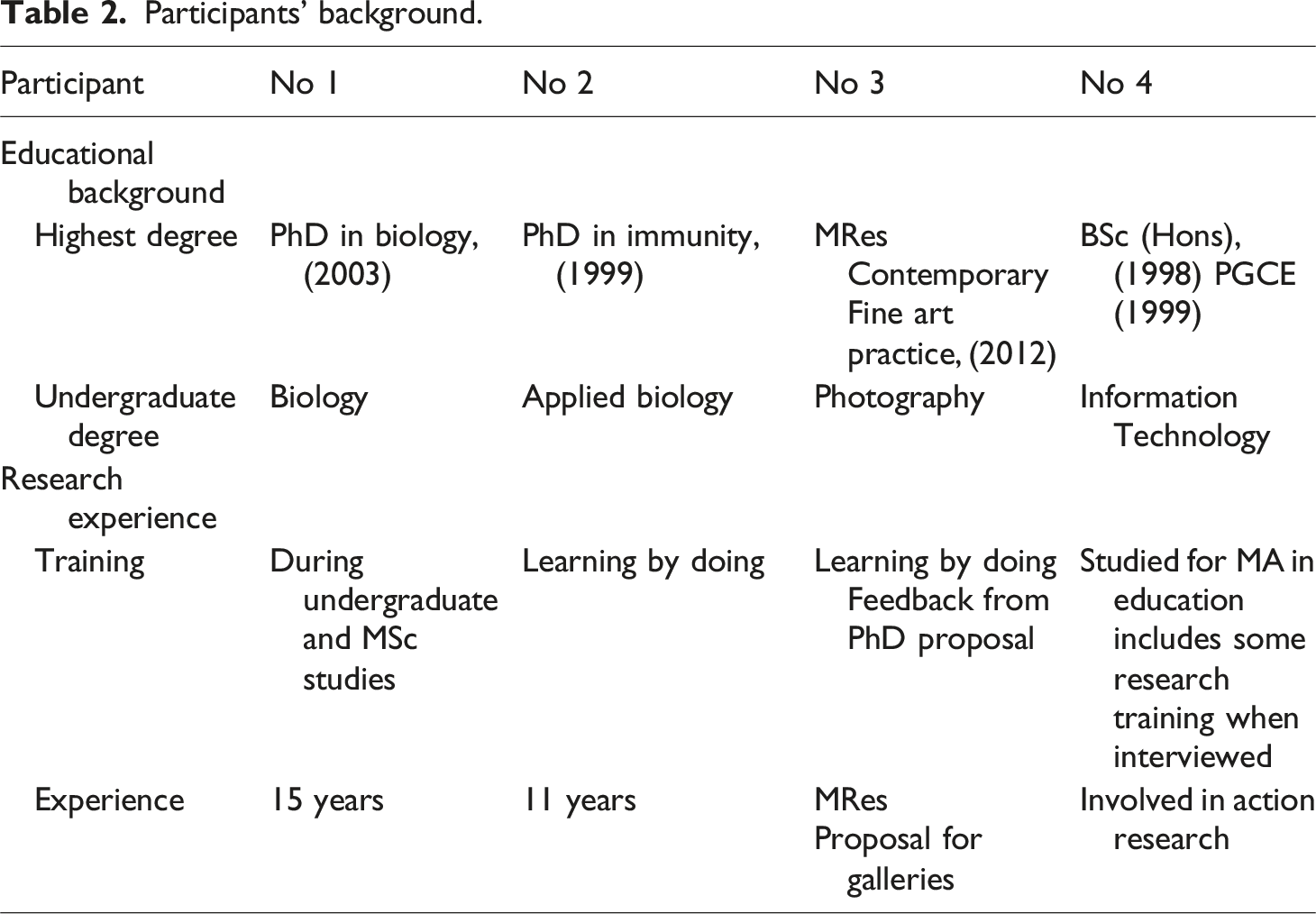
Some of the researchers in the field of research skills teaching have used a questionnaire based approach to survey a large number of participants (Gray et al., 2015; Harwood and Harwood, 2004; Turner et al., 2018a, 2018b). This was sometimes combined with telephone interviews (Harwood and Harwood, 2004) or focus groups (Gray et al., 2015). However, as the number of participants was small, this was not necessary for this case study and semi-structured, in-depth interviews were used as the main method of study. This offered the opportunity to explore issues and reflective statements more thoroughly (Morgan, 2015; Mason et al., 2010; Saunders et al., 2009), and to test the research assumptions (Cohen et al., 2013). As a precursor to these interviews relevant module handbooks were examined (Braun, 2019), which indicated differences in research skills teaching, thus motivating this research. This analysis was revisited during the course of the present study to complement interview results and then compare them to the applicable QAA Subject Benchmark Statement, Biglan’s framework (1973) and relevant literature. The ethical approval was received through the ethics committee of Leeds City College following the BERA (2012) guidance. As the third principle in BERA (2012) is concerned with protecting privacy, the participants contribution was anonymised as much as possible. For instance, their research background was included in Table 2 to situate them in the tradition of their respective fields, but their teaching experience has not been. In addition, it should be noted that the interviewees are not always the authors of the module handbooks.
This case study required the participation of lecturers, who taught research skills at top-up degree level from various academic disciplines at the aforementioned urban college. To achieve this, a few recruitment methods were employed including an invitation posted on the HE digital notice board, targeted emails and personal contacts. This secured the participation of four research skills lecturers teaching on biomedical science programmes, the BA (Hons) Photography, the Health & Social Care and Children and Young People’s Care and Education (CYPCE) top-up degrees, and computer science top-up programmes. It was felt that, although the number was smaller than anticipated, this represented a reasonable spread of disciplines, ranging from natural and formal science subjects to social science and visual arts.
Using interviews rather than a focus group allowed more flexible arrangements and each individual participant could be drawn out about their own practice without feeling inhibited by other participants’ responses (Saunders et al., 2009). For instance, as the comparison between the different disciples was part of the data analysis task, hearing other lecturers explaining their teaching practice may have influenced responses. The six main questions for these interviews (included in the appendix) related to lecturers’ educational, teaching and research backgrounds, their views on the differences between CBHE and university based HE, their own research skills training and their research skills teaching. The purpose of these background questions was to find out if the interviewees represent the research tradition of their respective fields to a reasonable degree. This questionnaire was sent to the participant a day before the interview as most of the questions needed some reflection and data collection on the part of the participant. During these voice recorded interviews, which lasted between 53 min and 1 h 21 min, the questions were displayed on computer screens and both the interviewer and the interviewee were able to enter answers in this document. This helped not only to keep the discussion on track, but also to clarify answers.
For the analysis of both the interviews and these 20 credit top-up degree module handbooks an inducive thematic analysis was used (Nowell et al., 2017). For interviews, this included the steps of capturing the participants’ research related background as shown in Table 2 and preparing a transcript of the answers to the other questions. These transcripts were colour coded to investigate the themes: Research skills, other relevant academic/study skills, ethics, research skills development and their transferability, students’ background and other relevant support provided by the college. During this coding the interpretation of the term ‘research skills’ was guided by the explanation by Kincheloe and Steinberg (2002) who define primary research as conducting “research directly in particular contexts” (p 4) and explain that secondary research skills include locating relevant sources through, e.g., library skills and the ability to critique the information thus found. Other relevant academic/study skills may relate to the research planning or the writing up. This coding was done in conjunction with listening to the interview recording in order to reduce data loss (Cohen et al., 2013). For the module handbooks the thematic analysis involved carefully reading through the introductions, module learning outcomes, indicative content and schemes of work. These sections were colour coded differentiating: Research theory, research planning, literature review/secondary research, primary research and ethics.
Results
The results of the thematic analysis of the handbooks are discussed first and is then followed by a summary of the participants’ educational and research background. However, the largest part of this section examines relevant interviewees responses, which are, where appropriate, compared with the handbook analysis.
Summary table of model handbook analysis.
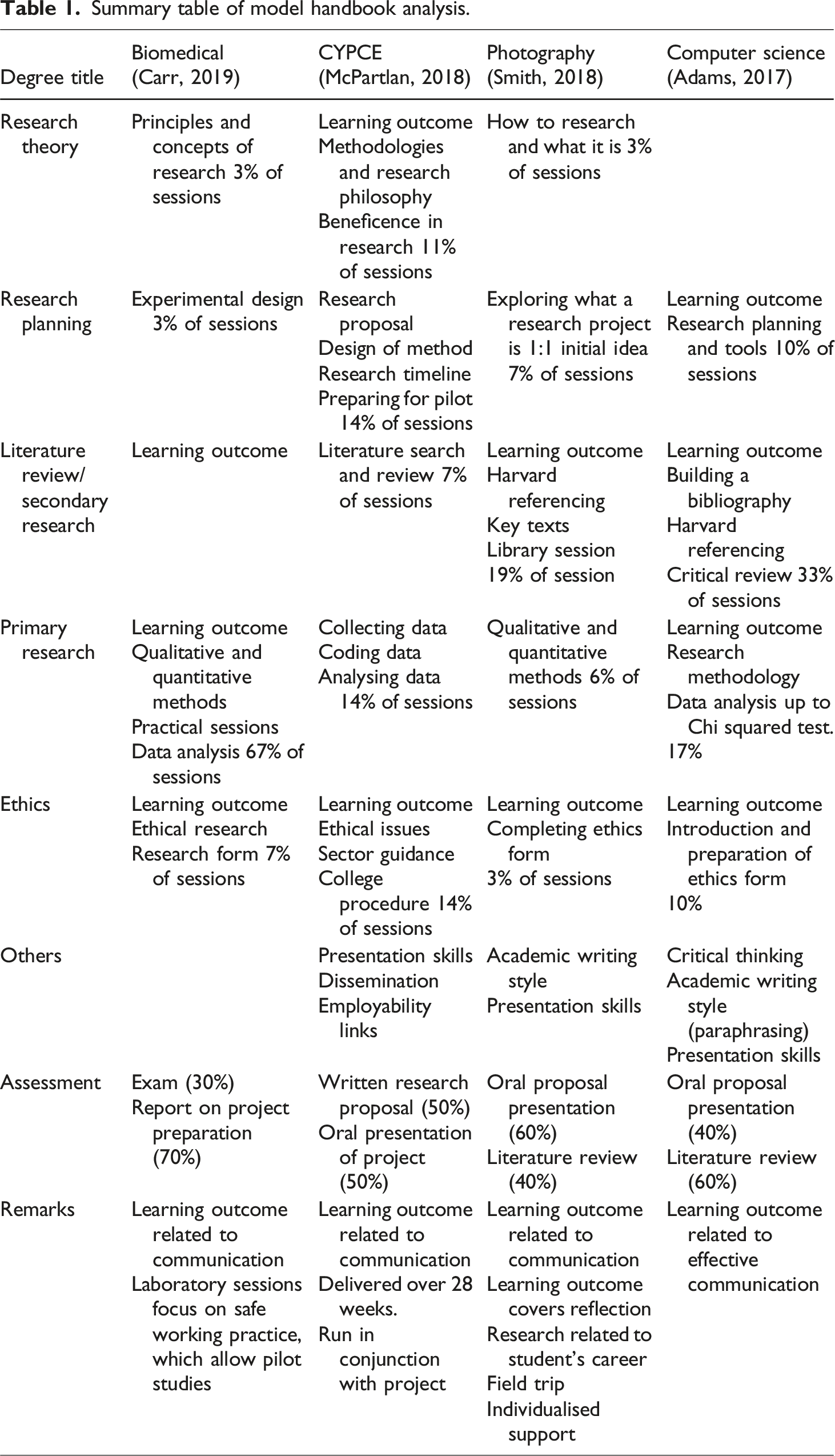
When comparing the analysis of the four different handbooks, it is apparent that research theory in general, although acknowledged in most of the modules, is most thoroughly discussed in the CYPCE module. This seems to also be the case for research planning, although it is not quite clear if the content of the CYPCE module applies only to the skills training or also to dissertation sessions, as the module was delivered alongside the project/dissertation module. Almost all modules have a direct reference to literature review in their learning outcome, and sessions explicitly devoted to this range from none in the biomedical sciences module, to a third of all sessions (computer science). Most of the sessions in the biomedical science module are related to primary research skills, which may be lab sessions or classroom teaching. Other modules have far less with photography explicitly devoting only about 6% of all the sessions to this topic. Regarding this module it should be borne in mind that the actual title is ‘Professional Practice’ indicating a wider remit. All learning outcomes explicitly acknowledge the importance of ethical research with CYPCE devoting the most sessions to this topic, which may not be surprising considering that primary research may include children and young people. Most of the other topics included relate to transferable skills such as writing and presentation skills. Some (McPartlan, 2018), if not all, of the assessment tasks are preparatory tasks for the primary research undertaken during the project/dissertation module. The ‘Remarks’ row highlights relevant points not covered in other parts of Table 1, such as that photography students are encouraged “to contextualise their current position within their photographic career” (Smith, 2018: p 3), or that the CYPCE module runs over 28 weeks, whereas the others are only 15 weeks long.
Participants’ background.
Secondary research, in particular a literature review, is required for at least one of the assessment tasks for the modules discussed in Table 1 (the literature review is part of the ‘report on project preparation’ for the biomedical top-up degree) and, therefore, all of the lecturers mentioned this in their interviews as one of the skills required to succeed in their undergraduate project. Participant No 2 and Participant No 3 found that the sessions run by their respective HE librarian to be very helpful as they covered how to find and evaluate information. Participant No 2 also pointed out that these sessions introduce the HE librarian to her students so that they could consult with the librarian outside of scheduled sessions. According to Participant No 1, her students are required to do a significant amount of reading during the summer break so that when they come back after the break, they have a reasonably clear idea what they are planning to do. Although there is no session title indicating literature research training in the relevant handbook (Carr, 2019), Participant No 1 explained that she used scientific articles to introduce methodology to her top-up degree students. While there is a certain amount of overlap between research skills in the different disciplines when it comes to literature research and review, their focus may be quite different. For instance, Participant No 3 encourages his students to read more widely to understand society at large, whereas Participant No 4 sees literature evaluation skills as a basis for identifying bias in sales literature in their professional practice after graduation. These comments suggest that the purposes of the secondary research depend on the subject area.
The discrepancy between the different vocational/academic fields is even more pronounced when it comes to primary research methods. The impression portrayed in Table 1 regarding the laboratory skills necessary for the biomedical top-up degree (Carr, 2019) was also confirmed during the interview with Participant No 1 where she detailed a number of laboratory skills ranging from risk assessment to image analysis methods involving microscopy. In common with the others, Participant No 1 mentioned simple descriptive statistic skills as necessary for her students. Although survey skills such as questionnaires and/or interview skills were mentioned by the three other HE lecturers, Participant No 4, who teaches computer science, suggested that more practical undergraduate projects in his area would be of more value to the professional development of his students. This, however, would require some changes to learning outcomes, consequently his students are mainly persisting with surveying people with respect to knowledge of and attitude towards computer related topics. To cope with the associated data analysis, computer science students are taught a range of statistical methods mentioned in the handbook (Adams, 2017).
Although the importance of ethics was reiterated in most of the interviews, and therefore corroborated the scheme of work in the handbooks, their interpretation and application were quite different. For instance, Participant No 3 explained that in his field ethics included not misleading the viewer by putting photographs “in the wrong context” or supplying misleading captions. Participant No 2, on the other hand, explained that ethical considerations were especially important in her area as her students may have to deal with vulnerable adults and so she emphasised the understanding of the underlying concept of beneficence as necessary for the research of her students. This also tallies with the CYPCE module handbook (McPartlan, 2018) which includes beneficence in research and research philosophy as topics to be covered. Finally, Participant No 1 emphasised that all the modules on her biomedical programmes have ethics embedded in them and that she and her students “are talking about ethics quite a lot”. However, her focus of what constitutes ethical research is different again as her field deals with different research objects.
During the interviews it became apparent that all the top-up degree students come from the college’s FD feeder programmes. The interview showed further that it is inter-disciplinary practice to develop research and other related skills throughout the different undergraduate levels (similar to SEEC (2010)). Having said that, none of the research skills teachers questioned the need for a research skills related module and, when asked if there was any other way of imparting research skills, all of the participants emphasised the value of the research skills module. Participant No 4 was probably the most adamant when he stressed that without the research skills module his students would struggle even more with their dissertation than they already do. In his case, though, it could be argued that the dissertation topics provide a certain amount of disconnect between the bulk of the programmes (including the FDs), which are practically/vocationally oriented (hard, applied in Biglan’s framework (Biglan, 1973)), and the dissertation, which, in many cases, is more social science oriented (thus in the soft, pure field (Simpson, 2017)) as many students investigate attitudes to certain computer science related topics.
All the lecturers clearly articulated that the research skills training was vocationally oriented because, for instance, graduates are to apply the scientific method as part of their daily work (Participant No 1, biomedical), keep up with an evolving field (Participant No 4, computer science) or develop an evidence-based practice (Participant No 2, Health & Social Care). However, it was the photography lecturer who most strongly emphasised this, which is in line with his module title ‘Professional Practice’. One way he interpreted research skills is to “develop taste” by reviewing other photographers’ work to understand how they operate, also in a commercial sense.
Discussion
To better understand the similarities and differences regarding research skills requirements in the four top-up degree courses discussed here it is elucidating to locate them in the framework developed by Biglan (1973) and refined by, amongst others, Simpson (2017). Biglan originally suggested the three dimensions: Hard (i.e. a field with strong paradigm consensus) versus soft, pure versus applied, and concerned with living or organic objects. However, it could be argued that, by their very nature, CBHE programmes are vocational (Gray et al., 2015; QAA, 2020), hence the second dimension (pure vs applied) can be disregarded as all programmes are ‘applied’.
In this framework computer science can be classified as having a strong paradigm consensus. This is supported by the subject benchmark statement (QAA, 2019c) which, although acknowledging that the computing discipline is developing at a rapid pace, requires the knowledge and application of mathematics, engineering and a “disciplined approach to problem solving” (p 4). Such a paradigm strong subject requires time to study these underlying concepts before being able to apply them (White and Irons, 2007). This supports Participant No 4’s idea of having a more practical final year project to consolidate material previously studied. This should be complemented by literature review training as such instruction may not have taken place owing to the necessity of teaching paradigm related material (White and Irons, 2007). In such a practical project human participants are not the study objects (Biglan’s third dimension) and, therefore, ethical considerations should be easily met. This would link the final year project to the professional practice to follow and may make the research skills training easier as the social science aspect of the current topics can be replaced by such necessary skills as dealing with and evaluating technical information found, e.g., in sales literature.
A subject situated in the strong paradigm consensus and concerned with living or organic objects is biomedical sciences. This also implies a significant time investment in studying and applying predefined approaches. However, as the subject benchmark statement brings out (QAA, 2019b), the biomedical field makes heavy use of the scientific method used in research, such as planning “an experiment in terms of hypothesis, sample, test or observation, controls observable outcomes and statistical analysis” (p 7) and, therefore, research skills training is part of the whole undergraduate programme. The need for a large amount of practical lab sessions, indicated in the biomedical science module handbook (Carr, 2019), has also been reported by Yeoman and Zamorski (2008). In addition to this, these authors also report on the need to support students with their understanding of research papers as they can be “full of technical jargon” (p 10). This may suggest that the evaluation of secondary sources should be demonstrated by a subject specialist, rather than by a librarian. As the research object can be living or organic matter, it seems a logical conclusion that the benchmark statement mentions ethical issues more than once, also in conjunction with laboratory practice. This is closely echoed by Participant No 1’s statement that she and her students “are talking about ethics quite a lot” something not found in the module learning outcomes (Carr, 2019).
Biglan (1973) suggests that the social sciences have no strong paradigm consensus and are concerned with living things. This is the closest match to the Health & Social Care/CYPCE top-up degree programmes investigated here. The lack of a strong paradigm is supported by the wealth of references in the paper by Wagner et al. (2011) which summarises investigation into the research teaching in the social sciences. A further support of this conclusion is the paper by Hardcastle and Bisman (2003), which discusses teaching social work research, as it reports on ongoing “tensions within the profession about the nature and function of research” (p 31) and then introduces three main models for teaching research in social work. This lack of consensus may be the reason why the CYPCE research-skills module handbook (McPartlan, 2018) includes research philosophy as the bedrock of research skills training. Despite this lack of consensus, the subject benchmark statement (QAA, 2019d) reiterates the idea of evidence-based practice (Hardcastle and Bisman, 2003), thus emphasising the need for research skills including critical engagement with literature, which was also highlighted by Participant No 2 during the interview. Since the second aspect of social science highlights that humans and society are the primary study objects (related to Biglan’s third dimension), it is unsurprising that the benchmark statement includes a large section on values and ethics, an aspect also reflected in the module handbook (McPartlan, 2018) and in the interview where Participant No 2 explains that the students may deal with vulnerable adults during their research and, therefore, need to display ethical behaviour in their research.
The subject benchmark which covers photography is art and design (QAA, 2017). Simpson (2017) locates the field of cinematics and photography amongst the applied, soft subjects suggesting little paradigm consensus. The lack of common consensus was also reflected in the interview as Participant No 3 highlighted the developing of taste as part of the project. The understanding of composition, or as QAA (2017) puts it, the developing of an “aesthetic sensibility”, has been mentioned by An (2015) as a top-priority in teaching photography. The benchmark mentions ethical work practice, which could also include intellectual property (IP) issues. The research and information skills listed in the benchmark include the retrieval and management of information from various sources, which may need to include a consideration of IP issues. Something not encountered in the other three fields examined in this study.
Examining the research participants’ background summarised in Table 2 suggests that they can be regarded as representing the research tradition of their respective field reasonably well. For example, Participant No 1 has a significant amount of formal training and research experience frequently found in this field as indicated by the subject benchmark statement (QAA, 2019b). On the other hand, the photography lecturer teaches an arts subject with a strong vocational slant, hence, the research aspect indicated by the benchmark statement (QAA, 2019a) is more vocationally oriented including areas such as IP issues or ‘retrieving and managing information from a variety of sources’ (see p. 15). This matches this interviewees background quite well as he has not had very much formal research training, but does have practical, professional skills. Similarly, the computer science lecturer has an undergraduate degree in IT and has taught in this area for a while, but his formal research skills are only just being developed through his master’s studies, as they are not required when working in the field as indicated by the relevant subject benchmark statement (QAA, 2019c). The only slight exception is participant No 2 whose background is in biology and not in Health & Social Care/CYPCE. However, because her degrees also involve living organisms (Biglan’s third dimension) she is well sensitised to research ethics, which is of significant concern in Health & Social Care/CYPCE research. Furthermore, she has taught in the field for over a decade suggesting familiarity with the research tradition of this field.
Conclusions
Based on the work detailed above it may be concluded that: • Research skills development through a dedicated module is a viable model for the top-up degrees studied in this case study. This conclusion is supported by the very existence of the research/professional skills modules in all four areas despite some relevant skills development in lower-level modules with all the lecturers emphasising the value of these modules. • There is a certain amount of overlap in literature review skills needs which may be effectively met by a librarian. Two lecturers found that their respective librarians running sessions for students on information retrieval and evaluation to be very helpful. However, it could be argued that, although the principles may be the same, the specifics vary between disciplines and, therefore, discipline specific literature skills training may be necessary. • The framework suggested by Biglan (1973) can be simplified to two dimensions (existence of paradigm consensus (i.e. hard vs soft) and concerned with living or organic objects of study versus other subjects) and that it can be employed to explain: a) The need for significant ethics training for subjects where study objects are living or organic as demonstrated by the CYPCE handbook and the interview with the lecturer teaching on this research skills module. b) The use of primary research tools and techniques peculiar to a field with strong paradigm consensus (relating to Biglan’s first dimension) without overlap to other fields. For example, the biomedical field requires laboratory skills not needed in the other three fields studied here.
These examples indicate that it may be difficult to effectively teach a common core set of research skills. • The four lecturers represent the research skills in their respective fields reasonably well. For instance, Participant No 1 has a high level of formal academic research training and experience, which is common in her field. On the other hand, Participant No 3 is a photographer and more in tune with less academic research skills relating to the practical aspects of this occupation.
This work indicates the importance of research skills training incorporated in CBHE top-up degrees and this despite research skills development in feeder qualifications. Further work could include an investigation into whether a similar need exists in university-based top-up degree courses. Furthermore, it should be explored if it is possible to develop resources that teach research philosophy and some common primary research tools and techniques (such as questionnaires or interview skills and their analysis) in paradigm consensus weak subjects. Another point of enquiry could be an action research project investigating the value of involving research librarians in research skills module development.
Footnotes
Declaration of conflicting interests
The author(s) declared no potential conflicts of interest with respect to the research, authorship, and/or publication of this article.
Funding
The author(s) received no financial support for the research, authorship, and/or publication of this article.
