




Abstract
In recent years, teachers around the world have been increasingly confronted with various expectations concerning the improvement of their classroom practices and school activities. One factor widely acknowledged to facilitate school and classroom improvement is a strong collaborative culture among teachers. As such, teachers are expected to work in teacher teams, to collaborate closely with colleagues, to co-construct classroom practices, and thus to strengthen trust relationships within the team. A growing number of researchers has analyzed how teachers address these expectations. They suggest that there is a link between teachers’ embeddedness in collaboration networks and teachers’ trust relationships. The present study seeks to contribute to the research literature by presenting results of Social Network Analyses (SNA) and exponential random graph models (ERGMs) on teacher collaboration in nine secondary schools in Germany (N = 366 teachers). We investigate how the involvement of teachers in co-constructive collaboration in schools, measured by the amount of team teaching (TT), relates to teachers’ trust levels. Results of our analyses suggest that a high amount of TT is not necessarily related to a higher degree of trust among teachers at the school level. However, a high involvement of teachers in TT is related positively to their being perceived as trustworthy. Furthermore, the emergence of trust relations in teacher networks depends on general network characteristics, such as homophily, reciprocity and transitivity.
Keywords
Introduction
In recent years, teachers around the world have been increasingly confronted with various expectations concerning the improvement of their classroom practices and school activities. One factor widely acknowledged to facilitate school and classroom improvement, is a strong collaborative culture among teachers. As such, teachers are expected to work in teacher teams, to collaborate closely with colleagues, to co-construct classroom practices, and thus to strengthen trust relationships within the team (Richter & Pant, 2016). However, it is not only society and politics demanding that schools be professionally prepared for such changing requirements. This is also an important concern for many schools. Consequently, teacher collaboration is implemented as a key principle in various school improvement projects, teacher development initiatives and policy frameworks worldwide, including measures to foster trustful relationships between teachers. For instance, the National Staff Development Council (a non-profit association established in 1969 to foster school improvement in the United States) has introduced teacher collaboration and sustaining trust relationships within schools as main standards for quality staff development in US American schools.
In line with the trends outlined above, scholars interested in education have increasingly turned their attention to the role and impact of both teacher collaboration and trust relationships in different countries and educational settings (e.g., Moolenaar et al., 2012). The “Teaching and Learning International Survey” (TALIS) that is focused on teachers and school leaders has demonstrated the importance of trust in fostering teacher collaboration (OECD, 2020). In the past, scientific literature on teacher networks has had a particular focus on the driving forces behind teacher collaboration (Vangrieken et al., 2015). However, the interplay between collaborative activities and the formation of trusting relationships between teachers has rarely been explored in empirical studies to date. The present study addresses this gap in the research by investigating the following main research questions:
How does teachers’ involvement in team teaching (TT) activities relate to the emergence of trustful relationships among colleagues at the school level? How does teachers’ involvement in TT activities affect the perceived trustworthiness of individual teachers?
To approach these questions, we first collect data from nine German secondary schools (three high schools, 1 five comprehensive schools, 2 one secondary modern school 3 ) in the states of Berlin, Brandenburg, Hessen, Lower Saxony, North Rhine-Westphalia and Schleswig-Holstein, each with between N = 11 and N = 93 teachers (in total N = 366 teachers). We then apply techniques of Social Network Analysis (SNA) and exponential random graph models (ERGMs) to analyze the data.
By investigating how the involvement of teachers in TT activities in schools is connected with teachers’ trust relations, this article aims to contribute to recent research on teacher collaboration and trust relations in schools (Kolleck, 2019; Moolenaar, 2012; Moolenaar et al., 2012; Schuster et al., 2021; Vangrieken et al., 2015). Notably, managing such collaborations has become a critical part of leadership roles within schools and local educational authorities (Clement and Vandenberghe, 2000; Conley et al. 2004; Díaz-Gibson et al., 2017; Goddard et al. 2000; Horn and Little, 2010; Kolleck, 2014; Kolleck et al., 2020). The present study enriches this research field by presenting new empirical insights and initial evidence on the mutual relationship between teacher trust and teacher collaboration, with a specific focus on a highly demanded collaborative practice, namely TT. Against this background, this study also aims to provide valuable information for educational practitioners and policy makers concerned with the opportunities and challenges inherent in engaging effective forms of teacher collaboration and fostering trust relationships among colleagues in public education.
Theoretical and policy background
Teacher collaboration
Conceptualizations
Collaboration among teachers has been a field of research for decades. In a recent systematic review, Vangrieken et al. (2015) classify different benefits of and constraints on teacher collaboration and summarize the strengths, depths and challenges of teacher collaboration as have been outlined in the scientific literature. The authors further acknowledge that teacher collaboration is quite a heterogeneous construct, ranging from mere aggregates of individuals to strong team entitativity including, for example, shared goals and values. Different meanings and understandings of teacher collaboration find their expression in various terms used to describe the phenomenon. The literature on teacher collaboration draws on many different expressions such as teacher teams, co-teaching, professional (learning) communities, (teacher) learning teams, or, more broadly, communities of practice (Kolleck, 2019). With the aim to develop more conceptual clarity, scholars have started to distinguish between different forms of teacher collaboration that arise. Little (1990) is probably one of the first authors discerning four forms of collegial relationships among teachers: storytelling and scanning for ideas; aid and assistance; sharing; and joint work. These forms are situated along a continuum from independence to interdependence. Building on this research, Gräsel et al. (2006) identify three forms of teacher collaboration that can be located on this theoretical continuum by Little (1990). They distinguish exchange, division of work/synchronization, and co-construction to describe how teachers collaborate with each other. While exchange (e.g., exchanging classroom or test material) does not require much time or effort, more intense forms of collaboration, such as an effective synchronization of team members or the mutual development of classroom practices and standards for teaching, can be regarded as being more effortful.
The present study understands teacher collaboration as an intentional interaction between teachers who are connected by a reference to common professional goals and tasks (Gräsel et al., 2006). Based on this understanding, teacher collaboration is communicative, requires trust, presupposes a certain autonomy of the actors and needs to be committed to the norm of reciprocity. These prerequisites apply especially to the forms of collaboration that require a high effort and intense work, as is the case when teachers engage in co-constructive practices. According to these theoretical frameworks, one of the most intensive forms of teacher collaboration is TT. This is a form of teaching in which two or more teachers prepare, carry out, evaluate and, if necessary, continue a lesson or unit of teaching together (Krammer et al., 2018). In its broadest sense, team- or co-teaching, as it is often called in an international context, can be regarded as an instructional model according to Johnson and Johnson’s cooperative learning theory (2005), grounding it in social interdependence theory from social psychology.
Teacher collaboration in the German context
Current evidence on teacher collaboration in Germany – which is the context of this study – is provided by Richter and Pant (2016), who conducted a survey with a total of 1015 German secondary school teachers. The authors found that almost all teachers consider it important to collaborate with others. However, a closer look at the data revealed substantial differences in the forms of collaboration that teachers pursue. Whereas an exchange of teaching and learning materials among teachers at a school was reported by almost all teachers, only a minority (approx. 20 percent) engaged in more intense forms of collaboration, e.g., planning projects together or involvement in TT.
It must be considered that school policy in Germany is characterized by the federal system, thus the primary responsibility for legislation and administration in education (i.e., cultural sovereignty) rests with the federal states (Bundesländer). Consequently, policies to promote teacher collaboration also differ across states and even schools. Overall, they range from mere recommendations for action to the implementation of TT and other co-construction activities (the latter two occur in only a few selected schools, mostly with a special profile such as inclusive schools). However, while there have been increasing calls for more teacher collaboration in recent years, most policies in Germany are still non-binding and, thus, many forms of teacher collaboration are still the exception. As a result, reactions to the increasing demand for teacher collaboration vary widely. While some schools and teachers implement the changes voluntarily because they see a benefit in increased collaboration, others regard strengthening collaboration between teachers as an additional burden (Hargreaves and Dawe, 1990; Kolleck, 2019).
Correlates of teacher collaboration
The question of whether and how teachers in schools collaborate with each other depends on various factors. This includes individual attributes of teachers such as age (i.e., older teachers are found to collaborate to a lesser degree than their younger colleagues), gender (i.e., female teachers are more likely to collaborate than male teachers) and experience (i.e., teacher collaboration is higher among novice teachers) (e.g., Bridwell-Mitchell and Cooc, 2016; Mora-Ruano et al., 2018; Schuster et al., 2021). However, Bridwell-Mitchell and Cooc (2016) also highlight that the degree of cohesion in teachers’ communities matters more than individual factors.
Runhaar et al. (2010) show that self-efficacy and learning goal orientation are positively related to asking for feedback. Teachers with a high sense of efficacy who believe in their capabilities to achieve goals are more likely to engage in structured collaboration and improvement strategies (Runhaar et al., 2010; Thoonen et al., 2011). Drawing on SNA to study teacher collaboration in inclusive settings, Sannen et al. (2021) find that teachers in highly dense networks have more positive attitudes towards inclusion and implement more differentiated instruction. Muckenthaler et al. (2020) illustrate how teachers opt for forms of collaboration that involve relatively little reduction in their own autonomy. Based on an expectancy-value model of teacher motivation, Drossel et al. (2019) demonstrate that subjective values explain teachers’ motivation to collaborate. The personal relevance of collaboration for teachers and their subjective values also relate to teachers’ perceptions of their principals as well as their personal tendency to collaborate. At the same time, teachers' ability to improve student achievement appears to be significantly related to seeking advice (Wilhelm et al., 2016). In addition, formal subunits in schools can facilitate information-seeking connections (Meredith et al., 2017). Teachers’ self-efficacy and collective efficacy are further positively related to extra-role behavior; that is, behavior that exceeds the requirements of a teacher’s role to voluntarily support a team’s or a school’s goals (Somech and Drach-Zahavy, 2000).
Teacher collaboration is connected with teacher well-being and job satisfaction according to international surveys such as TALIS, which is the first international survey focused on teachers and school leaders concerning six areas: learning environment; appraisal and feedback; teaching practices and classroom environment; development and support; school leadership; and self-efficacy and job satisfaction. Hierarchical regression analysis drawing on TALIS 2013 data including teachers’ individual, professional and organizational characteristics reveals that organizational characteristics explain the largest share (two thirds) of total explained variance in teachers’ well-being and motivation (Yıldırım, 2014). The most influential organizational characteristics are collaboration among staff, classroom atmosphere, feedback and assessment, and the climate of the school (Yıldırım, 2014).
Another series of international assessments providing information on teacher collaboration is the Trends in International Mathematics and Science Study (TIMSS), a comparative study of student achievement that is conducted by the International Association for the Evaluation of Educational Achievement. Teacher data provided by this study build a source to analyze the types and frequencies of collaboration and its effects on job satisfaction and teacher confidence. Empirical studies based on TIMSS data gathered in the United States demonstrate that collaboration involving the visiting of other classrooms as well as collaborative planning significantly influence job satisfaction (Reeves et al., 2017).
Trust
Conceptualizations
In the literature, different forms of trust are conceptualized. For instance, an individual’s general tendency to trust others (i.e., generalized trust) needs to be distinguished from relational or interpersonal trust (e.g., Kappauf and Kolleck, 2018; Kolleck, 2014; Tschannen‐Moran, 2001). The present study is interested in relational trust between teachers in schools. The concept of trust development relates to the processual nature of trusting. Trust is reviewed and at best confirmed in every new situation. Experience accumulates over time and is translated into (experiential) knowledge, which in part leads to implicit expectations (Luhmann, 2009). This reduces uncertainty in dealing with the other person.
Uncertainties arise where it is difficult to assess the behavior of the other person because they are unknown to the person trusting them. However, if the behavior of the other person seems calculable, this has a beneficial effect on the development of trust (Kassebaum, 2004). In particular, subjectively established similarities can reduce uncertainties (Berger and Calabrese, 1975).
Correlates of trust
In the academic literature on teacher collaboration, the importance of trust between teachers is often highlighted. However, there is still a lack of empirical studies on the role of teachers’ trust relationships and collaboration within schools. Few studies have addressed aspects of trust between teachers. This includes, for example, a study by Coburn and Russell (2008) who are interested in how district policies influence teachers’ social networks in elementary schools. In their mixed methods study, they show that education policies can influence the structure and depth of teacher collaboration as well as the level of trust within teachers’ interactions. They argue that teachers who have known each other for a longer period of time tend to be closer and trust each other more (Coburn and Russell, 2008). Scribner et al. (2002) demonstrate that relationships between teachers and head teachers based on trust positively influence the teachers’ shared commitment to the school’s goals. Thoonen et al. (2011) are interested in the motivation of teachers. Based on a quantitative study, the authors illustrate that relationships of trust have a positive effect on teaching practice. They are conveyed through teachers’ involvement in professional learning activities as well as through teacher motivation. Contrary to these findings, Moolenaar et al. (2012) do not find any effects of social relationships between teachers on the development of trust.
Based on these considerations, the aim of this study was to find answers to our overall questions as to how teachers’ involvement in TT activities relates to the emergence of trustful relationships among colleagues at the school level and how teachers’ involvement in TT activities affects the extent to which individual teachers are perceived as being trustworthy. Drawing on inferential network analyses, we were particularly interested in testing the following hypotheses: Teachers who engage in TT activities to a similar degree are more likely to perceive each other as trustworthy than teachers who engage in TT activities to very different degrees. Teachers who are involved in TT activities are more likely to be perceived as trustworthy than teachers who are not involved in TT activities. Trust relationships are reciprocal and occur in transitive constellations.
Methods
Sampling/data collection
The study presented in this article was conducted in 16 secondary schools in predominantly urban regions of Germany. All schools were part of a project on teacher collaboration and innovative school capacity. The survey that included questions to assess teacher networks was implemented during the first phase of the project. We obtained written consent from each individual teacher. During data collection and analyses, all federal guidelines for data protection were met. For the network part of the survey, we worked with a code list for each school that listed all teachers and staff members with a randomized code. This list allowed for a data collection procedure that assured anonymity to each individual participant. Teachers filled out the network questions with the codes as pseudonyms. The list matching the teachers’ names to pseudonyms was distributed only in the data collection setting, and was then collected from all the participants and shredded immediately after they had filled out the questionnaire. As the data collection was part of regular teacher meetings in which participation was obligatory, we reached an average participation rate of 70% of the teachers from a school. However, the teachers’ response rate was generally lower in the network questions than in the remaining part of the survey. Thus, seven schools had to be excluded from the sample due to lower response rates in the network questions. The networks analyzed for this study covered nine secondary schools, each containing between N = 11 and N = 93 teachers. Altogether, 366 teachers were included in the analyses (see Table 1).
Response rate, school type, and state of schools studied for this article.
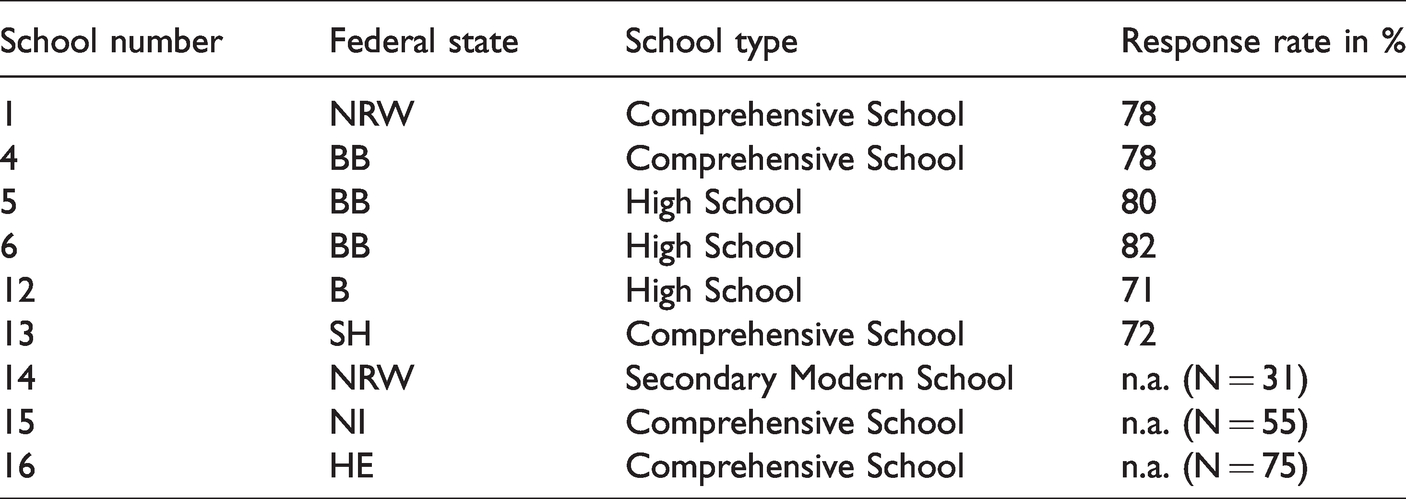
Table 1 presents descriptive statistics on our dataset. For each school number, the Federal State in which the corresponding school is located, the school type, and the response rate are listed. We did not receive data on the size of the college for schools 14–16, so percentages cannot be calculated.
Instrumentation
Social network data
The social relations between teachers were surveyed with techniques of SNA. Respondents of our study were asked to “list the 5 people with whom you have discussed situations in class and developed solutions particularly frequently over the past year.” Following Merluzzi and Burt (2013), this name generator was used to facilitate network analyses and the computation of network-analytical parameters (Burt, 1984). Participants also used a name interpreter to provide information on their trust relationships (“I place special trust in this person”), which they could assess on a Likert-type scale from 1 to 5. Respondents were only asked about their trust relationships with those colleagues they had nominated in the name generator. Using the information on trust relationships, we created networks in which the nodes represented the teachers who responded to the survey and the ties represented trust relationships. We dichotomized the information on trust relationships and counted a trust relationship as existing for the levels 3 ‘rather agree’ and 4 ‘fully agree’.
Network analytical parameters express the centrality and influence of actors in a network and are generated using the names provided in the name-generating questions. Generally, such network parameters can be determined using a multitude of algorithms. For example, a count of the sheer number of contacts an actor has (i.e., degree centrality) comprises one commonly known parameter applied in the present study.
Team teaching
The questionnaire included two questions about TT. To determine the extent of TT, teachers were first asked whether they “carry out TT at your school together with colleagues?” In addition, the frequency of TT was recorded with the question “How often did you teach in the team last year?” (with Likert-type answers ranging from 1 ‘1–2 times per school year’ to 4 ‘almost daily’). To avoid interdependence between the two variables, they were combined into one variable: the answer ‘no’ to the first question was incorporated as an additional level 1 ‘never’ in the second question, moving the other levels to an overall range of 1 to 5.
Network parameters and analysis techniques
We calculated the densities of the networks in order to answer the first part of our research question, namely how teachers’ involvement in TT relates to the overall level of trust at the school level. The density of a network represents the ratio of relationships actually established to all possible bonds. In addition to the total density, we calculated the density of the trust network, i.e., the number of actual trust relationships of teachers per school in relation to all possible connections between network members.
To include the overall level of trust among the teachers at a school, we calculated the proportion of the overall density and the density of the trust networks, i.e., how much the trust density differs from the total density. This ratio allowed us to measure the extent to which the relationships in a network are conceived as trustworthy. We then calculated a correlation between the frequency of TT and the ratio of trust relationships at school level to test for a significant relationship between the two variables. However, it must be noted that parameters at the network level are very sensitive to the network size as well as missing data: the larger a network and the more missing data, the lower the density usually is.
To gain deeper insights into the correlation between a teacher’s involvement in TT and the perception of trust among teachers, we implemented inferential social network techniques (exponential random graph models; ERGMs) to analyze the network data. In other words, we tested whether individual teachers’ involvement in TT as a collaborative classroom practice is related to the emergence of trust relationships.
We applied a subclass of ERGMs or p* class models (Robins et al., 2007; Wasserman and Pattison, 1996). In general, ERGMs are used to approximate the data generating process of the observed network by using exogenous covariates (i.e., structural attributes at the node- and dyad-level), as well as endogenous network statistics (i.e., self-organizing network dependencies) (Morris et al., 2008; Robins et al., 2007). In this way, ERGMs enabled us to test whether our observed networks differ significantly from any other possible network and consider both structural features of the network members and network theoretical dependencies between the ties.
As we examined multiple independent networks, we calculated pooled ERGMs. This allowed us to estimate the identical model for all nine networks and to receive average estimates for the covariates (Leifeld et al., 2018). We performed our model estimation using the ‘btergm’ package as implemented in the ‘xergm’ meta package (Leifeld et al., 2018) in RStudio (R Core Team 2019) to estimate parameters that best fit simulated whole networks based on the empirically observed local network properties.
In the scientific literature, only a limited number of missing data is usually tolerated for the application of ERGMs. In this study we follow Siciliano (2017), who also applied ERGMs to the analysis of networks between teachers. Originally, the data set for this study included 16 schools. These had to be reduced to nine schools to meet the 65% threshold for response rates (Siciliano, 2017). 4 When using SNA, it is also important to consider the boundary specifications of a given network (Kossinets, 2006). To give an example, interviewed persons can decide whom to nominate for further interviews and the researcher has to decide which nodes and relations are to be included. While many studies conclude that missing ties and alters that have been forgotten are those with less important ties to the ego, this study aimed to capture all relevant actors by formulating several cautious questions regarding different relations (including collaboration, trust, information flows and communication) that aimed to prevent important alters from being forgotten. Thus, following Merluzzi and Burt (2013), in our survey the borders of the network were defined by relevance (i.e., considering five names as the cost-effective number for name generators).
Our final model contained both endogenous and exogenous covariates. As our main independent variable of interest, we added a term for both incoming (‘TT frequency alter’) and outgoing (‘TT frequency ego’) ties as well as a homophily term for TT (‘TT frequency homophily’). 5 This allowed us to detect whether the frequency of TT relates to the probability that a teacher identifies another teacher as being trustworthy, is themselves identified as trustworthy, or that teachers who have similar TT behavior are more likely to form a trusting relationship. In addition, we included terms for incoming (‘alter’) and outgoing ties (‘ego’) as well as homophily terms for gender, work experience, and formal role. With ‘formal role' we referred to functional positions, such as assistant principal, school subject coordinator, or head of student councils (i.e., responses to the question “Do you have a functional position at the school (e.g., high school coordinator))?” We also added a term for the tendency of teachers to have trustful relations with others who teach similar subjects.
As endogenous variables, we included one term to control for the density of the network (‘edges’) and two terms to control for the distribution of in- and out-degree. To consider the tendency of network members to rely on already existing connections when engaging in relationships, we included one term for reciprocating ties (‘reciprocity’) and two terms for closing transitive relations (‘gwesp’ and ‘gwdsp’).
Results
Team teaching and trust relationships at the school level
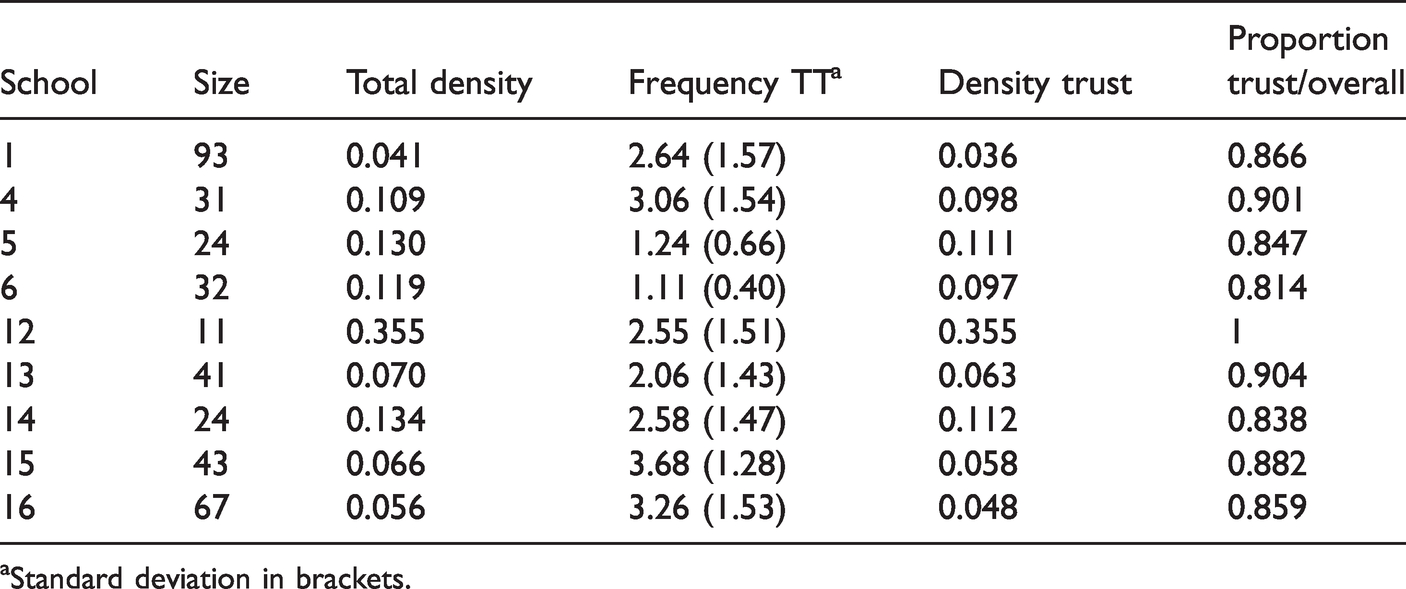
Table 2 shows the network parameters of the participating schools at school level. The left column presents the corresponding number for anonymized schools. The number of teachers at the schools who were involved in the analyses is given in the column “size”. Table 2 also shows the average frequency of TT at a given school, calculated as an overall mean score, as well as the total density and the density of the trust network. Moreover, the overall trust level can be found in the column “proportion trust/overall”. Whereas in school 12 all of the mentioned relationships are described as trustful, in school 6 only 81 percent of the relations are trust relations.
Parameters at school level.
aStandard deviation in brackets.
To answer the first part of the research question, there is no significant correlation between the frequency of TT and the ratio of trust relationships at school level (Spearman’s rho: r = 0.28 p=.460). Schools in which teachers do a lot of TT do not have a significantly higher proportion of trust relations among colleagues. However, the relatively high proportion of trust across all schools should be noted as this demands some caution in interpreting this finding.
Team teaching and trust relations at the individual level
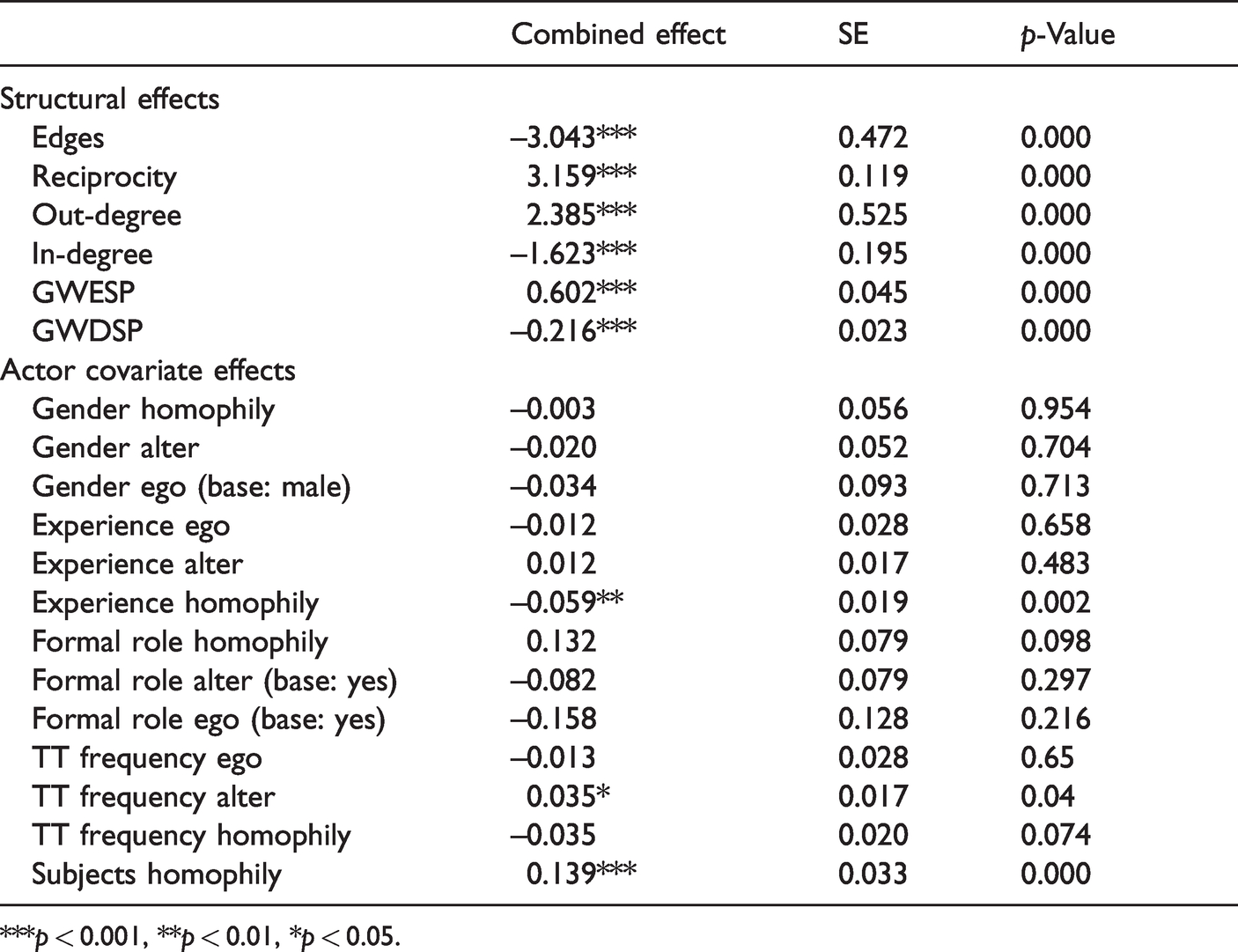
In the model presented in Table 3, the dependent variable is “network of trust” (i.e., responses to the question “I place particular trust in this person”). TT serves as an independent variable. Hence, the model tests to what extent the implementation of TT relates to the emergence of a trust relationship. Two of the results based on this analysis seem particularly noteworthy. First, teachers who do a lot of TT are named significantly more often as being trusted than teachers who tend to teach alone. In other words, more confidence is invested in those teachers with high levels of participation in TT. Second, trust relationships are more frequent between people who are similarly involved (or similarly less involved) in TT activities. 6 Hence, teachers who do similar amounts of TT tend to describe each other as trustworthy. However, the latter result is slightly less than significant (p = .07).
Relationship between trust relationships and TT (ERGM results of trust relations).
***p < 0.001, **p < 0.01, *p < 0.05.
To investigate these results in more detail, we deliberately selected two of the schools for a visualization of TT frequency and trust relationships (Figure 1). The figure shows both the trust relationships and the extent of TT. Each node represents a teacher at the respective school. The connection between the nodes indicates whether a trust relationship exists. The color specifies how often a teacher practices TT (from light to dark). In other words, light nodes signify that the teacher in question tends to practice little or no TT, whereas teachers represented with dark nodes practice TT frequently. The size of the nodes is represented by the in-degree, i.e., how often a person has been described as trustful.
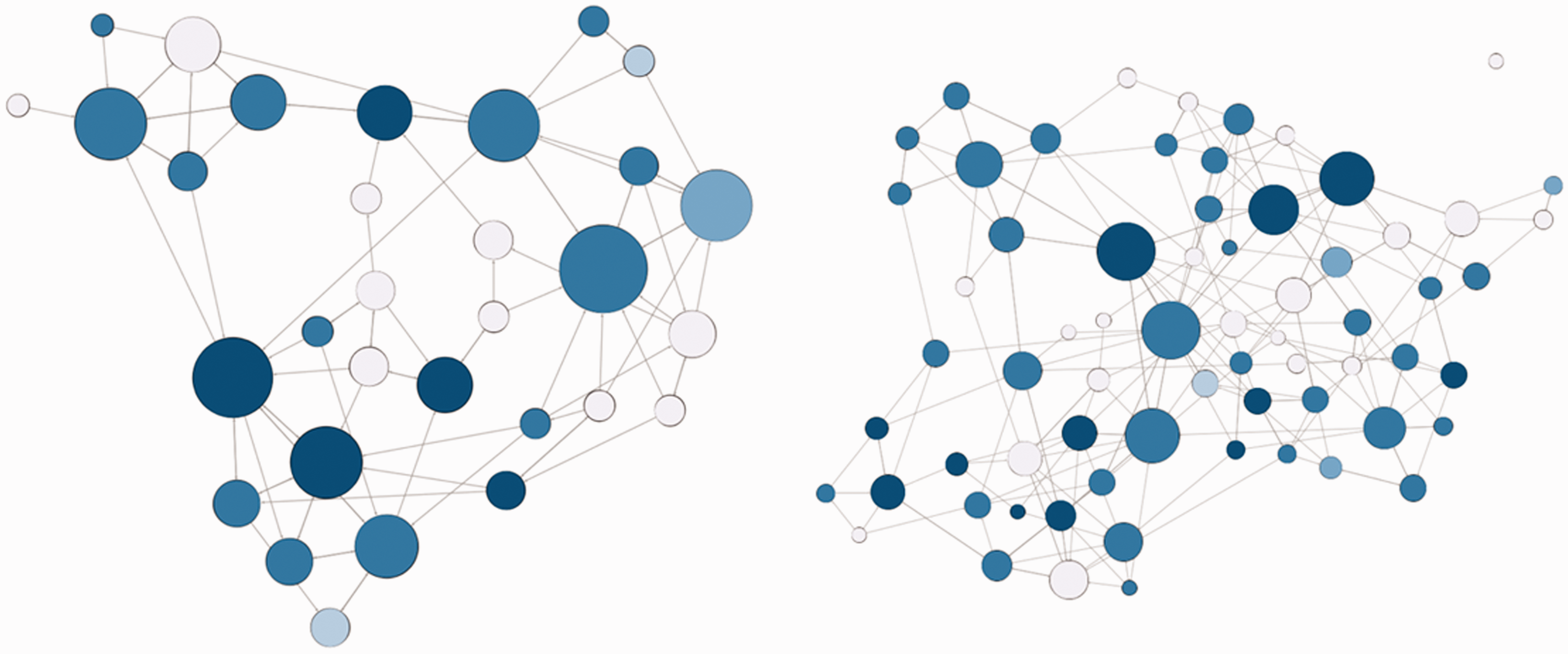
Teacher networks based on teachers’ trust relations in two example schools from our data set (node size represents in-degree; color represents frequency of TT: light = never; dark = frequently).
It can be figured from the visualizations of these two example school networks that dark nodes tend to be rather large. Teachers who enter into trust relationships seem to be involved in TT more often than other colleagues. The illustration of the two networks also points to a group formation in the teaching staff, which is marked by the colored clusters. Teachers with the same color seem to be closer to each other. This impression is consistent with the concept of social homophily and our assumption that teachers with a similar level of involvement in TT are more likely to perceive each other as trustworthy.
In contrast to our main variables of interest, most of the control variables implemented in the model do not seem to be related to a teacher’s trust. For instance, neither the variable “gender” nor the variable “formal role” (i.e., the functional position within the schools) show an influence on teachers’ trust relationships at the individual level. Only the homophily term for formal role suggests a weak relation to the trust network (p < .10). This means that teachers with a formal role tend to trust others with a formal role, whereas teachers without a formal role are more inclined to trust those without formal roles. Likewise, the professional experience of a teacher (measured by years of experience in the field) explains the network structure only to the extent that people with similar professional experience tend to trust each other. 7 The same applies to teachers of similar subjects. In other words, the results concerning “subjects homophily” in Table 3 demonstrate that teachers with similar subjects trust each other more than teachers with different subjects.
Finally, for the endogenous factors it is shown that trust relationships are rather reciprocal and also occur in transitive constellations. In other words, if a person A trusts a person B and person B in turn trusts a person C, it can be assumed that person A also trusts person C.
Discussion and limitations
The present article sought answers to the questions of how teachers’ involvement in TT activities relates to the emergence of trustful relationships among colleagues at the school level and how this affects the perceived trustworthiness of individual teachers. Presenting findings of SNA and ERGMs, our study suggests that a high level of involvement in TT at a school does not automatically imply a higher level of trust among colleagues. This result seems surprising since previous studies have referred to the benefits of both teacher collaboration in schools (e.g., Vangrieken et al., 2015) and teachers’ interactions based on trustful relations (e.g., Coburn and Russell, 2008). However, it should be interpreted with caution due to the high presence of trust that we found in the schools of our sample, possibly indicating a ceiling effect in our data. In addition, the small sample size of our database may also have influenced the low statistical power of our analyses at the school level due to non-significant results.
Moreover, using inferential SNA techniques based on ERGMs at the individual level, our analyses imply that teachers’ involvement in TT is positively related to the degree to which they are perceived by other colleagues as being trustworthy. The results further suggest that teachers with a similar TT workload are more likely to perceive each other as trustworthy. Also, the emergence of trust relationships in teacher networks depends on general network characteristics, such as reciprocity and transitivity.
Clearly, the results of our study are limited in terms of scope and generalizability due to several factors. Due to the location of data collection, results can only be interpreted within the context of secondary schools in Germany. Moreover, to meet methodological requirements for the network analyses, we had to exclude several schools thereby reducing our sample even further.
Still, we assume that our study provides some valuable insights into teacher collaboration and trust networks given that these kinds of data are hard to assemble as part of surveys in schools. A further limitation relates to the assessment of TT in our questionnaire. Regarding the wide variety of collaborative practices among colleagues in the school context, TT is only one possible manifestation of an intense form of teacher collaboration (see Gräsel et al., 2006; Richter and Pant, 2016). Future studies aiming at a more nuanced understanding of relations between trust and collaboration may wish to extend this aspect of assessment.
Since TT is surveyed at regular intervals and on a large scale in many other OECD countries, the question arises as to how our results based on the German context compare to other systems regarding the incidence of TT. It is interesting to note that the results on the relevance of TT activities in schools and the general qualities of social relations between teachers are largely consistent (OECD, 2020; Yıldırım, 2014). However, while TALIS results show that professional collaboration involving more interdependence between teachers, such as TT, is also less frequent in other OECD countries (see OECD, 2020), TALIS results are comparable with our study to a limited extent only. This is firstly because we had to focus on a small sample of nine secondary schools in Germany and secondly because the present study used a different questionnaire including differing items. Also, TALIS does not include network items meaning that the application of (inferential) network analyses is not possible.
Practical implications and prospects for further research
Practical implications of this study include the enhancement of teachers’ trust relationships and teacher collaboration. Decision makers in educational policy and administration as well as school administrations should promote TT to a much greater extent.
It is particularly helpful for educational administrators and politicians to formulate practical strategies to motivate teachers to collaborate and to further support attracting potential teachers and retaining them in the teaching profession. In recent years, education systems and their actors around the world have been confronted with growing expectations to strengthen collaboration between teachers. This overview provides new insights into the importance of trust and TT. Practitioners could learn from these insights and introduce new ways to support collaboration and to foster trust between teachers while strengthening teacher autonomy. The research results show different ways in which schools ensure that teachers actually want to work together, while more research is needed on what types of collaboration have a positive impact on teacher wellbeing.
It must be taken into account that TT as an intensive form of collaboration between teachers might be considered too expensive for some schools or school systems and for this reason fails to be realized. On the one hand, this argument can be countered by the fact that TT has shown numerous positive effects on other factors related to the quality of schools and teaching (see e.g., Kricke and Reich, 2016). On the other hand, there are several alternatives that seem to come at somewhat lower costs. One example would be the ‘one teaches, one assists’ method, which is suitable with educators who are not necessarily teachers themselves (e.g., preservice teachers, school assistants or learning facilitators). In addition, schools could create new professional groups to support TT (a kind of assistant teacher system). However, the effects of these alternatives have not yet been scientifically evaluated.
In general, our study provides some insights into how a network approach might be useful for teachers, leaders, educational policy makers, administrators and managers. The way network concepts have been used to improve schools and teaching and to help educational researchers to identify how teachers are affected by network structure, and how they might themselves make use of network structures to increase their impact, has been discussed conceptually in more depth elsewhere (see for instance, Chapman and Hadfield, 2010; Coburn and Russell, 2008; Moolenaar et al., 2012; Penuel et al., 2009). Our study contributes to this stream of research by providing more empirical evidence on the skills and knowledge needed for managing new expectations confronting teachers and education systems in a way that can benefit schools.
Footnotes
Acknowledgements
We would like to thank Dirk Richter, Don Peurach and Eran Tarmir for their helpful feedback during earlier stages of the work, and the members of the CoMMIT project for their extensive support with the data collection and preparation.
Declaration of conflicting interests
The author(s) declared no potential conflicts of interest with respect to the research, authorship, and/or publication of this article.
Funding
The author(s) disclosed receipt of the following financial support for the research, authorship, and/or publication of this article: This work was supported by the German Research Foundation (grant number KO 4997/4-1); and the Robert Bosch Stiftung.
