




Abstract
The paper reports a study that investigated engagement with and response to strategy-based instruction (SBI) targeting grammar learning strategies (GLS). Participants were 36 Polish university students majoring in English. The intervention spanned one academic semester and involved eight 30-minute sessions incorporated into regularly scheduled classes. Data were collected by means of post-intervention questionnaires completed immediately after each session. The students indicated the levels of their engagement at the beginning, in the middle, and at the end of each session on a seven-point scale and responded to open-ended questions. Quantitative analysis showed moderate levels of engagement in all sessions but also indicated that engagement tended to decrease as the sessions progressed. Qualitative analysis identified three main themes, each comprising more specific subthemes: (1) the effectiveness of grammar tasks, (2) new methods of learning grammar, and (3) student engagement. Implications for effective SBI targeting GLS are discussed.
Introduction
While the need for grammar instruction has been hotly debated by second language acquisition (SLA) specialists for decades, there is now a broad consensus that such instruction is beneficial, with most discussions revolving around how this should best be done (Loewen, 2020; Pawlak, 2021). Whatever instructional options are employed, what transpires in the second or foreign language (L2) classroom is unlikely to allow learners to gain full control over grammar structures. Specifically, the knowledge of grammar is highly complex because it involves not only the form of a particular grammar feature but also its meaning and use (Larsen-Freeman, 2003). In addition, and much more importantly, helping learners understand how a given structure works and how to use it when they have ample time to draw upon requisite rules, or developing their explicit knowledge, is only the first step in achieving mastery of grammar. By contrast, it is exceedingly more challenging to aid students in developing implicit knowledge or automatizing their explicit knowledge to such an extent that it can be employed in spontaneous interactions (DeKeyser, 2017; Ellis, 2009). Therefore, it is important to empower learners to be able to take steps to master target language (TL) grammar on their own in a way that best suits their needs and preferred ways of learning. In other words, it is crucial to foster learner autonomy in learning L2 grammar (Pawlak, 2016). This is where the adept use of grammar learning strategies (GLS) comes into play. However, little is known about such strategies beyond patterns of their use in different contexts. In particular, there have been almost no attempts to examine whether GLS use can be enhanced through strategy-based instruction (SBI) and how learners perceive and respond to such strategic intervention. This study addressed this issue by investigating English majors’ engagement in SBI targeting strategies for learning grammar and their perceptions of the activities and tasks employed for this purpose.
Definition and Classification of GLS
GLS are defined as deliberate actions and thoughts that students employ to learn and gain better control over the use of grammar structures (Cohen and Pinilla-Herrera, 2010). In other words, these strategies not only contribute to understanding the workings of grammar in relation to the form, meaning, and use of specific structures but also aid learners in using grammar features accurately, meaningfully, and appropriately in different contexts (Larsen-Freeman, 2003). Such contexts include both situations in which students have sufficient time to draw on their explicit knowledge, such as when doing controlled exercises, and situations in which they have to convey their messages in spontaneous interactions in real time, which necessitates reliance on automatized knowledge (DeKeyser, 2017). For example, students may paraphrase rules to understand them better, compare their speech with that of more proficient TL users, listen carefully for corrective feedback, or try to use new grammar structures in meaningful contexts (e.g. in a class discussion).
Although GLS can simply be treated like other language learning strategies (LLS) by changing the wording of some of the items included in existing classifications (e.g. O’Malley and Chamot, 1990; Oxford, 1990), this approach ignores the specificity of learning TL grammar. For this reason, Pawlak (2018) proposed a dedicated classification of GLS that considers the diverse ways in which learners can approach this intricate process. Based on the categorization of LLS by Cohen and Dörnyei (2002), a taxonomy of instructional options in teaching grammar (Ellis, 1997; Pawlak, 2006), and existing empirical evidence, he divided GLS into four main groups: (1) metacognitive GLS, used to plan, monitor, and evaluate grammar learning (e.g. trying to find more effective ways of learning grammar), (2) social GLS, which involve learning grammar with others (e.g. practicing grammar structures with other students), (3) affective GLS, employed to self-regulate emotions (e.g. trying to relax when encountering problems with learning and using grammar), and (4) cognitive GLS, which are directly related to getting to know and using grammar features. The last category contains four subgroups: (1) GLS involved in using grammar in communication (e.g. using Internet resources to see how a structure is employed in meaningful contexts), (2) GLS used to develop explicit knowledge (e.g. marking grammar structures graphically, using color, underlining, etc.), (3) GLS used to automatize explicit knowledge (e.g. incorporating phrases containing specific structures in one's TL performance), and (4) GLS employed to capitalize on corrective feedback on grammar errors (e.g. attending to feedback provided by the teacher or more proficient TL users). The classification served as a basis for the development of the Grammar Learning Strategy Inventory (GLSI), which includes 70 five-point Likert-scale items divided into the categories and subcategories specified above. Several validation studies conducted, among others, in China and Iran have corroborated the underlying structure of the GLSI, even if some items needed to be eliminated (Pawlak et al., 2023; Wang et al., 2024).
Research into GLS
Research into GLS is still in its infancy, which is evident from the scant number of studies and their limited scope. The bulk of existing empirical investigations have focused on the identification of such strategies, and participants have mostly been university students in degree programs in English. For example, in the Turkish context, Sarıçoban (2005) and Gürata (2008) used a slightly modified general-purpose classification of LLS and found that university-level learners of English most often opted for cognitive GLS. Similar results were reported in several studies involving English majors in Poland. The qualitative analysis in the diary study undertaken by Pawlak (2008) revealed that participants mainly reported reliance on a limited set of traditional strategies, such as formal practice, with little concern for taking steps to use grammar features in spontaneous interaction. Pawlak (2012), in turn, showed that although responses to Likert-scale items indicated an emphasis on GLS related to the use of grammar for communicative purposes, students’ answers to open-ended queries pointed to the predominance of cognitive GLS such as doing controlled exercises (e.g. paraphrasing, translating). More recent empirical investigations that have relied on the GLSI have painted a more nuanced picture, perhaps thanks to the focus of the instrument on distinctive processes involved in L2 grammar learning. Specifically, Pawlak (2019) in the Polish context and Nakachi (2021) in the Japanese setting reported that English majors most frequently used cognitive GLS aiding the processing of corrective feedback on grammar errors and the use of grammar features in communication.
Few studies have examined the link between GLS use and attainment or other factors. Tilfarlioğlu (2005) failed to uncover statistically significant differences in GLS use between successful and unsuccessful Turkish university students in a preparatory program in English. Similarly, Pawlak (2009) did not find significant differences between lower- and higher-level participants in a degree program in English in Poland. Regarding specific GLS categories, a very weak correlation was identified between GLS involved in explicit deductive learning (i.e. those that involve working with rules) and grades in a grammar course. More recently, using the GLSI to collect data from Hungarian and Polish students majoring in English, Pawlak and Csizér (2023) found that strategy use, particularly GLS enhancing the employment of grammar structures in communication, explained 13%–15% of the variance in attainment. Zarrinabadi et al. (2023) revealed that Iranian learners’ use of all types of GLS included in the GLSI depended on growth mindsets in a second and third language, and that such mindsets were positive predictors of grammar test scores. Also, in the Iranian setting, Hassanzadeh and Ranjbar (2022) demonstrated that GLS use in a consciousness-raising task, which required participants to collaborate to discover grammar rules, predicted grammar proficiency.
Despite empirical evidence that instruction targeting LLS is effective, even if this effectiveness is mediated by different variables (e.g. age, context, proficiency (Plonsky, 2019)), there is almost no research investigating the effects of SBI focusing on GLS. This is unfortunate because providing evidence for more frequent use of different types of GLS or showing that such use is related to attainment may be of little value for teachers seeking to aid their students in mastering L2 grammar. One notable exception is the study by Trendak (2015), which explored the effects of strategic intervention focusing on cognitive and memory GLS with respect to overall LLS use and the mastery of emphasis by Polish learners of English from junior and senior high school as well as university level. The intervention spanned six weeks and involved the employment of a number of awareness-raising activities. SBI proved to be beneficial both in terms of enhanced command of the targeted feature and more frequent strategy use, with training focused on memory strategies being more effective than instruction targeting cognitive strategies. However, this study suffered from several limitations (see Cohen et al., 2023), one of which was the failure to explore the extent to which participants engaged with the SBI and how they perceived it. The present investigation aimed to fill this gap by providing much-needed insights into students’ involvement in instruction targeting GLS and their response to it. This is an important issue in view of the fact that how students respond to SBI and the extent to which they engage with the activities it encompasses determine the effects of the pedagogic intervention.
The Study
Aims and Research Questions
This study is part of a large-scale research project examining the effectiveness of SBI targeting GLS in terms of both the use of these strategies and the development of grammar knowledge. Specifically, it explored participants’ response to this strategic intervention. The following research questions were formulated:
To what extent do students engage with SBI?
What are students’ perceptions of the strategic intervention?
Participants
Participants were 36 English majors: 30 females, 4 males, and 2 who did not specify their gender. On average, they were 19.17 years of age (SD = 0.94) and their experience in learning English amounted to 11.61 years (SD = 3.40). The students were enrolled in the first year of a three-year BA program. They were required to attend an intensive course in English, divided into classes focusing on TL skills and subsystems (e.g. reading, speaking, grammar) and content classes covering linguistics, applied linguistics, literature, and history. Participants’ self-evaluation on a scale from 1 (lowest) to 6 (highest) reflected their varying TL proficiency across skills and subsystems: reading – 4.89 (SD = 0.98), listening – 4.75 (SD = 1.08), speaking – 4.19 (SD = 1.12), writing – 4.14 (SD = 1.17), grammar – 3.94 (SD = 1.09), pronunciation – 3.92 (SD = 1.18), and vocabulary – 4.25 (SD = 1.16).
The choice of the target group was in part related to convenience, as the researchers had relatively easy access to English majors in the departments in which they worked. Much more importantly, however, the SBI was designed with the unique needs of the participants in mind. Specifically, while being admitted into the program required mastery of a range of English grammar structures, they experienced considerable difficulty in using these structures in spontaneous interactions under time pressure.
Strategic Intervention
SBI targeting GLS was implemented over one academic semester and comprised eight 30-minute segments delivered during regularly scheduled foreign language methodology classes taught by the second author. This ensured that the instruction fully aligned with the guidelines formulated by the present researchers. The treatment sessions targeted different types of GLS included in Pawlak's (2018) classification, but the main focus was placed on strategies aiding the use of grammar in spontaneous interactions (i.e. cognitive GLS supporting the use of grammar features in communication, automatization of explicit knowledge, and processing of corrective feedback). This emphasis closely reflected the needs of the participants, namely, students in the first year of a BA program in English (see above). Due to limitations of space, it is not feasible to include the details concerning the treatment sessions. Thus, below we provide brief descriptions of two treatment sessions (1 and 3), and the materials used during these sessions are included in the Supplementary Materials. In addition, Table 1 presents the main foci of the eight intervention sessions together with examples of tasks implemented as part of the SBI. It should be clarified that the students were made aware that the focus of the intervention was on GLS at the start of the study and they were reminded of this focus during each following treatment session.
Main foci and example tasks of intervention sessions.
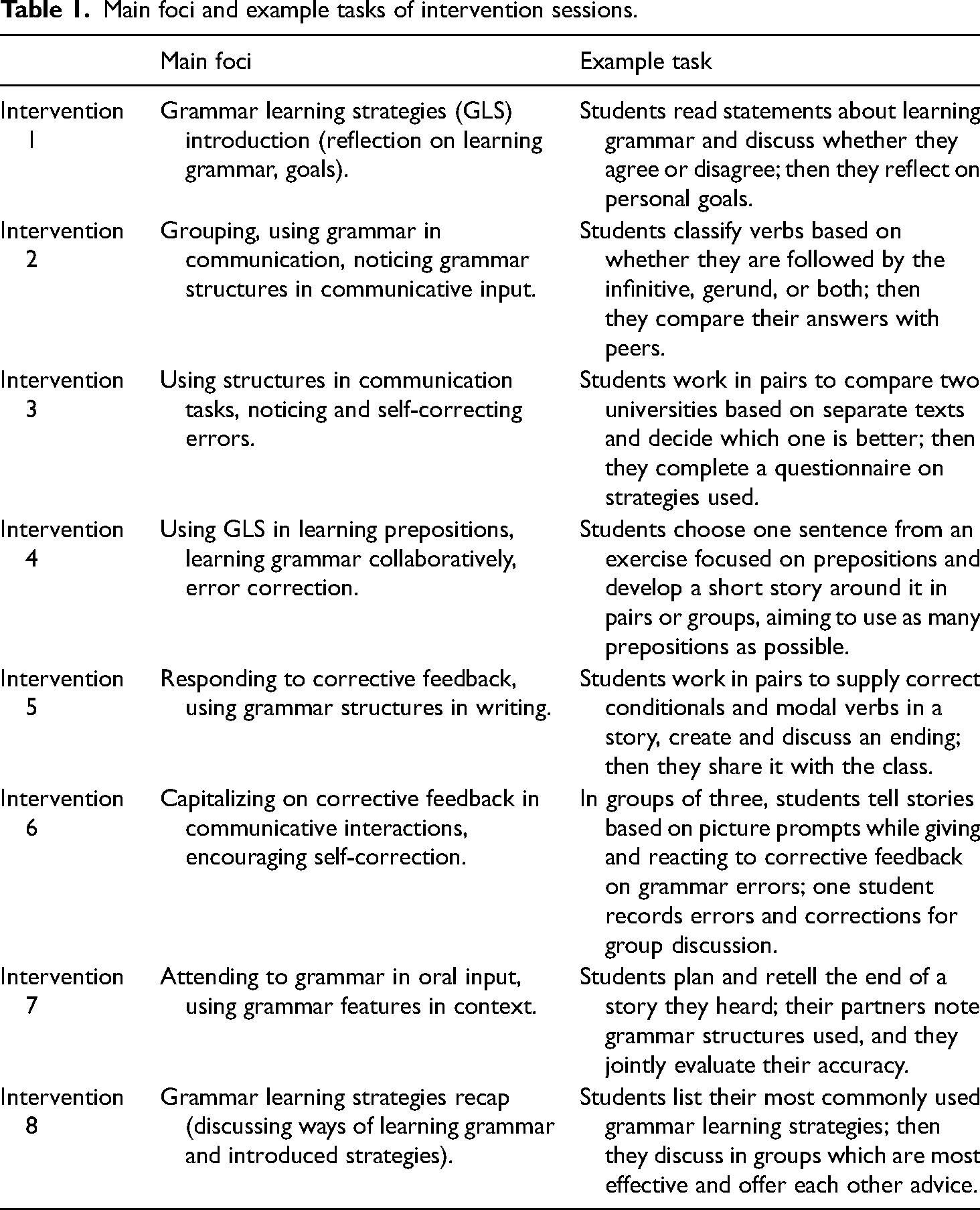
Intervention 1, which was introductory in nature, consisted of three tasks: (1) students read statements about learning grammar, chose those with which they agreed, and then shared their opinions; (2) participants were presented with selected GLS and reflected on their usefulness; and (3) students listed their strengths and weaknesses in English grammar, identified the goals they would like to achieve, and shared those goals with the group. In Intervention 3, the students were instructed to perform the following activities: (1) discussing in pairs or small groups things they could do to use the grammar features in communicative interactions; (2) completing an information-gap communication task requiring the use of the passive voice (i.e. exchanging information about two imaginary universities in the USA); and (3) discussing grammar structures that needed to be used for the attainment of the communicative goals as well as the errors that the students had noticed either in their own output or that of their interlocutors (see Supplementary Materials).
Data Collection
The data were collected at the end of each session through a post-intervention questionnaire (PIQ) that comprised two parts. In the first part, the students indicated the level of their engagement on a scale of 1 (lowest) to 7 (highest) at three time points: the beginning, middle, and end of the session. Engagement was broadly understood here as overall involvement, and no attempt was made to tease apart its dimensions. Although the researchers are fully aware that engagement is viewed as multicomponential, comprising, for example, behavioral, cognitive, social, and affective facets (e.g. Mercer and Dörnyei, 2021; Philp and Duchesne, 2016), this conceptualization appeared to be sufficient for the purpose of gauging students’ involvement with the treatment sessions, particularly given the fact that the larger research project was exceedingly complex and involved multiple data collection tools. It would therefore have been unrealistic and too time-consuming to have the students tease apart different dimensions of engagement in a dynamic, naturally evolving class segment. In addition, by asking students to self-rate levels of their composite engagement retrospectively at three time points, we hoped to obtain a more nuanced picture of their involvement that took into account the nature of the tasks and activities comprising the SBI. In the second part of the PIQ, the students answered three open-ended queries: “How useful were the tasks you performed? Please justify,” “What ways of learning grammar did you get to know?” and “How engaged were you in the tasks? Why?” They were free to decide whether to use English or Polish (i.e. their mother tongue) for this purpose, although most of them opted for the latter. Consequently, RQ1 was addressed based on the self-ratings and the responses to the first part of the third open-ended query, while RQ2 was answered drawing on the remainder of the qualitative data.
Data Analysis
Quantitative data analysis assessed engagement levels across eight sessions (PIQ1–8). The mean (M) and standard deviation (SD) were calculated for each measurement point (i.e. beginning, middle, end) to examine central tendency and variability. Normality checks using the Shapiro–Wilk test indicated that the data were not normally distributed (p < 0.05 for most sessions and the combined dataset). Therefore, the Friedman test was used to compare engagement levels, both within individual sessions and across sessions using aggregated scores. Where significant differences were found within sessions, Wilcoxon signed-rank tests were conducted for pairwise comparisons.
Qualitative data analysis followed the five-step process used by Gao and Zhang (2020), and it was run separately for the first part of the third open-ended question (i.e. the level of engagement) and for the rest of the qualitative data. Initially, the data were cleaned by reading through to check for consistency and accuracy. Subsequently, the data were coded through multiple readings to generate open codes, ensuring that all relevant information was captured. Themes were then generated by comparing and grouping these codes based on their relevance to the research questions. These themes provided a structured framework for the analysis. Finally, a comprehensive report was produced, including illustrative excerpts to support the findings. To ensure reliability, 20% of the data were reviewed by an applied linguist, resulting in an inter-coder agreement index of 0.91 (Cohen's Kappa), as calculated using Cohen's Kappa coefficient. To make the qualitative findings more transparent and to clarify how students viewed the intervention, the numbers of responses reflecting specific themes were added where appropriate.
Results
Quantitative Analysis (RQ1)
Table 2 presents the means and standard deviations for engagement at the beginning, middle, and end of each intervention session (PIQ1–PIQ8). Engagement levels were moderate overall, typically clustering around 4.5 on a seven-point scale, with the lowest score recorded at the end of PIQ3 (M = 4.00) and the highest in the middle of PIQ4 (M = 4.89).
Mean and standard deviation values of engagement at the beginning, middle, and end of each session.
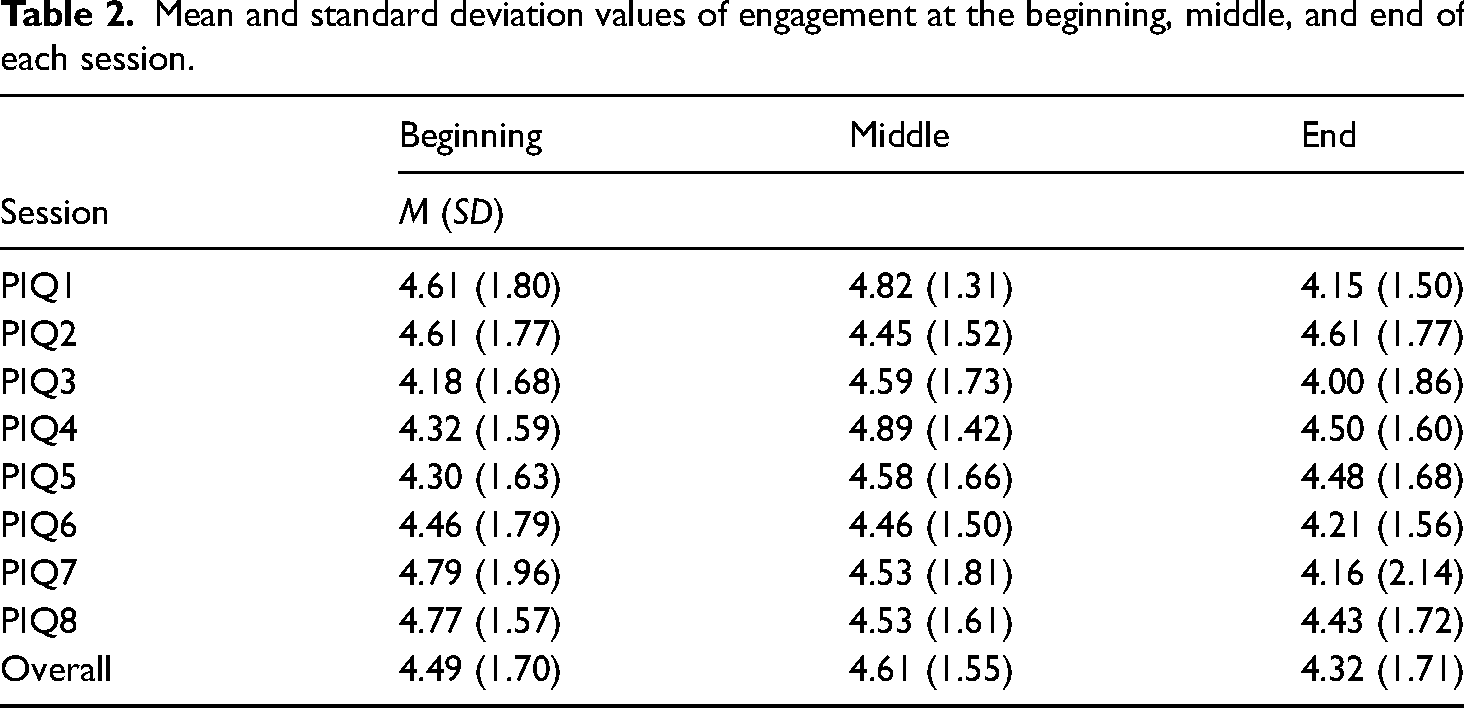
To assess changes in engagement, the Friedman test was applied in two ways: first, within each session to compare ratings across the three stages, and second, across sessions using average scores for each stage. The within-session analysis revealed statistically significant differences in four sessions: PIQ1, χ²(2, n = 33) = 7.15, p = .028; PIQ3, χ²(2, n = 34) = 10.61, p = .005; PIQ7, χ²(2, n = 19) = 6.05, p = .049; and PIQ8, χ²(2, n = 30) = 6.39, p = .041. To explore the nature of these differences, Wilcoxon signed-rank tests were conducted for each pair of time points in these sessions. In PIQ1, engagement decreased significantly from the middle to the end (p = .003). In PIQ3, there was a significant increase from the beginning to the middle (p = .018), followed by a significant decrease from the middle to the end (p = .003). In PIQ7, engagement significantly decreased from the beginning to the end (p = .027) and from the middle to the end (p = .035). In PIQ8, a significant decline occurred from the beginning to the end (p = .048), with other comparisons not reaching statistical significance. Standard deviations were relatively high, with values of 1.5 or greater in all but one case, indicating substantial individual variability in engagement. The greatest variability was observed at the end of PIQ7 (SD = 2.14), whereas the lowest occurred in the middle of PIQ1 (SD = 1.31). The Friedman test applied to aggregated scores across all sessions also yielded a statistically significant result, χ²(2, n = 8) = 10.14, p = .006. Engagement increased from the beginning (M = 4.49, SD = 1.70) to the middle (M = 4.61, SD = 1.55), then declined by the end (M = 4.32, SD = 1.71), with the middle stage showing the most consistent levels of engagement.
Qualitative Analysis (RQ1 and RQ2)
The first part of the qualitative analysis focused on learners’ comments on their engagement, collected after each intervention session and analyzed collectively. The responses indicated varying levels of engagement. A substantial number of students (n = 14) described themselves as highly engaged, using expressions such as “very engaged,” “fully engaged,” or “completely.” Others (n = 12) assessed their engagement as moderate or average, referring to it as “in the middle,” “neutral,” or “somewhat.” A smaller proportion (n = 5) reported low or minimal engagement, characterizing their involvement as “not really,” “barely,” or “not at all.”
The second part of qualitative analysis focused on the reasons for different levels of engagement as well as the participants’ responses to the SBI. It allowed for the identification of three themes: (1) effectiveness of grammar tasks, (2) new methods of learning grammar, and (3) student engagement. Each theme included several subthemes (see Table 3).
Themes, subthemes, and examples.
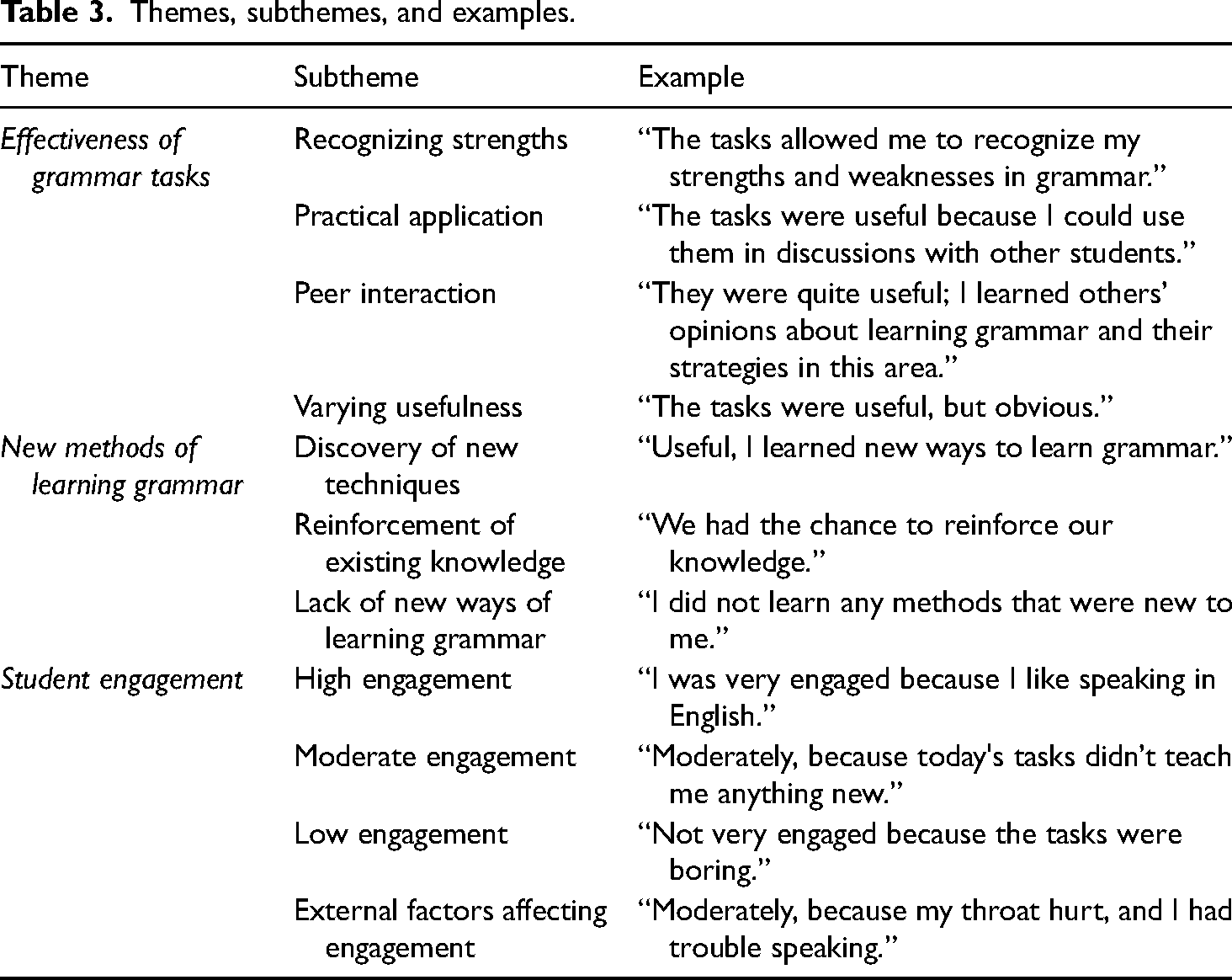
As regards the first theme, effectiveness of grammar tasks, it concerned the utility of the activities employed in SBI targeting GLS. The analysis yielded the following subthemes:
Recognizing strengths: Many participants (n = 15) found the tasks useful because they allowed them to identify their strengths and weaknesses. Recognizing these areas helped students focus on their learning needs and improve their grammar skills. As one respondent pointed out, “They were useful because they allowed us to recognize our strengths.” The ability to self-assess was seen as a significant benefit of the tasks. Practical application: The tasks were appreciated for their practical application, helping students apply grammar rules in real-life conversations. Several students (n = 9) made such comments. By engaging in discussions and activities that required the application of specific grammar features, students were able to practice English grammar in a meaningful context. One student commented: “The tasks were very useful because they enabled conversation with another person and improved my skills.” This practical aspect was a common point of praise among the respondents. Peer interaction: Interaction with peers was another significant benefit highlighted by participants (n = 8). Collaborative learning allowed students to compare their preferences and strategies, fostering a supportive learning environment. This is visible in the following comment: “They were useful, especially the part where I could compare my preferences with those of my peers.” Such interaction not only facilitated learning but also provided valuable feedback and enabled the exchange of opinions on the utility of GLS. Varying usefulness: Some participants (n = 4) had mixed feelings about the tasks’ usefulness. While certain aspects of the activities were beneficial, others seemed repetitive or less engaging. The following comment reflects this sentiment: “Some were useful, but the later parts were a bit repetitive.” Such opinions indicate that the tasks’ design could be improved to maintain interest and engagement.
Moving on to the second theme, new methods of learning grammar, it focused on the GLS that participants became acquainted with and practiced as a result of the intervention. The following subthemes emerged:
Discovery of new techniques: A few participants (n = 3) reported discovering new GLS during the intervention sessions. These respondents valued exposure to different techniques that they had not encountered before, which enriched their learning experience. This is evident in the following comment: “I learned new methods of learning grammar so the tasks were useful.” This discovery aspect added value to the learning experience for those participants who were eager to explore new grammar learning strategies. Reinforcement of existing knowledge: For many participants (n = 17), the intervention tasks served to reinforce their existing grammar knowledge rather than introducing new GLS. This reinforcement was still seen as beneficial, helping students solidify their understanding of grammatical concepts. One student commented: “I did not learn any new ways but it was a good reinforcement.” This suggests that while the activities were useful, they could be enhanced by incorporating more innovative approaches to grammar learning. Lack of new ways of learning grammar: Some respondents (n = 9) felt that the tasks did not introduce new strategies for learning grammar, focusing instead on revising well-known techniques. This was seen as a limitation by those hoping to get acquainted with new GLS. One student wrote: “I did not learn any new ways during the tasks.” This highlights the need to diversify the repertoire of strategies for learning grammar that was the focus of the tasks, taking into account the needs of individual students since some of them may have benefited more from, for example, GLS directly aiding development and consolidation of explicit knowledge (e.g. trying to better understand grammar rules).
The final theme identified through qualitative analysis was student engagement. Four subthemes were identified within this category:
High engagement: Many students (n = 14) reported high levels of engagement, particularly when the tasks encouraged active participation. This involvement was driven by the interactive nature of the activities implemented as part of SBI, which made the learning process dynamic and enjoyable. One participant wrote: “I was very engaged because I think I should expand my possibilities during the conversation.” This indicates that tasks that foster active involvement tend to enhance engagement in SBI. Moderate engagement: Moderate engagement was often reported due to the familiarity with the material covered or the task format. Some students (n = 12) felt that while the tasks were engaging, they did not always offer new challenges or provide new information. One student commented: “Moderately engaged because there were many things I already knew.” This suggests that while the tasks were perceived as useful, they would benefit from more varied and challenging content. Low engagement: A smaller number of students (n = 5) reported low levels of involvement, often due to the nature of the tasks. This is evident in the following response: “Not very engaged because the tasks were not interesting.” This highlights the need to design tasks that are interesting and relevant to enhance the likelihood that students will engage with SBI. External factors affecting engagement: External factors such as health and classroom environment also influenced engagement. Some students (n = 5) reported being less engaged due to personal circumstances, as is visible in the following comment: “I was not very engaged due to feeling unwell.” Another student pointed out: “Moderate engagement; the room was too cold, making it hard to concentrate,” highlighting how environmental factors can impact focus. Such external conditions can diminish students’ participation in learning activities.
Discussion
The study addressed two research questions related to engagement with the SBI and the participants’ perceptions of the intervention. When it comes to RQ1, looking at the self-ratings and the analysis of the relevant part of the qualitative data, the students’ involvement was moderate and comparable across sessions. Surprisingly, the treatment sessions focusing on GLS facilitating the use of grammar in meaningful, real-time communication and those helping participants best utilize corrective feedback in such contexts (e.g. Interventions 2, 3, 5, or 6) failed to trigger noticeably higher levels of involvement despite the intervention prioritizing such GLS use. It would thus seem that the preference for more traditional, cognitive strategies attested to in prior research (e.g. Pawlak, 2012; Sarıçoban, 2005) and the existing, deeply ingrained approach to learning TL grammar may have precluded the participants from fully appreciating and capitalizing on strategies that would facilitate the automatization of explicit knowledge, thus allowing the use of grammar features in spontaneous interactions. One possible reason could be the fact that evaluation in grammar classes included in the intensive English course was mainly based on grammar test scores, and such scores account for a considerable percentage of the grade on the final exam. Therefore, participants might have been in two minds about the immediate usefulness of strategies aiding the employment of grammar structures in real-time meaning conveyance. Another important finding was that engagement tended to decline during each session, irrespective of the specific tasks and activities implemented as part of the SBI, which, naturally, differed in their nature. On the one hand, this might indicate that tedium had begun to set in, but, on the other, it could also signal the students’ concern that the limited class time was not being allocated to what really mattered in their minds, that is, learning English grammar itself. In other words, the students may have sacrificed the somewhat elusive goal of being better able to use grammar structures in communication in favor of the far more tangible aim of better course performance. However, considerable individual variation was also observed, which may have indicated that the students prioritized different things in grammar learning and may have therefore been more or less receptive to the foci of SBI as well as the activities utilized to implement it. Such discrepancies could also have stemmed from the inevitable impact of individual differences among the participants (e.g. beliefs, motivations, learning styles, emotions), an issue that was not investigated in this study.
Moving on to RQ2, the students’ response to the intervention was overall positive, as they recognized the opportunity to identify their strengths and weaknesses, apply grammar features in meaningful contexts, engage in interactions with peers (which often resulted in valuable feedback), become familiarized with novel GLS, and consolidate their existing knowledge of grammar structures. Some of them also underscored that the tasks necessitated the use of grammar structures in meaningful interactions, which increased their engagement and triggered enjoyment. However, these positive perceptions were not shared by all students, and they hinged on the nature of the SBI activities and other factors. In particular, some of the participants complained about repetitiveness, insufficient challenge, and also the failure of the intervention to introduce new, potentially effective ways of learning grammar. Looking at the themes that emerged from the qualitative analysis, it could reasonably be argued that there is merit to implementing SBI targeting grammar, with the caveat that careful attention should be given to its form and the way it is conducted. More importantly, students in L2 degree programs may have disparate needs with respect to learning grammar, which unavoidably results in pursuing different agendas and priorities. This explains dissenting voices concerning the effectiveness of the intervention.
The study suffers from some limitations, which are inevitable in intervention-based, classroom-oriented research. First, the sample size was relatively small, which does not allow for making far-reaching generalizations. That said, the data were derived from a larger-scale intervention-based study, and the implementation of such studies entails daunting challenges that often preclude the involvement of large numbers of participants. Second, an argument could be made that English majors may not constitute the best candidates for SBI targeting GLS, since they can be expected to have a good command of TL grammar, and they are likely to have decided on strategies that work best for them. However, the students’ self-evaluation of the mastery of grammar and, as was explained above, the difficulty they had in using grammar structures they knew in communicative interactions indicate that there is room for pedagogical interventions targeting GLS in this context. Third, engagement was operationalized holistically although, theoretically, it is regarded as comprising several dimensions (see Philp and Duchesne, 2016). This decision, however, was dictated by the nature of the investigation, practical concerns, and the strive for ecological validity. Fourth, the students self-rated their engagement retrospectively rather than doing so as the SBI activities were in progress, and such ratings may have been more reflective of these activities rather than the treatment in its entirety. At the same time, this approach enabled a more nuanced evaluation of different elements of the intervention, allowing participants to reflect on the entirety of the treatment and the relative effects of its components on their involvement. Fifth, this investigation did not consider the impact of any individual difference factors on engagement with, perceptions of, and response to the SBI. This is definitely an important issue that should be taken heed of in future research endeavors in this area. Finally, a positive response to SBI targeting GLS does not guarantee that learners will actually benefit from such an intervention by using these strategies more effectively and attaining greater mastery of TL grammar. It must be stressed, though, that this study is part of a larger-scale research project that aimed to examine the effects of the intervention on GLS use and grammar attainment.
Conclusion
The study offers valuable insights into the extent to which English majors are likely to engage with SBI targeting GLS and how they respond to such training. Although, overall, the SBI can be seen as beneficial, some important caveats and takeaways from the results should be considered when planning and implementing this type of intervention. First, given the considerable toll that the treatment inevitably took on course objectives, an argument could be made that shorter, more focused SBI that is carefully attuned to curricular goals would be a better option in this context. For example, some of the intervention tasks could incorporate grammar features intended to be covered in class anyway. Second, SBI could perhaps do a better job of achieving its aims if it were more individualized and geared to students’ needs. While one could possibly envisage a scenario where GLS included in the intervention are negotiated in individual tutorials, the feasibility of this solution is unclear, as this would need to entail students’ readiness to take part in this undertaking, which is not guaranteed. Third, there are grounds to assume that SBI targeting GLS could trigger greater involvement, be more positively received, and ultimately prove more effective with non-language majors, but also less advanced L2 learners at lower educational levels. For example, in secondary school, carefully planned strategic intervention could be more seamlessly interwoven into instructional practices due to the greater amount of time teachers have at their disposal since they are not required to focus on specific TL areas in separate classes. In effect, such intervention could be better integrated and individualized, thus likely producing superior results.
One way or another, there is a clear need for more research to gauge the effects of different forms of SBI in different contexts and with different groups of participants to provide a basis for tangible guidelines for practitioners in this respect. In light of the complexity of grammar and the difficulty of using consciously known grammar structures in spontaneous interactions, pedagogical interventions in this area might be indispensable to enable students to learn and use TL grammar more effectively. This is because they have the potential to foster autonomy with respect to this TL subsystem in the classroom and outside, thus helping students identify their own ways of ensuring that they can use what they are taught in real-life contexts. Obviously, such research also needs to go beyond investigating learners’ engagement, perceptions, and response, examining the effects of the intervention on actual GLS use and the extent to which such enhanced use translates into the development of explicit and implicit (automatized) knowledge of L2 grammar.
Supplemental Material
sj-docx-1-rel-10.1177_00336882251369172 - Supplemental material for Instruction in Grammar Learning Strategies: Exploring Learners’ Response
Supplemental material, sj-docx-1-rel-10.1177_00336882251369172 for Instruction in Grammar Learning Strategies: Exploring Learners’ Response by Mirosław Pawlak and Mariusz Kruk in RELC Journal
Footnotes
Funding
The authors disclosed receipt of the following financial support for the research, authorship, and/or publication of this article: This work was supported by the National Science Center, Poland (grant number 2020/39/B/HS2/00501 (2021–2024)).

Supplemental Material
Supplemental material for this article is available online.
References
Supplementary Material
Please find the following supplemental material available below.
For Open Access articles published under a Creative Commons License, all supplemental material carries the same license as the article it is associated with.
For non-Open Access articles published, all supplemental material carries a non-exclusive license, and permission requests for re-use of supplemental material or any part of supplemental material shall be sent directly to the copyright owner as specified in the copyright notice associated with the article.
