




Abstract
The growth of English medium instruction (EMI) programs at universities worldwide has raised questions about the implications of teaching through L2 English on students’ content learning outcomes. This study examined the impact of four factors on students’ academic success (e.g. content learning) in the Turkish EMI context: (1) students’ language-related challenges; (2) students’ opinions about the effectiveness of EMI; (3) students’ perceived language proficiency levels; and (4) the amount of L2 English used in EMI classes. Students’ perceived academic performance was taken as a proxy of EMI success. The study employed a quantitative empirical design using questionnaires and regression analysis. Data were collected via an online questionnaire from 498 students at an EMI university in Turkey. The results revealed that students’ language-related challenges and perceived language proficiency were the only predictors that were associated with academic success in their EMI courses at a statistically significant level. The amount of English used in the classroom was not found to predict success in EMI, suggesting that students may benefit from multilingual models of teaching. These findings underscore the importance of adequate language support for students on EMI programs, and implications are discussed with respect to EMI policy, program planning, and teacher pedagogy.
Introduction
English medium instruction (EMI) is defined as “the use of the English language to teach academic subjects (other than English itself) in countries or jurisdictions where the first language (L1) of the majority of the population is not English” (Macaro et al., 2018a: 37). Interest in the relationship between EMI and students’ academic achievement in their content courses has been burgeoning for the last 15 years. With some exceptions (e.g. Rose et al., 2019; Yuksel et al., 2021), research on EMI has generally focused on students’ language performance (e.g. Lin and Morrison, 2010) or linguistic challenges (e.g., Kamasak et al., 2021) rather than academic performance to measure the effectiveness of EMI for teaching and learning in university settings. This focus on language contrasts with the central aim of EMI, in which language is considered as a vehicle to teach content knowledge (Macaro, 2018). Factors such as students’ challenges, L1 and L2 use in the classroom, students’ opinions on the effectiveness of EMI, and language proficiency are frequently mentioned in the literature (see Macaro et al., 2018a), although the extent to which these factors influence academic performance remains unknown.
Moreover, the aims and expectations of EMI stakeholders (i.e. teachers, students, and managers) may vary depending on the higher education (HE) context and learning environment (Macaro et al., 2018a). Rose et al. (2019: 2) have noted that “the ways in which EMI programs are implemented differ due to contextualized educational needs.” This situation makes context-specific studies necessary for obtaining insightful findings on how these variables might affect students’ academic performance in the field of EMI, yet there is a paucity of empirical research exploring this relationship in unique educational settings.
This article contributes to the existing EMI literature by examining the interplay between student challenges, the amount of L2 English used in instruction, students’ opinions toward EMI, and students’ language proficiency in order to explore the variance in students’ content performance in EMI courses in Turkey. These variables represent factors that have been frequently examined in EMI contexts and relate specifically to the phenomenon of learning through L2 English, although their effect on students’ academic success remains unknown. As such, this study addresses the following research question: Do students’ language challenges, students’ opinions on the effectiveness of EMI, students’ language proficiency, and the amount of L2 English used in the classroom affect academic success in EMI?
Literature Review
Language Proficiency and Content Learning
Learning academic content through L2 English involves more than simply changing the medium of instruction. Rather, it raises questions about students’ acquisition of content knowledge, since the relationship between L2 proficiency and academic performance is a complex phenomenon (Cho and Bridgeman, 2012). Research investigating the impact of EMI on students’ content learning and academic success is limited, and the results are inconclusive (Macaro et al., 2018a; Yuksel et al., 2021).
Rose et al. (2019) examined the effects of language proficiency, academic language skills, and motivation on students’ academic content learning in an EMI business program at a university in Japan. The study found that L2 proficiency and academic English skills predicted success, while motivation was not found to predict higher course grades. A similar study in China (Xie and Curle, 2022) produced similar results: students’ Business English proficiency was found to be a statistically significant predictor of academic success but motivation was not. Thompson et al. (2022) found that self-efficacy, L2 proficiency, and English preparatory program performance – measured according to students’ English for Specific Purposes (ESP) course grades – predicted academic success in an EMI international business program in Japan.
Although collectively these three studies suggest that students’ L2 proficiency is a predictor of EMI academic success, a similar study conducted in Turkey (Curle et al., 2020) found that students’ general English proficiency did not predict their EMI academic success, although academic success in L1 medium of instruction (MOI) courses did predict success in EMI courses. Further complicating this picture of the relationship between language proficiency and academic success, another study in Turkey (Yuksel et al., 2021) found that students’ L2 proficiency improved over the four years of their EMI program at a level that was statistically significant and that this improvement in L2 proficiency predicted EMI academic success. These inconclusive findings suggest that academic success in EMI is a complicated issue and can be influenced by multiple factors, including L2 proficiency. However, a study in Japan found that students continued to face language challenges, even after they had met the minimum L2 proficiency threshold for their EMI programs (Aizawa and Rose, 2019). These findings suggest that even students with high L2 proficiency may experience challenges to EMI learning that affect academic success.
Students’ Language Challenges in EMI
Many studies have investigated the language challenges that EMI students face, with several of these studies highlighting vocabulary knowledge (Başıbek et al., 2014; Kırkgöz, 2009; Soruç and Griffiths, 2018). The importance of vocabulary in these studies is underscored by the fact that EMI students are required to learn a considerable amount of discipline-specific technical vocabulary (see Macaro, 2019, for discussion of technical terminology).
However, the language-related challenges faced by EMI students are not limited to vocabulary. In a large-scale mixed-methods study by Evans and Morrison (2011) in Hong Kong, EMI students reported writing-related difficulties as the most challenging aspect of EMI courses. A similar study in Turkey also found that writing and speaking were the most challenging areas for EMI undergraduate students (Kamasak et al., 2021). Other reported language challenges experienced by EMI students include taking notes (Hellekjær, 2010), understanding lectures (Hua, 2020), and asking and answering questions (Hu and Duan, 2019). Given the wide range of language-related difficulties reported in the literature, there is a need for studies to explore the relationship between students’ language challenges and their academic success.
Students’ Opinions About the Effectiveness of EMI
Previous studies have examined students’ opinions on the benefits of EMI (e.g. Kırkgöz, 2014). Byun et al. (2011) found that students at a Korean university were generally satisfied with EMI and its effectiveness in improving their English proficiency. This stands in contrast to Ozer and Bayram's (2019) findings on Turkish students’ perception that English proficiency did not improve through EMI study. In another study in Turkey, Kırkgöz (2014) found that EMI students’ opinions of EMI included both positive (e.g. accessing resources in English, enhancing English language skills) and negative (e.g. difficulty in understanding disciplinary knowledge, time-consuming nature of EMI) aspects of the experience. However, none of these studies examined the relationship between students’ opinions and their academic success – an area of importance since students who attribute more value to their EMI courses may be more likely to believe that they can master disciplinary knowledge. In other words, students who hold more positive opinions about the effectiveness of EMI may expend more effort in their pursuit of academic success (see Thompson et al., 2022, for the role of self-efficacy in EMI).
The Amount of L2 Used in EMI Classes
The quantities and functions of L1 and L2 used in EMI classrooms have been investigated in research (Macaro et al., 2018b; Sahan et al., 2021). Critical here are debates around whether EMI should be interpreted as English-only instruction or whether translanguaging/multilingual pedagogies are more appropriate (Sahan et al., 2022). Research examining how the amount of L1/L2 use might affect students’ success in EMI classes “where the learning of the L2 is a by-product of content learning” (Pun and Macaro, 2019: 64) has yielded mixed findings. Studies have consistently shown that the L1 is used for various purposes and to various degrees in EMI (see, for example, Paulsrud et al., 2021), although the amount of L1 use has been found to vary according to educational settings (e.g., Pun and Macaro, 2019). Research conducted in the Turkish EMI context has repeatedly found that L1 use and translanguaging practices are common (Kırkgöz et al., 2023; Yıldız et al., 2018). However, one study found significant differences in the proportion of L1 use and teacher–student interaction across seven Turkish universities, with less L1 use found at elite universities compared to other state universities (Sahan et al., 2021).
Although L1 use has been found to be a common feature of EMI pedagogy, the question of when and how much L1 should be used in EMI classes has not been resolved. Some scholars have warned against the unprincipled use of the L1 for teaching (e.g., Turnbull et al., 2011), and research has suggested that L1 use might exclude international students who do not speak the local language (Karakas, 2016). Other research, however, has demonstrated that translanguaging is a valuable pedagogical resource (Kırkgöz et al., 2023; Tai and Wei, 2021). While these studies have highlighted the usefulness of the L1 in EMI classes, little is known about the relationship between the amount of L1/L2 use and academic success.
To summarize, this study addresses that gap by investigating four variables that are theorized to affect students’ learning in an EMI context, although the relationship between these variables and academic success remains unclear. Previous research has found that L2 proficiency alone appears to be an insufficient predictor of academic success in EMI. As such, we have considered it alongside other variables (language challenges, students’ opinions, and the amount of L2 use in EMI classes) that have been extensively examined, including in the Turkish context, to better understand the factors influencing students’ academic success in EMI.
Context
EMI has a long history in Turkey (see Selvi, 2014) and was first introduced in higher education in the 1950s with the founding of Middle East Technical University (Orta Doğu Teknik Üniversitesi). Since then, the number of universities offering full or partial EMI programs has grown, as has research interest in EMI in Turkey (see Kirkgöz and Karakaş, 2022). EMI programs in Turkey follow the preparatory model of language support (see Macaro, 2018), through which students with limited English proficiency attend a one-year intensive English preparatory program before enrolling in their EMI academic courses. Despite this provision for language support, research has suggested that many students in EMI programs in Turkey continue to experience language-related challenges in their academic courses (Ekoç, 2020; Kırkgöz, 2009). As such, Turkey offers an ideal context for investigating the factors that may affect students’ success in EMI programs. The present study was conducted at a private university in Istanbul at which EMI is used for all degree programs.
Methodology
Participants and Setting
This study collected data from students using an online questionnaire to explore whether students’ language challenges, opinions about EMI, language proficiency, and the amount of L2 English used affect students’ academic success in EMI. A total of 512 students from a private university in Istanbul, where all degrees are studied through EMI, completed the questionnaire and agreed to share their most recent English proficiency test scores. Due to missing data from 14 students, 498 usable questionnaires were analyzed.
The participants were undergraduate students whose year of study ranged from the first to the fourth year of their program, and they studied a variety of disciplines including social sciences, engineering, and medicine. While 336 (67.5%) participants were Turkish students with L1 Turkish background, 162 (32.5%) participants were international students with an L1 background other than Turkish. As for gender, 282 (56.6%) participants were female and the remaining 216 (43.4%) were male. All participants satisfied the language proficiency requirements of the university to enroll in an EMI class either by attending the English preparatory program or by achieving a satisfactory score from the university's proficiency (UNIP) exam or the TOEFL (Test of English as a Foreign Language) or IELTS (International English Language Testing System) exams. The participant demographics are summarized in Table 1.
Participant demographics (n = 498).
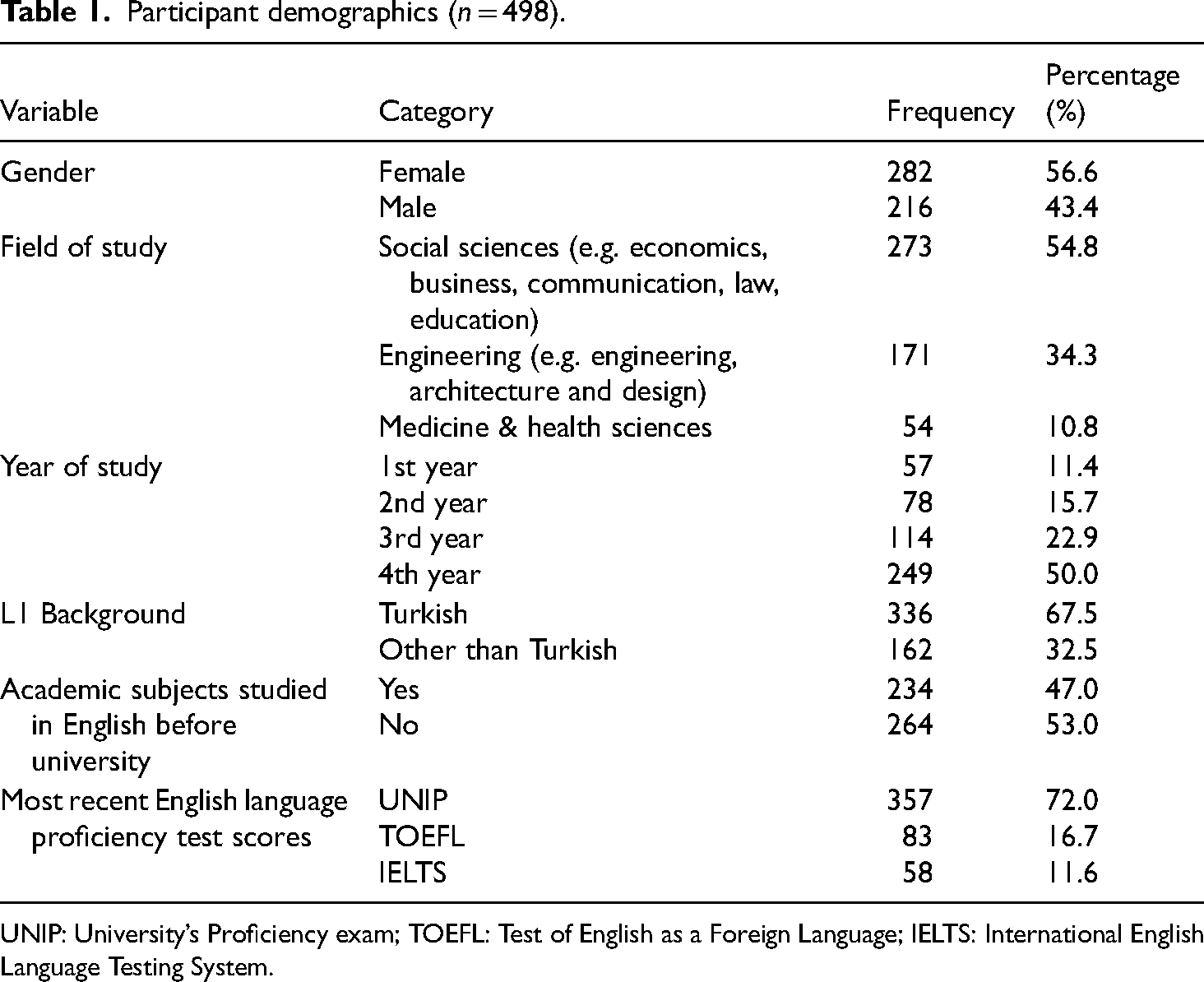
UNIP: University's Proficiency exam; TOEFL: Test of English as a Foreign Language; IELTS: International English Language Testing System.
Participation in the study was voluntary, and the questionnaire responses were fully anonymized. Permission to conduct the study was obtained from the university. Due to ethical considerations, we were unable to obtain records of the students’ exam scores, grade point averages (GPA), class rank, or official English proficiency test scores, since this information was treated as confidential. Thus, we relied on self-reported measures of challenges, success, and English proficiency.
Data Collection Instrument
Data were collected using an online questionnaire that consisted of 69 items, including five items pertaining to demographic details and one item regarding the English language proficiency test scores of the student participants. The full questionnaire is available on the IRIS database (https://www.iris-database.org/). Responses to the items were recorded on a seven-point Likert-type scale, which allowed us to assess the intensity of participants’ opinions (Saunders et al., 2007). The questionnaire also included items pertaining to students’ perceptions of the linguistic challenges they face in EMI classes and their academic success. Studies using a perception-based construct to measure students’ experiences are common in EMI research (e.g. Hellekjær, 2010; Jiang et al., 2019). Due to ethical considerations, direct measures of students’ academic performance (e.g. exam scores, GPA) were not accessible. We therefore opted for a self-reported measure of success that is comparable across academic departments. The items of the questionnaire and their theoretical sources are described below.
Demographic Details
Demographic information was collected from the first five items of the questionnaire and included students’ (1) field of study, (2) year of study, (3) gender, (4) L1 background, and (5) experience studying academic subjects in English before university. The sixth item of the questionnaire asked students to report their most recent English language proficiency test scores.
Students’ Challenges
To measure students’ challenges, 45 items were adopted from Evans and Morrison's (2011) scale of student challenges in EMI education. The items aimed to measure challenges faced by students in writing, speaking, listening, and reading components that were used in EMI classes. While 15 items were used for the writing component, 10 items were used for each of the other components. The scale was developed specifically for an EMI university setting by Evans and Morrison (2011) in Hong Kong, and it has been used by researchers in other contexts (e.g. Aizawa and Rose, 2019, in Japan) and validated in the Turkish context (Kamasak et al., 2021).
Students’ Opinions of the Effectiveness of EMI Programs
Four items to measure what students think about the effectiveness of EMI were adapted from Byun et al. (2011), which compared student responses across multiple semesters at a Korean university. The items investigated student satisfaction with EMI, their English development, and their ease and effort of learning in EMI.
The Amount of L2 Used in Students’ EMI Classes
Six items to measure the amount of English used in EMI classes were adopted from Evans (2002).
Students’ Perceived English Proficiency Levels
Six items were adopted from Byun et al.'s (2011) study to measure the perceived English proficiency levels of students. These items asked students to rate their difficulty understanding lectures and their English skills.
Students’ Perceived Academic Success in EMI Classes
Two items were adopted from studies conducted by Kim (2003) and Park (2006) investigating students’ success in their academic content classes and their ability to comprehend instruction. These items asked students to rate their performance in EMI courses and their learning of academic content through EMI.
Data Collection and Analysis Procedures
Data for this research were collected through an online questionnaire. A web-link with a cover letter explaining the aim of the study was shared with the participants via email, using the university's email system. A pilot study was conducted with 50 students. The participants were asked to state their opinions about the length, clarity, and comprehensibility of the questionnaire. Moreover, an initial validity and reliability check (e.g. factor analysis) was done. The participants commented positively on the questionnaire, and so no changes were made to the items. The initial factor analysis provided acceptable reliability values of Cronbach's alpha, and all items were loaded into their stipulated constructs with satisfactory loading values (see Kamasak et al., 2021, for validation of the research instrument). Two weeks after the initial email was sent, a follow-up reminder was sent to students, and a third email was sent three weeks later, in order to increase the response rate of the study.
Reliability, Validity, and Normality Checks
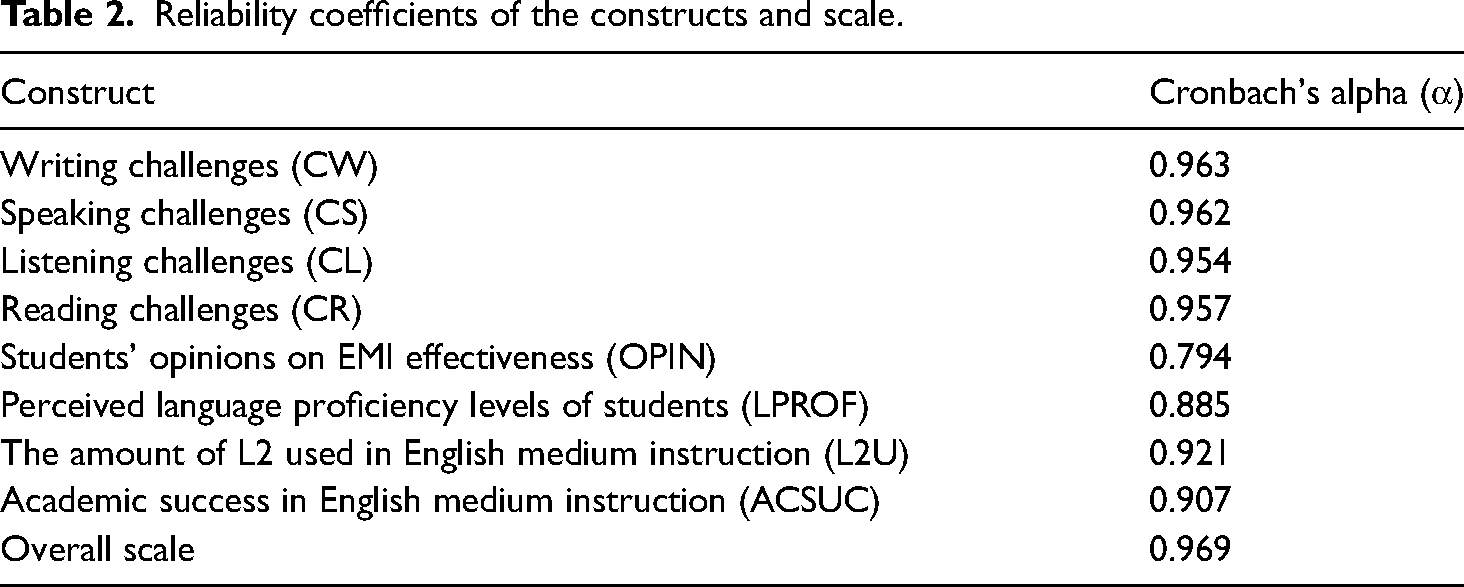
To test the reliability and internal consistency of the questionnaire, Cronbach's alpha coefficients were calculated, and values equal to and greater than 0.70 were accepted as indicative of reliable constructs (Hair et al., 2009). The questionnaire measured eight construct categories: student challenges in (1) writing (CW), (2) speaking (CS), (3) listening (CL), and (4) reading (CR); (5) students’ opinions on EMI effectiveness (OPIN); (6) students’ perceived language proficiency level (LPROF); (7) the amount of L2 used in class (L2U); and academic success in EMI (ACSUC). Satisfactory reliability scores were found for the overall scale (α = 0.969) and for each construct (Table 2).
Reliability coefficients of the constructs and scale.
An exploratory factor analysis (EFA) with VARIMAX rotation was conducted to assess the validity of the constructs and to understand the factor pattern of the instrument. The analysis, which yields eight factors, resulted in the theoretically expected factor solutions. Except for four items, all items of the research instrument exceeded the suggested 0.50 loading value of an appropriate item for its predicted construct. Of these four items, one was from the writing challenges construct (“expressing ideas in correct English”), one from the reading challenges construct (“using your own words when taking notes”), one from the student opinions on EMI effectiveness construct (“my English improved after taking EMI course”), and one from the perceived English language proficiency construct (“understanding the lecture is difficult due to the professor's lack of English proficiency”), with loading values of 0.319 (CW2), 0.386 (CR9), 0.298 (OPIN2), and 0.352 (LPROF2), respectively. These four items were dropped to gain higher overall reliability.
The rest of the scale also underwent CFA (Figure 1) to cross-check the validity of the items and to investigate the fitness indices of all latent constructs in the model. The results showed that the item “understanding classmates’ accents” from the listening challenges factor had a standardized regression weight of 0.539 (CL10), which is lower than the suggested 0.70 and above the standardized weight value of an appropriate item for its factor (Hair et al., 2009). Therefore, as a redundant item, (CL10) was dropped from the scale to improve the model. Although two items from the amount of L2 used factor had fairly low standardized regression weight values of 0.664 (L2U5) and 0.637 (L2U6), it was decided to retain them to avoid a construct identification problem. Hence, four items after EFA and one item after confirmatory factor analysis (CFA) – a total of five items – were removed to ensure that unidimensionality and absolute fits were achieved. The analysis continued with the remaining 64 items.
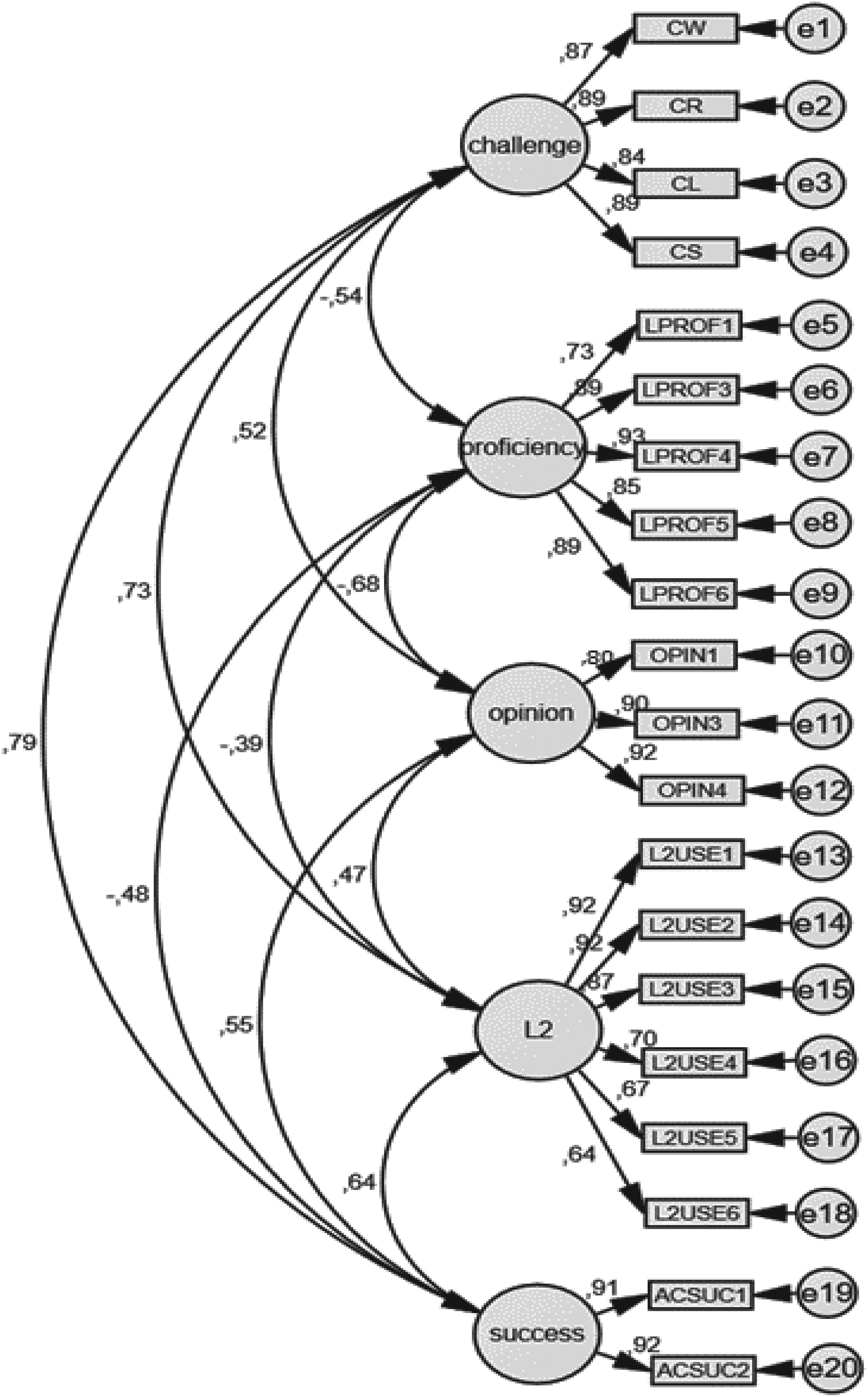
Factor structure of the whole scale.
The normality of the data was assessed by calculating skewness and kurtosis, which were found to be within the acceptable range (−1 to +1) for normal distribution (Hair et al., 2009). The Kolmogorov–Smirnov and Shapiro–Wilk tests also produced significant levels of normality statistics for all constructs.
Analyses and Results
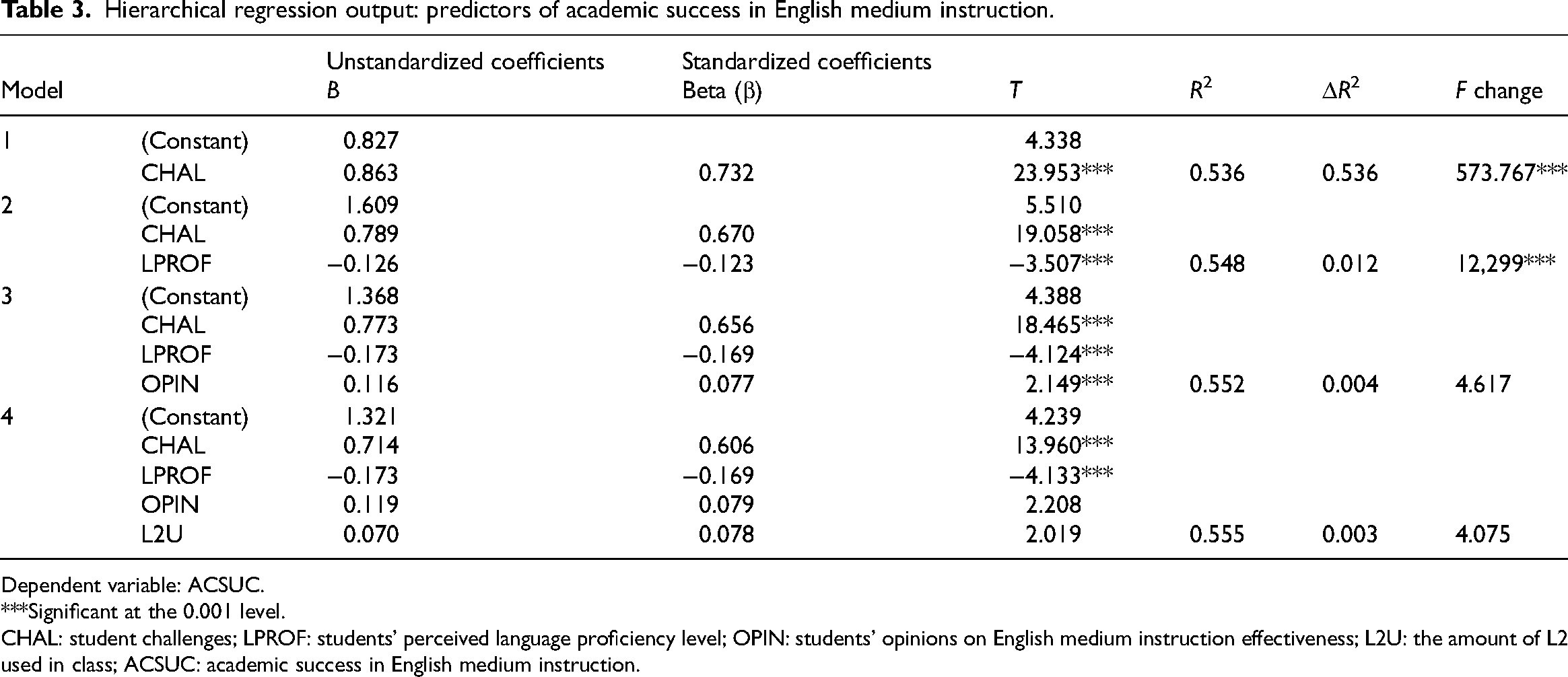
The unique contribution of student challenges, students’ opinions on EMI, perceived language proficiency, and L2 English use in explaining academic success in EMI was explored by a hierarchical regression method where each set of independent variables was entered into separate blocks to calculate the incremental changes of the R2 statistic. The analysis started with entering the student challenges (CHAL) variable into the model (model 1) and, without other variables, student challenges explained 53.6% [F (1, 496) = 573.767, p < 0.001; R2 = 0.536] of academic success (Table 3).
Hierarchical regression output: predictors of academic success in English medium instruction.
Dependent variable: ACSUC.
***Significant at the 0.001 level.
CHAL: student challenges; LPROF: students’ perceived language proficiency level; OPIN: students’ opinions on English medium instruction effectiveness; L2U: the amount of L2 used in class; ACSUC: academic success in English medium instruction.
Students’ reported language proficiency (LPROF) was entered into model 2 in addition to student challenges, and the explanatory power of the R2 value of academic success in EMI increased to 54.8%. Therefore, the entrance of students’ language proficiency provided an additional and significant 1.2% (ΔR2 = 0.012) contribution [F (1, 495) = 12.299, p < 0.001; R2 = 0.548] to academic success in EMI.
It should be noted that the standardized beta coefficient shows a negative relationship between language proficiency and academic success (β = −0.123, p < 0.001). However, this is due to the wording of items in the questionnaire: students who thought their English needed to improve (i.e. had lower English proficiency) opted for greater values in the scale. Thus, lower English proficiency levels (which corresponded to higher scale values) are associated with lower academic success. In other words, the less English proficiency improvement students need, the more success they achieve.
In model 3, the students’ opinion on EMI effectiveness (OPIN) variable was entered in addition to student challenges and students’ perceived language proficiency, and the explanatory power of the R2 value of academic success in EMI increased to 55.2%. Although the entrance of students’ opinion on EMI effectiveness variable provided an additional 0.4% (ΔR2 = 0.004) contribution to academic success, it was insignificant [F (1, 494) = 4.617, p = 0.032; R2 = 0.552], thus perceived effectiveness did not make a significant contribution to academic success in EMI.
Finally, the variable measuring the amount of English used in EMI classes (L2U) was entered into model 4 in addition to student challenges, students’ perceived language proficiency, and students’ opinion on EMI effectiveness, and the explanatory power of R2 value of academic success in EMI increased to 55.5%. The entrance of the amount of English use in EMI class variable provided an additional 0.3% (ΔR2 = 0.003) contribution to academic success, yet it was insignificant [F (1, 493) = 4.617, p = 0.044; R2 = 0.555]. Thus, the amount of English used in EMI classes did not make a significant contribution to academic success in EMI, meaning that the use of more English in EMI did not predict success in content learning (and, conversely, nor did the use of more of the L1). The findings indicate that, among all the variables, only student challenges and perceived language proficiency were statistically significant predictors of, and made a unique contribution to, students’ academic success in EMI.
Discussion
Among the four variables examined in this study, only student challenges and students’ language proficiency were found to predict academic performance. Students’ language-related challenges were the strongest determinant of academic success in EMI, and language proficiency's prediction power supports the association between student challenges and academic performance. Accordingly, as students’ language proficiency increases, they experience fewer language-related challenges in relation to content learning, which might influence their academic success positively. This result echoes similar findings in other EMI contexts where a relationship between students’ language proficiency and academic performance was found (Rose et al., 2019; Thompson et al., 2022; Xie and Curle, 2022). However, the question still remains as to what level of English proficiency is necessary and sufficient for students’ success in EMI. The findings of our study suggest that, rather than simply focusing on students’ English proficiency level, mitigating language-related challenges might be more effective in supporting content learning. This finding offers practical teaching implications for EMI content and language instructors, who can provide scaffolded, language-aware instruction to support students’ learning.
In order to mitigate language-related challenges, students in EMI courses should be well prepared linguistically and offered tailored, ongoing support throughout their EMI programs. Given the preparatory program's critical role in implementing EMI effectively in Turkey, the language curricula used in these programs should be revised in accordance with students’ needs. Specifically, we call for more awareness of ESP instruction in EMI settings and for collaboration between content and language instructors to address language challenges. Previous research has suggested that discipline-specific language proficiency may be more important for students in EMI programs than general English proficiency (e.g. Curle et al., 2020; Xie and Curle, 2022). Previous research has also indicated that students’ language-related challenges vary across disciplines (Kamasak et al., 2021), and scholars have called for an expansion of “tailored and targeted language support classes” (Thompson et al., 2022: 206, emphasis in original). Nonetheless, preparatory programs in Turkey – and language support in other contexts – are typically designed to improve students’ general English proficiency without considering academic and discipline-specific challenges. Rather than this one-size-fits-all type of preparatory program, the language curriculum should be designed to meet the unique language-related challenges faced by students in these programs. This type of language support can be achieved through targeted needs analysis and discipline-specific considerations, devised in collaboration with EMI content lecturers.
Students’ opinions on EMI effectiveness did not predict their academic performance in this study. This finding might be explained by a potential relationship between students’ opinions and their motivation to study through EMI. Although motivation was outside the scope of this study, previous research in Turkey has suggested that EMI students are primarily motivated by instrumental reasons such as improved employment prospects and English skills (Sahan and Şahan, 2021; Kırkgöz, 2009, 2014). In line with Byun et al.'s (2011) conclusion that students’ opinions on the effectiveness of EMI may be related to their opinions about the importance of English for their careers, these motivations may have influenced students’ opinions about EMI.
The amount of L2 used in EMI classrooms was also found to be insignificant in predicting students’ academic performance. Namely, studying content through “English-only” or “English-mostly” instruction did not correlate with better academic success in this study. These findings join a growing body of research in suggesting that a multilingual or translanguaging approach to EMI might be more appropriate to capture the language use and needs of bilingual students in EMI contexts (Paulsrud et al., 2021; Sahan et al., 2022). Previous research in Turkey has found that EMI students and teachers favor the use of the L1, at least in moderation, to facilitate the teaching and learning of academic subjects (e.g., Baykut et al., 2021; Ekoç, 2020; Kırkgöz et al., 2023), and these findings mirror those in other global contexts (e.g., Galloway and Sahan, 2021). Given these findings on L1 use, approaches to good EMI pedagogy should be expanded to encompass more than English language use: EMI teacher training programs and models of effective EMI pedagogy should consider the importance of pedagogical techniques such as interaction for effective teaching and learning through L2 English (Macaro, 2022; Sahan et al., 2021). Student-centered pedagogies to encourage active participation may afford teachers insight into the language-related challenges that their students are experiencing in real time, while also providing opportunities for teachers to scaffold discipline-specific language for their students – which would allow teachers to support students in overcoming EMI language challenges.
Limitations and Future Research Suggestions
This study, naturally, has some limitations that future research should aim to address. Because data were collected from only one private university in Turkey, the findings cannot be generalized across the whole Turkish EMI context, let alone globally. Thus, additional studies using larger sample sizes and data from across universities are recommended. Because the participants came from one university and shared similarities (e.g. similar language proficiency scores and learning experiences), we did not control for the demographics of the sample, which represents a limitation of the study. Disciplinary differences were beyond the scope of this study, and future investigation is needed to understand the relationship between disciplinary background and variables influencing academic success. Because the performance measurements used in this study were based on students’ self-perceptions, similar research using more objective performance measures, such as exam scores or GPA, may be helpful to verify the findings.
This study was derived from a purely quantitative approach to shed light on the determinants of academic success in EMI contexts. As such, it was unable to capture nuances in students’ opinions or experiences beyond the items included in the questionnaire. Future studies could consider a mixed-methods or qualitative approach to understand in more detail how students and teachers understand the role of students’ challenges, opinions, language proficiency, and L2 use on learning in EMI contexts. Moreover, based on its quantitative investigation, this study assumes a direct and linear type of relationship between the variables under investigation and academic performance. There might be more complex interactions between variables that could be revealed through qualitative methods such as in-depth interviews in a longitudinal study.
Finally, this study employed a limited number of variables to measure the unexplained variance in EMI success. As a direction of future research, a broader but not an exhaustive number of constructs, such as students’ motivation and self-efficacy, students’ preparatory program performance, and lecturers’ pedagogical competence, could be examined to explain further the variation in students’ academic performance.
Footnotes
Author's Note
Rifat Kamaşak is also affiliated at Faculty of Business and Law, University of the West of England, UK.
Declaration of Conflicting Interests
The author(s) declared no potential conflicts of interest with respect to the research, authorship, and/or publication of this article.
Funding
The author(s) received no financial support for the research, authorship, and/or publication of this article.
