



Abstract
This article examines the relationship between Japanese undergraduate students’ English language proficiency and English language-related challenges faced when studying an international business course through English. It also examines English language proficiency thresholds students need to reach in each academic skill (i.e. reading, listening, speaking and writing) to experience a lower level of linguistic challenges. A total of 264 students were surveyed in Tokyo, Japan, and 13 follow-up interviews were conducted. Exploratory and confirmatory factor analyses confirmed the underlying factors in the EMI (English medium of instruction) Challenges Scale loaded onto a priori assumptions of dimensions falling along skill-based constructs. Analysis of questionnaire data revealed that English language proficiency (i.e. TOEIC score) was a statistically significant predictor of challenges in the EMI programme. While no clear discernible threshold was observed, the differences in perceived ease of study at different levels of English proficiency influenced the challenges students reported for each academic skill. Interview data uncovered the multi-faceted nature of how the thresholds are determined not only by language proficiency but also by other factors, such as prior content knowledge, motivation, and the classroom learning environment. Practical implications for pedagogy are also discussed.
Keywords
I Introduction
As higher education has internationalized, English medium instruction (EMI) has emerged as one of the largest global educational phenomena of the twenty-first century. In this article, EMI is defined as ‘the use of the English language to teach academic subjects other than English itself in countries or jurisdictions where the first language of the majority of the population is not English’ (Macaro, 2018, p. 19). While educational models that combine content and language learning objectives are not new, the current global explosion of EMI in higher education is unparalleled, fuelled by global competitiveness and global mobility of faculty, students and researchers.
At a superficial level, EMI appears to share some likenesses with Content and Language Integrated Learning (CLIL), which is a pedagogical approach to education in a second language (L2) that was popularized in the 1990s. However, unlike CLIL, EMI by its very definition, pays little attention to students’ language development, and has emerged as part of broader internationalization goals. As a result of this detachment from language teaching, many language-related challenges have accompanied the growth of EMI. These challenges have long been observed in established EMI contexts like Hong Kong (Evans & Morrison, 2011), where English language has played a historical role as an educational medium of instruction. In other contexts, where the growth of EMI is more recent such as Japan (Rose & McKinley, 2018), challenges are likely to have a greater impact on students’ learning experiences.
EMI has been described as ‘most significant trend in educational internationalization’ (Chapple, 2015, p. 1) and as an ‘unstoppable train’, from which EMI educators must ensure students alight at their destination safely (Macaro, 2018). To reduce the challenges faced by students on their EMI journeys, we must first understand the language-related challenges that many students experience when learning via an L2. This article explores challenges faced by students undertaking their first EMI course within a bilingual business program in Japan and explores the interaction of these challenges with language proficiency. By exploring this course as a single bounded case study, the study is able to control for content and pedagogy in its collection of direct measures of proficiency and academic language competence to explore contextualized interrelationships between these constructs and linguistic EMI challenges.
II Literature review
1 Driving forces behind EMI in Japan
In line with global trends, EMI has been implemented rapidly in higher education in Japan, prompted by various government policies to accomplish the benefits of international student and faculty mobility, and facilitate local students to improve their language proficiency. In recent Japanese national guidelines provided by the Ministry of Education, Culture, Sports, Science and Technology (MEXT) such as the Selection for Fiscal Year 2014 Top Global University Project (MEXT, 2014), numerous incentives were offered for the expansion of EMI in higher education, including nurturing global human resources by implementing English as the medium of instruction at higher education. This move was seen to boost local students’ career advancement, and to enhance the domestic labour market and the performance of Japanese corporations internationally (Bradford & Brown, 2018; Yonezawa, 2014).
In Japan, previous higher education policies (e.g. Go Global Japan, Global 30; see MEXT, 2014) have sought to elevate the position of research universities in global rankings. These educational reforms included improving the number of EMI programmes and attracting high quality international students, researchers and faculty members (Bradford & Brown, 2018; Rose & McKinley, 2018). As a result of this increased pressure to internationalize, in 2015, MEXT announced that over one-third of Japan’s nearly 800 universities offered undergraduate EMI programmes, an almost 38% increase from 2008 (MEXT, 2015).
While perceived benefits of EMI remain highly context-specific, researchers around the world have also suggested numerous driving forces behind the growth of EMI that are common across the contexts (Hu, Li & Lei, 2014; Kunioshi, Noguchi, Tojo & Hayashi, 2016; Lueg & Lueg, 2015). In a British Council report on EMI in East Asia, Galloway, Kriukow and Numajiri (2017) outlined various perceived benefits of EMI. Coinciding with English positioned as a language of prestige in higher education and as a means to enhance academic discourse (Morrison & Lui, 2000; Smit, 2010), the two main benefits for the domestic university population revolve around the enhancement of English proficiency and the development of internationally-minded local students and faculty members. Galloway et al. (2017) further suggest that the most prominent purported benefit of EMI for many institutions is ‘to kill two birds with one stone’ (p. 6); in other words, students concurrently acquire both language and content knowledge. EMI as an ideal learning approach to fulfil this dual aim has been supported by many scholars (Brinton, Snow & Wesche, 2003; Coleman, 2006; Smit & Dafouz, 2012), who argue that EMI offers students exposure to English while negotiating content knowledge. While the ideal proportion of content and language aims has not been universally agreed across EMI contexts, the push towards EMI has seen developments in the field of TESOL in Japan, as language programmes are developed to better support and prepare students for EMI study (Rose & Galloway, 2019). What remains somewhat unclear are the linguistic challenges students face when negotiating this content, particularly when proficiency levels are low.
2 EMI students’ challenges and general proficiency
A growing body of EMI research has been carried out to document challenges encountered by L2 English students in adjusting to the demands of EMI programmes (e.g. Hellekjær, 2010; Tsuneyoshi, 2005; Wilkinson, 2013). One potential reason for their language-related challenges stems from the insufficient levels of English language proficiency among students entering an EMI university from a first language (L1) medium school (Ali, 2013; Sultana, 2014). Lower proficiency students express considerably more onerous linguistic challenges while academic language support is available before starting an EMI programme or while undertaking their classes (see ‘preparatory year model’ and ‘institutional support model’ in Macaro, 2018). Understanding students’ challenges in terms of the types of academic skills covered in such support programmes would help to develop a more nuanced skill-based support scheme for EMI students.
EMI students’ challenges often stem from their insufficient academic English skills, explained as difficulty in producing essays in an appropriate academic convention (writing) (Evans & Morrison, 2011); understanding lectures and instructors’ accents (listening) (Hellekjær, 2010); delivering oral presentations or taking part in seminar discussions (speaking) (Kırkgöz, 2005); and comprehending textbooks with an abundance of unfamiliar words (reading) (Andrade, 2006).
In regard to listening skills, several factors have been reported to hamper tertiary students’ comprehension of lectures, including lecturers’ use of specialized vocabulary, unfamiliar accents, spontaneous and ad hoc lecture delivery style and students’ shorter concentration span (Bradford, 2018; Chan, 2015). In terms of reading, the torrent of unfamiliar terms used in disciplinary textbooks is one of the recurring themes hindering EMI students’ reading comprehension (Uchihara & Harada, 2018). Research has asserted that L2 English undergraduates’ restricted grasp of technical and academic terms averts them from efficiently and adequately understanding and completing their assigned reading tasks (Tatzl, 2011). Their constant dictionary use and translation of English terms into their L1 equivalents as a coping strategy is described as time-consuming and ineffective (Chan, 2014). In relation to writing, students experience issues with their unrefined writing style and production of extended written texts, struggling to accomplish the more stringent requirements of university-level written assignments. Their issues regarding writing are often due to not only inadequate English language skills but also unfamiliar academic discourses and referencing conventions (e.g. Hinkel, 2003; Pessoa, Miller, & Kaufer, 2014). Finally, with regards to speaking, research has highlighted the difficulties students face when expressing content, and speaking in front of others (Kırkgöz, 2005).
EMI university students’ insufficient linguistic knowledge is commonly recognized as a significant factor hindering successful EMI study in higher education research (e.g. Chapple, 2015; Hu, Li & Lei, 2014). This has led some researchers (Hellekjær, 2010; Wong & Wu, 2011) to assert that undergraduates going through EMI education without the adequate English proficiency may fail to achieve the same standard of content knowledge as their counterparts who have received their degree in their L1. EMI learners require not only general English proficiency, but also must have control of disciplinary language, including competency for the use of English for academic purpose (i.e. EAP) and subject specific English (i.e. ESP); understanding of appropriate varieties for the local context (e.g. North American English). When students are not suitably armed with sufficient skills to effectively interact with the study of content via English, one potential drawback of EMI is that it may have disastrous effects on the quality of education received by many students, which Macaro (2018) observes as ‘a deleterious effect on content learning’ (p. 179). To combat such effects, Galloway and Ruegg (2020) highlight the ‘need for additional support for both the language and academic skills of students’ (p. 2). As such, EMI programmes in contexts such as Japan have implemented preparatory or foundation courses to help learners develop the linguistic skills needed for success. Such programmes are typical in contexts of EMI that Macaro (2018) refers to as the ‘preparatory year model’ and ‘institutional support model’, where language support is offered before, or alongside, EMI provision.
3 Academic English skills and ESP in EMI
Recent EMI research has increasingly emphasized the substantial wider benefits of supplementary academic English courses (i.e. EAP and ESP) which are organized concurrently alongside the mainstream EMI courses (Schmidt-Unterberger, 2018; Uchihara & Harada, 2018). These studies have advocated the usefulness of in-sessional academic English courses for not only the direct improvement of students’ academic English knowledge but also their overall readiness for content learning through L2 English, such as raising students’ self-efficacy to succeed in content courses (Thompson, Aizawa, Curle & Rose, 2019). Recent evidence asserts that the implementation of effective support schemes for students is crucial for successful EMI provision. These are especially powerful when well-integrated linguistic support curricula are available for L2 English students who might otherwise be placed at a considerable linguistic disadvantage (Rose, Curle, Aizawa & Thompson, 2019).
These academic English courses are often embedded within the universities’ pre-existing EMI course curricular as a compulsory preparatory course and specifically tailored to mitigate the learners’ linguistic challenges and facilitate their learning of the chosen academic disciplines. (i.e. international business in our study). Nevertheless, researchers (e.g. Huong, 2001; Woodrow, 2006; Yen & Kuzma, 2009) have frequently adopted participants’ general English scores as a default measure of students’ English knowledge, due to possible generalizability across different research contexts. A majority of previous EMI studies often ignore students’ EAP and ESP competence and performance as potential mediators of their challenges in later EMI activities. Accordingly, our study recognizes the significance of ESP in EMI programmes and investigates the relationship between students’ discipline-specific preparatory performance (i.e. ESP scores), L2 proficiency, and their perceptions of challenge towards EMI study (i.e. perceived challenges in English-mediated tasks).
4 English language threshold in EMI programmes
A wealth of research evidence has shown that learning content in EMI programmes requires a high level of English proficiency (e.g. Lei & Hu, 2014; Macaro et al., 2018). Research (Bergroth, 2006; Trenkic & Warmington, 2019; Turnbull, Lapkin & Hart, 2001) supports an association between students’ English language proficiency and academic performance, arguing that their language-related issues are more noticeable particularly among less proficient English learners. For example, Light, Xu and Mossop (1987) found that TOEFL scores were positively correlated with the GPA scores of international graduate students. Yen and Kuzma (2009) also found positive associations between academic performance and IELTS (International English Language Testing System) scores. These findings seem to suggest that EMI learners may experience greater language-related challenges according to their English level.
Despite the importance of students’ English knowledge, these results have been only based on correlational designs exploring the relationship between students’ English knowledge and their performance in content learning. Little to no research has established whether there are linguistic thresholds after which English language proficiency stops being a substantial barrier to their academic performance and perceptions of ease towards EMI study. The current study examines whether students at different levels of English proficiency experience significant differences in the perceptions of challenges associated with academic tasks needed for EMI study.
III The study
The current study addresses the following two research questions:
To what extent does English language proficiency (TOEIC or Test of English for International Communication) and academic preparatory success (ESP) predict student ease of study in EMI?
To what extent do student perceptions of academic ease for different skills change by L2 proficiency level?
In answering these questions, we also aim to confirm the validity to which student perceptions of challenges in EMI studies can be grouped by language skills, as suggested in the Evans and Morrison (2011) adapted questionnaire.
1 Setting
The study was carried out at a business management school at a university in Japan, where students start EMI study during their second year after completing an 18-month academic foundation programme. The academic preparatory program also required students to complete language proficiency tests, which allows for a standardized L2 measure to be used in this study. Data were collected at the same time as students began their first English-mediated lecture-style course, named ‘International Business’ (IB), a course that requires students to demonstrate academic competency in reading (textbook comprehension), listening (lecture content), writing (business reports), and speaking (oral presentation).
The participating students completed a preparatory course as part of a foundation program, named ‘English for Specific Purposes’ (ESP), which prepared students for their first EMI class via reading comprehension exercises from the text used in the IB class, review of business vocabulary, presentations and reports of managerial decisions by multinational companies, and discussion of key terms required for textbook and lecture comprehension before each lecture. The course also provided students with opportunities to experience and practice the associated skills required for actively participating in EMI lectures. In other words, a primary purpose of the course was to help students manage the receptive (i.e. reading, listening) and productive (i.e. speaking, writing) academic challenges of their EMI studies. Accordingly, student performance in the ESP course is used as a measure of success in language preparation for studying through EMI.
As a bilingual degree course, almost all students were Japanese (there were one Chinese and one Korean exchange student in the cohort of participants) and had completed the same 18-month academic foundation programme. The single context setting of the study reduces the potential influence of contextual (e.g. different learning experiences) and demographic (e.g. nationality) variables upon the interaction between success in EMI preparation, L2 proficiency, and perceptions of linguistic challenge towards EMI, while extending knowledge about the extent to which different areas of academic challenge are perceived to be more or less difficult for students.
2 Data collected
The current study draws upon the following research instruments and measures:
A 45-item questionnaire adapted from Evans and Morrison (2011) about student perceptions of ease for different tasks towards four skill areas: academic writing (15 items), academic speaking (10 items), academic reading (10 items), and academic listening (10 items). Students responded via a seven-point Likert scale with answers ranging from 1 (very difficult) to 7 (very easy). This instrument is referred to in the current study as the English Medium Instruction (EMI) Challenges Scale.
‘English for Specific Purposes’ (ESP) course performance scores, as a measure of success in academic preparation for EMI study.
Student scores on the Test of English for International Communication (TOEIC), as a measure of general English proficiency. Students in the program take TOEIC Listening/Reading Test at frequent intervals and the highest score achieved by students during the preparatory programme were used in the current study. Using minimum conversion benchmarks for TOEIC to CEFR (Common European Framework of Reference for Languages; see Tannenbaum & Wylie, 2013, 2019), TOEIC scores were converted to CEFR levels for testing the relationship between proficiency thresholds and academic challenge.
Semi-structured interviews with 13 students (see Table 1).
Interview participants.
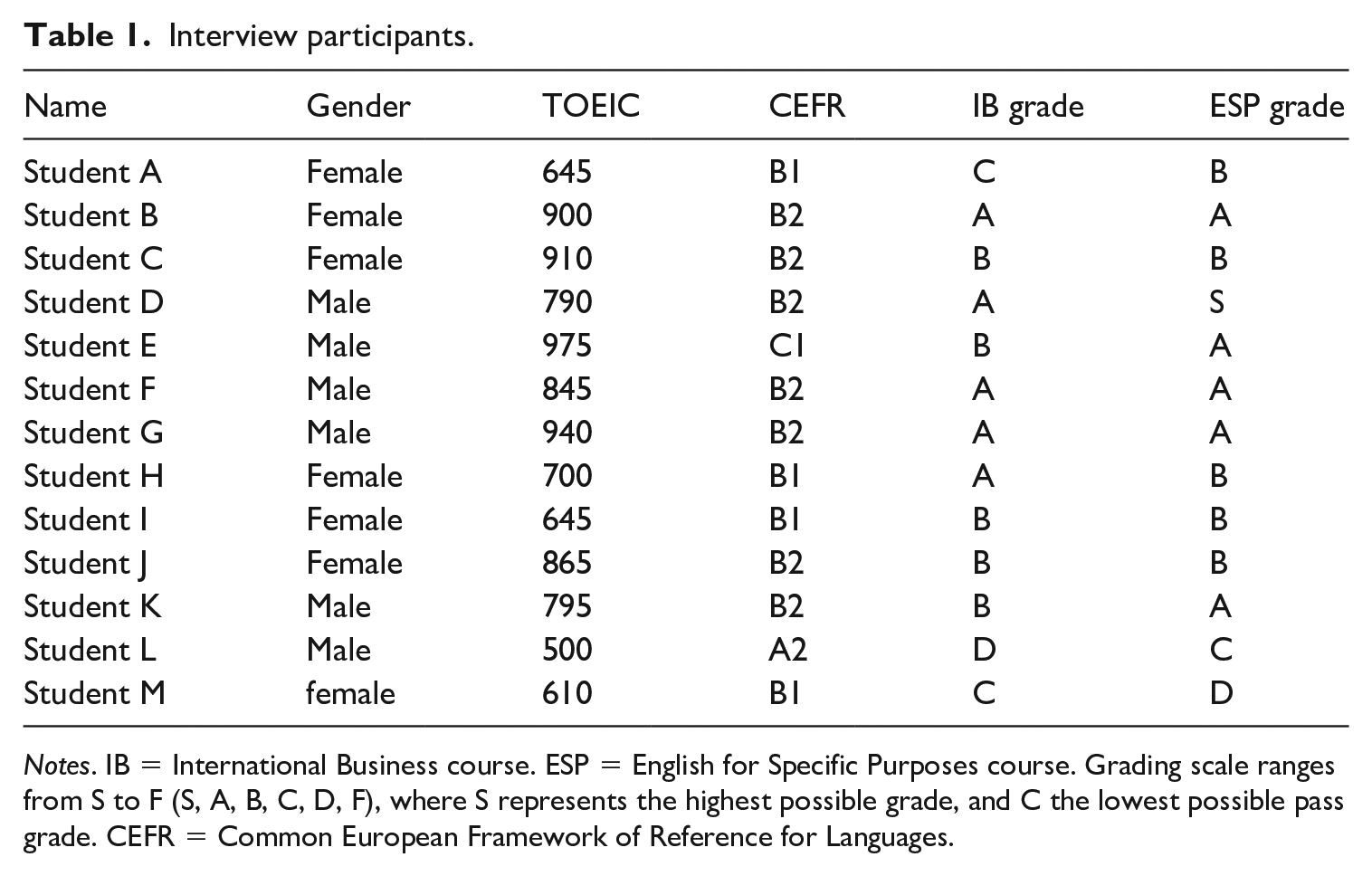
Notes. IB = International Business course. ESP = English for Specific Purposes course. Grading scale ranges from S to F (S, A, B, C, D, F), where S represents the highest possible grade, and C the lowest possible pass grade. CEFR = Common European Framework of Reference for Languages.
3 Participants and procedures
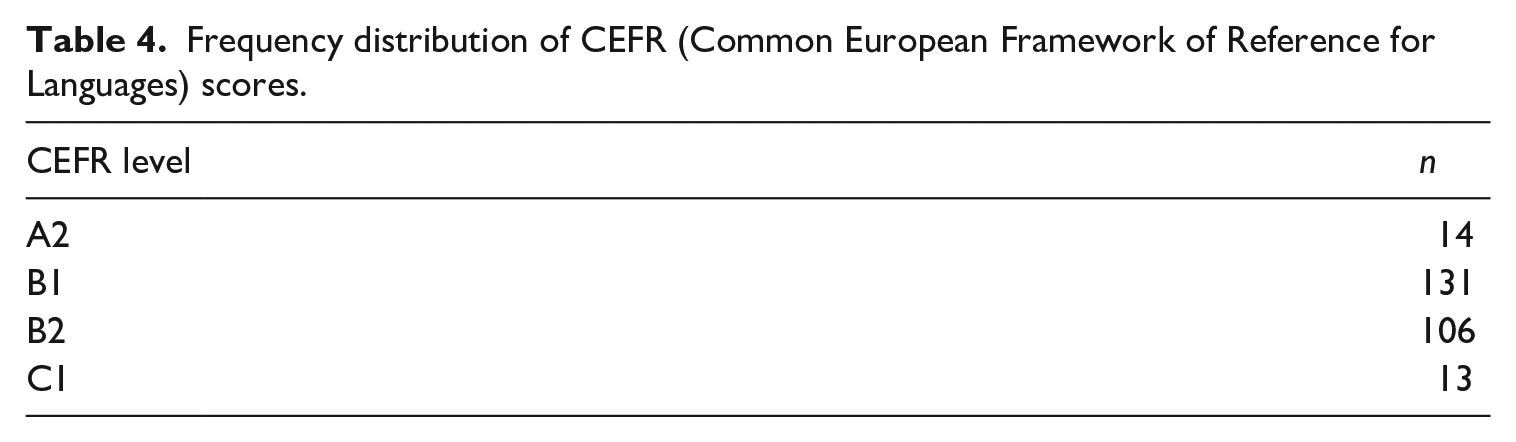
A total of 296 students agreed to participate in the study and completed the survey in week six of a 14-week semester. However, due to missing data from 32 individuals (18 questionnaires with incomplete responses, 14 individuals with missing TOEIC or ESP scores), a total of 264 survey responses were ultimately analysed in our quantitative analyses for each research question. The mean TOEIC score of participants was 756.61 (SD = 122.37), with the lowest score being 385, and the highest 990. Using Tannenbaum and Wylie’s (2013) conversion benchmarks, this placed students between CEFR levels A2 to C1, with the majority of students falling into the B1 level (see Table 4 below).
Semi-structured interviews were conducted with 13 students who volunteered to participate in follow-up interviews, to add contextualized, qualitative data to our interpretation of the quantitative results. Interviews were conducted at the end of semester, and in Japanese, to allow participants to provide adequate detail in responses (see Lin, 2015).
4 Data analyses
Exploratory and confirmatory factor analyses were carried out on the EMI Challenges Scale adapted from Evans and Morrison (2011), who grouped the questionnaire responses by skill (reading, listening, writing, speaking) without using a data reduction technique such as exploratory factor analysis (EFA). While the groupings of items were theoretically justified, this decision was not statistically supported: internal reliability was not reported, and the assumed factors were not confirmed, despite a large number of responses which would have allowed for validation. To fill this methodological gap, our study first examined the extent to which student perceptions of academic challenge could be validly grouped by language skill.
For research question one, participant totals for the EMI Challenges Scale were calculated. These were used as the outcome variable and a multiple linear regression model was carried out to predict perceptions of ease towards academic study via English (i.e. participant totals for the EMI Challenges Scale) from L2 proficiency (TOEIC), and academic preparation success (ESP Scores). To explore research question two, a four (CEFR levels) by four (Challenges Scales) between-participants multivariate analysis of variance (MANOVA) was conducted to test whether there were any significant differences in the levels of linguistic challenge for each language skill according to CEFR level. In other words, the analysis examines whether student perceptions of skill towards academic writing show statistically significant differences for students at each CEFR level.
Each of these analyses are supplemented by findings from a qualitative content analysis (Selvi, 2020) of the follow-up interviews. Interview coding was conducted abductively, with initial deductive coding carried out using categories from the research literature and research questions (i.e. perceived challenges of academic study, assessment of personal academic skill, discussion of the influence of L2 ability), while themes were also generated inductively from codes.
Our interview findings are limited by the number of participants who agreed to participate and the make-up of the participant pool; students with stronger English ability may deal with EMI challenges more easily than less advanced classmates (see Harrington & Roche, 2014). Findings may also be limited by the influence of self-selection by participants, those with higher English ability, and stronger feelings (either positive or negative) about EMI study may have volunteered for the study. However, as shown in Table 1, our participants (6 male, 7 female) represent a varied range of L2 proficiency levels, with variation in their grades in both the preparatory (ESP) and EMI (International Business) courses. Accordingly, they provide some insights about the relationship between EMI challenge for learners at higher and lower levels of L2 proficiency, and preparatory and EMI success.
IV Instrument validation
As a first step in data analysis, we tested the constructs presented in our questionnaire, to confirm that the assumed factors in Evan’s and Morrison’s (2011) questionnaire, which was developed in Hong Kong, were transferable across EMI learning contexts. As we had a priori assumptions of dimensions falling along skill-based constructs, we tested these. An exploratory factor analysis (EFA) was first used to analyse the underlying factors in the EMI Challenges Scale using the psych package in R. All assumptions were met: Mahalanobis distance (X2(45) = 80.04); Bartlett’s test (X2(10221.65) = 990, p < 0.001); KMO (MSA = 0.96). A parallel analysis and scree plot (see Figure 1) suggested four overall factors, which fit the hypothesized model of the questionnaire.
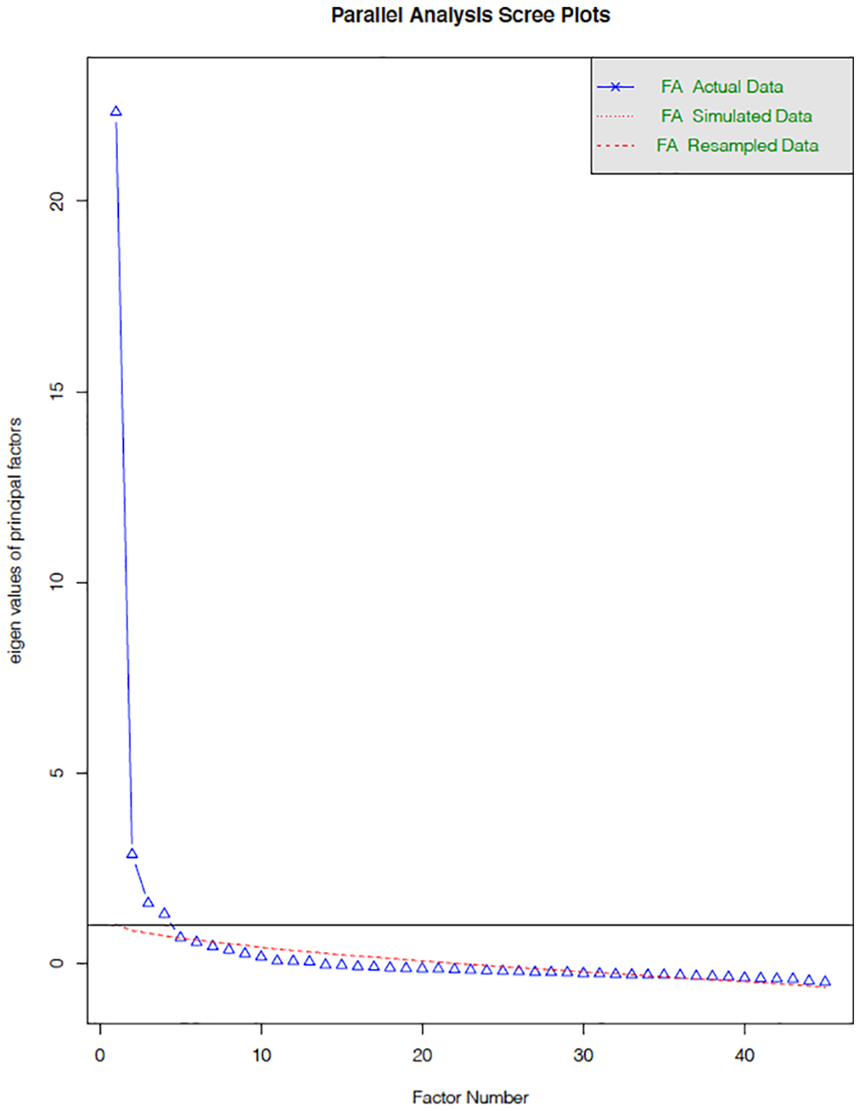
Screeplot of EFA on EMI Challenges Scale.
Based on this initial exploration (and the original questionnaire design), a 4-factor model was tested. 1 Four items loaded across two factors. These items were eliminated from further analyses: Academic Reading (Item 10), Academic Speaking (Items 1 and 6), and Academic Listening (Item 7), and the analysis was re-run. The model had satisfactory fit: RMSEA was moderate (0.09, 90% CI (0.07, 0.08)), SRMR was excellent (0.04), CFI satisfactory (0.9) and TLI (0.87) indicating slight room for improvement (Hu & Bentler, 1999).
All items loaded on to the expected factors (Reading, Writing, Listening Speaking). The reliability of all four factors was very high with 0.95, 0.94, 0.94 and 0.95 for Factors 1, 2, 3 and 4 respectively. The mean scores for each factor were: Factor 1 M = 3.53 (SD = 1.08), Factor 2 M = 3.44 (SD = 1.16), Factor 3 M = 3.59 (SD = 1.34) and Factor 4 M = 3.19 (SD = 1.26). These results were reiterated in a confirmatory factor analysis (CFA) as illustrated in Figure 2. Final results indicated that a four-factor model fit the data with fit indices of: CFI = 0.9, TLI = 0.9, RMSEA = 0.06, and SRMR = 0.05.
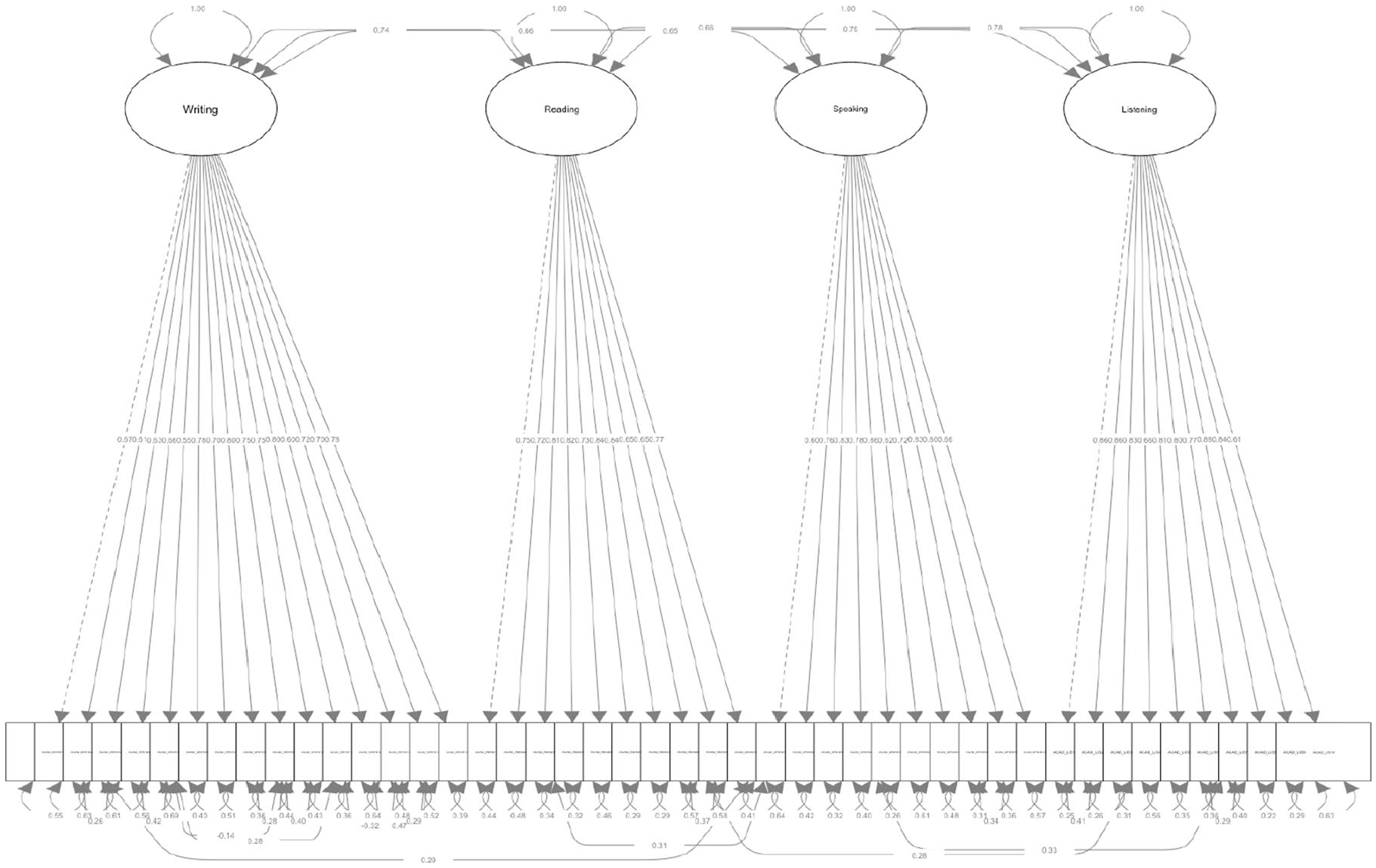
Results of CFA on EMI Challenges Scale.
As a result of this process, we could conclude that the questionnaire was a psychometrically reliable measure of academic language challenges according to four skill areas. This knowledge allowed us to proceed with subsequent analyses which used mean scores according to each of these skills to explore relationships with other constructs such as proficiency.
V Results
1 Proficiency and ease of study
Our first research question aimed to explore the extent to which general English language proficiency (TOEIC) and academic English competence (ESP) was related to the challenges students experienced when studying in an EMI context. In order to answer this question, a multiple regression model was used that contained English language proficiency (TOEIC scores) and academic English competence (ESP scores) as potential predictor variables to explore the variance in student perceptions of the academic challenges associated with EMI (the outcome variable). The higher the score on the EMI Challenges Scale, the greater the ease with which students experienced EMI; the lower the score, the greater the challenges were experienced. Descriptive statistics in Table 2 show that the highest value was 7 and the lowest 1, with a range of 6, a mean of 3.63, and a standard deviation of 1.02. The skewness was 0.02 (falling within –1 to +1) and kurtosis was –0.24 (falling within –3 to +3), an acceptable range (Hair et al., 2010). The data met all the assumptions for multiple regression.
Descriptive statistics of TOEIC scores, ESP scores, and EMI Challenges Scale.
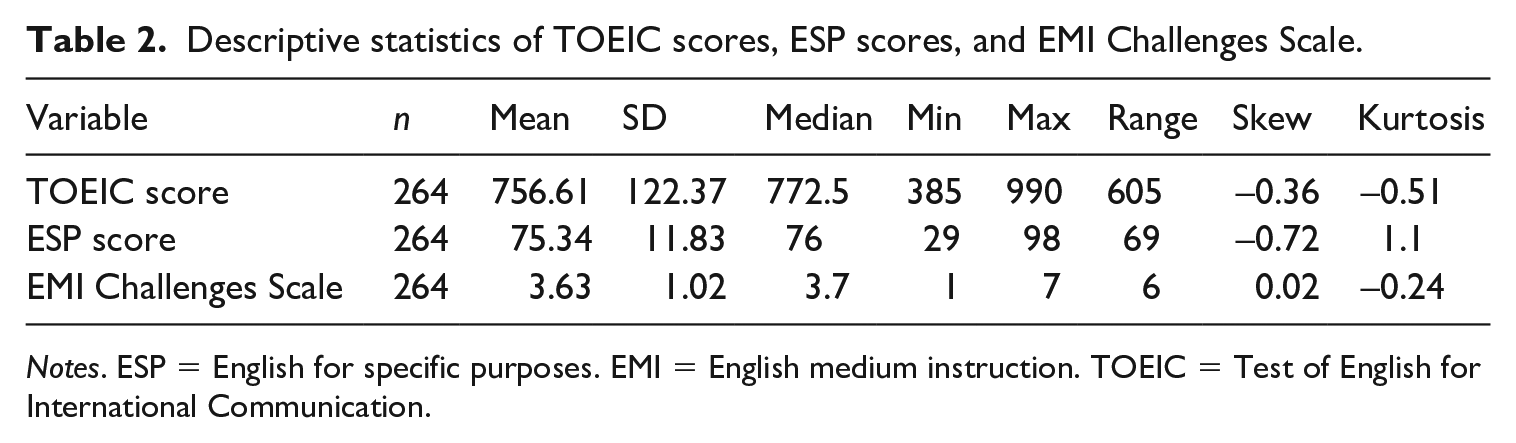
Notes. ESP = English for specific purposes. EMI = English medium instruction. TOEIC = Test of English for International Communication.
As Table 3 shows, the R2 value was 0.1463, which means that 14.63% of the variance in EMI challenges was explained by the two predictor variables combined. The EMI Challenges Scale increased by 0.1360 for every point increase in TOEIC Score; and increased by 0.02 for every point increase in ESP score. However, only TOEIC scores (i.e. general English language proficiency) was a statistically significant predictor of Challenges in EMI (F(2,261) = 22.36, p = 0.0000). This indicates that for the students in our sample, a higher level of general English proficiency seemed to lessen the language-related challenges they faced in their EMI courses.
Multiple regression output: TOEIC scores, ESP scores, and Challenges.
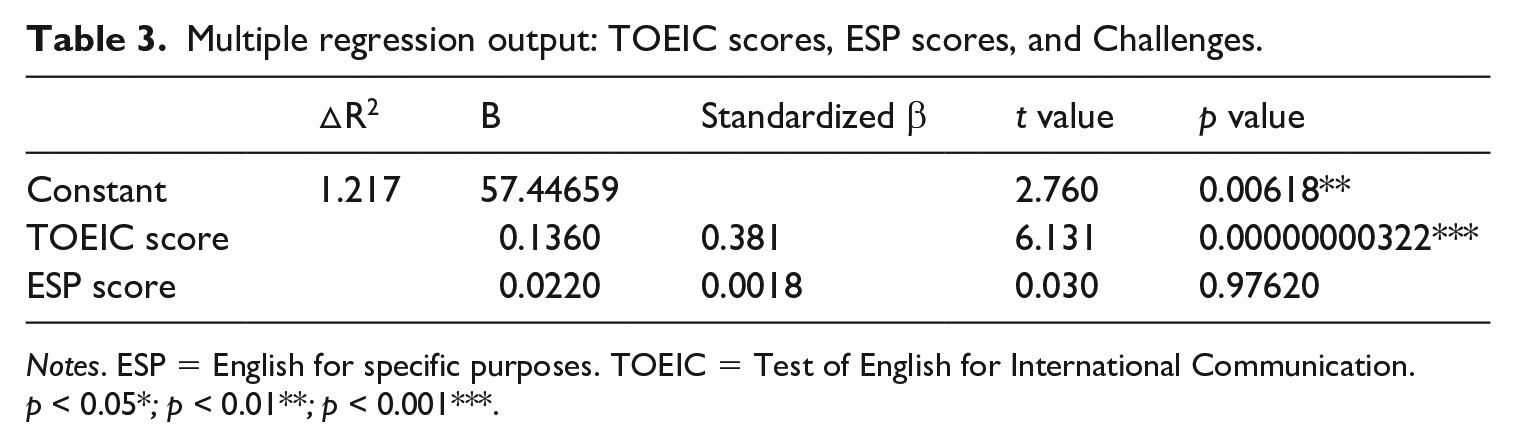
Notes. ESP = English for specific purposes. TOEIC = Test of English for International Communication.p < 0.05*; p < 0.01**; p < 0.001***.
2 Proficiency thresholds
The second research question sought to better understand differences in perceived ease of study at key proficiency thresholds, as defined by Common European Framework of Reference for Languages (CEFR) levels. TOEIC scores were converted to CEFR levels. Table 4 shows a breakdown of students placed at each CEFR level. The bulk of the sample had a CEFR level of B1 (n = 131) and B2 (n = 106).
Frequency distribution of CEFR (Common European Framework of Reference for Languages) scores.
A four (four CEFR levels) by four (four Challenges scales) between-participants multivariate analysis of variance (MANOVA) was conducted to test whether there were any significant differences in the levels of linguistic challenge according to CEFR level. Descriptive statistics (see Table 5) show that no variables were highly skewed (all fell within a –1 to +1 range) or highly kurtotic (all fell within –3 to +3, Hair et al., 2010). The EMI Challenges Scales (see Appendix 1) were independent of each other (ICC = 0.43), and the covariance matrices were equal (Box’s M test, p = 0.15). Levene’s F tests were all non-significant (p > 0.05), therefore the assumption of homogeneity was met. The data therefore met all the assumptions for MANOVA.
Descriptive statistics of the EMI Challenges Scales and CEFR scores.
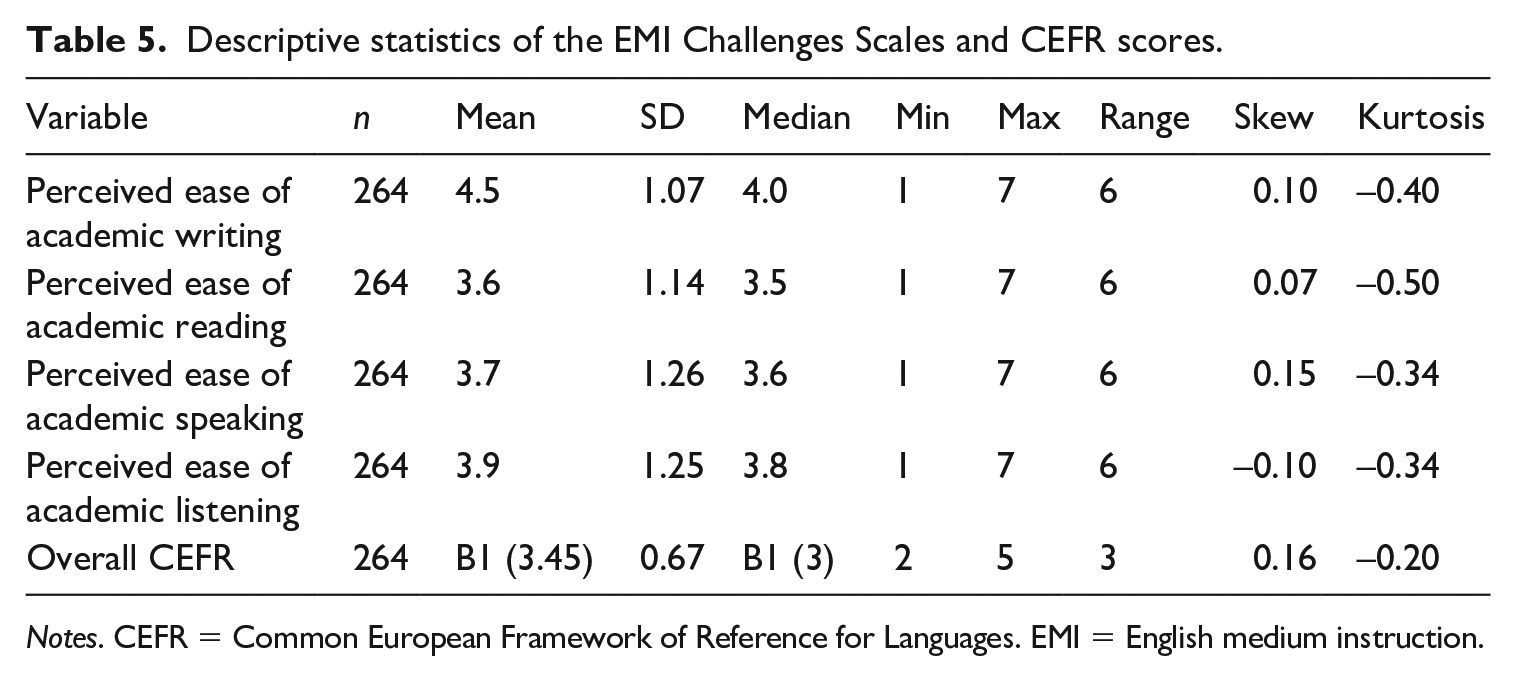
Notes. CEFR = Common European Framework of Reference for Languages. EMI = English medium instruction.
All of the MANOVA test statistics showed a statistically significant effect of CEFR level (i.e. the means of the four linguistic challenges differed significantly according to CEFR level). Pillai’s Trace = F(3, 260) = 4.82, p = 0.000***, ηp2 = 0.207. Post-Hoc ANOVAs and the Games–Howell test (Field et al., 2012) were run to explore nuanced differences between CEFR level and each perceived linguistic challenge. A Bonferroni correction was applied to the α-levels of the ANOVAs to control for the overall Type I error rate (Tabachnick & Fidell, 2013).
There was an overall statistically significant effect of CEFR level of writing-related challenges (F(3, 260) = 4.29, p = 0.006***, ηp2 = 0.047). The post-hoc test revealed a statistically significant difference between CEFR level A2 and C1 (Mean difference = −1.03, p = 0.05).
Likewise, there was an overall statistically significant effect of CEFR level on academic reading-related challenges (F(3, 260) = 13.704, p = 0.000***, ηp2 = 0.137). The Games-Howell post-hoc test revealed a statistically significant difference between all CEFR levels except B2 and C1:
A2 and B1 (Mean difference = −0.759, p = 0.011*)
A2 and B2 (Mean difference = −1.35, p = 0.000***)
A2 and C1 (Mean difference = −2.03, p = 0.000***)
B1 and B2 (Mean difference = −0.593, p = 0.000***)
B1 and C1 (Mean difference = −1.276, p = 0.002**)
(Notes. p < 0.05*; p < 0.01**; p < 0.001***)
This indicates that, in this context, a B2 level might be sufficient to mitigate reading-related challenges.
Similarly, academic speaking-related challenges showed an overall statistically significant effect according to CEFR level (F(3, 260) = 7.512, p = 0.000***, ηp2 = 0.080). Post-hoc analysis showed statistically significant differences between extreme low (A2) and high (C1) English proficiency, as well as the middle range (B1 and B2):
A2 and C1 (Mean difference = −1.256, p = 0.048)
B1 and B2 (Mean difference = −0.625, p = 0.001**)
B1 and C1 (Mean difference = −1.067, p = 0.02*)
Finally, academic listening-related challenges showed an overall statistically significant effect (F(3, 260) = 16.961, p = 0.000***, ηp2 = 0.165). The Games-Howell post-hoc test showed statistically significant differences between all CEFR levels except A2 and B1, meaning lower differences may not be as important as low-high differences:
A2 and B2 (Mean difference = −1.44, p = 0.000***)
A2 and C1 (Mean difference = −2.13, p = 0.000***)
B1 and B2 (Mean difference = −0.807, p = 0.000***)
B1 and C1 (Mean difference = −1.46, p = 0.001**)
Thus, CEFR level did seem to impact the challenges students reported for each skill, with more distinctive differences across group boundaries in academic listening and reading. Figure 3 below summarizes these patterns in a visual display of mean differences according to each academic skill. Notably, except for speaking, there is a clear visual linear relationship between challenges and CEFR level, with no discernible threshold where challenges suddenly dissipate, or level-off. Note that the higher level of speaking at the A2 level compared to B1 level may be due to representativeness of sample size, with 14 students in this group compared to 131 at the B1 level.
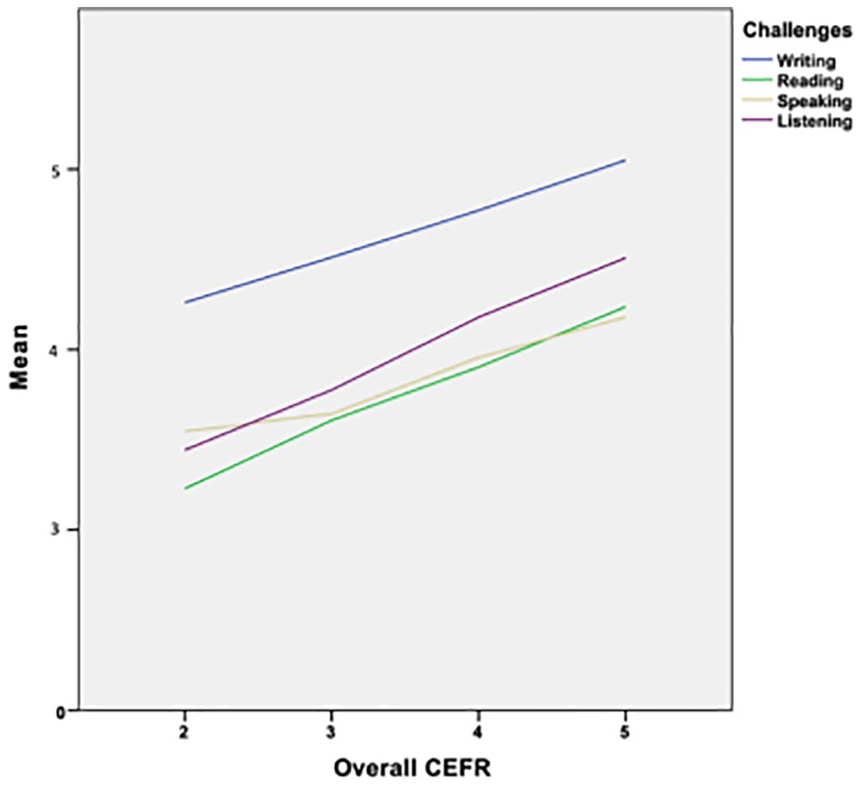
Mean frequency of Challenges by CEFR level.
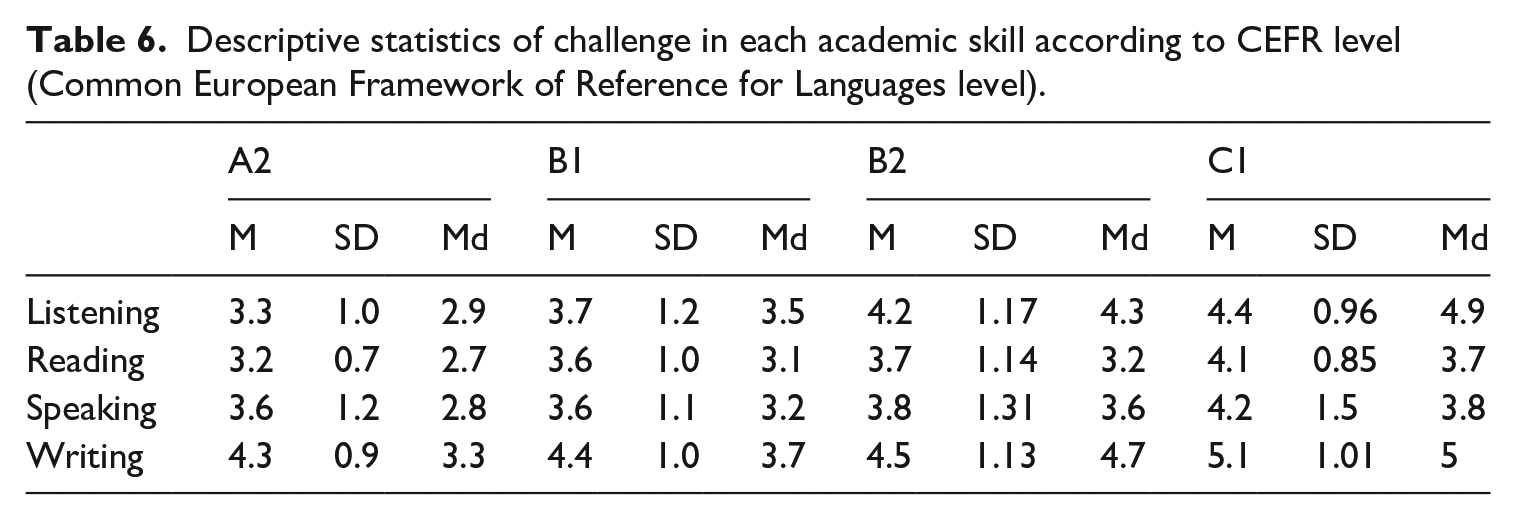
Table 6 below shows the descriptive statistics of challenge in each academic skill according to CEFR level, indicating that the participants reaching the C1 level are, on average, over the 4-point mid-mark of challenges in all of the four academic skills. This indicates that the average student at the C1 level experiences more ease than difficulty in each of the four skills. However, the median scores for this group only surpass this threshold for the writing and listening skills, indicating that the majority of C1 students still report more challenges for reading and speaking. Similarly, the majority of B2 level students are also over the 4-point mid-mark in the areas of listening and writing skills, which is also true of the average student in this group. Thus, when exploring the data in terms of the threshold between difficulties and ease, there is some evidence to suggest that at the B2/C1 level, student start to report greater ease for some of the language-related challenges associated with EMI, especially in the areas of writing and listening.
Descriptive statistics of challenge in each academic skill according to CEFR level (Common European Framework of Reference for Languages level).
3 Students perceptions of a threshold of English required to mitigate challenges
With no clear discernible threshold in the quantitative data, the interview data was explored to elicit students’ perceptions of their perceived threshold of English knowledge required to mitigate their challenges when studying through EMI. Interview data revealed two key findings:
although the participants unanimously agreed that the higher their proficiency the better they are able to mitigate EMI challenges, there was no clear consensus among them as to where exactly this threshold lies after which language stops being a barrier to their academic performance; and
the L2 proficiency thresholds key to students are not only determined by general proficiency (i.e. TOEIC) but also by more specific academic English skills, such as being able to ask questions, engage in conversation and express opinions confidently in English.
Each of these key findings are discussed in further depth.
a L2 thresholds and the need for constant improvement in proficiency
Although most students perceived themselves to be able to handle the challenges of EMI study, most also specified a need for higher language proficiency scores. These scores were seen by students as an explicit indicator of the required English level in order to be more successful as EMI learners. For example, student L (TOEIC 500, CEFE A2, IB grade D) had a low proficiency score, and believed that gaining a higher proficiency test score would be ideal for better lecture comprehension, lamenting the current situation where his struggle primarily stemmed from his insufficient English knowledge. Nonetheless, he felt his current level of proficiency was still sufficient for EMI learning. Student F (TOEIC 845, CEFR B2, IB grade A), who had higher proficiency, claimed that ‘I have TOEIC 845 but still find it difficult to fully understand my EMI lectures. The minimum requirement for EMI should be TOEIC 900.’ What is most striking from these two cases is that both students exhibit the further need to improve their English, despite large differences in their current proficiency levels. It seems the perceived requisite English proficiency for EMI varies according to how individual learners interpret their current challenges of learning.
These statements support the quantitative results, which revealed a lack of a discernible linguistic threshold above which challenges level-off for students. In fact, none of the six interviewees whose scores were over 800 perceived their current scores to be sufficient to mitigate challenges. Rather these highly proficient students urged the importance of obtaining even higher scores for more successful learning in their EMI program. For example, despite achieving a high proficiency score, student G (TOEIC 940, CEFR B2, IB grade A) stated that ‘I want to further improve my English scores because I still take a much longer time to prepare for my EMI lectures than my Japanese lectures and there are many academic and technical English words that I still need to study.’ Thus, although proficiency gains affect language-related challenges, even reaching high levels of proficiency does do not necessarily alleviate all of the challenges that students encounter. To the contrary, high proficiency students still have to deal with language related learning challenges that impede content learning.
b Skill and class specific L2 thresholds
In terms of how a linguistic threshold should be determined in EMI contexts, students expressed unease at ascertaining an exact cut-off line using TOEIC scores, indicating less explicit indicators should be used instead. Student D (TOEIC 790, CEFR B2, IB grade A), for example, argued that the exam-English focus of TOEIC should not be valued more than practical skills, such as speaking skills, claiming that ‘it is more important to be able to ask questions and reach out to seek help confidently in English.’ Similarly, student B (TOEIC 900, CEFR B2, IB grade A) highlighted listening skills as the most essential skill in EMI, claiming that ‘ideally EMI students are equipped with all the four academic English skills but in reality should achieve at least a good command of listening skills to survive EMI lectures.’
Another crucial factor complicating the process of determining a linguistic threshold is the high-level of context dependency of participants’ English requirements for EMI. Highlighting context dependent factors, student H (TOEIC 700, CEFR B1, IB grade A) stated that her language needs differed according to content and context, claiming: I need different levels of English skills for different courses and need a particularly high level of English for the International Human Resource course where I don’t know much about its course content and the majority of my course mates are international students who speak fluent English.
All of the interviewees (n = 13) observed a clear relationship between English proficiency and the magnitude of their challenges, but objected to the idea that proficiency is the only factor that contributed to their EMI learning experience. They suggested that other factors should be more facilitative to their content learning. These include prior content knowledge, motivation, self-efficacy, ability to utilize online resources (e.g. YouTube), performance in the ESP courses, and classroom learning environment (e.g. instructors, class size, course mates). One student, for example, stated that EMI challenges could be overcome through increased motivation and effort in learning: I make more effort and study longer hours when learning through English than Japanese. I don’t need to read my pre-assigned textbooks when attending lectures in Japanese as I can still quickly skim through them while listening to my lecturers. Although I still face more challenges when learning in English than Japanese, I’m satisfied with how my learning takes place as I’m more motivated to study my degree in EMI. (Student C, TOEIC 910, CEFR B2, IB grade B)
Another student suggested that English language support classes were essential in improving performance in EMI, as well as raising self-efficacy: In ESP classes, my teacher encouraged us to talk actively, which helped me improve my confidence in using academic English and get used to completing a good amount of assignments in English. I’m now happy to ask questions and participate in class discussions in English in EMI lectures. (Student L, TOEIC 500, CEFR A2, IB grade D)
Another student stated that out-of-class learning could be a powerful way to improve the language skills necessary to survive in their EMI studies: I watch online American TV drama series, English music videos and English news to help myself learn English better to prepare for EMI lectures. I need to make my learning unique and effective because learning in English is more difficult. As a result of listening to English frequently, I face very few challenges when listening to EMI lectures. (Student M, TOEIC 610, CEFR B1, IB grade C)
Thus, based on our qualitative findings, the students generally agreed that while general language proficiency was important to alleviate challenges in EMI, it was not the only factor that mattered. They believed that there were a number of other factors contributing the magnitude of their EMI challenges. We can therefore suggest that those who may not have reached the threshold may still be able to effectively rectify their challenges if successfully compensating their insufficient English proficiency for improving other factors, such as spending longer hours on revision and preparation and utilizing online learning resources. Further to this, the interviewees interpreted the idea of a threshold in a nuanced way, agreeing that reaching a required level of proficiency would not necessarily enable them to completely combat all of their learning challenges.
VI Discussion and implications
A number of interesting discussion points emerge from the findings of this study, which have been organized around the following themes: methodological contributions of the study; a comparison of challenges across EMI contexts; and problematizing of a language threshold for EMI.
1 Methodological contributions
A first, and major, contribution of this study is the adaptation and validation of Evans and Morrison’s (2011) questionnaire as a robust measure of EMI challenges. Our findings support the operationalization of EMI linguistic challenges according to four language skills. Neither EFA or CFA was carried out in the original study by Evans and Morrison (2011), nor in subsequent studies which have used this instrument (e.g. Aizawa & Rose, 2019). Confirmation of the assumed factors underlying the challenges questionnaire not only strengthens the findings of our study, but also of previous research that has used this instrument. For example, in Evans and Morrison’s (2011) study, the questionnaire data ‘were used to form a composite mean for each skill area; that is, a ‘mean of means’ derived from the items in each area’ (p. 203), but this decision was not psychometrically justified, or statistically supported. The validation of this questionnaire adds evidence to support these previous methodological decisions, and allows for greater comparability of EMI experiences across contexts that have explored language-related challenges via the four skills.
2 Comparison of challenges across EMI contexts
The results of our study in this Japanese setting revealed that writing was the least challenging area of EMI for students. The skills of speaking and reading represented the greatest challenges. Previous studies have also highlighted the skill of speaking as a difficult skill for EMI in other contexts (e.g. Evans & Morrison, 2011; Kırkgöz, 2005), and thus our results concur with such findings. Results surrounding reading difficulties also corroborate previous EMI research that found students experience difficulties understanding and completing assigned reading tasks (Tatzl, 2011).
Interestingly, our study highlighted writing as an area of significantly less challenge. This contradicts other studies that have noted writing to be a major challenge for EMI students from tasks such as note-taking (e.g. Andrade, 2006), essay writing exams (e.g. Breeze & Dafouz, 2017) to using appropriate academic style in essay writing (e.g. Evans & Morrison, 2011). It also contradicts the results of Lee and Lee (2018) whose survey of over 3,000 students highlighted writing as the most problematic language skill.
Reasons for this difference may be context specific. It may be due to the large focus on writing development in the 18-month academic foundation program in the context of our study. It may also have been due to nature of writing assessment in the IB lecture (a group business report worth a small percentage of the final grade), which perhaps alleviated some of the individual pressures of writing demands for students.
Overall, the results of our study, in comparison with the results of others, highlight that each EMI context is unique in terms of the linguistic demands placed on students. Challenges might also differ according to academic discipline, a notion emphasized in cross-disciplinary EMI research (e.g. Kuteeva & Airey, 2014). As a result, students may benefit from preparatory language courses that pay particular attention to the specific academic skills needed for subject-specific EMI programs.
3 Problematizing language thresholds for EMI
Finally, our study has suggested that it may be difficult to establish a proficiency threshold, at which the language difficulties associated with EMI learning noticeably decrease. While our regression analysis suggested a clear linear relationship between proficiency and challenges, whereby increases in proficiency result in increases in ease of learning, there appears to be no discernible threshold at which students have ‘enough’ proficiency to mitigate challenges completely. This was also confirmed when we explored the students challenges according to CEFR level, where significant differences existed across most groups for most language skills, even at the higher levels. Thus, it is difficult to establish whether a clear ‘threshold’ of proficiency exists for EMI, a notion supported in the qualitative data, where even the very high proficiency learners at a B2/C1 level reported challenges associated with learning in their L2.
These results echo previous findings that a B2/C1 level may not be high enough to mitigate lacks in the requisite language and literacy skills to ensure success in English medium studies (Trenkic & Warmington, 2019). While other studies have suggested B2 as a suitable threshold for academia (e.g. Harsch, 2018; Harsch, Ushioda & Ladroue, 2017), our findings would emphasize that students at this level may still be disadvantaged in terms of the linguistic challenges that they must overcome in their studies.
Our qualitative findings suggest that proficiency ‘thresholds’, while useful, should not be the only factors considered to mitigate challenges in EMI. The participants highlighted that difficulties from L2 proficiency can be overcome through the motivated behaviour of learners, and increased efforts in out-of-class learning. It is important to emphasize that our study has explored the effects of proficiency on challenges. An important next step will be to explore how these challenges, alongside a myriad of other factors, interact with levels of success in EMI programmes.
4 Implications from the study
The findings of this study have implications for entrance requirements for lower proficiency students who have to make greater efforts to survive in an EMI learning environment, compared to students whose English proficiency has already passed a B2/C1 threshold. That being said, reaching a threshold of proficiency alone may not be enough to mitigate all the language-related challenges associated with EMI.
Our findings suggest that rather than using proficiency as a barrier of entry to EMI studies, better language support systems could be put in place to equip students with the academic language skills to undertake discipline specific activities in EMI programmes, with greater levels of support given to lower proficiency students. The foundation programme in our study’s context may have played a vital role in influencing students’ linguistic readiness to undertake EMI courses, an area of potential future investigation. Recognizing that our findings suggest certain skills (i.e. speaking and reading) to be more problematic than others, skill-based support systems may be instrumental in further expanding EMI programmes (Galloway & Ruegg, 2020; Wingate, 2012). Additionally, this support should not only equip students with the requisite academic language skills, but also attempt to address learner self-efficacy and regulatory behaviour.
EMI lecturers should be made more aware of the language-related challenges that their students face when undertaking studies, and be encouraged to make accommodations for these challenges in their lectures. They should also create opportunities for out-of-class learning and revision for lower proficiency students, as this can help students overcome challenges through increased motivated behaviour and effort.
