




Abstract
Technology reviews are a specific article genre published in several language teaching and learning journals. Their emergence is likely due to the proliferation of technology that facilitates and supports language acquisition. These reviews aim to increase teachers’ and learners’ awareness of the forms of technology available and succinctly describe their benefits and limitations for language teaching and learning. As education enters a new digital age, accelerated by the COVID-19 pandemic, it is essential to determine which forms of technology support teachers’ professional learning and how they can be utilized. This article presents a systematic review of technology reviews published between 2017 and 2022 in five Q1 SCOPUS-indexed language teaching and learning journals: RELC Journal, TESOL Journal, CALICO Journal, Language Learning and Technology and Teaching English as a Second Language Electronic Journal (TESL-EJ). These five journals were the only Q1 language teaching and learning journals we identified that publish technology reviews. All 73 technology reviews published in the 5-year period in the 5 journals were reviewed. Using professional digital competence as a framework, we explore what the articles reveal about how technology is used, as well as the knowledge gaps that remain. We examine the types and features of the technology described in the reviews, the language skills and educational levels of the learners, and the pedagogical implications of technology use. We found that the technology reviews mainly introduced the technological features and functions of the reviewed technologies with less emphasis placed on their pedagogical utilities and social aspects of their use for language teaching. The article concludes with recommendations for authors and journal editors regarding the content that should be included in a technology review to ensure that it is helpful to the profession. We also offer advice to practitioners on how to benefit from technology reviews.
Keywords
Introduction
In recent years, a new article genre has emerged in language teaching and learning journals: the technology review. Its emergence is likely due to the proliferation of technology that facilitates and supports language acquisition (Li, 2017). A technology review is a description and critical analysis of a form of technology (e.g. digital tool, app, website, hardware) that can be used for teaching and learning. Unlike a case study, a technology review does not need to describe or recount how the technology is implemented in practice. Moreover, it should not only describe technical capabilities and functions; instead, it should focus on how the technology supplements, enhances or transforms teaching and learning. For reviews in language learning and teaching journals, this means an explicit and critical analysis of how the technology is useful for language teaching and learning. Technology reviews should be grounded in theory and relevant principles, and authors of technology reviews should establish a clear connection between the tool and the theory (Kohnke and Moorhouse, 2022).
Technology reviews primarily aim to raise awareness about the forms of technology that are available and succinctly present their benefits and limitations. As Kessler (2018) has stated, ‘language teachers today are faced with so many fascinating options for using technology to enhance language learning that it can be overwhelming’ (205). Technology reviews can help language teachers become familiar with different digital tools and enhance their teaching practices – making something ‘overwhelming’ more manageable. Research has found that reading journals and books is the most common professional development in which teachers engage (Macalister, 2018). Therefore, practitioners are likely to read technology reviews as a form of professional development. In addition, technology reviews are typically shorter than other types of articles, which can make them more accessible to busy practitioners.
Despite the potential benefits technology reviews may afford, an initial cursory search of technology reviews in language and teaching journals led us to question some articles’ utility in supporting language teachers’ professional development. Specifically, we observed that some articles dedicated considerable space to the technical features and functions of the reviewed digital tools, and less attention to the pedagogical compatibility of the tools for language teaching. Given that practitioners are likely to seek out resources that can help them develop their teaching skills (Macalister, 2018), it is important to understand the aspects of teachers’ professional digital competence (PDC) that existing reviews address. This can allow us to propose recommendations that could enhance the utility of future reviews.
Education is entering a new digital era. Technological advancements (Li, 2017) and the necessity to use technology caused by the COVID-19 pandemic have meant teachers are now using a greater amount and variety of technology in their practices (Moorhouse, 2023). Technology has also facilitated new pedagogical approaches (e.g. flipped classrooms and blended learning) and teaching contexts (e.g. synchronous online language lessons). Given the increasing integration of technology into language teaching and the ways technology is changing pedagogical practices, developing PDC is now a requirement rather than an optional extra for teachers (Starkey, 2020). As readers and writers of technology reviews, we propose that they can have a place in developing PDC; however, they must meet the developmental needs of practitioners.
Therefore, this article presents a systematic review of technology reviews in five language teaching and learning journals: RELC Journal, TESOL Journal, CALICO Journal (hereafter CALICO), Language Learning and Technology (hereafter LL&T) and Teaching English as a Second Language Electronic Journal (TESL-EJ) (hereafter TESL-EJ). Using PDC as an analytical framework, the review aims to: (a) identify the key information presented in technology reviews in language learning and teaching journals; and (b) explore the aspects of professional digital competence that they address. We conclude by providing recommendations for authors and journal editors regarding the content that should be included in a technology review to ensure that it is helpful to the profession. We also offer advice to practitioners on how to benefit from technology reviews.
Professional Digital Competence (PDC)
There has recently been a growth in digital technologies specifically designed for education, including learning management systems, student response systems and language learning platforms (Hockly and Dudeney, 2018). Their development has coincided with advancements in tablet computers and Wi-Fi capabilities. This has made it possible to integrate digital technology into the classroom using Internet-enabled personal devices. However, it is widely understood that teachers must be digitally competent in order to use technology effectively for educational purposes (Starkey, 2020).
This understanding has led scholars to identify the knowledge and skills teachers need to use technology effectively. Instefjord and Munthe (2017) proposed a conceptual model – PDC. They defined PDC as the ability to ‘integrate and use technology, both personally and professionally, as well as specific teaching-profession skills’ (37). Their model includes three aspects: technological proficiency, pedagogical compatibility and social awareness. First, teachers need to be aware of the forms of digital technology available, as well as their functions and features, and be able to analyse them to choose one that will help them complete a personal or professional task. Second, they must be able to use technology to substitute, enhance or transform their teaching practices to achieve their pedagogical goals. Third, they need to have social awareness related to technology; they must know how to use it safely, legally, ethically and morally (Torres-Hernández and Gallego-Arrufat, 2022) to ensure that no harm comes to the students within their care, as well as to critically educate their students about the potential benefits and threats of it (Moorhouse, 2023). Importantly, PDC also concerns a teacher's ability to help their learners use technology in productive ways (Lund et al., 2014). Therefore, teachers not only need to be competent technology users, but also have the responsibility to help their learners to gain these skills as well.
PDC has been primarily used by scholars to conceptualize the knowledge and skills pre- and in-service that teachers need in order to use technology effectively for teaching. This conceptualization allows for an evaluation of teachers’ competence, and the ways teacher professional development, initial teacher education (ITE) or resources (e.g. technology reviews) can aid in the development of PDC. For example, Gudmundsdottir and Hatlevik (2018) used PDC as a framework to examine the perceptions of newly qualified Norwegian teachers towards the effectiveness of their ITE in preparing them for using technology in their professional practices. Similarly, Moorhouse (2021) used PDC to examine teachers’ preparedness for online teaching during the COVID-19 pandemic.
Review Procedures
As this review focuses on a specific genre of articles (technology reviews in selected language teaching and learning journals), we adopted relevant review procedures (see Figure 1). First, we visited the websites of each Q1 SCOPUS-indexed language teaching and learning journal in the ‘Social Sciences: Linguistics and Language’ and ‘Arts and Humanities: Language and Linguistics’ categories (e.g. ReCALL, Computer Assisted Language Learning, TESOL Quarterly, ELT Journal) to identify journals that publish technology reviews. This procedure identified five journals, RELC Journal, TESOL Journal, CALICO, LL&T and TESL-EJ, that publish technology reviews. Most Q1 SCOPUS-indexed language teaching and learning journals were found not to publish technology reviews. By restricting our review to Q1 SCOPUS-indexed journals, we hope to ensure the articles included had undergone a rigorous review process and therefore were of substantial quality. We hope this limitation of scope increases the value of the contribution of this review to the editors, readers, and authors of the selected journals. LL&T and TESL-EJ are fully open-accessed journals. RELC Journal, TESOL Journal and CALICO are available through subscription. CALICO seems to make technology reviews open access, while RELC Journal and TESOL Journal have some free and open-access articles.
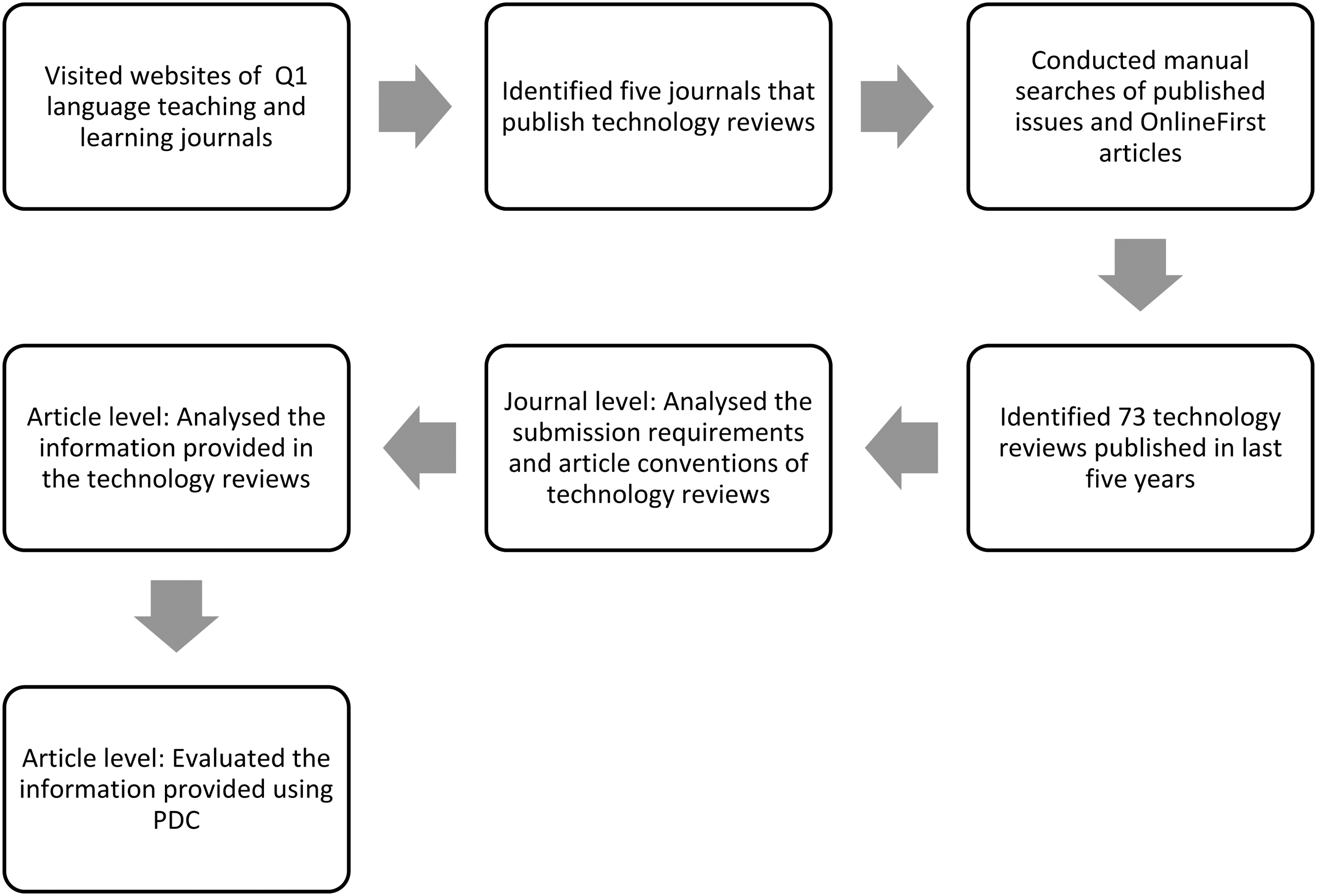
Review procedures.
A literature search was conducted between 8 and 14 July 2022. We visited each of the five identified journals’ websites and conducted manual searches of each published issue, as well as OnlineFirst articles (articles published online before being included in an issue). We reviewed articles published between 2017 and 2022. As technology is constantly changing (Hockly and Dudeney, 2018; Kessler, 2018), we felt that a five-year period would ensure that the technology described was up-to-date and relevant to language teachers. The initial search yielded 73 technology reviews: CALICO (n=22), TESL-EJ (n=22), RELC Journal (n=21), TESOL Journal (n=5) and LL&T (n=3) (see Appendix 1 in online supplementary for the full list and short descriptions of the technologies reviewed).
In the next stage, two levels of analysis were conducted: the journal level and the article level. At the journal level, the submission requirements, naming conventions, and publication frequency of technology reviews in each journal were reviewed (see the analysis below). After reviewing the journal-level data, we then conducted a systematic review of the articles. We used spreadsheet software to create a table with fields specifically designed to extract important information and address our aims (e.g. type of technology, reported benefits, reported limitations, target languages and supporting material). We also evaluated the information provided in the reviews using the aspects of PDC as an analytical framework. Each article was read, and key information was highlighted and then re-read. We then extracted the key information and organized it in the spreadsheet. Once all the information was compiled, we compared the information, collated the numerical data and extracted key themes from the qualitative data (e.g. collating digital technologies with similar functions into a ‘type of digital technology’ and counting them).
We then reviewed the information and rated it using the three aspects of PDC in order to address the second aim of this study. During the initial coding process, we observed that all of the articles paid substantial attention to raising readers’ awareness of the technological features and functions, which can aid teachers’ technology proficiency. However, only a few articles (n=16) mentioned social issues or concerns regarding the reviewed technology, which can raise teachers’ social awareness. These aspects are discussed in the following thematic review. The reviews provided various degrees of information on the pedagogical utility of the technology reviewed. Therefore, we decided to use a scale to code the amount of information each article included that could relate to the pedagogical utility of the tool: 1 = Not at all; 2 = Very little; 3 = Somewhat; 4 = To a great extent. This information included teaching ideas, suggested learning activities and related educational theories.
Throughout the data analysis process, we implemented a number of practices to strengthen the reliability of the findings. First, we analysed five articles separately and then met to compare and discuss our initial codes. A coding guide was created. As we continued the review, we added and modified the guide as new codes emerged or codes were reviewed. We met again once all the articles were reviewed to finalize the codes. We kept in regular communication throughout the process.
In the next section, the findings of the journal-level analysis are presented, followed by the findings pertaining to the aims of the systematic review.
Submission Requirements and Conventions
We analysed the submission requirements for technology reviews in each identified journal (see Table 1). Each journal uses a different name for technology reviews (e.g. media reviews in TESOL Journal and ICT (information and communications technology) reviews in RELC Journal). The word limits for technology reviews were similar in each journal: approximately 1000–2000 words. Although CALICO and LL&T do not state word limits on their websites, we noted that the articles were approximately the same length as the technology reviews in other journals when reviewing them. This is substantially shorter than other types of articles. For example, the word limit for research articles in RELC Journal is 6000 words. All of the websites suggest that technology reviews go through a peer review process. Only RELC Journal and TESOL Journal accept unsolicited technology reviews. The other journals require authors who are interested in writing a technology review to contact the section editor with their ideas before submitting one. Unlike research articles, none of the technology reviews required abstracts. However, some (e.g. TESL-EJ) included a metadata page with key details about the technology. CALICO reviews included keywords, as did some RELC Journal reviews (12 out of 21); the remaining journals did not include them.
Technology review submission requirements.
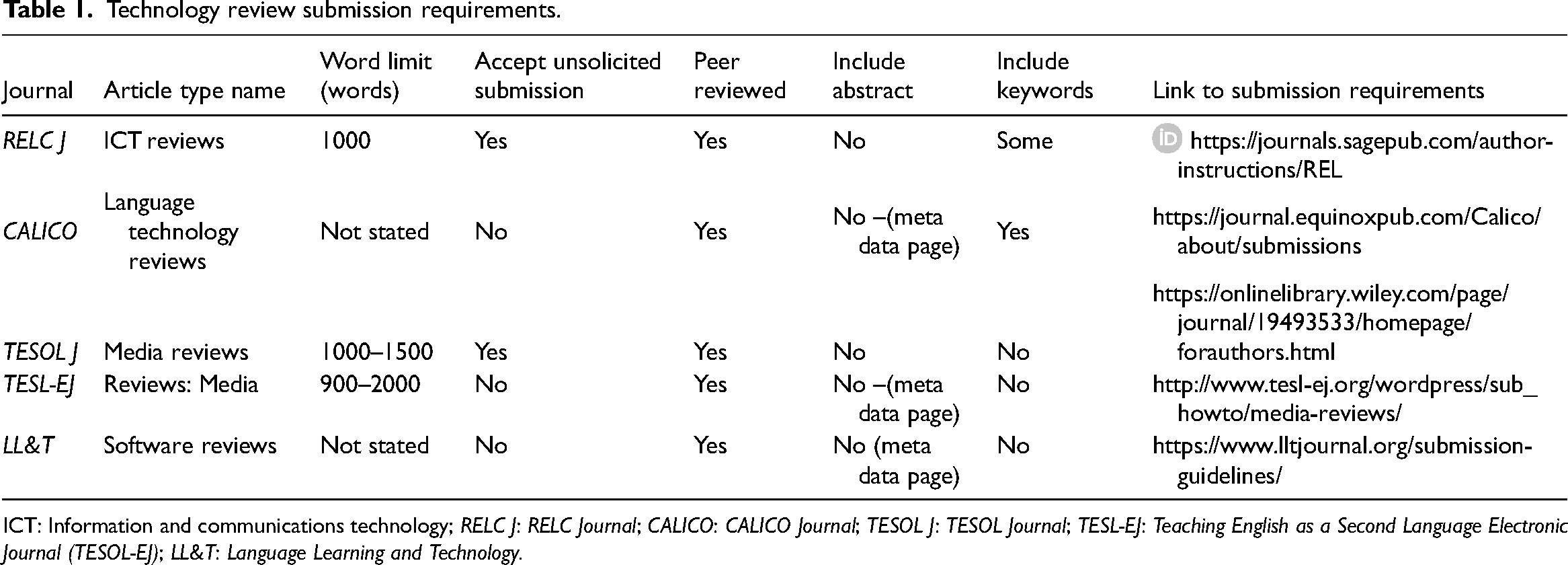
ICT: Information and communications technology; RELC J: RELC Journal; CALICO: CALICO Journal; TESOL J: TESOL Journal; TESL-EJ: Teaching English as a Second Language Electronic Journal (TESOL-EJ); LL&T: Language Learning and Technology.
In addition, we analysed the publication trend of technology reviews over the past five years. We found that a steady number (between one and six) of technology reviews were published each year in three of the five journals (RELC Journal, TESL-EJ and CALICO; see Table 2). In TESOL Journal and LL&T, technology reviews were published less frequently.
Technology review articles published by year.
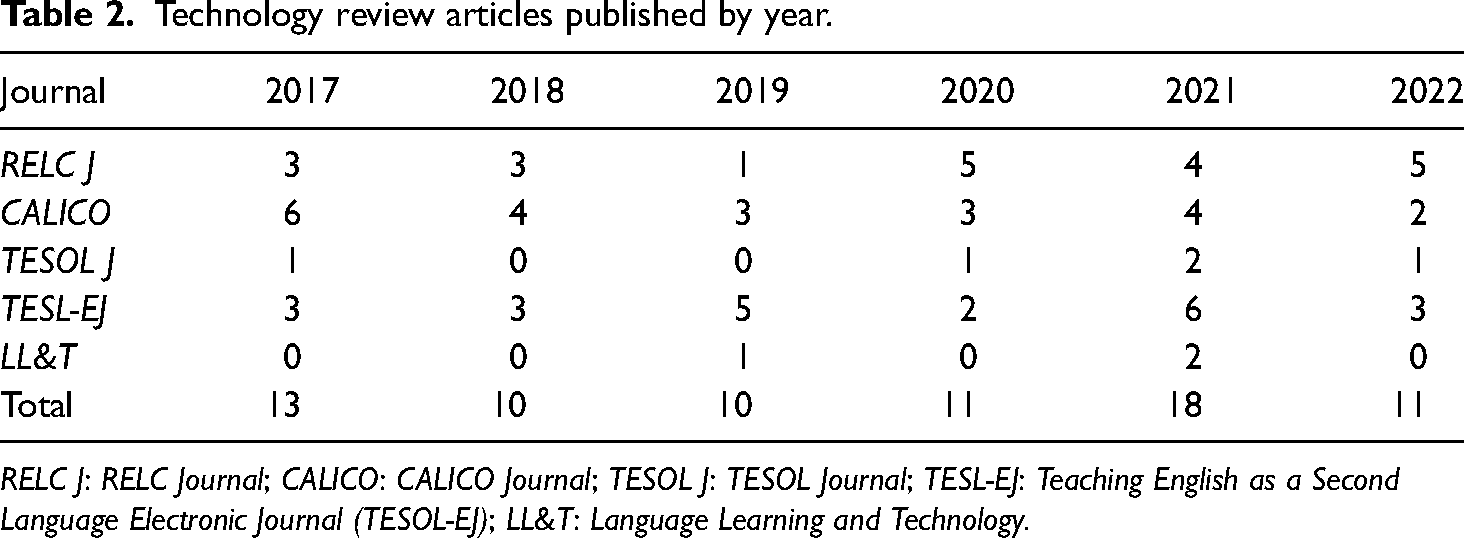
RELC J: RELC Journal; CALICO: CALICO Journal; TESOL J: TESOL Journal; TESL-EJ: Teaching English as a Second Language Electronic Journal (TESOL-EJ); LL&T: Language Learning and Technology.
While analysing the articles, we noticed that in three of the journals (RELC Journal, TESL-EJ and TESOL Journal) there were inconsistencies in the article naming conventions. Some article titles stated the name of the digital technology being reviewed (e.g. ‘Duolingo’: Teske, 2017). Other articles included a longer, extended title, or sub-title that included information about its technological functions or pedagogical uses (e.g. ‘WordSift: Reading Easier by Understanding Key Words’: Hu et al., 2022). CALICO and LL&T had standardized naming conventions, which included the name only (CALICO), or the fixed stem ‘A review of xxx’ (LL&T) (see Table 3).
Article titles.
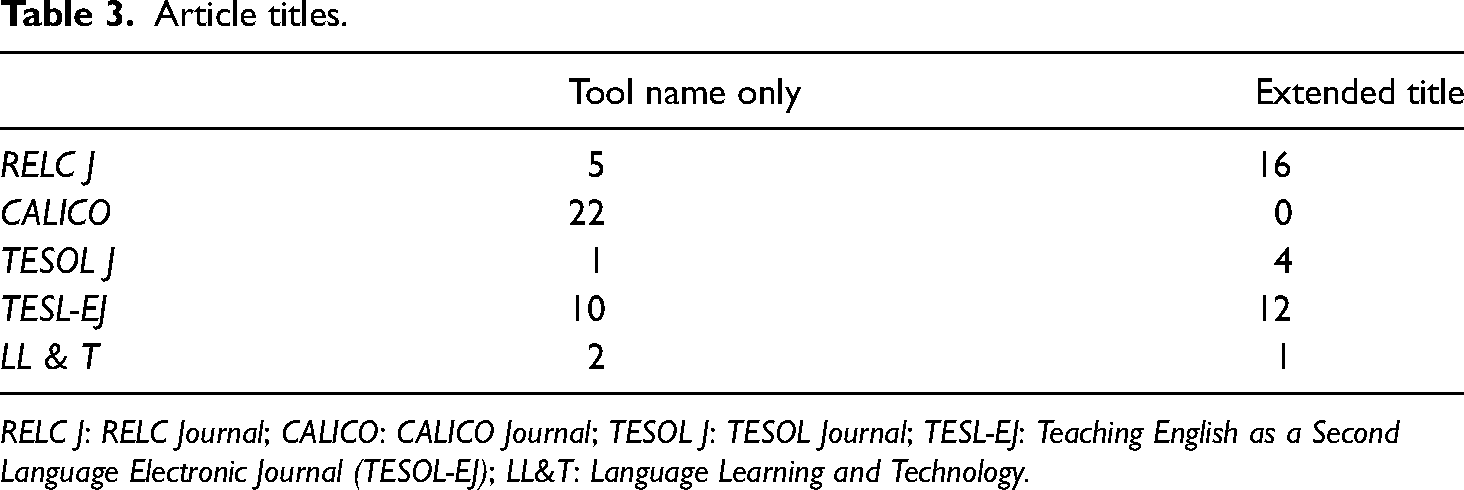
RELC J: RELC Journal; CALICO: CALICO Journal; TESOL J: TESOL Journal; TESL-EJ: Teaching English as a Second Language Electronic Journal (TESOL-EJ); LL&T: Language Learning and Technology.
Thematic Review
Aim 1: Identify and Present Key Information in the Technology Reviews Published in Language Learning and Teaching Journals
To address the first aim, we identified and collated key information about the selected technology reviews, including the types of technology reviewed and details pertaining to educational level and language proficiency suitability, language compatibility, language skills addressed and other salient features.
Types of Technology Reviewed
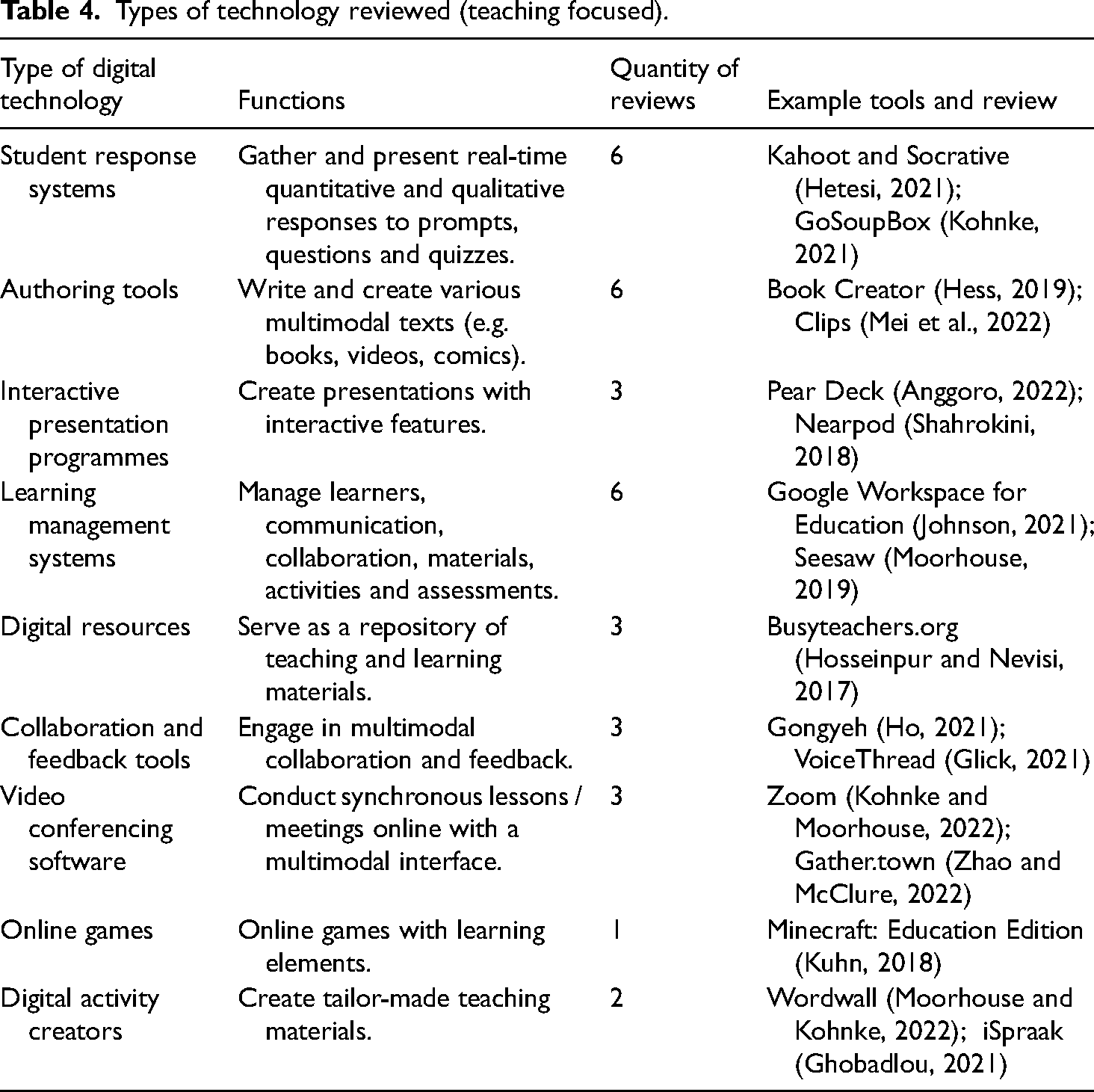
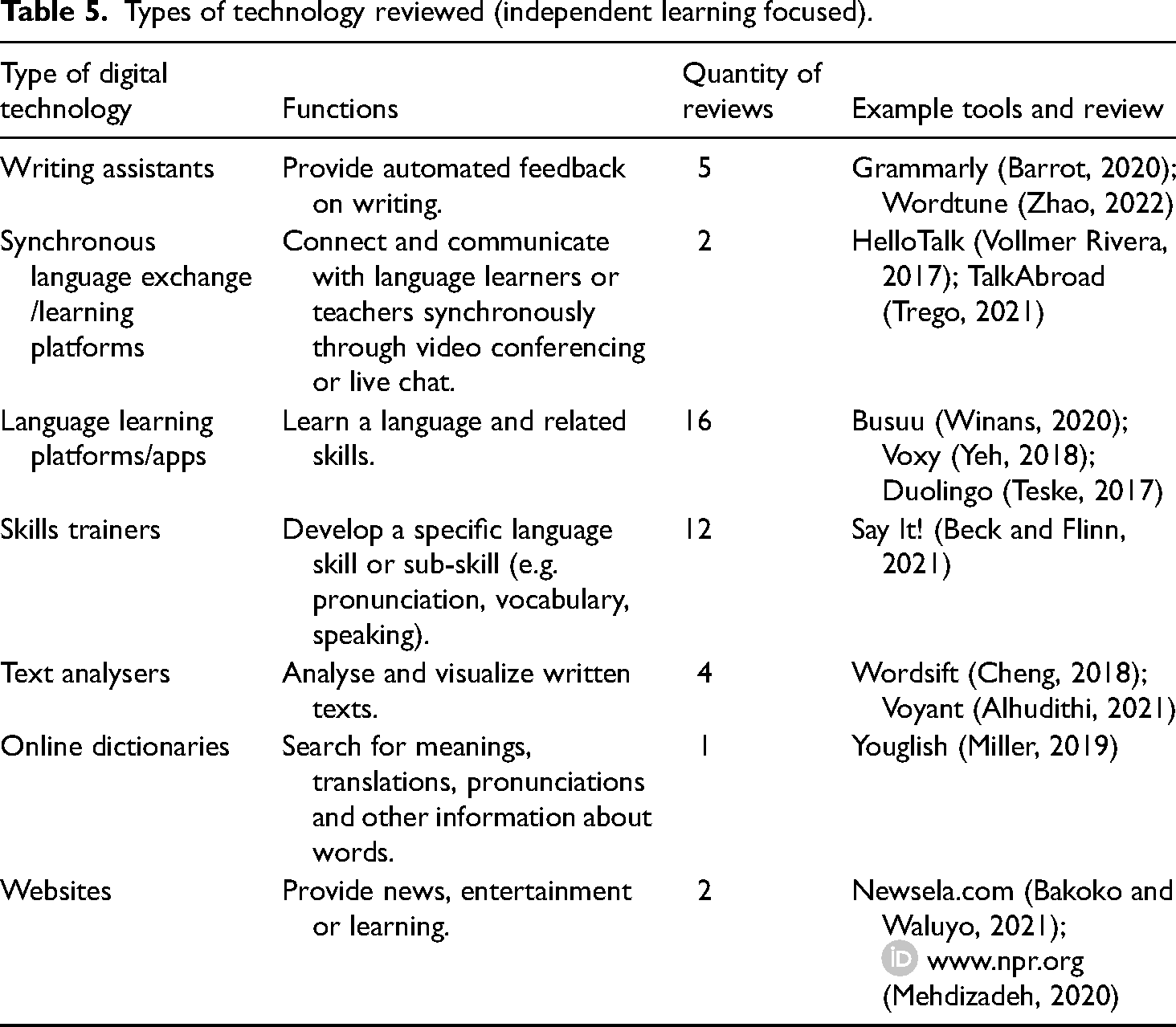
When conducting the review, we noticed that the digital technologies could be divided into teaching-focused technologies and independent-learning-focused technologies based on their purpose, features and functionality. Generally, the teaching-focused technologies (e.g. student response systems) were designed for general education purposes but could be applied in the language classroom. In contrast, the independent-learning-focused technologies (e.g. writing assistants or language learning platforms/apps) were primarily designed for language-learning purposes. Importantly the distinction between these two forms of technology is not fixed. Some independent-learning-focused technologies (e.g. online dictionaries) can be used by teachers to supplement or extend language learning. In addition, learners can use various teaching-focused technologies (e.g. digital activity creators) to support independent learning.
Once we divided the technologies, we further categorized them into types by looking more closely at the specific purposes, features and functionalities mentioned in the reviews (Table 4 presents the teacher-focused technologies and Table 5 presents the independent-learning-focused technologies). For example, Pear Deck and Nearpod were both reported as tools that can be used to create presentations that include various interactive elements, such as quizzes, drawing boards, and polls (Anggoro, 2022; Shahrokini, 2018). Therefore, we categorised them as interactive presentation programmes. The categories are not rigid. Indeed, many of the tools have multiple functions and can be used for various teaching and learning tasks. However, they help provide a broad overview of the technology in the reviews.
Types of technology reviewed (teaching focused).
Types of technology reviewed (independent learning focused).
In addition, while most reviews focused on one form of digital technology, two articles in TESL-EJ offered a comparison of tools with similar functionality (e.g. Storyjumper, Book Creator and Storybird: Ezeh, 2020). Furthermore, some reviews analysed a specific feature of a digital tool. For example, Winans (2021) analysed the ‘tone detector’ function of Grammarly to critique its use in helping students write pragmatically appropriate texts.
Educational Level and Language Proficiency
The majority of the reviews (n=62) did not indicate the educational levels for which the technology is suitable. Of the 11 reviews that included information or suggestions on suitable age groups, most of them indicated that they were suitable for all learners or that they were suitable for either younger or adult learners who have different needs. Given that there has been a growth in digital tools for younger learners who have different needs from older learners, it is understandable that the reviews included this information. Similarly, most of the reviews (n=43) did not indicate the tool's suitability for learners of different proficiency levels. In the articles that addressed suitability in terms of language proficiency, terms such as beginner, intermediate and advanced were used. Most articles (n=18) stated that the tool was suitable for all language proficiency levels.
Languages
The reviews that analysed teaching-focused digital technologies rarely mentioned the specific languages the tools are suitable for. If they did mention language suitability, they typically stated that the tool was suitable for any language (depending on the user-interface languages). Most of these tools are versatile and allow input in multiple languages and scripts. The reviews focused on tools developed for independent learning were more likely to include target language(s). The majority of these tools focused on developing users’ English proficiency, or supported language acquisition in multiple languages. A few articles focused on other specific languages, such as Swahili (Mose, 2017) or Chinese (Chen, 2017). It is important to note that TESL-EJ and TESOL Journal explicitly focus on publishing articles exploring the teaching of English as a foreign/second language, while the other journals accept articles about the teaching and learning of any language.
Language Skills
Regarding language skills (reading, writing, speaking, listening) and sub-skills (vocabulary, grammar, pronunciation, spelling, translating), we observed an important distinction between tools that were designed to support the development of specific skills (e.g. Say It!) and those that were developed for general education purposes (e.g. Seesaw). In the former case, the link between the tool and skills was clearly stated, as in the following passage: One tool created to support pronunciation training is Say It: English Pronunciation Made Easy, an informative app which aims to improve the pronunciation, speaking, and listening skills of English language learners at all levels (Beck and Flinn, 2021: 1).
For reviews of tools developed for general education or other purposes, some authors provided pedagogical suggestions for how the tools could be used to develop specific or multiple skills. For example: Kahoot!'s advantages in the language classroom extend beyond motivation. Many of the activities teachers use to introduce, revise and assess grammar, vocabulary, phonology and functional knowledge can be adapted to the Kahoot! platform. For example, teachers can design odd-one-out, fill-in-the-gap, matching (e.g., images to words, oral to written, synonyms and antonyms), spelling and correction activities (Kohnke and Moorhouse, 2021: 3).
However, not all the reviews mentioned language skills. Some highlighted the potential of the technology to help teachers to elicit responses, increase interaction and engagement, motivate learners, aid in formative assessment practices and improve remote teaching.
Other Useful Information
As part of our review, we also identified other useful information, including subscription prices, supporting materials (screenshots/hyperlinks), compatible platforms and the number of references cited in each review. Fifty-seven articles mentioned subscription prices (including the availability of free versions), while the remaining articles did not. Sixty-two contained screenshots showing various technological features or pedagogical uses of the tools, and 15 included links to the tool's website. All the reviews mentioned compatibility, with most of the tools being web-based. All but two of the reviews included references to literature to support the analysis of the tools. The median number of references was 8, with a range of 0 to 20.
Aim 2: Explore the Aspects of PDC Addressed in Technology Reviews
To address the second aim, we coded and extracted content from the articles pertaining to the features, reported benefits and limitations, and suggested teaching and learning activities and social considerations. We then evaluated the depth and breadth of the content based on the three aspects of PDC.
Technological Proficiency
Nearly all the articles included key information about the technological functions and features and dedicated significant article space to this. This included the technology's compatibility with various operating systems, as well as its primary functions and sub-functions that help people achieve personal or professional tasks. For instance, in their review of Gather.Town, Zhao and McClure (2022) describe its primary function: Gather.Town is a proximity-based video-conferencing (VC) platform that combines 2D game-like features with VC functionality …. By using an avatar in a 2D map, users can interact with each other through built-in games, multimedia materials (e.g., video recording, whiteboards) and proximity-based VC (i.e., VC features triggered by close-proximity between avatars), as well as sharing documents and direct messaging, all within an informal environment. (2)
Often, the differences between free versions and paid subscription versions of the tools were discussed, as well as whether the reviewers reviewed the paid or free version of the technology. This is important because the features of paid and free software can be significantly different. Some reviews included step-by-step instructions on how to use the technology for various functions, supported with screenshots of its various features. For example, Miller's (2019) review of YouGlish included a detailed procedure, with screenshots of the platform interface: On the front page of YouGlish, a search bar is located at the top. Users type the word or phrase they wish to hear and can then select whether to hear video pronunciation samples in American, British, or Australian English accents. (2)
As well as describing the features of the digital technologies, many of the reviewers also evaluated them. Typically, the reviews commented on connectivity, user-friendliness, ease of navigation, reliability, stability, the attractiveness of the interface and layout, functionality and technological support. The evaluations focused on benefits and limitations pertaining to these areas. For example, in Zhang's (2022) review of Mentimeter, the author commented on its limitations in context with few technological resources: From a technological perspective, students can only contribute to Mentimeter if they have a WiFi-connected device. At times the internet connection in numerous regions is relatively slow, especially when loading the mobile Mentimeter App. Teachers may need to consider whether all their students have access to a device that allows them to join in the Mentimeter presentation. This might not be the case in a significant number of classrooms around the world. In contexts with low digital literacy and access to technology, it can be challenging to follow the on-screen instructions so as to submit a response. Finally, the free version of Mentimeter is constricted to two questions and five quiz slides. (7)
The significant attention given to the technological aspects of the tools can help increase the technological proficiency of practitioners. By reading the reviews, they can become familiar with a digital tool and consider whether it is suitable for their educational goals and context. For example, they may be looking for a tool that can help them with a specific task, such as collecting student responses, so technical details may help them find a suitable tool. In addition, details about the tools’ limitations, such as the need for a Wi-Fi connection, can help them understand whether the tool is suitable for their teaching context.
Pedagogical Compatibility
The reviews provided various degrees of information about the pedagogical utility of the technology for language learning and teaching (no mention 3; limited 23; some 40; extensive 7). The reviews that included some or an extensive number of pedagogical suggestions focused on the kinds of activities teachers could use in the classroom, or in which learners could engage independently. For example, in his review of Kaizena, a tool that provides written feedback on writing, Pearson (2021) described how it could be used in a specific setting and the pedagogical benefits of its use: In learning-to-write settings involving syntactically and semantically complex content-focused written feedback (e.g., academic writing, English for specific purposes), teachers can draw on the app's multimodal feedback capabilities. Textual comments and replies allow the teacher and learner to co-construct a joint feedback dialogue, promoting greater interaction, clarification, and negotiation that may better facilitate learner understanding of the teacher's intended meaning or identification of a suitable revision strategy. (3)
Similarly, Hu et al.'s (2022) review of Wordsift provided suggestions on how teachers can use it at various stages of reading instruction: pre-reading, during reading, and post-reading. The authors provided an evidence-based rationale and screenshots to support their suggestions. Glick's (2021) review provided three examples of tasks teachers can implement using VoiceThread, with screenshots to illustrate each task. Reviews written during or after the COVID-19 pandemic (e.g. Mei et al., 2022), suggested how the reviewed tools can be used either for in-person or remote teaching and learning.
About half (n=38) of the articles mentioned language learning and/or educational theories that they believed underpinned the design or potential use of the technology. These theories included audiolingualism (Burston, 2017), game-based learning (Hetesi, 2021), comprehensible input (Nicklas, 2017), communicative competence (Obaid, 2019) and the conditions for vocabulary learning (Moorhouse and Kohnke, 2022). In Hetesi's (2021) comparison of Kahoot! and Socrative, the author used the 13 characteristics of game-based learning proposed by Flores (2015) to evaluate and compare their usefulness for language teaching and learning.
Given the nature of technology reviews, it seems important to dedicate a substantial part of them to potential pedagogical uses. As language teachers work in contexts with a wide range of technological resources and have learners with different characteristics, awareness of how a tool can be used for teaching can help them decide if it will be beneficial to them and their learners. This may also give them more confidence to try the tool, as they will have clear suggestions of how to use it. Similarly, providing a theoretical rationale for pedagogical suggestions can help teachers justify their use of a specific digital technology.
Social Awareness
Very few articles paid attention to the social aspects of technology. Only 16 articles mentioned important aspects that could aid in developing the social awareness aspect of PDC. These aspects included privacy, security, fatigue, safety, revenue models (including commercial advertisements, surveillance), copyright and plagiarism. In Kohnke and Moorhouse's (2022) review of Zoom, the authors highlighted the privacy and security risks associated with the platform; specifically, the phenomenon of ‘Zoombombing’, and recommended steps teachers can take to address the issue. In Shahronkini's (2018) review of Nearpod, the author mentioned that the platform is void of advertisements and ‘commercial redirections’, which creates a ‘safe environment for users’. Johnson's (2021) review of Google Workspace for Education (GWE) provided a long critique of Google's revenue model and explicitly warned educators to consider the risks to student and teacher privacy before using it. The author stated with supporting evidence that [a] possible critique of GWE, especially when students are compelled to use Google's tools as part of their learning environment, is the presence of Google's revenue model, data mining and targeted advertising… . If educators choose to use GWE in their classrooms, they must be aware of the possible risks. It is up to the educator, and possibly students, to weigh the cost and determine for themselves if it is worth it. (2)
The funding models of commercially produced digital technologies are important to teachers; they need to be aware of the risks to which they might be exposing students. Some tools, particularly learning management systems, have public and private sharing options. Teachers and learners need to be aware of the privacy risks if they share information or work publicly.
Another complex issue pertaining to social awareness is the variety of cultures and languages. For example, in Winans’ (2020) review of Busuu, the author mentioned that the English version of the tool only provides practice and feedback in British English. The author argued that this could ‘mislead’ users of the service, as it does not represent the ‘diverse language environment that exists online’ (Winans, 2020: 123) and in the world.
For practitioners to gain a holistic understanding of the digital technologies available, it is important to pay attention to their social awareness. Teachers or learners could potentially experience harm if they unwittingly use a tool in a certain way or the tool promotes certain views of culture and language.
Conclusion and Recommendations
This systematic review has identified and presented key information from technology reviews published in selected language teaching and learning journals over the past five years and explored the aspects of PDC they addressed. We found that the technology reviews mainly introduced the technological features and functions of the reviewed technologies with less emphasis placed on their pedagogical utilities and social aspects of their use for language teaching. Based on our experience conducting the review and our findings, we will propose recommendations for authors and journal editors, as well as advice for practitioners to benefit from technology reviews.
Recommendations for Authors
Authors need to remember that the primary audience of technology reviews consists of teachers, teacher educators and professional development providers. They are likely to read a review that they feel will help them enhance or transform their teaching practices. Of course, the use of technology for teaching is complex and the success (or failure) of technological innovations depends on various factors (Li, 2017). However, for practitioners to find a review relevant and useful, it must help them develop at least one aspect of PDC. Therefore, the following considerations are proposed:
Prioritize the pedagogical utility of the technology. The technological features will change constantly, and can likely be found on the tool's website. However, the utility of the tool for language learning and teaching is likely to be of greater use to practitioners. Suggestions for teachers in different contexts, using various modes and with learners of different ages and proficiency levels, are recommended. Support reviews with relevant computer-assisted language learning (CALL) theories, second language acquisition (SLA) theories and educational theories. Teachers should understand the rationale for using a specific tool in a particular way. Include information that is likely to be ‘timeless’ – for example, subscription charges change frequently and may differ in different countries, so including them in a review may not be useful. A link to the tool's website is sufficient. Make practitioners aware of the potential security and associated risks associated with using technology in the classroom (Torres-Hernández and Gallego-Arrufat, 2022). Include a critical analysis of the risks and any potential cultural assumptions inherent in a specific technology (e.g. Johnson, 2021). Analyse the pedagogical usefulness or specific functions of a tool – see, for example, the review of Grammerly's tone detector by Winans (2021) – as digital technologies have become more complex and multifunctional. Include screenshots of the technology being used. These can help practitioners visualize the functions and features of the technology. Consider writing comparisons of tools with similar features and functions – see, for example, the review of Storybird, Book Creator and Storyjumper by Ezeh (2020). Different digital tools can have similar features and functions. Authors can consider the benefits and limitations of different tools in different contexts. Similarly, reviews of new technologies can include comparisons with features and utilities of technologies that have previous been reviewed or tools readers might already be familiar with.
Recommendations for Journal Editors
We are very grateful to journal editors for providing space for technological reviews within their journals. They serve an important function in raising practitioners’ awareness of new and emerging technologies and their potential applications in language teaching. Based on our experience, this can increase the likelihood that these technologies will actually be used in practice. Furthermore, the short and structured genre of the technology review provides new and early career practitioners and scholars an opportunity to contribute to academic journals (Kohnke and Moorhouse, 2021). However, we have identified some recommendations for journal editors to increase the value of technology reviews to the profession:
Create a directory of technology reviews on journal websites. This would provide easy access for practitioners to locate technology reviews across different issues. Provide more explicit instructions to authors on the purpose and content of technology reviews. Our review found that authors dedicate much of the reviews to describing the technical functions of the digital technology, rather than critically analysing its use for language learning and teaching. We believe a reorientation towards pedagogical compatibility and social awareness would make the reviews more useful. Standardize titles and publication details. Some journals have different requirements for titles and publication details. For example, the title may be just the name of the digital tool or a longer title, giving some details of its functionality. Similarly, some articles have abstracts and keywords and others do not. We feel that a longer, more detailed title or sub-title is useful to readers. In addition, keywords can help practitioners find the review more easily, while abstracts can provide a snapshot of the article, which is useful for busy teachers, who may not have time to read every review in detail.
Finally, given that the primary audience of technology reviews is frontline practitioners, editors and publishers of paid subscription journals could consider making technology review articles open-access. This would increase their accessibility and help maximize the benefits of the knowledge presented in the reviews to the field.
Advice for Practitioners
Finally, we turn our attention to the intended reader of technology reviews: language teaching practitioners. We believe that practitioners can benefit from technology reviews. In addition to raising their awareness of the existence of specific digital tools, they can also gain useful pedagogical suggestions regarding how to use the technology in their language lessons. However, it is important for practitioners to be mindful of the fact that technology reviews are written at a specific point in time. As technology is constantly changing (Hockly and Dudeney, 2018; Kessler, 2018), the technological features and functions may be different from those described in the review. Similarly, platform compatibility and subscription prices can change. Teachers can supplement reviews with information on digital tool websites, YouTube tutorials, and posts on teaching forums and blogs.
Furthermore, practitioners still need to consider how the technology can be used in their own contexts. We suggest that when practitioners find a digital technology they are interested in using, they engage in teacher research, such as action research, reflective practice or lesson study. This will allow them to investigate the implementation of the technology in their own practice (for suggestions on how teachers can research their own teaching and learning context, see England, 2018).
Final Thoughts
The authors of this systematic review found it a fruitful and rewarding experience. We were surprised to find so many different and unique digital technologies that are useful in language teaching and learning. We plan to use some of them in our teaching. As we enter the post-pandemic digital age, ready access to expert advice on the use of various digital tools for language teaching and learning is essential. We believe technology reviews have a role to play in developing teachers’ PDC during this new and exciting educational revolution.
Supplemental Material
sj-docx-1-rel-10.1177_00336882221150810 - Supplemental material for A Systematic Review of Technology Reviews in Language Teaching and Learning Journals
Supplemental material, sj-docx-1-rel-10.1177_00336882221150810 for A Systematic Review of Technology Reviews in Language Teaching and Learning Journals by Benjamin Luke Moorhouse, Lucas Kohnke and Yuwei Wan in RELC Journal
Footnotes
Funding
The author(s) disclosed receipt of the following financial support for the research, authorship and/or publication of this article: This work was supported by the Early Career Scheme 2021/2022 of the University Grants Committee, Hong Kong SAR (Grant Ref No: 22612121).

Supplemental Material
Supplemental material for this article is available online.
References
Supplementary Material
Please find the following supplemental material available below.
For Open Access articles published under a Creative Commons License, all supplemental material carries the same license as the article it is associated with.
For non-Open Access articles published, all supplemental material carries a non-exclusive license, and permission requests for re-use of supplemental material or any part of supplemental material shall be sent directly to the copyright owner as specified in the copyright notice associated with the article.
