




Abstract
Artificial intelligence (AI) technologies have contributed significantly to the advancement of society. In recent years, AI-powered writing assistants have received increasing attention among English as a Foreign Language (EFL) communities. However, most of these digital writing tools focus on the revision and editing stages. Few digital tools are developed to help users during the writing process, such as assisting users in formulating or translating their ideas into writing. Wordtune is an AI-powered writing assistant that understands the writer’s ideas and suggests options for rewriting them using different tones (e.g. casual, formal) and lengths (e.g. shorten, expand). This tool can help EFL writers maintain a continuous flow and learn useful ways to express their ideas in written English. This tech review aims to provide an overview of Wordtune and its affordance in English writing for EFL writers, while also addressing the benefits and limitations of this technology.
Keywords
Introduction
English writing can be a challenging process for English as a Foreign Language (EFL) writers, who often face language barriers. Research suggests that digital writing tools can positively impact the quality of English writing (Nobles and Paganucci, 2015). With the recent advancement of artificial intelligence (AI) technologies in education, AI-powered writing tools have emerged to support users in their English writing processes (Barrot, 2020; Coenen et al., 2021) and enhance L2 users’ writing skills while facilitating their self-directed learning (Pokrivcakova, 2019; Nazari et al., 2021). However, most writing tools focus on the revision and editing stage (e.g. providing grammar corrections and similarity reports) (Winans, 2021). Fewer technologies are developed to assist writers in the writing process. Wordtune is an AI-powered technology that helps users during the writing process by understanding what they wish to say and helping them to formulate their ideas into sentences through offering rephrase options (https://www.wordtune.com). This tech review provides an overview of Wordtune, its affordance for EFL writers, as well as its benefits and limitations.
Overview
Wordtune is an AI-powered digital writing assistant that provides rewrite options on highlighted text by altering the sentence structure or replacing words with synonyms while retaining the original meaning. This technology utilises machine learning techniques (Natural Language Processing) that train the machine to understand and generate natural text based on large datasets of written material. Supported by AI technology, Wordtune recognises patterns learned from a large dataset to provide options for rewriting one's original sentences rather than taking content from other online sources.
Wordtune can be accessed online as a web browser extension (Chrome Webstore and Edge addon) or directly through its own web-based editor. As a browser extension, the program is compatible with a wide range of online apps, such as Gmail, Google Docs, Facebook, Twitter, LinkedIn, WhatsApp (web version), Slack and more. Once added as a web browser, users can open any compatible web-based application for writing (e.g. Google Docs, Gmail). A purple circle with the letter ‘W’ will appear above the highlighted text. Users can click on this icon to view a list of rewrite options for the selected text. Wordtune provides a wide range of features for rewriting, including a basic rewrite, casual tone, formal tone, shortened text and expanded text (Figure 1).
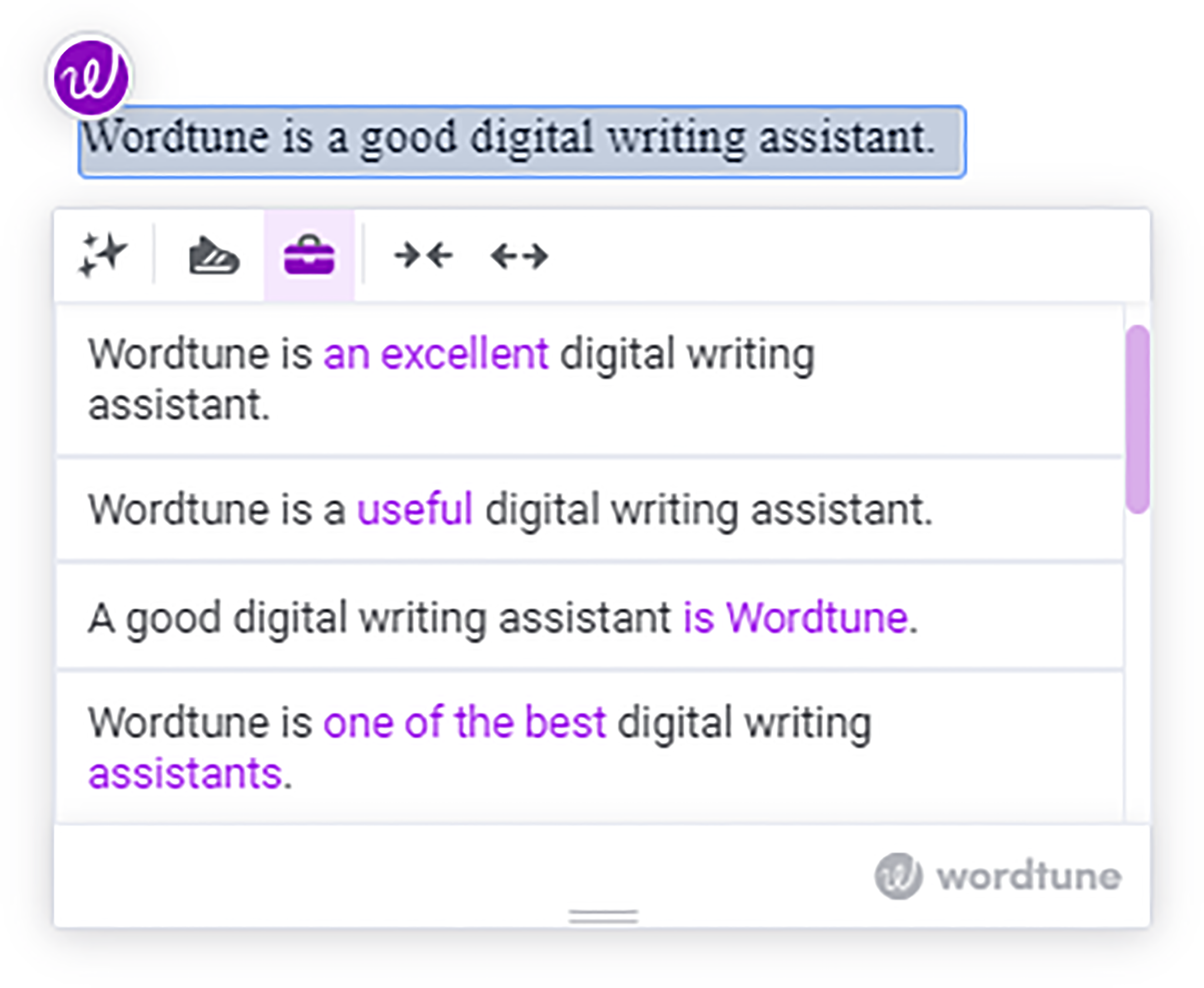
An example of a rewrite suggestion via Wordtune (formal tone).
Wordtune is currently only available for English writing; however, the program can translate text from other languages into English. This translation function is particularly useful for EFL writers who write a sentence or part of a sentence in another language and then select the text to receive rephrasing options in English (Figure 2). Currently, the translation feature supports Spanish, Mandarin, Arabic, Hindi, Korean, Hebrew and Russian.
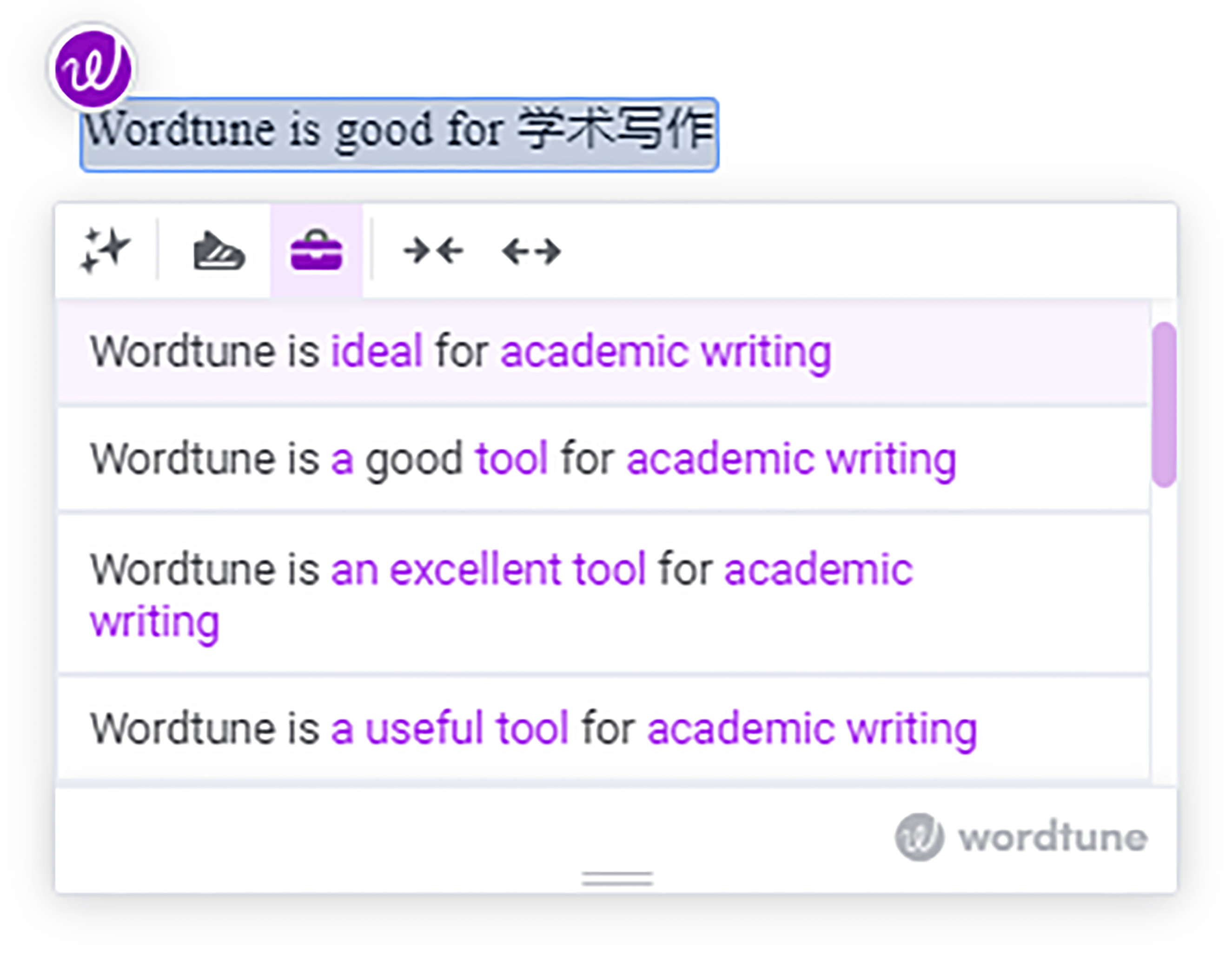
An example of the translation feature of Wordtune.
There are three plans for users to choose from (Figure 3). The Free version allows users to view basic rewrite options for a maximum of 20 sentences per day. The Premium version for individual account holders provides full rewrite features (e.g. casual tone, formal tone) and offers rewrites on an unlimited number of sentences. This version also offers premium support. Finally, the Premium for Teams version allows for team billing in groups of more than five users. Wordtune offers an educational discount (40%) on the premium versions (on both the annual and monthly plans) for students or educators enrolled at an academic institution. Users who wish to apply for an educational discount can contact Wordtune directly (discounts@wordtune.com). This tech review is based on the author's experience using both the free and premium versions.

Wordtune subscription plans.
Affordance for English Writing
Wordtune offers real-time rewrite options that help users make cognitive connections between their thinking and writing processes. For EFL writers, in particular, consciousness of input at the level of noticing is a prerequisite for the acquisition of a second language (Schmidt, 1990). Rewrites provide writers with opportunities to notice dissonance in their writing and, thus, create meaning and learn through revisions (Sommers, 1980). As Barrot (2020) suggests, by noticing dissonance between their own writing and the more effective rewrite options, EFL writers can build their interlanguage system and enhance their English writing proficiency through self-directed learning.
Wordtune is suitable for users with varying levels of English proficiency. For example, the translation feature is particularly beneficial for English beginners who face language barriers. These users can even write an English sentence that consists of some phrases from their native language, and then use Wordtune to generate rewrite or paraphrase options in English based on their sentence. The technology will assist them to maintain a continuous flow of English writing rather than getting stuck on one particular phrase or expression. For intermediate and advanced EFL writers seeking to write on a more sophisticated level, the AI-powered rewrite options can help users enhance their English writing by offering appropriate synonyms, removing incorrect words and adopting a preferred writing tone (Fitria, 2021). Users can also use the shortening or lengthening function to make their writing more concise or generate more ideas.
Wordtune offers self-directed learning opportunities for EFL writers, but can also be useful from a pedagogical perspective. For example, teachers could set up online writing activities and encourage students to use Wordtune during the writing process. Teachers could also ask students to reflect on what they have learnt through engaging with the rewrites, such as new vocabulary, synonyms, clauses and formal sentence structures that they would otherwise not have been able to use in their writing.
Conclusion and Limitations
Wordtune is an AI-powered writing assistant that helps users throughout the writing process by offering rewrite or paraphrase options on their original text. This tool can help EFL writers formulate or translate ideas into English and improve the quality of their writing. It can also motivate users throughout the writing process and prevent them from getting stuck on difficult words or expressions in English. Wordtune is a promising application for EFL writers who are interested in improving their English writing. However, it is not without its limitations. Currently, the tool can only be used when a user is connected to the internet. Furthermore, if the selected original text is too complicated, the rewrite options may be less accurate. On a list of rewrite options, the top choices are often more accurate than those on the bottom.
Footnotes
Declaration of conflicting interests
The author(s) declared no potential conflicts of interest with respect to the research, authorship, and/or publication of this article.
Funding
The author(s) received no financial support for the research, authorship, and/or publication of this article.
