




Abstract
As student creativity is increasingly emphasized in English as a Foreign Language education, it is necessary to consider instructional techniques to encourage it. This study examines the effectiveness of two instructional techniques on creative writing performance of English as a Foreign Language students in a South Korean university. These techniques are variations of brainstorming known as mind mapping and SCAMPER. Survey data from the participants (n = 39) were analysed to determine which technique resulted in higher levels of perceived creative output (essays). Additionally, a creativity rubric was developed and used to assign analytic scores to the essays to examine the relative benefits of the two techniques for high and low creative ability students. Results show that SCAMPER produced statistically significantly higher levels of perceived creative output. The essays written using SCAMPER generally received higher creativity scores than those written using mind mapping, though this difference was not statistically significant. Finally, results suggest that both techniques may help to narrow the performance gap between high and low creative ability students.
Introduction
In a rapidly changing world, creative thinking is seen as an important life skill (Lucas and Spencer, 2017). In South Korea, there is a growing emphasis on teaching students to be creative in all subject areas, including English as a Foreign Language (EFL) in public and higher educational settings (Choe et al., 2012). The South Korean Ministry of Education has indicated that creative education is a powerful way of engaging learners (Shin, 2018). This perspective aligns with the argument made by Richards (2013) that activities designed for developing creativity increase levels of student motivation and self-esteem. Meanwhile, some language education commentators claim that learning and using language is an inherently creative process (Thornbury, 2017), and that playful, creative language practice encourages learners to attend to both the form and meaning of language (Cho and Kim, 2018).
Although creativity has become a core competency for South Korean university students, research has demonstrated that university classes often do not encourage students’ creativity (Kim et al., 2009). The reasons for this include lecture-based classes, relative evaluation systems and the lack of creativity-related subjects and teacher training (Choe et al., 2012). Research has also noted that English instructors in South Korea can experience difficulty when trying to teach in a creative way (Shin, 2018), and that classroom language teaching and learning in South Korea continue to focus more on accuracy than creativity (Cho and Kim, 2018; Kang, 2012). This may be due to a lack of awareness of how to integrate creativity development into language classes (Kang, 2012).
Like creativity, an insufficient amount of time is spent on writing practice in EFL education. Although writing is considered a relatively difficult language skill, more lesson hours are usually spent on listening and reading, which leads to deficiencies in student writing (Han, 2020). To address this imbalance, the present study examines EFL instructional techniques to promote student creativity in writing. Research into the effectiveness of techniques in EFL classes is sparse; therefore, the overarching purpose of this research is to explore the potential of instructional guidance to support creative expression in EFL writing within a South Korean university setting.
Literature Review
Definitions of Creativity
The definition of creativity varies from context to context (Parkhurst, 1999). It has been described as the ability to: (a) solve problems in original, valuable ways relevant to goals; (b) see new meanings and establish new connections between things; (c) have original and imaginative thoughts and ideas; and (d) use imagination and experience to create new learning possibilities (Fisher, 2004). These abilities are framed primarily in terms of verbal creativity indicators: fluency, flexibility, originality and elaboration (Munandar, 2009). These indicators are reflected in the criteria of the often-used Torrance Tests of Creative Thinking (TTCT; an extension of the Guilford divergent thinking tests (Torrance, 1974)). Though research on EFL students’ writing creativity is scant, that which has been done has tended to use these verbal indicators to assess creativity (Ghufron and Ermawati, 2018).
While all individuals can be creative, researchers contend that the degree of creativity a person shows depends on flexibility of thought (Kenett et al., 2018) – the ability to break away from fixed notions. This corresponds to the second of Guilford’s (1959) two modes of thinking: convergent and divergent. Convergent thinking is the process of logically analysing an existing idea or problem to converge on an understanding of it, while divergent thinking is the flexible process of generating new ideas and responses to problems (Goldstein, 2001). Moreover, Torrance (1966) suggests that flexibility is the ability to provide responses to a given problem that fall into various categories.
Creativity can also be thought of as a property of products. As Stein (1953) suggests, ‘[t]he creative work is a novel work that is accepted as tenable or useful or satisfying by a group in some point in time’ (311). This definition has been widely employed by creativity researchers (Weisberg, 2015). However, the assessment criteria for creative products have varied (Parkhurst, 1999), generally centring on two criteria: novelty and appropriateness. A product’s novelty can be judged in terms of its originality (Corazza, 2016) or uniqueness, meaning the relative infrequency of its conceptualization (Silvia et al., 2009). Meanwhile, a product’s appropriateness can be judged in terms of its effectiveness as a solution to a problem (Corazza, 2016), or its social value (Csikszentmihalyi, 1999). Other definitional criteria include surprise or non-obviousness (Simonton, 2012). Given this definitional diversity, it is reasonable for researchers to select the most contextually suitable criteria to assess creative products.
Promoting Creativity Through Instructional Guidance in EFL Writing
Creativity has been found to have an influence on the quality of writing performance. In the EFL context, creative output in writing goes beyond producing novel and appropriate thoughts, as it has also been linked to writing achievement in general (Jaelani, 2017), and writing complexity, accuracy and fluency specifically (Nosratinia and Razavi, 2016). This is because creativity encourages more active participation and greater focus on producing more elaborate and meaningful written ideas (Jaelani, 2017), which is particularly important in an EFL context due to the added difficulty of competently and comprehensively producing text in one’s second language (Nosratinia and Razavi, 2016). Although research links creativity to better writing performance, being creative while negotiating meaning in a foreign language can be quite challenging (Jaelani, 2017). Because of this, there is a need for more instructional support to enhance creativity, as EFL writing students have identified insufficient instructional support as a contributing factor leading to a lack of creativity in their writing (Rababah et al., 2018). Therefore, instructors must consider ways of providing instructional support to promote creativity in EFL writing courses.
Research shows that guiding EFL students through a series of steps involving questions and answers, image and text prompts, and brainstorming cues leads to higher levels of writing performance and creativity (Marashi and Dadari, 2012). Additionally, when using guided brainstorming techniques that prompt learners to make connections, EFL students demonstrate more creative thinking and create more syntactically complex essays (Seidinejad and Nafissi, 2018). While these studies offer a rare glimpse of the effect of guided instruction on EFL learners’ creativity in writing classes, their results are based on post-test measurements of individual creativity, rather than creativity as a product of a specific writing task.
Nevertheless, research suggests that greater instructional guidance leads to more creative output in general. For example, students produce more creative solutions if problems are ‘decomposed’ into manageable steps (Santanen et al., 2000). Also, procedural steps that introduce stimuli (objects, images, concepts, analogies, etc.) unrelated to the original problem encourage production of more creative solutions (Hender et al., 2001). Furthermore, instructionally guided questions and prompts encourage connections between ideas (Hathcock et al., 2015; Hender et al., 2001) leading to more flexible thinking (Torrance, 1974) and more unique ideas. In addition to higher levels of creativity, instructional guidance has been shown to narrow the creativity gap between high and low creative ability learners. Wahyudi et al. (2019) examined a group of students with varying creativity levels based on their ability to show flexibility, fluency, novelty and elaboration. They found that when presenting students with instructional scaffolds designed to produce multiple solutions, not only were higher creativity levels produced overall, but the gap between low creativity ability learners and high creative ability learners was reduced. The principles behind instructional guidance may also apply to EFL writing tasks; however, the lack of empirical evidence leaves open the question of whether additional levels of instructional guidance allow for the generation of novel and unique ideas in writing as well.
Brainstorming Activities: Mind Mapping and SCAMPER
Brainstorming is thought to promote creativity due to the volume of new ideas generated (Demir, 2005). One widely used brainstorming technique is mind mapping, in which learners branch out from a central idea, make connections between isolated ideas and ultimately produce novel ideas (Budd, 2004). This activity facilitates creativity by permitting an unlimited number of solutions associated with various connections across multiple layers within the mind map (Georgiou, 1994).
Another technique, SCAMPER, involves directing participants to improve an object or solve a problem by subjecting it to the following operations: Substitute, Combine, Adapt, Modify/magnify/minify, Put to other use, Eliminate/elaborate and Reverse/rearrange (Eberle, 1996; Elmansy, 2015; Glenn, 1997). Developed by an educational administrator named Robert Eberle as an imagination game for teachers to use with young students, SCAMPER is a spatial framework based on Osborn’s concept generation checklist (Eberle, 1996), related to Gardener’s (2011) notion of visual/spatial intelligence and Fanselow’s (2010) imperative to ‘try the opposite’ when exploring solutions to problems. In classrooms, as a creative thinking process activity, SCAMPER may involve prompting students to answer questions designed to encourage the manipulation of mental images of objects or problems (Glenn, 1997). For example, students might be asked: ‘What part of this object/situation can be replaced with better alternatives?’ (Elmansy, 2015). Research has demonstrated the effectiveness of SCAMPER for supporting idea generation and problem-solving in various educational contexts (Buser et al., 2011; Chulvi et al., 2013). When compared to brainstorming with less procedural guidance in a non-educational context, SCAMPER was shown to encourage generation of less novel but more useful ideas (Chulvi, et al., 2013). This may be because SCAMPER provides a ‘starting point’ with a ‘clear goal and focus’ (Buser et al., 2011: 265), and so supports convergent as well as divergent thinking. This suggests SCAMPER may be useful for supporting student creativity, which requires both modes of thinking (Chulvi et al., 2013).
Although both techniques are commonly understood to guide learners toward creative idea generation (Seidinejad and Nafissi, 2018), there is some justification for the claim that SCAMPER contains higher levels of instructional guidance. While mind mapping provides a structure to direct creative thinking, it contains a limited amount of procedural guidance, as the learners are left on their own to build on their ideas after they are directed to create the mind map. In comparison, SCAMPER includes additional procedural guidance in the form of specific directions designed to guide learners to creative ideas and solutions (Ang and Yuen, 2016). The seven steps of SCAMPER act as instructional cues that allow learners to connect ideas creatively in ways they would not have done otherwise (Ang and Yuen, 2016). Ang and Yuen (2016) support this contention/claim by comparing the differences between mind mapping and SCAMPER through a series of qualitative interviews with university students who used both techniques. Results showed that compared to mind mapping, the participants viewed SCAMPER as more instructionally supportive, noting that SCAMPER guided them to a clearer design path through the seven additional instructional cues that directed them toward divergent thinking.
Method
Because both mind mapping and SCAMPER are brainstorming techniques with varying levels of procedural steps used to guide learners toward a creative outcome, it was determined that these two techniques would be ideal for examining the difference in creative output based on levels of instructional guidance. While procedural guidance associated with brainstorming activities appear to encourage creative output, studies to date have not yet explored how such guidance may affect creativity as a product of EFL writing. The aim of this study is to explore the effects of instructional guidance associated with brainstorming activities by assessing creative writing produced by EFL students who generate ideas using mind mapping and SCAMPER. In light of the importance of creative self-beliefs (Beghetto et al., 2011) and the potential motivational benefits of creative activities (Richards, 2013; Shin, 2018), the authors of the present study (hereafter, the researchers) decided to consider students’ creative writing both in terms of how creative the students themselves perceived it to be, and how creative it appeared to assessors. The researchers also aimed to explore whether the benefits of brainstorming activities are related to students’ pre-existing creative ability. The following questions are addressed:
Do brainstorming activities (mind mapping and SCAMPER) lead to a significant difference in the levels of students’ perceived creative output? Do brainstorming activities (mind mapping and SCAMPER) lead to a significant difference in creativity scores of English writing? Is there a significant difference between the creativity scores of essays written by low and high creative ability learners depending on the different brainstorming activities?
Context and Participants
The participants (n = 39) were undergraduate students at a university in South Korea. To enter the department in which this study took place (British and American Humanities), students are expected to pass a standardized proficiency exam and to take various English-medium courses. Thus, participants can all be said to have above-average English proficiency. Of the 39 participants, 12 were male and 27 were female between 19 and 30 years old, with a mean age of 21 and a standard deviation of 2.14. The primary goal of the course was for students to learn how to produce academic writing in a clear and persuasive manner. As part of in-class work, they participated in weekly writing activities focused on essay development. These activities serve as the context of this study.
Research Procedure
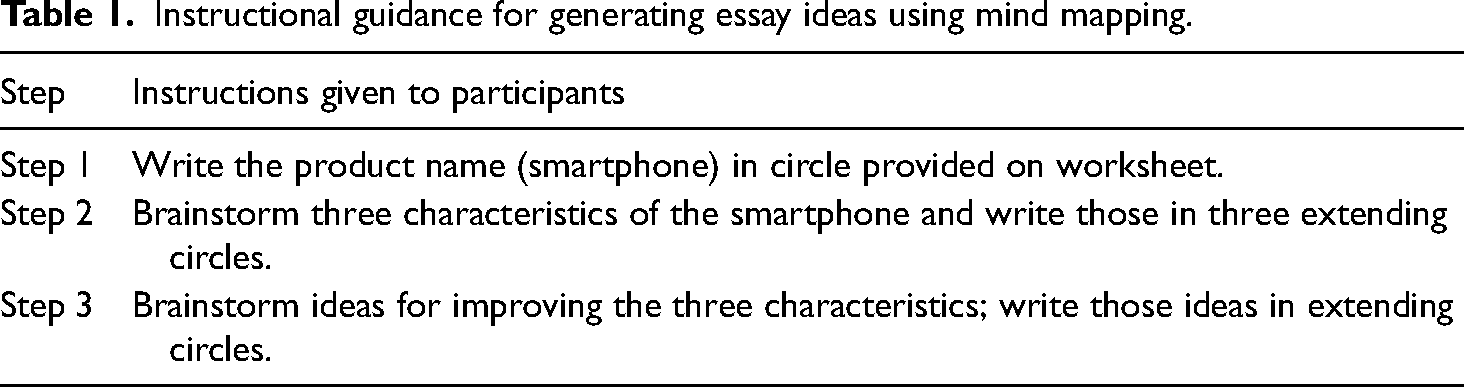
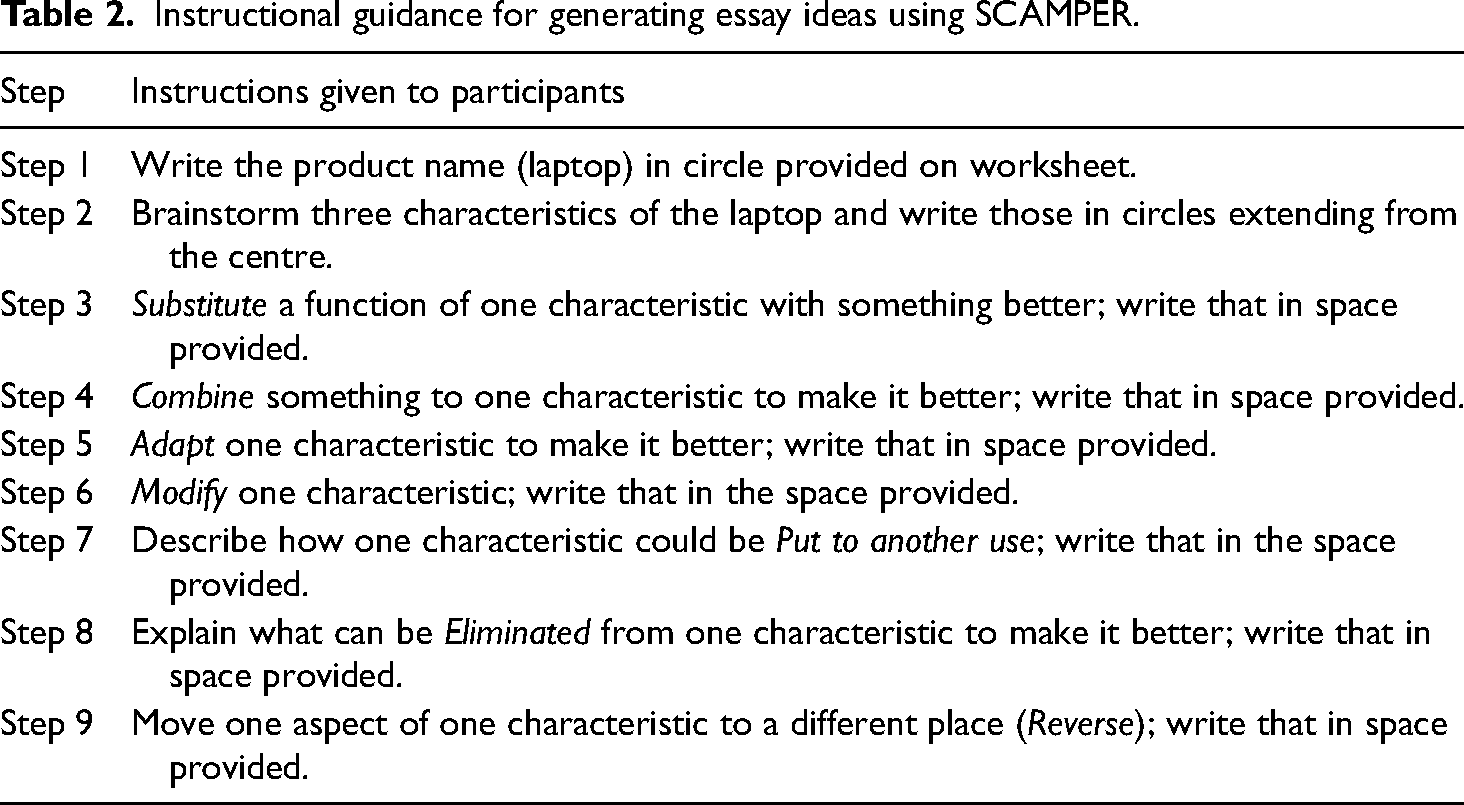
Participants were instructed how to develop comparison/contrast and argumentative essays. Additionally, mind mapping and SCAMPER techniques were incorporated as idea-development activities for the essays. The experiment took place over four weeks, two weeks for mind mapping and two weeks for SCAMPER. Both brainstorming activities contained instructional guidance intended to lead students through a series of steps and, ultimately, to produce creative answers. These steps are detailed in Tables 1 and 2.
Instructional guidance for generating essay ideas using mind mapping.
Instructional guidance for generating essay ideas using SCAMPER.
In Week 1, participants were instructed to produce ideas for a comparison/contrast essay. First, they individually brainstormed three aspects/functions of an existing technology: a smartphone. This served as the convergent thinking stage. The students were then instructed to expand their mind map by brainstorming ideas of how to improve each aspect/function identified (see Appendix 1). This served as the divergent thinking stage, and was intended to produce an abundance of varying ideas. Participants were then told to produce an essay comparing the existing smartphone with their improved smartphone. They engaged in the same mind mapping pre-writing activity in Week 3, though on a different topic (ways to address a problem: global warming), and for an argumentative essay. The wording of the instructional steps was slightly modified in the third week to reflect the new topic. The mind map worksheet used in this experiment can be seen in Appendix 1.
In Week 2, participants were again instructed to brainstorm ideas for a comparison/contrast essay, but with a laptop as a starting point. The initial convergent brainstorming of aspects/features was the same as in the first week; however, the divergent thinking stage took the form of a SCAMPER activity (see Appendix 2). Students were asked to improve the product by performing all of the SCAMPER operations (see Table 2), and then asked to produce a comparison/contrast essay using their ideas. The same SCAMPER-based procedure was followed in Week 4, but as in Week 3, the goal was an argumentative essay, and the topic was how to address a problem: student cheating. The SCAMPER worksheet used in this experiment can be seen in Appendix 2.
Data Collection and Analysis
After each intervention, participants completed a survey containing four Likert-scale items developed by the researchers to get a sense of how creative the participants perceived themselves to have been as a result of the mind mapping or SCAMPER activities. The items are based on an understanding of creativity as the generation of various novel and useful ideas (Buser et al., 2011; Fisher, 2004; Raven, 2002; Richards, 2013). Internal reliability of the four post-treatment measurements was calculated. The Cronbach’s alpha for the perceived creativity construct of each of the four lessons are as follows: .853 (Week 1), .856 (Week 2), .808 (Week 3) and .861 (Week 4). The data gathered through the analysis of the items were used as the dependent variable for the subjective measurements of this study. To determine whether the two brainstorming activities led to a difference in essay creativity scores, a rubric was developed and used to assess the essays (n = 24) of a subsample of participants. Early versions of the rubric were applied to another subsample of participants’ essays that had not been selected for inclusion in the research sample. In this way, the rubric was developed and refined inductively.
The completed rubric was designed to assess three creativity-related criteria: uniqueness, flexibility and effectiveness (see Appendix 3). These criteria were chosen because they covered the qualities of creative products (Hennessey et al., 2011) and of creative thinking (Torrance, 1974). Uniqueness was selected because the (un)commonality of ideas within the sample was found during rubric development to be a reasonable proxy for novelty/originality. Though participants worked alone, certain ideas occurred in many essays and others in few or one. Flexibility was included as a measure of the diversity of participants’ thinking. The researchers observed that some participants approached products and problems from various angles, while others produced multiple ideas relating to only one aspect of the product/problem. Assessment of effectiveness involved judging the likelihood that the proposed new technology or solution would have positive effects. As producing such a product/solution was the goal of the essay writing, this doubled as a measure of the appropriateness (Hennessey et al., 2011) of students’ ideas. One other potential criterion, fluency, was not included in the rubric. Students were not required to include every idea they brainstormed in their essays, and so the researchers concluded that the essays would provide a poor indicator of creative fluency, as compared to the brainstorming sheets themselves, which were not assessed. Consequently, fluency was not used as a rating criterion in this research since the pedagogical goal of the writing class was to produce essays with a limited set of good quality ideas, rather than the most ideas possible.
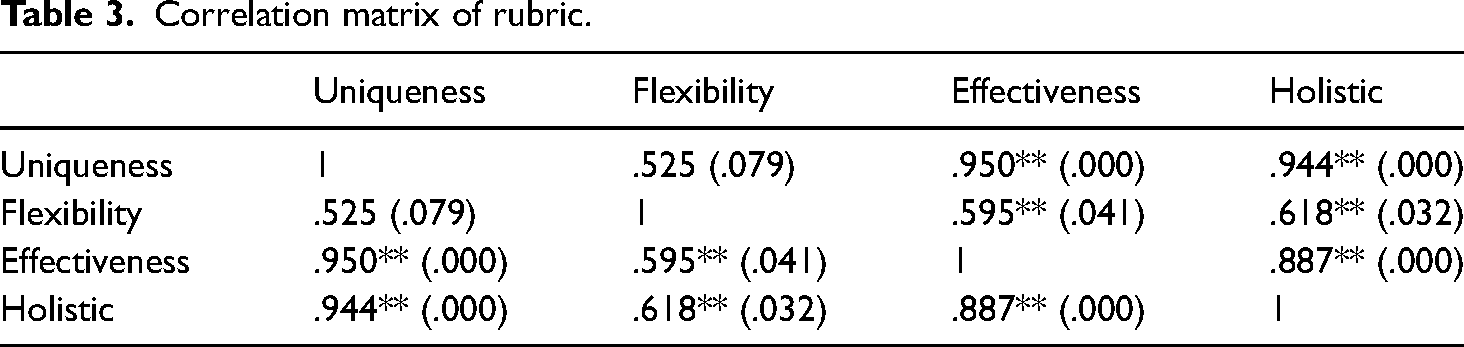
Additionally, raters also provided a holistic score reflecting their overall impression of creativity displayed in each essay. The researchers piloted the rubric with randomly chosen writing samples and found it reliable and valid by verifying internal consistency and content validity. Cronbach’s alpha values of uniqueness, flexibility and effectiveness were .775, .841 and .623, which supported the reliability of the creativity assessment rubric. Table 3 shows the correlation matrix, revealing that the higher the analytic score, the higher the holistic score for creativity, which also supported the validity of the assessment rubric. The creativity rubric used in this experiment is found in Appendix 3.
Correlation matrix of rubric.
Before the experiment, all participants took the TTCT to establish a score for their creative thinking ability. To ensure that both high and low creative ability learners were included in the assessed subsample, the six highest-scoring students and the six lowest-scoring students on the TTCT were selected for analysis. Two essays written by each of these 12 participants – one produced with mind mapping, the other with SCAMPER, 24 essays in total – were collected by the researcher who was the instructor in the experimental writing classes. This researcher had interacted with participants, and knew which essays were produced using which brainstorming technique, and therefore was not a rater. The two other researchers and an additional colleague used the prepared rubric to rate the essays, independently of each other. The raters did not have access to information about the participants, nor did they know which essays had been produced using mind mapping and which with SCAMPER. Afterwards, internal reliability for the three criteria scores was calculated. The evaluations were reasonably consistent, with interrater reliabilities ranging between .62 and .84.
Results
Using SPSS version 20, this study employed paired t-testing to examine the difference between levels of perceived creative output, and two-way multivariate analysis of variance (MANOVA) to test the effect of brainstorming activities on participants’ creative writing output. The levels of perceived creativity output were treated as the dependent variable for the first research question, and all four creativity scores (uniqueness, flexibility, effectiveness and holistic) were treated as dependent variables for the second and third research questions. The two techniques (mind mapping and SCAMPER) and students’ creativity levels (high and low), as determined by the TTCT, were treated as independent variables.
Each participant received two treatments for mind mapping and two for SCAMPER, with a post-activity survey about their creative output self-perceptions administered each time. Paired t-testing was performed on the survey results collected following each of the two mind mapping treatments, and separately on the survey results following the two SCAMPER treatments. The results in Table 4 show that there is no statistically significant difference in mean scores between the two mind mapping treatments, or between the two SCAMPER treatments.
Self-perceptions of creative output in brainstorming activities.
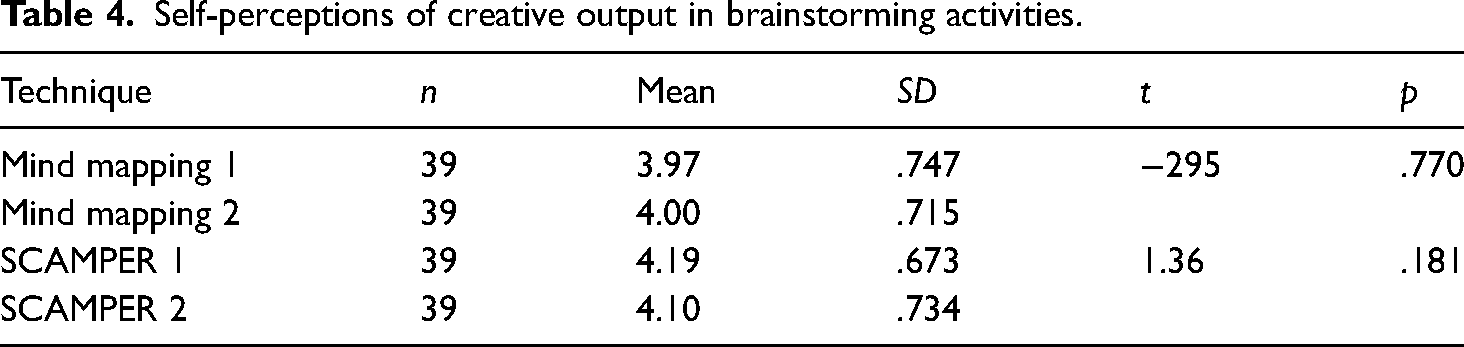
Due to the statistically similar scores in Table 4, the survey scores of both mind mapping treatments for each participant were combined into a total mind mapping mean score, as were the scores for SCAMPER. To answer the first research question, a comparison was made between the total mean score of mind mapping and the total mean score of SCAMPER. The difference in mean scores was assessed using paired t-testing. Table 5 shows a statistically significant difference (p = .033) between mean creativity output of the two techniques, with SCAMPER producing a higher mean score than mind mapping.
Self-perceptions of creative output based on technique (mind mapping vs SCAMPER).

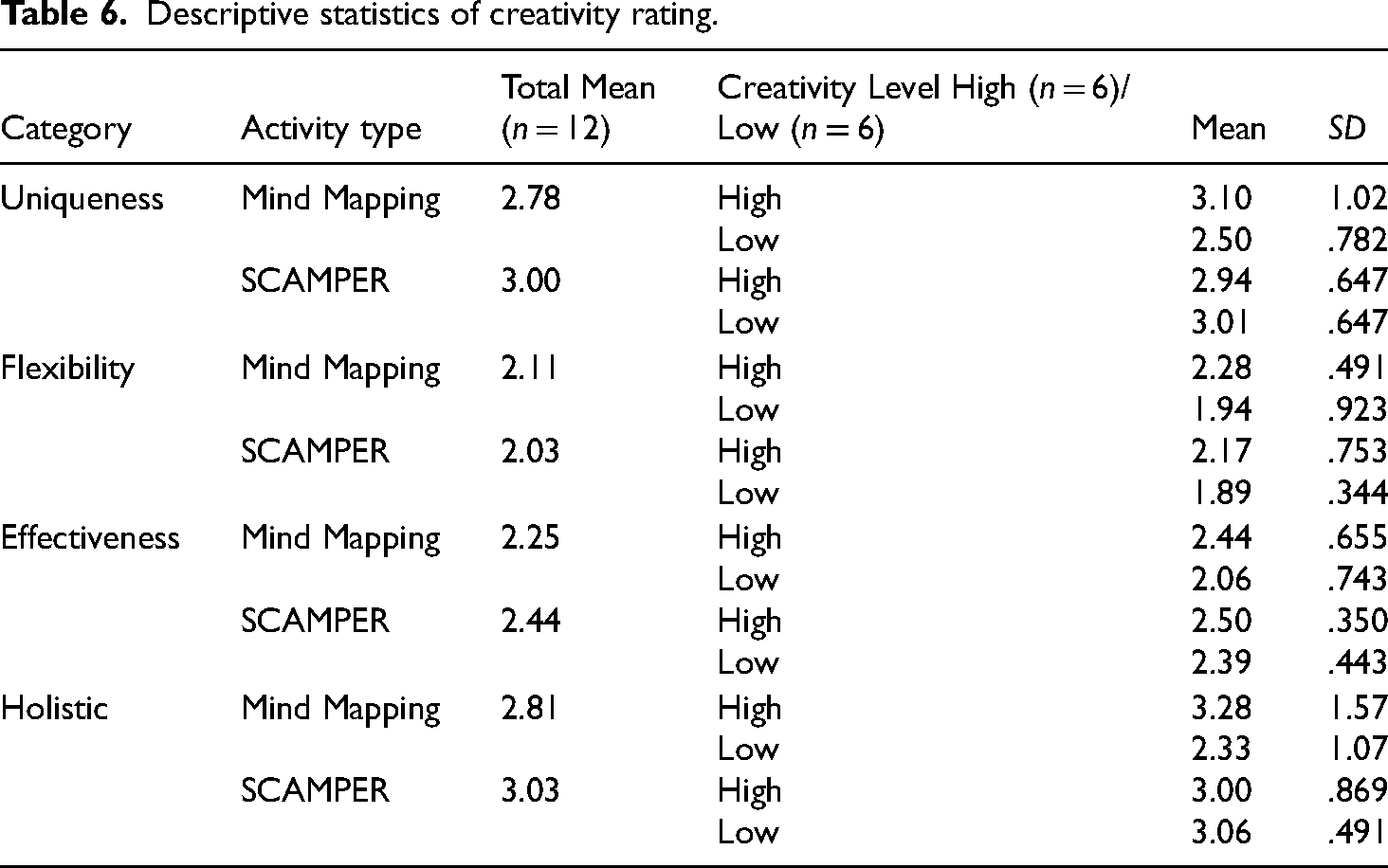
Both the second and third research questions were answered by using two-way MANOVA. Before examining the MANOVA results, descriptive statistics shown in Table 6 were used to get a sense of the various mean levels that ultimately contributed to the results. Regarding the second research question, it was revealed that total mean scores of SCAMPER essays are generally higher, with the exception of flexibility, than the total mean scores of mind mapping essays. However, the scores all appear fairly similar. Regarding the third research question, the mean scores all appear to be fairly similar between high and low creativity learners for both mind mapping essays and SCAMPER essays.
Descriptive statistics of creativity rating.
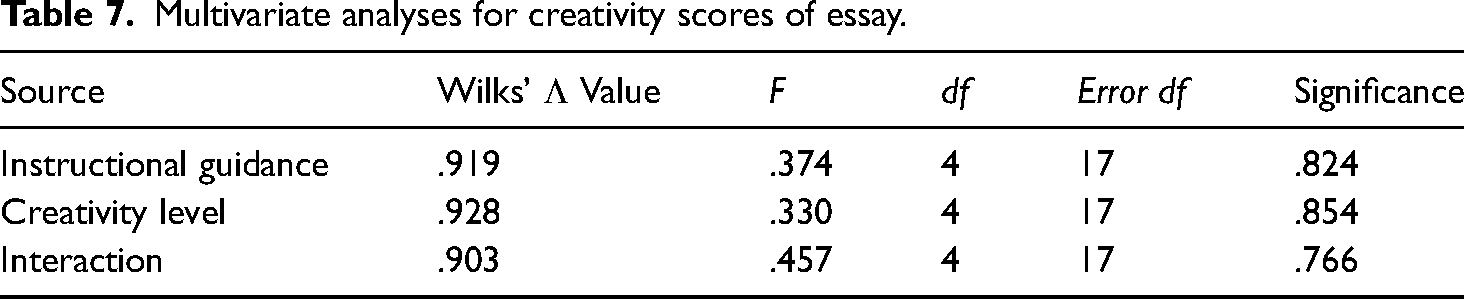
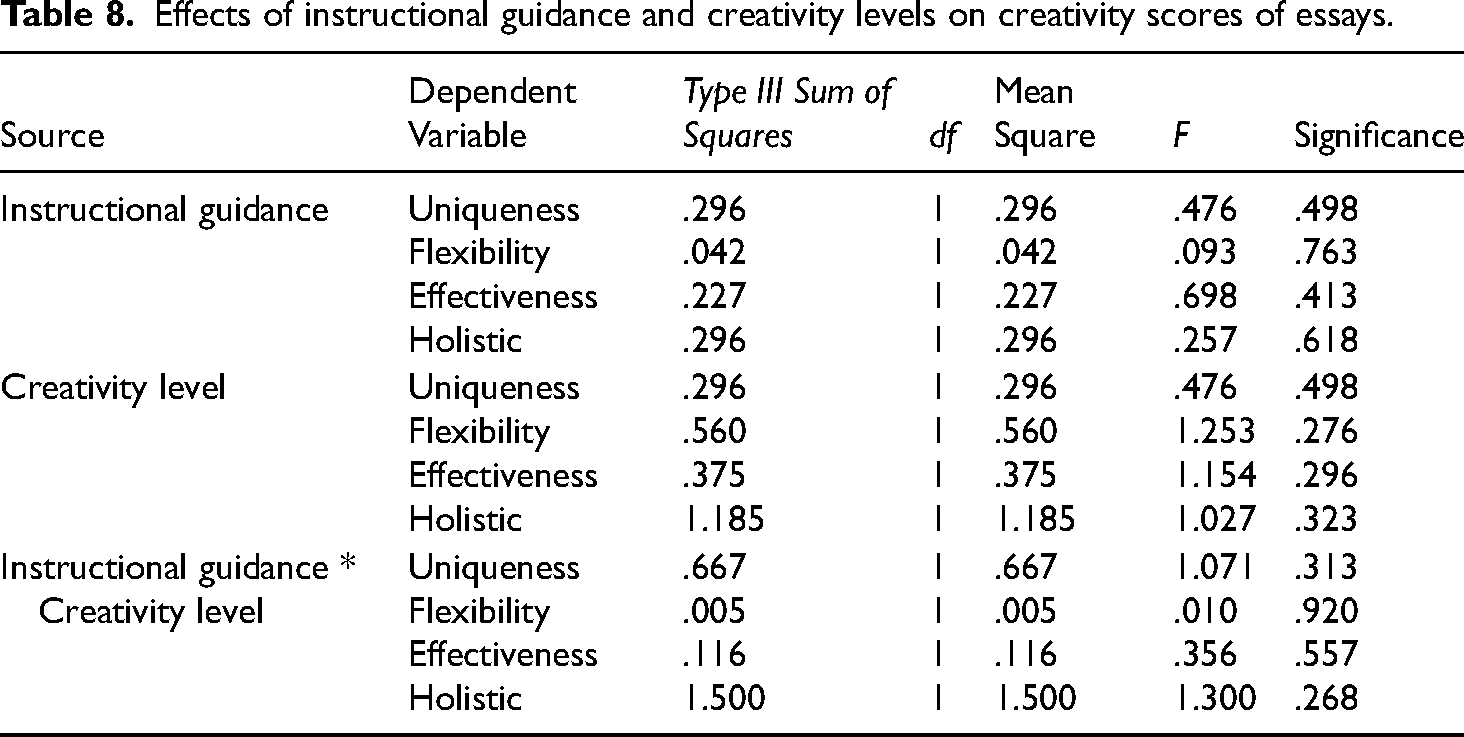
To examine for statistically significant effects, a two-way MANOVA was conducted. Table 7 shows no significant difference of essay scores on creativity between instructional guidance, F (4, 17) = .919, p = .824, and between creativity level, F (4, 17) = .330, p = .854. Also, there were no significant effects of instructional guidance or creativity level on any of the creativity rating (uniqueness, flexibility, effectiveness and holistic). In other words, there were no significant mean differences in essay scores on any of the creativity ratings. Additionally, the interaction between instructional guidance and creativity level did not appear either (see Table 8). These results implied that higher levels of instructional guidance did not necessarily lead to higher creativity scores on the essays and that more creative students did not necessarily make more creative essays in this experiment.
Multivariate analyses for creativity scores of essay.
Effects of instructional guidance and creativity levels on creativity scores of essays.
Discussion
The results of this study show that when learners develop creative ideas for EFL essays through SCAMPER rather than mind mapping, the perceived creativity levels among those learners are significantly higher. Given that creative activities may positively affect students’ motivation (Richards, 2013; Shin, 2018), encourage them to attend to both form and meaning of the language being learned (Cho and Kim, 2018), and produce greater levels of complexity, accuracy, and fluency within their writing (Nosratinia and Razavi, 2016), this result may serve to support the use of the SCAMPER technique in EFL classes on both motivational and writing efficacy grounds.
As for the creativity scores of participants’ essays, the results are less pronounced. Essays produced using SCAMPER generally scored higher in contrast to mind mapping, though this was not a statistically significant difference. Therefore, the results of this study gel with arguments that support a higher level of instructional guidance to promote creativity (Hathcock et al., 2015; Hender et al., 2001; Santanen et al., 2000). However, the evidence in this study is insufficient to demonstrate that, for creative idea generation in EFL writing classes, SCAMPER is superior to mind mapping.
There are several possible interpretations of this result. In this study, mind mapping and SCAMPER had several commonalities. Students were provided with instructional guidance in two stages: firstly, students were directed to think convergently, to identify aspects of the product/problem; secondly, they were directed to think divergently, coming up with novel ideas to improve the product or solve the problem. In this way, the visual/spatial feature of SCAMPER meant to guide divergent thinking (Glenn, 1997) was isolated for experimental purposes. It may be that this approach of manipulating and reshaping ideas was beneficial, which could account for the overall higher scores of SCAMPER essays. If so, SCAMPER may represent a helpful boost to procedural guidance for creative thinking, which improves creative output (Hender et al., 2001).
However, given the slight difference in results between the two techniques, it is also possible that the unique features of SCAMPER were not powerful enough to significantly support students’ creative output compared to mind mapping. It is worth mentioning that both activities contained essential procedural features, including both steps of creative thinking: convergent and divergent (Guilford, 1959). It is important to note that additional instructional steps in themselves are not the solution to producing more creative ideas; rather, according to Hathcock et al. (2015), each step should be designed to allow learners to think, analyse and add further support to pre-existing ideas. The operations of SCAMPER are intended to encourage students to think and analyse in this way. The results suggest that these operations may indeed do this, but they do not clearly demonstrate any advantage over relatively free-form idea generation.
Overall, the present study contributes an example of the use of SCAMPER in an educational context to existing literature (Buser et al., 2011; Chulvi et al., 2013; Demir, 2005; Elmansy, 2015; Georgiou, 1994; Glenn, 1997; Hender et al., 2001), with a notable point being that students may perceive themselves to be more creative with SCAMPER than mind mapping. However, the results, though promising for SCAMPER, are not enough to discount the effectiveness of mind mapping for idea generation.
Indeed, the results may indicate that both mind mapping and SCAMPER helped to level the playing field between high and low creative ability participants. These two groups received markedly different scores on the TTCT, yet there was no statistically significant difference between the creative output of both groups in this study. This suggests that both techniques were effective in reducing the gap of creative output between high and low creative ability learners. The researchers’ tentative interpretation of this result is that the procedural guidance offered in both activities acted as scaffolding for lower-creative-ability students, guiding and supporting them to the point that the distinction between them and higher-ability students was reduced; an effect demonstrated in other research (Wahyudi et al., 2019). Further study is necessary to examine this phenomenon, but, tentatively, the results support the inclusion of procedural guidance in creative idea generation activities.
Conclusion
The results suggest that procedural instructional guidance may benefit students’ creative expression when employed in an EFL writing context. Post-treatment survey results indicate that use of the higher instructional guidance activity, SCAMPER, allowed students to produce more new, unique and practical ideas, according to their own estimation. However, it might also be expected that the SCAMPER activity would produce higher levels of creativity from a third-party rater’s perspective. Yet, while SCAMPER essays did tend to outperform mind mapping essays, the higher SCAMPER scores were not statistically significant. This may indicate a limit to the benefits of added instructional guidance, or at least such additional guidance as the SCAMPER technique offers. This should be further examined in future research.
One limitation of this research is its small sample size. A larger-scale study would perhaps be able to demonstrate the presence or absence of a statistical benefit to the SCAMPER technique. Moreover, analysis of a larger sample using the criteria employed in this present study might be more accurate because the uniqueness of an idea in a larger sample is less likely to be coincidental (Silvia et al., 2009). A larger sample could provide a clearer picture of the benefits to uniqueness of different levels of guidance. Furthermore, future studies might use criteria other than those employed in this study. A potentially important criterion that was not considered here was fluency (the number of ideas generated (Torrance, 1974)). This could be incorporated into a future study by requiring students to include all of their ideas in their essays, or by assessing students’ brainstorming itself rather than the subsequent complete essay. Another limitation of this research is that it does not include qualitative data, such as interviews with students. Although a qualitative approach may provide more detail as to why more instructional guidance is beneficial for creative idea generation in writing, the quantitative findings of the present study serve as a starting point from which future qualitative research may further explore the relationship between instructional guidance and creativity in EFL writing classes. Indeed, any further studies on SCAMPER and mind mapping in EFL writing classes would likely be illuminating, as creativity is inherently a subjective concept, and the ratings of other raters, and the perspectives of other students, would surely enrich our understanding of the phenomena explored in the present paper.
As for the present study, it exemplifies the incorporation of creativity into an EFL writing class. It may, therefore, serve as a guide for teachers hoping to promote creativity in foreign-language classes through activities such as mind mapping and SCAMPER. Also, as participants of high and low creative ability used both of these activities to produce work that was not statistically dissimilar from each other, this study may be taken as a tentative endorsement of instructional guidance for promoting creativity.
Footnotes
Declaration of conflicting interests
The authors declared no potential conflicts of interest with respect to the research, authorship and/or publication of this article.
Funding
The authors received no financial support for the research, authorship and/or publication of this article.
