




Abstract
The outbreak of COVID-19 witnesses a sudden surge of fully online classes globally. Scholarly attention has promptly shifted to explore the personal experiences and perceived challenges of students and teachers. For English as a Foreign Language (EFL) instructors around the world, many are required to teach online for the first time, yet studies on their teacher identity development in online teaching contexts remain limited. To address this gap, the researchers conducted a case study of three EFL instructors in a Chinese university within an online semester to understand how their online teacher identities developed and shifted. The concepts of ‘imagined and practiced identity’ and social representation theory have been adopted as the conceptual framework. The findings revealed the trajectories of three online EFL instructors as their imagined identities evolved and renegotiated into their practiced ones based on individual and contextual factors. The findings reveal a lack of rule-based identities from the participants and highlight the need for pedagogical and psychological support for EFL teachers when they transition to an online context. Recommendations are made accordingly.
Introduction
The outbreak of COVID-19 evolved to be a global pandemic in 2020, which impacted more than 1.38 billion learners as a result of national school closures worldwide (Li and Lalani, 2020). For instance, in China, educational institutions hosted an estimate of 200 million online students in the spring semester of 2020 (Wang and Qin, 2020), which created a challenging situation where teachers suddenly needed to teach online. Language instructors in particular faced tremendous challenges, as teaching language online lacks the non-verbal and paralinguistic signals much needed and normally prevalent in traditional face-to-face classrooms (Krish, 2008). In contrast to the urgent shift of teaching mode, the harsh reality is that most language instructors have limited experience and training to teach online. Therefore, the need for language instructors to work comfortably and confidently in the online environment grows more pressing than ever before. Several studies have responded to a variety of issues about online teaching under COVID-19, including the challenges teachers and students face (Atmojo and Nugroho, 2020), effective online teaching practices (Moorhouse, 2020) and changes in teacher emotions (Liu et al., 2021). Central to this change were the language instructors themselves, who would experience paradigm shifts in teaching practices, and some even experience change of identities and roles (Krish, 2008). However, how exactly online teachers shift and develop their identities is poorly understood.
In the study of teacher identity, a sense of fluidity in identity when linking past, present and future in language teachers’ identities has been found to be conducive to teachers in the profession, especially when facing challenging situations (Yuan, 2019). Consequently, the transition process of teachers’ professional identities is particularly worth investigation in this online context. Adopting social representation theory (Moscovici, 2000) as the conceptual framework in studying identity shift from ‘the imagined’ to ‘the practiced’ (Xu, 2013), this research hopes to delve into the identity development of university English as a Foreign Language (EFL) instructors at this special time, generating insights into the identity transition processes for these teachers, which hold implications for educators and policymakers alike.
Literature Review
Online Teacher Identity
Teacher identity, which is broadly defined as the ways teachers make sense of themselves and the images they present to others, has gained scholarly attention in traditional classroom settings (Beauchamp and Thomas, 2009). An effective teacher identity has proven to be instrumental, as it can greatly affect teachers’ self-efficacy, confidence and competence, as well as their decisions in curriculum, pedagogy and even teaching motivation and psychological well-being (e.g. Beijaard et al., 2004; Hafsa, 2019; Yuan, 2019). Teachers’ successful professional identity is equally important to students since teachers play a crucial role in student academic success in their learning experience in higher education courses (Baxter, 2012).
With all its significance, teacher identities are also dynamic in nature (Yuan, 2019). Teacher identity, contrary to a stable and unitary entity, is a complex and dynamic equilibrium where professional self-image is balanced with various self-perceived roles of teachers and their complex surrounding context (Beijaard et al., 2004). The global pandemic further creates uncertainties for teachers in their work and lives, as they transition to online teaching (Allen et al., 2020). This drastic change of context not only influences teachers’ pedagogical choices, but also their self-perceptions and identities as a language teacher.
Albeit limited in volume, scholars have looked into online teacher identity through reflective narratives (e.g. Comas-Quinn, 2011; Hurst, 2015; Johnson et al., 2014; Richardson and Alsup, 2015). The line of research reveals that the challenges and successes faced by new online instructors are quite different from, though parallel to, those faced by novice teachers in traditional settings (Richardson and Alsup, 2015). Apart from technology, many other factors might create barriers that hinder the successful transitions of teachers to the online environment (e.g. Johnson et al., 2014; Shin and Kang, 2018). In particular, Comas-Quinn (2011) pointed out that existing teacher training programs did not offer enough support for the required identity transformations for online teachers to perform their pedagogical roles. The current survey of literature highlights the lack of empirical research on teacher identity development of language instructors when they transition to online semesters.
Conceptual Framework
To explore the dynamic nature of teacher identity with its multifaceted challenges, scholars have examined EFL teachers’ identity transition from a dual perspective: imagined and practiced identity (e.g. Jiang, Yuan and Yu, 2021; Hamiloglu, 2013; Xu, 2013). Imagined identity emerges from individuals’ imagination, demonstrating the intricate relationships of individuals with the contextual elements in an imagined community without real-life practice (Anderson, 1991; Norton, 2013), while practiced identity originates from individuals’ concrete engagement and interactions within their communities of practice (Wenger, 1998). In the context of online teaching, EFL instructors who have never taught online will imagine their identities and thus (re)construct parts of their professional identity. When they actually start online teaching, they spontaneously carry out teaching practices in response to the specific context and adopt different identities accordingly. Similar to novice EFL teachers transitioning to traditional classrooms (Jiang et al., 2021), experienced EFL instructors who have never taught online (thus considered a novice online teacher) might experience great shifts in their imagined and practiced identities.
This study aims to understand this potential identity transition process of online language teachers’ imagined and practiced identities through adopting social representation theory (Moscovici, 2000). Drawing on social thinking and attitudes in conventionalizing people's collective behaviours or engagement in the situated context, this theory has been widely applied to understand individual identity since it could provide references to the intricate systems of values, beliefs and practices shared among members in a certain social community (Jiang et al., 2021). To demonstrate people's social cognition patterns, the social representation theory (Moscovici, 2000) categorized people's professional identity into four types, based on cues, exemplars, rules and schema, as analytical tools to examine identity changes. Cue-based identity refers to the cues from representative features of the social entities (i.e. teaching). For example, an EFL teacher that identifies himself as an ‘English expert’ holds the cue that a teacher should obtain adequate knowledge of English. Teachers with an exemplar-based identity usually align themselves with role models, or ‘example’ teachers. Schema-based identities ‘embed a series of social cognitions and behaviours in response to a dynamic context or situation’ (Xu, 2013: 80). For instance, novice EFL teachers tend to adjust their mental status and teaching practices to concentrate on students’ examination results in response to an examination-oriented school culture. Rule-based identity represents institutional regulations and policies in what a teacher should be or do, which was found to negatively pose novice teachers’ identities as ‘catching up the schedule’ or ‘a routine performer’ (Jiang et al., 2021; Xu, 2013). Such rule-based identities might cause teacher attrition or teachers may reject the institutional imposed rule-based identities to sustain or reconstruct new practiced identities (Jiang et al., 2021).
Drawing upon this conceptual framework, Xu (2013) found that novice EFL teachers experienced a linear socio-cognitive trajectory from cue- and exemplar-based imagined identities to rule- and schema-based practiced ones while interacting with the teaching context. From a socio-cultural perspective, Jiang and his co-authors (2021) further identified four identity transition trajectories (establishment, evolution, renegotiation and sustainment) mediated by individual factors (i.e. personal beliefs, learning and teaching practice experiences) and contextual factors (i.e. institutional examination-oriented culture and teaching principles). Although these studies focus on pre-service or novice EFL teachers, in-service instructors may also experience potential changes of their constructed identities when they suddenly shift to online teaching during the COVID-19 pandemic. Adopting social representation theory (Moscovici, 2000) as the conceptual lens, the study aims to explore how online teacher identity changes from ‘the imagined’ to ‘the practiced’ (Norton, 2013; Wenger, 1998). The following are three guided research questions:
RQ1: What kind of imagined identities did the EFL teachers construct before teaching online?
RQ2: What are the actual practiced identities of the EFL teachers during online teaching?
RQ3: How did the identities of these EFL teachers shift and transition? What are the possible reasons for such shifts?
Methodology
Context
This study took place in an English Language Centre (ELC) at a key provincial university in Guangdong Province, China. The ELC offers four compulsory English courses for undergraduate students of non-English majors. Specifically, ELC1 and ELC2 aim to strengthen students’ integrated language skills with a focus on communicative skills including reading and listening. ELC3 focuses on intercultural communication and the introduction of different cultures. ELC4, as the last compulsory course, concentrates on English for academic purpose. In an effort to boost student interaction and learning outcome, each class hosts only 20 to 30 students.
In early March, facing the unexpected COVID-19 pandemic, all courses in the ELC were moved online for the spring semester of 2020. Students were advised to use electronic devices, including laptops and smartphones, to attend ‘live stream lessons’ on various platforms (e.g. Zoom and Tencent Meeting) or apps selected by their teachers. As previously held traditional semesters, all ELC classes meet for 90 min, twice a week, for 16 teaching weeks. The only teaching guideline for the online semester was on class discipline (e.g. attendance, punctuality), offered by the Teaching Affairs Office of the university. Otherwise, teachers enjoyed the freedom to design their own lessons.
Participants
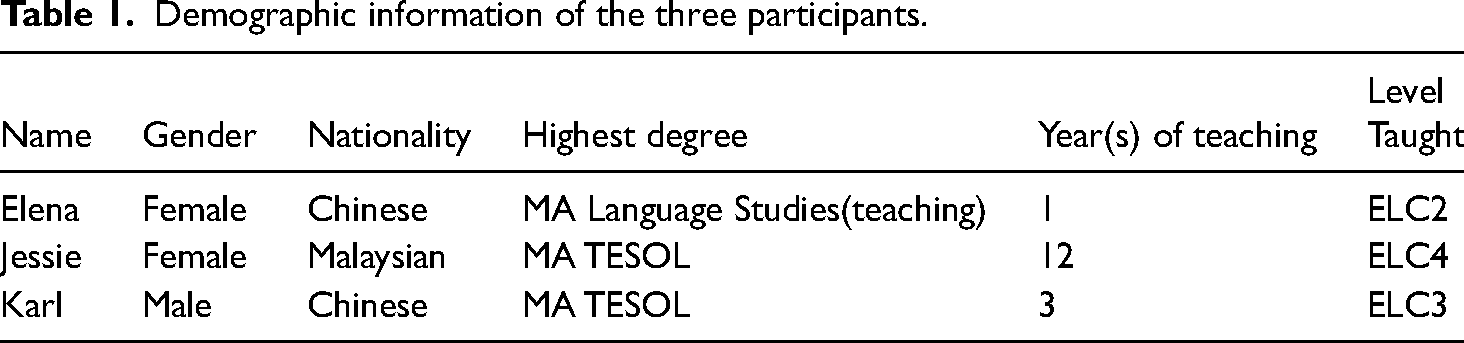
Soon after the announcement of online teaching, the researchers sent out recruitment emails and WeChats, calling for voluntary participants. The three participants – Elena, Jessie and Karl (all pseudonyms) – were recruited. Table 1 shows participants’ diverse backgrounds in nationality, education and level of teaching at the time of research.
Demographic information of the three participants.
Data Collection
Transcripts from semi-structured interviews were the main source of data, triangulated with teaching artifacts and WeChat exchanges. Three rounds of semi-structured interviews were conducted with each participant via WeChat voice calls to elicit their narratives – that is, stories they draw on to make sense of their teaching experiences and themselves (Tsui, 2007). To understand participants’ potential identity changes in relation to their teacher selves, the interview questions were designed to explore ‘what teachers themselves find important in their professional work and lives based on both their experiences in practice and their personal backgrounds’ (Beijaard et al., 2004, drawing on Tickle, 2000: 108).The first round of interviews, conducted several days before the semester, was designed to delineate participants’ past experiences and their projection of possible identities for the upcoming semester. Participants were asked to share their previous experiences of both traditional and online teaching (if any), and their expectations or concerns towards online teaching. The second interview took place in the third teaching week after participants received students’ feedback on their first two weeks of online teaching, a survey conducted per institutional requirement. The participants reflected on students’ feedback and reported possible adjustments of their identities. The final round of interview was conducted a week after the end of the semester. It offered an overall review of participants’ online teaching experience, changes of emotions, teaching practices and other relevant aspects of their teacher identities. For a detailed list of the interview questions, please refer to Appendix 1. All the interviews were conducted in participants’ preferred languages, Chinese or English. Each interview lasted 30 to 45 min and was audiotaped, then transcribed verbatim. To better triangulate the interview data based on their first-person narratives, the researchers also collected participants’ course artefacts including their course syllabus, lesson materials (e.g. PowerPoint slides and exercise worksheets) and students’ online feedback results. The participants were also invited to share their thoughts of daily online teaching through WeChat messages on a voluntary basis, which have been included as part of the data sources with their permission.
Data Analysis
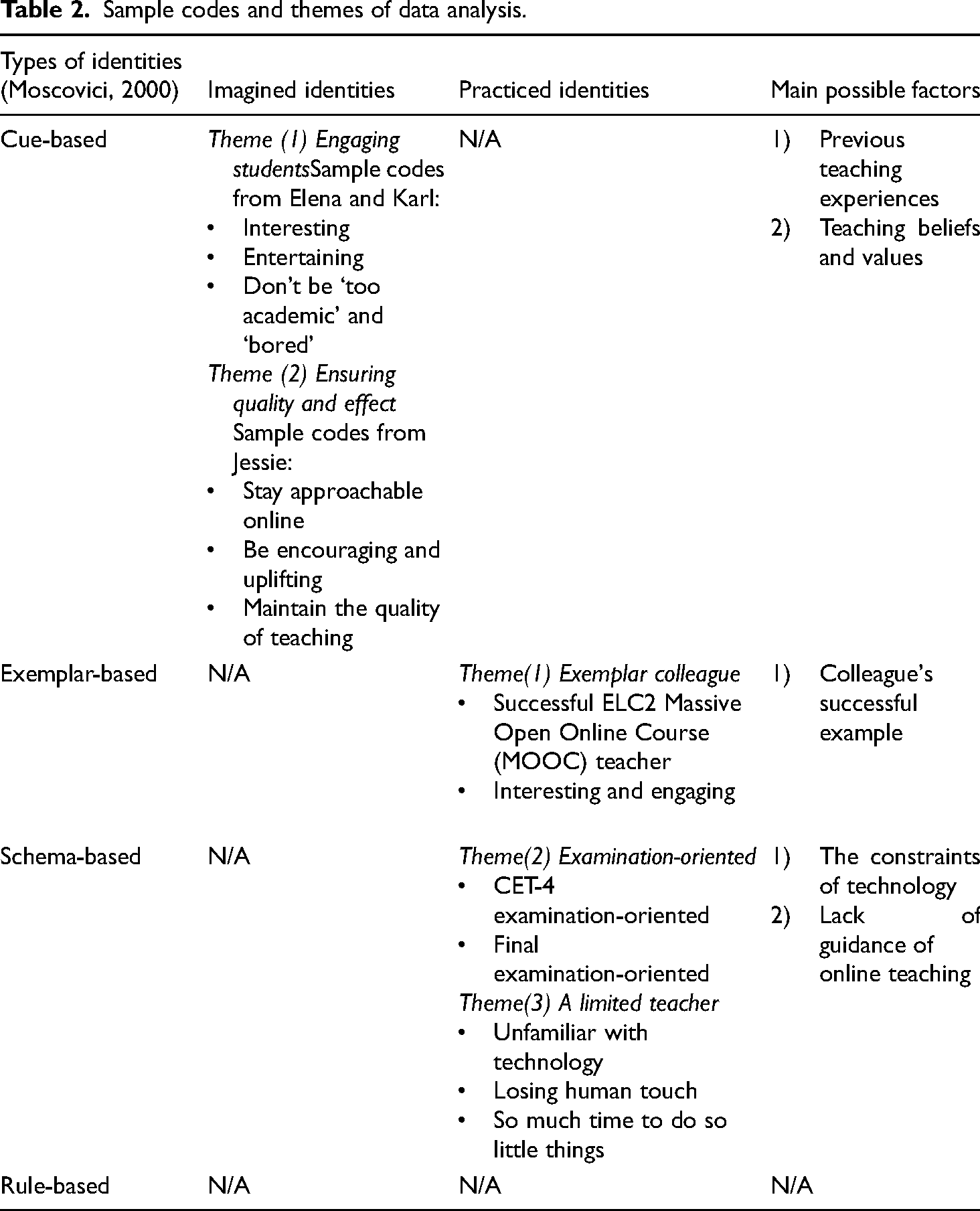
The qualitative paradigm (Miles et al., 2014) has been adopted to inform the iterative and recursive data analysis process. The researchers first conducted open coding, during which interview transcripts were read and re-read to identify main themes and critical events of participants’ pedagogical, emotional and cognitive changes. For example, codes of ‘CET-4 examinations oriented’ and ‘Final examination oriented’ were applied in Elena's second interview, where she not only experienced feelings of ‘frustration’ and ‘doubt’ during online teaching (Elena, second interview), but also changed her perception of a good teacher – ‘teachers should emphasize test preparation’. Thus, the unified theme ‘examination-oriented’ has been established based on the two similar codes. Each change was labelled to its relevant category, and compared with previous codes to identify the changes taken place. The researchers also labelled influencing factors for such changes when indicated in the transcripts. For instance, Elena failed to keep her imagined identity (e.g. an ‘interesting’ teacher) while teaching online, and attributed the format of online teaching to be the reason. This was labelled as ‘constraints of technology’.
In the second round, informed by the conceptual framework, the researchers further compared and reduced the codes into larger overarching categories: ‘imagined identities’ and ‘practiced identities’. Drawing on the social representation theory (Moscovici, 2000), codes of ‘cue-/exemplar-/schema-/rule-based’ are applied to each personal narrative to further study the individual shift of identity. A simplified presentation of the codebook is shown in Table 2. It is worthy of note that all participants’ imagined identities are cue-based, while none of the practiced identities are rule-based. This brings about an interesting discussion, as will be illustrated in the discussion section.
Sample codes and themes of data analysis.
After recategorizing the categories of each case, the researchers conducted cross-case analysis (Merriam, 1998) to compare the potential differences and similarities of all three participants’ identity change trajectories and possible factors. The entire process was iterative, and the two authors separately coded the interviews. Rare disagreements were discussed until consensus was reached. For example, the authors differed in naming the theme that categorized ‘entertaining’ and ‘interesting’ teacher, one suggesting ‘understanding students’, the other ‘engaging students’, as they emphasized different focuses of the teachers’ identity. Through re-reading the transcriptions and rounds of discussion, the researchers agreed that though teachers mentioned the importance of understanding their students, their main goal was to engage students so as to achieve effective teaching; thus, ‘engaging students’ was chosen as the theme. Course artefacts (e.g. course syllabi, PowerPoint (PPT) slides) and WeChat messages were also used for data triangulation.
Findings
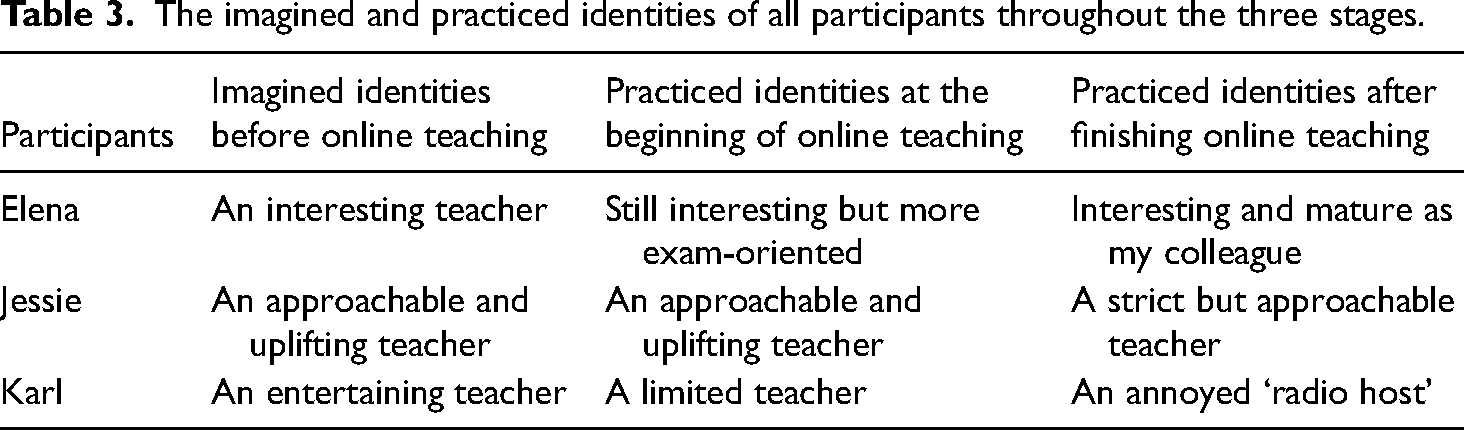
This section aims to uncover the trajectories of each participant's identity changes throughout the semester. The changing development of their identities are illustrated in Table 3.
The imagined and practiced identities of all participants throughout the three stages.
Elena: I Want to Be as Interesting and Mature as My Colleagues
As the participant with the least teaching experience, Elena expressed her nervousness in the first interview before the online semester. She imagined herself to be ‘an interesting teacher’ who would truly engage her students:
I still want to be an interesting teacher since my core value of teaching is students’ interests … I don’t want my ELC2 lessons to be too academic since students’ might easily feel exhausted and lose focus during abundant listening practices …. To avoid these, I plan to have more Q&A interactions and group discussions like what I did in the (face-to-face) classrooms before. (Elena, first interview)
Elena's emphasized use of ‘still’ indicated that students’ interest is central to her value of teaching, both in traditional and online contexts. Being interesting, her cue of a successful teacher, had a strong association with her previous experiences in traditional classrooms. This cue-based imagined identity motivated her to plan accordingly to cater to students’ interest and needs. The first week passed and she admitted in her WeChat message to the first author: ‘I’m less overwhelmed and it's not as difficult as I supposed’ (March 15, 2020). However, she acknowledged that she also perceived challenges she did not anticipate, and her practiced identity was somewhat different:
Honestly, it's not the same as I imagined. It's difficult to show my affinity towards students merely by verbal language. Many planned interactions and activities couldn’t be conducted online. It's really challenging to stay interesting when we are doing in-class listening exercises online. (Elena, second interview)
Facing the limitations of online teaching, she started to worry whether she could still keep her imagined identity. Her nagging concern was reinforced when she saw her student feedback after the first two weeks of teaching online. Though most of her student feedback was positive, some others expressed doubts over the learning outcome of the online semester, which prompted her to further reflect on her role as a teacher and take on a more pragmatic identity:
I totally understand their feedback when they received listening drills in this online setting. Under this circumstance, students need more concrete motivations than just ‘interest’. Thus, I tried to link our in-class listening exercises to the sections in the forthcoming CET-4 Examination (College English Test Band 4 for Chinese college students) for reminding them that we’re not here (online) just for fun. I should let them know what they’re learning is useful. I need to be more examination-oriented. (Elena, second interview)
As a result, her practiced identity tried to stay ‘the interesting teacher’, but with a more examination-oriented angle. She realized that being ‘interesting’ was not easy in an online context, nor was it enough to keep students’ attention and motivation through tedious online listening exercises. Thus, such a practiced identity was generated from her changing cognitive schema when she further reflected on students’ feedback on learning outcomes. These triggered her to refer to the compulsory CET-4 Examination as a concrete motivation to keep students’ interests and engagement. Her schema-based practiced identity could also be revealed by her PPT slides. Apart from posting some cartoon stickers and posters (e.g. One Piece: a famous Japanese cartoon that Chinese students like) to introduce new vocabulary in the listening exercises, she also highlighted certain genres from in-class listening exercises to match the corresponding sections tested in CET-4 Examinations (e.g. ‘News Listening: Multiple Choice Questions-locate details in Listening Section A of CET-4’ in Week 10 PPT). In her final interview, after reflecting on her endeavours, she admitted that she ‘could have done a better job’ and she spent quite some time discussing the successful example of an experienced colleague, Ms X:
I saw Ms X posted some pictures of her well-designed ELC2 MOOC. Her planning and content were fantastic! I feel that I could have done a better job in this semester. Although students still provided positive feedback to my online teaching, I knew that I just got occasional ‘flashes’ in my mind that bring interesting insights to my lessons. I wish I could deliver online lessons as mature as Ms X who systematically organized the examination content in diverse and attractive ways. (Elena, third interview)
As time went by, Elena's practiced identity clearly changed from a cue-based ‘interesting’ teacher to a schema- and exemplar-based ‘interesting and mature teacher’ like her experienced colleague, Ms X. The recognition in her social cognition of being a successful online EFL teacher was heavily influenced by Ms X's ELC2 MOOC, which engaged students’ interests while successfully covering the examination content. Eventually, influenced by a ‘role model’, Elena's practiced identity tended to identify with ‘a mature teacher’ who can balance students’ interest with crucial examination content.
Karl: From an Entertaining Teacher to an Annoyed Radio Host
Similar to Elena at the beginning of her online teaching experience, Karl claimed that he wanted to keep the same teacher identity as constructed in traditional classrooms, and he highlighted the value of interpersonal communication and interaction with students during online teaching:
ELC3 focuses on intercultural communication. I think I can remain a profile of ‘an entertaining teacher’. I always caught students’ attention by telling good jokes and sharing humorous life stories with students. Then, students can be more interested and motivated to learn about cultural issues. (Karl, first interview)
Karl minutely explained his rationale for his imagined identity as a teacher to the ELC3 course. To him, students cannot acquire intercultural communication without practicing interpersonal communication. He used humour as vital cues for a successful language teacher, thus projecting his successful teaching methods to the imagined identity of ‘an entertaining teacher’. However, like Elena, Karl also experienced frustration when he started to teach online and even forcefully claimed that ‘online teaching is definitely not as good as face-to-face’ in the second interview. He further explained his feelings and struggles, especially the lack of ‘human elements’: ‘I intended to stay entertaining as usual, like telling some jokes and my life stories related to the topics. However, the effect wasn’t good online. Online teaching lost the human elements. Now, I am limited as a teacher’ (Karl, second interview).
Facing the given online teaching settings, limited human interactions between teacher and students constrained his practiced identity as an entertaining teacher. The first two interviews manifested his cognition that a successful teacher should exert to be entertaining to achieve satisfying interactive classroom effect, which he quickly realized to be rather difficult online. In turn, he could only ‘do limited things’ to carry out his practiced identity as an entertaining teacher. This indicates that his identity changed from a cue-based entertaining teacher to a schema-based one. He tried to experiment with course content (e.g. life stories or pop songs) and class arrangements (e.g. whole-class discussions instead of group discussions for ‘promoting monitored interactions under my eyes’, Karl's second interview). However, as time went by, Karl's schema-based practiced identity seemed to experience increasing frustration, as he emotionally complained in the last interview:
Online teaching grows more and more annoying. I just spoke to the microphone and repeated like a radio host to ‘the audience’ who were just the names on my computer screen. I really hope that our university can make it a rule for students to turn on the camera to allow me to see their faces. Now, even the host (I) made jokes and shared prepared stories, I couldn’t see their facial expressions and only a few responded in the chat room …. All these brought me down and its difference from face-to-face teaching is like day and night. I hope we won’t have online teaching anymore; otherwise I will be fuming! (Karl, third interview)
By the end of the semester, Karl perceived his practiced identity as ‘an annoyed radio host’ due to his increased repetitions and lack of student visibility and responses. He still tried to entertain students based on the same cognitive schema on the importance of interpersonal communication. He also called for the schools’ rule for students to turn on the camera for achieving the communication goal. However, the ineffectiveness of the online discussions and the dreariness of constant repetition of class content further alienated his practiced identity from his imagined one. As a result, just like the metaphor ‘day and night’, ‘an annoyed radio host’ eclipsed his initial imagined identity as ‘an entertaining teacher’, which demotivated him to engage in online teaching.
Jessie: an Approachable and Uplifting Teacher who Values the Learning Quality
In the first interview, Jessie echoed Karl's worries on the constrains of online teaching and added a string of challenges, including lack of online teaching experience, difficulty to build rapport with students and challenges in taking care of weaker students. After listing these challenges, she paused for quite a while before she stated her determination to ensure the quality and effectiveness of online teaching by being ‘approachable’ towards her students:
First of all, I need to be approachable towards my students even we couldn’t meet physically. They could text me anytime if they have problem about this course and I really hope that students don’t keep me in the dark! (Jessie, first interview)
Aware of the physical distance created by online teaching, Jessie highlighted being ‘approachable’ as an important part of her imagined identity. She was willing to answer students’ questions anytime and the metaphorical expression ‘don’t keep me in the dark’ could reflect her cue of good English teachers – always acknowledging and meeting students’ learning needs instead of teaching blindly. She also discussed the potential of online teaching, and put forth another aspect of her imagined identity – ‘uplifting’:
Maybe there is silver lining in every dark cloud! Students might feel less pressured, because they don't have to be in the classroom. They might be able to learn better, assuming they put into the same effort. So, I should also be uplifting and extra positive when I conduct my lessons. (Jessie, first interview)
From her words, being ‘approachable’ would liberate her from the ‘darkness’ of physical distance; and being ‘uplifting’ could create the ‘silver lining’ that might keep both teacher and students positive in the last compulsory English course, which now had to be conducted online. Jessie's imagined identity originated from her teaching belief that quality and effectiveness should be ensured through being an approachable and uplifting online teacher. As a senior EFL teacher, she was able to come up with implementable actions to concretize and practice the two aspects (i.e. approachable and uplifting) of her imagined identity, as she stated in her second interview:
I am doing quite OK …. I frequently used WeChat to give instructions for students’ group discussions and made one-on-one voice calls to give writing feedback to the weak students on their drafts of the essays. During the process, one of our colleagues designed a ‘smart’ Excel grade book to help us track students’ performance …. Though everything goes on well so far, I still wish I could get more support from the centre to improve my online teaching quality and enable students to achieve ideal learning outcomes. (Jessie, second interview)
With a smooth transition to online teaching, Jessie's imagined identity was concretized and contextualized to a practiced ‘approachable and uplifting’ teacher when she employed specific strategies to teach online. Her practices of providing technology-assisted instructions, feedback and assessment to students manifested that her schema of being an online EFL teacher was rooted in her valuing the quality of students’ learning outcomes. Thus, her identity changed from a cue-based to a schema-based one based on her quality-driven cognition. Despite her smooth identity change, she still appealed to more support from the centre to meet her requirements on teaching quality and learning outcomes. After the semester ended, she further reflected on her identity when she received students’ examination results and written feedback in teaching evaluation:
Actually I felt a bit dissatisfied. Although most students did well in their ELC4 final examination, some weak students still fell behind. I had predicted it after the midterm and I started to become stricter and require everyone to answer my questions in each lesson. I also kept providing incredible length of feedback on their essays. However, students still didn’t provide any ‘outstanding’ feedback on my teaching. I didn’t get any lengthy feedback as I did last semester. Oh … (pause). I’ve spent so much time to do so little things. (Jessie, third interview)
During the semester, when some weak students had been left behind, Jessie adjusted her schema-based practiced identity, which highlighted the new dimension of ‘being strict’, while keeping her initial ‘approachable’ feature embedded in her cognition as a quality-driven teacher. Though not all students performed well in the final examination after her dedicating efforts as ‘an approachable and strict teacher’, she still successfully maintained a consistent schema-based practiced identity and implemented her teaching accordingly.
Discussions and Implications
This study tracks how three EFL instructors at a Chinese university gradually transitioned from their imagined identities to practiced ones over one semester of online teaching. The three participants, despite their teaching and contextual backgrounds, all exemplify trajectories that are similar, yet different. All participants acknowledged nervousness in adopting online teaching before the semester, and expressed continued preference for traditional face-to-face teaching throughout, and even after the semester.
The three teachers first held imagined identities that are cue-based (Moscovici, 2000) – cues that they had taken to be a successful EFL instructor in traditional classrooms. This echoes previous findings that teachers do not develop a separate identity as online teachers, but rather expand their identities to include what they aspired to be while using online technology in their teaching (Hafsa, 2019). Correspondingly, prior to online teaching, all three instructors projected cue-based imagined identities. The difference in specific cues arises from differences in their personal factors (e.g. previous teaching experiences, conceptions, beliefs) as well as contextual factors (e.g. class types, institutional rules) (Norton, 2013). For instance, apart from personal factors, one contextual factor (e.g. the course type) heavily influenced the teachers’ imagined identities. More specifically, ELC 4 was the only academic English course and was the last exiting course for all ELC courses. Thus, Elena and Karl, who taught ELC 2 and 3, emphasized ‘interpersonal communication’ through being ‘interesting’ and ‘entertaining’, while Jessie highlighted ‘teaching quality’ to ensure students can pass the last compulsory English course ELC4. When they started teaching online, their practiced identities became more exemplar- and schema-based. Their identities responded dynamically to the online teaching context embedding a series of social cognitions and behaviours (Xu, 2013), which echoed the identity-changing trajectories of evolution and renegotiation proposed by Jiang and his co-authors (2021).
It is interesting to note that Elena and Karl experienced more drastic changes of identities when transitioning to the online semester. Though many factors (e.g. teaching experience and personal dispositions) might be at play here, the choice of imagined identity might also serve as a decisive factor. Being an ‘interesting’ and/or ‘entertaining’ teacher relies heavily on the evaluation of the students, not to mention that it is further complicated and restrained by the online context, where many activities cannot be conducted online. In comparison, Jessie's choice of being a teacher who emphasizes ‘quality’ seems more manageable, as it relies heavily on the teacher’s own effort and judgement, and, thus, is more in the teacher’s control. This has practical implications for future online EFL teachers in that teachers should establish realistic identity goals when it comes to online teaching.
Throughout the online semester, the three teachers experienced instructional, pedagogical and emotional changes, which, in turn, propelled their identity development. Our finding indicates that rule-based identity indicators were not evident among our participants, which suggests the role of the institution during online teaching was underdeveloped. Despite previous scholars (Jiang et al., 2021; Xu, 2013) reporting negative influences of institutional rules on novice teachers when sustaining or reconstructing their practiced identities, our participants (i.e. Karl and Jessie) called for school rules to support their online teaching and identity transition. Through calling for rules for different stakeholders (e.g. students, teachers and the institution) in online teaching, Karl and Jessie exemplified a need for institutional support and a call for rule-based identity during online teaching. Indeed, it might be difficult for an individual teacher to require all students to turn on cameras to engage in online classes; yet, if set as an institutional rule, class management during online classes would be much easier for teachers like Karl, who was frustrated over having only ‘names on screen’ and experienced a negative renegotiation of his practiced identity. Even Jessie, who had undergone a relatively smooth transition of her online identity, complained of how she ‘spent so much time to do so little things’ when facing the unsatisfied learning outcomes and inadequate feedback from students. Teachers require a different skillset (Krish, 2008; Peachey, 2017) when teaching and evaluating EFL students online, and institutions should lay ground rules to support both teachers and students in the online semester, including online classroom etiquette and community policies. Appropriate school rules would greatly facilitate teachers in online teaching and classroom management and collegial cooperation, allowing the teachers to develop positive rule-based practiced identities (Jiang et al., 2021).
Additionally, institutions should offer professional development opportunities that facilitate teachers’ online teaching. In the interviews, all three participants mentioned receiving help from individual colleagues on procedural, administrative and technical problems during online teaching. Elena, for example, expounded the insights gained from the example of another colleague, while Jessie and Karl also indicated the importance of colleagues’ support in their teaching and assessment. It is heart-warming to have witnessed the voluntary and selfless support individual teachers bestowed upon one another. However, relying on communal self-help from the individual teachers alone during the online shift is far from enough. Institutions should shoulder more responsibility in teachers’ identity and professional development during online teaching by offering more guidance, and even establish a community of practice for all teachers (Wenger, 1998).
Institutions should offer a community where teachers can engage in collaborative reflective practices (e.g. Burhan-Horasanlı and Ortaçtepe, 2016; Glazer et al., 2004). In the final interview, two of the three participants expressed sincere gratitude for the interviews as a space for constructive reflections, which is reflective of the lack of community in their institutions. This yearning for community highlights the importance of community of practice, and thus underlines the importance of institutions in this time of change. Through institutional norms and rules, platforms and pathways for collective reflection can be offered so that individual teachers can engage in a community of practice with colleagues who share similar challenges. Teachers will greatly benefit from this community of practice during the online semester, as learning and identity constructions are social processes (Lave and Wenger, 1991; Wenger, 1998). When institutions offer practical guidance and establish a community of practice, teachers gain acknowledgement about their hard work and receive support towards their endeavours, which would be conducive to their successful online teaching identity. Additionally, students, as another important stakeholder in online teaching, should be guided to actively participate in online learning community in developing effective online learner identities, which may facilitate the smooth transition of identities in their teachers.
Conclusion
In conclusion, this paper examined the professional identity changes of three university EFL instructors in their first semester teaching online. The findings further testify the importance of a successful online teaching identity, and attest the importance of institutional support, as a successful online teaching identity is not the work of teachers alone.
Given the suddenness of the move from traditional to online classrooms that has taken place, higher education institutions have tremendous developmental potential in effectively facilitating teachers’ online identity development, which holds significant implications for teacher retention (Yuan, 2019). This is why research with such orientation is especially important and pertinent. Because of the constraints of time and resources, the duration of the study was only one semester, and classroom observation was not conducted. Therefore, we recommend future studies to involve more schools/institutions and enrol more participants in different contexts with longer periods of time. Additionally, future researchers are advised to observe EFL teachers’ online teaching practices to gain more insight into their actual teaching practices and how their identities are formed in practice.
Footnotes
Declaration of Conflicting Interests
The author(s) declared no potential conflicts of interest with respect to the research, authorship, and/or publication of this article
Funding
The authors received no financial support for the research, authorship and/or publication of this article.
