




Abstract
Objectives:
This evaluation describes an innovative approach to align a master of public health (MPH) core curriculum with the Evidence-Based Public Health (EBPH) framework and the 2016 revised Council on Education for Public Health (CEPH) competencies. We describe implementation of revised core courses during the COVID-19 pandemic and student evaluation of the novel curriculum.
Materials and Methods:
Faculty mapped competencies to the EBPH framework, developed courses, and implemented the curriculum using a cohort model. For early cohorts enrolled from fall 2020 through summer 2021, faculty evaluated the effectiveness of the core courses, student satisfaction, and self-reported competency achievement through pre- and postcourse surveys starting in fall 2020. Additional qualitative insights were gathered from 6 focus groups (n = 50 students) and 10 interviews conducted in spring 2022.
Results:
The redesigned curriculum launched in fall 2020 and emphasized an interdisciplinary approach that incorporated vital domains: health equity, community engagement, and the essential public health services. Survey findings indicated increased student self-efficacy and achievement of CEPH competencies. High retention and positive qualitative feedback underscored this curriculum’s relevance for students with diverse backgrounds, including those who were new to public health, online learning, or US graduate education. Ongoing quality improvement and iterative curriculum refinement ensure that the evolving needs of public health practice are met.
Practice Implications:
The lessons learned through developing and implementing this evidence-based curriculum across delivery modes serve as an opportunity for other institutions aiming to enhance public health education in diverse student populations and address workforce needs. Applying this framework ensures that students attain the competencies required for the 21st-century public health workforce.
In 2016, the Council on Education for Public Health (CEPH) released new skills-based competencies required for all accredited master of public health (MPH) programs to better prepare students for the 21st-century public health workforce.1,2 Developed with collaborative input from diverse key informants, these competencies emphasized practical skills employers identified as essential for the workforce. 1 Following the successful 2016 reaccreditation of the University of Alabama at Birmingham (UAB) School of Public Health (SOPH), faculty and staff mapped these new competencies to the existing MPH curriculum, which included 16 credit hours of required coursework spread across each discipline-specific academic department (Health Behavior, Health Care Organization and Policy, Environmental Health Sciences, Epidemiology, and Biostatistics). In April 2019, CEPH notified UAB SOPH that it could not validate compliance with 12 of the 22 new competencies. Following an on-site consultation with CEPH in April 2019 and additional training on addressing the new competencies, UAB SOPH leadership developed an innovative approach to the MPH core curriculum. We evaluated the curriculum redesign process, including the planning framework, competency mapping, course conceptualization, and implementation beginning in fall 2020.
A New Approach to Training Public Health Professionals
The 2016 CEPH accreditation criteria for the MPH largely followed work led by the Association of Schools and Programs of Public Health to reimagine the MPH for the 21st century. 2 Through this work, the MPH was envisioned as “rigorous, applied, skills-based . . . and aligned with the knowledge, skills, and attitudes that employers expect in graduates.” 2 In other words, the MPH was envisioned as a professional practice degree. Recognizing that allowing individual departments or disciplines to develop their own foundational content would be insufficient, school leadership responded by prioritizing resources to an interdisciplinary overhaul. Drawing on lessons learned from the creation and implementation of a unique MPH-integrated public health core at UAB SOPH in 2001, the 2016 CEPH criteria, and the Evidence-Based Public Health (EBPH) planning framework, a comprehensive review and redesign began. 3 The assistant dean for accreditation at UAB SOPH (K.E.S.) developed structured plans for data collection, analysis, and evaluation to enable continuous assessment and refinement of the program.
Using the Evidence-Based Framework for Public Health as a Guide
EBPH is defined as “the process of integrating science-based interventions with community preferences to improve the health of populations.” 4 Brownson and colleagues developed the EBPH framework and training in 2003 for the public health workforce, initially for chronic disease directors at state health departments and international public health practitioners.5-7 The EBPH framework comprises 7 core components and is similar to a basic health planning model (eBox in the Supplement). In addition to these 7 core components, current EBPH training includes modules on economic evaluation and communicating and disseminating evidence to policymakers. This training has been implemented by both the US state and local public health workforce and in international public health practice settings. 8 Brownson et al demonstrated the effect of EBPH training and identified barriers, facilitators, and evidence of its practical application in public health settings.9,10
Given the EBPH framework’s demonstrated effectiveness in the workforce and alignment with CEPH competencies, UAB SOPH leaders asked, “If the MPH is a practice degree, why not redesign its core using that framework?” An affirmative response to this question became the starting point for the MPH redesign. This new approach aimed to connect with practice, address the public health workforce shortage and need, and incorporate community focus with health equity—a core element of the Essential Public Health Services (EPHS) framework as revised in 2020.11,12
Materials and Methods
EBPH Framework: Development of Novel Curriculum
Before developing a new core curriculum, it was essential to ascertain alignment between competencies and the EBPH framework. In August 2019, school leadership mapped the 22 MPH competencies and 12 learning objectives for foundational public health knowledge to the EBPH framework. School leadership established an 8-person Core Curriculum Revision Committee (CCRC; 6 of whom had an MPH and 3 of whom also held practiced-based doctor of public health degrees) to draft initial course outlines and descriptions using backwards design. 13 The CCRC met 3 times in 3 months. In the first meeting, the associate dean of academic affairs (E.L.A.) presented the plans for the new curriculum and timeline of the process, which included the steps necessary to receive approval from the school’s faculty and Educational Policy Committee. The faculty feedback was positive and accepting of the changes and process. The CCRC presented course descriptions to the Educational Policy Committee (eTable 2 in the Supplement). The CCRC then prepared course templates with comprehensive course descriptions, including details of what students would learn and method(s) to assess students’ competency. Course descriptions were limited to 2000 characters, providing a broad overview of course topics and referencing the skills (competencies) students could demonstrate upon completing the course.
The core principles that guided the final development of the redesigned MPH curriculum were
incorporation of course content from all 5 disciplines in the school and involvement of faculty from all departments;
a single MPH core for all MPH degrees, including coordinated (dual) degrees;
core courses available both in-person and online;
a requirement that the core must be completed in the first semesters of enrollment and concurrently with concentration-required courses before an internship; and
admittance of new full-time students in only the fall and spring semesters.
After review by the Executive Committee (comprising deans and department chairs) and the Faculty Assembly (all faculty), the Educational Policy Committee ultimately approved the 6 new courses in October 2019 (Figure 1).
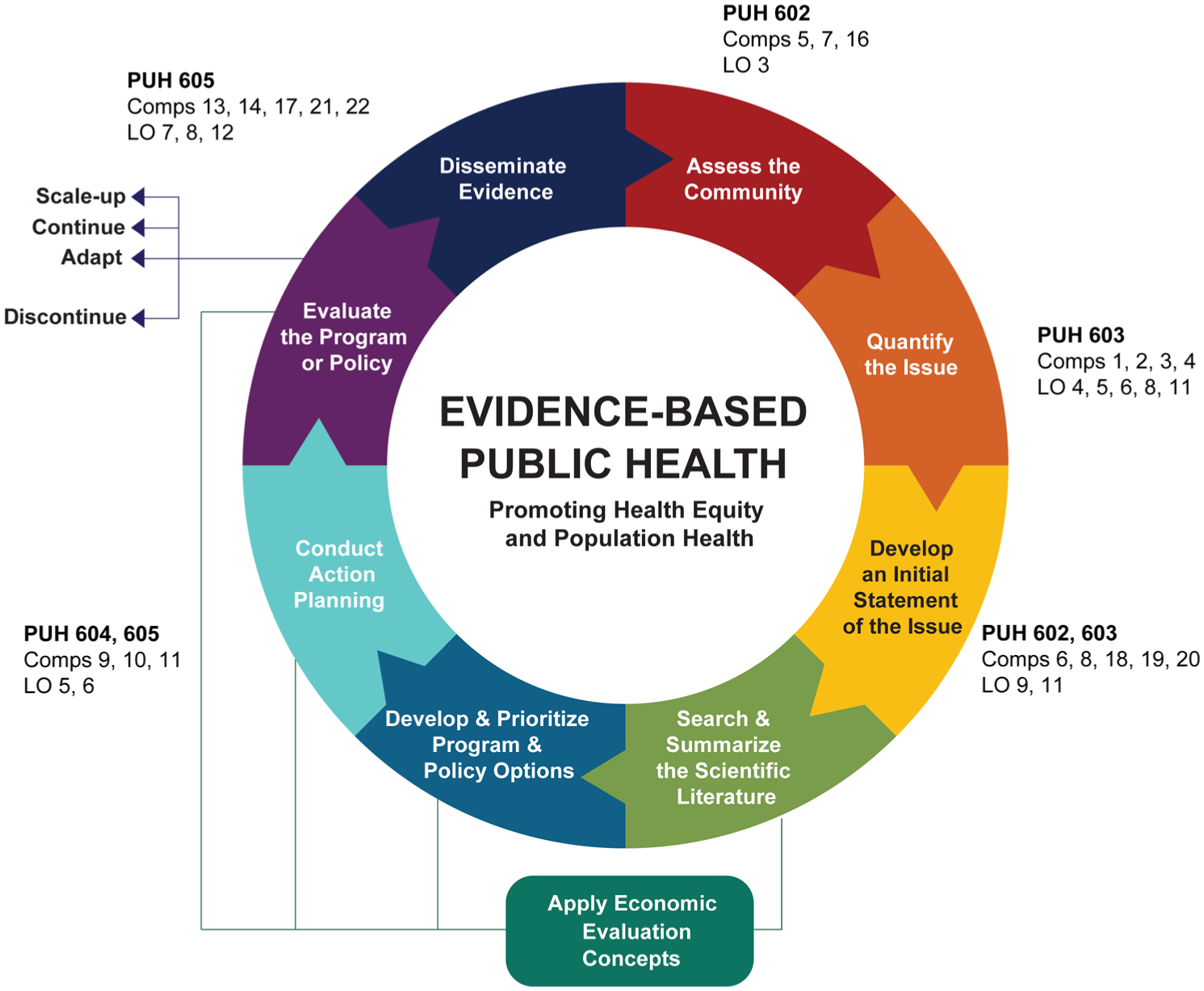
A map of the 2016 Council on Education for Public Health (CEPH) competencies (skills) to the existing evidence-based public health (EBPH) framework () to develop novel master of public health core courses, University of Alabama School of Public Health, fall 2020. Abbreviations: comps, competencies; LO, learning objective; PUH, public health.
Implementing the Novel Curriculum
The CCRC identified instructor teams to work together to further develop the approved MPH core curriculum courses. The program followed a 7-week cohort model (eTable 3 in the Supplement). Each course was organized by modules (topics, weeks) with learning objectives based on Bloom’s Taxonomy of Learning. 14 When COVID-19 disrupted instruction in early 2020, faculty quickly transitioned to virtual delivery. Given existing experience with online teaching and emergency response planning, the MPH Core Redesign Committee elected to proceed with implementation in fall 2020 rather than delaying it until a return to in-person instruction for an unknown length of time. Thus, the planned in-person cohort was delivered synchronously online in alignment with pandemic mitigation efforts.
Applying Mixed Methods to Evaluate the Novel Curriculum
Drawing on the evidence-based evaluation procedures emphasized throughout the courses, faculty designed the evaluation around Kirkpatrick’s level 1 (reaction), level 2 (learning), and level 3 (behavior) and applied an explanatory sequential design to assess effectiveness and acceptability. 15 The UAB Institutional Review Board (IRB) considered this evaluation exempt (no written consent required) because it involved normal educational practices in an established educational setting (IRB-300008127). Instructors administered anonymized, matched pair surveys electronically using Qualtrics XM (Silver Lake) embedded within the learning management system Canvas at the start and end of each core course to all enrolled students. 16 These voluntary surveys were based on a modified Public Health Foundation Competency Assessment for Public Health Professionals with its own rating system. 17 The assistant dean for accreditation (K.E.S.) compared descriptive statistics (percentages and means) with outcome metrics to determine whether the metrics were met.
A faculty member with mixed-methods expertise who did not participate in the curriculum revision or teach the early cohorts (M.B.R.) recruited eligible students through flyers and targeted emails. This faculty member conducted virtual, 1-hour semistructured individual interviews and focus groups to better understand student perspectives. Focus groups and interview guides asked students about their understanding of the use of the EBPH framework to inform the course structure and sequence; the quality of resources, activities, and assessments and whether they were relevant to public health practice; students’ self-efficacy with regard to skills required to meet competencies and desire for additional training or exposure; and whether and how the core curriculum informed students’ fit in their career path. Audio was recorded and transcribed. Two coders (M.B.R. and a student) conducted a priori thematic analysis using NVivo version 12 (Lumivero).
Results
Initial student cohorts shared their perspectives on self-efficacy in attaining competencies and quality improvement through surveys and complementary qualitative components (Figure 2). Student retention was high: 90% (38 of 42) and 83% (182 of 220) in the first 2 cohorts who enrolled in fall 2020 and spring 2021, respectively (eTable 4 in the Supplement). Student cohorts had various educational and professional backgrounds, with participation across instructional modes (Table 1).
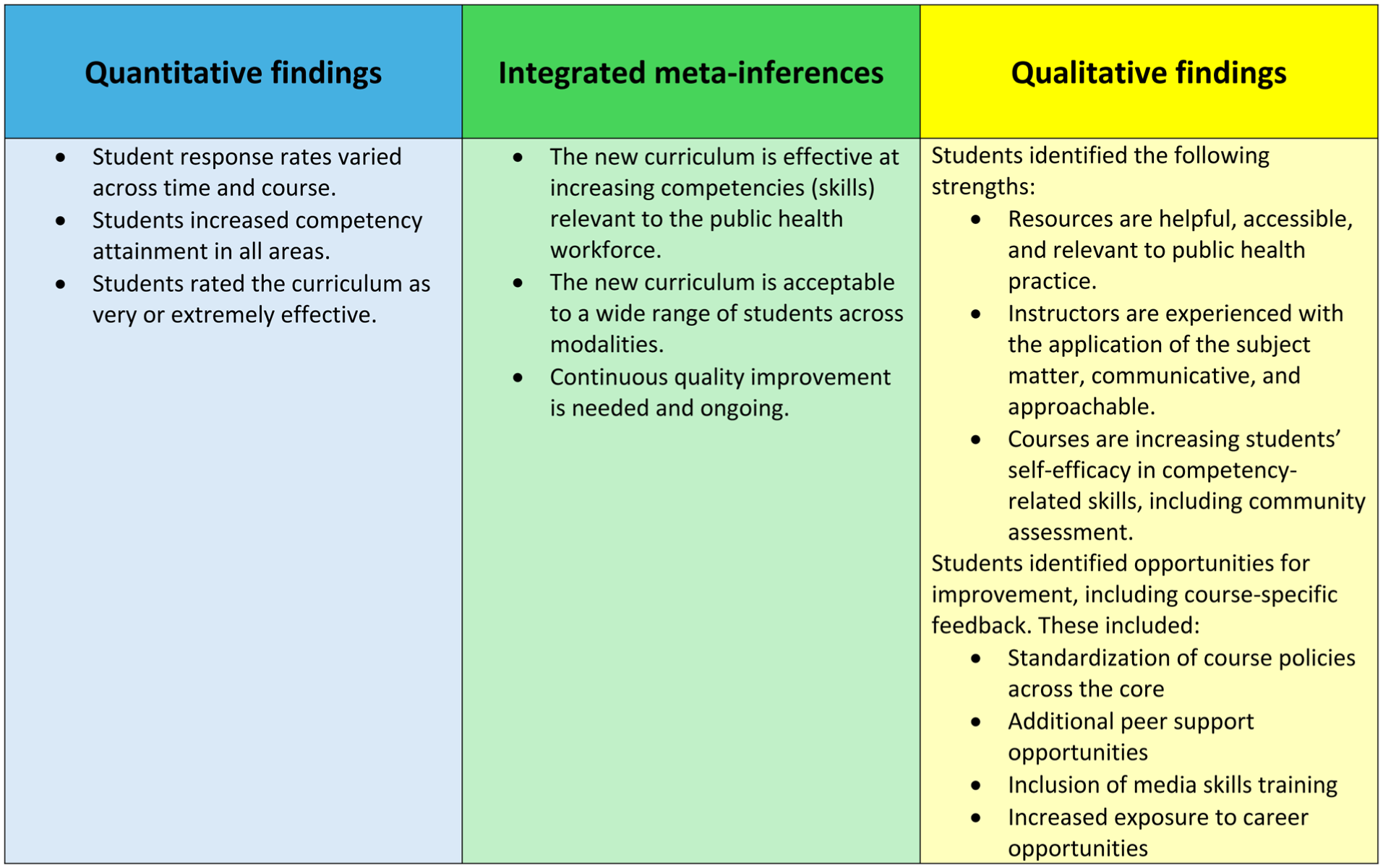
Application of a mixed-methods evaluation to the revised master of public health core curriculum from students enrolled at the University of Alabama School of Public Health in cohorts beginning fall 2020 to summer 2021. The summary of the pre- and postcourse surveys from fall 2020 to summer 2021 and findings from focus groups and interviews in spring 2021 were synthesized. This joint display of data shows the students found the curriculum based on the Evidence Based Public Health (EBPH) framework was effective at attaining competencies and acceptable across modalities with continuous quality improvement needed and ongoing.
Characteristics of initial cohort student participants (N = 60) in 6 virtual focus groups (n = 50) and interviews (n = 10), University of Alabama at Birmingham School of Public Health, spring 2022 a

Abbreviation: MPH, master of public health.
Students who were initially enrolled across modalities in fall 2020–summer 2021 in the School of Public Health at the University of Alabama at Birmingham participated in a mixed-methods evaluation of the novel curriculum conducted by faculty for quality improvement. Faculty presented optional pre- and postsurveys on competency attainment to all students in each core course. In spring 2022 after completing the core curriculum, student participants were oversampled to ensure they represented the students enrolled—ethnically diverse students and students with a range of previous public health workforce experience and education experience. Students volunteered feedback through focus groups and semistructured interviews for students whose work schedules precluded group participation. This qualitative approach enhanced the pre- and postsurvey feedback.
One participant self-described as Middle Eastern and another as White and Middle Eastern.
Survey response rates varied widely by course and by when the survey was administered. For example, response rates for cohort 1 varied from 92% for a precourse survey in 1 course to 18% for a postcourse survey in another course. Of the cohort 2 students who responded to posttests (63 of 182; 35%), about half rated the curriculum as very effective or extremely effective (33 of 63; 52%). Students’ self-assessed competency attainment increased in all areas from ratings of no awareness or limited awareness of the competency or skill to ratings of knowledgeable and comfortable and proficient in their knowledge or skill.
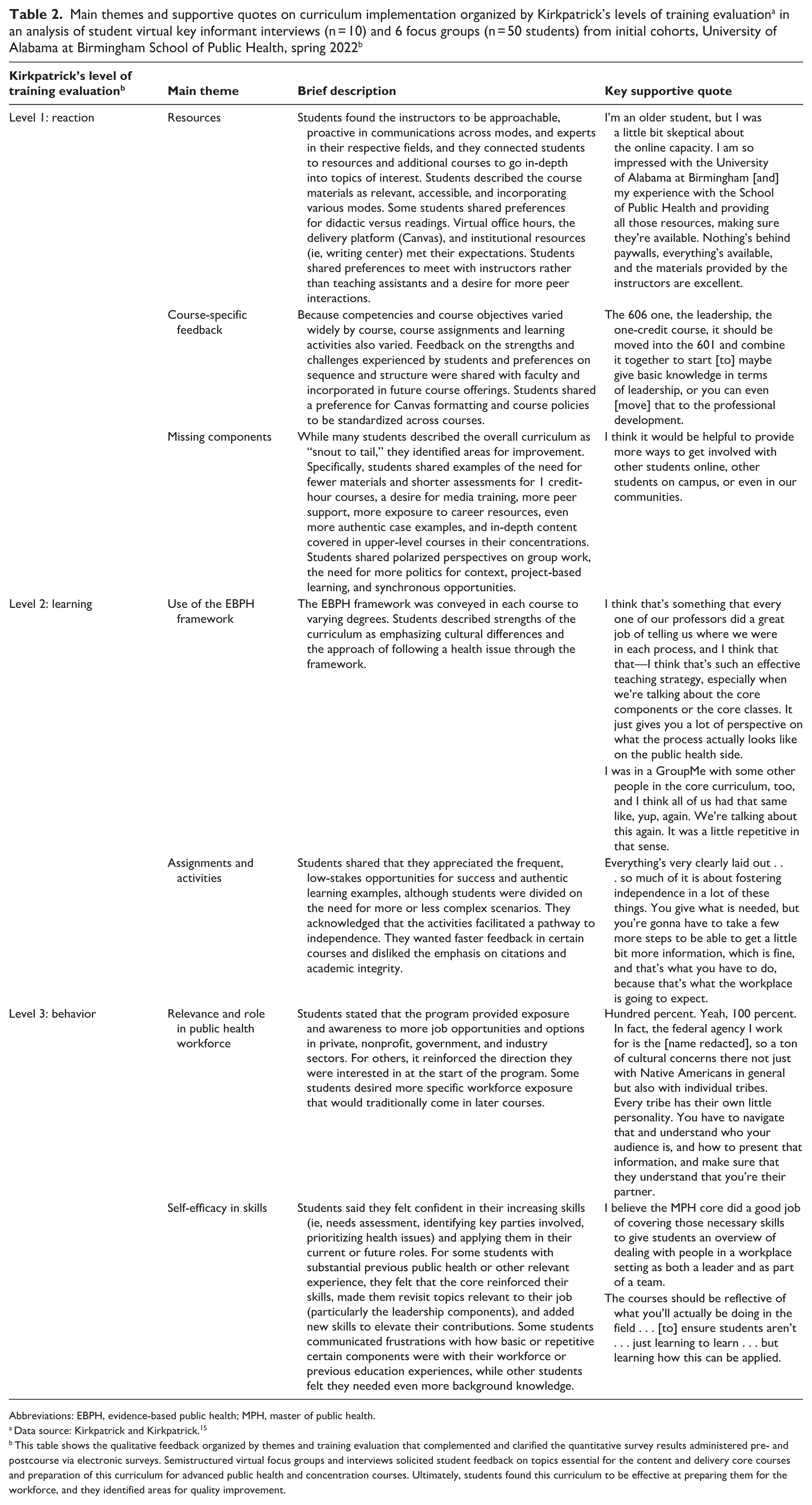
A total of 60 students participated in the qualitative components (10 participated in interviews, 50 participated across 6 focus groups) (Table 1). Students had completed the 6 core courses during 2 semesters, were enrolled in the various modes of course delivery, had a wide range of previous public health or other relevant work experience, and had diverse backgrounds (eg, racial and ethnic diversity, first-generation college students). Main themes included use of the EBPH framework, resources, relevance and role in the public health workforce, assignments and activities, course-specific feedback, missing components, and self-efficacy in skills (Table 2).
Main themes and supportive quotes on curriculum implementation organized by Kirkpatrick’s levels of training evaluation a in an analysis of student virtual key informant interviews (n = 10) and 6 focus groups (n = 50 students) from initial cohorts, University of Alabama at Birmingham School of Public Health, spring 2022 b
Abbreviations: EBPH, evidence-based public health; MPH, master of public health.
Data source: Kirkpatrick and Kirkpatrick. 15
This table shows the qualitative feedback organized by themes and training evaluation that complemented and clarified the quantitative survey results administered pre- and postcourse via electronic surveys. Semistructured virtual focus groups and interviews solicited student feedback on topics essential for the content and delivery core courses and preparation of this curriculum for advanced public health and concentration courses. Ultimately, students found this curriculum to be effective at preparing them for the workforce, and they identified areas for quality improvement.
Collection of supplemental key informant feedback is ongoing. Intermediate-term evaluation outcomes aligned with Kirkpatrick levels 1 to 3. In addition to the student perspectives shared here, informant feedback extended to MPH core faculty satisfaction and best practices, department concentration faculty satisfaction with the core preparing students with a strong foundation for future advanced coursework, demonstrated attainment of core competencies, and confidence in competencies on applied practice examinations. Long-term outcomes, aligned to Kirkpatrick’s level 4 (results), included graduates
Discussion
Changes to Implementation
Students preferred standardized policies, fewer 8
Findings indicate that the EBPH framework provides an effective foundation for an MPH core course at a research-intensive institution with students from diverse backgrounds, including students from underrepresented racial and ethnic minority backgrounds, first-generation students, and working professionals.18-20 This curriculum centers health equity and the 10 EPHS while maintaining strong practice-based and community-focused learning. The EBPH approach to curriculum design and implementation has been successful in engaging students and has been established as relevant to public health practice, with areas of opportunity to improve the program identified and implemented.5,6,10,21 This innovative curriculum offers a comprehensive, adaptable model for other institutions. It provides opportunities to address complex public health challenges through a holistic, multidisciplinary perspective, such as recently expanding programs. 22 Efforts to elevate the curriculum are ongoing and include feedback from instructors, student course surveys, and the CCRC. This critical investment in programing mirrors investments from other institutions. 23 The faculty member who conducted the qualitative evaluation (M.B.R.) presented the summary feedback from the initial cohorts to core course instructors, who incorporated the feedback as part of ongoing quality improvement. All core courses were certified through Quality Matters (https://www.qualitymatters.org/), the standard for best practices in online learning, to be delivered consistently across modes and semesters. 11 Notably, the curriculum was a strength of a recent CEPH reaccreditation approval.
While MPH degrees are designed to be practice-focused, schools of public health traditionally instruct theoretical principals. At UAB SOPH, school leadership approached course redesign by reaffirming the value of the practice-based degree so students will be better prepared for a workforce stretched beyond the limits. 11 Data from the most recent Public Health Workforce Interests and Needs Survey show the current workforce needs are great: one-third of students surveyed considered leaving the workforce in the next few years.24,25 The public health workforce was stretched before the COVID-19 pandemic, with more than 70% of state and local government public health workers reportedly experiencing burnout, and with ongoing retirements, there will be a loss of leaders and institutional and leadership knowledge.26-29 New graduates will step into roles with the potential to be fast-tracked to leadership opportunities. 30 Given the political uncertainty, shifting priorities of the current administration, and emerging technologies, public health graduates will need practical skills and the ability to navigate an environment fraught with challenges. Furthermore, graduates will need to address these challenges from a practical rather than theoretical perspective, which is a well-documented challenge. 31 This need for a growth mindset distinguishes a practice-based program from a fixed mindset of skills that may become obsolete.
Participation in the program across instructional modes was strong despite the COVID-19 pandemic. Students in initial cohorts highlighted strong instruction and connection to public health practice. Students noted alignment among competencies, materials, and assessments. Instructors adapted to student preferences, which allowed students to focus on processing and applying the concepts. The EBPH framework curriculum reflects recent student perspectives on the future of public health education—community-focused, equity-driven, and emphasizing the role of the social determinants of health.32-35 Public health professionals across multiple disciplines collaboratively designed this curriculum to tackle wicked problems, which are complex, intractable issues that require creative, long-term systemic commitments. 36 This multidisciplinary approach is similar to other novel curricula in programs preparing future public health practitioners.35-37 Incorporating student perspectives remains critical because students will bridge the gap between current practice and future directions and implement recent calls to action.38,39 Le et al summarized 12 student-authored articles that called for a shift from individual-level behaviors toward critically confronting systems that lead to oppressive structures. 40 Students called for the consideration of more radical approaches than current public health pedagogy on structural racism despite a lack of consensus on how best to teach these challenging concepts.41-43 Other institutions have mapped competencies into curriculum to meet similar goals, but evaluations lacked insight from the landscape-changing pandemic, relied exclusively on self-reported measures with low response rates, lacked programmatic evidence, or lacked sufficient details to emulate in their own programs.44-48
Lessons Learned
We distilled several concrete lessons organized by stage that can inform adoption of this curriculum by other schools.
Planning
Align the curriculum with the EBPH framework, CEPH competencies, and the school’s mission, vision, and values to ensure relevance to practice and reaccreditation standards.
Identify which departments the expertise of the competencies are mapped to and engage exceptional instructors to participate in curriculum development.
Integrate the 10 EPHS, emphasize health equity, and underscore the social determinants early in the process to prepare students for wicked public health challenges and respond to student calls for systemic approaches to health issues rather than individual drivers. 12
Anticipate the needs of online, parttime, and coordinated (dual) degree students by designing flexible sequencing and delivery modes.
Build resiliency into the design that includes contingency plans for disruptions and evolving challenges (ie, COVID-19 pandemic, generative artificial intelligence, political shifts).
Implementation
Standardize platforms and policies (ie, communication norms, consistent deadlines) to improve the student experience.
Once the curriculum is developed and piloted, rotate instructional responsibilities across departments with faculty who have demonstrated strong evidence of instructional success and communication to diversify perspectives and distribute resources (tuition collected per credit hour enrolled) equitably across the school.
Embed authentic and equity-centered learning experiences aligned with competencies to enhance practice readiness.
Apply best practices in online learning (ie, Quality Matters certification) to ensure consistency in delivery across courses and semesters.
Evaluation
Require evaluations as integrated, mandatory assessments to strengthen longitudinal opportunities for quality improvement.
Streamline instruments and reduce duplication to ensure engagement and quality of data collected.
Implement a mixed-methods approach with surveys, focus groups, and interviews to mitigate low response rates and oversample to ensure representation across diverse cohorts.
Revision
Iterate the process to ensure continuous quality improvement.
Refresh cases, update materials, and realign assessments with evolving competencies with major revisions at minimum every 5 years.
Remove rigid core course sequencing requirements to simplify degree completion plans for students, especially for online, part-time, and coordinated (dual) degree students, populations that account for an increasing share of overall enrollment in the MPH degree.49,50
Adhere to standard semester scheduling to ensure in-depth engagement in the content.
Explore the provision of expanded opportunities for online learners to engage remotely in on-campus events that promote growth and development.
Limitations
This evaluation had several limitations. First, the pre- and postsurveys were optional, which led to low uptake and limited feedback. Second, survey fatigue and the challenges of implementing the evaluation during the COVID-19 pandemic, with its documented increases in psychological stress, likely reduced student engagement and contributed to inconsistent response rates across courses. 51 Third, although student input was sought via multiple channels through the mixed-methods design and oversampling to ensure diverse representation, we recommend that future redesign efforts provide rationale, require key evaluation components, and streamline delivery. Finally, this study may not be generalizable to all schools and programs of public health, as noted by a similar case study in Isreal.52-54
Practice Implications
The UAB SOPH developed an MPH curriculum using the EBPH framework to meet competencies and prepare students for practice-focused professional positions. The evaluation highlighted its relevance for students who are new to public health, online learning, and US graduate education. The substantial increase in enrollment and a modest rise in attrition, compared with previous years, could have been related to the COVID-19 pandemic, the demand of the new core curriculum, neither, or both. 55 Using the EBPH framework, aligned with institutional mission and values and CEPH competencies, this curriculum has been shown to be effective for increasing self-efficacy and achievement in public health competencies as evidenced by pre- and postsurveys, focus groups, and interviews in early student cohorts. By emphasizing the role of rigorous scientific evidence in decision-making (eg, which interventions work, for what populations), an MPH core curriculum built around the EBPH framework can explicitly link the research conducted by public health faculty at UAB SOPH with the skills students need to be effective public health practitioners. This novel MPH core curriculum implemented pedagogy above and beyond expectations for a new program and responded to the needs of the public health workforce, while also highlighting the critical work our faculty do to provide scientific evidence and improve population health.
The EBPH framework has proven to be an effective organizing principle for an MPH core curriculum, yielding enhanced engagement, practice relevance, and competency attainment and earning external validation through Quality Matters approval and CEPH reaccreditation. By institutionalizing continuous quality improvement—grounded in standardized platforms and policies, mandatory evaluation, equity-centered learning, and cross-departmental instructional rotation—the program offers a replicable model and interdisciplinary approach for schools and programs of public health seeking to prepare future public health professionals to be ready for practice and capable of addressing the complex and evolving challenges of the field.
Supplemental Material
sj-docx-1-phr-10.1177_00333549261446616 – Supplemental material for An Evidence-Based Master of Public Health Curriculum
Supplemental material, sj-docx-1-phr-10.1177_00333549261446616 for An Evidence-Based Master of Public Health Curriculum by Molly B. Richardson, Jessica T. Chambliss, Erika L. Austin, Anne E. Brisendine, Matthew Fifolt, Lisa McCormick, Greg Pavela, Julie K. Preskitt, Kelley E. Swatzell and Paul C. Erwin in Public Health Reports®
Footnotes
ORCID iDs

Funding
The authors received no financial support for the research, authorship, and/or publication of this article.
Declaration of Conflicting Interests
The authors declared the following potential conflicts of interest with respect to the research, authorship, and/or publication of this article: The authors are or were recent faculty members at the University of Alabama at Birmingham School of Public Health, and many have training and experience in implementing the Evidence-Based Public Health framework for workforce development.
Supplemental Material
Supplemental material for this article is available online. The authors have provided these supplemental materials to give readers additional information about their work. These materials have not been edited or formatted by Public Health Reports’s scientific editors and, thus, may not conform to the guidelines of the AMA Manual of Style, 11th Edition.
References
Supplementary Material
Please find the following supplemental material available below.
For Open Access articles published under a Creative Commons License, all supplemental material carries the same license as the article it is associated with.
For non-Open Access articles published, all supplemental material carries a non-exclusive license, and permission requests for re-use of supplemental material or any part of supplemental material shall be sent directly to the copyright owner as specified in the copyright notice associated with the article.
