




Abstract

Keywords
There would be meat stored in great piles in rooms; and the water from leaky roofs would drip over it, and thousands of rats would race about on it. It was too dark in these storage places to see well, but a man could run his hand over these piles of meat and sweep off handfuls of the dried dung of rats. —Upton Sinclair, The Jungle, 1906
1
For the first time in #HIV history, #epidemic control is possible. Today, on #WAD2017, lets redouble our commitment to end it for good. #EndAIDS #WorldAIDSDay.
2
—CDC Global Health, tweet, December 1, 2017
Writing is crucial to public health, whether it be 335 pages or 136 characters. In 335 pages, Upton Sinclair’s 1906 novel, The Jungle, drew attention to the horrible occupational and sanitary conditions of Chicago’s meatpacking industry. 1 Although Sinclair’s objective was to change the working conditions of immigrant meatpacking workers, the novel led to passage of the Pure Food and Drug Act 3 and the Meat Inspection Act 4 within a year of the book’s publication. 5 In 2017, the Centers for Disease Control and Prevention’s (CDC’s) 136-character tweet on World AIDS Day drew attention to progress in HIV care and the need for a sustained commitment to end the epidemic. 2 Although different in length and form, both illustrate the use of writing for the purpose of improving the health of populations.
The issues of public health communication are as diverse as the audiences with whom public health practitioners communicate. Public health practitioners communicate in writing to colleagues, funders, researchers, politicians, and community members from various cultural backgrounds to create change and improve health through various written texts. 6 The breadth of topics and audiences involved requires exposure to, and training in, a wide range of writing types.
Training programs need to consider that writing is not a general transferable skill. 7,8 Although some components (eg, spelling, punctuation) do transfer from one discipline to another, other components (eg, types of text or included components) do not. Writing forms use conventions that are specific to a context (such as the audience and the occasion in which the audience reads), which means that writing in public health differs, for example, from writing in the humanities. 8 Despite some overlap, writing in the humanities tends to be more writer-centered and more directed to describing and exploring the human condition than writing in public health. In contrast, writing in public health is more functional than writing in the humanities; its purpose is to help readers understand and act on information. The information and how it is used by readers are more important than the author’s style or voice. 9 For example, scientific writing makes fewer references to self (ie, “I” or “we”) than does writing in the humanities. This difference may be purely semantic, but analysis suggests that it says much about the role of writer (or researcher) and how the writer is positioned in relation to the evidence deemed important to the field. 10 Scientific writing is more objective than writing in the humanities, and the information is more important than the writer. 11 Regardless of their level of training, students transitioning from other disciplines to the public health field will need to learn to identify and characterize new audiences, new purposes, and new vocabulary.
In 2016, the Council on Education for Public Health revised its competencies to include written communication as a necessary competency at all levels of public health education, 12 and employers consistently identify writing as a necessary skill. 13 Although the Council on Education for Public Health competencies included written communication, it actually said little about how writing should be taught. When public health educators consider how to teach writing in public health, learning to write needs to be considered as a process of becoming acculturated to shared beliefs and disciplinary practices in public health. In this article, I review approaches to teaching writing and how writing instruction has been integrated across the curriculum at the University of Washington (UW) School of Public Health, starting with the types of documents commonly used in public health writing. 7,9,11,14
Defining Types of Public Health Documents
Newcomers to a field are initiated into the ways of thinking and writing by reading and writing documents used in the discipline. 8,15 Students gain an understanding of the essential questions, acquire and assess valued evidence, and construct arguments to be understood by a particular audience through exposure. This familiarity is important at both the macro-level—deciding when to use certain document types—and the micro-level—rhetorical strategies and construction of phases. 6,7 Even students with well-developed grammar and vocabulary skills face challenges as they enter the public health field and learn how to write functional documents for specific audiences.
“Writing in the disciplines” is a framework that suggests that identifying public health document types is necessary in good writing instruction. Identifying document types creates the opportunity for more explicit and systematic teaching of texts, analysis of content features, and consideration of audience. 11 In 2012, faculty at the UW School of Public Health identified the range of document types used in public health that could be used when teaching (Table).
Types of documents used in public health writing identified by the University of Washington School of Public Health, 2012
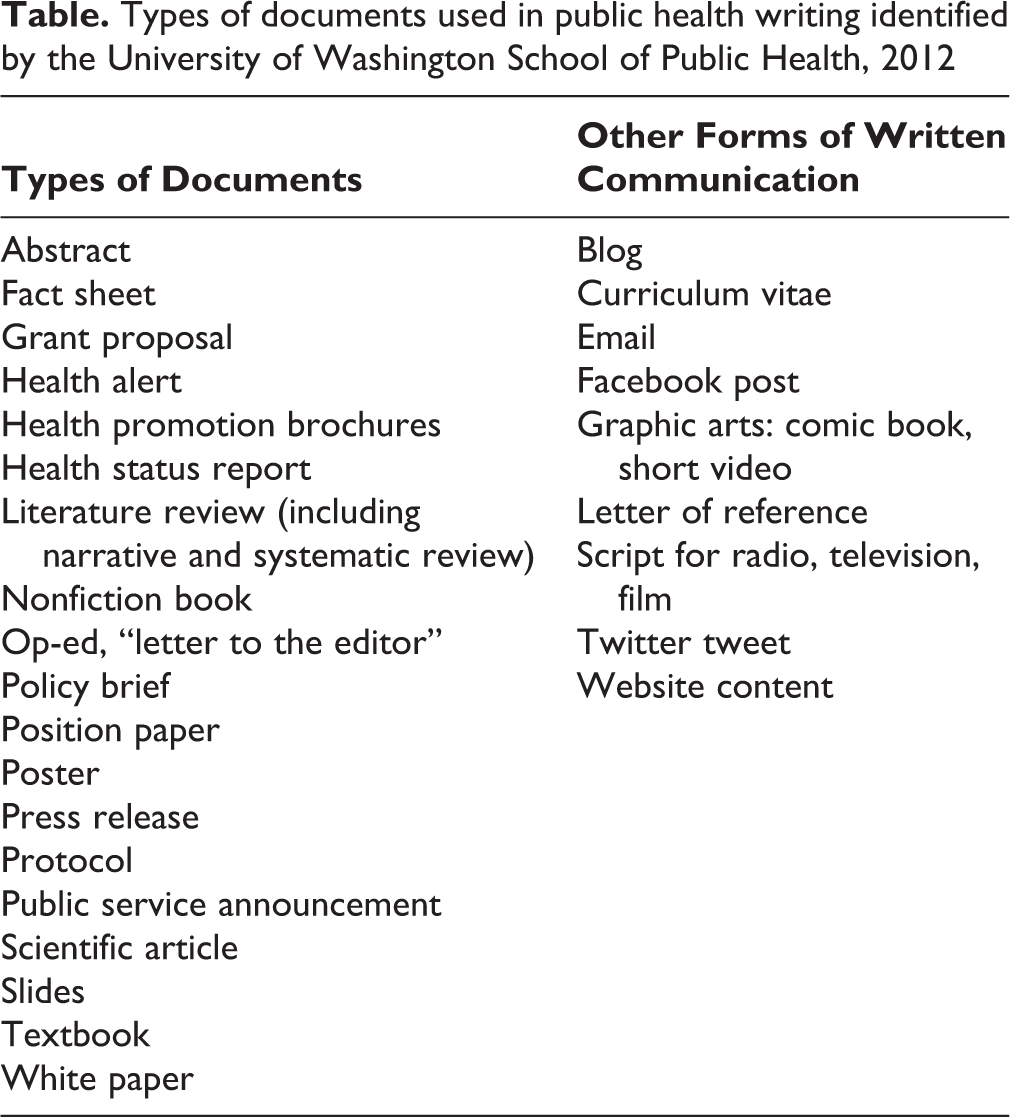
In creating this list, faculty did not identify or describe the norms, conventions, or formats for each. Rather, faculty thought broadly about what types of writing are used in the public health field. Some documents, such as literature reviews, grant proposals, and scientific articles, have standard organizations and formats. Others, such as health promotion brochures, white papers, and health alerts, are less standardized and function in a broader range of potential social contexts. In addition, faculty believed writing for social media was important, given the expanding use of this medium. Facebook, Twitter, blogs, and online forums are increasingly used in public health communication and are evolving media for targeting a range of audiences. 16,17
Listing the types of documents highlighted a lack of consistency in how UW School of Public Health faculty describe, prepare, and use these documents. In addition, faculty differed about which established criteria, techniques, or practices were most important. For example, faculty discussed which components of white papers, fact sheets, and health alerts were important to their effectiveness. Experts in a field are generally comfortable with a range of document types and nuanced variations within document types. For most faculty, learning to write in the profession is a slow process of acculturation, not the result of intentional instruction or analysis. As a result, faculty are not always aware of how they know what they know about writing. 18
The literature suggests that students move through stages of understanding as they develop writing skills. 17 Initially, students assume that some writing rules are universal, such as the required components of a literature review or a requirement for formality in language. As they complete discipline-specific courses, they encounter various types of writing, such as narrative and systematic literature reviews, and faculty members have their own set of required components. Initially, students assume that the differences reflect idiosyncrasies of the faculty. Eventually, the students reach a higher level of understanding and recognize the complexity of conventions. As students improve their writing skills, they evolve from mechanical writers to more nuanced writers able to appreciate subtle variations in document type and audience. 6,18
Students can become acculturated through immersion, in which they learn to write various types of documents simply by being exposed to them. However, making explicit the expectations and conventions of disciplinary document types benefits students’ development. 19 For example, when teaching about grant writing, explicitly helping students understand that agencies have various rules for required components and formatting is important. This lesson may be particularly important for students from backgrounds that are historically underrepresented in the public health profession because these students will have been less exposed than more privileged students to documents similar to those used in public health. 20 In addition, raising faculty awareness about the range of document types used in public health practice allows faculty to intentionally use these documents in their teaching. Exposing students to the range of document types through reading and writing allows them to see the similarities and differences among document types as students learn which aspects of writing are seen as relevant in public health.
Strategies for Teaching Writing: Writing Across the Curriculum
Writing in the disciplines tends to focus on the types of writing students and experts do, as well as on the processes by which students learn the document types in the discipline. 19 Writing in the disciplines supports the notion that public health writing is a social experience and enhances acculturation into the public health community. If public health educators accept this premise, the next step is to consider how to incorporate writing into public health education. Writing across the curriculum (WAC) is a pedagogical approach that began in the 1970s and has since been widely implemented in higher education. An important component of WAC is recognizing the importance of teaching writing across curricula rather than in isolated courses or remedial workshops. 20 -25 In WAC, all faculty are involved in helping students learn to write. Public health faculty do not need to become writing teachers; rather, they are encouraged to use writing to help students learn how to do public health work. 7
When writing is integrated across the curriculum, it allows students to engage with content (“writing to learn”) and to learn the situational contexts in which various document types are used within the discipline (“learning to write”). 7,8,26 Integrating WAC changes how higher education is delivered, from a lecture-and-examination–based model to one that is more student-centered, interactive, and engaging. 8 The writing-to-learn concept recognizes that writing is important in student learning. Writing forces students to process, evaluate, and make sense of discipline-specific content. With thoughtful prompts, writing leads to greater understanding and better critical thinking. 26,27
The writing-to-learn approach generally involves less formal and shorter low-stakes writing assignments, emphasizing that the process is more important than the end product. Low-stakes writing is used to help students process and integrate information. 26 Writing to learn provides students opportunities for self-reflection or examination of how their experiences are related to new knowledge and allows them to integrate new information into their understanding. Examples of writing-to-learn assignments include answering guided questions that require students to summarize, explain, or critique a reading; composing quick writes or free-writes in class in response to an open-ended prompt; asking students to take a position, which can then be discussed in small or large groups; and keeping a journal in which students reflect on their changing roles, goals, professional socialization, or development. If low-stakes assignments are graded, the focus is on the student’s reasoning and processing of content, rather than the quality of the writing.
The learning-to-write approach emphasizes integrating discipline-specific document types so that students become skilled at recognizing what type of writing to use in various social contexts. When writing is integrated across a curriculum and faculty understand the writing-to-learn and learning-to-write dynamics, they can better integrate writing activities into their teaching. Assignments can break concepts into smaller learning steps and then build them back into a full understanding. If faculty coordinate across courses and across the curriculum, they can incrementally design the curriculum so that students grow stronger in their understanding and skills, and faculty can incrementally remove the amount of support they provide—a process called “scaffolding.” 28 Students may first be asked to perform low-stakes writing about a content area and, when the content is more familiar, be asked to complete higher-stakes document-specific writing. They might also be asked to write about content in a particular document type (eg, health alert) and then transpose the content into another format (eg, grant). The intentional sequencing of tasks within and across courses allows students to build confidence and competence in their use of content knowledge and writing various types of documents. 29
The WAC model has been effective in several health sciences programs, primarily nursing, medicine, and social work. 24,25 Successful writing-to-learn programs in the health sciences incorporate writing assignments that complement course objectives and that students believe are meaningful and related to a professional task they will eventually perform. Such assignments should build from simple to complex, involve examples of good writing with clear grading criteria, and allow for revisions. 30,31
Teaching Writing at the UW School of Public Health
In 2012, the UW School of Public Health developed the bachelor of arts and bachelor of science degrees for public health majors. The team developing the degrees believed the core curriculum needed to have a strong writing component and, after reviewing the literature, adopted a WAC model. This decision continues to affect content delivery, curriculum, and faculty development.
Writing is a central component of required, sequenced courses at the UW School of Public Health. Students write often, and faculty regularly discuss how various document types are used across the curriculum to enhance learning. In developing assignments, faculty identify the knowledge and skills necessary for a student to write a particular document. For example, to write a narrative literature review, students must have the skills to perform a literature review. To develop a public service announcement from the literature review, they must be able to determine which information in the review is most important for a given audience. In addition, faculty ask how various document types align with the competencies in core courses and then select the appropriate document type. For example, in the History and Practice of Public Health course, students learn about the structure and function of public health agencies. An aligned assignment is for students to research public health community resources that address emergency response. The students then develop a public service announcement for identified community members. In the Science and Public Health course, students learn about the place of basic science research in developing public health recommendations. An aligned assignment asks the students to perform a literature review and analyze a grant. In the Research Methods course, students build on the literature review and write a grant. Finally, in the capstone course, students select the document type most relevant to the work they are doing at a community-based agency. The real-life grounding of assignments and their intentional connection to course content help students appreciate public health work. In addition, the range of document types allows faculty to challenge students to match type with an audience, evidence, and purpose.
Faculty development is a key component of WAC because all faculty are responsible for helping students learn to write and because the process of writing changes how content is delivered. Developing and sequencing assignments create opportunities for collaboration among core course instructors. Public health faculty bring content expertise but learn together how to use writing to help students engage with that content. Faculty development meetings incorporate facilitated readings and discussions about the position of writing in the curriculum. Writing experts are regularly invited to biannual retreats to help faculty gain confidence in developing writing assignments, providing feedback, and using writing to assess learning. In addition, faculty can work with the writing center individually to develop grading systems, assignments, and peer-review activities.
Integrating WAC activities at the UW School of Public Health has had intended and unintended consequences. Faculty set out to improve students’ learning and writing proficiency and are now developing an evaluation of the longitudinal effect on students’ writing skills. In the short term, focusing on writing has led core faculty to become more thoughtful and deliberate about describing the goal and purpose of assessments. In addition, faculty are now more likely to consider real-life writing assignments because they can select from a list of public health documents. The shared experience of contemplating how to incorporate writing across the curriculum has enhanced a collaborative, collegial approach. 32
Writing has become a shared interest that has improved communication by faculty across courses and increased awareness about what others are teaching. The experience has created opportunities for faculty to clarify questions about content and their educational expectations in sequential courses. Faculty maintain their autonomy as teachers, but they enhance the student experience through collaboration around writing.
Implementation has not always been easy. With the increased writing load in courses that regularly have 150 students, more teaching assistants have been added and their hours have been increased, which raised the cost of each course. Peer review has been incorporated into teaching to provide additional feedback and to develop students’ skills in recognizing how to give and request feedback.
Developing writing assignments and grading criteria is also time intensive. The UW School of Public Health has a standardized template for assignments that identifies the purpose, audience, and document type. Grading criteria are developed collaboratively. The University Writing Center is a resource for teaching assistants, faculty, and students. For teaching assistants and faculty, staff members at the center review assignments and grading criteria for clarity. For students, the center offers individualized tutoring.
Finally, the process has highlighted the range of writing experience that students bring to the program. With a diverse student body and a mission to train students from backgrounds historically underrepresented in the health professions, faculty try to assign reading and writing tasks that are relevant to a broad range of communities. 20,33,34 In addition, faculty are diligent about providing feedback to enhance learning and to quickly identify students who may need additional support. Incorporating writing for social media has allowed students to explore a broader range of writing applications, some of which may be closer to those already familiar to them and that may be necessary to reach younger populations and diverse communities.
Writing in Public Health
In developing an integrated approach to writing in 2 undergraduate public health degree programs, faculty at the UW School of Public Health started by recognizing the importance of writing and identified established strategies for teaching writing, such as identifying discipline-specific document types, audience, and scaffolding. Faculty recognized the need to incorporate WAC and that writing could not be relegated to a single course. Various document types are now intentionally used to develop writing skills. Having committed faculty and campus resources that can assist in this process has been instrumental in integrating WAC.
In the multidisciplinary field of public health, undergraduate and graduate programs train students from diverse backgrounds to work in a complex world. Writing is so central to public health work that it needs to be central to the education of public health students at undergraduate and graduate levels. Increasing the use of WAC will better prepare students for their professional writing tasks—whether the task requires 136 characters or 335 pages.
Footnotes
Declaration of Conflicting Interests
The author declared no potential conflicts of interest with respect to the research, authorship, and/or publication of this article.
Funding
The author received no financial support for the research, authorship, and/or publication of this article.