




Abstract
While noncongregate shelters are an increasingly common intervention for homelessness, their effect on residents’ psychological well-being is not well understood. This study evaluated the effect of a low-barrier, noncongregate shelter on the well-being of individuals experiencing homelessness in a small Northern California city in 2023. Focusing on 5 key areas of well-being—sleep quality, sense of community, sense of control, generalized anxiety, and psychological safety—this study surveyed 106 (of 170) shelter residents 9 months after the opening of the shelter. A retrospective pretest–posttest design and generalized linear models permitted an analysis of changes in well-being after previously unsheltered individuals moved into the noncongregate shelter, as well as within-subjects’ differences by sex, age, and duration at the shelter. All indicators of well-being with the exception of sense of control showed significant improvement after the shelter move-in. Specifically, on a 5-point Likert scale, with higher scores meaning a more positive outcome, mean sleep quality improved from 2.6 to 4.0 (P < .001), sense of community from 3.1 to 3.4 (P = .01), and psychological safety from 3.1 to 3.5 (P < .001); on a 4-point Likert scale, with higher scores indicating higher levels of anxiety, anxiety decreased from 2.7 to 2.1 (P < .001). Additionally, interactive analyses indicated that changes in well-being differed depending on an individual’s sex, age, and duration at the shelter. While this study demonstrates improvements in well-being relative to individuals living unsheltered, future research should use comparative designs to assess long-term housing stability outcomes for individuals in temporary shelters compared with those who remain unsheltered or in secure permanent supportive housing.
Unsheltered homelessness in California increased by 54% from 80 455 people in 2007 to 123 974 people in 2024. 1 Addressing unsheltered homelessness occurred amid policy shifts that affected anticamping ordinances. 2 The 2018 Martin v Boise ruling limited enforcement of anticamping ordinances without adequate shelter. 2 This legal standard, coupled with the COVID-19 pandemic, spurred experimentation with various types of temporary and low-barrier shelters, as noted in a 2021 report. 3 However, the 2024 Supreme Court decision in Johnson v Grants Pass has since allowed cities greater authority regardless of shelter availability, effectively ending the previous legal standard. 4 The proliferation of these shelters provides an opportunity to understand their effectiveness.
Following a lawsuit that challenged encampment sweeps under Martin v Boise, a settlement led the city of Chico, California, to build 177-unit low-barrier, noncongregate Pallet Shelters at a single site, colloquially referred to as the Pallet Shelter. These prefabricated, 80-square-foot structures include a small heater, air conditioner, and locking doors. The structures accommodate single individuals or cohabitating pairs with communal dining and bathroom areas at the site. The shelter’s implementation faced widespread opposition from local activists, nonprofit organizations, concerned citizens, and members of city council; selection for admission to the Pallet Shelter prioritized individuals from encampments that were targeted for removal as the city intensified anticamping enforcement, linking shelter provision to displacement and encampment clearances, a pattern noted in prior research. 5 Limited capacity also meant many individuals interested in the shelter were turned away.
Previous studies have demonstrated the detrimental effects of encampment abatement (ie, the practice of clearing and dismantling homeless encampments) on the health of unhoused residents 6 and the effectiveness of Housing First and permanent supportive housing (PSH).7,8 However, in the context of a vast shortage of PSH units, 9 this case study provides insight into well-being in temporary, low-barrier sheltering—a less studied area. This case study evaluates the impact of a single low-barrier, noncongregate shelter in Northern California on resident well-being (sleep quality, community, control, anxiety, safety) following a request from the shelter provider.
While research on recently expanded noncongregate shelters and well-being is limited, studies of individuals in temporary accommodations indicate that social support is a critical factor for achieving housing stability and enhancing well-being.10,11 However, these models do not resolve the broader crisis of an inadequate supply of affordable housing. Homelessness is fundamentally a housing problem, driven by structural market conditions rather than individual deficits. 9
Integrated noncongregate shelters may help residents manage a range of chronic health conditions (eg, depression, anxiety, epilepsy), 12 particularly those with integrated health care. One study found that the privacy and stability of hotel rooms allowed residents to rest, reduce stress, and focus on health management and securing housing. 13 The enhanced autonomy—a key theme identified by 1 study of noncongregate hotel shelters 12 —and more home-like conditions afforded by such settings are increasingly recognized as important for improving the well-being of people experiencing homelessness. Nilsson et al 14 further emphasized that social support networks, including having a partner, increase the likelihood of exiting homelessness, suggesting that noncongregate shelter environments that foster social stability may improve long-term housing outcomes. Their meta-analysis of individual-level predictors for exiting homelessness found that factors such as having a partner and experiencing fewer psychiatric or substance use problems were associated with increased odds of leaving homelessness, highlighting the importance of addressing these individual and social factors in efforts to promote housing stability. 14
Purpose
The purpose of this study was to evaluate the effect of a low-barrier, noncongregate shelter on the well-being of previously unsheltered individuals. Per the request of and with the assistance of the shelter operator, we used a quasi-experimental design to examine several aspects of well-being to understand how moving into the shelter affected occupant well-being relative to living unsheltered. We did not compare long-term housing stability outcomes relative to individuals remaining in encampments or moving into PSH because that was beyond the scope of the study. Rather, the findings contribute to an understanding of how temporary, noncongregate shelters influence the well-being of their occupants.
Methods
We used a retrospective pretest–posttest survey design to assess self-reported changes in well-being before and after shelter entry. 15 The complete draft survey was reviewed by the shelter operator and pretested among a small subset of shelter occupants. Data collection took place during a 2-week period in January 2023. The research team surveyed 106 of 170 individuals who were residing in the shelter at the time, resulting in a 62% response rate. Participants were recruited by using convenience sampling, beginning with a sign-up sheet placed in the shelter’s front office. Shelter staff encouraged participation as individuals visited the office. To increase response rates, we implemented a snowball sampling approach whereby initial participants referred others.
The institutional review board (IRB) of California State University, Chico (#IRB-2022-173) approved this study, and all participants completed informed consent forms before proceeding with the survey.
Based on the existing literature, and in collaboration with the shelter operator, we identified 5 dimensions of well-being: sleep quality, sense of community, sense of control, anxiety, and psychological safety.
Sleep Quality
We measured sleep quality by using the Patient-Reported Outcomes Measurement Information System Sleep Disturbance item bank. 16 The most minimal questionnaire consists of 4 items on a a 5-point Likert scale, where 1 = not at all and 5 = very much. This scale suited the practical needs of keeping the number of items low and capturing a universal sense of sleep disturbances before and after moving into the noncongregate shelter.
Sense of Community
We assessed sense of community by using the Brief Sense of Community Scale, which consisted of 8 items on a 5-point Likert scale, where 1 = strongly disagree and 5 = strongly agree. 17 Measuring a sense of community was relevant because many of the shelter residents moved into the shelter as the city cleared encampments across town and enforced local anticamping ordinances, potentially disrupting communities that existed in the encampments. Attempts were made to keep these neighbors together at the noncongregate shelter when requested.
Sense of Control
We measured sense of control by using a scale from research on income and sense of control, 18 with 2 subscales that assessed a sense of personal mastery and a measure of perceived constraints. This dimension totaled 8 items on a 5-point Likert scale, where 1 = strongly disagree and 5 = strongly agree. This dimension has emerged as an important outcome in shelter settings.19,20
Anxiety
We measured anxiety by using the General Anxiety Disorder-7, a validated clinical tool widely used to assess anxiety severity with 7 questions on a 4-point Likert scale, where 1 = not at all and 4 = nearly every day. 21 Shelter administrators identified anxiety as a key concern following displacement, citing increased distress among residents. Research supports the use of anxiety as an outcome variable across multiple homeless populations. 22
Psychological Safety
The Neuroception of Psychological Safety Scale is a self-report instrument designed to assess the dimensions of psychological safety, including compassion, social engagement, and bodily sensations. The subscale used consisted of 10 questions focused on social engagement using a 5-point Likert scale, where 1 = strongly disagree and 5 = strongly agree. 23 While it has been validated primarily among health and social care workers in the United Kingdom, 24 its application in studies involving unhoused populations is limited. However, its focus on perceived safety in social and environmental contexts makes it a relevant tool for assessing psychological safety in shelter settings.
We conducted initial analyses by using 2-tailed paired-sample t tests to compare pretest–posttest measures of well-being, with significance set at α = 0.05 and 95% CIs reported. P values are reported alongside the test statistics and mean differences to clearly indicate what comparisons were made. To further examine differences in well-being outcomes over time, we used repeated-measures general linear models (GLMs). 25 Given that duration of stay varied widely (0-9 months) and was not assigned experimentally, we treated it as a moderator rather than a covariate to better capture individual differences in trajectories of well-being. In repeated-measures GLM, time-dependent factors such as shelter duration may influence well-being in nonuniform ways. For example, longer stays may contribute to improved well-being because of stability or diminish it because of shelter constraints. Treating duration as a moderator allowed us to examine whether its effects on well-being differed across participants, rather than assuming a uniform aspect affecting all participants equally. This approach captures variation in how well-being unfolds over time, rather than adjusting for duration as a static predictor.
Results
Most of the 106 respondents to the survey were male (60%; n = 63) and White (89%; n = 90). One-third were aged 23 to 44 years (36%; n = 38), 45 to 54 years (33%; n = 35), and 55 to 74 years (30%; n = 32). Only 1 respondent reported being currently employed. More than one-third (37%; n = 39) of respondents had resided in the shelter for 0 to 3 months, 32% (n = 34) for 4 to 7 months, and 30% (n = 32) since the shelter had opened, approximately 9 months before the survey.
The difference of means tests indicated that every measure of well-being, with the exception of sense of control, improved after occupants moved into the noncongregate shelter. Specifically, mean sleep quality improved 1.5 points on the 5-point scale, from a mean of 2.6 before the move-in to 4.0 after the move-in (t105 = −8.97; P < .001). Sense of community increased from a mean of 3.1 to 3.4 (t105 = −2.56; P = .01), and sense of psychological safety improved from a mean of 3.1 before the move-in to 3.5 after the move-in (P < .001). Finally, anxiety levels decreased from a before move-in mean of 2.7 to an after move-in mean of 2.1 (t104 = −6.57; P < .001), on a 4-point scale. Overall sense of control did not change significantly (P = .29) from a before move-in mean of 3.3 to an after move-in mean of 3.4.
GLM analyses indicated that sex moderated the within-subjects effect of 2 indicators of well-being—sense of control and anxiety. While the full sample showed no within-subjects change in sense of control, a significant between-subjects interaction (F1,100 = 10.70; P < .001) indicated that women experienced increases while men experienced decreases.
Women reported higher retrospective anxiety than men, but both sexes showed a reduction in present anxiety, with a significant between-subjects interaction effect (F1,102 = 6.61; P = .01).
The effects of shelter move-in varied by age group for all indicators of well-being except sense of community. For sleep quality, anxiety, and sense of safety, the youngest age cohorts saw significantly larger improvements than the more modest effects experienced by the older age categories. The within-subjects interaction effect of time and age was significant for sleep quality (F1,102 = 6.85; P = .002) and anxiety (F1,102 = 5.44; P = .01). We also found a significant interaction effect for sense of safety (F1,102 = 4.28; P = .02). For sense of control, the interactive effect took a different form: younger respondents started with less control and experienced gains, whereas older respondents started with more control but experienced losses, as indicated by a significant within-subjects interaction effect for age (F1,102 = 5.46; P = .01) (Figure).
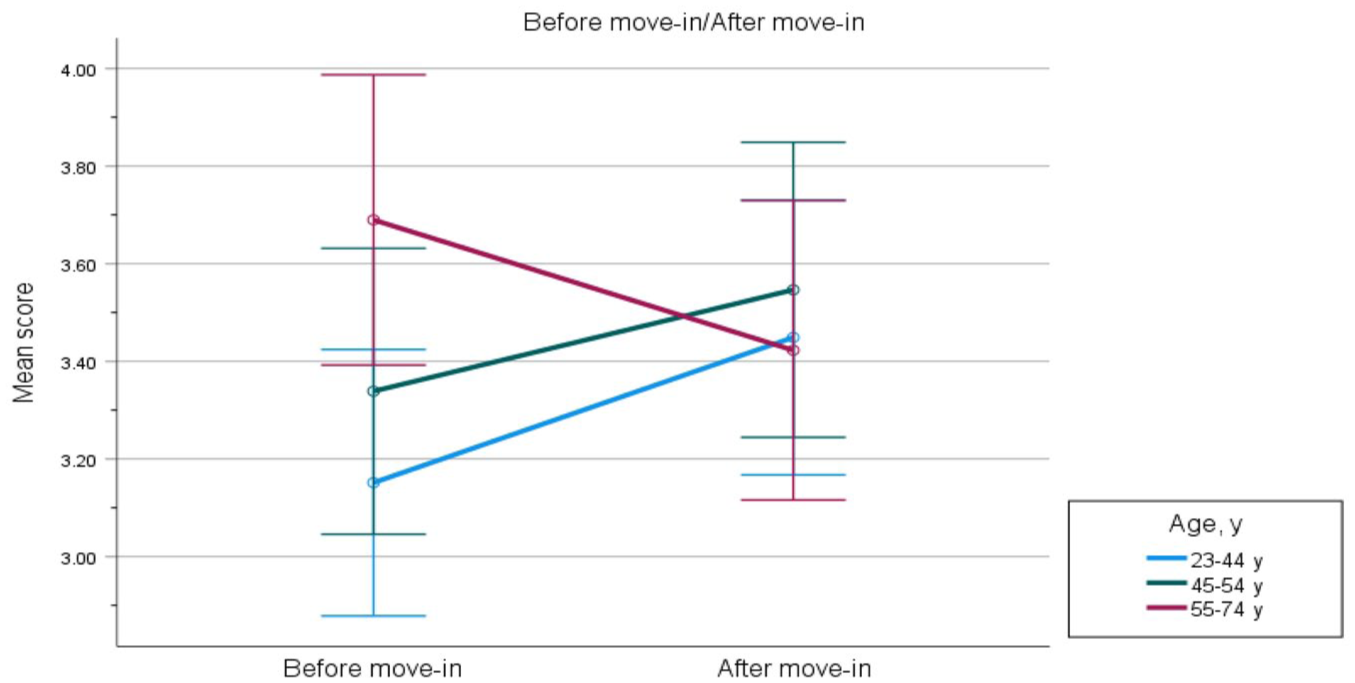
Mean sense-of-control scores among shelter residents by age group, before and after move-in, Chico, California, 2023. Higher scores indicate a better sense of control. Pre-shelter move-in reflects a retrospective self-assessment of well-being before entering the shelter, while time since occupancy reflects a current assessment 9 months after move-in. Error bars represent 95% CIs. Results are from a repeated-measures general linear model. The within-subjects interaction effect of time and age was significant (F = 5.46; P = .01), while the between-subjects effect for age was not significant (P = .37).
Lastly, when we explored whether the duration of stay at the shelter moderated the effect of shelter move-in on well-being, we found significant within-subjects interaction effects in sense of safety and move-in categories (F2,102 = 4.00; P = .02). Specifically, residents who had been at the shelter for 8 to 9 months reported little change in psychological safety, whereas the mean sense of safety increased for residents who had moved in recently.
Discussion
This study examined how residence at a noncongregate shelter affected the well-being of occupants. Overall, results indicated improvements across most well-being indicators. While individual well-being may improve in a controlled shelter setting, these findings do not address whether such interventions affect the broader landscape of housing precarity. In light of the broader literature that well-being is a predictor of future housing stability, our findings suggest that temporary noncongregate shelters may be a beneficial route for stabilizing previously unsheltered individuals, enhancing well-being, and providing the foundation to move into more permanent stable housing, given proper social and community support. However, without meaningful pathways to PSH, emergency shelters risk becoming stopgap measures that perpetuate cycles of displacement rather than serving as a bridge to long-term stability. Further studies are required to examine the direct effect of temporary, noncongregate shelters on housing stability.
While residents reported modest improvements in well-being, these findings must be contextualized within the broader structural effects of displacement associated with encampment abatement. Recent estimates suggest that ongoing involuntary displacement increases mortality risk among unsheltered individuals by 24.4%, primarily because of disrupted service access and heightened overdose risk. 26 Given that the Pallet Shelter’s implementation coincided with intensified encampment removals, its role within a broader system of punitive homelessness management warrants critical examination.
Because of the rapid implementation of the shelter in response to immediate needs, limited opportunities existed for intentional design with respect to designating neighborhoods or incorporating trauma-informed design principles. 27 The finding that the effect of residence on well-being varied by sex and age further suggests the potential for more intentional design of noncongregate shelters that pay special attention to the unique needs of women and older adults.
The finding that sense of control increased for younger individuals but decreased for older individuals in the noncongregate shelter warrants careful consideration. This outcome appears to contrast with some reported benefits of other noncongregate shelter models, such as hotel conversions, where increased stability, privacy, and opportunities for agency generally contributed to residents’ improved well-being and ability to focus on future goals. 28 However, literature on older adults experiencing homelessness offers a critical lens to understand our divergent finding, 29 indicating that these older adults face unique challenges, including potentially ill-suited shelter environments and the phenomenon of “accelerated aging.” Accelerated aging is when individuals may experience health declines and functional limitations typical of older chronological ages at a younger age because of the hardships of homelessness. Shelter environments, even if noncongregate, may impose rules and routines that, while providing structure, could be perceived as a loss of autonomy for older individuals who are accustomed to navigating their survival independently, however precariously. This sense of diminished control could be compounded if the shelter services are not adequately accessible or age-friendly, or if older adults experiencing homelessness feel particularly disempowered by the transition from self-reliance to a managed setting that may not fully cater to their physical or social needs. 29 While younger individuals in our sample may have perceived the structure and safety of the individual units as an increase in control relative to unsheltered living, older adults may have experienced the move as an imposition that curtailed their established routines and perceived freedoms, leading to the observed decrease in their sense of control.
This study had several methodological limitations. First, findings were specific to a single noncongregate shelter, limiting generalizability to other settings. The study used a single-group retrospective pretest–posttest design. While this design was chosen for its capacity to reduce response-shift bias by having participants assess “then” and “now” from the same postintervention vantage point,15,30 it limited causal inference. Second, this study was limited by recall bias, particularly because participants had resided in the shelter for up to 9 months. While some studies that use retrospective pretest–posttest designs have found consistent retrospective reports for periods of 6 to 12 months,25,30 potential memory distortions, especially for those with longer stays, could have influenced the reported magnitude of change in well-being. Findings should therefore be interpreted with caution.
Third, while the response rate (62%; n = 106) was high, convenience and snowball sampling were necessary for this population, potentially introducing selection bias. However, participant characteristics roughly mirrored point-in-time data from the city of Chico for all people experiencing homelessness, both sheltered and unsheltered, in regard to sex (52% male, 38% female, 7% not collected), race (73% White, 10% Native or Indigenous, 5% Black, 2% Asian), and age (39% were aged 25-44 years, 21% were aged 45-54 years, and 26% were aged ≥55 years). 31 Fourth, this study examined the effects of shelter move-in on well-being but did not compare outcomes with the outcomes of remaining unsheltered individuals or those in PSH; such comparisons using a comparative effectiveness research design are needed.
Future research should use longitudinal designs with robust sampling to enhance generalizability, use mixed-effects models to assess individual changes over time, and further examine the effect of such shelters on long-term housing stability.
Footnotes
Acknowledgements
The authors acknowledge occupants of the shelter for their voices and role in shaping this evaluation.
Declaration of Conflicting Interests
The authors declared no potential conflicts of interest with respect to the research, authorship, and/or publication of this article.
Funding
The authors received no financial support for the research, authorship, and/or publication of this article.
