




Abstract

Keywords
Published continuously since 1878, Public Health Reports (PHR), the official journal of the Office of the US Surgeon General and the US Public Health Service, is the oldest scholarly public health journal in the United States and one of the oldest such journals in the world.1,2 In 2021, PHR launched the Public Health Reports: Year in Review article series to inform its contributors and readers about its latest publication metrics, content, and planned improvements. 3 The series currently includes 2 reports—from 2020 and 2021.3,4 To allow for historic volume-based comparison, analyses in these articles continue to be performed by volume, not online publication date, except for time-sensitive COVID-19 articles, which are being analyzed by online publication date. This study did not involve human data or participants; therefore, institutional review board assessment was not necessary per the policy of the Office of Science and Medicine at the US Department of Health and Human Services (HHS), Office of the Assistant Secretary for Health.
Journal’s 2022 Performance Metrics
In 2022, PHR received, for the second year in a row, its highest impact factor ever, 3.117, an 11.6% increase from 2021 (2.792). The impact factor is based on the previous year’s citations to the articles published within 2 preceding years. 5 Therefore, PHR’s rising trend could be due, in part, to the sustained high percentage of articles on COVID-19, which tend to attract more citations than non–COVID-19 content. 6
During 2022, PHR received 806 new submissions: 772 for its regular bimonthly issues and 34 for the invited or sponsored supplemental issues. This number represents a 30.9% decrease in new submissions from 2021 (n = 1166), including a 30.0% decrease for regular-issue submissions (n = 1098) and a 50.0% decrease for supplement submissions (n = 68). This drop is likely caused by the reduction in COVID-19 submissions. The journal’s 2022 acceptance rate for bimonthly peer- or editor-reviewed content was 14.2%: 794 total final decisions were made in 2022—113 acceptances and 681 rejections. These data exclude articles in supplements and articles that were not peer or editor reviewed, such as Surgeon General’s Perspective and Executive Perspective articles (which are commentaries by HHS officials). However, these data do include such content as letters to the editor and responses to such letters, peer-reviewed Reports and Recommendations articles, and contributions to the departments of Law and the Public’s Health and From the Schools and Programs of Public Health, which are reviewed by the department’s associate editor and may undergo peer review. The acceptance rate for 2022 was close to that for 2021 (13.7%). 4
In 2022, PHR’s editor in chief made 776 first decisions on bimonthly peer-reviewed content (vs 1073 first decisions in 2021). 4 This number differs from the number of articles submitted in 2022 (n = 772) because decisions made in early 2022 may have included late 2021 submissions and, conversely, articles submitted late in 2022 may have received their first decision in 2023; also, some bimonthly submissions were not peer reviewed (eg, Surgeon General’s Perspective and Executive Perspective). The time to first decision was a mean (range) of 30 (1-221) days and a median (IQR) of 20 (11-39) days. These values represent a stable or somewhat worsened mean time to first decision as compared with 2021 (24 d) and some worsening of the median time (14 d). Articles with a long time to first decision (ie, those in the top 25%) were delayed because of the same reasons as last year, 4 including difficulties in finding reviewers and transitions in associate editor and peer review staff.
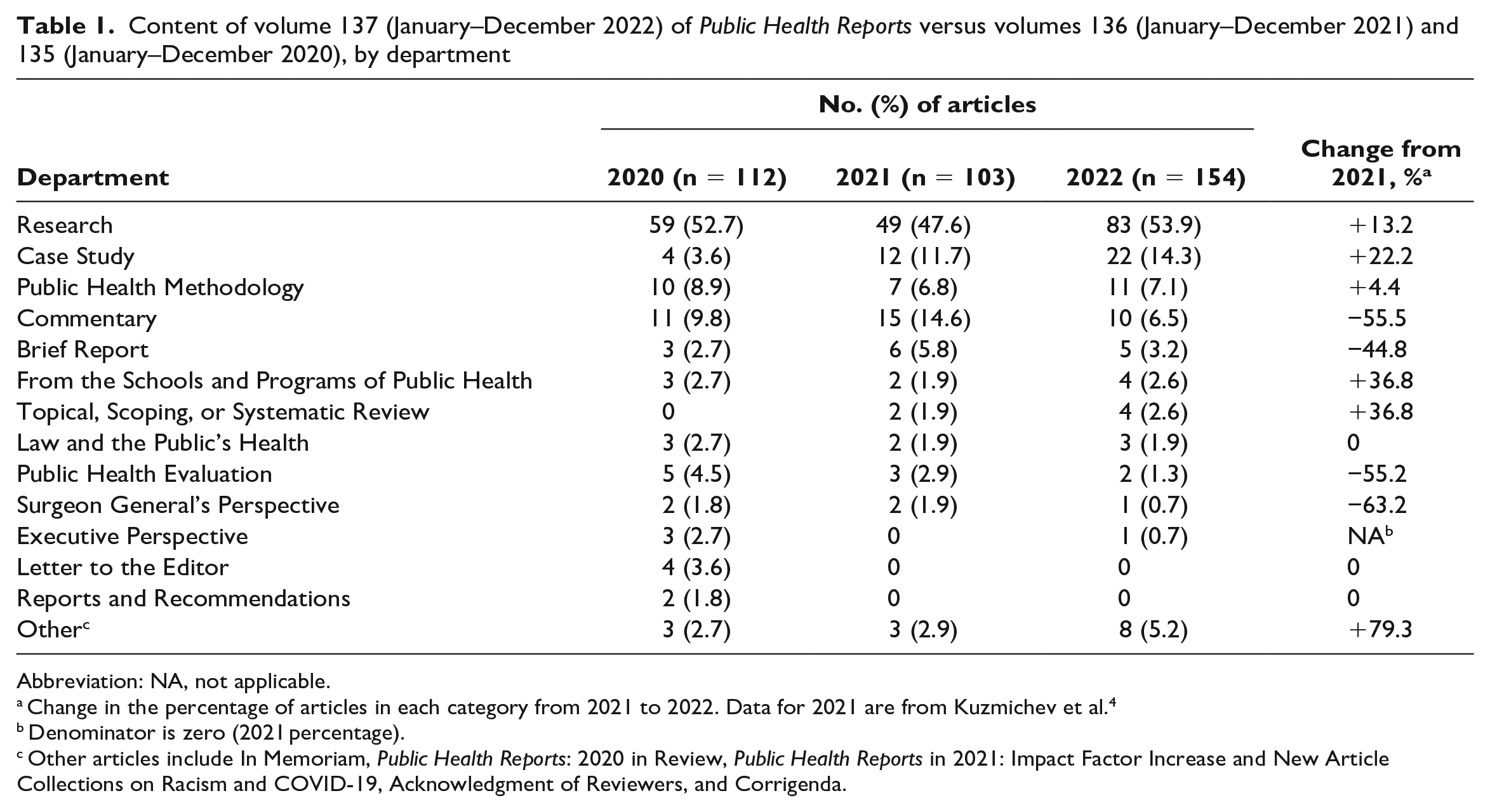
PHR published 154 articles in volume 137 (January–December 2022), including research contributions (n = 83), case studies (n = 22), public health methodology articles (n = 11), commentaries (n = 10), brief reports (n = 5), contributions to the From the Schools and Programs of Public Health department (n = 4), topical or systematic reviews (n = 4), contributions to the Law and the Public’s Health department (n = 3), public health evaluations (n = 2), Surgeon General’s Perspective articles (n = 1), Executive Perspective articles (n = 1), and 8 other articles (eg, Public Health Reports in 2021: Impact Factor Increase and New Article Collections on Racism and COVID-19, Acknowledgment of Reviewers, and Corrigenda; Table 1). PHR published 49.5% more articles in volume 137 (2022) than in volume 136 (2021) (154 vs 103). The biggest changes by department included a 55.5% reduction in the number of commentaries and a 79.3% increase in “other” articles, likely driven by 6 corrigenda (vs 0 in 2021). The change in the number of commentaries was likely due to a spike in the number of submissions in this category in 2021 (the percentage of commentaries was 9.8% in 2020, which is comparable to 2022), which possibly reflects the fact that many early COVID-19 articles, which peaked in 2021, fell in this category as quantitative studies took longer to emerge.
Content of volume 137 (January–December 2022) of Public Health Reports versus volumes 136 (January–December 2021) and 135 (January–December 2020), by department
Abbreviation: NA, not applicable.
Change in the percentage of articles in each category from 2021 to 2022. Data for 2021 are from Kuzmichev et al. 4
Denominator is zero (2021 percentage).
Other articles include In Memoriam, Public Health Reports: 2020 in Review, Public Health Reports in 2021: Impact Factor Increase and New Article Collections on Racism and COVID-19, Acknowledgment of Reviewers, and Corrigenda.
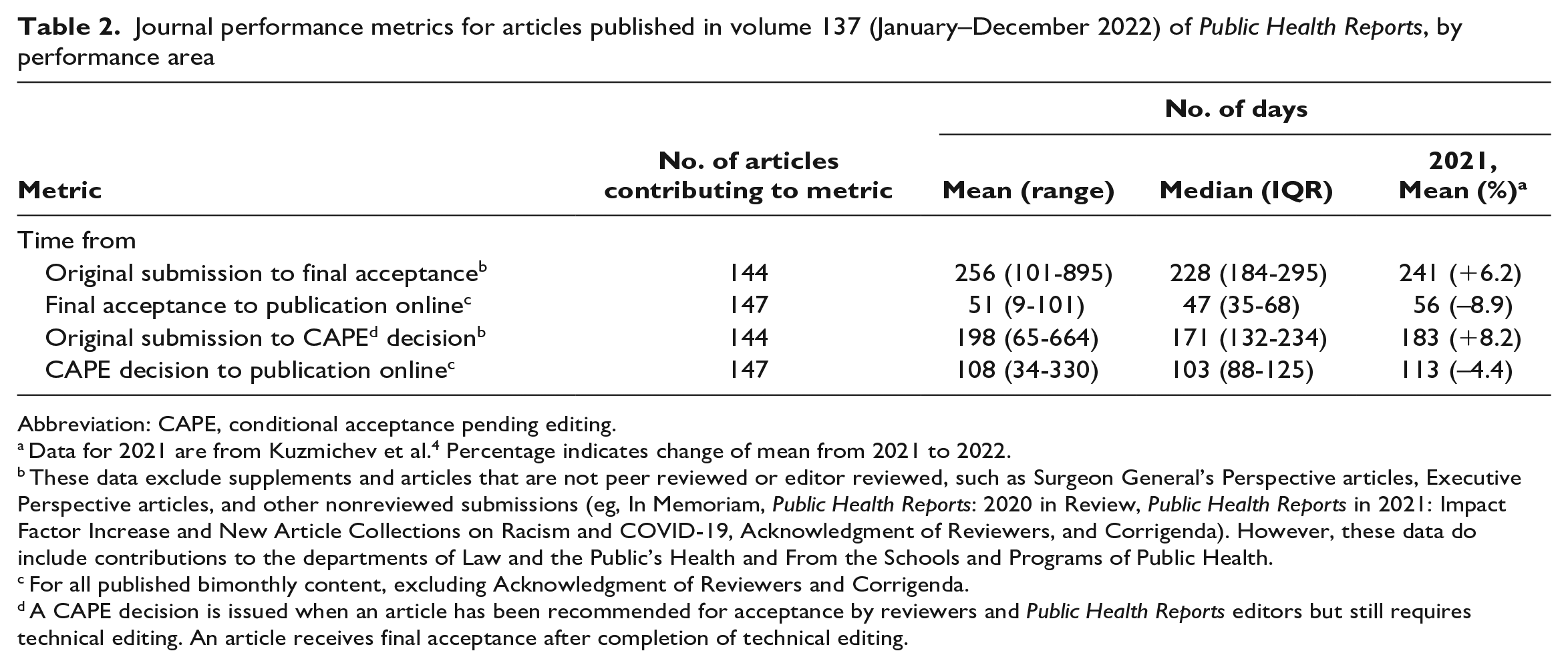
Among articles published in 2022 that were peer or editor reviewed (n = 144; excluding Surgeon General’s Perspective and Executive Perspective articles, Acknowledgment of Reviewers, Public Health Reports in 2021: Impact Factor Increase and New Article Collections on Racism and COVID-19, and Corrigenda), the time from original submission to final acceptance was a mean (range) of 256 (101-895) days and a median (IQR) of 228 (184-295) days (Table 2). This 6.2% increase in mean time from 2021 (241 d) was likely due to a higher number and severity of unusually delayed outliers (maximum time from submission to final acceptance was 895 days in 2022 vs 498 days in 2021). An examination of review and production history of these outliers revealed the same barriers as during previous years. The larger contribution of these unusually delayed outliers to 2022’s average time from submission to final acceptance could be explained by the increased workload on journal staff in 2022 as compared with 2021 because of the increase in published articles, likely fueled by the pandemic.
Journal performance metrics for articles published in volume 137 (January–December 2022) of Public Health Reports, by performance area
Abbreviation: CAPE, conditional acceptance pending editing.
Data for 2021 are from Kuzmichev et al. 4 Percentage indicates change of mean from 2021 to 2022.
These data exclude supplements and articles that are not peer reviewed or editor reviewed, such as Surgeon General’s Perspective articles, Executive Perspective articles, and other nonreviewed submissions (eg, In Memoriam, Public Health Reports: 2020 in Review, Public Health Reports in 2021: Impact Factor Increase and New Article Collections on Racism and COVID-19, Acknowledgment of Reviewers, and Corrigenda). However, these data do include contributions to the departments of Law and the Public’s Health and From the Schools and Programs of Public Health.
For all published bimonthly content, excluding Acknowledgment of Reviewers and Corrigenda.
A CAPE decision is issued when an article has been recommended for acceptance by reviewers and Public Health Reports editors but still requires technical editing. An article receives final acceptance after completion of technical editing.
The time from final acceptance to online publication for the 147 full-content articles in volume 137 (excluding only Acknowledgment of Reviewers and Corrigenda) was a mean (range) of 51 (9-101) days and a median (IQR) of 47 (35-68) days (Table 2). This time was an 8.9% decrease in mean time from 2021 (56 d), which could be attributed to measures taken by the journal in 2022 to accelerate its production processes, including proactive outreach to authors on copyright forms and close monitoring of expedited production of COVID-19 submissions. Analysis by department did not reveal any substantial differences in turnaround times by article categories.
In 2022, PHR continued the practice of issuing the CAPE decision (conditional acceptance pending editing), which indicates that the article has cleared peer review and is ready for postreview editing. For peer-reviewed volume 137 content (defined previously), the time from original submission to CAPE was a mean (range) of 198 (65-664) days and a median (IQR) of 171 (132-234) days (Table 2). This time was an 8.2% increase from 2021 (mean, 183 d). To understand the reasons for the large spread of this variable (65-664 d), we examined the causes of delay for submissions in the top 50% for the time from submission to CAPE (ie, those taking >332 d). We found 12 (8.3%) such submissions. We reviewed submission system logs of the top 3 most delayed articles. One article (664 d from original submission to CAPE) was delayed because of the authors’ delayed response to edits (218 d between CAPE decision and resubmission vs a standard of 60 d). Another article (559 d) was also delayed because of a revision extension requested by the author, which resulted in 281 days from one peer review decision to resubmission (vs a standard of 30 d). A third article (523 d) was delayed because of a combination of an author-requested extension (118 d from one peer review decision to resubmission) and an extraordinary difficulty finding 2 reviews for the original submission (180- vs 60-day standard). Interestingly, the number of peer review revisions seemed not to be a factor, as all 3 outlier articles received CAPE decision at first or second revision. In the future, an approach should be devised to define timeliness of completion of CAPE editing as well as a procedure to monitor author responsiveness. Other common barriers for articles in the top quartile for the time from submission to CAPE included associate editor reassignment and difficulty securing reviewers or reviews for original submissions. CAPE time worsening in 2022 versus 2021 could have been due to the increased weight of severely overdue outliers that were submitted during the previous year, the peak year for COVID-19 submissions, which had strained administrative and scientific staff.
The time from CAPE to online publication for full-content articles in volume 137 (defined previously) was a mean (range) of 108 (34-330) days and a median (IQR) of 103 (88-125) days (Table 2). These numbers represent a 4.4% decrease in mean time to online publication from 2021 (113 d). This improvement could be attributed to the production acceleration measures mentioned previously as well as an increase in the journal’s editing staff. Analysis of outliers identified a single article with a time of >170 days (330 d) from CAPE to online publication. This outlier was the same article as the top outlier for the time from original submission to CAPE. Its post-CAPE delay was due to the authors taking 64 days (vs 7-day standard) to submit copyright forms. For other articles within the top 50% for the times from CAPE to online publication (166-170 d; n = 4 [2.8%]), a common pitfall was also the delay in receiving copyright forms from authors. Interestingly, we found an overlap between outliers from submission to CAPE and from CAPE to online publication (defined previously): 3 of 12 articles in the top 50% for the former metric were also in the top 50% for the latter metric and, conversely, 3 of 5 articles in the top half for the second time (this includes the 330-day outlier) were also in the top half for the first time, suggesting that the authors’ general responsiveness to the journal plays an important role in how quickly articles are published online.
PHR published 6 corrigenda in 2022, which was an increase from 2021 (no author-requested corrigenda). This change could reflect the fact that prioritization of COVID-19 articles over less impactful content (such as corrigenda) in the journal’s fixed annual page allowance was more pressing at the pandemic’s peak in 2021 than in 2022.
A total of 145 corresponding authors of regular, full-content articles in volume 137 (excluding supplements, Acknowledgment of Reviewers, and Corrigenda) were from US institutions, and 2 were from other countries (Canada and Portugal). The 145 US authors were affiliated with academia (n = 66; 45.5%); HHS (eg, Centers for Disease Control and Prevention [CDC], National Institutes of Health, Office of the Assistant Secretary for Health) (n = 47; 32.4%); state, tribal, local, and territorial (STLT) public health agencies (n = 19; 13.1%); the health care sector (n = 5; 3.4%); nonprofit organizations (n = 4; 2.8%); and private organizations (n = 4; 2.8%). When compared with 2021, a 131.4% increase was observed in HHS authorship (vs 14.0% in 2021), which likely explains the reduction in academia’s weight (−25.4% vs 61.0% in 2021). Increased HHS authorship in 2022 could have been driven by an increase in the number of quantitative COVID-19 studies from CDC, which represent the more mature COVID-19 science than what was produced in 2021.
Authorship by STLT Agencies
A key focus of PHR’s mission is to translate public health science into practice, disseminating information as soon as possible to maximize public health action. STLT agencies play an important role in this charge, and their participation in PHR studies can be seen as an indicator of the success of these efforts. STLT agencies often partner with other entities, such as universities or federal organizations (eg, CDC), on various projects,7,8 possibly including research studies.
To assess PHR’s STLT authorship in 2022 in more detail, we extended our corresponding author analysis to determine how frequently representatives of STLT agencies served as coauthors on PHR publications. Of 145 US-authored regular-issue, full-content studies published in 2022, 43 (29.7%) studies had an STLT author (corresponding or coauthor). Of these studies, 24 (55.8%) had at least 1 coauthor from an STLT agency and 19 (44.2%) had a corresponding author from an STLT agency. Of the 24 studies with STLT coauthors, 9 (37.5%) had a corresponding author affiliated with academia, 13 (54.2%) with HHS, 1 (4.2%) with the health care sector, 1 (4.2%) with a nonprofit organization, and none with private organizations. Among HHS agencies, CDC was STLTs’ sole lead collaborator (13 of 13 studies). Accordingly, of 41 articles with a corresponding author from CDC, 13 (31.7%) had at least 1 coauthor from an STLT agency. We also examined information on who STLTs’ most frequent supporting collaborators were. Of 19 studies with a corresponding author from an STLT agency, 8 had at least 1 coauthor from academia, 5 from HHS (all from CDC), 2 from the health care sector, 2 from nonprofit organizations, and 3 from private organizations. Several articles had coauthors from different organization types, resulting in the total coauthor number exceeding 19. These data suggest that STLT authorship was broader than what could be expected from just the corresponding authorship analysis. We also observed STLT agencies’ frequent partnership with other types of organizations, especially CDC and academia. Frequent coauthorship of PHR studies between STLT organizations and CDC may reflect these groups’ close partnership to respond to priority public health issues, 7 while STLT partnership with academia may reflect practice- and science-based links to schools and programs of public health and other academic institutions and the need to provide practical training for the next generation of public health workers.
Topics of PHR Articles Published in 2022
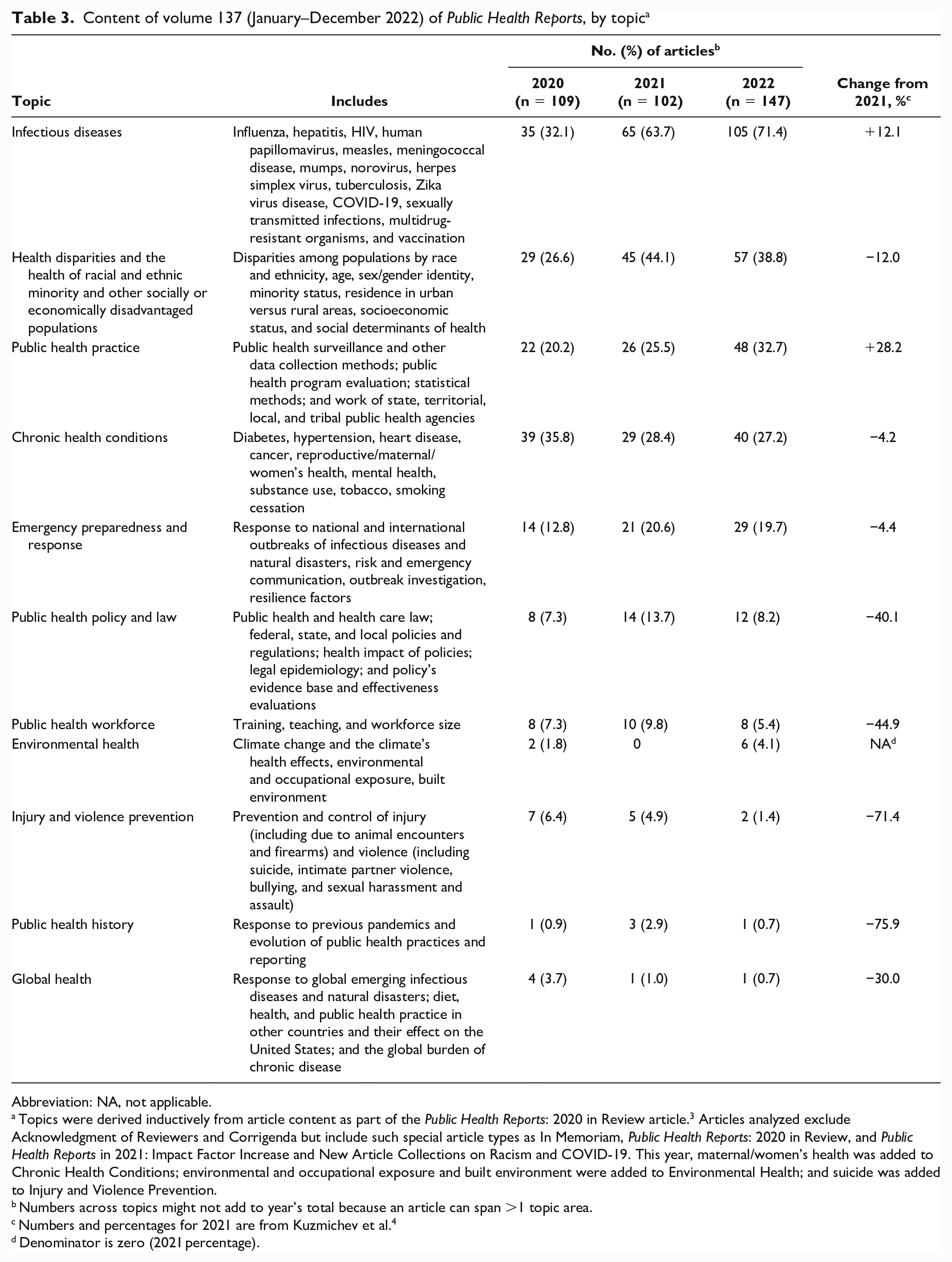
Thematically, content in volume 137 (147 full-content articles, excluding Acknowledgment of Reviewers and Corrigenda but including such special article types as Public Health Reports in 2021: Impact Factor Increase and New Article Collections on Racism and COVID-19) can be grouped into 11 public health topics (not mutually exclusive; Table 3). The top 3 most common topics in 2021 were infectious diseases (105 articles), health disparities and the health of racial and ethnic minority and other socially or economically disadvantaged populations (57 articles), and public health practice (48 articles). Topics with >10 articles showing the biggest change from 2021 included public health policy and law (−40.1%), public health practice (+28.2%), and infectious diseases (+12.1%). These changes were likely due to the increase in COVID-19 content in 2022 as well as to its evolving focus, shifting from commentaries on transmission control policies—common during the pandemic’s early stages—to reports of local public health response as this information became more readily available. While the percentage of articles on health disparities and minority health decreased (−12.0%), their absolute number (n = 57) continued a rising trend from 2021 (n = 45) and 2020 (n = 29), which likely reflects sustained attention to the topic in the public health field as well as the journal’s investment into it.
Content of volume 137 (January–December 2022) of Public Health Reports, by topic a
Abbreviation: NA, not applicable.
Topics were derived inductively from article content as part of the Public Health Reports: 2020 in Review article. 3 Articles analyzed exclude Acknowledgment of Reviewers and Corrigenda but include such special article types as In Memoriam, Public Health Reports: 2020 in Review, and Public Health Reports in 2021: Impact Factor Increase and New Article Collections on Racism and COVID-19. This year, maternal/women’s health was added to Chronic Health Conditions; environmental and occupational exposure and built environment were added to Environmental Health; and suicide was added to Injury and Violence Prevention.
Numbers across topics might not add to year’s total because an article can span >1 topic area.
Numbers and percentages for 2021 are from Kuzmichev et al. 4
Denominator is zero (2021 percentage).
PHR and the COVID-19 Response
PHR continued to invite and disseminate science on the COVID-19 pandemic by maintaining an active call for papers—COVID 19: Challenges, Lessons Learned, and Opportunities for Public Health Practice—which launched on March 27, 2020. 9 In response to the call, PHR received 1482 original submissions and 802 presubmission inquiries through the end of 2022 (including 383 submissions and 143 inquiries in 2022). These 2022 numbers represent a 40.6% reduction in submissions and 58.8% reduction in inquiries as compared with 2021 (645 submissions and 347 inquiries). This reduction could be due to a general saturation of COVID-19 science10,11 and a decline in the pandemic’s national visibility.12,13
Annual submission numbers (especially those for COVID-19 submissions) may fluctuate depending on when they were assessed because of the way PHR’s electronic system calculates the original submission date. For example, manuscripts in draft form or returned to draft form administratively do not count toward a given year if they are still in draft form at the time of the analysis (eg, early in the new year), but once they are fully submitted or resubmitted, they are added retroactively to their first submission’s (ie, draft’s) year, resulting in higher submission numbers for the previous year when accessed during the subsequent year. Another potential source of such fluctuation, specifically for COVID-19 submissions and presubmission inquiries, lies in the fact that the determination that a submission is a COVID-19 one (which is based on the centrality of the topic of the pandemic to the study’s objectives) may change over time as the article is evaluated by PHR staff. Thus, there were 645 COVID-19 submissions in 2021 when assessed on January 18, 2023, which was 13 articles more than the number of submissions assessed in January 2022 (n = 632). 5 Similarly, the number of COVID-19 submissions in 2020 was 454 when assessed on January 18, 2023, but the same number reported in the “2020 in Review” article was 453. 3
Through the end of 2022 (based on the article’s first online publication date), PHR published 167 COVID-19 articles. A study is considered a COVID-19 article if it is included in the journal’s online collection of articles on COVID-19. 14 Such inclusion is based on the same criteria as for COVID-19 submissions with an additional exclusion of corrigenda. These 167 articles included 93 COVID-19 articles published in 2022, a 74.1% increase from 54 COVID-19 articles published in 2021. It may seem counterintuitive that published COVID-19 content increased in 2022 while COVID-19 submissions dropped during the same year. However, articles published in 2022 reflect submissions from several previous years, including years when COVID-19 submissions were rising. The dip in submissions in 2022 will likely be reflected in the COVID-19 content published in 2023.
Several COVID-19 articles published in 2022 (volume 137) were particularly noteworthy. For example, 1 article estimated the prevalence of missed, skipped, or delayed preventive checkups among households with children as a result of the pandemic 15 (3 Web of Science citations, 1377 views and downloads, and an Altmetric score of 27 [which reflects an article’s news and social media attention]). Another study examined COVID-19 outcomes among people of various Asian ethnic subgroups in an urban safety-net hospital system 16 (8 citations, 2001 views and downloads, and an Altmetric score of 66).
This year, the top 3 articles with the highest Altmetric scores were all on the topic of COVID-19. These articles included a study assessing the prevalence, predictors, and other correlates of COVID-19 vaccine hesitancy among parents of a child or adolescent 17 (an Altmetric score of 349; 1552 views and downloads; no citations), a legal commentary arguing for a need to reform laws on adolescent consent to COVID-19 vaccination 18 (an Altmetric score of 292; 3679 views and downloads; 8 citations), and an analysis of the pandemic’s effects on the mental health of grocery store workers in Arizona 19 (an Altmetric score of 284; 7242 views and downloads; 5 citations).
As the pandemic, the response to it, and the science about it progressed, the call for submissions on COVID-19 was modified to include vaccination and the post–COVID-19 condition.
Other Important Content From 2022
Beyond COVID-19, PHR published several articles in 2022 of general public health interest that generated substantial scholarly, public, and media attention. These articles included a systematic review identifying pedagogic methods and curricula that can support the training of US public health students to improve their understanding of racism as a structural determinant of health 20 (an Altmetric score of 70; 5621 views and downloads; 7 citations), a study evaluating health care access among essential critical infrastructure workers 21 (an Altmetric score of 96; 1806 views and downloads; 3 citations), and a historical overview of local health officers’ response to the 1889 outbreak of Russian influenza in Connecticut 22 (an Altmetric score of 33; 1549 views and downloads; no citations).
In 2022, PHR articles were downloaded 561 571 times, which was a 20.2% reduction from 2021 (703 866 times). This reduction likely reflects the relative loss of interest in COVID-19 content, as seen in similar journals (Alyssa Venezia, SAGE Publishing Inc, personal communication, January 2023). The number of article downloads was still higher in 2022 than during the prepandemic year (418 593 downloads in 2020), suggesting that there may be a pandemic-independent upward trend in the journal’s readership. The 3 most downloaded articles from 2022 were a commentary by the US surgeon general on the importance of improving the mental health of minority and marginalized young people 23 (4998 views or downloads; an Altmetric score of 186; no citations; mentioned by CNN 24 ), an analysis of US public schools’ curricula on racism (5621 views or downloads; an Altmetric score of 70; 7 citations), 20 and a commentary from a supplement on human trafficking that applied the critical race praxis theory to the problem of sex trafficking of minors (2981 views or downloads; an Altmetric score of 3; 1 citation).
The mean Altmetric score of all articles published in volume 137 (excluding corrigenda and Acknowledgement of Reviewers) was 16.3 as assessed on January 18, 2023. This is comparable to the score of 16.4 for 2021.
Supplements Published in 2022
In addition to 6 regular issues, PHR published 2 supplements (ie, sponsored peer-reviewed issues focusing on a particular public health topic or issue) in 2022. One supplement—The Public Health Response to Human Trafficking: A Look Back and a Step Forward—was sponsored by the Administration for Children and Families, Office of Trafficking in Persons. It aimed to build the evidence base for human trafficking prevention and intervention and to elevate the importance of strong public health response to commercialized forms of violence. 25 Its highlights included a commentary that applied the theory of public health critical race praxis to the problem of sex trafficking of minors 26 and a literature review that found limited evidence on the effectiveness of screening tools, calling for more research on screening tools to identify human trafficking victims in health care. 27 The guest editorial for the supplement, 25 the article on critical race praxis, 26 and several other articles from the supplement were among this year’s top viewed or downloaded articles.
The second supplement—Innovations in COVID-19 Case Investigation and Contact Tracing—was sponsored by the State, Tribal, Local, and Territorial Support Task Force of the CDC COVID-19 Response. 28 It provided firsthand examples of how US public health departments identified flexibilities to accommodate fluctuating COVID-19 incidence, collaborated with partners to augment case investigation and contact tracing, optimized processes to improve outreach to communities disproportionately affected by the pandemic, used innovative digital tools, and evaluated the effectiveness of their strategies. The issue’s highlights included a brief report from the Chicago Department of Public Health 29 on how it took into account health equity when recruiting outreach workers from areas of the city experiencing the most economic hardship, and case studies from Michigan 30 and Maricopa County, 31 which provided replicable examples of flexible and timely responses by health departments to surging case counts.
New Department on Public Health Ethics, Certified in Public Health Continuing Education Credits, and Other Editorial Updates
In 2022, PHR launched a new department, Ethical Dimensions of Public Health. 32 Its goal is to fill the gap in publishing opportunities in the area of practical public health ethics. It features articles that focus on the translation of and interface between public health ethics theory and practice. Contributions may cover such topics as primacy of equity in public health practice, the role of solidarity, ethical communications, incorporating ethics into public health decision-making, and teaching ethics.
This year, PHR also launched an opportunity to earn continuing education credits for Certified in Public Health (CPH) degree recertification, as approved by the National Board of Public Health Examiners. 33 Reviewers can earn 6 CPH credits per manuscript, and Editorial Committee members can receive 1 credit per hour of their effort on the journal (up to 20 hours per cycle). Authors of published articles may receive 10 CPH credits per article.
PHR also refined its author guidelines. For example, supplemental materials are allowed but not edited. We also strengthened our language on institutional review board approvals per the AMA Manual of Style, 11th edition, and International Committee of Medical Journal Editors guidelines. Lastly, to increase our articles’ accessibility, the journal now offers an option to translate selected articles into American Sign Language.
Conclusion
Moving forward, the journal plans to continue to instill equity in all its practices to improve the author and reader experience, increase the number of supplements published, improve its peer review and production metrics, and perform analyses of its historic content to inform current and future public health practice and policy.
Footnotes
Acknowledgements
The authors are grateful to Alyssa Venezia and Katie Willis, MS, of SAGE Publishing, Inc for their assistance with this article.
Disclaimer
The findings and conclusions in this article are those of the authors and do not necessarily represent the official position of the US Department of Health and Human Services or the US government.
Declaration of Conflicting Interests
The authors declared no potential conflicts of interest with respect to the research, authorship, and/or publication of this article.
Funding
The authors received no financial support for the research, authorship, and/or publication of this article.
