



Abstract
Objectives:
Smartphone-based digital exposure notification (EN) tools were introduced during the COVID-19 pandemic to supplement strained case investigation and contact tracing efforts. We examined the influence of an EN tool implemented in Washington State, WA Notify, on user engagement in behaviors that protect against COVID-19 transmission.
Methods:
From January 25 through June 30, 2021, we administered 2 surveys to WA Notify users who received notification of a possible COVID-19 exposure. The initial survey, sent when users received a notification, focused on intent to engage in protective behaviors. The follow-up survey captured data on self-reported actual engagement in protective behaviors and contact by a public health contact tracer.
Results:
Of 1507 WA Notify users who completed the initial survey, 40.1% (n = 604) reported intending to seek COVID-19 testing and 67.1% (n = 1011) intended to watch for COVID-19 symptoms. Of 407 respondents to the follow-up survey, 57.5% (n = 234) reported getting tested and 84.3% (n = 343) reported watching for COVID-19 symptoms. Approximately 84% (n = 1266) of respondents to the initial survey received a notification from WA Notify before being reached by public health contact tracers; on follow-up, 42.5% (n = 173) of respondents reported never being contacted by public health.
Conclusions:
Our findings suggest that WA Notify users may initiate protective behaviors earlier than nonusers who will not know of an exposure until notified by public health or by a known contact. Digital EN tools may be a valuable addition to existing public health outbreak investigation and response activities.
Digital exposure notification (EN) technologies were developed and implemented worldwide to augment traditional public health COVID-19 case investigation and contact tracing (CI/CT) during the COVID-19 pandemic. These tools use Bluetooth technology embedded in a smartphone to anonymously alert a user of close proximity to a person who has recently received a positive test result for COVID-19. 1 Washington State launched its digital EN tool—WA Notify—statewide on November 30, 2020. WA Notify uses the privacy-preserving Google Apple EN Express framework to distribute proximity-based notifications to users who have added or activated this feature on their smartphones. 2
Most EN tools have inherent anonymity features that make it difficult to evaluate whether users followed public health guidance or changed their behavior in response to a notification, such as seeking COVID-19 testing or implementing other protective actions. Notifications from WA Notify include a limited-access link to the Washington State Department of Health (WADOH) landing page that provides public health guidance for recently exposed people, including instructions to get tested and engage in protective behaviors (eg, isolation, testing). Apart from a pilot study on the University of Washington campus prior to the launch of WA Notify, 3 to our knowledge no research has been conducted on how receiving a notification might influence digital EN tool users’ behavior. We sought to understand the influence of WA Notify on supporting user engagement in behaviors that protect against COVID-19 transmission.
Methods
The limited-access WADOH landing page provided the opportunity for us to capture information via survey on the behaviors of WA Notify users. We designed 2 surveys as part of the WA Notify implementation and evaluation project, conducted through an interagency agreement between the University of Washington School of Public Health and WADOH.
The initial survey was available when a WA Notify user accessed the WADOH landing page after receiving a notification. The survey was posted on the WADOH landing page on January 25, 2021, and was available to any WA Notify user who received a notification. Participation in the survey, accessed through a link on the WADOH landing page, was voluntary and no incentive was offered to complete it. The initial survey was designed to take 5 minutes to complete and included the following 6 questions with answer options:
Did you recently receive an exposure notification (EN) message from WA Notify on your smartphone? The message would tell you that you might have been in contact with someone who tested positive for COVID-19.
When did you receive this notice?
The DOH “What to do next” page contained information about what to do if you’ve been exposed to COVID-19. Which of the following do you plan to do? (Select all that apply): Get tested for COVID-19. Get tested for COVID-19 only if I develop symptoms. Stay home until I get test results. Stay home for 10-14 days. Avoid public places for 10-14 days. Stay away/isolate myself from others in my household. Contact my health care provider. Watch for COVID-19 symptoms.
Please check any COVID-19 symptoms you are experiencing: fever or chills; cough; shortness of breath or difficulty breathing; fatigue; muscle or body aches; headache; new loss of taste or smell; sore throat; congestion or runny nose; nausea or vomiting; diarrhea; I am not experiencing any of these symptoms.
Did you also receive a phone call or text message from public health about being exposed to someone who tested positive for COVID-19?
We would like to learn a little more about you: What is your age? (18-24, 25-34, 35-44, 45-54, 55-64, 65-74, and ≥75 y). Do you identify as Hispanic/Latinx? (yes/no). What race do you identify as? (Check all that apply): White, Black/African American, Asian, American Indian/Alaska Native, Native Hawaiian/Pacific Islander, Other. What gender do you identify as? (male, female, nonbinary, prefer not to answer).
The survey was translated into the 7 most frequently used languages on WADOH webpages: Spanish, Russian, Tagalog, Ukrainian, Somali, Chinese (simplified), and Vietnamese. Translation processing was completed by WADOH expert review to ensure adherence to linguistic and cultural appropriateness. A seventh survey item asked respondents if they were willing to receive a follow-up survey.
Respondents who agreed to receive the follow-up survey and provided their email address received an email invitation with a survey link 2 weeks after completing the baseline survey. The follow-up survey included 6 questions as listed with answer options:
Did you receive a phone call or text message from your local public health department about being exposed to someone who tested positive for COVID-19?
When did you receive this call or text message?
Have you experienced any of the following COVID-19 symptoms? Fever or chills; cough; shortness of breath or difficulty breathing; fatigue; muscle or body aches; headache; new loss of taste or smell; sore throat; congestion or runny nose; nausea or vomiting; diarrhea; I did not experience any of these symptoms.
After learning you might have been exposed to someone who tested positive for COVID-19, did you get tested for COVID-19?
Did you test positive for COVID-19?
We’d like to hear what else you did after learning you might have been exposed to someone who tested positive for COVID-19. Which of the following did you do? (Select all that apply). Stayed home until I got test results. Stayed home for 10-14 days. Avoided public places for 10-14 days. Stayed away/isolated myself from others in my household. Contacted my health care provider. Watched for COVID-19 symptoms. Other.
Both surveys were programmed in REDCap. 2 The University of Washington Institutional Review Board reviewed the project plan and determined it to be a public health surveillance activity.
Statistical Analysis
We counted the number of hits on the WADOH landing page by WA Notify users who received a notification. For privacy reasons, it was not possible to eliminate duplicate page hits. We recorded the number of people who responded to the initial survey and, for analysis, eliminated incomplete surveys. We summarized descriptive statistics on demographic information (race and ethnicity, gender, and age). For the follow-up survey, we recorded the number of people who provided their email on the initial survey and the number who activated the survey link in the email invitation; we excluded incomplete surveys in the analysis. We calculated percentages of intended and actual protective behaviors among initial and follow-up survey respondents and compared planned and actual engagement in protective behaviors. We calculated the percentages of WA Notify users who were contacted by public health contact tracers at the time of receiving an EN and 2 weeks later on the follow-up survey.
Results
From January 25 through June 30, 2021, the WADOH landing page received 23 232 hits by WA Notify users who had received a notification and then activated the link in their EN message to learn more about what to do next.
Of those who activated the link to access the WADOH landing page, 1543 people responded to the initial survey. After elimination of incomplete surveys, 97.5% (n = 1507) of initial surveys were eligible for analysis (English, n = 1490; Spanish, n = 16; Vietnamese, n = 1). Of the 1507 respondents to the initial survey, 57.2% (n = 862) agreed to receive the follow-up survey and provided an email address. The follow-up survey response rate was 48.6% (n = 419 of 862 respondents who agreed to receive the follow-up survey). After elimination of incomplete surveys, 407 follow-up surveys were eligible for analysis (English, n = 406; Vietnamese, n = 1).
Demographic Characteristics
Participants in both surveys were primarily White (81%, initial survey; 86.5%, follow-up survey) and female (85.6%, initial survey; 68.8%, follow-up survey) (Table).
Characteristics of respondents to WA Notify user surveys who received notification of a possible COVID-19 exposure from WA Notify, the Washington State digital exposure notification tool, January 25 through June 30, 2021
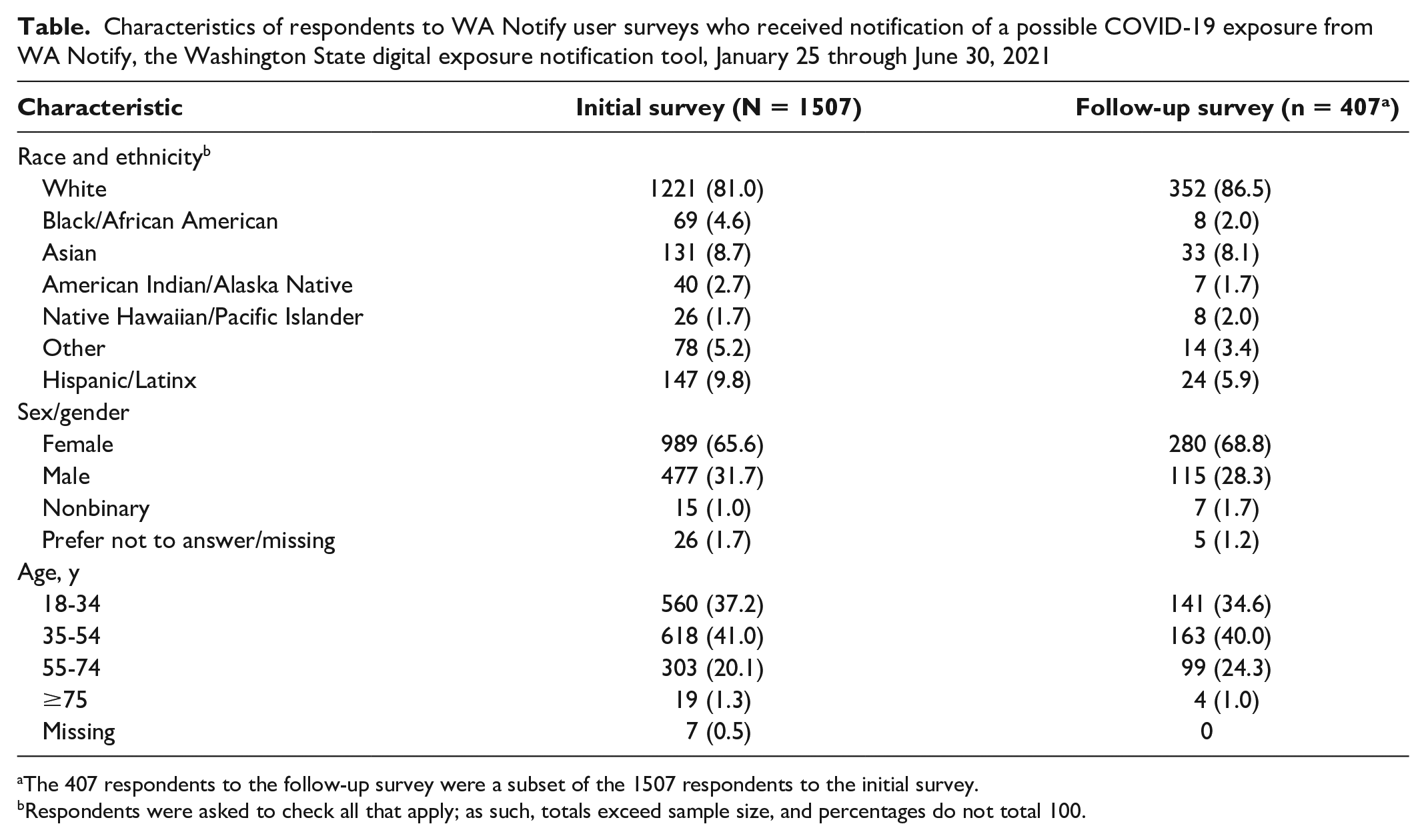
The 407 respondents to the follow-up survey were a subset of the 1507 respondents to the initial survey.
Respondents were asked to check all that apply; as such, totals exceed sample size, and percentages do not total 100.
Engagement in Protective Behaviors
The most frequently selected protective behaviors on the initial survey were “Watch for COVID-19 symptoms” (67.1%, n = 1011) and “Get tested” (40.1%, n = 604) (Figure 1).
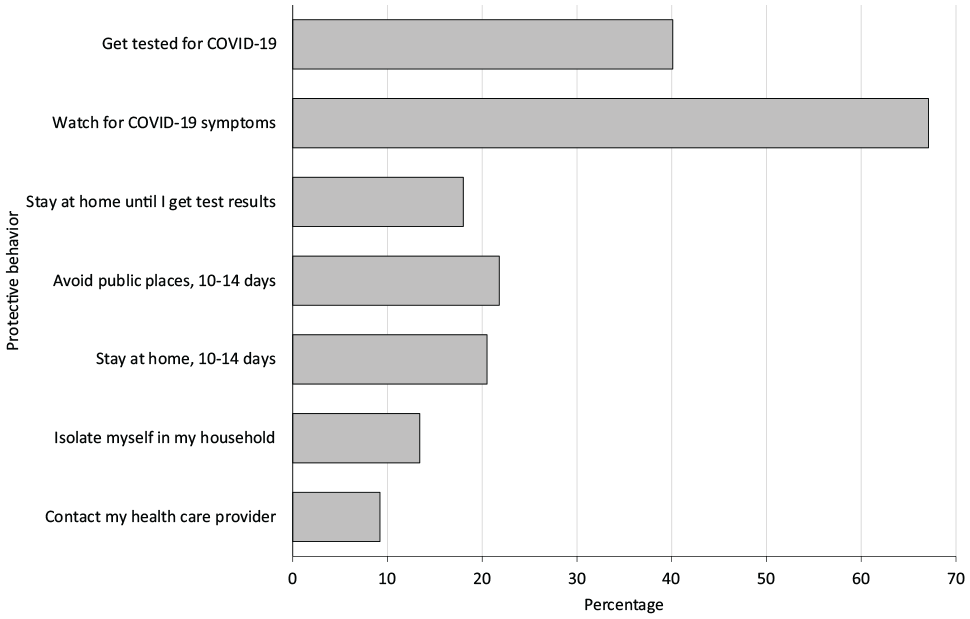
Intention to engage in protective behaviors after receiving a notification from WA Notify, the Washington State digital exposure notification tool, of possible exposure to someone who received a positive test result for COVID-19 from January 25 through June 30, 2021. The initial survey focused on intent to engage in protective behaviors (eg, isolating, testing) and public health communication after notification (N = 1507 respondents completing initial survey).
An overall 234 (57.5%) respondents to the follow-up survey reported having been tested (Figure 2). The most frequently reported protective behaviors of respondents to the follow-up survey were “Watched for COVID-19 symptoms” (84.3%, n = 343) and “Stayed home until I got test results” (39.1%, n = 159). With the exception of avoiding public places for 10 to 14 days, self-report of engagement in all other protective behaviors was higher in the follow-up survey than in the initial survey.
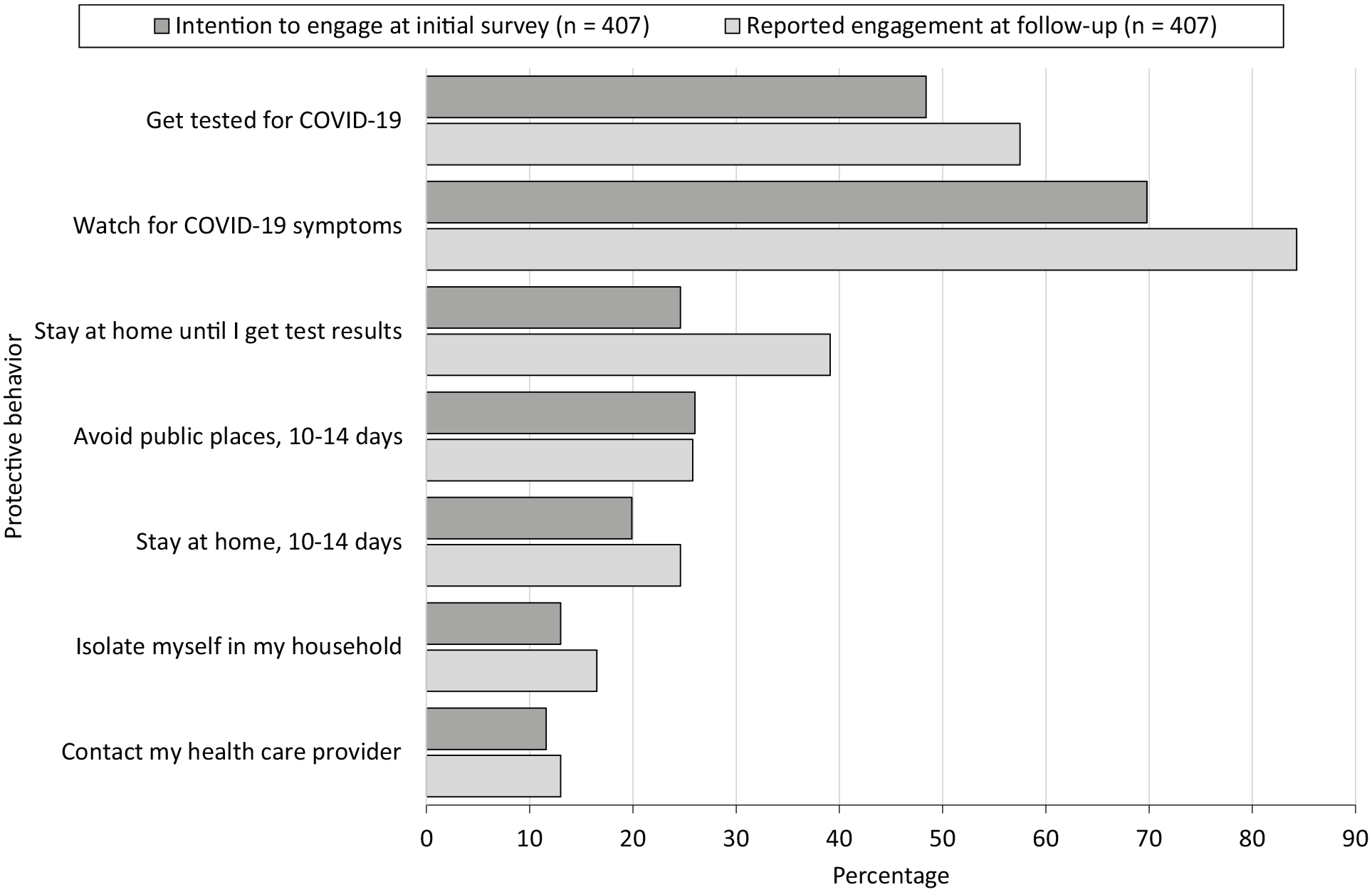
Self-reported engagement in protective behaviors by follow-up survey respondents (n = 407) 2 weeks after receiving a notification from WA Notify, the Washington State digital exposure notification tool, of possible exposure to someone who received a positive test result for COVID-19 from January 25 through June 30, 2021. The follow-up survey focused on getting tested, test results, engagement in protective behaviors (eg, isolating), and public health communication after notification.
Timeliness of Notifications
Eighty-four percent (1266 of 1507) of initial survey respondents reported receiving the notification from WA Notify before being reached by public health. Two weeks later, 42.5% (173 of 407) of survey respondents reported that they still had not been contacted by public health.
Discussion
To our knowledge, our surveys of WA Notify users were the first deployed in a state that had implemented a digital EN tool. Two ways in which WA Notify may supplement traditional public health CI/CT processes are the ability to (1) notify nonhousehold and other unknown contacts of possible disease exposure and (2) notify close contacts more quickly than through traditional CI/CT procedures.4,5 It was encouraging to learn that most survey respondents reported having undertaken some protective measures after receiving a notification, even if to monitor themselves for symptoms. However, whether these self-reported protective behaviors arose from being a WA Notify user and receiving fairly immediate guidance from the WADOH landing page is not known. Regardless, 84% of survey respondents reported that WA Notify alerted them of possible exposure before any traditional CI/CT public health contact, indicating that adoption of a digital EN tool may have influenced early decision making by WA Notify users to engage in protective behaviors.
Limitations
This study had several limitations. First, because of the anonymity of EN, we were unable to link individual WA Notify users with their geographic location. Not knowing users’ geographic location prohibited our ability to make direct conclusions about regional CI/CT challenges. Second, the limited demographic data captured by these surveys do not support generalization to the larger statewide population. Although non-English surveys were made available, few were used. Finally, response bias was a limitation. WA Notify users potentially represent a unique population, and users who were willing to participate in our surveys might represent people inherently more concerned about their COVID-19 risk or more willing to follow public health recommendations than nonusers.
Conclusions
Both surveys remain open and will continue to collect data. Additional analyses of these data are planned, including more detailed analyses of the range of intended and reported protective behaviors and how they are associated with respondent demographic characteristics and other contextual influences, such as presence of SARS-CoV-2 variants, case count fluctuations, and vaccine eligibility.
Challenges to public health CI/CT—including contact tracing workforce capacity, limitations identifying contacts beyond households, and unwillingness of contacts to respond to public health outreach—have been widely acknowledged during the pandemic. Earlier and more complete notification through EN has the potential to slow the spread of the virus, provided that notified contacts follow public health guidance on protective measures.
The scale and pace of the pandemic challenged traditionally conducted public health CI/CT. With the world’s adoption of mobile technologies, public health has been urged to modernize.6,7 Tools such as WA Notify are a valuable technology to integrate into public health’s CI/CT efforts. Incorporating digital EN tools such as WA Notify into the suite of public health tools can improve the timeliness and comprehensiveness of outreach, enabling more rapid and broader uptake of protective behaviors to mitigate risk among contacts.
Footnotes
Declaration of Conflicting Interests
The authors declared no potential conflicts of interest with respect to the research, authorship, and/or publication of this article.
Funding
The authors disclosed receipt of the following financial support for the research, authorship, and/or publication of this article: This work was funded through an interagency agreement between the Washington State Department of Health and the University of Washington School of Public Health (HED contract 25742).
