




Abstract

In the United States and worldwide, the Black Lives Matter movement and the disproportionate impact of COVID-19 on communities of color have sparked challenging conversations about the deeply ingrained structural causes of racial disparities in the criminal justice system and other health-related aspects of life in the United States. In the anti–sex trafficking field, the relationship between racial inequity among Black girls and domestic minor sex trafficking (DMST) is largely unexplored. In this article, we define DMST as the commercial sexual exploitation of a minor aged <18 years in the United States. 1
DMST Among Black Girls
Several initiatives aimed at increasing awareness of and compelling action to prevent human trafficking generally, and DMST specifically, have been enacted, including the Polaris Project 2 (established in 2002) and the Office on Trafficking in Persons within the Administration for Children and Families division of the US Department of Health and Human Services (established in 2001). 3 As a result of these efforts, public awareness of human trafficking has increased, evident in the steady increase in the number of suspected cases of human trafficking reported to the Human Trafficking Hotline each year.4,5 Yet, no national database exists to measure the prevalence rates of DMST, because of a lack of agreement on which indicators to use and myriad methodological challenges in reaching the clandestine populations.6,7 Published statistics on sex trafficking often do not include racial or ethnic backgrounds of victims, but in a rare albeit dated publication, data on confirmed federal cases of sex trafficking from 2008-2010 revealed that 40% of survivors were primarily Black females (40%), compared with 26% who were White females. 8 In addition, in studies that sample from primary point-of-contact agencies (ie, juvenile courts, medical facilities, and child protective services), Black females aged ≤24 years represented 38% to 80% of DMST survivors.9-13 Although it is difficult to conclude from these data alone that Black girls are disproportionately affected by DMST—for example, these statistics might also reflect racial bias in policing14,15 or the existing disproportionality in the child welfare system 16 —the data are nevertheless alarming and deserve critical analysis.
A recent push has been made toward using a public health approach to sex trafficking, which emphasizes prevention and population-level factors instead of the reactionary, criminal justice perspective that has historically dominated the field.17-20 Public health directs our attention upstream to identify risk factors and potential points of intervention to prevent or mitigate poor health outcomes.21-23 A focus of this public health approach in sex trafficking includes an examination of social determinants, such as structural racism, that put certain groups at increased vulnerability for sex trafficking. However, a public health approach alone is insufficient. We argue that as researchers, practitioners, and policy makers reflect on the progress made in the sex trafficking field thus far, and how to chart the paths forward in the coming decades, an important part of this journey is Public Health Critical Race Praxis (PHCRP). PHCRP brings race consciousness to DMST and strengthens our explicit recognition of the role of race and racism in contributing to the apparent increased vulnerability of Black females involved in DMST.
Viewing DMST From a Race-Conscious Perspective
In a 2001 publication, the United Nations unequivocally recognized that racial discrimination is linked to trafficking risk 24 and recommended that the anti-trafficking field pursue an intersectional examination of gender and race discrimination. Yet, few scholars have explicitly explored racial bias and discrimination in DMST, with the exceptions of Butler, 25 Chong, 26 and others.27-29 Butler contends that sexual exploitation is racialized and names structural racism as a root cause of the disparity of Black females in sex trafficking, arguing that contemporary anti-trafficking paradigms, rooted in racial bias (eg, the myth of the “iconic” White female victim), continue to marginalize people of color and Black females in particular. 25 Similarly, Chong’s study of international sex trafficking argues that discrimination based on race and gender, in conjunction with poverty and marginalization, contributes to vulnerability for sexual exploitation, violence, and sex trafficking. 26 An upstream and race-conscious approach, which PHCRP brings, is necessary to fully explicate and address the underlying causes of the apparent racial inequity of Black females in DMST.
Using PHCRP to Address DMST
PHCRP is an extension of Critical Race Theory (CRT), a race-conscious legal movement focused on “transforming the relationship between race, racism, and power.” 30 Central to CRT is the understanding that race is a social construct and that in racialized societies such as the United States, whiteness is privileged in the racial hierarchy. Furthermore, contemporary racism is subtle and covert, requiring an enhanced set of legal tools (eg, counterstorytelling, intersectionality) to address inequities that stem from implicit and systemic racism. Although PHCRP is new to the anti-trafficking field, other theories related to CRT have been applied to the issue of human trafficking. For example, literature from the field of social work draws on Critical Theory to improve child welfare systems 31 and client practices when working with trafficked people. 28 In addition, Butler, 32 a legal scholar, applied Critical Race Feminism to examine the role of race and racism in the commercial sex industry and anti-trafficking movement in the United States.
PHCRP, first articulated by Ford and Airhihenbuwa in 2010, 33 adapts and reshapes CRT, merges tenets of the public health approach, and has been applied in HIV research 34 and in the study of policing behaviors. 35 PHCRP is a systematic framework that unites science, theory, experiential knowledge, and action to pursue racial equity in all aspects of public health research and practice.33,34,36 Race consciousness—attentiveness to the racialized dynamics in society and the contribution of these dynamics to research, practice, and one’s personal experiences—is a central feature of PHCRP. 33 Using a race-conscious approach to DMST means recognizing that race matters and race is connected to economic resources and educational opportunities. Chong 26 argues that for women globally, “Both race and ethnicity are the reasons for their poverty. . . . With no opportunities offered by the welfare state and its policies, these women have been historically engaged in low-profit activities and the informal economy.” Similarly, domestic minor sex trafficking in the United States occurs within a racialized context—in a system in which girls of color are socially and economically marginalized.
PHCRP provides a guide to the research process that is organized along 4 focus areas—(1) contemporary racialization, (2) knowledge production, (3) conceptualization and measurement, and (4) action—and 10 principles (for a full description of the principles and the entire PHCRP framework, see Ford and Airhihenbuwa 33 ). Each focus area is accompanied by at least 1 principle that further delineates the affiliated concepts (Table). To demonstrate its applicability to DMST, we provide an overview of the PHCRP focus areas and selected principles, as they relate to Black girls and DMST.
Public Health Critical Race Praxis (PHCRP) a principles and focus areas applied to domestic minor sex trafficking (DMST) among Black girls in the United States
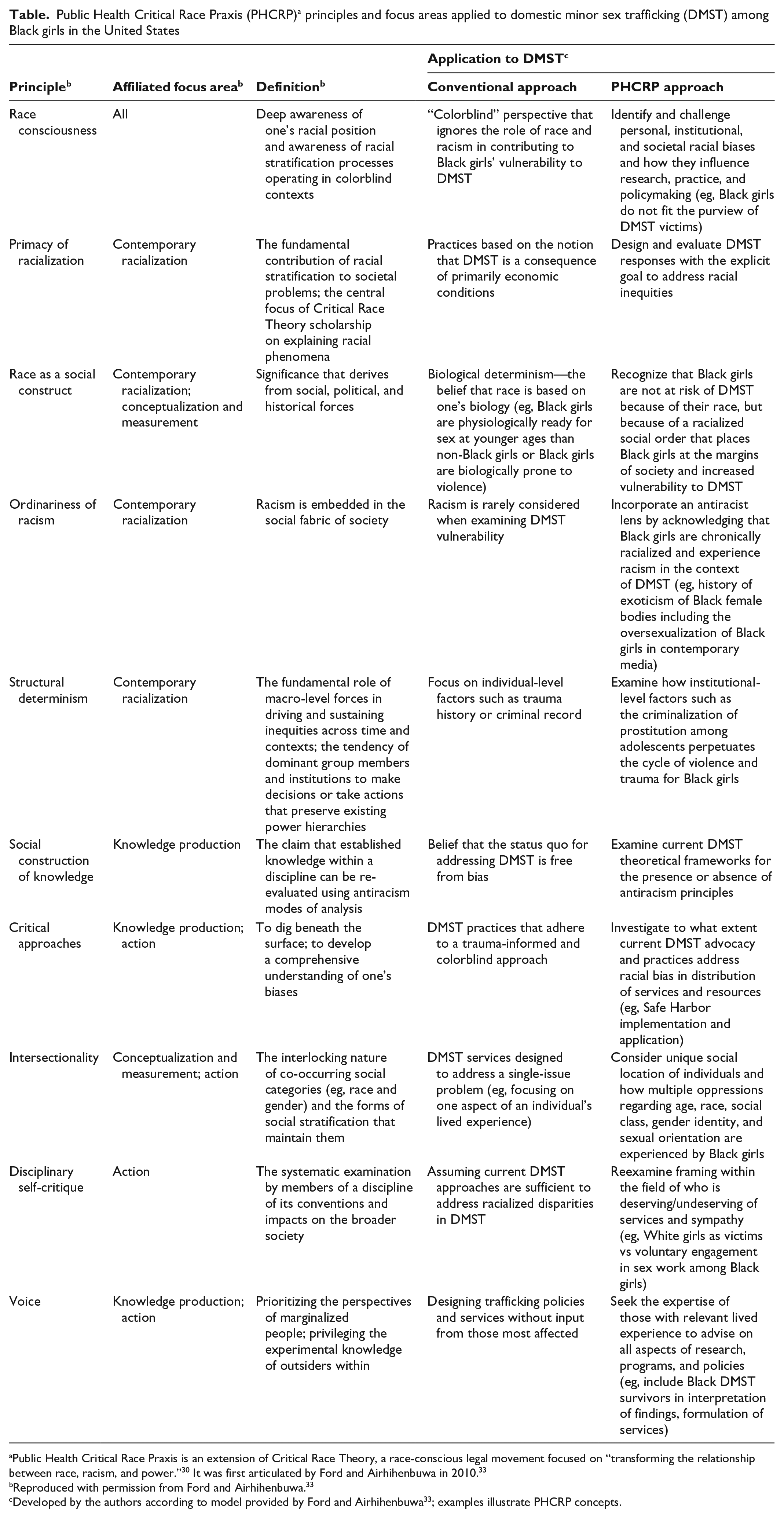
Public Health Critical Race Praxis is an extension of Critical Race Theory, a race-conscious legal movement focused on “transforming the relationship between race, racism, and power.” 30 It was first articulated by Ford and Airhihenbuwa in 2010. 33
Reproduced with permission from Ford and Airhihenbuwa. 33
Developed by the authors according to model provided by Ford and Airhihenbuwa 33 ; examples illustrate PHCRP concepts.
Contemporary Racialization
The first focus area, contemporary racialization, considers the proper racial and historical context to understand how racism and racialization operate at a given point in time. In this focus area, the principle race as a social construct is key. For example, the contemporary “adultification” of Black girls—the misconception that Black girls are less innocent and more adultlike than their White peers 37 —is not based on biological traits but is a result of the historical exoticism of Black female bodies and the oversexualization of Black women and girls in modern media. 25
Applying the principle of structural determinism, we can further explicate how this oversexualization and devaluing of Black girls and the accepted belief that Black girls are violent and out of control25,37 contributed to racially biased responses by law enforcement and the justice system. The case of Cyntoia Brown38,39 sheds light on how Black girls are perceived and treated by the justice system. Brown, a Black 16-year-old survivor of DMST, who shot and killed her 46-year-old “John” after exchanging sex for money, was sentenced to 51 years in prison without parole in 2004. She received clemency from the governor of Tennessee 15 years later, after multiple failed court appeals. 38 Brown received clemency because the governor believed imposing a life sentence on a juvenile was too harsh. 39 Brown’s initial conviction and the legal proceeding that followed illustrate how the macro-level forces and institutions (in this case, the justice system) contribute to and perpetuate racial inequities and are a major determinant of outcomes for DMST survivors.
Knowledge Production
The second focus area, knowledge production, questions how anti–sex trafficking efforts are shaped by racialized beliefs, uncovering the ways in which racial bias may be reinforced. Here, the social construction of knowledge principle, which refers to how the established knowledge in a discipline is shaped by the norms and culture of that discipline and by social context more generally, is particularly pertinent. Another aspect of adultification is the widely held assumption that Black girls are ready for and engaged in sexual activity in early adolescence, which can often lead to the perception that Black girls simply choose to engage in sex work instead of recognizing their marginalization and vulnerability to exploitation. This racially biased production of knowledge presents a challenge for Black DMST survivors in 2 ways: oversight that Black girls are victims and victim blaming. On the one hand, Black girls are not recognized as potential victims of DMST, and their victimization often goes unnoticed by those with the power to intervene. On the other hand, if they are recognized as victims, then they are blamed for their victimization (ie, the adultification of Black girls). This flawed knowledge, if left unchallenged, influences how services are provided and justice-related decisions are made.
Another principle, critical approaches, challenges researchers and practitioners to move beyond the status quo of anti-trafficking efforts and to investigate how personal and institutional biases affect knowledge and knowledge production. An example of how critical approaches are applied in DMST can be seen in an article by Gerassi, in which the authors—a researcher, an organizer, and a practitioner—provide critical reflections on their discourses, assumptions, and actions, especially naming the unacknowledged bias that was occurring in an anti-trafficking task force in both leadership and service delivery. 29
Conceptualization and Measurement
The third focus, conceptualization and measurement, highlights the need to clearly operationalize the race and/or racism-related constructs and relationships assessed in DMST research and practice. This focus is done in tandem with attending to the new knowledge gained from the first and second focus areas and is necessary to clarify how researchers understand the mechanisms at work, how to interpret research findings, and how to critically reassess assumptions embedded in practice and policy.
For example, the principle of intersectionality states that various social categories (eg, race, gender, class) intersect and overlap, which can compound experiences of disadvantage and discrimination.33,34,40 Anti-trafficking researchers have incorporated an intersectional approach to DMST, primarily focusing on gender and class. Through race consciousness, PHCRP contributes to the anti-trafficking field’s understanding of how interlocking social categories such as race and gender (eg, Black and female) can put individuals and groups at differential risk for DMST.25,41 Building on this theoretical foundation, the PHCRP framework encourages practitioners to critically evaluate the types of data and methods needed to assess these complex relationships. In other words, if we are to take seriously the measurement and conceptualization of intersectionality as it relates to Black girls’ vulnerability for DMST, then we must start by collecting data on race and ethnicity, in addition to data on gender and other relevant constructs. Hospital-based anti-trafficking programs that implement a multidisciplinary approach to health services are uniquely positioned to collect intersectional data encompassing both medical and social information (see the THRIVE Clinic for an example). 42
Action
The final focus, action, is the application of new knowledge gained from the previous focus areas to address causes of inequity. The principle of disciplinary self-critique encourages DMST researchers and practitioners to question the norms and accepted practices in the anti–sex trafficking field that perpetuate inequity. One way to practice disciplinary self-critique is for researchers to be reflexive about existing racial power dynamics and to question who holds the power in determining the research agenda, program questions, and the interpretation of the results (eg, Gerassi 29 ). The principle of voice, applied to DMST, is needed to address the lack of young Black female voices in DMST initiatives. Researchers need to ensure young Black females are given opportunities to participate in designing and evaluating policies and services. GEMS (https://www.gems-girls.org/) and My Life, My Choice (https://www.mylifemychoice.org/) are 2 examples of organizations that are founded on survivor-led involvement in programmatic decisions. PHCRP also encourages the use of methods and approaches not typical of public health research, such as storytelling. An example of storytelling is Camara Jones’s seminal article, which uses an allegory of a gardener to explain, in an emotionally neutral way, 3 levels of racism (institutionalized, personally mediated, and internalized). 43 The anti-trafficking field can use similar techniques such as ethical storytelling 44 that value experiential knowledge to center voices typically relegated to the margins.
Conclusion
We have outlined the central focus areas and selected principles of PHCRP, in relation to DMST. This framework can aid DMST research, program, and policy in explicating and then acting on the ways in which racialization and racism affect the anti–sex trafficking field. PHCRP is inclusive of all aspects of the public health approach and is applicable to multiple disciplines. From understanding researcher and practitioner biases, to challenging accepted norms for knowledge production, to questioning the constructs used in DMST, to encouraging novel ways to take action, PHCRP can be used to confront racial inequity in DMST research and practice. DMST practitioners need to design and evaluate DMST prevention activities with an explicit goal to address racial inequities. We acknowledge that young people of various racial and ethnic backgrounds experience DMST differently. We encourage researchers and practitioners to incorporate these principles in ways that are equitable and culturally relevant to the populations they serve. Using DMST, we lay the foundation from which the anti-trafficking field, including labor and sex trafficking, can conceptualize and apply PHCRP in other contexts.
Footnotes
Acknowledgements
The authors appreciate Hector Myers, PhD, Vanderbilt University; Stacia Freeman, MA, EPIC Girl; and 2 anonymous reviewers for providing insightful reviews and suggestions.
Declaration of Conflicting Interests
The authors declared no potential conflicts of interest with respect to the research, authorship, and/or publication of this article.
Funding
The authors disclosed receipt of the following financial support for the research, authorship, and/or publication of this article: The research described was supported by Clinical and Translational Science Award no. 5KL2TR002245 from the National Center for Advancing Translational Sciences. The contents of this article are solely the responsibility of the authors and do not necessarily represent the official views of the National Center for Advancing Translational Sciences or the National Institutes of Health.
