




Abstract
Objective
With the completion of the Human Genome Project and swift development of genomic technologies, public health practitioners can use these advancements to more precisely target disease interventions to populations at risk. To integrate these innovations into better health outcomes, public health professionals need to have at least a basic understanding of genomics within various disciplines of public health. This descriptive study focused on the current level of genomics content in accredited master of public health (MPH) programs in the United States.
Methods
We conducted an internet search on all 171 Council on Education for Public Health (CEPH)–accredited MPH programs in the United States for genomics content in required and elective courses using the search terms “genetics,” “genomics,” and “molecular.”
Results
Of the 171 CEPH-accredited MPH programs examined, 52 (30.4%) schools and programs in 34 states offered some type of genomics education. Thirty-five (20.5%) schools and programs had a course in genetic epidemiology, 29 (16.9%) had a course in genetic biostatistics or bioinformatics, and 17 (9.9%) had a course in general public health genomics. The remaining 119 offered no course with a focus on genetics or genomics. In addition, some electives or specifically focused courses related to genomics were offered.
Conclusion
We found inadequate training in public health genomics for MPH students. To realize the promise of precision public health and to increase the understanding of genomics among the public health workforce, MPH programs need to find ways to integrate genomics education into their curricula.
With the advent of the Human Genome Project in 2003 1 and the Precision Medicine Initiative in 2015, genomics has found a prominent place in medical research and the treatment of disease. Precision medicine is defined as “the right drug for the right patient at the right time.” 2 As the use of genomics increases in clinical medicine, a public health voice is needed as a complementary approach to disease prevention at the population level. This approach is accomplished through research on relationships between genetic traits and diseases across populations that could help guide intervention strategies that prevent disease. 3 Similar to precision medicine, “precision public health” is defined as “providing the right intervention to the right population at the right time.” 4 Precision public health maintains the emphasis on population health, giving attention to large groups of people at high risk of disease based on genetic variations and targeting interventions toward those groups.
The focus on genomics and precision public health has brought attention to the public health workforce and genomics education. Little information exists on genomics education offerings at the master of public health (MPH) level. To assess current genomics offerings for public health students, an investigation of public health programs, specifically MPH programs, is warranted. The objective of this study was to explore the status of genomics education in accredited MPH programs in the United States.
Numerous examples of public health genomics exist. The growth of public health genomics has been seen at the state level as health departments have expanded into genomics 5 and at the national level as genomics was added to Healthy People 2020. 6 In public health practice, genomics is used in maternal and child health through newborn screening programs; in infectious diseases through public health laboratories, part of the National Health Laboratory Service, and in increased use of infectious disease genomics; and in initiatives at the Centers for Disease Control and Prevention (CDC), such as the Advanced Molecular Detection initiative. 7 Research in public health genomics often focuses on epidemiological studies of population health using biostatistical analysis and in environmental health studying gene–environment interactions. This work is important because approximately 90% of the leading causes of death in the United States, including cardiovascular disease, cancer, stroke, diabetes, and Alzheimer disease, have a genetic component. 8 CDC’s Office of Genomics and Precision Public Health offers an online testing guideline database that classifies public health genomics testing into 3 tiers based on scientific evidence. 9 Tier 1 contains genomics applications supported by synthesized literature sources indicating they are ready to be implemented. 9 These applications include targeted surveillance and treatment of people at risk for such diseases as hereditary breast and ovarian cancer, Lynch syndrome, and familial hypercholesterolemia; these applications also include cascade screening of family members.
Consensus has not always existed on the level of involvement for public health in genomics and the importance of genomics education for students and public health professionals. If genomics continues to expand its reach and utility, a workforce that understands genomics will be needed to fill vacated and new positions. This need will extend to the general population, where public health professionals who work directly in communities and with patients may need to educate them. 10 Admittedly, public health has not necessarily kept pace with the increasing genomics information. 11 In addition, public health genomics itself is a broad field encompassing diverse activities. 12 Sorting out these factors to align with public health work is a challenge. 11
With the increased focus on genomics in public health at the state and national levels, public health genomics education for current and future public health professionals may be needed. As early as 2003, the Institute of Medicine declared that it is vital for public health professionals to not only understand genomics but to “think genomically.” 13 CDC’s Office of Genomics and Precision Public Health in 2011 declared genomics education as a priority item for 2012-2017 and suggested partnering with schools and programs of public health offering the MPH degree to develop learning competencies. 14 In that same year, the Secretary’s Advisory Committee on Genetics, Health, and Society at the National Institutes of Health focused on genetics education and training, stating that improvement of genomics literacy for public health professionals and the public is critical to ensure that findings benefit the public’s health. 15
CDC recommended competencies in genomics for the public health workforce in 2001. 14 These competencies were designed for multiple groups: (1) the public health workforce at any level in any program, (2) all public health professionals, (3) all public health leaders/administrators, (4) all public health professionals in clinical services evaluating individuals and families, and (5) all public health professionals in epidemiology and data management, population-based health education, laboratory sciences, and environmental health. 14 Public health organizations at all levels should recognize the necessity of human genome knowledge in public health practice.
Several studies have focused on genomics knowledge among public health professionals. Studies by Chen et al 16 -18 found genomics training for public health educators to be an important influence on genomics knowledge. Overall, public health educators surveyed were unaware of CDC’s competencies and genomics initiatives implemented in health promotion. Chen and Goodson 16 also found that public health educators lacked basic genomics knowledge: the average score among survey respondents was 51.1% for the 6 survey items on basic and applied genomics knowledge. In a subsequent study, Chen et al 17 concluded that public health educators were hesitant to include genomics competencies in health promotion: only 35% were willing to include genomics in community education. Health educators trained in genomics met competencies, increased their knowledge of the use of family health history, and were more likely than those not trained in genomics to adopt and use it confidently. 18 A 2020 study exploring college majors that included genomics education found that within the life sciences, biology and biochemistry majors were specified the most, while few nonscience majors included genomics education. 19 The study concluded that students with nonscience majors should be trained in genomics to increase understanding and demonstrate the importance of genomics in society. 19 Although this study did not focus on public health, it included the field. Finally, health disparities in patient genomic information may be related to public health genomics education. A study revealed a lack of basic genomics education among 182 health educators in Texas. 20 A lack of knowledge was significantly correlated with self-efficacy in genomics, and self-efficacy was associated with intention to provide genomics services to patients. 20 These results indicated a possible effect on genomics-related health disparities. An increase in confidence to provide genomic information and services to patients, who may not normally have access to them, may be part of the solution to address these disparities.
Examinations of genomics education found similar results internationally. One study assessed genomics knowledge, attitudes, and training needs among public health professionals in Italy. 21 A questionnaire sent to 1200 public health professionals in Italy asked about participants’ knowledge and opinion of genetic testing in the realm of public health. Only 20.3% of questionnaire respondents learned about genetic testing used to predict chronic disease in their undergraduate education, and only 24.3% learned about it in their graduate education. When asked questions that tested their knowledge, only 10.2% of respondents answered all questions correctly. 21 A pilot study by Rosso et al 22 surveyed public health professionals in 2016 at Sapienza University of Rome and Vrije University of Amsterdam. The 34 respondents overwhelmingly agreed with all statements in the survey about the incorporation of genomics into public health activities including genetic testing, risk factors and genetic susceptibility, and assessment of access to genetic services by various populations. However, the sample size was small, and further research is needed.
In 2003, the Association of Schools of Public Health (now the Association of Schools and Programs of Public Health [ASPPH]) surveyed 33 US schools and programs of public health accredited by the Council on Education for Public Health (CEPH) and inquired about 8 topic areas, one of which was genomics. ASPPH found that 52% of schools and programs offered a genomics course, and 58% provided a lecture or module within a course. 23 When offered, genomics was an elective in most (76%) schools, and most (70%) intended to add genomics in the future. 23 Two studies explored genetics or genomics course offerings at CEPH-accredited ASPPH schools and programs of public health. The first study (DeHudy A, Jones S, Citrin T, unpublished data, 2007) had a small sample size (n = 38), and the second study (Frieser M, Kasper A, Citrin T, unpublished data, 2011) had a similar sample size (n = 53). From 2007 to 2011, the total number of courses decreased from 193 to 154. Almost 90% were in the areas of epidemiology, biostatistics, biology, or genetic counseling, and the remaining 10% were in the areas of health management, ethics, or law. Similarly, London 24 in 2013 randomly selected 20 CEPH-accredited programs of public health and found that only 35% offered genetics or genomics courses. If this trend continues, genomics education offerings may be lacking for students entering the field of public health.
Methods
We obtained a list of all CEPH-accredited MPH programs in the United States from the CEPH website in January 2018 (https://ceph.org). Using public information obtained from the internet, we examined the course offerings of 171 MPH schools and programs for genomics content. We conducted a search for required and/or elective courses with the words “genetics,” “genomics,” or “molecular” as terms we suspected would provide the most courses focused on genomics content. We classified types of courses into the following categories based on what we saw in the data as most commonly offered: genetic biostatistics or bioinformatics, genetic epidemiology, general public health, and none. We calculated frequencies and percentages of genomics courses by type (type of course divided by sample size [n = 171]) and overall percentages of MPH schools and programs with and without course offerings (total number of MPH schools and programs with and without course offerings divided by sample size [n = 171]). We used Tableau Public software version 2020.4.2 (Tableau Software, LLC) to create a map to show the location and number of MPH schools and programs in each state.
Results
Of the 171 CEPH-accredited MPH programs examined, 52 (30.4%) schools and programs in 34 states offered some type of genomics education (Figure). Thirty-five (20.5%) schools and programs had a course in genetic epidemiology, 29 (16.9%) had a course in genetic biostatistics or bioinformatics, and 17 (9.9%) had a course in general public health genomics. The number of schools and programs that did not offer any genetics or genomics courses was 119 (69.6%).
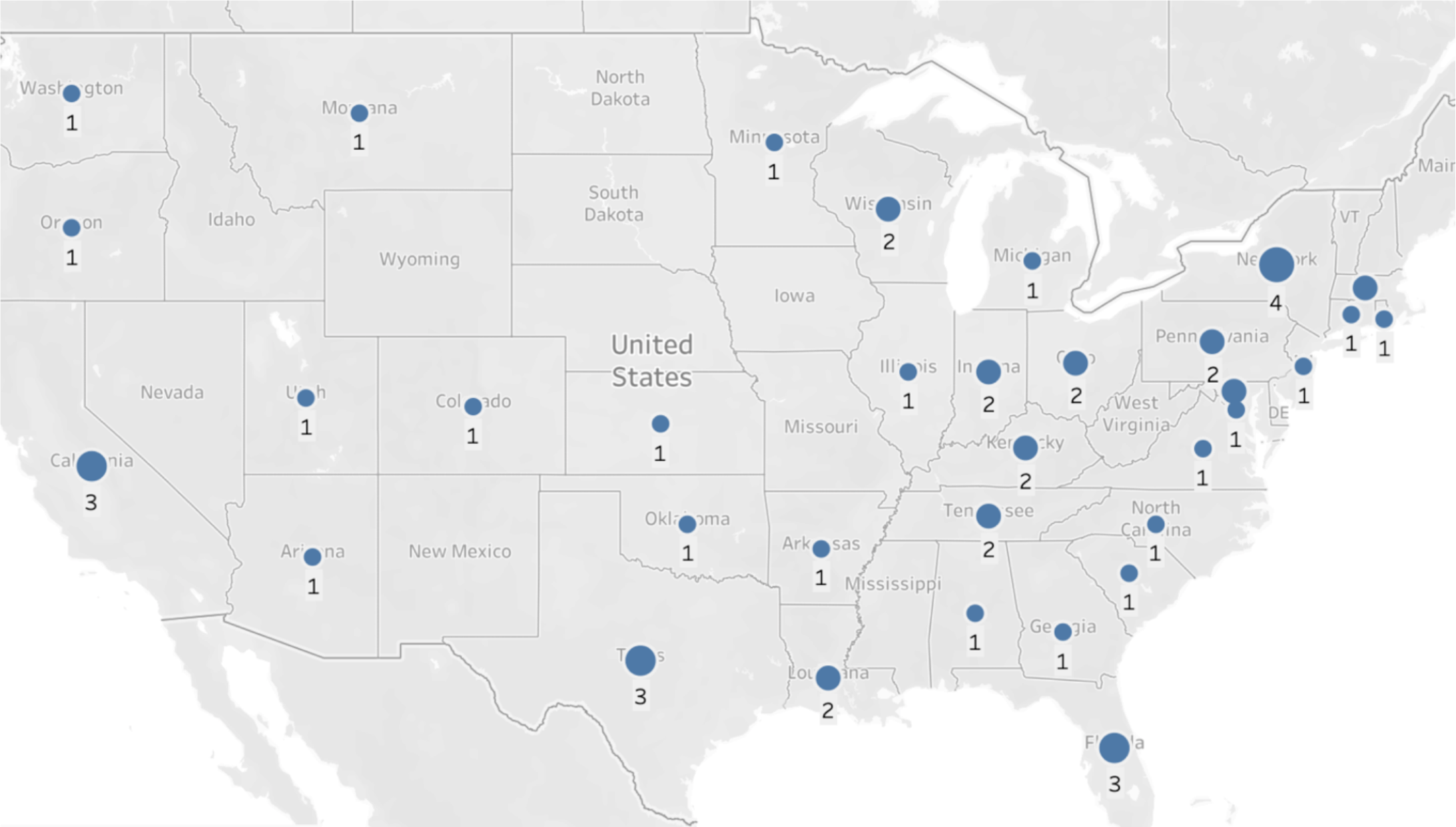
Council on Education for Public Health–accredited schools and programs of public health (n = 52) offering courses with genetics or genomics in the course name, by location and number, United States, 2018. Each dot represents the presence of a school or program in a state (n = 34); the corresponding number indicates the number of schools or programs in a state.
In some programs, MPH students had the opportunity to take an elective genomics course. Electives included Public Health Biology; Molecular Fundamentals; Evolution and Gene Expression; Environmental Genomics; Financial, Ethical, Legal, and Social Implications of Genomics; Genomics and Infectious Diseases; Obesity—From Genes to Junk Food; Pharmacogenomics; Molecular Toxicology; Nutrigenomics; Behavioral Genomics/Health Education; and Genomics of Chronic Diseases. Many MPH schools and programs offered access to genomics courses through other university departments.
Discussion
The results of this exploratory study demonstrated limited genomics education being offered to MPH students. Our study findings are consistent with the findings of earlier studies, which found that the current course offerings in genomics may be insufficient. 23,24 As advances in genomics continue, both clinical medicine and public health can benefit from increased implementation of genomics programs. For example, epigenetics is a relatively new field that involves heritable genetic tags in a person’s genome that can be modified through behaviors such as diet and environmental factors such as chemical exposures. 12 These are examples of social determinants of health and health behaviors, both foundational components of the public health profession. Gene and environment interaction is an area of interest for public health professionals to explore disease prevention strategies.
Because genomics has expanded and genomics literacy is recognized as an emerging need, 10 the divide is narrowing between people who support genomics education for public health students and people who oppose it. The challenge for public health has always been to explain how the field will use genomics knowledge in practice. 5,11 The current state of public health genomics has evolved and grown in the last several decades, evidenced by some 20 initiatives implemented from 1997 through 2017. 5 It is difficult to find current literature opposing genomics education. However, a possible barrier is the slow movement in translating genomics to social and behavioral research. 25
Public health professionals will need to have a broad understanding of the connection between genomics and population health and should lead and provide public health services that include genomics. An educated public health workforce and consumer base is crucial for successful integration and implementation of public health genomics programs to realize the promise of precision public health. Public health professionals can also be instrumental in shaping and implementing genomics in public health policy. Therefore, it may be beneficial for training future public health professionals in MPH programs to include public health genomics education into their curricula.
Based on the pace of genomics discovery and its possibility to reduce morbidity and mortality, the current state of genomics education may need to be revisited. Graduate public health programs have a responsibility to provide an education that addresses new technologies, evolving policies, and disease states. Simple recommendations for improving genomics education include developing an elective course on general public health genomics, offering a lecture or module on genomics into a core course, or creating a web-based course, webinar, or genomics certificate. Guidance could be provided through collaboration with local and state public health departments or genetics centers.
The process of developing genetics education is not without challenges, and several factors may inhibit or restrict the possibility of implementing these recommendations. The field of genomics is large and evolving rapidly. It may seem overwhelming to find not only a place for curriculum in an already crowded program but also the personnel qualified to teach it. Budgets are always a concern, and a field in which the evidence for population health benefits is limited may be perceived as a low return on investment. Finally, keeping up with advances in genomics technology and ethical concerns requires a commitment of time and resources.
Future research should be conducted to understand genomics education from the perspective of MPH program directors. A survey of MPH program directors may provide insight into the reasons for offering or not offering genomics training for MPH students. These reasons may then be addressed through initiatives that include solutions for training the future public health workforce.
Conclusion
Few MPH programs offer genomics education, and only a handful offer specific public health genomics courses. Public health practitioners may need to have a basic knowledge of genomics to begin to understand how to translate this powerful tool proactively and effectively into public health practice and design well-targeted interventions. Training MPH students in genomics will increase understanding and may further help current public health professionals and other groups such as community leaders and health care providers. Furthermore, increased genomics education improves knowledge and develops skills in communicating that knowledge to others, addressing public genomics literacy. As Allen et al 10 suggest, increasing genomics literacy should encompass more than learning new information; it should also include interaction with communities. Community interaction is an area where public health workers can excel.
Footnotes
Declaration of Conflicting Interests
The authors declared no potential conflicts of interest with respect to the research, authorship, and/or publication of this article.
Funding
The authors received no financial support for the research, authorship, and/or publication of this article.
