



Abstract
Public health in the United States has long been challenged by budget cuts and a declining workforce. The COVID-19 pandemic exposed the vulnerabilities left by years of neglecting this crucial frontline defense against emerging infectious diseases. In the early days of the pandemic, the University of Texas Medical Branch and the Galveston County Health District (GCHD) partnered to bolster Galveston County’s public health response. We mobilized interprofessional teams of students and provided training to implement projects identified by GCHD as necessary for responding to the pandemic. We provided a safe outlet for students to contribute to their community by creating remote volunteer opportunities when students faced displacement from clinical rotations and in-person didactics converted to virtual formats. As students gradually returned to clinical rotations and didactic demands increased, it became necessary to expand volunteer efforts beyond what had initially been mostly hand-selected student teams. We have passed the initial emergency response phase of COVID-19 in Galveston County and are transitioning into more long-term opportunities as COVID-19 moves from pandemic to endemic. In this case study, we describe our successes and lessons learned.
The size of the public health workforce in the United States has declined during the past 2 decades. 1,2 The shortfall of public health workers in 2020 was estimated to be 250 000 workers, not counting the additional need created by the COVID-19 pandemic. 2 In Texas, the public health workforce declined by 16% from 2008 to 2019. 3 The state lacks a sufficient number of epidemiologists to track disease outbreaks because of a lack of funding and competitive salaries. 3 The shortage of public health workers in the United States and Texas in particular is part of a larger problem of consistently underfunding and decreasing public health budgets at national and state levels. 2 -5 In 2014, public health accounted for just 2.7% of total health expenditures in the United States, with an expected decrease to 2.4% by 2023. 5 In 2019, Texas ranked 40th in the nation on public health funding at approximately $17 per person. 3 Public health funding has historically surged during times of crisis and then again constrained once the crisis is over. 6
COVID-19 Public Health Workforce Need and Response in Galveston County
The COVID-19 pandemic required additional human resources to implement public health practice components needed to identify, monitor, track, and prevent COVID-19 infections. In March 2020, just as the COVID-19 outbreak hit the Texas Gulf Coast region, the University of Texas Medical Branch (UTMB) Center for Global and Community Health, the program office of the Texas Area Health Education Center of East Texas (Texas AHEC East), and the UTMB Department of Preventive Medicine and Population Health mobilized student volunteers to work in interdisciplinary teams on several projects identified by the Galveston County Health District (GCHD) as vital to the COVID-19 outbreak response in Galveston County, Texas. For student safety, all volunteer opportunities were conducted remotely.
As of April 30, 2021, Galveston County had reported 33 406 cases of COVID-19 and 344 deaths. 7 The county had a surge in the number of cases and deaths in June and July 2020 and another surge that began in November 2020 and ran through February 2021. GCHD has focused its efforts to contact every person diagnosed with COVID-19 for an epidemiological investigation and contact tracing in Galveston County. GCHD also follows up with patients to monitor symptom progression and provide vital services, including providing quarantine and isolation guidance, referrals for health care and testing services, discharge documentation from home isolation, and general emotional support for caregivers, as needed. In addition, GCHD maintains a call center with an information hotline and a publicly available online dashboard of daily case counts and other data trends. 7 The demand for GCHD services has required the participation of volunteers and contractors, providing UTMB with a unique and timely educational service opportunity.
Purpose
Volunteerism among health professions students is relatively common but is rare as part of a large-scale, concerted effort. However, an unprecedented global public health emergency allowed thinking beyond traditional volunteer approaches to guide student volunteerism to achieve the most substantial impact safely. To date, data on volunteerism among health professions during COVID-19 are limited. The available literature, however, confirms our assessment of the desire among students to contribute meaningfully, particularly when their educational activities are paused. 8 -10 The use of health professions students as volunteers during the COVID-19 pandemic has mostly involved students serving in health assistant roles in the clinical environment, primarily in COVID-19 hotspots in New York City, the United Kingdom, and the Netherlands. 8 -11 In Louisiana, medical students filled vital roles in triage call centers, personal protective equipment (PPE) distribution planning, community outreach programs to geriatric patients, and patient communication plans. Students with the appropriate credentials assisted with laboratory processing of COVID-19 polymerase chain reaction tests. 12 Medical students at Harvard University created an online, continually updated COVID-19 curriculum, developed education and communication aids, and served as activists in the community for populations at increased risk of contracting COVID-19 and requiring hospitalization. 13 The purpose of this article is to describe how UTMB engaged health professions students in projects through partnership with GCHD, using the interdisciplinary nature of public health as a vehicle to cross traditional disciplinary boundaries that positively affected the community and saved lives.
Methods
Initially, we identified student teams and team leads by contacting students known to the authors through previous projects. However, the GCHD workload quickly demanded the need for more volunteers, and we sent a call for volunteers to students in all 4 schools at UTMB (School of Medicine, School of Nursing, School of Health Professions, and the Graduate School of Biomedical Sciences). In total, more than 250 students from various programs volunteered. Volunteers completed an orientation program designed by UTMB staff members, including a basic overview of COVID-19, telephone etiquette, review of the Health Insurance Portability and Accountability Act, and project-specific training. We assigned students to projects and appointed student team leads to oversee the day-to-day coordination of projects. Staff members from the UTMB Center for Global and Community Health, Texas AHEC East, and GCHD managed overall project direction and provided mentorship.
Outcomes
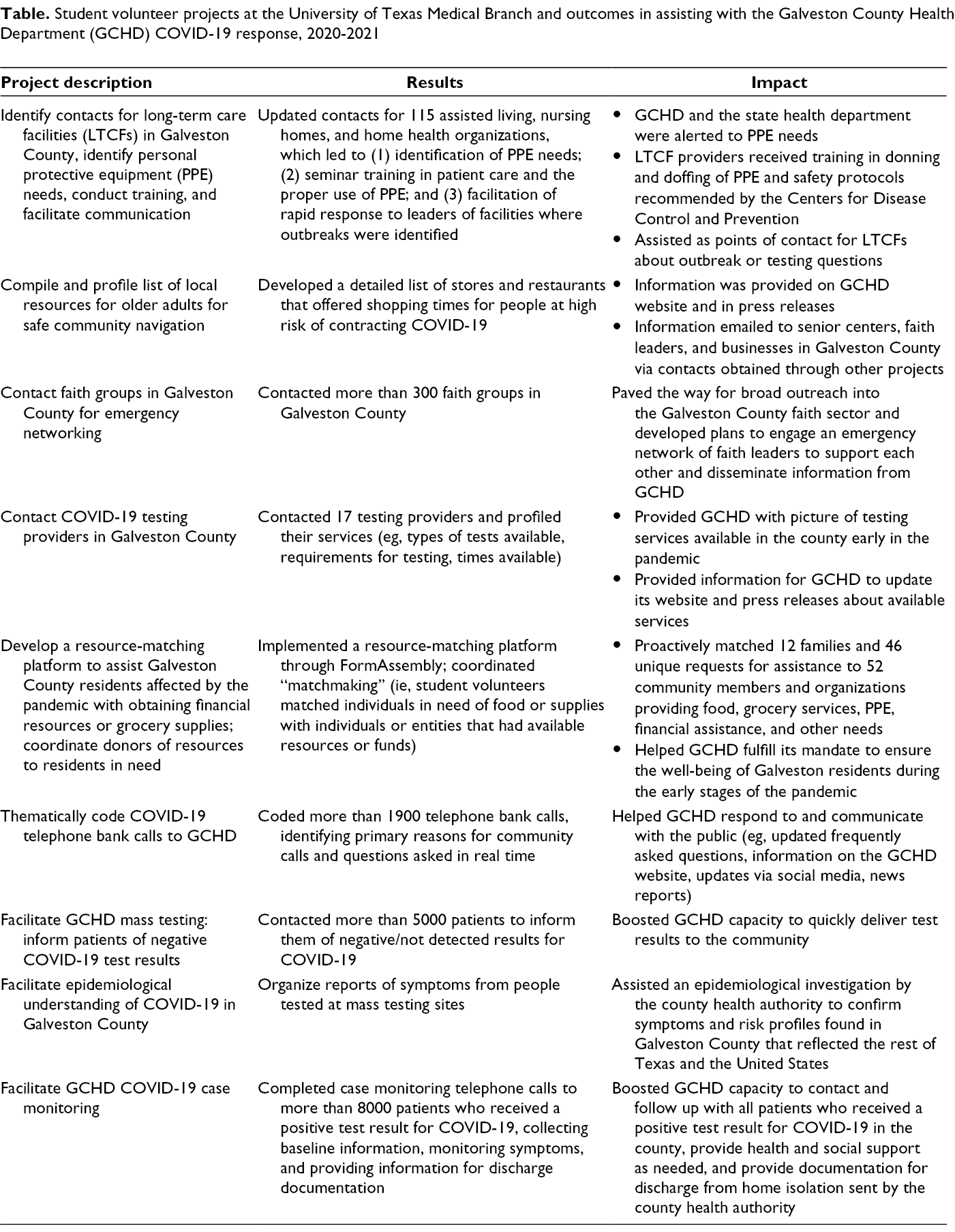
Based on GCHD partner requests for assistance, COVID-19 projects initially focused on data gathering and communications with various community partners (nursing homes, religious institutions, food banks, and other organizations with outreach into the community), with a shift toward more direct involvement in the pandemic response when COVID-19 cases began to surge in early June 2020 (Table). UTMB student volunteers logged more than 3500 hours on GCHD COVID-19 projects. Student volunteers bridged the workforce gap to allow the time necessary for GCHD to expand and train its professional workforce and implement automated systems for COVID-19 case monitoring. Student volunteers continue to serve in a reserve capacity for anticipated surges in COVID-19 cases in Galveston County. Students tracked COVID-19 vaccine supply, distribution, and administration through follow-up with vaccine providers in Galveston County and beyond to the broader region served by the UTMB health system and the Texas AHEC East region. This project was intended to provide the county with information to advocate need at the state level, but priorities changed to mass vaccination sites. However, the project helped the county assess the high demand for the vaccine.
Student volunteer projects at the University of Texas Medical Branch and outcomes in assisting with the Galveston County Health Department (GCHD) COVID-19 response, 2020-2021
Lessons Learned
Student Volunteer Management
This volunteer program was implemented rapidly (from initial conceptualization to operation in a matter of days) to help address the needs of GCHD and the Galveston County community as they arose during the COVID-19 pandemic. As such, a continuous review of processes was necessary to optimize the best use of volunteer time and address the evolving needs of GCHD. At the onset of this initiative in March 2020, UTMB sent home all nonessential health care personnel to work remotely. All clinical rotations for students halted, and didactic courses paused to convert to online formats. This time allowed us to engage students, who had few to no other time commitments, in this process. Initially, many of the team leads were senior medical students who had just matched to residency programs. Although this strategy served us well initially, as the COVID-19 pandemic evolved, it quickly became necessary to expand to other students. Volunteer expansion was necessary to tackle the sheer volume of work and address volunteer burnout and time constraints. These issues arose as didactic courses fully transitioned to online platforms and senior medical students relocated for residency. Team leadership roles transferred to other students identified by both mentors and existing team leads for their dedication and performance as volunteers. Ultimately, for longer-term projects such as COVID-19 patient monitoring, we found that having 2 student co-leaders helped balance the time commitment and minimize volunteer burnout. We implemented a student volunteer log and used color codes so that volunteers could self-report their level of burnout and time constraints. We encouraged students who were not comfortable with responding on a volunteer-wide log to email UTMB staff members directly. Flexibility was key to include a large number of volunteers from various educational backgrounds and training levels. UTMB staff members used daily and weekly sign-up sheets to help with planning and allow volunteers to choose days they were available. Several projects (eg, call center coding) did not have strict work hours, and work could be completed at times that were convenient to the students and their schedule. Overwhelmed students could regulate their time by using the sign-up sheet or work with UTMB staff members to identify projects that worked best with their schedule.
A survey and video project of volunteer experiences is being produced to document the impact the volunteering had on students and GCHD staff members. Ideally, for such long-term events as the COVID-19 pandemic, an evaluation would have been built in from the beginning. Some early volunteers have since graduated and moved on to other opportunities.
Incentives
During summer 2020, through available funding from Texas AHEC East and the Center for Global and Community Health, we offered $1000 scholarships to all volunteers who joined the AHEC Scholars program. AHEC Scholars is an interprofessional, multi-institution program designed to increase workforce capacity in rural and medically underserved areas of East Texas by providing additional didactic and experiential opportunities in these areas. Our students were in unpaid, volunteer roles, and these funds enabled us to recognize and reward their hard work and dedication. We have also expanded the volunteer opportunity to students outside UTMB who participate in the Texas AHEC East Scholars program. In addition, several students were able to use their volunteer hours to meet other fellowship and scholarship requirements, unique to their situation, with review from UTMB staff members. Beginning in the summer 2020 semester, nursing students were able to use their hours volunteering in patient monitoring to meet course requirements.
Partner-Driven Needs
Aside from volunteers, this endeavor would not have been, or continue to be, successful without strong, bidirectional engagement between GCHD and UTMB. Efforts were successful because student volunteer projects met partner-driven and community needs. Our effort benefited from having a primary faculty member (P.K.) who also serves as the local health authority for Galveston County. It is necessary to have a dedicated staff member to serve as a liaison between UTMB and GCHD. Two staff members of Texas AHEC East (A.E., B.B..) dedicated time to manage student volunteer efforts with GCHD. One staff member (A.E.) served as the liaison between the 2 entities and coordinated volunteers, including project-specific training. The other staff member ensured volunteers completed basic training and volunteer paperwork required by GCHD. Initially, we managed training on Blackboard, UTMB’s online learning management system; however, a non-UTMB volunteer cannot be enrolled on Blackboard. With the inclusion of non-UTMB volunteers, we transitioned this training to Course Sites, a free version of Blackboard that allows for enrollment of external volunteers.
Logistics
When telephone calls to community members were necessary during mass testing and patient monitoring, student volunteers used the Google Voice communications service, which allowed for (1) masking the students’ cell phone numbers and (2) community members to receive telephone calls from a 409 Galveston area code, which increased the likelihood of calls being answered and voicemails being returned. In addition, because all volunteer efforts were remote, we used Zoom to hold team meetings and trainings. For ongoing projects, such as patient monitoring, GCHD provided training videos and updates as its internal processes evolved.
Conclusion
The COVID-19 pandemic highlighted vulnerabilities of the public health system in the United States that resulted from years of underfunding and declining human resources. UTMB and GCHD partnered to give students who were seeking ways to help the community a safe, meaningful, and, most importantly, partner-driven outlet during the most important public health crisis in a century. Public health transcends traditional disciplinary boundaries and allows students from various health and science disciplines and training levels to contribute to COVID-19 response efforts in Galveston County. We hope our experience serves as a guide for other programs to involve their students in local public health efforts, not only during the COVID-19 pandemic but also during future public health emergencies.
Ideally, a well-funded public health system would be able to meet the challenges of emerging infectious diseases and other emergencies without relying on volunteer labor and would undoubtedly be more efficient and sustainable. However, the extraordinary circumstances of the COVID-19 pandemic spurred a spirit of “all hands on deck,” providing an educational opportunity for health professions students to gain experience in community and public health outside their typical curriculum. The projects available for student involvement varied widely in terms of time commitment, and because all projects were conducted remotely, much of the work could be completed according to the students’ schedules and location needs. The flexibility of remote volunteer opportunities allowed for involvement from students who may otherwise have been unable to volunteer because of personal or financial constraints.
University relationships with county health departments can provide excellent experiences for student involvement, and we recommend that funding and support for student service opportunities be included as part of a well-funded public health system, especially at the local and county levels.
Footnotes
Declaration of Conflicting Interests
The authors declared no potential conflicts of interest with respect to the research, authorship, and/or publication of this article.
Funding
The authors received no financial support for the research, authorship, and/or publication of this article.
