




Abstract
Clear writing is a critical component of public health research and practice. The ability to convey information in a concise, engaging, and insightful manner influences stakeholder engagement and is the backbone of program and policy development, organization, and implementation. To help master of public health (MPH) students adapt their writing skills to these specialized demands, Boston University School of Public Health launched the Peer Writing Coach Program in 2010 staffed by MPH students. The service is open to all students enrolled in public health classes. They can schedule up to 2 appointments per assignment for both individual and team papers. Student use increased from 55 appointments in academic year 2010-2011 (the first year of the program) to 767 appointments in academic year 2017-2018. For the 2016-2017, 2017-2018, and 2018-2019 academic years, 1128 (74%) of 1530 appointment requests asked for assistance “writing clearly and concisely,” 886 (58%) for assistance “organizing and synthesizing main points of argument,” and 529 (35%) for assistance “tailoring writing for a specific audience.” This case study describes the rationale for creating the program, outlines the chronology of its development since 2010, and provides an overview of peer coach training, student use, and lessons learned as we addressed logistical challenges.
Students enrolled in public health graduate programs often have little experience writing policy briefs, research protocols, scientific abstracts, and other types of documents typical to the profession. 1 Some are mid-career professionals, but many arrive directly from undergraduate programs. Their academic training varies across multiple disciplines, as do their writing skills and styles. Public health instructors must, therefore, be prepared to guide students as they learn new terminology and types of professional and technical writing. 1,2 To help master of public health (MPH) students adapt their writing skills to these specialized demands, Boston University School of Public Health (BUSPH) launched the Peer Writing Coach Program in 2010.
The Peer Writing Coach Program is similar to a writing center where students sign up for one-on-one appointments to get feedback on a draft. 3 -6 All students enrolled in classes in the BUSPH can schedule appointments with peer coaches. We opted to call it a coaching program to appeal to students at all skill levels. 5 University writing centers are frequently found in undergraduate English and writing-across-the-curriculum programs. But they also exist in discipline-specific programs where tutors are familiar with the content of student papers, disciplinary conventions, and audience expectations. 5 -8 The Peer Writing Coach Program is anchored in this tradition of writing in the disciplines and writing process theory.
Composition is a cognitive learning process tied to language acquisition and collaborative revision. 9 -15 The term “writing process” is commonly used to describe the stages of composition as a discrete 3-step progression:
Prewriting: research, planning, freewriting;
Drafting: assembling information into a solid (if rough) argument;
Rewriting: reworking the draft in response to feedback into a polished final product. 10,16
But decades of composition scholarship argue that this model is too simple and linear. 15 -17 The writing process is messy, time-consuming, and recursive. 10,11,13 This description of the writing process is as true for accomplished writers as it is for novices. 14,15
Our peer writing coaches function as conversation partners who remind authors that their writing will be read by someone who expects to understand the message. They help students see sentences that are unclear. They ask them to explain muddled points and encourage them to simplify. In doing so, they help authors transition from writing for themselves to writing for an audience. 5,18,19 This relationship between student authors and coaches is often referred to in composition scholarship as “collaborative learning.” 18 -20
The Peer Writing Coach Program seeks to (1) nurture an understanding that the best writing goes through multiple iterations, (2) create an environment in which students turn to peers for encouragement and support, (3) provide students with writing assistance directly relevant to their public health classes, and (4) make the service accessible by locating it in the BUSPH.
Purpose
Our decision in 2010 to create a peer writing coach program in the BUSPH emerged from an ad hoc faculty committee tasked with documenting the types of writing assigned in MPH courses and reviewing options for providing writing support. The committee found that most classes were writing intensive, and members were familiar with frequent faculty concerns about student writing. The committee recommended creating a program in which all MPH students could seek feedback from trained writing coaches who understood the stylistic norms expected by public health readers.
The large size of our student population also contributed to the decision to develop our own program. BUSPH has 1200 students, and approximately 450 new students are admitted annually. Class sizes sometimes exceed 50 students, particularly in first-semester core courses. Many professors and teaching assistants felt that students needed more writing support than they were able to give. We needed an on-site service that could grow with student demand.
Our goal in building the Peer Writing Coach Program was to give students support beyond what they were already receiving in their classes. We set out to create a culture in which all students—regardless of skill, experience, or confidence—start papers early, seek feedback from peers, and revise.
In 2016, BUSPH implemented a new MPH curriculum, which included integrating the 4 core courses students take in their first semester. 21 This integration provided an opportunity to position the Peer Writing Coach Program within an overarching Public Health Writing Program that encourages faculty and students to think of writing as a skill built over time through deliberate practice: daily intentional engagement and constant attention to possibilities for improving process, style, and precision. 1,22 -24 The Peer Writing Coach Program is a cornerstone of the Public Health Writing Program.
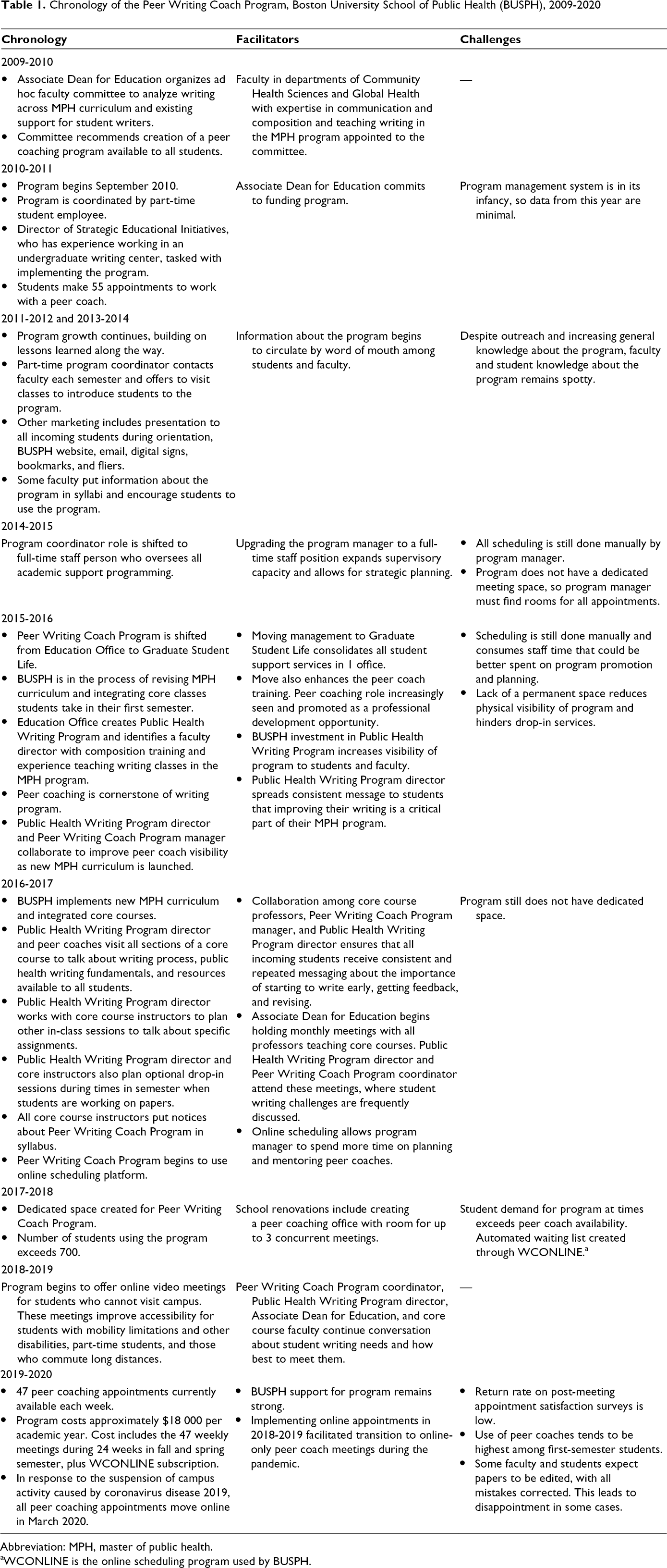
BUSPH’s writing resources have evolved since 2010 (Table 1). We are in a constant process of learning and adapting the program to run more efficiently and better meet student needs. The objective of this case study was to describe the Peer Writing Coach Program, peer coach training, student use of the program, and key lessons from meeting challenges.
Chronology of the Peer Writing Coach Program, Boston University School of Public Health (BUSPH), 2009-2020
Abbreviation: MPH, master of public health.
aWCONLINE is the online scheduling program used by BUSPH.
Methods
To gather data and retrace the history of the Peer Writing Coach Program, we reviewed administrative reports and other documents, including training documents, publicity materials, and the BUSPH academic resources website. We also compiled program management data. The type of data we collected changed over time. From September 2010 through May 2016, we collected all data manually, and only documented the number of students using the program. Students contacted the program manager, who scheduled all appointments manually.
In September 2016, we began using an online scheduling program, WCONLINE. Students create an account and log in to check the availability of writing coaches. This platform allows us to collect (1) information on student reasons for requesting assistance, (2) feedback reports written by peer coaches summarizing feedback given on a paper and an action plan for revision, and (3) students’ comments on the feedback they received and the usefulness of the meeting.
We stripped WCONLINE data of identifiers before analysis. A qualified staff member of the Boston University Medical Campus Institutional Review Board determined use of program data for this report to be exempt under category 9 of the policies and procedures of the Human Research Protection Program.
Outcomes
Structure and Substance of Coaching Sessions
Each appointment in the Peer Writing Coach Program is 1 hour, and students may make 2 appointments per assignment at any point in the writing process. Most appointments are held in-person in the program office. Starting in 2018, students could request an online meeting. These interactions are conducted by using the WCONLINE video conferencing function.
Every session starts with the peer coach asking students for more information about their ideas, where they are in the research and writing process, and difficulties they have encountered. The peer coach reads the assignment instructions, the grading rubric for the assignment, and the draft. For short papers, full drafts are reviewed. For any paper longer than 10 pages, the coach asks students to identify the section of the paper they would like to discuss.
Peer coaches help students organize and clarify their ideas, build an argument, incorporate and cite evidence, target the needs of their audience, and improve readability. They do not copy edit, but they do assist students struggling with wordiness, clumsy sentence structure, imprecise prose, and jumbled organization. They help authors see gaps between what they want to convey and what they have written. They provide assistance on both individual and team assignments. Each session ends with the peer coach helping the student create a revision plan based on the feedback provided.
Students interested in learning a citation management program are referred to free online tutorials and librarians for individual assistance. Peer coaches do not check for plagiarism or monitor formatting of citations. They do provide feedback on paraphrasing and when to include citations if they see a gap or if a student asks.
Peer Coach Recruitment, Selection, and Training
Peer coaches are MPH students who have completed their core courses. The application process is competitive, with more than 90 applicants annually. We vet applicants on their communication skills (demonstrated by an A or A− in writing-intensive public health courses), ability to describe writing process challenges, and interpersonal skills. During the interview, we ask applicants to read and provide written and oral feedback on a paper. This feedback allows us to assess applicants’ ability to give both encouragement and constructive feedback to their peers. Many who apply do so because they see it as a way to improve their own writing.
Training for the new coaches involves 2 in-person meetings focused on:
Providing student-directed feedback;
Eliciting student input on what they would like assistance with;
Developing realistic goals at the start of each session;
Using a triage approach to providing feedback;
Referring students in distress to BUSPH staff members;
Complying with the Family Educational Rights and Privacy Act and university policies and procedures. 25
We train peer coaches to tell students that they cannot predict grades or a professor’s response to a draft. They learn to urge students to consult instructors, teaching assistants, syllabi, and assignment instructions when they are unclear about requirements or have questions about feedback from their professor.
Peer coaches attend monthly meetings to discuss challenges and upcoming course assignments with students. These meetings provide peer coaches with an opportunity to share experiences, support one another, and request resources. The program manager who supervises the peer coaches facilitates these meetings and plans future training exercises based on these discussions.
Student Use of Peer Coaches
Student use of peer coaches increased from 55 appointments in the first year of the Peer Writing Coach Program, academic year 2010-2011, to a high of 767 in academic year 2017-2018 (Figure). The spikes in demand in academic years 2016-2017 and 2017-2018 aligned with our largest incoming classes. Approximately one-third of the students who used the program made multiple appointments. The number of appointments consistently exceeded the number of students seeking assistance.
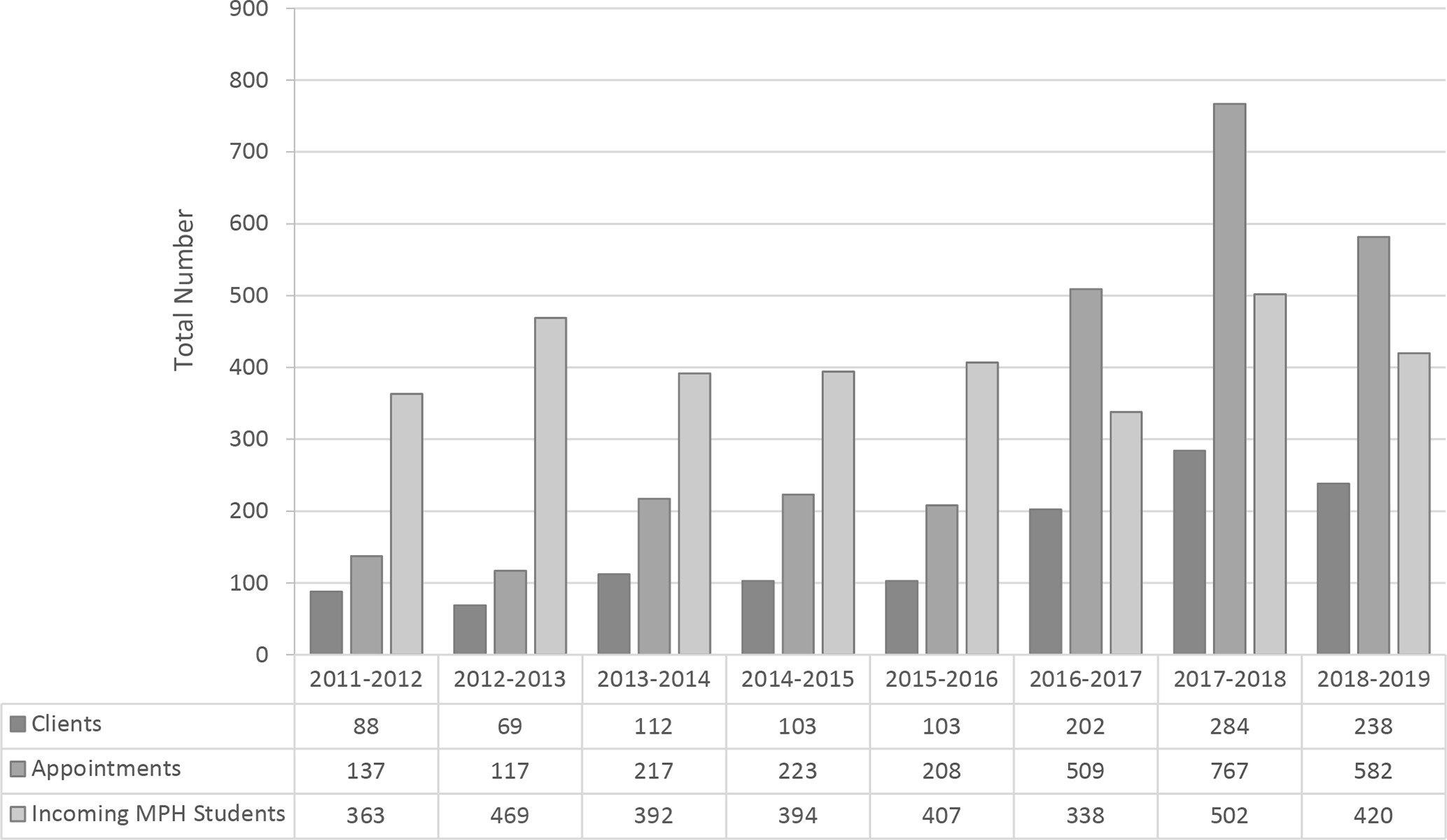
Student use of peer coaches in the Peer Writing Coach Program at the Boston University School of Public Health (BUSPH), 2011-2019. Years refer to academic years. Abbreviation: MPH, master of public health.
When students schedule an appointment on WCONLINE, they must choose a reason for requesting the appointment from a dropdown menu. For the 2016-2017, 2017-2018, and 2018-2019 academic years, 1128 (74%) of the 1530 appointment requests asked for assistance “writing clearly and concisely,” 886 (58%) for assistance “organizing and synthesizing main points of argument,” and 529 (35%) for assistance “tailoring writing for a specific audience.”
Student Feedback on Working With a Peer Coach
Within 24 hours of their appointment with a peer coach, students receive an automated email asking them to complete a 10-question evaluation through WCONLINE. Evaluation questions ask students for information about how they learned about the program and their satisfaction with the help they received. Of the 351 students who completed post-appointment surveys in the 3 academic years studied, 185 (53%) reported hearing about the program from an instructor, 51 (15%) from a friend or peer, and 37 (11%) from an in-class presentation. Students rate their satisfaction by responding to 3 prompts focused on the clarity of the feedback they received, their confidence in their ability to revise, and their ability to apply advice received from the peer coach. (Answer choices are strongly agree, agree, neutral, disagree, and strongly disagree.) Of the 351 students who completed surveys, 98% agreed or strongly agreed that “it was easy for me to understand what I discussed with the peer coach” (Table 2).
Post-appointment student ratings, Peer Writing Coach Program, Boston University School of Public Health, academic years 2016-2017, 2017-2018, and 2018-2019
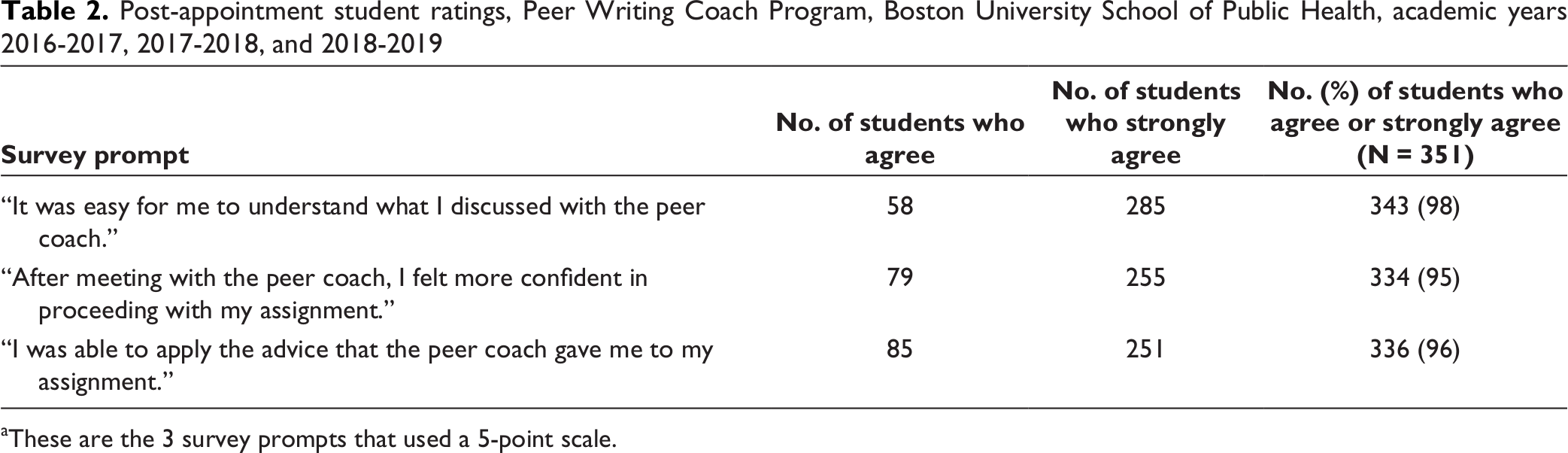
aThese are the 3 survey prompts that used a 5-point scale.
The post-appointment survey also asks students to respond to an open-ended question, “What about the session was helpful?” Many students described how peer coaches emphasized the importance of using instructions and rubrics when planning and revising. They also described boosts in their confidence. The following quotes illustrate these themes:
My peer coach helped me break down the paper and restructure it based on the rubric. She also helped me identify places where I didn’t need quotes, needed to paraphrase, and areas where the language was too fluffy for public health writing.
I went to my first peer writing appointment for a group paper and it was a great experience. I was apprehensive about giving up 3 hours of my time (commuting), but it was well worth it. Those 3 hours saved our group double that amount of time, helped us understand our own work at a deeper level, and provided a sympathetic and humorous ear regarding the struggles of getting comfortable with the unfamiliar style of public health writing.
Of the 351 evaluations completed by students, none offered negative critiques. But we know anecdotally that some students left appointments frustrated because the peer coach did not copy edit their prose or check the accuracy of their citations. We are encouraged by the positive responses to the post-appointment survey, but the 19% response rate (351 of 1858 appointments) underscores the limitations of our data.
Lessons Learned
During the past 10 years, we have learned a great deal about our students’ needs for writing assistance and best practices in providing them with peer support. This learning process continues as we receive feedback from coaches, student clients, and faculty; address challenges; and streamline program logistics (Table 1). We summarize key lessons learned and ongoing priorities.
Start Small and Build Student Demand and Program Capacity Over Time
The Peer Writing Coach Program currently offers 47 hour-long coaching sessions per week (24 weeks during 2 semesters), and our direct program costs are approximately $18 000 per academic year, which covers student labor and our annual subscription to the WCONLINE platform. The investment was much smaller when we began and grew incrementally.
The program was managed by part-time student employees under the supervision of a full-time staff member based in the Education Office until 2014. As the program grew, we shifted responsibility for the program to a full-time staff member.
Streamline Program Management
Addressing numerous logistical challenges during the past 10 years has helped us understand the importance of investing in online scheduling software and securing a dedicated space where multiple coaching sessions can occur simultaneously.
Improving student response rates to post-appointment surveys is a priority. We ask students to submit evaluations after their appointments, but compliance is not mandatory. For this reason, we lack consistent information about how to improve the program.
In academic years 2017-2018 and 2018-2019, more than half of all enrolled students made at least 1 appointment with a peer coach. Among those who use the program, slightly more than half make only 1 appointment. Students who return ≥3 times tend to work with peer coaches throughout their time in the MPH program. We need to better understand the needs of students who make 1 or 2 appointments or never use the program at all.
Think Creatively About Program Evaluation
We are beginning to review options for evaluating the program’s impact on student writing. 25 -27 This review will involve a careful assessment of the composition and writing center literature and consultation with composition experts on the best methods and measures. 26,28,29 BUSPH conducts an annual survey for alumni and employers that might be a good starting point for questioning alumni about changes in their writing process, abilities, and confidence during and after leaving the program.
Highlight Importance of Writing in MPH Curriculum
During academic year 2016-2017, BUSPH initiated the Public Health Writing Program with the goal of building a school-wide dialogue about writing. The faculty director has been able to engage colleagues across the school in conversations about the connection between writing and cognitive development and the importance of a multidraft process and feedback to learning. This engagement has raised the profile of the Peer Writing Coach Program as a resource that professors can encourage all students to use.
The Peer Writing Coach Program allowed us to provide writing assistance to 1200 students in 9 years. It also helped BUSPH establish a strong sense of identity as an MPH program where students build their writing skills. Our community conversation about how best to support student writers is constantly evolving.
Footnotes
Acknowledgments
We thank the dedicated and passionate staff members who built the Peer Writing Coach Program in its early years: Alexandra May Cavallaro, Melecia Miller, Colbey Ricklefs, and Brennan Scott; the many peer coaches who have devoted thousands of hours to providing MPH students with empathetic and constructive feedback; Christine Paal for her early guidance as we created the program; and Lisa Sullivan, Associate Dean of Education, and Amanda Velez, Director of Educational Initiatives, for their ongoing enthusiastic support for this program and feedback on early drafts of this article.
Declaration of Conflicting Interests
The authors declared no potential conflicts of interest with respect to the research, authorship, and/or publication.
Funding
The authors received no financial support for the research, authorship, and/or publication of this article.
