




Abstract

Keywords
Clear and effective communication is a critical component of public health leadership. In no other field do authors routinely deal with a complex range of factors that include age, gender, education, economics, race, sex, culture, medicine, genetics, individual behavior, family, community, and social justice. Furthermore, one of the conditions necessary for improving public health is clear communication among a wide array of stakeholders, including researchers, practitioners, health providers, administrators, policy-makers, journalists, educators, and communities. Writing Program, Harvard T.H. Chan School of Public Health
1
Writing is public health. It is what makes public health public. It is the way that we in public health convey our messages, policies, and practices, and it is the way that we prompt action. This central role of writing in public health means that writing in public health must be effective and understandable to a range of audiences, from high-level academia, to public health agencies, to the general public. The health problems facing the world are far too serious for public health writing to be publicly reticent and accessible mainly to experts. Public health writing must be powerful in all the ways that language can be powerful—technically, rhetorically, and in its precision.
In recent years, schools and programs of public health have paid increasing attention to writing as a needed skill, and faculty members have recognized that students must be able to write clearly, effectively, and powerfully, in various genres. The rapid growth in undergraduate public health programs has magnified faculty interest in the teaching and pedagogy of writing. This interest surfaced recently at the 2017 and 2018 annual meetings of the Association of Schools and Programs of Public Health (ASPPH), where curriculum development workshops were held on how to improve student writing. Participants were primarily faculty members at schools and programs of public health.
Schools and programs of public health across the country have begun programs to improve writing competency among their students. For example, the Boston University School of Public Health and the Harvard T.H. Chan School of Public Health have built extensive writing programs into their curriculum.
The growth in the number of undergraduate public health degree programs explains only part of this rising interest in writing competency. Another major driver is the recognition that writing is an occupational skill that students—both undergraduate and graduate—must have to succeed when they graduate. At ASPPH, we now often receive questions about how well schools and programs of public health are preparing students for writing in internships, fellowships, and clinical positions, and we hear continuing concerns about the writing performance of early career professionals. These new public health workers are called upon to write in traditional formats, such as scientific-technical prose, but also increasingly in new formats, such as writing for social media and online posts.
Some public health faculty who participated in the recent ASPPH curriculum development workshops have said that, although they believe in the importance of writing, they do not always feel prepared to teach it. They also have said they are looking for effective methods and resources to assist them in what they regard as a major need. They recognize that improving writing in public health requires far more than simply better grammar and copyediting. It also requires training and mentoring in other writing qualities, such as a well-tuned sense of idea flow and structure, a sensitivity to the logic of language, a clarity of meaning, and a movement away from writing for the writer toward writing for the reader. 2,3
Public health faculty are not alone in recognizing this need. Colleges and universities recognize the importance of clear and effective writing. In 2017, the Association of American Colleges & Universities reported that 53% of its approximately 1400 member institutions required integration of writing into their curriculum beyond the freshman level. 4,5 Employers also recognize the importance of writing. An Association of American Colleges & Universities survey of employers found that 80% of employers would be “more likely to consider an individual as a job candidate if he or she had completed multiple courses that require significant writing assignments.” 6 The National Writing Project, which provides professional development to improve writing skills for educators, concluded in 2014 that “writing is essential to communication, learning, and citizenship. It is the currency of the new workplace and global economy. Writing helps us convey ideas, solve problems, and understand our changing world. Writing is a bridge to the future.” 7
In its 2016 revised Accreditation Criteria for Schools of Public Health and Public Health Programs, the Council on Education for Public Health (CEPH) included for the first time criteria requirements for written and oral communications at the bachelor’s degree, master of public health degree, and doctor of public health degree levels (Box). 8 Recognizing the need for clear and effective writing at the undergraduate and graduate levels, in 2017 ASPPH established the ASPPH/Riegelman Writing in Public Health program. The program, which has a broad, long-term mandate and financial support, is designed to reach public health faculty in their writing roles as educators, researchers, practitioners, and public health advocates. The program aims to integrate writing into the education of public health students throughout the educational continuum, from degree and certificate programs at community colleges to doctoral education.
Written and oral communication competencies for undergraduate and graduate public health education identified by the Council on Education for Public Health, 2016a
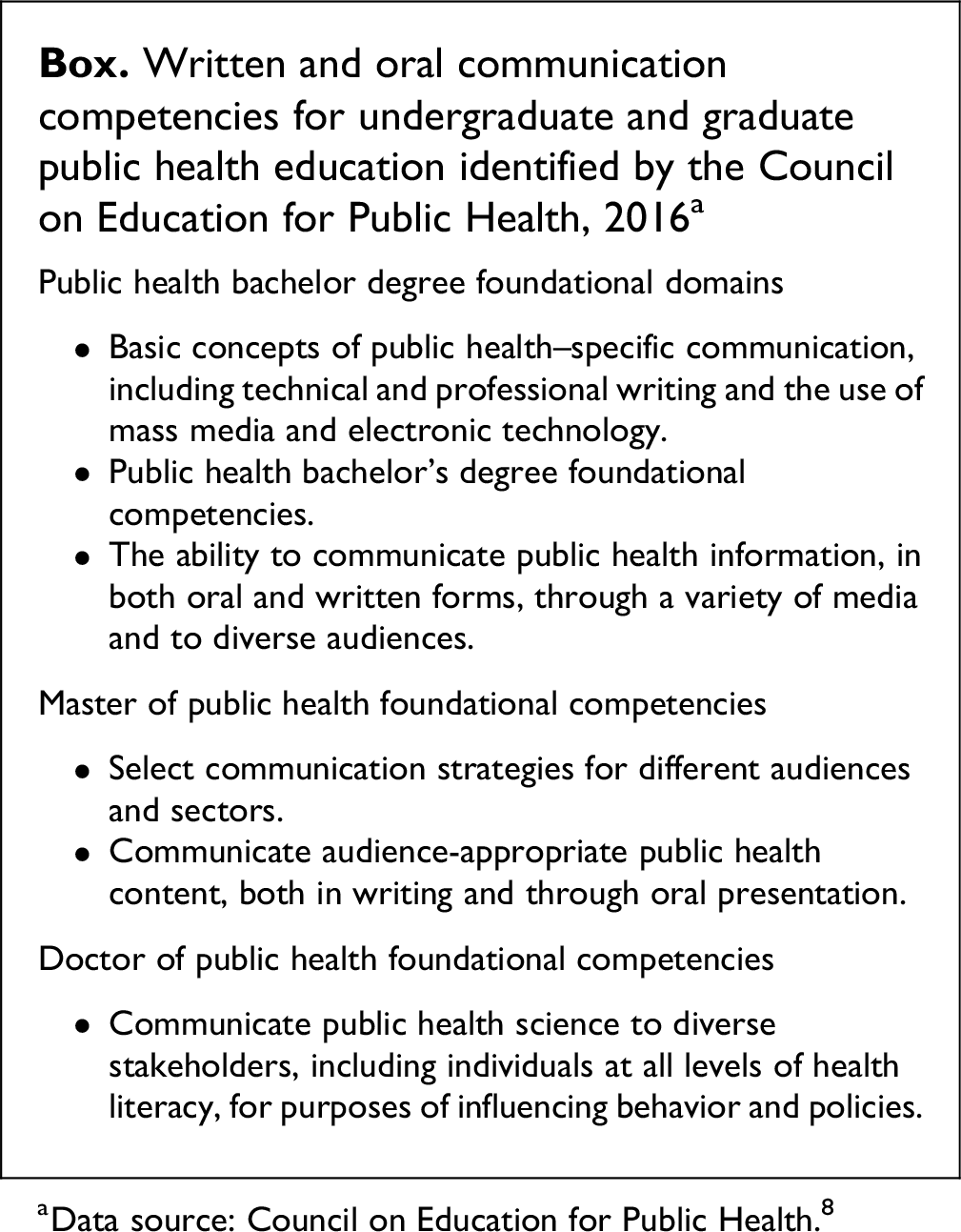
a Data source: Council on Education for Public Health. 8
The ASPPH/Riegelman writing program created a Writing in Public Health Advisory Committee comprising public health and writing experts, including deans and faculty from schools and programs of public health, experts in writing education from outside public health, and the editor in chief of Public Health Reports. The advisory committee and ASPPH staff members undertook a yearlong planning process that included workshops and presentations at the 2018 ASPPH national meeting. These sessions brought together both public health faculty and experts on writing. A discussion session provided opportunities for participants to suggest topics and approaches.
The advisory committee, along with ASPPH staff members, also developed an 18-question survey on writing that was distributed by email in January 2018 to 99 members of the ASPPH Academic Affairs Section and 25 school deans (or program directors, if a representative from the ASPPH Academic Affairs Section was not available). 9 The survey included questions about the quality of graduate students’ writing and sought to gather information about writing programs for graduate students. Questions also covered campus resources, writing initiatives designed to support faculty, and plans for addressing the CEPH criteria on communication. Seventy-nine persons responded to the survey, for a response rate of 73%.
The survey’s results confirmed what ASPPH had already been hearing from schools and programs of public health. Sixty-eight (86%) respondents answered “yes” to the question, “In your best judgment, is there a perception at your school or program that there is a problem with the state or quality of public health graduate student writing?” Sixty-seven (85%) respondents agreed that initiatives are needed to support the improvement of graduate student writing at their institutions. The survey also addressed the concomitant needs of faculty and asked about the types of support available in schools and programs of public health, such as workshops, grant writing training, writing centers, mentoring, peer review or writing groups, faculty and teaching centers, individual consultations, and fellowships. Only 37 (57%) respondents said that they had access to support for developing their own writing or their teaching of writing. 9
The advisory committee reviewed the survey results along with feedback from recent ASPPH workshops and used a systems-thinking approach to find leverage points where ASPPH or individual schools and programs of public health could intervene to address concerns about writing. One idea was to find ways to increase faculty’s confidence in teaching writing by creating a toolkit that could provide access to innovative and effective forms of pedagogy designed to help all students improve their writing, 10 such as model writing assignments and examples of pedagogy and writing assessments. Such a toolkit also could help faculty members intervene in especially difficult circumstances, such as teaching writing in large classes, where professors typically have fewer opportunities to work with individual students compared with small classes. The advisory committee members have been intrigued by assignment designs such as educational peer review, in which students provide structured feedback to other students. 11 The committee also has recommended that ASPPH conduct a series of webinars on the teaching of writing. These webinars will draw on the extensive experience of ASPPH members in using techniques such as education peer review and the growing body of research supporting it.
Another topic of interest to the committee has been the assessment of writing, particularly the use of rubrics. A rubric is a guide that can help both students and faculty understand the criteria for, and characteristics of, good writing. Rubrics are used frequently to assess writing in general education and in certain disciplines. In 2014, the Council of Writing Program Administrators published its Outcomes Statement for First-Year Composition, which outlines writing programs’ priorities for first-year composition in postsecondary education. 12 The Association of American Colleges & Universities’ VALUE Rubrics 13 are designed as grids or tables that specify learning outcomes and describe performance levels. For example, the Written Communication VALUE Rubric is for writing in any discipline. In 2019, the ASPPH/Riegelman writing program intends to collect rubrics organized by level and genre of writing and distribute them online, with feedback encouraged.
The advisory committee recognizes that considerable experience and expertise in writing for public health exist at ASPPH member institutions and in the broader educational community. Development of the toolkit and dedicating a section of the ASPPH website to this topic will encourage an exchange of ideas and will offer opportunities for faculty to lead and learn. The Writing in Public Health section of ASPPH’s website also will provide links to resources, articles, and ASPPH webinars.
The longer-term priorities for the ASPPH/Riegelman writing program are to help improve writing in a larger sphere—public health research, the whole profession, and the public. The advisory committee and ASPPH also are encouraging submissions to the Writing for Public Health department in Public Health Reports. 14 This new department presents a unique opportunity for scholars and others who study and teach writing to publish research, case studies, and commentaries on writing for public health. The first article published in the new department focused on identifying and teaching writing in the range of public health genres. 15
The first phase of the ASPPH/Riegelman writing program will extend through June 2021. During the 2020-2021 academic year, ASPPH expects to conduct an evaluation of the first phase and to propose a second phase. Improving writing in public health will require long-term effort and long-term commitment. We hope that the initial engagement of ASPPH faculty and deans, as well as Public Health Reports’ new Writing for Public Health department, will bolster this effort and encourage excellence in public health writing.
Footnotes
Declaration of Conflicting Interests
The authors declared no potential conflicts of interest with respect to the research, authorship, and/or publication of this article.
Funding
The authors received no financial support for the research, authorship, and/or publication of this article.