



Abstract
This study explored the mediating roles of mindfulness facets in the relationship between adult attachment and positive emotions. Specifically, it examined the subjective experiences and regulation strategies associated with positive emotions. A total of 513 participants completed self-report questionnaires assessing dispositional mindfulness, adult attachment, discrete positive emotion, and regulation strategies related to positive emotions. The parallel multiple mediation analysis indicated that nonjudging repeatedly emerged as significant mediator in the relationship between attachment insecurity (anxiety and avoidance) and discrete positive emotions and the regulation strategies used. Describe facet only emerged as a significant mediator in the context of attachment avoidance and positive emotions and regulation strategies. The effects of attachment insecurity on positive emotions differed through various mindfulness facets. The current findings extend understanding of the mechanisms that may explain why individuals differ in the extent to which they engage in positive emotional experiences. This insight may inform the adaptation of mindfulness-based programs to better address individual differences.
Introduction
Growing research has demonstrated that repeatedly experiencing positive emotions serves as an upward spiral towards better resilience and well-being (Chang, 2025; Roth et al., 2024). Fredrickson’s (2001) (Fredrickson, 2001) broaden-and-build theory suggests that positive emotions broaden mindsets and expand think-action repertoires (Sugawara & Sugie, 2021), leading to more enduring personal and social resources (Fredrickson & Joiner, 2018). Conversely, difficulties with experiencing positive emotions can negatively impact mental health, increasing risks for depressive and anxiety symptoms (Silton et al., 2020). Individuals employ a wide range of strategies to regulate positive emotion, which may involve down-regulating or dampening - use of strategies that reduce intensity and persistence of the emotional experience (Feldman et al., 2008), and up-regulating or savouring - actively engaging in and enhancing positive emotions. Reduced savouring has been linked to depression and a reduced frequency and intensity of positive affect (Silton et al., 2020; Vanderlind et al., 2022). Similarly, suppressing positive emotions is associated with poorer stress coping abilities (Millgram et al., 2019), reduced sleep quality (Latif et al., 2019) and lower psychological resilience (Polizzi & Lynn, 2021). Despite the growing body of literature exploring the impacts of positive emotions, there remains limited research on the mechanisms underlying individual differences in experiencing or regulating positive emotions.
Previous research has identified several mechanisms contributing to individual differences in emotion regulation, yet there remains a lack of a focus specifically on positive emotion (Gross, 2015). Gross proposed the need for an integrative framework, emphasising that individual differences in emotion regulation can be understood as originating from distal antecedents and further shaping by emotional understanding and values (Gross, 2014). Studies on positive emotion have highlighted the role of adult attachment as a significant antecedent factor and mindfulness as a subsequent trait essential for promoting emotional regulation (Goodall, 2015; Mikulincer et al., 2013).
Early experiences with caregivers and significant others contribute to the development of internalised cognitive representations, or internal working models (IWMs), which are thought to underpin adult attachment orientations (Mikulincer & Shaver, 2016). IWMs shape perceptions of self and others and influence behaviours in interpersonal and intimate relationships (Bosmans et al., 2020; Fearon & Roisman, 2017), as well as influencing how people manage attention, thoughts and emotions (Waters et al., 2021), which are the key components of the attachment-behavioural system, explaining how the early caregiving interactions affect social and emotional functioning throughout life (Gillath et al., 2016; Mikulincer & Shaver, 2016). Attachment anxiety in adulthood is associated with IMWs characterised by a view of the self as vulnerable and dependent, alongside heightened fear of abandonment (e.g., Mikulincer & Shaver, 2007). In response to perceived threat, the attachment system tends to become hyperactivated with heightened reassurance-seeking, intensified distress, and efforts to maintain proximity to attachment figures (Domic-Siede et al., 2024). This pattern is, in turn, associated with selective attentional processing towards negative and threatening stimuli (Peng et al., 2024; Wang et al., 2024). Attachment avoidance, by contrast, is associated with an IWM characterised by self-reliance and a mistrust of others (e.g., Mikulincer & Shaver, 2007), and a hypo-activating strategy which involves denial or suppression of upsetting stimuli and a tendency to be unclear about emotions experienced (Mikulincer & Shaver, 2019). Both insecure attachment dimensions have been associated with differential experiencing of positive emotion. For example, attachment anxiety correlates with lower levels of joy, pride and contentment, whereas attachment avoidance is negatively associated with feelings of love and compassion (Shiota et al., 2006). It is assumed that attachment-related differences in the experience of negative emotions are underpinned by attachment related goals (Mikulincer & Shaver, 2019), however, it remains unclear that whether these patterns are the same when regulating positive emotions. For example, some studies did not find significant negative associations between attachment anxiety and savouring positive emotions (Goodall, 2015; Verhees et al., 2021).
Mindfulness, defined as “paying attention in a particular way: on purpose, in the present moment, non-judgmentally” (Kabat-Zinn, 1990, p. 4), offers an important framework for understanding positive emotions. While mindfulness can be cultivated through training, individuals vary in their dispositional mindfulness, or their tendency to sustain mindful awareness of the present moment (Brown & Ryan, 2003). Dispositional mindfulness comprises five facets: nonreacting (nonreactivity to inner and external experiences), observe (noticing or attending to experiences), acting with awareness (paying attention to the present moment rather than behaving automatically), describe (expressing one’s experiences in words), and nonjudging (adopting nonjudgmental stances towards experiences) (Baer et al., 2006). The core features of dispositional mindfulness – open curiosity, attentiveness, nonjudging, and nonreacting (Gilbert et al., 2012), may expand individuals’ capacity to experience and regulate positive emotions. Facet-level studies further highlight nuanced differences in how mindfulness components relate to positive emotions. For example, nonjudging has robustly predicted increasing positive emotions (Mahlo & Windsor, 2021; Raynes & Dobkins, 2025). While associations between act with awareness and positive emotion range from weak (Medvedev et al., 2021) to strong (Raynes & Dobkins, 2025). Evidence for other mindfulness facets such as observe, nonreacting and describe, remains inconsistent where some studies show positive associations but some find nothing significant (e.g., Medvedev et al., 2021; Raynes & Dobkins, 2025). These discrepancies may reflect differences in how both mindfulness facets and positive emotions are measured, needing further investigation.
Altogether, as a distal antecedent factor, adult attachment plays a key role in explaining why individuals differ in how they experience and regulate positive emotions. According to attachment theory, Mikulincer and Shaver (2015, 2020) proposed the “broaden-and-build” effects of attachment security. Attachment security allows for creative, non-defensive interactions with the environment, and cultivates a receptive perception and effective awareness of both self and other mental states (Mikulincer & Shaver, 2015). This process broadens cognitive repertoires and enhances the optimal functioning of the behavioural systems, such as mindful awareness and emotion regulation (Mikulincer & Shaver, 2020). Growing evidence demonstrates that securely attached individuals tend to exhibit higher levels of trait mindfulness (Quickert, 2022; Stevenson, 2019). Similarly, attachment security priming – a way to experimentally enhance one’s sense of love, comfort and safety (Gillath et al., 2022) – has been shown to effectively increase state mindfulness both in the present-moment and over time (Melen et al., 2017; Pepping et al., 2015). Such evidence indicates that mindfulness might be an important mechanism linking attachment patterns to positive emotion. Indeed, Garland et al. (2010) proposed the upward spiral of trait mindfulness and positive dispositionality, suggesting that the capacity of being mindful is proposed to expand cognitive flexibility, thereby facilitating savouring of positive emotional experiences by enhancing flexible attention and awareness (Garland et al., 2010; Johnson et al., 2021). In the context of positive emotion, key unanswered questions include: (a) whether mindfulness facets function differently in discrete positive emotions; and (b) which mindfulness facets contribute to different regulation strategies among insecurely attached individuals.
This current study aimed to explore the mediating role of dispositional mindfulness facets in the relationship between attachment insecurity dimensions and (1) discrete positive emotions and (2) the regulation of positive emotions. Based on the research outlined above, the following hypotheses were developed. This study was pre-registered prior to conducting the research on OSF 1. The relationships between adult attachment dimensions and discrete positive emotions (PE) will be mediated by dispositional mindfulness (DM) facets. 2. The relationships between adult attachment dimensions and regulation of PE will be mediated by DM facets.
Method
Participants
In total, 517 participants completed an anonymous online survey. As no financial incentive was offered for participation, the likelihood of fraudulent responses was reduced (Salinas, 2023). To further ensure data integrity, responses were checked for internet bot participation. Each response was evaluated based on the completion duration, IP address, and conflicting answers (e.g., reporting difficulties describing feelings while also indicating proficiency in doing so), repetitive answers across all questions, specific response patterns, and identical timestamps. 4 responses completed in under 5 min were removed. This threshold was determined by the research team during pre-testing, as 5 min was deemed insufficient for a human to complete the survey (Salinas, 2023).
Participants Demographic Characteristics

Procedure
This study was approved by the University Ethics Committee. Participants were recruited through online social media platforms (Facebook, Twitter, Reddit, LinkedIn, WhatsApp group chats and WeChat group chat), and through flyers posted on campus buildings. The survey was hosted on Qualtrics. Participants accessed the survey by clicking a link or scanning the QR code provided in the flyer. After being directed to the survey page, they were presented with an information sheet and consent form, which they were required to agree to before proceeding. The data was collected between March 2023 and May 2023.
Measures
Participants provided demographic information including age, gender, nationality, ethnicity and education. They were asked to indicate how frequently they meditated, choosing from the following options: never, infrequently, monthly, weekly, daily.
The Experience in Close Relationship Scale – Short Form (ECR-S; Wei et al., 2007) yields two dimensions of attachment insecurity(avoidance and anxiety). Participants rate 12 statements reflecting their general experience in relationships (e.g., “I want to get close to my partner, but I keep pulling back”) on a 7-point scale ranging from 1 (strongly disagree) to 7 (strongly agree), with higher scores indicating greater attachment insecurity. The ECR-S has psychometric properties similar to the 36-item ECR, good test-retest reliability and acceptable internal consistency (Wei et al., 2007). In this study, Cronbach’s Alpha was .77 for the anxiety subscale and .84 for the avoidance subscale.
The Five Facet Mindfulness Questionnaire (FFMQ; Baer et al., 2006) was used to measure dispositional mindfulness. The 39-item FFMQ yields five subscales: observe, describe, act with awareness, non-reacting and non-judging. Participants rated the extent to which each statement applied to them, such as (e.g., “I pay attention to how my emotions affect my thoughts and behaviour”) on a 5-point scale ranging from 1 (never or very rarely true) to 5 (very often or always true). Higher scores in each facet reflect greater capacity in each mindfulness facet. The FFMQ has good convergent validity and acceptable internal consistency (Christopher et al., 2012). In this study, the internal consistency for all facets ranged from α = .79 to .93.
The Intensity and Time Affect Scale (ITAS; Diener et al., 1995) is a 24-item self-report measure of the frequency of discrete emotion. For this study, only 8 items from the positive emotion subscales (love subscale: affection, love, caring, fondness; joy subscale: happiness, joy, contentment, pride) were used. Participants reported how frequently they had experienced these emotions over the past week, using a 7-point Likert-scale ranging from 1 (never) to 7 (always). The positive emotion subscales have good internal consistency (McMahan & Estes, 2012) and strong evidence of validity (Lucas et al., 2009). The internal consistency for the love subscale was .89, and for the joy subscale was .84.
Adaptive and Maladaptive Strategies for the Regulation of Positive Emotion (ERP-R)

Statistical Analysis
Statistical analyses were conducted using SPSS version 29. Descriptive statistics and bivariate correlations among all the main study variables are preliminary analyses. To test whether facets of dispositional mindfulness mediated the relationship between attachment and positive emotions, a series of eight parallel multiple mediation analyses (PMMAs) were conducted using PROCESS model 4.3 (Hayes, 2013) (see Figure 1). PMMAs allow the independent variable (X) to have both a direct effect on the dependent variable (Y) and an indirect effect through multiple independent mediators (M
1
, M
2
, …). In this study, it was hypothesised that attachment insecurity dimensions ((X: attachment anxiety and attachment avoidance) would have an indirect effect on positive emotions ((Y: discrete positive emotion and regulation strategies), through different facets of dispositional mindfulness (M
i
). Parallel multiple mediation model.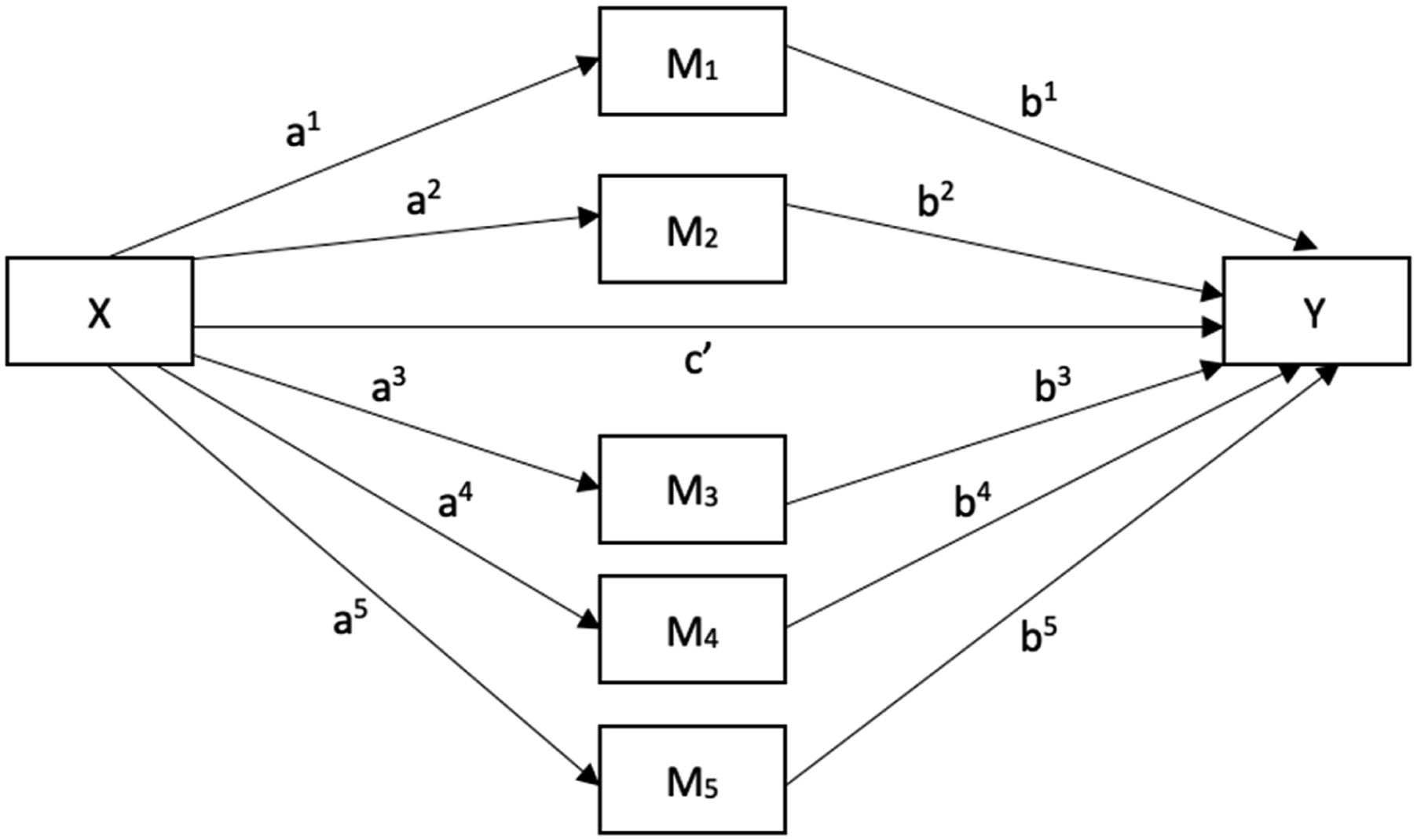
Results
Correlations, Means, and Standard Deviation of Study Variables (N = 513)

*p < 0.05 level; **p < 0.01 level.
Demographic Differences on FFMQ, ERP-R, and ITAS (N = 513)

*p < .05 level; **p < .001 level.
PMM Analysis With Dispositional Mindfulness (FFMQ) Subscales as Mediators Between Attachment and Discrete Positive Emotion (N = 513)

PMM Analysis With Dispositional Mindfulness (FFMQ) Subscales as Mediators Between Attachment and Regulation of Positive Emotion (N = 513)

Discussion
The aim of the current study was to examine the mediating effects of mindfulness facets between attachment insecurity dimensions and the experiencing of, and regulation of positive emotions.
For discrete positive emotion, none of mindfulness facets mediated the link between attachment anxiety and love but describe mediated the relationship between attachment avoidance and love; while act with awareness and non-judging mediated the association between both attachment dimensions and joy, while non-reacting additionally mediated the relationship between attachment anxiety and joy. Consistent with prior work, people high in either attachment anxiety and attachment avoidance reported decreased love and joy (Park et al., 2023; Shiota et al., 2006). The present findings further highlight that love and joy differ in their social relevance: love is more socially relevant and promotes developing long-term social bonds; while joy is arguably less socially relevant and more intrapersonal (Stanton et al., 2021). From a mindfulness-multifacet perspective, trait facets are treated as intrapersonal skills (Baer et al., 2006; Zeng et al., 2025) and therefore more effective at enhancing self-focused emotional states such as joy. In contrast, interpersonal mindfulness practice such as loving-kindness meditation (LKM), have been showned to increases other-oriented positive emotions like love (Stell & Farsides, 2016). This could explain why these facets analysed in this study mediated the association between attachment insecurity and joy more consistently than love. From an attachment perspetive, insecurely attached individuals may experience less self-focused joy because hyperactivation (attachment anxiety) or deactivation (attachment avoidance) hinders their ability to bring undivded attention and full awareness to positive feelings or maintain an unjudgmental stance towards positive emotional experiences (Stevenson et al., 2017; Zhang et al., 2022). Though the mediating effects of mindfulness facets were generally weak for other-oriented emotions like love, describe uniquely served as a mediator for attachment avoidance. This may occur because they are reluctant to label such feelings, which is aligned with their attachment goals to avoid intimacy or emotional bonds (Fearon & Roisman, 2017).
In relation to regulating positive emotion, current findings reported that attachment anxiety dimension was related to both decreased savouring and increased dampening of positive emotion via non-judging, with act with awareness additionally acted as a mediator on dampening. These results partially support the hypothesis and align with previous research (Parada-Fernández et al., 2021; Stevenson et al., 2017). According to attachment theory, the IWM of attachment anxiety tends to hyperactivate emotional experiences while presenting a devalued self-image (Mikulincer & Shaver, 2016). Positive emotions may be judged as threatening or meaningless, possibly resulting in “fear of happiness” – a term proposed by Gilbert et al. (2012) suggesting that individuals with attachment anxiety may view positive emotions as undeserved or even as something that should be avoided (Gilbert et al., 2012). Such fear or the inability to be mindfully non-judgmental towards positive emotional experiences may make them more likely to suppress or be unable to enjoy, share and express these emotions (Lee et al., 2025). Furthermore, act with awareness, as a driving force of mindfulness (Heeren et al., 2021), mediated the link between attachment anxiety and dampening. Though this was not aligned with the hypothesis or previous work (Stevenson et al., 2022), it should not come as a surprise. Previous studies have provided evidence that the hyperactivating strategy commonly observed in anxiously attached individuals hinder the development of the core constructs of mindfulness, e.g., acting with consciousness awareness rather than on autopilot (Macaulay et al., 2015; Stevenson et al., 2017). Findings in this study might suggest that the default mode for anxiously attached individuals involves focusing on negative elements of positive events or distract oneself from these from such events to unrelated worries.
The present findings also showed that attachment avoidance was linked to both decreased savouring and increased dampening of PE through describe and non-judging, with act with awareness additionally acting as a mediator on dampening, partially aligning with previous work (Stevenson et al., 2022). According to attachment theory, avoiding building emotional bonds with others or being fearful of closeness serves as the avoidant attachment goal (Mikulincer & Shaver, 2019). Positive emotions may be viewed as threatening because they could disclose the willingness of building emotional bonds with others or presenting the needy self. Such resistance stops them developing non-judgmental stances towards inner or external experiences, or the ability to describe thoughts or feelings (Yang & Oka, 2022). This may further explain why avoidantly attached individuals tend not to share, display the positive experiences with others or engaging in positive events. Moreover, the avoidant attachment system’s focus on maintaining an independent self-image and psychological distance makes it difficult for individuals to engage with their emotions in an open, present-focused way (Mikulincer & Shaver, 2020). This resistance often consumes emotional resources (Caldwell & Shaver, 2013), making it harder for avoidantly attached individuals to be open to, and aware of their habitual avoiding strategies towards emotional experiences. As a result, they may rely on automatic dampening strategies, such as suppressing emotional expression, distracting from positive experiences to unrelated thoughts, and attributing positive emotions to negative external factors (Nelis et al., 2011).
Interestingly, non-reacting did not show any mediating effects between both attachment dimensions and positive emotion (both discrete PE and regulation). Though research on negative emotions has shown that non-reacting mediated relationships between both attachment dimensions and cognitive reappraisal and expressive suppression (Stevenson et al., 2022), there are mixed discussions in the literature regarding how non-reacting applies to positive emotions. Non-reacting encourages neither the simple suppression nor amplification of emotional experiences (Van Gordon et al., 2023), but savouring or dampening involves actively responding to positive emotions in ways that enhance and suppress (Kiken et al., 2017). Notably, the non-reacting subscale of FFMQ primarily measures responses to distressing or difficult situations (e.g., “When I have distressing thoughts or images I am able just to notice them without reacting”). Further elaboration of the meaning of non-reacting in relation to positive emotions is therefore warranted. Future research could explore more in-depth whether non-reacting toward positive emotions works similarly to its role in negative emotions.
Limitations
First, the sample predominantly consisted of participants from western countries, which limits the generalisability of the results. Indeed, the structure and facets of trait mindfulness may vary across cultures, particularly between western and eastern societies (Karl et al., 2020). Future research should explore how mindfulness interacts with positive emotions across different cultural backgrounds.
In addition, this study relied on trait measurement of mindfulness and self-reported frequency of positive emotions over the past week. Many previous studies have also used cross-sectional, single-time-point measurements to examine the relationship between attachment styles, mindfulness and positive emotions (e.g., McDonald et al., 2016; Stevenson et al., 2022). However, the changes in positive emotions or state mindfulness over time remains an area of interest (Kiken et al., 2017). Future research could benefit from using momentary assessment to measure real-time positive emotions over an extended period.
Another limitation concerns the measurement of mindfulness and positive emotions. Specifically, one subscale of FFMQ, non-reacting, primarily addresses responses to distress emotions. Hence, future studies could explore a more positive emotion-focused tool to measure mindfulness facets, providing more accurate insights into how individuals respond to positive emotions. Moreover, the ITAS measure used in this study measured frequency of positive emotion but not arousal levels. Research has shown that mindfulness training can increase low-arousal positive emotions such as calm and quiet (Jones et al., 2018). Further research could explore positive emotion at a multi-facet level, considering both discrete types of positive emotions and their arousal levels.
Altogether, future studies could utilise: (i) longitudinal designs (e.g., ecological momentary assessment) to assess both temporary and long-term changes in these relationships and how they interact over time, and (ii) experimental designs incorporating mindfulness inductions, security priming and positive mood inductions to investigate causal relationships.
Conclusion
The results highlighted that mindfulness facets, such as holding a non-judging stance toward emotional experiences and acting with awareness instead of running ‘on autopilot’, played key mediating roles in how individuals respond to and engage in positive emotions. Moreover, the findings also suggested that different positive emotions show different mechanisms in how attachment insecurity impacts them. This study gives insights into which mindfulness traits may hinder individuals from engaging in positive emotions, offering valuable information for adapting mindfulness-based programmes to accommodate individual differences.
Supplemental Material
Supplemental Material - Adult Attachment Insecurity and Positive Emotions: The Mediating Role of Dispositional Mindfulness Facets
Supplemental Material for Adult Attachment Insecurity and Positive Emotions: The Mediating Role of Dispositional Mindfulness Facets by Yanming He, Zsofia K. Takacs, Zara P. Brodie, and Karen Goodall in Psychological Reports
Footnotes
Acknowledgments
The authors thank all the participants who joined our online survey. This study was pre-registered on Open Science Framwork (OSF:  ). I confirm that I am submitting this manuscript as one of the authors and not in the capacity of a submission service, university administrator, or other third-party agent.
Ethical Considerations
The research study was approved by the University of Edinburgh clinical & health psychology ethics committee (reference number: 22-23CLPS025).
Consent to Participate
Informed consent to participate was recorded by Qualtrics before participants joined the online survey.
Consent for Publication
Informed consent for publication was provided by the participants.
Author Contributions
Study conception and design were performed by Yanming He, Dr Karen Goodall and Dr Zara P. Brodie. Material preparation, data collection and analysis were performed by Yanming He. The first draft of the manuscript was written by Yanming He and all authors commented on previous versions of the manuscripts. All authors read and approved the final manuscript.
Funding
The authors received no financial support for the research, authorship, and/or publication of this article.
Declaration of Conflicting Interests
The authors declared no potential conflicts of interest with respect to the research, authorship, and/or publication of this article.
Data Availability Statement
Supplemental Material
Supplemental material for this article is available online.
Author Biographies
References
Supplementary Material
Please find the following supplemental material available below.
For Open Access articles published under a Creative Commons License, all supplemental material carries the same license as the article it is associated with.
For non-Open Access articles published, all supplemental material carries a non-exclusive license, and permission requests for re-use of supplemental material or any part of supplemental material shall be sent directly to the copyright owner as specified in the copyright notice associated with the article.
