




Abstract
Research suggests that mindfulness is positively related to attachment security in romantic relationships. However, studies on the processes underlying this association are relatively scarce. In this longitudinal study, we investigated the mediating role of emotion dysregulation between mindfulness and attachment insecurity. A total of 333 Chinese university students were recruited for three time points, with a 6-month lag between time points, to complete self-report questionnaires of mindfulness, emotion dysregulation, attachment avoidance, and attachment anxiety. Cross-lagged mediation analysis showed that greater mindfulness was indirectly associated with lower attachment anxiety via lower emotion dysregulation, after controlling for age, gender, and autoregressive control variables, indicating emotion dysregulation as a mediator. However, emotion dysregulation did not mediate the longitudinal association between mindfulness and attachment avoidance. The present findings inform researchers of the importance of cultivating mindfulness and emotion regulation to enhance attachment security in romantic relationships.
Keywords
Introduction
Mindfulness refers to the arising awareness from paying attention without judgment, on purpose, and in the present moment (Baer et al., 2012; Jain et al., 2007; Kabat-Zinn, 1994). Studies of mindfulness over the past decade have suggested its relation to positive psychological outcomes, such as higher emotion regulation and lower psychological distress (Baer et al., 2012; Chambers et al., 2009; Cheung & Ng, 2019; Tomlinson et al., 2018), and positive relationship functioning, such as lower attachment anxiety in close relationships (Fall & Shankland, 2021). Guided by Teper et al. (2013), much research has further demonstrated emotion regulation as a mediator between mindfulness and health outcomes (e.g., Osborne et al., 2023). Despite the relevance of mindfulness in emotion regulation (Hanley et al., 2015; Iani et al., 2019) and adult attachment anxiety (e.g., Fall & Shankland, 2021; Hertz et al., 2015), little has been done to examine emotion regulation as a potential process between dispositional mindfulness and attachment security among emerging adults.
Emotion regulation refers to an on-going modulating process of emotional expressions and experiences in response to behavioral, physiological, and experiential domains (Cole et al., 1994; Gross, 2002). Numerous studies have indicated a significant relation between mindfulness and emotion regulation strategies, namely cognitive reappraisal and expressive suppression, among emerging adults (e.g., Brockman et al., 2017; Cheung & Ng, 2020; Hanley et al., 2015). As a process, emotion regulation was found to mediate the relation between dispositional mindfulness and mental health in both non-clinical samples (e.g., Freudenthaler et al., 2017; MacDonald & Baxter, 2017; Parmentier et al., 2019; Prakash et al., 2015) and clinical samples (e.g., Curtiss et al., 2017; Desrosiers et al., 2013; Desrosiers et al., 2014). Similar findings were demonstrated in mindfulness-based intervention studies. Following an 8-week Mindfulness-Based Cognitive Therapy adapted for healthy Chinese adults, dispositional mindfulness was found to reduce the levels of anxiety and depression, with emotion regulation as a mediator (Ma et al., 2018). In another study, residents of Canada receiving a 4-week mindfulness-based intervention similarly experienced an increase in emotion regulation (Al-Refae et al., 2021). As such, recent evidence converges to suggest emotion regulation as a process through which mindfulness enhances mental health.
Emotion regulation as a mediator between mindfulness and attachment security
Aside from mental health outcomes, emotion regulation and dysregulation may also serve as a process between mindfulness and relationship functioning (e.g., Hafner et al., 2019; Karremans et al., 2017; Velotti et al., 2015). In their theoretical model, Karremans et al. (2017) postulated that individuals with a lower level of mindfulness have more difficulties in modulating and responding to their emotions, which may further be linked to problematic relationship functioning, including attachment insecurity.
Attachment was originally defined by Bowlby (1998) as the affective bond between an infant and their primary caregiver. Attachment theory (Bowlby, 1969, 1988) highlights the fundamental role of intimacy in human nature and posits that humans are naturally inclined to establish emotional connections, particularly intimate relationships. During the early stages of development, a child forms an emotional bond with their primary caregiver, which helps them feel secure and maintain closeness to the caregiver (Bowlby, 1969). Adult attachment theory, proposed by Hazan and Shaver (1987), extends this concept to adult romantic relationships and distinguishes between secure and insecure adult attachment. Secure adult attachment refers to adults perceiving their partner as trustworthy, having self-confidence, and being comfortable with depending on others or being depended on (Hazan & Shaver, 1987; Mikulincer et al., 2003). Adults with higher levels of insecure attachment to romantic partners often exhibit attachment anxiety and/or attachment avoidance (Fraley et al., 2000; Mikulincer et al., 2003). Specifically, adults with higher levels of anxious attachment often worry about rejection and abandonment, not only during stressful events but also in neutral contexts (Hazan & Shaver, 1987; Shaver & Mikulincer, 2002). They also tend to display hypersensitivity to perceived threats to the relationship (Shaver & Mikulincer, 2002). In contrast, while individuals with higher levels of avoidant attachment are less likely to dwell on worries and fears in their romantic relationships, they may suppress negative thoughts and deny their need for closeness to avoid distress caused by the unavailability of their attachment figure (Mikulincer et al., 2003; Shaver & Mikulincer, 2002). They may also distance themselves from stressful or threatening situations and exhibit discomfort with dependency and closeness (Hazan & Shaver, 1987; Shaver & Mikulincer, 2002).
Supporting this theory (Karremans et al., 2017), previous research generally demonstrated that individuals with greater mindfulness exhibited lower attachment anxiety and avoidance (Fall & Shankland, 2021; Hertz et al., 2015; Jones et al., 2011; Zhou et al., 2020). However, a study conducted by McDonald et al. (2016) identified a negative link between mindfulness and attachment anxiety but not with attachment avoidance. To explain the nonsignificant association between mindfulness and attachment avoidance, the authors speculated that certain aspects of attachment avoidance (e.g., discomfort with closeness) may be negatively correlated with mindfulness, whereas other aspects (e.g., not dwelling on stressful experiences) may be positively correlated with mindfulness, thereby canceling out the effects (McDonald et al., 2016). Furthermore, a meta-analytic study revealed significant negative correlations between mindfulness and both attachment anxiety and avoidance, with slightly larger effect sizes for the relation between mindfulness and attachment anxiety compared to that between mindfulness and attachment avoidance (Stevenson et al., 2017). However, all of the studies included in the review employed cross-sectional designs (Stevenson et al., 2017). To gain insight into the directionality of effects, Gazder and Stanton (2023) conducted a longitudinal study and found that individuals with more open attention and awareness were less likely to experience anxiety in close relationships. Additionally, those who exhibited greater relationship-specific mindfulness had more empathy towards their partner, which was further associated with lower attachment avoidance. Despite the initial findings, little is known about the longitudinal effect of dispositional mindfulness on attachment, particularly through processes such as emotion regulation.
Turning to the direct association between emotion dysregulation and attachment, a recent cross-sectional study of adults aged between 18 and 77 years indicated that individuals with emotion regulation difficulties are more likely to exhibit insecure attachment in close relationships, such as worrying about being abandoned or feeling discomfort with being close to significant others (Snyder et al., 2023). Similar findings were revealed by other cross-sectional studies among emerging adults (Espeleta et al., 2017; Ozeren, 2022). Additionally, adverse emotion-oriented coping (e.g., self-blaming and denial) was found to be longitudinally associated with attachment anxiety in emerging adults (Pascuzzo et al., 2013). However, little has been done to examine the longitudinal effects of emotion dysregulation on attachment insecurity, particularly on attachment avoidance.
Emerging adulthood
Emerging adulthood is a developmental period from 18 to 30 years old, a period whereby individuals reach physical maturity and explore their identity in various areas such as romantic love, work, and worldviews (Arnett, 2000; Kuang et al., 2024). During this period, emerging adults commonly experience transitions in romantic relationships, changes in living and study environments, and opportunities for new adult roles and identities (Scharf et al., 2004; Schulenberg et al., 2004; Schwartz et al., 2005). Previous research suggested that secure adult attachment with romantic partners among emerging adults may facilitate transitions to adulthood, as it was positively related to psychosocial identity development (Ávila et al., 2012), self-esteem (Passanisi et al., 2015), and life satisfaction (Guarnieri et al., 2015). Insecure attachment in emerging adulthood was associated with social anxiety (Read et al., 2018), depressive symptoms (Bishop et al., 2019), and alcohol problems (Goldstein et al., 2019). Based on these findings, the study of adult attachment during this developmental period is particularly crucial.
The present study
Grounded in Karremans et al.’s (2017) theory of mindfulness and relationship outcomes, the present study aims to investigate emotion dysregulation as a mediator between dispositional mindfulness and attachment insecurity, namely attachment anxiety and avoidance, among Chinese emerging adults. Through a cross-lagged mediation model (Cole & Maxwell, 2003), we hypothesized that emotion dysregulation would mediate the effect of mindfulness on attachment insecurity. Specifically, mindfulness would negatively predict emotion dysregulation, which, in turn, would positively predict attachment avoidance and anxiety. We also included the reversed directionality of effects in the hypothesized cross-lagged model, as previous research suggested a bidirectional association between mindfulness and attachment security (e.g., Karremans et al., 2017; Stevenson et al., 2021). For instance, Karremans et al. (2017) posited that attachment security can foster mindfulness, as being secure in close relationships may mitigate biases and avoidance toward current experiences, helping secure individuals be more present. This theocratical assumption has been supported by previous studies (Caldwell & Shaver, 2013; Stevenson et al., 2021). Moreover, emotion dysregulation mediated the negative effect of attachment insecurity on dispositional mindfulness in a cross-sectional study (Pepping et al., 2013). As such, the reversed directionality of effects was included in our hypothesized model.
Previous studies demonstrated bidirectional associations between mindful awareness and emotion regulation (McDonald et al., 2021), and emotion regulation strategies and attachment insecurity (Tammilehto et al., 2022). Therefore, in addition to testing the theory-driven model, we conducted a supplementary cross-lagged analysis to examine an alternative mediation model, i.e., whether mindfulness mediated the effect of emotion dysregulation on attachment insecurity.
Method
Participants
Participants were 333 Chinese college students (238 women, 95 men) recruited at a university in Hong Kong via online forums and emails, with a mean age of 19.96 years at Time 1 (SD = 1.69 years; Median = 20.00 years; Range = 17–28 years). The average household size was 3.15 (SD = 1.12; Median = 3.00; Range = 0–6). The median monthly household income ranged between HK$20,001 (∼US$2561.23) and HK$30,000 (∼US$3841.65), which was comparable to the median monthly household income in Hong Kong, i.e., HK$27,650 (∼US$ 3,532.53; Census and Statistics Department, 2023).
The study had three time points at 6 months apart, with retention rates from 87.09% to 95.51% between time points. The study was approved by the Human Research Ethics Committee. Informed consent was sought before the administration of questionnaires. Participants received a supermarket coupon as compensation at each time point, with a total of HK$250 (∼US$32.05) for three time points.
Measures
Dispositional mindfulness
The Chinese version of the 39-item Five Facet Mindfulness Questionnaire (FFMQ, Baer et al., 2006) was used to measure mindfulness on a 5-point scale, ranging from 1 (never or very rarely true) to 5 (very often or always true). Sample items included, “When I do things, my mind wanders off and I’m easily distracted” and “I have trouble thinking of the right words to express how I feel about things.” Item scores were averaged to form a composite score of mindfulness, with higher scores indicating greater mindfulness. The FFMQ was validated previously in Chinese community samples (e.g., Hou et al., 2014). The measure yielded adequate internal consistency, with Cronbach’s alpha = .83 at Time 1, .86 at Time 2, and .85 at Time 3.
Emotion dysregulation
The 36-item Difficulties in Emotion Regulation Scale (DERS; Gratz & Roemer, 2004) was used to measure participants’ difficulties in emotion regulation on a 5-point scale from 1 (almost never) to 5 (almost always). The scale was translated from English to Chinese by two independent research assistants following the back-translation procedures (Brislin, 1970), and discrepancies were resolved by the first author upon follow-up discussions. Sample items included, “When I’m upset, I have difficulty concentrating” and “When I’m upset, I believe that there is nothing I can do to make myself feel better.” The DERS was validated in a Chinese sample (Li et al., 2018). The measure had adequate internal consistency with Cronbach’s alpha = .92 at Time 1, .93 at Time 2, and 93 at Time 3.
Attachment
The 36-item Experiences in Close Relationships Questionnaire-Revised (ECR-R; Fraley et al., 2000) was used to measure participants’ attachment on a 7-point scale, ranging from 1 (strongly disagree) to 7 (strongly agree). At the beginning of the questionnaire, participants were asked to indicate their relationship status (“Are you in a relationship?“). Those in a relationship were instructed to answer based on their current partner, whereas those who were not in a relationship were instructed to respond based on typical behavior and feelings toward their romantic partners. A total of 35.69% of participants reported that they were currently in a relationship. The ECR-R has two subscales, namely Attachment Anxiety and Attachment Avoidance. The 18-item Anxiety subscale included sample items such as “I often wish that my partner’s feelings for me were as strong as my feelings for him or her” and “My desire to be very close sometimes scares people away.” The 18-item Avoidance subscale included sample items such as “I am very comfortable being close to romantic partners (reversed)” and “I am nervous when partners get too close to me.” The item scores were averaged to form a composite score, with higher scores indicating greater attachment anxiety and attachment avoidance, respectively. The measure had been validated in a sample from Taiwan (Mallinckrodt & Wang, 2004). In this study, independent-sample t-tests showed no significant differences between participants with and without a romantic partner among all study variables, except for Time 3 attachment avoidance, t (243) = 3.75, p < .001. Specifically, participants without romantic partners at the time of data collection reported higher avoidance (M = 3.55; SD = .68) compared to those with a romantic partner (M = 3.21; SD = .69). The measure had adequate internal consistency with Cronbach’s alpha = .88 at Time 1, .89 at Time 2, and .89 at Time 3 for attachment anxiety, and Cronbach’s alpha = .80 at Time 1, .83 at Time 2 and .83 at Time 3 for attachment avoidance.
Analytic plan
IBM SPSS Statistics 25 (SPSS Inc., Chicago, IL, USA) was used to conduct descriptive analysis and zero-order correlations. Following the approach by Cole and Maxwell (2003), a three-wave cross-lagged panel mediation model including autoregressive, cross-lagged, and concurrent associations was conducted using MPLUS, Version 8.3 (Muthén & Muthén, 1998-2017). First, autoregressive paths from each variable to the follow-up assessments of the same variable were estimated. Second, cross-lagged paths were examined, including (a) hypothesized paths between the predictor variable (i.e., mindfulness) and the follow-up assessment of the mediator (i.e., emotion dysregulation), (b) hypothesized paths between the mediator and the follow-up assessments of the outcome variables (i.e., attachment anxiety and avoidance), (c) hypothesized paths between the predictor variable at T1 and attachment insecurity at T3, (d) reversed paths between the mediator and the follow-up assessment of the predictor variable, (e) reversed paths between the outcome variables and subsequent follow-up assessments of the mediator, and (f) reversed paths between the outcome variables at T1 and the predictor variable at T3 (see Model 7 in Cole & Maxwell, 2003 for details). Third, concurrent residual covariances between variables at Time 1 were estimated.
The comparative fit index (CFI), Tucker‒Lewis Index (TLI), root mean squared error of approximation (RMSEA), and standardized root mean squared residual (SRMR) were investigated to assess the model fit. A good model fit was indicated by CFI and TLI values greater than .95, and RMSEA and SRMR values lower than .08 (Hu & Bentler, 1999). Full information maximum likelihood estimation was applied to handle missing data. As previous research indicated that bootstrapping provides more accurate estimates of the indirect effect of standard errors compare to other approaches (Shrout & Bolger, 2002), bootstrapping was used to test the mediation effect in the current study. Moreover, gender and age were included as covariates as previous research suggested that they were related to attachment security to a romantic partner (Chopik & Edelstein, 2014; Velotti et al., 2016; Weber et al., 2022).
In addition to testing emotion dysregulation as a mediator, supplementary cross-lagged panel mediation analysis was conducted to test the alternative directionality of effects, with mindfulness as a mediator for the relations between emotion dysregulation and attachment avoidance and anxiety.
Results
Correlations, means, and standard deviations of the study variables.
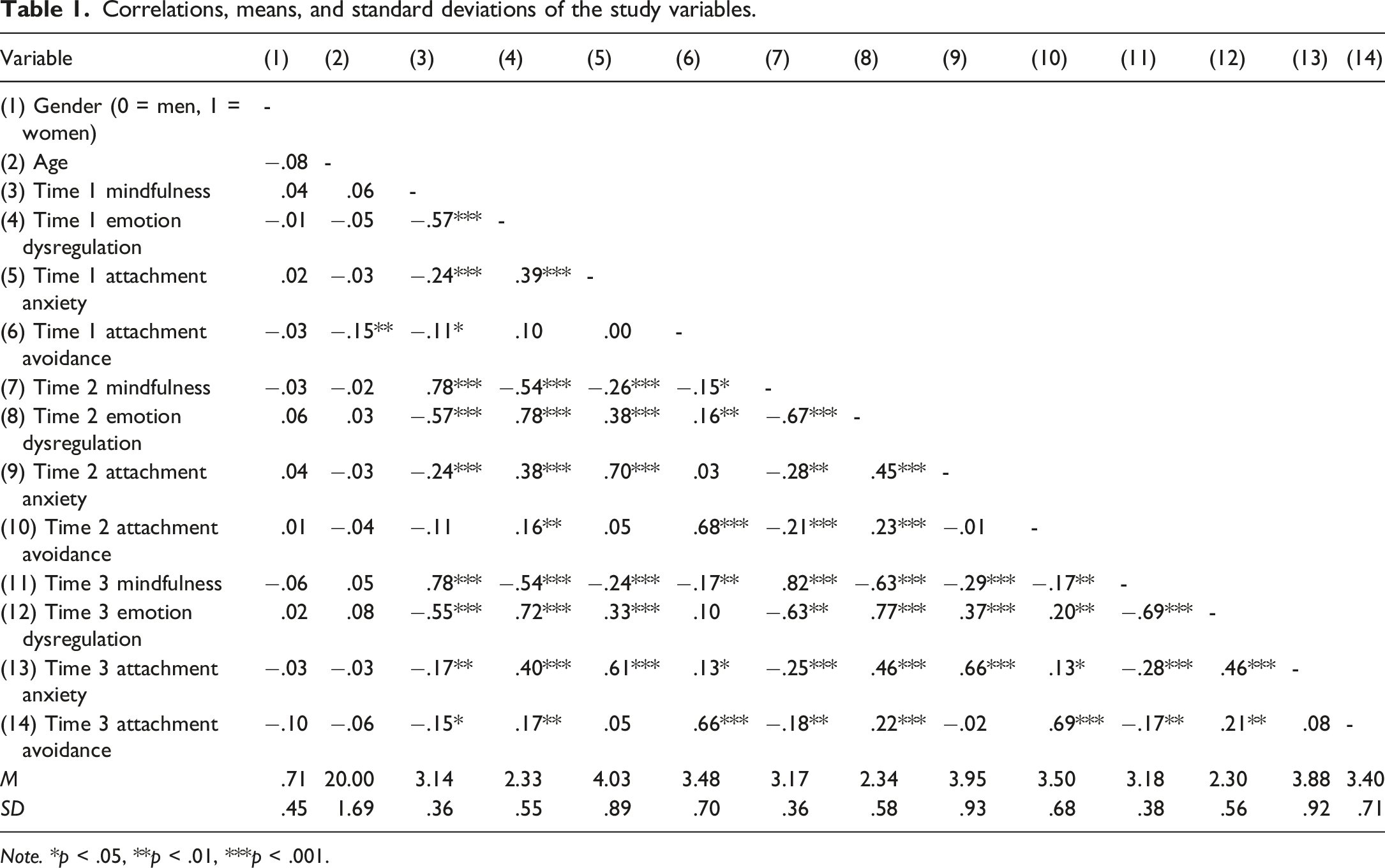
Note. *p < .05, **p < .01, ***p < .001.
Emotion dysregulation as a mediator
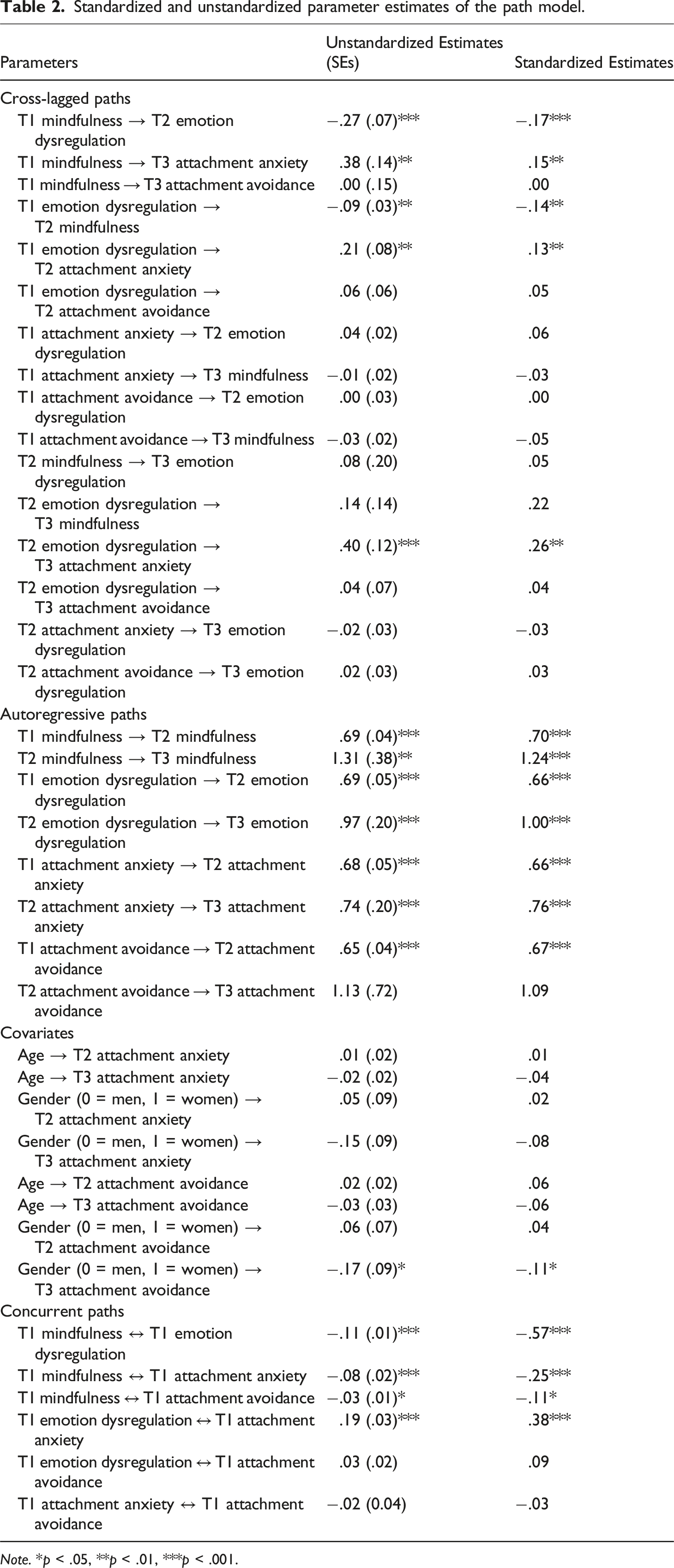
The cross-lagged panel mediation model with emotion dysregulation as a mediator showed a good fit to the data, χ2 (37) = 91.10, p < .001, CFI = .98, TLI = .95, RMSEA = .07, SRMR = .04 (see Figure 1 for details). The unstandardized and standardized coefficients of the model are presented in Table 2. Most autoregressive paths were positive and significant, ps < .001, except between T2 and T3 attachment avoidance, p > .05. After controlling for covariates, concurrent paths, and autoregressive paths, T1 mindfulness significantly predicted T2 emotion dysregulation (β = −.17, B = .27, SE = .07, p < .001). Subsequently, T2 emotion dysregulation significantly predicted T3 attachment anxiety (β = .26, B = .40, SE = .12, p = .004). However, T2 emotion dysregulation did not significantly predict T3 attachment avoidance. Besides, T1 mindfulness significantly predicted T3 attachment anxiety (β = .15, B = .38, SE = .14, p = .007) but not T3 attachment avoidance. In the same model, both T1 attachment anxiety and T1 attachment avoidance did not significantly predict T2 emotion dysregulation. Moreover, T2 emotion dysregulation did not significantly predict T3 mindfulness. However, T1 emotion dysregulation significantly predicted T2 mindfulness (β = −.14, B = −.09, SE = .03, p = .007). Cross-lagged mediation model between mindfulness, emotion dysregulation, and attachment anxiety and avoidance. χ2 (37) = 91.10, p < .001, CFI = .98, TLI = .95, RMSEA = .07, SRMR = .04. **p < .01, ***p < .001. Non-significant paths are depicted in dotted lines. Hypothesized paths are depicted in bold. Concurrent associations between T1 variables, direct effects of T1 mindfulness on T3 attachment anxiety and avoidance, and direct effects of T3 attachment anxiety and avoidance on T1 mindfulness were estimated but are not depicted for clarity. Standardized and unstandardized parameter estimates of the path model. Note. *p < .05, **p < .01, ***p < .001.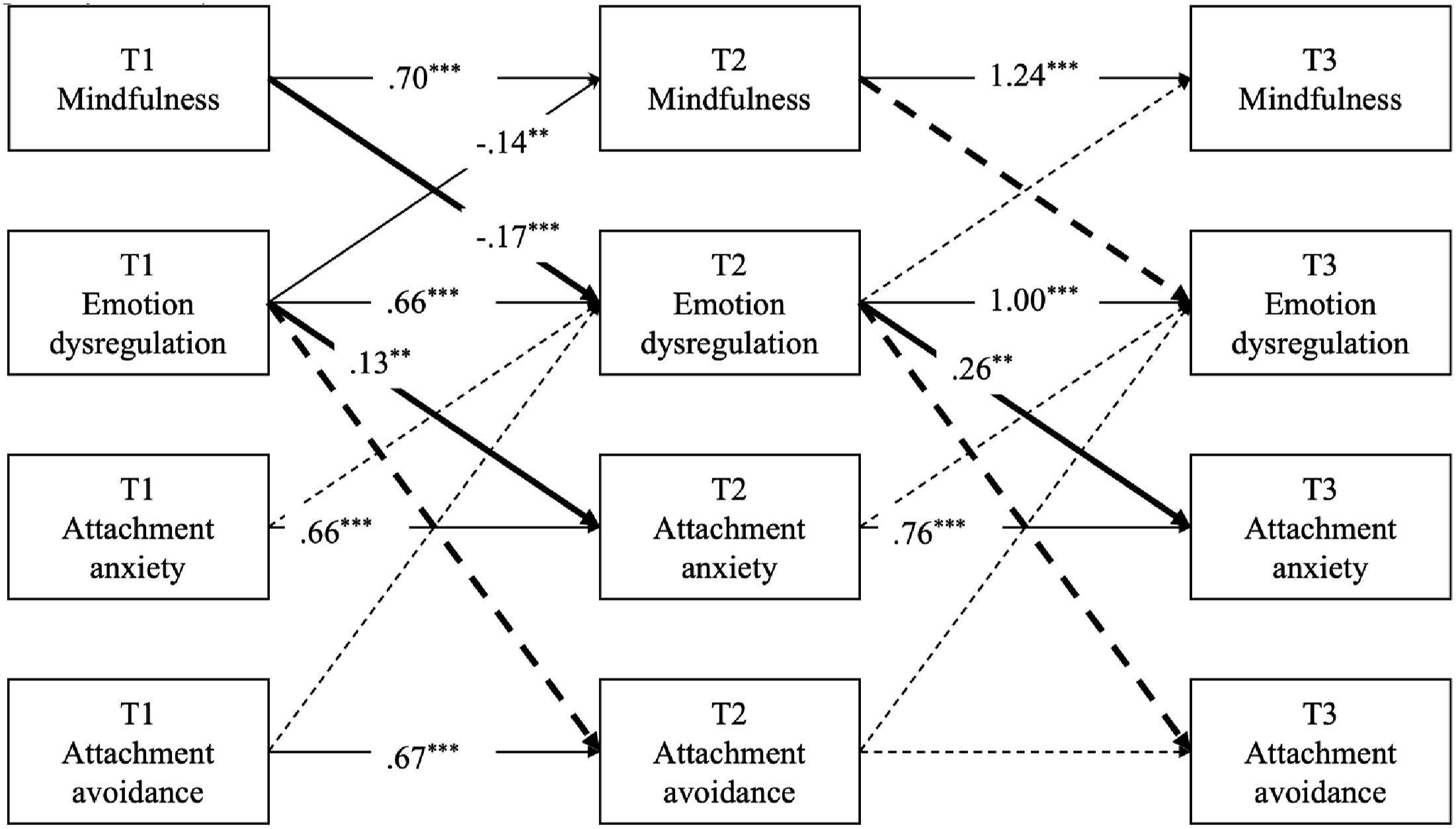
The mediation process between T1 mindfulness and T3 attachment anxiety as well as T3 attachment avoidance were tested via bootstrapping, based on 5000 bootstrap samples with replacement. The 95% confidence interval (CI) indicated that the standardized indirect effect between T1 mindfulness and T3 attachment anxiety did not include a zero, β = −.04, p = .01, 95% CI [-.08, −.02], suggesting that emotion dysregulation was a mediator between mindfulness and attachment anxiety. The 95% confidence interval (CI) indicated that the standardized indirect effect between T1 mindfulness and T3 attachment avoidance included a zero, 95% CI [-.03, .02], suggesting that emotion dysregulation was not a mediator between mindfulness and attachment avoidance.
Test of alternative model: Mindfulness as a mediator
The cross-lagged panel mediation model with mindfulness as a mediator for the relation between emotion dysregulation and attachment anxiety and avoidance showed an adequate fit to the data, χ2 (37) = 102.20, p < .001, CFI = .97, TLI = .94, RMSEA = .07, SRMR = .05. Most autoregressive effects were significant, ps < .001, except for T2 and T3 attachment anxiety and avoidance, respectively, ps > .05. After controlling for covariates, concurrent paths, and autoregressive paths, T1 emotion dysregulation significantly predicted T2 mindfulness (β = −.13, B = −.08, SE = .03, p = .006) and T3 attachment anxiety (β = .75, B = 1.25, SE = −.62, p = .04). However, T1 emotion dysregulation did not significantly predict T3 attachment avoidance. In addition, T2 mindfulness did not significantly predict T3 attachment anxiety and avoidance. All reversed directionality of effects were not significant, except that T1 mindfulness significantly predicted T2 emotion dysregulation (β = −.17, B = −.27, SE = .07, p < .001). Taken together, the results did not support mindfulness as a mediator.
Discussion
Guided by theories and empirical studies (e.g., Karremans et al., 2017; Shaver et al., 2007; Stevenson et al., 2017), the present study investigated the associations between mindfulness and attachment insecurity (i.e., attachment avoidance and anxiety), with emotion dysregulation as a mediator. Cross-lagged analysis based on three-wave longitudinal data indicated that greater mindfulness predicted lower attachment anxiety towards romantic partners through lower emotion dysregulation over time. However, the mediating role of emotion dysregulation between mindfulness and attachment avoidance was not supported.
Consistent with previous research showing the mediating role of emotion regulation between greater mindfulness and lower sensitivity to potential rejection in interpersonal relationships (Hafner et al., 2019), the present study revealed that greater mindfulness was longitudinally predictive of lower attachment anxiety, as mediated by lower emotion dysregulation. That is, emerging adults with higher levels of mindfulness are less likely to experience difficulties in regulating emotions (Brockman et al., 2017; Cheung et al., 2020). In addition, individuals with a greater capability to manage negative emotions (e.g., fear and doubt) are subsequently less anxious about perceived threats in intimate relationships (e.g., potential abandonment and rejection). Conversely, individuals who struggle with regulating negative emotions may fail to manage their anxiety about perceived threats in romantic relationships. These findings are consistent with previous cross-sectional studies showing a negative relation between emotion regulation and attachment anxiety to romantic partners (Espeleta et al., 2017; Snyder et al., 2023).
Contrary to our hypothesis, the present findings did not support the mediating role of emotion dysregulation between mindfulness and attachment avoidance. More specifically, emotion dysregulation did not predict attachment avoidance among emerging adults over time. The findings contradicted previous cross-sectional studies suggesting that greater difficulties in emotion regulation was linked to greater avoidance of intimacy in romantic relationships (Espeleta et al., 2017; Snyder et al., 2023). The nonsignificant association may be due, in part, to the complex patterns of attachment avoidance. While certain characteristics of attachment avoidance (e.g., denying and avoiding attachment needs) may not be positively related to emotion regulation (Mikulincer et al., 2003; Mikulincer & Shaver, 2019; Shaver & Mikulincer, 2002), other characteristics (e.g., avoiding impulsive reactions to relationship stress) may be positively related to emotion regulation. Future studies should further examine different aspects of attachment avoidance in relation to emotion regulation.
Consistent with previous cross-sectional research (McDonald et al., 2016), the present study indicated that emerging adults’ mindfulness did not predict attachment avoidance over time. The findings also aligned with Gazder and Stanton’s (2023) longitudinal study, which found that mindful attention awareness and mindfulness in intimate relationships were not directly linked to attachment avoidance. However, this contrasted with other cross-sectional studies indicating that individuals with greater mindfulness were less likely to experience discomfort with closeness and dependency on their partners (Fall & Shankland, 2021; Hertz et al., 2015; Jones et al., 2011; Zhou et al., 2020). Unexpectedly, our study also revealed that greater mindfulness at T1 predicted higher attachment anxiety at T3. This deviated from previous findings (e.g., Fall & Shankland, 2021; Zhou et al., 2020) and contradicted our zero-order correlation results (see Table 1). Given the negative zero-order correlations between mindfulness and attachment anxiety, the surprising finding in the path model might have been due to multicollinearity.
Regarding the reversed directionality of effects, our findings showed that the effects of attachment avoidance and anxiety on emotion dysregulation were not significant among emerging adults. These findings did not support theoretical studies (Mikulincer et al., 2003; Shaver & Mikulincer, 2002) suggesting that individuals higher in attachment insecurity are more likely to maladaptively regulate their feelings and thoughts. The findings also contrasted with cross-sectional studies showing that higher attachment avoidance and anxiety predicted greater emotion dysregulation (Pepping et al., 2013). Taken together, our data revealed that emotion dysregulation preceded attachment anxiety, but not vice versa, and that emotion dysregulation and attachment avoidance were not longitudinally related.
Our findings indicated that higher levels of emotion dysregulation at T1 predicted lower levels of mindfulness at T2 among emerging adults. As such, the results extended previous studies (e.g., Brockman et al., 2017; Pepping et al., 2013) by revealing the bidirectional negative effects between mindfulness and emotion dysregulation. Unlike previous research showing the longitudinal negative associations between attachment insecurity and mindfulness facets (Stevenson et al., 2021), our cross-lagged analysis showed that attachment insecurity (i.e., attachment anxiety and avoidance) did not significantly predict mindfulness over time. Hence, future studies are necessary to verify the directionality of effects between adult attachment insecurity and mindfulness.
Finally, tests of the alternative directionality of effects in the supplementary analysis indicated no indirect effects of emotion dysregulation on attachment insecurity through dispositional mindfulness. Although greater emotion dysregulation did predict lower mindfulness over a 6-month interval, mindfulness did not further predict attachment anxiety and avoidance over time. Moreover, greater emotion dysregulation at T1 predicted higher levels of attachment anxiety at T3, with a 12-month interval in between. However, the prediction was unidirectional, that is, attachment insecurity did not predict emotion dysregulation over time. Based on these findings, the alternative directionality of effects was not established, except for the link between mindfulness and emotion dysregulation.
Limitations and future directions
The findings should be interpreted in light of several limitations. First, the study relied on self-report measures to assess mindfulness, emotion dysregulation, and attachment. Future studies should consider utilizing a multi-method and multi-informant approach to enhance objectivity. Second, our study included college students, with a majority (64.31%) reporting that they were currently not in a relationship. Future studies should, instead, recruit couples to further understand psychological functioning and relationship dynamics. Third, in this study, we did not collect data on gender identity, disability information, sexual orientation, and the number of pregnant participants. To add specificity to the present findings, researchers should incorporate important demographic information in future research. Fourth, most of the participants were women (n = 238, 71.47%) which may not be representative of the broader community, thus limiting the generalizability of the results. Future studies should aim to recruit participants of diverse genders and balance the gender ratio to gain a more comprehensive understanding of the effects between mindfulness and attachment security. Fifth, while our study applied cross-lagged analysis which allowed us to understand the directional and reciprocal relationships between variables, causality between the study variables warrants further investigation. Future studies should, for instance, include experiments to examine the causal relationships between the variables. Finally, the 6-month short lag between time points gave rise to the stability of the variables over time. Although these processes are expected to demonstrate some fluidity in transitional periods such as emerging adulthood (Arnett, 2000), future studies should lengthen the time lag to minimize stability in longitudinal data analysis (Scharfe & Bartholomew, 1994).
Conclusion
Grounded in the theoretical model of mindfulness and romantic relationships (Karremans et al., 2017), this study investigated emotion regulation as a mediator between mindfulness and attachment security in romantic relationships among emerging adults in a Chinese context. The cross-lagged analysis revealed that greater mindfulness predicted lower emotion dysregulation, which, in turn, predicted lower attachment anxiety over time. However, mindfulness and emotion dysregulation did not predict attachment avoidance over time. Taken together, the present findings highlighted the potential of cultivating mindfulness and emotion regulation for curtailing attachment anxiety in emerging adulthood.
Footnotes
Declaration of conflicting interests
The author(s) declared no potential conflicts of interest with respect to the research, authorship, and/or publication of this article.
Funding
The author(s) disclosed receipt of the following financial support for the research, authorship, and/or publication of this article: This study was funded by The Education University of Hong Kong (RG60/2014-2015R, 04111, and RG90/2015-2016). The study was undertaken while the authors were at The Education University of Hong Kong. The findings have not been published previously.
Open research statement
As part of IARR’s encouragement of open research practices, the authors have provided the following information: This research was not pre-registered. The data used in the research cannot be publicly shared but are available upon reasonable request. The data can be obtained from the corresponding author by emailing
