




Abstract
Previous research in psychological aesthetics has already highlighted the influence of personality on the experience and appreciation of art. And yet, the question of whether personality can manifest itself in arts attendance behavior remains far from settled. We therefore aimed at examining whether personality–measured with the Mini International Personality Item Pool–is linked to arts attendance motivations as well as to the art forms people choose to attend across two distinct samples of 1398 Greek and 408 German students. Results of both studies revealed that all the Big Five traits contributed differentially to arts attendance motivations, implying that people with different personality traits have different reasons for attending the arts. Logistic regression results further suggested the relevance of openness to experience and–to a lesser extent–extraversion to arts attendance, with openness to experience contributing to attendance at several art forms in the Greek sample. We might therefore assume that people do attend the arts to satisfy their personality-related needs or, to put it another way, the experience of art lies in the eyes of the beholder.
Introduction
Over the past two decades, a fair amount of the research concerned with psychological aesthetics has been directed towards a better understanding of what motivates people to attend the arts (e.g., Bideci & Albayrak, 2018; Manolika & Baltzis, 2022; Swanson et al., 2008), why different people attend different art forms (e.g., Mastandrea et al., 2007), and how people evaluate and experience art (e.g., Leder & Nadal, 2014; Menninghaus et al., 2017; Weigand & Jacobsen, 2023). However, the complex pattern of arts attendees’ behavior remains unclear, and this is mainly because people’s attendance decisions depend on a multiplex network including both situational aspects and person characteristics. Person-related characteristics that have been repeatedly examined and shown to affect the experience of art are the Big Five traits (e.g., Jacobsen, 2006; Myszkowski et al., 2014; Silvia et al., 2015).
Increasing evidence, the majority of which comes from research in media and music psychology, suggests that the relation of personality to the experience of mass art can be explained in terms of needs gratification (e.g., Ruggiero, 2000). 1 That is, people may use forms of art and media entertainment, such as movies, music, television, and books, to create experiences that are compatible with their personality (e.g., Bowes et al., 2018; Manolika, 2023; Qiu et al., 2019; Rentfrow et al., 2011). In fact, the notion that people actively choose situations/environments to fulfill their needs and match their personality is hardly a novel one to personality theorists (e.g., Allport, 1961; Ickes et al., 1997). In the present study, we aimed at providing new evidence for this notion by examining whether personality is associated with arts attendance behavior.
To be specific, across two studies–one conducted in Greece and one in Germany–we examined whether the Big Five traits are differentially related to arts attendance motivations and whether they contribute to visual and performing arts attendance. Given that prior research on arts attendance motivations has mainly focused either on visual (i.e., museums/art galleries; Bideci & Albayrak, 2018) or on performing arts (i.e., theater, opera, and dance performances; Swanson et al., 2008), the present study also aimed at filling this gap by focusing both on visual and performing arts attendance motivations. That is, in the context of this manuscript “art” is used predominantly to refer to visual and performing arts, 2 leaving architecture aside. Analyzing data from two distinct but closely related cultures in terms of aesthetic appreciation (Butler, 2012), will contribute not only to a better understanding of the relation between personality and arts attendance behavior, but also to more accurate estimates of generalizability of findings. For instance, can the results of our study be generalized well beyond Greece? We acknowledge, however, that both countries appreciate the arts, and that Greek art has influenced German literature (Butler, 2012), yet Greece is a mainly collectivistic country, whereas for the Germans achievement and autonomy represent important values (e.g., Hofstede, 2001). The rationale for this study builds on the growing need to account for the expression of personality through arts attendance and to provide a bridge between personality theory and research on arts attendance motivations as well, thereby expanding our current understanding of arts attendees’ behavior.
Arts Attendance Motivations
It is almost forty-five years since DiMaggio and Useem (1978) indicated that their review of visual and performing arts attendance in the United States was informed by approximately 230 studies. And yet, it is only in the past two decades that the question of why people attend the arts has been addressed in a systematic way (e.g., Bideci & Albayrak, 2018; Manolika & Baltzis, 2022; Swanson et al., 2008). Indeed, there has recently been a considerable number of studies examining arts attendance motivations in various art forms and different populations, often suggesting that some motivational variables, such as festival attraction, are associated with specific events (e.g., Kim et al., 2006), while others have been shown to generalize across studies, art forms, and populations (e.g., Maeng et al., 2016).
Considering that the experience of art is primarily hedonic (Menninghaus et al., 2019), some scholars have observed that people attend performing arts to experience positive emotions, such as amusement and pleasure (e.g., Swanson et al., 2008). Other relevant studies have likewise revealed that people visit museums and art galleries to find a diversion or escape from routine (e.g., Bideci & Albayrak, 2018). But beyond mere pleasure, arts attendees may be motivated by curiosity, which stimulates exploratory behavior (Berlyne, 1960). That is, people attend several art forms to expand their intellectual horizons and learn more about the arts (e.g., Manolika & Baltzis, 2022; Swanson et al., 2008). Apart from the above motivational variables, Maeng et al. (2016) showed socialization–the establishment of new relationships and the maintenance of in-group relations–and family togetherness–the desire to strengthen family kinships–to be among the more frequent mentioned reasons for festival attendance. McCartney and Ip Si Kei (2018), however, further acknowledged that, in addition to socialization, arts festival attendees are motivated by social status. This, in fact, echoes the “cultural capital paradigm” developed by Pierre Bourdieu (1984), which emphasizes the generation of social distinction through arts attendance. That is, and according to Bourdieu (1984), “elites” use fine arts attendance as a cue to signify belonging to the upper-middle class, thereby distinguishing themselves from non-attendees. What we can therefore conclude is that–among other things–art can be hedonic, transformative, and a means of social bonding or even differentiation (e.g., DiMaggio & Mukhtar, 2004; Menninghaus et al., 2017), which further highlights its importance to our life.
Personality and the Experience of Art
In the early 1990s, Costa and McCrae introduced the FFM (Costa & McCrae, 1992) and proposed that personality can be classified into five broad bipolar dimensions: openness to experience, conscientiousness, agreeableness, extraversion, and neuroticism (Costa & McCrae, 1992; Goldberg, 2013; McCrae & Costa, 2008). Since then, the Big Five traits have been linked to aesthetic preferences (e.g., Chamorro-Premuzic et al., 2009; Cleridou & Furnham, 2014), aesthetic attitudes and activities (e.g., McManus & Furnham, 2006), aesthetic sensitivity (e.g., Myszkowski et al., 2014), and to interest and knowledge in the arts (e.g., Furnham & Chamorro-Premuzic, 2004).
Of the Big Five traits, openness to experience is the most relevant to theory and research in psychological aesthetics, mainly because “open” people “tend to be particularly sensitive to art and beauty” (McCrae, 2007, p. 6). Indeed, people high in this trait pursue the arts (e.g., Kraaykamp & van Eijck, 2005; Mastandrea et al., 2009), display positive aesthetic attitudes (e.g., McManus & Furnham, 2006), and prefer a wide variety of different art forms–especially modern and abstract art forms, rather than conventional or traditional ones (e.g., Chamorro-Premuzic et al., 2009; Cleridou & Furnham, 2014). Extraversion–the propensity to pursue sensory stimulations and opt for high levels of arousal–has been linked to preferences for art forms and types of activities displaying a high degree of tension and complexity, such as surrealist paintings and recreational reading (e.g., Finn, 1997; Furnham & Avison, 1997). In contrast to people high in extraversion, those high in neuroticism indicate lower preferences for complex/intense art forms and types of activities in an effort to lessen external stimulation and relieve tension (e.g., Cleridou & Furnham, 2014; Weaver, 2003). Yet, the relation of conscientiousness and agreeableness to aesthetic preferences seems to be more equivocal. People high in conscientiousness, for instance, prefer sophisticated and representational paintings (e.g., Furnham & Walker, 2001), yet they do not visit museums/art galleries frequently (e.g., McManus & Furnham, 2006). People high in agreeableness, likewise, participate less in arts-based activities, although they indicate positive aesthetic attitudes (e.g. McManus & Furnham, 2006).
Aim of the Present Study and Hypotheses
Based on personality theories (e.g., Allport, 1961; Ickes et al., 1997) and prior research in media and music psychology suggesting that people choose forms of art and media entertainment to match their personality (e.g., Bowes et al., 2018; Manolika, 2023; Rentfrow et al., 2011), the present study examined the hypothesis that people’s motivations to attend the arts as well as the forms of art they choose to attend are linked to their personality. To do so, we conducted two studies, one in Greece and one in Germany. Although we expected to find consistent results across both studies, analyzing two different samples allows us to examine the consistency of the results across two distinct but closely related cultures in terms of aesthetic appreciation (Butler, 2012); that is, the complementary nature of both studies can potentially lead to mutual corroboration of results.
Due to a lack of evidence for an association between the Big Five traits and arts attendance motivations, the proposed hypotheses stem from prior research on the relation of the Big Five traits to aesthetic preferences, attitudes, and activities (e.g., Chamorro-Premuzic et al., 2009; Mastandrea et al., 2009). First, we hypothesized that people high in openness to experience–characterized by intellectual curiosity, creativity, and aesthetic sensitivity–would be more likely to attend the arts to expand their intellectual horizons (Hypothesis 1a [H1a]) and learn more about the arts (Hypothesis 1b [H1b]). Which is why, we also expected that they would attend a variety of different art forms (Hypothesis 1c [H1c]). Since people high in extraversion tend to be sociable and outgoing, we hypothesized a positive link of extraversion to socialization (Hypothesis 2a [H2a]) and arts festival attendance–a type of activity facilitating social interaction–(Hypothesis 2b [H2b]). Last, we hypothesized that people high in neuroticism would be more prone to attend the arts to find a diversion or escape stressful life events (Hypothesis 3 [H3]), mainly because they tend to frequently experience unpleasant affective states (Costa & McCrae, 1992).
Method
Participants and Procedure
The Greek sample consisted of 1398 students (385 men and 998 women; 15 participants did not indicate their biological sex) pursuing various courses at the Aristotle University of Thessaloniki. The mean age of the participants was 24.37 years (age range, 19–50 years), with a standard deviation of 6.75. Of the total sample, 20.2% were medicine students, 18.4% were psychology students, and 15.0% were law students; the rest of them were studying various other subjects, such as primary education, mechanical engineering, and agriculture. The German sample comprised 408 students (262 men and 129 women; 17 participants did not indicate their biological sex) pursuing various courses at the University of Hamburg. The mean age of the participants was 21.44 years (age range, 18–51 years), with a standard deviation of 3.81. Of the total sample, 21.1% were biology students, 10.7% were social-economics students, and 9.5% were physics students; the rest of them were studying various other subjects, such as primary education, psychology, and sociology.
Participation in the study for both Greek and German students was online and voluntary; students were not reimbursed for their participation. Students were given a link to the study and were requested to fill out a number of self-report measures. Participants were first provided with information about the aim of the study and the voluntary nature of participation, and then they gave informed consent. They then completed an online questionnaire concerning motives for arts attendance (Manolika & Baltzis, 2022) and the Mini-International Personality Inventory Pool (Mini-IPIP; Donnellan et al., 2006). The survey concluded with questions regarding attendance at different art forms and student demographics. Participants completed the online survey in approximately 15 minutes.
Measures
Arts Attendance Motivations
Arts attendees’ motivations were measured with a previously developed questionnaire (Manolika & Baltzis, 2022), which includes 37 items that can be grouped into six dimensions: Entertainment (five items); Escapism (eight items); Learning/Curiosity (eight items); Art interest (seven items), Socialization (five items); and Family togetherness (four items). 3 Responses were given on a 5-point scale ranging from 1 (strongly disagree) to 5 (strongly agree). German participants completed the translated version of the questionnaire. To be specific, in line with the guidelines of the International Test Commission (Hambleton, 2001), the Greek version of the questionnaire was first translated into German and then back-translated into Greek by two bilingual translators. The accuracy of translation was evaluated by comparing the original and back-translated versions; any discrepancy was discussed until an agreement was reached. Item comprehensibility was assessed through a pilot study in a small sample bearing the same characteristics as the main sample of our study. To be precise, participants included in the pilot study were students at the University of Hamburg (16 men and 14 women), with a mean age of 22.93 years (age range = 20–34 years; SD = 3.29). Cronbach’s alphas for this scale varied between .76 (Entertainment) and .94 (Family togetherness) in the Greek sample and between .69 (Entertainment) and .92 (Family togetherness) in the German sample. 4
Personality
The Big Five traits of openness to experience, 5 conscientiousness, agreeableness, extraversion, and neuroticism were measured with the 20-item Mini-IPIP (Donnellan et al., 2006). The Mini-IPIP is a short-form of the 50-item IPIP-FFM (German version: Ostendorf, 2003; Greek version: Vakola et al., 2006) that measures each of the Big Five traits with four items. Participants were asked to rate how accurately a statement describes them on a 5-point scale ranging from 1 (strongly disagree) to 5 (strongly agree). Cronbach’s alphas for the Big Five traits varied between .61 (neuroticism) and .72 (extraversion) in the Greek sample and between .62 (openness to experience) and .84 (extraversion) in the German sample.
Arts Attendance and Demographics
Arts attendance was measured with the following question: Have you participated in or done the following activities during the last twelve months: (1) cinemas; (2) theater; (3) arts festivals; (4) dance performances; (5) museums/art galleries; and (6) opera. The set of possible answers was as follows: 0 = no; and 1 = yes. Finally, participants were asked to indicate their biological sex (woman = 0; man = 1) and age (in years).
Data Analysis
Before conducting the analyses, both the Greek and German data were examined for outliers and normality. The scores were first standardized, and all outliers identified as z scores greater than 3.29 (p < .001, two tailed; Tabachnick & Fidell, 2013) were excluded from the dataset. The variables were also tested for normality with skewness and kurtosis values (greater than ±2.00; Tabachnick & Fidell, 2013). For all subsequent analyses, the data were found to meet the necessary statistical assumptions.
The six-factor structure of the arts attendance motivations scale was tested using confirmatory factor analysis (CFA). Given the sensitivity of the Chi-square statistic (χ2) to sample size (Chen, 2007), in this study, we relied upon alternative goodness of fit indices that are less sensitive to sample size. These included the comparative fit index (CFI), the root mean square error of approximation (RMSEA), and the standardized root mean square residual (SRMR). The following cut-offs were used to determine good fit: CFI above .90 (better if above .95) and both RMSEA and SRMR below .08 (better if below .05) (e.g., Hu & Bentler, 1999; Kline, 2015). Multi-group CFA was used to examine the measurement invariance of the arts attendance motivations scale across the samples; we examined the configural, metric, and scalar invariance. Following Chen (2007), changes in CFI, RMSEA, and SRMR values were used to determine model invariance; ΔCFI ≤ −.010, ΔRMSEA ≤.015, and ΔSRMR ≤.025 for the metric model or ΔSRMR ≤.010 for the scalar model indicated invariance. In the event of non-invariance, we examined partial invariance to determine which specific parameters differed across groups by freeing one parameter at a time. Modification indices (MIs) and standardized expected parameter changes (EPCs) were used to determine partial invariance.
With respect to the FFM (Costa & McCrae, 1992; McCrae & Costa, 2008), although exploratory factor analyses (EFAs) have revealed very similar five-factor structures that supported the theoretical model (McCrae & Costa, 1997), CFAs have often failed to adequately model this structure (e.g., Chiorri et al., 2016; Cooper et al., 2010). 6 Given that such findings have led some researchers to question the appropriateness of CFA for verifying the structure of the FFM, we examined the factor structure of the Mini-IPIP employing principal axis factoring with oblimin rotation. The factorability was assessed with the Kaiser-Meyer-Olkin (KMO) measure of sampling adequacy and the Bartlett’s test of sphericity. Only factors with eigenvalues greater than one, and items with factor loadings greater than .30 were retained. Composite scores were calculated computing the mean of the items included in each domain; each item was equally weighted. 7 Internal consistency of all measures was assessed using Cronbach’s α coefficient.
Descriptive statistics and correlations were calculated for all composite measures. Given the exploratory nature of the study, in that, the link between personality and arts attendance behavior has not been examined systematically, to unravel the effects of the Big Five traits on arts attendance motivations, separate multiple regression analyses for each motivational variable were performed on both the Greek and German data. Since the amount of missing data was not large, we utilized a listwise deletion. In each model, the Big Five traits were entered as the independent variables and arts attendance motivations were entered as the dependent variables. Given that biological sex appears as a substantial predictor of patterns of arts attendance (e.g., Christin, 2012), student demographics were entered simultaneously as covariates. Binary logistic regressions were computed separately for the Greek and German data to examine the extent to which the Big Five traits contribute to attendance at cinemas, theater, arts festivals, dance performances, museums/art galleries, and opera after controlling for demographics. Logistic regression is a specialized form of regression that predicts a categorical dependent variable in terms of one or more categorical or continuous independent variables (Peng et al., 2002). Given the exploratory nature of both studies, we used the uncorrected a-level (a = .05) to allow for future research to corroborate the findings.
Results
The Structure of Arts Attendance Motivations
For the Greek data, the results of CFA showed that all loadings of items on latent factors were statistically significant (p < .001), ranging from .490 (item 23) to .895 (item 21). In terms of the fit of the model, fit indices suggested an acceptable model fit (χ2 = 2708.78, df = 614, p < .001; CFI = .932; RMSEA = .049; SRMR = .054). For the German data, all loadings of items on latent factors were statistically significant (p < .001), and they ranged from .354 (item 18) to .873 (item 26). The six-factor model did not provide a good fit to the data, in that, the value of CFI was below the cut-off value of >.90 (CFI = .832), although the other fit indices were acceptable (RMSEA = .070; SRMR = .080).
To improve the psychometric properties of the scale, we identified and retained the most reliable, discriminating, and informative items. Thus, items with loadings greater than .40 and correlations greater than .60 were extracted to construct an abbreviated version of the scale. Our goal was to reduce the scale to 4 items per facet. We also expected that 4 items per facet would constitute a minimum that would still exhibit acceptable levels of internal consistency. Because the wording of items can influence response biases, we also tried to retain items with the best wordings for the abbreviated scale. Those modifications, which were also applied in the Greek model, resulted in an improvement in all three fit indices (χ2 = 546.23, df = 237, p < .001; CFI = .922; RMSEA = .058; SRMR = .058) (see Figure 1). This suggests that the original arts attendance motivations scale has good psychometric properties among Greek people, yet there is some indication that the model can be improved. Confirmatory factor analysis of the arts attendance motivations scale for the Greek (left) and the German sample (right). Model fit: χ2 = 838.14, df = 232, p < .001; CFI = .966; RMSEA = .043; SRMR = .049 and χ2 = 546.23, df = 237, p < .001; CFI = .922; RMSEA = .058; SRMR = .058, for the Greek and the German data respectively.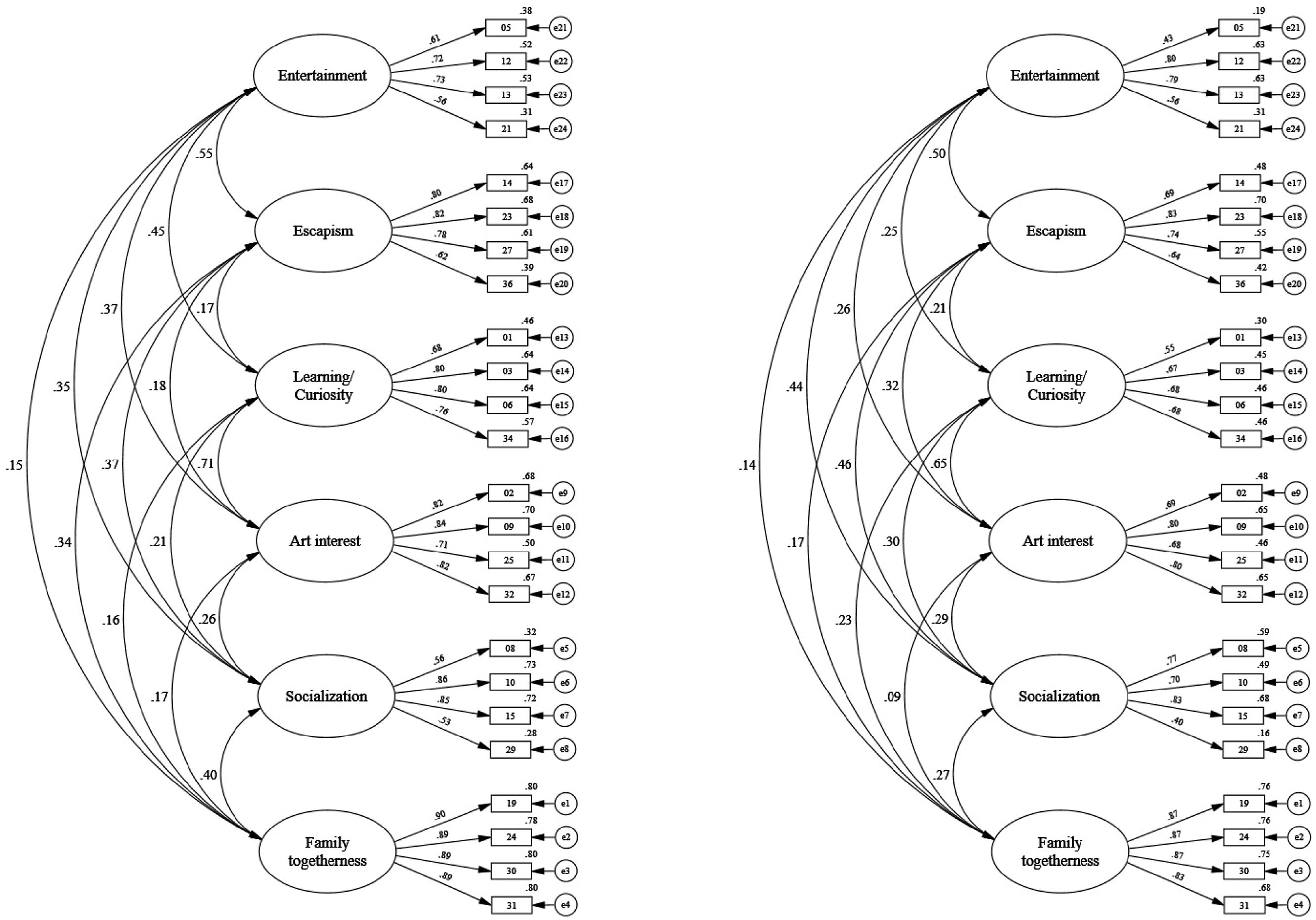
In supplemental analyses, we also examined the extent to which excluding 13 items from the original scale to create an abbreviated arts attendance motivations scale changes the factor scores; that is, whether the abbreviated scale still measures the same construct. To do so, we calculated the different types of scores for the six-factor model for both the original and abbreviated scales. The different scores computed were scores for the CFA approach and the exploratory structural equation modeling (ESEM) approach, respectively, for the measurement part of structural equation modeling (SEM), scores for EFA extracted factors, and mean scores. We then calculated Pearson correlation coefficients, looking in particular at the correlations between the original and the abbreviated scales for each type of scoring method. As depicted in Supplemental Figure S1, correlations between the original and abbreviated arts attendance motivations scales ranged from .92 (for the ESEM based scoring of Entertainment) to 1.0 (for the mean score of Family togetherness). Comparison of the regression/path coefficients showed that the differences between the original and the abbreviated scales were mostly negligible: min = −.126, 5%-percentile = −.042, moverall = −.003, 95%-percentile = .031, max = .185, with 52% of the differences being smaller than .01 and 95% being smaller than .05. The highest absolute differences were found for Escapism and the lowest for Family togetherness (see Supplemental Table S4).
Multi-Group CFA
Configural Invariance
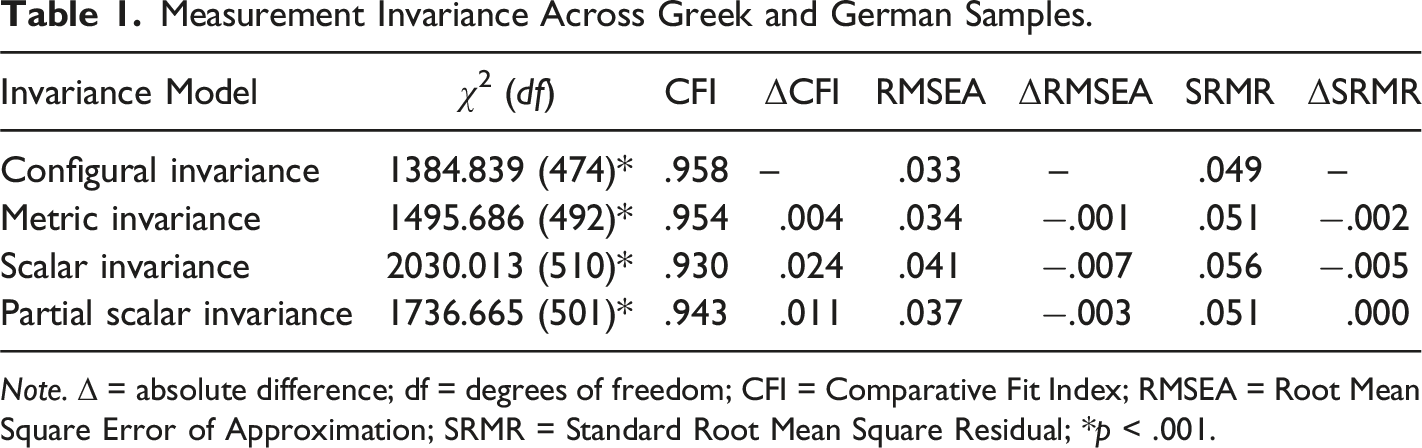
First, we examined configural invariance by fitting the six-factor model to the data for Greek- and German-speaking groups. In this model, the factor loadings were freely estimated. Results showed a good fit to the data (χ2 = 1384.83, df = 474, p < .001; CFI = .958; RMSEA = .033; SRMR = .049), suggesting that configural invariance was attained; that is, participants belonging to different groups conceptualize the construct in the same way.
Metric Invariance
Next, we examined metric invariance by constraining factor loadings to equivalence across Greek- and German-speaking groups. The metric invariance model fit the data well (χ2 = 1495.68, df = 492, p < .001; CFI = .954; RMSEA = .034; SRMR = .0509), which indicates that response patterns between groups were equivalent. The other measurement criteria, CFI, RMSEA and SRMR (ΔCFI = .005; ΔRMSEA = .000; ΔSRMR = .000) showed limited changes, providing additional support that metric invariance was held.
Scalar Invariance
Measurement Invariance Across Greek and German Samples.
Note. Δ = absolute difference; df = degrees of freedom; CFI = Comparative Fit Index; RMSEA = Root Mean Square Error of Approximation; SRMR = Standard Root Mean Square Residual; *p < .001.
Descriptive Statistics and Correlations
Descriptive Statistics, Correlations, and Reliabilities.
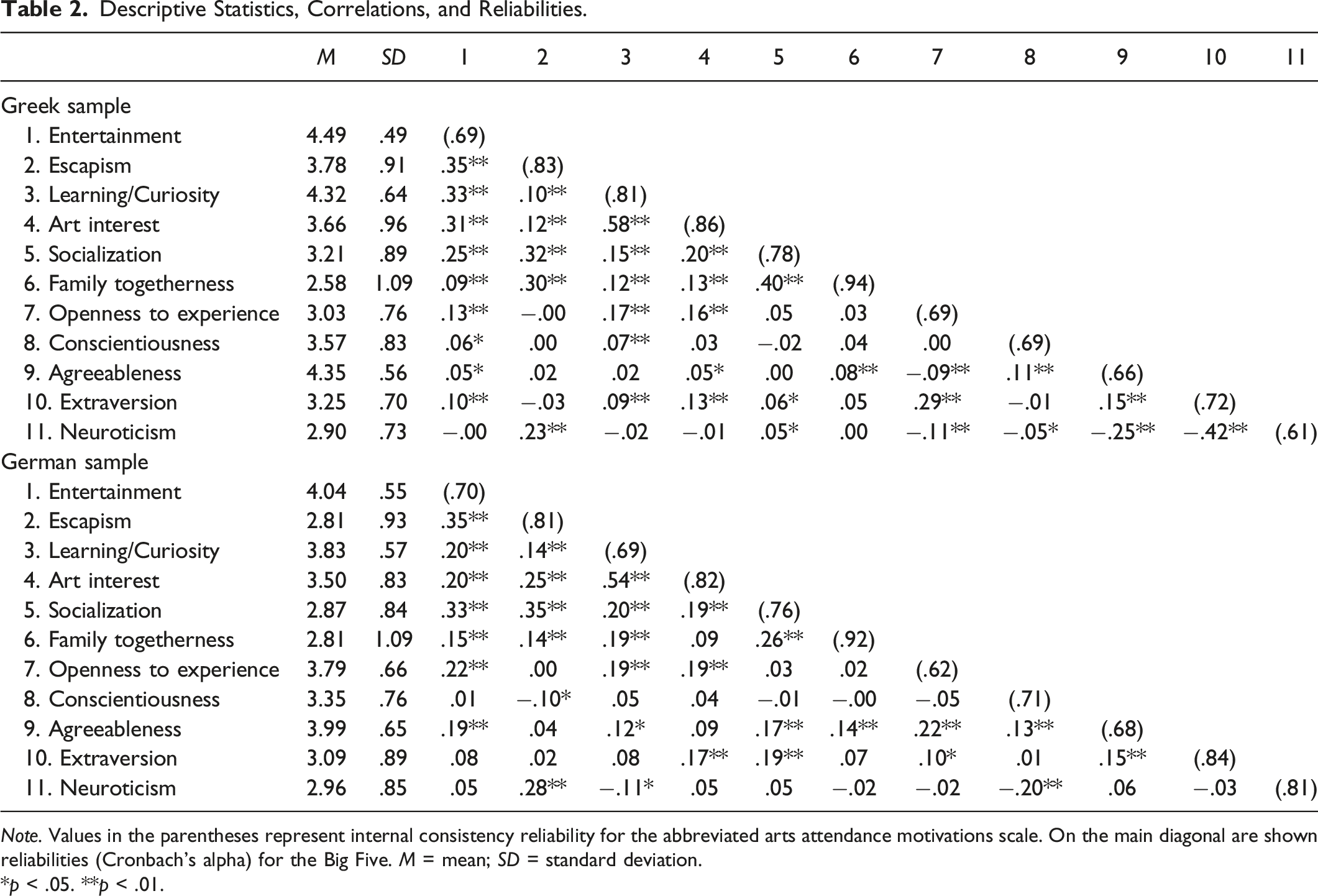
Note. Values in the parentheses represent internal consistency reliability for the abbreviated arts attendance motivations scale. On the main diagonal are shown reliabilities (Cronbach’s alpha) for the Big Five. M = mean; SD = standard deviation.
*p < .05. **p < .01.
Multiple Regressions for Predicting Arts Attendance Motivations
Multiple Regression Analysis for the Big Five Traits Predicting Arts Attendance Motivations.
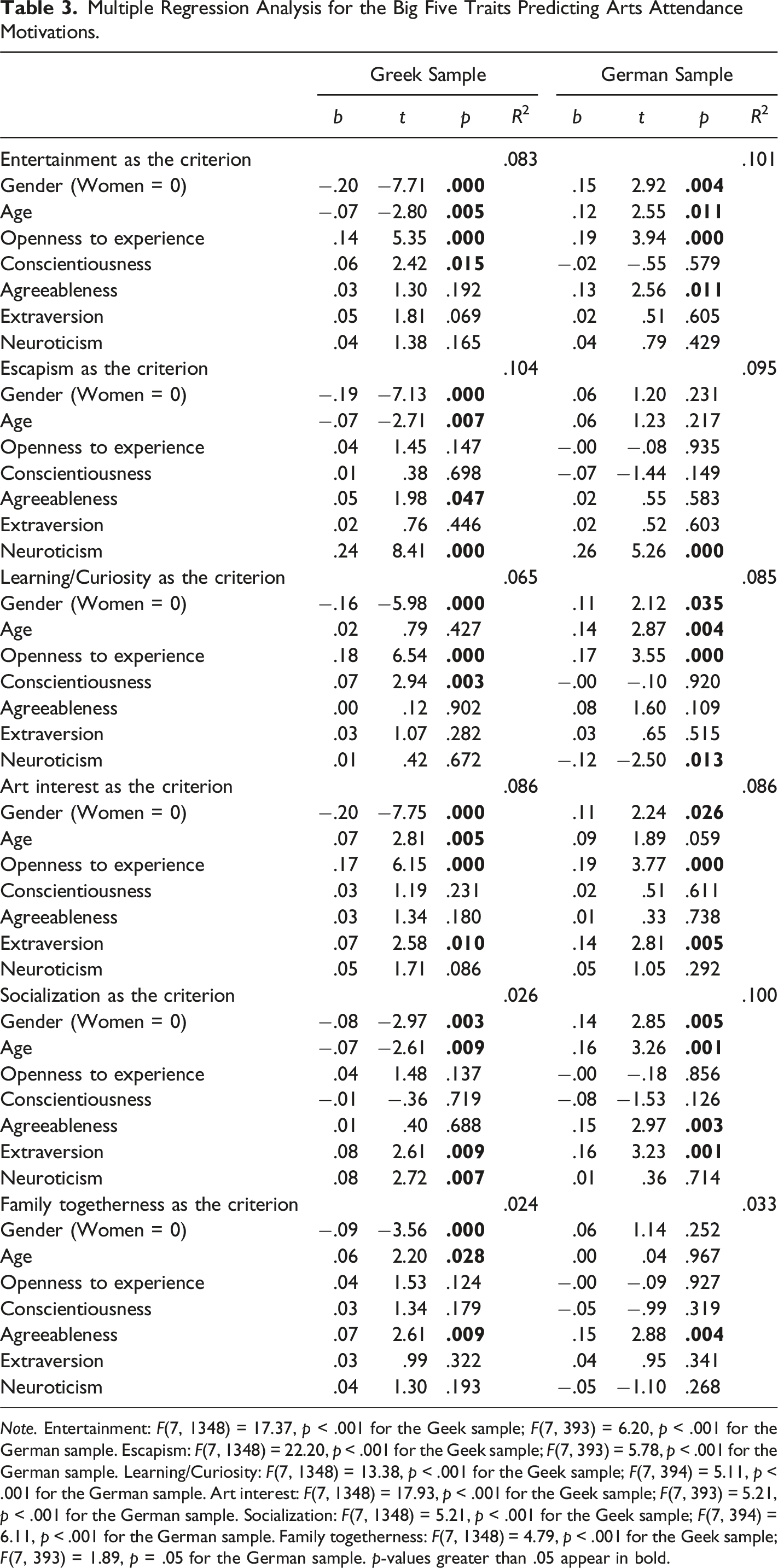
Note. Entertainment: F(7, 1348) = 17.37, p < .001 for the Geek sample; F(7, 393) = 6.20, p < .001 for the German sample. Escapism: F(7, 1348) = 22.20, p < .001 for the Geek sample; F(7, 393) = 5.78, p < .001 for the German sample. Learning/Curiosity: F(7, 1348) = 13.38, p < .001 for the Geek sample; F(7, 394) = 5.11, p < .001 for the German sample. Art interest: F(7, 1348) = 17.93, p < .001 for the Geek sample; F(7, 393) = 5.21, p < .001 for the German sample. Socialization: F(7, 1348) = 5.21, p < .001 for the Geek sample; F(7, 394) = 6.11, p < .001 for the German sample. Family togetherness: F(7, 1348) = 4.79, p < .001 for the Geek sample; F(7, 393) = 1.89, p = .05 for the German sample. p-values greater than .05 appear in bold.
Ordinal Logistic Regressions for Predicting Attendance at Several Art Forms
Ordinal Logistic Regressions on Attendance at Different Art Forms.
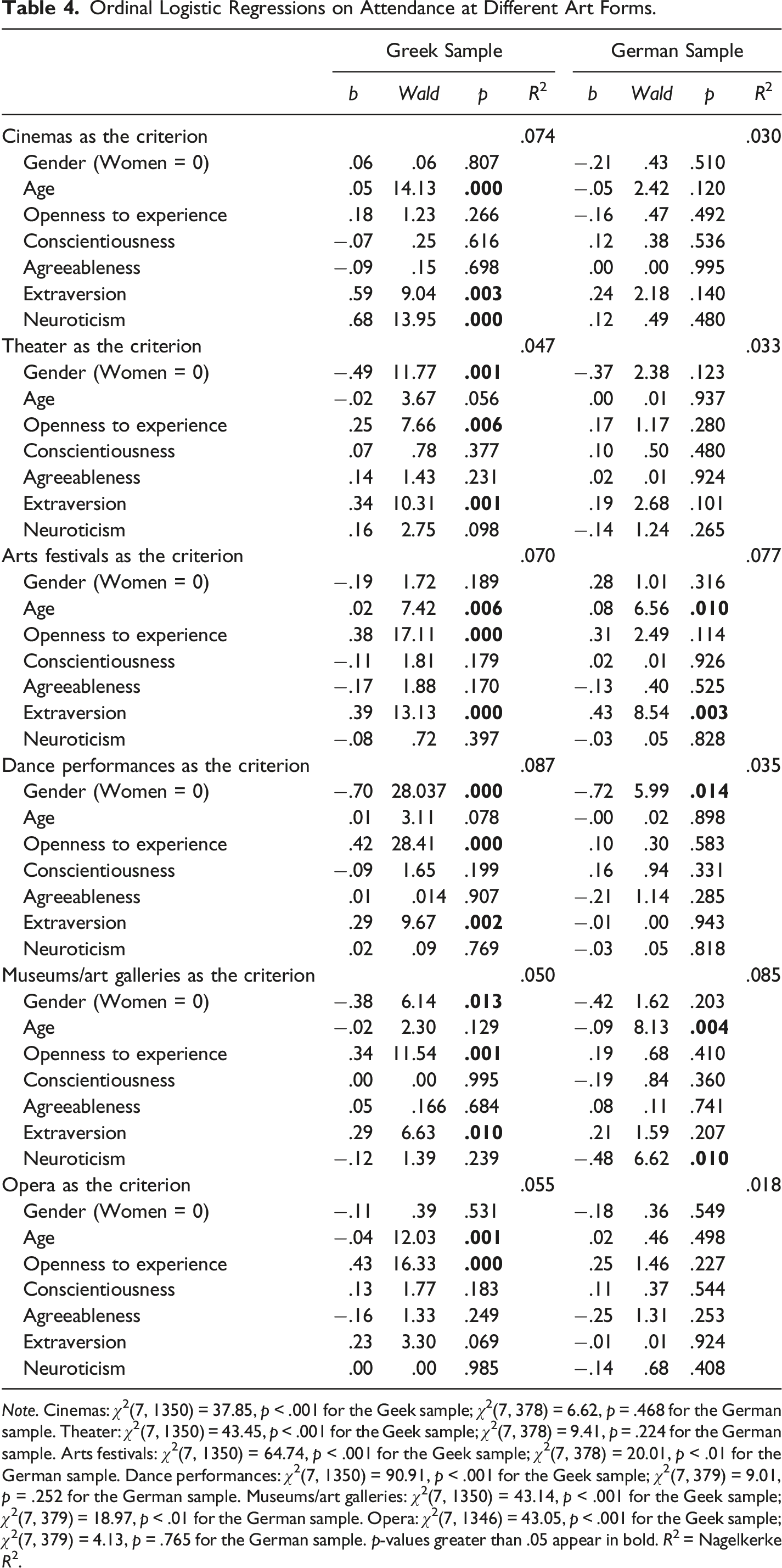
Note. Cinemas: χ2(7, 1350) = 37.85, p < .001 for the Geek sample; χ2(7, 378) = 6.62, p = .468 for the German sample. Theater: χ2(7, 1350) = 43.45, p < .001 for the Geek sample; χ2(7, 378) = 9.41, p = .224 for the German sample. Arts festivals: χ2(7, 1350) = 64.74, p < .001 for the Geek sample; χ2(7, 378) = 20.01, p < .01 for the German sample. Dance performances: χ2(7, 1350) = 90.91, p < .001 for the Geek sample; χ2(7, 379) = 9.01, p = .252 for the German sample. Museums/art galleries: χ2(7, 1350) = 43.14, p < .001 for the Geek sample; χ2(7, 379) = 18.97, p < .01 for the German sample. Opera: χ2(7, 1346) = 43.05, p < .001 for the Geek sample; χ2(7, 379) = 4.13, p = .765 for the German sample. p-values greater than .05 appear in bold. R2 = Nagelkerke R2.
Discussion
Building on and extending prior evidence that people use forms of art and media entertainment, such as movies, music, television, and books, allowing them to reflect aspects of their personality (Bowes et al., 2018; Manolika, 2023; Qiu et al., 2019; Rentfrow et al., 2011), the present study aimed at examining the hypothesis that arts attendees’ motivations as well as their patterns of arts attendance are linked to their personality. Results of both studies showed that the Big Five traits–especially openness to experience and extraversion–did contribute not only to arts attendance motivations, but also to the art forms people choose to attend. Our findings can therefore support what might seem self-evident to many: People attend the arts to satisfy their personality-related needs or, in other words, our personality manifests itself in the way we experience art, given the situational availability of respective choices.
To be specific, results of both studies showed that openness to experience positively predicted Learning/Curiosity and Art interest, thereby supporting H1a and H1b, accordingly; the higher people score on openness to experience, the more likely they are to attend the arts to meet their recurrent need to enlarge experiences through cognitive exploration (McCrae & Costa, 1997). Beyond intellectual pursuits, people high in openness to experience are also more likely to “experience a wide range of feelings and emotions” (McCrae, 2007, p. 6), which might explain the positive relation found between openness to experience and Entertainment in both samples. That is to say, people high in openness to experience are predisposed to find enjoyment and pleasure in the arts. Indeed, prior research in psychological aesthetics has linked openness to experience to profound aesthetic emotions, namely awe, wonder, fascination, and being moved (e.g., McCrae & Costa, 1997; Silvia et al., 2015). It is therefore surprising that this trait did not predict arts attendance in the German sample, although it did predict attendance at several art forms in the Greek sample (H1c). We acknowledge, however, that there were differences between the two samples in terms of the frequency of cinemas, theater, and arts festivals attendance (see Supplemental Table S2), with the Greek students being more likely than the German students to attend the aforementioned art forms. Using data from the German National Educational Panel Study, Haag and Specht (2022) revealed that high-frequency museum visitors, compared with non-visitors, were more likely to score higher on openness to experience. Taken together, these finding may indicate that the role of frequency of arts attendance should not be underestimated. It is quite possible, thus, that the link between openness to experience and arts attendance depends, at least in part, on the frequency of arts attendance. While arts attendance is usually measured with a range of attendance frequencies (e.g., “never,” “once a year,” “several times a year,” “once a month” etc.), in the present study, we measured it as a dichotomous variable (whether someone attends a particular art form at all or not). As a result, we cannot examine the finer-grained relation between openness to experience and different levels of arts attendance beyond the extent to which people attend the art form at all. That is, future studies should further examine whether people who frequently attend the arts differ from infrequent attendees in terms of openness to experience.
In support of H2a, results of both studies showed a positive link between extraversion and Socialization, which can be understood in terms of one of the core characteristics of extraverts: the tendency to be sociable. From a broader perspective, this finding is close to that found in the study of Finn (1997), where extraverts opted for non-mediated activities serving social functions–i.e., party attendance. In both samples, extraversion was also found to positively predict Art interest. Eysenck (1967), in fact, conceptualized people high in extraversion as “stimulus hungry,” and aesthetic activities could easily be seen as a source of novelty and complexity. Indeed, extraverts were found to attend not only art forms that facilitate interpersonal interactions, which supports H2b, but also those highlighting complexity, namely museums and art galleries.
In terms of neuroticism, results showed that it positively predicted Escapism in both samples, thereby supporting H3; the higher people score on neuroticism, the more likely they are to attend the arts to relieve anxiety, stress, and disappointments. In a study among young adults, Weaver (2000) likewise found that those high in neuroticism tended to watch television for passing time, stimulation, and relaxation. It is thus not surprising that neuroticism positively predicted the likelihood of cinemas attendance in the Greek sample. Neuroticism was also found to negatively predict Learning/Curiosity in the German sample. This is consistent with the meta-analysis by Colquitt et al. (2000), where anxiety, a facet of neuroticism, was negatively related to motivation to learn. Prior research in media psychology has further revealed that people high in neuroticism, compared with those low in neuroticism, spend less time reading for pleasure and prefer light books (e.g., Manolika, 2023; Schutte & Malouff, 2004). People high in neuroticism, in fact, prefer simplistic art forms, rather than complex ones (e.g., Cleridou & Furnham, 2014; Furnham & Walker, 2001) in an effort to lessen external stimulation and calm down, which can also explain the negative link between neuroticism and museums/art galleries visitation in the German sample. Note too that the study by Kraaykamp and Van Eijck (2005) also found that people low in neuroticism, compared with those high in neuroticism, were more likely to attend classical concerts and museums as well as to prefer informative TV programs.
Worthy of mention is that no predictions were made with regard to conscientiousness and agreeableness, yet both of them were linked to arts attendance motivations. In the Greek sample, for instance, results indicated a positive relation of conscientiousness to Entertainment and Learning/Curiosity. This might not be surprising, as conscientiousness is the only trait of the Big Five that has been consistently linked to motivation to learn (Major et al., 2006). Indeed, other relevant studies have shown that conscientiousness is associated with a preference for informational and science-related books (e.g., Manolika, 2023; Schutte & Malouff, 2004). In fact, due to their goal- and achievement-oriented behavior, people high in conscientiousness are more likely to learn across a variety of settings, and thus to be entertained through this process. Similar to conscientiousness, agreeableness was positively linked to arts attendance motivations, in that, it positively predicted Escapism in the Greek sample and Entertainment in the German sample. It seems that, to people high in agreeableness, the need to escape or reduce anxiety can be met while engaging in art-based activities. We also found a positive relation between agreeableness and Socialization in the German sample and between agreeableness and Family togetherness in both samples, which can be explained in terms of the innate tendency of people high in this trait to be friendly, cooperative, empathetic, and compliant (Costa & McCrae, 1992). That is to say, people high in agreeableness may attend the arts because such an activity provides them with the prosocial opportunities they seek out.
Limitations
This study, however, is subject to several limitations that need to be highlighted. One of them is that both samples were composed of university students, implying that the limited heterogeneity in respondents’ demographics might have affected the generalizability of our results to some extent. Theater audiences, for instance, are older than cinema goers (e.g., Manolika & Baltzis, 2022), while museums/art galleries visitation exhibits an inverted U-shape relation with age (e.g., Falk & Katz-Gerro, 2016). Therefore, to obtain more widespread findings, similar studies are needed in more diverse sample of participants. Added to that, not only were the samples not representative of their countries, but they also differed from each other, especially in terms of gender distribution and frequency of arts attendance. In this respect, we hesitate to draw conclusions about differences between Greeks and Germans based on our results; therefore, there is a clear need for future studies that examine cross-cultural similarities and differences using representative samples. Additional research is also required to question whether the current findings generalize to a wider set of activities, including both receptive and participatory arts engagement. In the present study, frequency of art attendance was introduced to the analysis as a dichotomous variable; that is, future studies might consider measuring it as an ordinal variable to better portray the relation between personality and arts attendance. It should also be noted that both samples included students, the vast majority of whom did not pursue arts-related courses. Prior research in psychological aesthetics, however, has shown that experts and novices differ in how they experience art (e.g., Lundy et al., 2019); that is, studies examining whether and, if so, how art knowledge is linked to both arts attendance motivations and patterns of arts attendance are needed.
A potential further limitation of this study is the use of a short-form measure of the Five-Factor Model. Even though several studies have provided evidence that the Mini-IPIP has acceptable reliability (e.g., Cooper et al., 2010; Donnellan et al., 2006), future scholars might employ long-form measures of personality to examine the influence of the Big Five traits on the behavior of arts attendees. It is also important to notice that we did not establish satisfactory metric and scalar invariance of the Mini-IPIP across the two samples, that is, differences in the associations between the Big Five traits and the arts attendance motivations for the samples should be interpreted with caution. One might also argue that openness to experience and extraversion shared similar phrase meaning with specific arts attendance motivations–i.e., Learning/Curiosity, Art interest, and Socialization–and, thus, ought to be predicted by them. To this end, subsequent research could also use measures of the Big Five facets for predicting arts attendees’ motivations, which may lead to an increased accuracy in prediction.
We also need to acknowledge that the arts attendance motivations scale shows promise as a useful measure, yet changes to the original model could improve the overall model fit of the scale. Future scholars, for instance, might/could consider revising or rewording weak items, which would not only maintain the breadth of the original scale but also lead to a more accurate and efficient assessment of arts attendees’ motivations. Future research could also extend the present findings by providing a more nuanced insight into the relation of other person-related characteristics, such as need for cognition, aesthetic attitudes, and personal beliefs, to arts attendance behavior.
Conclusion
The present study aimed at extending prior research in psychological aesthetics by offering a relevant new insight into the dynamic interplay between the Big Five traits and arts attendees’ behavior. Taken together, our findings revealed that arts attendees’ motivations as well as the forms of art they pursue can mirror their personality; people high in neuroticism, for instance, were more likely to attend the arts to escape stressful life events, and they tended to pursue simplistic art forms, rather than complex ones. That is to say, arts attendance is a dynamic process, where audiences are active in creating experiences to fulfill their personality-related needs. With that in mind, an understanding of the psychological correlates of arts attendance behavior is of particular use to arts managers and professionals for meeting the expectations of existing and potential attendees, reducing obstacles that might preclude arts attendance, as well as for providing people with satisfactory experiences. Previous studies, for instance, indicated lack of interest as a barrier to arts attendance (e.g., Kay et al., 2009), which may partly reflect a lack of understanding of what is available. In this case, arts managers can modify the way in which an event is promoted to match people’s personality, thereby stimulating their interest. And this, in fact, can lead not only to higher attendance rates but also to higher levels of well-being, in that, art can be a source of happiness (Westgate & Oishi, 2021). Indeed, through the pleasurable and meaningful experiences that it provides (Menninghaus et al., 2017), arts engagement can not only enhance people’s well-being (Westgate & Oishi, 2021) but also serve as a protective factor for life satisfaction and positive affect in those high in neuroticism (e.g., Manolika et al., 2024).
Supplemental Material
Supplemental Material - Who Attends the Arts and why? Examining the Role of Personality Across Two Distinct Samples
Supplemental Material for Who Attends the Arts and why? Examining the Role of Personality Across Two Distinct Samples by Maria Manolika, Valentin Wagner and Thomas Jacobsen in Psychological Reports
Footnotes
Acknowledgements
The authors would like to thank Alexandros Baltzis for contributing to the completion of the Greek study as well as Bjarn-Ove Tetzlaff and Hannah Waber for assistance with the German data collection. We also wish to thank the anonymous reviewers for their critical comments and suggestions.
Declaration of conflicting interests
The author(s) declared no potential conflicts of interest with respect to the research, authorship, and/or publication of this article.
Funding
The author(s) received no financial support for the research, authorship, and/or publication of this article.
Ethical Statement
Informed Consent
Informed consent was obtained from all participants included in the study.

Data Availability Statement
Data will be made available on request.
Supplemental Material
Supplemental material for this article is available online.
Notes
Author Biographies
References
Supplementary Material
Please find the following supplemental material available below.
For Open Access articles published under a Creative Commons License, all supplemental material carries the same license as the article it is associated with.
For non-Open Access articles published, all supplemental material carries a non-exclusive license, and permission requests for re-use of supplemental material or any part of supplemental material shall be sent directly to the copyright owner as specified in the copyright notice associated with the article.
