






Abstract
Personality can be described at different levels of abstraction. Whereas the Big Five domains are the dominant level of analysis, several researchers have called for more fine-grained approaches, such as facet-level analysis. Personality facets allow more comprehensive descriptions, more accurate predictions of outcomes, and a better understanding of the mechanisms underlying trait–outcome relationships. However, several methodological issues plague existing evidence on the added value of facet-level descriptions: Manifest facet scale scores differ with respect to their reliability, domain-level variance (variance that is due to the domain factor) and incremental facet-level variance (variance that is specific to a facet and not shared with the other facets). Moreover, manifest scale scores overlap substantially, which affects associations with criterion variables. We suggest a structural equation modelling approach that allows domain-level variance to be separated from incremental facet-level variance. We analysed data from a heterogeneous sample of adults in the USA (N = 1193) who completed the 60-item Big Five Inventory-2. The results illustrate how the variance of manifest personality items and scale scores can be decomposed into domain-level and incremental facet-level variance. The association with criterion variables (educational attainment, income, health, and life satisfaction) further demonstrates the incremental predictive power of personality facets.
Personality can be described at different levels of abstraction. At a very global level, DeYoung (2006) suggested differentiating between two metatraits: Stability (i.e. the tendency to maintain stability and avoid disruptions) and Plasticity (i.e. the ability to explore and engage flexibly with novelty; DeYoung, Peterson, & Higgins, 2002; DeYoung, 2006; Digman, 1997). These metatraits can be further segmented into the Big Five personality domains of Extraversion, Agreeableness, Conscientiousness, Negative Emotionality (or Neu- roticism), and Open-Mindedness (or Openness to Experience). The Big Five model is currently the most widely used and extensively validated model of personality (e.g. Goldberg, 1992; John, Naumann, & Soto, 2008; McCrae & Costa, 1987). It has proved useful for describing meaningful individual differences in affect, cognition, and behaviour and for predicting important life outcomes such as educational attainment, income, health, and life satisfaction (e.g. Lechner, Danner, & Rammstedt, 2017; Ozer & Benet- Martinez, 2006; Paunonen, 2003; Rammstedt, Danner, & Lechner, 2017; Roberts, Nathan, Shiner, Caspi, & Goldberg, 2007; Soto, 2019). The global Big Five domains can be further unpacked into more-specific personality facets. Soto and John (2017a) broke each domain down into three facets. For example, they divided the Extraversion domain into the facets Sociability, Assertiveness, and Energy Level, and they divided the Conscientiousness domain into the facets Organization, Productiveness, and Responsibility (for alternative facet structures, see Costa & McCrae, 1995; Goldberg, 1999; Saucier & Ostendorf, 1999). It has been proposed that, below facets in the personality trait hierarchy, individual differences can be described at the level of even more-specific personality characteristics, which have been termed ‘nuances’ (e.g. Mõttus, Kandler, Bleidorn, Riemann, & McCrae, 2017).
The present paper focuses on the level of personality facets and addresses the questions of whether they have incremental value over global personality domains and how their incremental value can be investigated empirically. We suggest a structural equation modelling approach that allows one to investigate whether personality facets assess unique personality variance that is distinct from the variance explained by the higher-level personality domains, whether personality facets are differentially associated with outcome variables, and to what extent facets provide incremental predictive power beyond the personality domains.
Why is there growing interest in personality facets?
Describing personality at the facet-level offers three potential advantages over higher levels of abstraction such as the Big Five domains: first, personality facets allow for a more comprehensive and fine-grained description of individual differences. Big Five domains, such as Extraversion, capture only very global individual differences, glossing over potentially important variation within the same domain. For example, an above-average Extraversion score suggests that a person tends to be talkative, outgoing, and assertive. However, not all of these adjectives may characterize the person equally well. For this reason, distinguishing related specific facets of Extraversion, such as Sociability, Assertiveness, and Energy Level, allows for a more comprehensive description. Facets allow researchers to disentangle, for example, whether a person is outgoing, assertive, and full of energy, or extremely sociable but not very self-assured and energetic.
Second, personality facets allow for more accurate predictions of important outcomes (or criterion variables), such as health, educational attainment, and life satisfaction, than do global domains. For example, Paunonen and Ashton (2001) compared the ability of the Big Five domains and their constituent facets to predict 40 behaviour criteria and found that specific facets performed better than the global personality domains, even when the number of facet predictors was limited to the number of factor predictors. Moreover, in a meta-analysis of 1176 studies, Judge, Rodell, Klinger, Simon, and Crawford (2013) showed that narrower personality facets outperformed broader personality domains in predicting job performance (for an overview of the utility of personality facets, see Hughes & Batey, 2017; Anglim & Grant, 2016; for additional outcomes, see Soto & John, 2017a; Rammstedt, Danner, Soto, & John, 2018).
Third, personality facets open up avenues towards a deeper understanding of the associations between criterion variables and global personality domains. As global domains encompass several facets, an association between an outcome and a global domain may mean that all or only some of these specific facets are associated with that outcome. A facet-level analysis of such associations allows differential associations with outcomes of interest to be identified. For example, using manifest regression analyses, Danner et al. (2019) could show that, of the three facets of Negative Emotionality—Depression, Anxiety, and Emotional Volatility—assessed with the BFI-2, only Depression predicted respondents' global health when all facets were investigated simultaneously. Likewise, in a study on the association between personality and obesity, Sutin, Ferrucci, Zonderman, and Terracciano (2011) assessed personality traits with the Revised NEO Personality Inventory (Costa & McCrae, 1995) and found that only one of the six facets of Neu- roticism, namely, Impulsiveness, was associated with body mass index. These results suggest that the link between Negative Emotionality and health is not caused by a global tendency to be neurotic but rather that different facets of Negative Emotionality are linked with different facets of health. In a similar vein, Kretzschmar, Spengler, Schubert, Steinmayr, and Ziegler (2018) used manifest correlations to investigate the association between facets of personality assessed with the Revised NEO Personality Inventory and facets of cognitive ability. They found that only one of the six facets of Conscientiousness, namely, Deliberation, was—albeit weakly—associated with reasoning (see also Rammstedt, Lechner, & Danner, 2018). The results such as these illustrate that facets can help in identifying circumscribed mechanisms linking traits to outcomes.
In sum, these results suggest that personality facets have incremental value over global personality domains. They allow a more comprehensive description of individual differences, a more accurate prediction of criteria, and a better understanding of associations between personality and other constructs and criteria. However, the results of previous research on facet–outcome associations can be difficult to compare or integrate because different studies have used different analytic approaches to estimate these associations— for example, simple bivariate correlations (e.g. Judge et al., 2013), ordinary least squares regression (e.g. Paunonen & Ashton, 2001; Soto & John, 2017a), and regularized (or penalized) regression (e.g. Mõttus, Bates, Condon, Mroczek, & Revelle, in press). Moreover, the majority of previous findings have been based on the analysis of manifest variables, and manifest variables are hampered by a number of issues that may undermine the validity of these findings.
Some psychometric considerations
The potential advantages of considering personality facets in addition to domains, and of paying heed to the hierarchical structure of personality more generally, are now widely recognized. However, several methodological challenges continue to plague existing evidence on the added value of personality facets, most of which, crucially, has been based on manifest items or scale scores.
The first and foremost methodological challenge relates to differences in the reliability of facets and domains and to the fact that the reliability of the variables can bias the results. The reliability of facet variables is typically less than .80 and lower than that of domains (see Costa & McCrae, 1995; Rammstedt, Danner, et al., 2018; Soto & John, 2017a), which tends to deflate correlations between facets and other variables of interest. Moreover, reliabilities differ substantially between facets. For example, McCrae, Costa, and Martin (2005) reported a reliability of only .48 for the facet Openness to Actions but a reliability of .81 for the facet Openness to Aesthetics (see also McCrae & Costa, 1987; Ostendorf & Angleitner, 2004). Hence, differences in the association between these facets and criterion variables may also be an artefact of the different reliabilities of the facets. 1
The second challenge relates to the relative amounts of domain-level and facet-level variance contained in manifest facet scores. Manifest facet scores may differ not only with respect to the amount of systematic variance they contain (i.e. reliability) but also with respect to the relative amounts of domain-level variance (i.e. variance that is due to the domain factor) and facet-specific variance (i.e. variance that is specific to a facet and not shared with the other facets from the same domain). For example, Rammstedt, Danner et al. (2018) analysed manifest facet-level associations between facets of the BFI-2 and a range of life outcomes and found a correlation of .21 between educational attainment and the Assertiveness facet of Extraversion but correlations of only .03 and .12, respectively, with the facets Sociability and Energy Level. But do these differences really imply that Assertiveness is incrementally associated with educational attainment? An alternative interpretation would be that the manifest Assertiveness scale score contains more Extraversion-specific variance than do the Sociability and Energy facets and that the correlation may thus reflect only the correlation with general Extraversion. In other words, it is unclear to what extent facet variables contain domain-level variance and incremental facet-level variance and to what extent this affects correlations with criterion variables.
And finally, the third methodological challenge relates to the intercorrelations between manifest personality scale scores. This overlap can bias results. From a conceptual point of view, there are good reasons why personality variables are correlated. First, the hierarchical conceptualization of personality facets and domains implies that facets
Each of these explanations has conceptual advantages, and there is ongoing debate about which account—or combination of accounts—is theoretically correct. From a practical perspective, however, adopting the blended variable model allows the Big Five domains to be modelled as orthogonal factors. This has two important practical advantages. First, in the blended variable model, each factor describes a unique part of personality, and the factors can be interpreted independently of each other. Higher scores on one domain (e.g. Conscientiousness) do not imply higher scores on other domains (e.g. Agreeableness). Second, orthogonal factors allow correlations between personality variables and criterion variables to be interpreted independently of each other in order to determine the personality variables' incremental contributions to predicting the criteria.
Why do orthogonal factors allow a simpler interpretation? If personality domains are orthogonal, each association between a personality domain and a criterion variable reflects a unique association. If personality domains are correlated, an association with a criterion variable may mean that only one domain is associated with the criterion or that both domains are associated with it. For example, if Agreeableness and Conscientiousness are correlated with each other and with life satisfaction, this could imply that being conscientious is associated with life satisfaction, that being agreeable is associated with life satisfaction, or that being conscientious and agreeable is associated with life satisfaction. However, if Agreeableness and Conscientiousness are modelled orthogonally as latent variables, each association would reflect a unique, incremental association. Thus, an orthogonal modelling strategy allows a simple and straightforward interpretation of associations with criterion variables.
In sum, the differential reliability of domain and facet scores, the unknown relative amounts of domain-level and facet-level variance contained in manifest facet scores, and the intercorrelations between manifest scale scores complicate the interpretation of most extant findings on the added value of personality facets over and above personality domains. What is required is a novel modelling strategy that tackles these three key issues, thereby yielding more cogent evidence on the incremental value of personality facets. As we argue in the following, this modelling strategy can only be based on advanced latent variable modelling approaches that can simultaneously model the effects of multiple factors on manifest variables while also accounting for measurement error (e.g. Chen, Hayes, Carver, Laurenceau, & Zhang, 2012). By combining several recently developed approaches in a novel way, we arrive at a modelling approach that overcomes the issues outlined above and allows for a straightforward interpretation of the incremental value of personality facets.
Developing a structural equation model for personality domains and facets: The domain-incremental facet-acquiescence bifactor model
In brief, the goal of the present paper is to describe a structural equation model that allows domain-level variance, incremental facet-level variance (i.e. variance specific to a facet and not shared with other facets from the same domain), and item-specific variance (sometimes also referred to as random measurement error) to be disentangled and personality domains to be specified as orthogonal to each other. We combine exploratory structural equation models (ESEM; Asparouhov & Muthén, 2009), bifactor models (Chen et al., 2012), and random intercept models (Aichholzer, 2014; Maydeu-Olivares & Coffman, 2006).
The resulting model, which we call the domain-incremental facet-acquiescence bifactor (DIFAB) model, decomposes the variance of each personality item into four different sources:
The The In addition, a Finally, the
Formally, the model can be described as

Taken together, this modelling approach focuses on personality domains and incremental personality facets. The model solves the problem of different reliabilities of manifest scale scores by specifying latent variables that are adjusted for measurement error. The model further allows domain-level variance and facet-level variance to be separated by using a bifactor framework that models both sources of variance simultaneously.
Like any other model, the DIFAB model should not be seen as true or false but rather a useful tool. And, like any other model, the DIFAB model has limitations. For example, it focuses on domains and facets but not on additional hierarchy levels, such as personality aspects (DeYoung, Quilty, & Peterson, 2007) or personality nuances (Mõttus, Kandler et al., 2017). Moreover, the model follows the blended variable approach (Ashton et al., 2009) and specifies domain factors to be orthogonal. This simplifies the interpretation of associations with outcome variables but does not take into account higher-order factors such as metatraits (DeYoung et al., 2002; Digman, 1997) or the General Factor of Personality (Rushton & Irwing, 2008). Thus, the DIFAB model should be seen as one of several useful tools for investigating whether personality facets assess unique personality variance over and above global domains and to what extent personality facets are incrementally associated with outcome variables.
The present study
The present study tests the usefulness of the DIFAB model by investigating (a) whether facet scales assess unique personality variance that is distinct from the variance explained by the higher-level domains; (b) whether personality facets are differentially associated with outcome variables; and (c) to what extent facets provide incremental predictive power beyond the Big Five domains. The uniqueness of the facets will be evaluated based on the variance decomposition of the manifest personality items—in particular, the amount of variance in the manifest personality items that is explained by the latent incremental personality facet variables, as opposed to the latent domain variables. The question of whether personality facets are differentially associated with outcome variables will be evaluated based on the associations between the incremental facet variables and respondents' educational attainment, income, health, and life satisfaction—in particular, based on the pattern of latent correlation coefficients. The incremental predictive power of the facets will be evaluated based on the amount of variance in the criterion variables that can additionally be explained by the latent incremental facet variables.
Method
Sample
The sample comprised
The sample used was part of ‘The Programme for the International Assessment of Adult Competencies (PIAAC) – English Pilot Study on Non-Cognitive Skills’. The study comprised four groups of participants (original items with five response categories, original items with four response categories, modified items with five response categories, and modified items with four response categories). For the purpose of the present study, we used only data of participants who answered the original items with five categories (Soto & John, 2017a). The dataset and further information can be accessed via the GESIS Data Archive (OECD, 2018).
Measures
Personality
Personality domains and facets were measured with the BFI-2 (Soto & John, 2017a). This inventory assesses the Big Five domains Extraversion, Agreeableness, Conscientiousness, Negative Emotionality (Neuroticism), and Open-Mindedness (Openness) as well as 15 more-specific personality facets (i.e. three facets per domain, see Table 2). The inventory comprises 60 key-balanced (i.e. 30 positively worded and 30 negatively worded) items—that is, 12 items per personality domain and four items per facet. Respondents answered each of these items on a fully labelled 5-point scale (1 = disagree strongly, 2 = disagree a little, 3 = neutral, 4 = agree a little, and 5 = agree strongly).
Criterion variables
Respondents' level of education was measured with six categories (primary school, high school or equivalent, some college or vocational school, bachelor or equivalent, master or equivalent, and doctoral or professional degree). Income was measured with nine categories (under $10 000; $10 000–$19 999; $20 000–$29 999; $30 000–$39 999; $40 000–$49 999; $50 000–$74 999; $75 000–$99 999; $100 000–$150 000; over $150 000). Self–rated health was measured with a 5-point scale (1 = poor, 2 = fair, 3 = good, 4 = very good, and 5 = excellent). Life satisfaction was measured with a single item using a 10-point scale that ranged from
Variance proportions of manifest scale scores
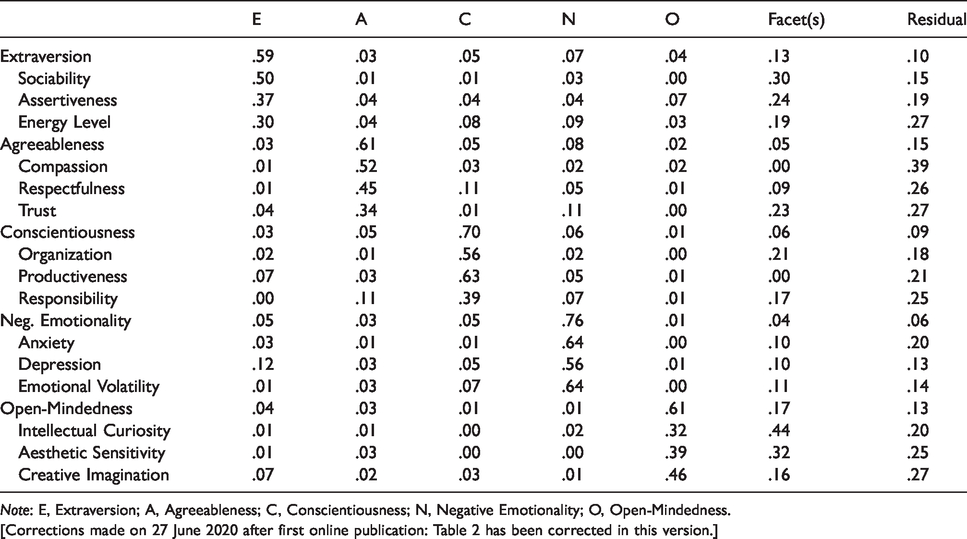
[Corrections made on 27 June 2020 after first online publication: Table 2 has been corrected in this version.]
Analyses
We performed all statistical analyses with Mplus 8.0. The latent domains factors were specified as ESEM factors—that is, each of the five domain factors loaded on each of the 60 BFI-2 items. Thus, the variances of different domains that were reflected in one item could be separated on a latent level. The domain factors were rotated using orthogonal target rotation. The target loadings were one for the theoretically corresponding domain factor and zero for the other four domain factors. For example, the item ‘I am efficient, get things done’ had a target loading of one on Conscientiousness and target loadings of zero on all other domains. Reversed items (e.g. ‘I tend to be lazy’) were not recoded. For these items, the target loadings of the domain factors were set to minus one instead of one. The latent incremental facet factors were specified as CFA factors. Only the four items belonging to a facet were allowed to load on that facet. All 60 items were specified to load on the latent acquiescence variable; the loadings were set to one for all items (Aichholzer, 2014; Billiet & McClendon, 2000; Danner et al., 2015; Soto & John, 2017a, 2017b). The latent domains and facets and the latent acquiescence factor were specified to be orthogonal to each other. The key advantage of specifying all factors to be orthogonal is that the associations between personality and the criterion variables are unaffected by covariances between the personality variables and can be interpreted independently of each other. Parameters were estimated using the maximum likelihood estimator. The Mplus input file for the DIFAB model is shown in Electronic Supplement 1 (ESM1).
Results
Association between the manifest personality scale scores
As a first step, we examined the correlations among the five manifest domain scores and the 15 manifest facet scores. This was carried out in order to examine the extent to which these manifest scores reflected variance unique to each domain or facet or common variance shared with other domains or facets.
Table 1 shows the correlation between the manifest personality domain scores. As can be seen from the table, there were substantial correlations of up to
Correlation between the manifest domain scores

This pattern of correlations suggests that manifest personality domain scores and manifest facet scores—even those belonging to different domains—share an often substantial amount of variance. Accordingly, simple correlations between manifest personality scores and criterion variables cannot be interpreted unambiguously. To disentangle the variance portions that are confounded in the manifest scores, a latent variable approach such as the one we propose is required.
Model fit of the domain-incremental facet-acquiescence bifactor model
The initial latent variable model consisting of five domain variables, 15 incremental facet variables, one acquiescence variable, and 60 residual measurement error variables fit the data well [root mean square error of approximation (RMSEA) = .039, comparative fit index (CFI) = .916, Tucker-Lewis Index (TLI) = .898, standardized root mean square residual (SRMR) = .030]. However, the variances of the incremental facet variables Compassion and Productiveness were close to zero (<.02) and not statistically significant, indicating that these facets are essentially equivalent to their overall domains. Thus, for further analyses, these variables were deleted from the model. Deleting the variables did not impair the model fit (RMSEA = .039, CFI = .916, TLI = .898, SRMR = .030). All other specific facet factors explained statistically significant portions of incremental variance beyond the domain factors.
The pattern of factor loadings also determines how well the model and the latent variables can be interpreted. The standardized factor loadings are shown in Table S2. In line with expectations, items that were assigned to a domain had their highest loading on the factor representing that domain. For example, Item 1, ‘I am outgoing, sociable’, loaded highest on Extraversion (λ = .60) and had lower loadings on the other four domains (−.22 ≤
Variance decomposition
The structural equation model allows the variance of the single items and the manifest scale scores to be decomposed into the different variance sources. In particular, the variance σ of a manifest domain score 
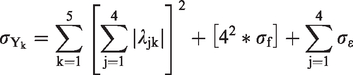
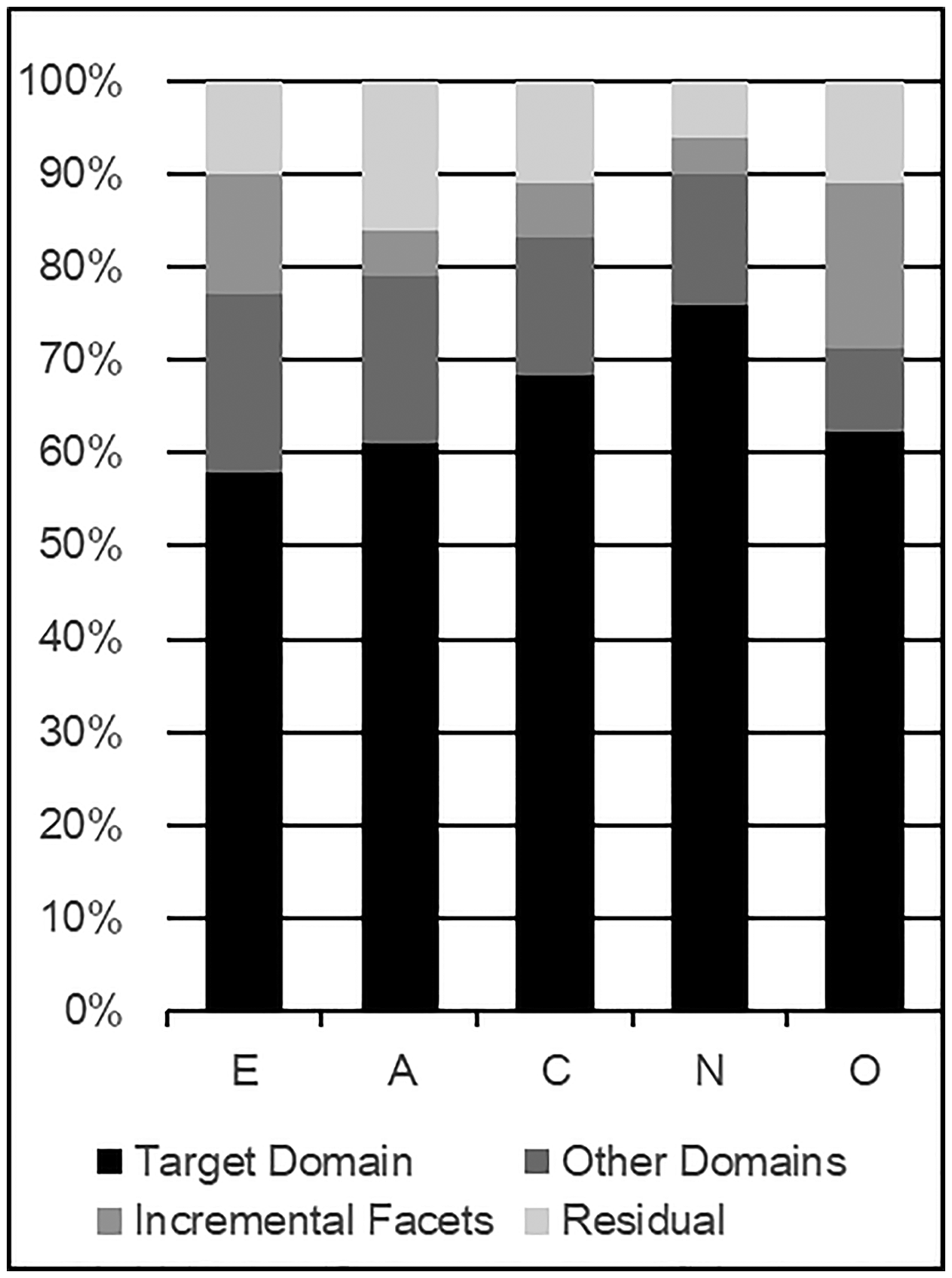
Variance proportions of manifest domain scores for Extraversion (E), Agreeableness (A), Conscientiousness (C),Negative Emotionality (N), and Open-Mindedness (O).
The results of the decomposition of the variance of the manifest facet scale scores are also shown in Table 2. These scores contain domain-level and incremental facet-level variance. The facet scale scores (e.g. Sociability) contain between 30% and 64% domain-level variance (e.g. Extraversion) and up to 44% incremental facet-level variance.
The variance proportions for the single items are shown in Table S3. In general, these results also show that single items contain variance of the domains to which they were assigned, variance of other domains, as well as incremental facet-specific variance (and acquiescence and residual measurement error). For example, Table S3 suggests that Item 41, ‘I am full of energy’, contains not only 26% Extraversion variance and 10% incremental variance of the facet Energy Level but also 11% variance of the domain Negative Emotionality. Taken together, these results indicate that, as expected, manifest domain, facet, and item scores conflate domain-general and facet-specific personality information.
Associations with criterion variables
The structural equation model not only allows the variances of the manifest personality items to be decomposed. It also allows the decomposition of the associations between manifest personality scale scores and criterion variables into domain-level associations and incremental facet-specific associations. The model further circumvents the overlap between the manifest personality domain variables by specifying orthogonal latent domain factors and orthogonal incremental facet factors. Thus, the latent correlations can be interpreted incrementally and are unaffected by the overlap between the manifest variables. In the following, we will demonstrate how our latent modelling strategy represents an advance over analyses using manifest scale scores by discussing divergences between the correlations of the manifest domain and facet scores with external criteria, on the one hand, and between the correlations of the latent domain and facet factors with these criteria, on the other. We will illustrate that our variance decomposition strategy allows for more straightforward conclusions regarding the incremental value of personality facets over domains.
Correlations between criterion variables and manifest and latent construct variables
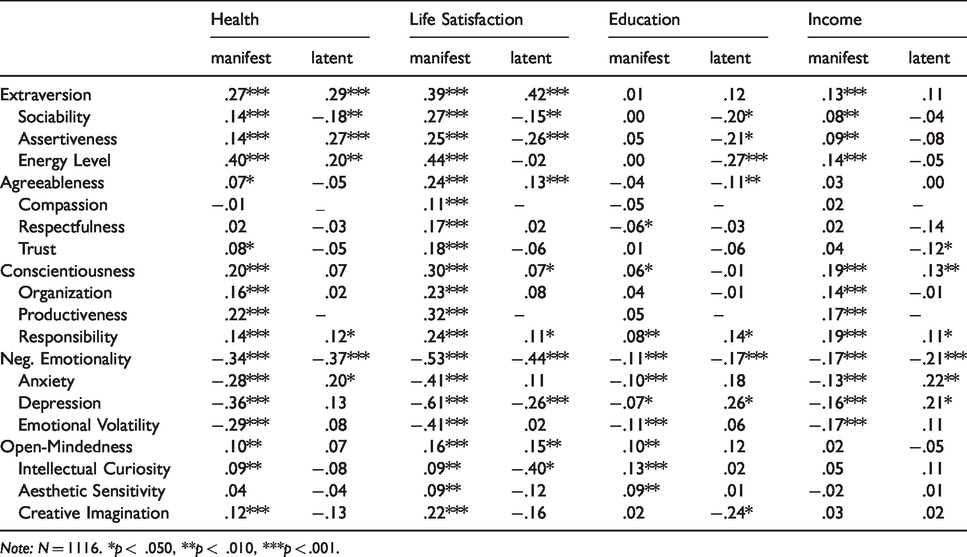
In order to investigate the association with criterion variables, we added health, life satisfaction, educational attainment, and income to the structural equation model. The criterion variables were allowed to correlate with each other as well as with the domain variables and the incremental facet variables. This model also fit the data well (RMSEA = .039, CFI = .914, TLI = .893, SRMR = .030). The manifest and the latent correlations are shown in Table 3. We discuss all correlations that are statistically significant at
Based on meta-analytic findings, we expected a positive association between educational attainment and Conscientiousness (Poropat, 2009); a positive correlation between income and Conscientiousness and between income and Extraversion; a negative correlation between income and Negative Emotionality (Judge, Higgins, Thoresen, & Barrick, 1999); a negative association between health and negative emotionality; a positive association between health and Conscientiousness (Strickhouser, Zell, & Krizan, 2017); and substantial associations between life satisfaction and (low) Negative Emotionality, Extraversion, Conscientiousness, and Agreeableness (Steel, Schmidt, & Shultz, 2008).
Associations with health
As can be seen in Table 3, on the manifest level, self-rated health was associated to a greater or lesser degree with all personality domains and facets. However, the substantial overlap between the manifest scores (see Tables 2 and S1) complicates the interpretation of these correlations. The latent variable correlations, on the other hand, reveal a clearer picture: better health was associated with Extraversion (
Although health was not significantly correlated with global Conscientiousness, there was a significant correlation between health and the Conscientiousness facet Responsibility (
Associations with life satisfaction
As can be seen in Table 3, life satisfaction was associated with all manifest personality domains and facet scores. Does this suggest that life satisfaction depends on all facets of personality? Although it seems easy to find a
Associations with educational attainment
As can be seen in Table 3, on the manifest level, there was a negative correlation between the Agreeableness facet Respectfulness and educational attainment (
On the manifest level, there were positive correlations between Conscientiousness and educational attainment (
In addition, all manifest Negative Emotionality facet scores (Anxiety, Depression, Emotional Volatility) were correlated with educational attainment (
On a manifest level, there were no associations between Extraversion and its facets and educational attainment. However, on the latent level, there were negative correlations with the incremental Extraversion facets but not with the global domain. This pattern suggests that being only sociable (but not assertive or energetic) is associated with lower educational attainment. Likewise, being only assertive (but not sociable or energetic) or being only energetic (but not sociable or assertive) is associated with lower educational attainment.
Associations with income
As can be seen in Table 3, on the manifest level, Extraversion, Conscientiousness, Negative Emotionality, and their facets showed small correlations with income. However, the substantial correlations between the manifest Extraversion and Negative Emotionality domain scores (
In our latent variable model, by contrast, a more nuanced pattern of associations emerged. There was a negative correlation between income and the Trust facet of Agreeableness (
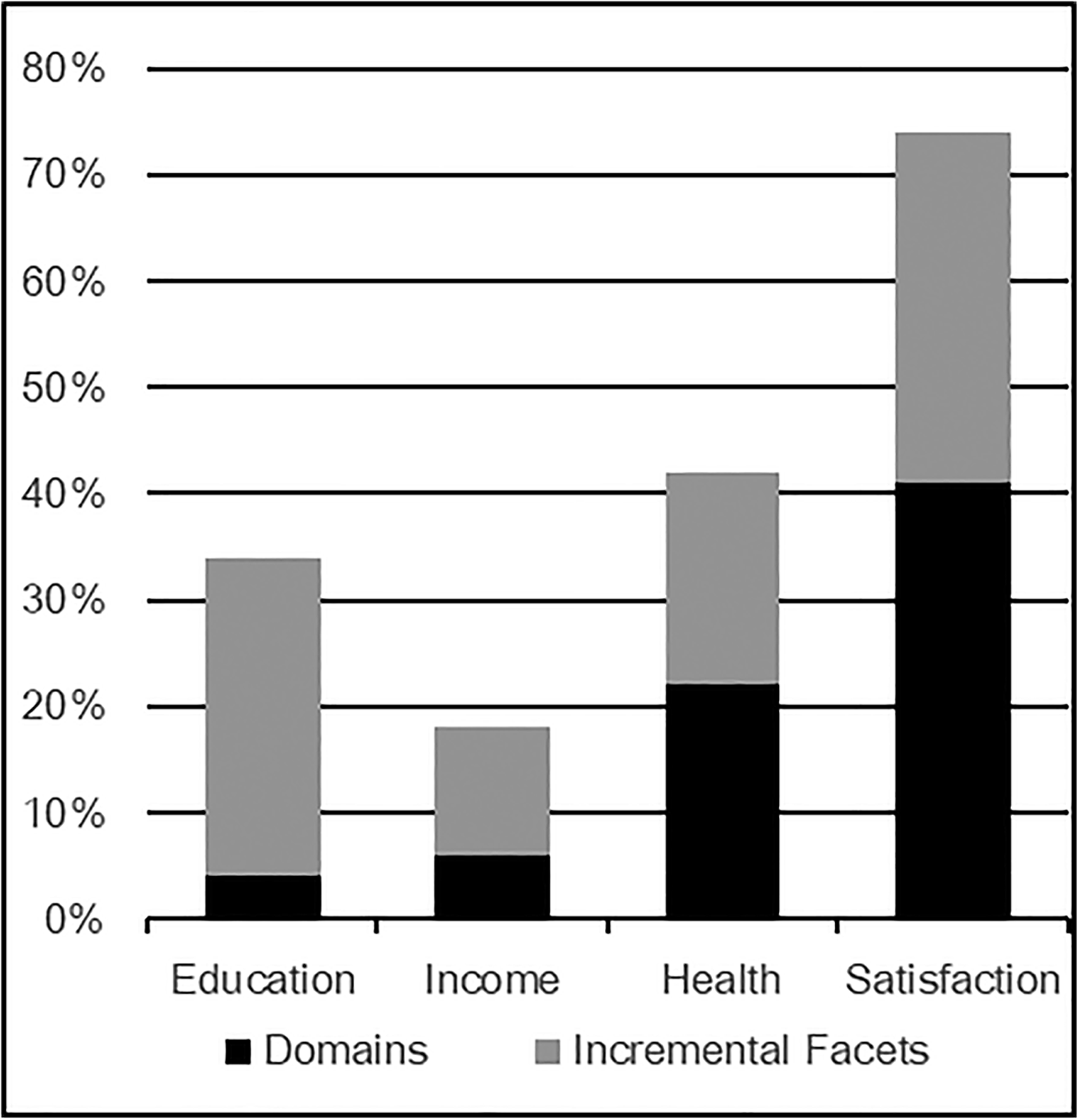
Share of the variance (
Predictive power of domains versus facets
We additionally computed the amount of variance in the criterion variables that was explained by the domains and, incrementally, by the personality facets. In the structural equation model, all latent personality variables were specified to be orthogonal to each other. Thus, the amount of variance explained (
Cross-validation of the domain-incremental facet-acquiescence bifactor model
Given the number of parameters in the DIFAB model, we expected that it would overfit the data to some extent. Thus, we randomly split the sample in two subsamples. First, we estimated the DIFAB model in the first subsample and applied all parameters (path coefficients, variances, etc.) in the second subsample. The parameters from the first subsample showed an acceptable fit with the data of the second subsample (RMSEA = .043, CFI = .862, TLI = .871, SRMR = .070). Then, we estimated the DIFAB model in the second subsample and applied all parameters in the first subsample. Here, too, the parameters from the second subsample showed an acceptable fit with the data of the first subsample (RMSEA = .046, CFI = .841, TLI = .851, SRMR = .071). All model results are shown in Tables S4 and S5. Given the smaller sizes of the subsamples (
Discussion
The present paper addressed the question of whether personality facets provide incremental value beyond the global Big Five domains. In particular, we investigated (a) whether facet scales assess unique personality variance that is distinct from the variance explained by the higher-level domains; (b) whether personality facets are differentially associated with outcome variables; and (c) the extent to which facets provide incremental predictive power beyond the Big Five domains. To answer these questions, we developed a structural equation modelling approach that allowed us to decompose the variance of manifest personality items and scale scores from the BFI-2 into domain-level and incremental facet-level variance. Based on this model, we examined the relationships with several criterion variables (income, health, life satisfaction, and educational attainment). The results convey a clear message: yes, personality facets do provide incremental value beyond the global Big Five domains.
The uniqueness of personality facets
The structural equation model revealed that facets provide unique personality variance and that most of the manifest personality items contained not only variance at the level of the domain (e.g. Extraversion) but also systematic variance at the level of the incremental facets (e.g. Sociability, Assertiveness, or Energy Level). For example, the manifest Sociability score contained not only 50% Extraversion-general variance but also 30% incremental Sociability-specific variance. This suggests that the Sociability scale of the BFI-2 captures systematic individual differences beyond Extraversion. Likewise, the Trust facet of Agreeableness contained not only 34% Agreeableness-general variance but also 23% incremental Trust-specific variance. This demonstrates that these facet scale scores are not redundant with the higher-level domain scale scores; rather, there are systematic individual differences in Sociability and Trust beyond their respective domains, Extraversion and Agreeableness, and these facets allow a more comprehensive description of individual differences than do the global domains.
The structural equation model further demonstrates that these incremental variance proportions are not an artefact of an overlap between facets and other domains. For example, it could be argued that the construct ‘grit’ (Duckworth, Peterson, Matthews, & Kelly, 2007) can be regarded as a compound of high Conscientiousness (being persistent) and low Negative Emotionality (being able to cope with setbacks). Likewise, it could be argued that the incremental value of a facet (e.g. Energy Level) over and above its domain (e.g. Extraversion) is due to an overlap with another domain (e.g. Negative Emotionality). However, in the structural equation model that we used, the incremental facets were modelled to be independent of all domains, which means that the latent facet variables reflected the incremental value of a facet beyond its domain and all other domains and facets. The results of the structural equation model clearly indicate that personality facets provide incremental systematic variance beyond the global domains. The only exceptions were the Agreeableness facet Compassion and the Conscientiousness facet Productivity, which did not provide an increment beyond their global domains in the present sample. This suggests that, in the present sample, these facets do not describe individual differences beyond the global Big Five domains. In the present sample, the Compassion facet defines the core of global Agreeableness that is shared with the facets Respectfulness and Trust, and the Productivity facet defines the core of Conscientiousness.
The associations with criterion variables
The results demonstrate that personality facets are differentially associated with criterion variables. We used manifest and latent correlations to investigate the association between personality domains, personality facets, and criterion variables. Most of the
In sum, the pattern of results suggests that personality facets are differentially and incrementally associated with important criteria such as education, income, health, and life satisfaction. For example, the positive correlation between Extraversion and life satisfaction and the negative association between the incremental facet Assertiveness and life satisfaction suggest that being extraverted is associated with higher life satisfaction but that being more assertive than extraverted in general is associated with lower life satisfaction. In other words, Daniel, who is average extraverted and average assertive may be more satisfied with life than Clemens, who is average extraverted but above-average assertive. Likewise, the positive correlation between Conscientiousness and income and the positive correlation between the incremental facet Responsibility and income suggests that being conscientious is associated with higher income and being more responsible than conscientious is associated with an even higher income. Hence, Daniel, who is also average conscientious and average responsible may have a lower income than Chris, who is average conscientious but above-average responsible.
The incremental predictive power of personality facets
The results demonstrate that specific personality facets provide incremental predictive power over and above global personality domains. For example, Responsibility incrementally predicted educational attainment, Trust incrementally predicted (low) income, Responsibility incrementally predicted health, and Depression incrementally predicted (low) life satisfaction beyond the Big Five domains. These results suggest that even global criterion variables such as professional success, health, or life satisfaction depend not only on global personality domains but also on more-specific personality facets (for a more detailed discussion of this topic, see Hogan & Roberts, 1996; Ones & Viswesvaran, 2013; and O'Neill & Paunonen, 2013).
Implications for investigating associations with criterion variables
In line with previous research (Ashton et al., 2009; Costa & McCrae, 1995; Danner et al., 2019; Soto & John, 2017a; van der Linden et al., 2010), we found substantial overlap between the manifest Big Five domain scores. These correlations complicate the interpretation of associations with criterion variables. For example, in the present sample, there was a correlation of
It is important to note that the DIFAB model does not allow a causal interpretation of associations with outcome variables. Mõttus (2016) argued that personality-outcome associations should be interpreted causally only if traits are existentially and holistically real, and the associations between facets and outcomes vary only in the degree to which facets reflect their parent traits (for a similar conceptualization of traits, see Borsboom, Mellenbergh, & van Heerden, 2003). Following this line of argumentation, the DIFAB model specifies domain variables as reflective variables that (statistically) explain variance in the personality items as well as variance in the outcome variables. The DIFAB model additionally specifies incremental facet variables that are also modelled as reflective variables that are orthogonal to the domains and that (statistically) explain incremental variance in the personality items and outcome variables. This modelling strategy allows traits to be decomposed into domains, and incremental facets and their associations with outcome variables to be estimated simultaneously. However, the DIFAB model only
Implications for investigating the hierarchical structure of personality
The present study revealed two findings that have implications for investigating the hierarchical structure of personality. First and foremost, specific personality facets do indeed provide incremental information beyond global domains such as the Big Five. The variance decomposition as well as the correlations with criterion variables demonstrated the incremental value of personality facets.
Second, the variance decomposition suggests that manifest personality items are not pure indicators of one personality domain or facet. The results of the structural equation model suggest that all personality items, facet scores, and domain scores contained variance of more than one domain. Items such as ‘I am full of energy’ captured not only the Energy facet of Extraversion but also Negative Emotionality. Items such as ‘I am reliable, can always be counted on’ captured not only the Responsibility facet of Conscientiousness but also Agreeableness. 3 To separate these different sources of variance that are confounded in a given item, we decided to model the Big Five personality domains as orthogonal latent variables. Accordingly, there were no higher-order factors such as Alpha and Beta (Digman, 1997), Stability and Plasticity (DeYoung et al., 2002), Agency and Communion (Bakan, 1966; Paulhus & Trapnell, 2008), or a general evaluative factor (Biderman, McAbee, Hendy, & Chen, 2019) in our model. This by no means implies that there are no higher-order factors of personality. The approach we took in the present study was to analyse the covariance matrix of 60 personality items and to demonstrate that a model that specifies five independent personality domains and 15 incremental facets fits the data well. The advantage of this model is that it allows us to separate different sources of variance and to explain the overlap between manifest personality items. It thus allows a simple and straightforward interpretation of the association with criterion variables (see also Ashton et al., 2009). However, this neither suggests that this is the only plausible model for the data nor does it question the usefulness of alternative personality models, which have their own advantages. For example, DeYoung's model of Stability and Plasticity (DeYoung et al., 2002) can be linked to physiological correlates or the genotypic or phenotypic development of personality structure, and the agency- communion model (Paulhus & Trapnell, 2008) has the advantage that it can be linked to motivational factors such as a need to belong or a need for achievement.
Limitations and future directions
Several limitations of the present study should be mentioned. First, research suggests that personality hierarchy extends below facets and above domains. There are narrower constructs than facets, such as nuances (Mõttus, Kandler et al., 2017), and broader constructs, such as aspects (DeYoung et al., 2007). It has also been proposed that the domains can be merged into metatraits, such as Stability and Plasticity (DeYoung et al., 2002) or Alpha and Beta (Digman, 1997), and—at the highest hierarchical level—the General Factor of Personality (Rushton & Irwing, 2008) or a general evaluative factor (Biderman et al., 2019). The focus of the present paper was on introducing a tool—the DIFAB model—that allows one to investigate whether personality facets provide incremental value beyond personality domains. This model allows personality item variance to be decomposed into domain-specific variance, incremental facet-specific variance, acquiescence-specific variance, and item-specific variance. However, it does not allow one to model all theoretically sound and empirically grounded personality hierarchy levels. It would therefore be a viable aim for future research to investigate how specifying alternative models that include nuances, aspects, metatraits, or the General Factor of Personality affects the variance decomposition and the association between personality facets/aspects/domains/ metatraits and outcome variables.
Second, the criterion variables that were available in the present study were based on cross-sectional self-reports. Thus, the present results should be seen more as a demonstration of the usefulness of the DIFAB model, and future research could further test the generalizability of the present findings by using longitudinal designs, peer reports, legal data, or behaviour observation.
Third, the present study focused on the Big Five model of personality—the most prominent but by no means the only accepted and useful model of personality. Therefore, future research could apply our approach to alternative personality models, such as the HEXACO model (Ashton & Lee, 2007) and its facet structures.
Fourth, we investigated the facet structure of the Big Five Inventory-2 (BFI-2; Soto & John, 2017a). Although this facet structure is theoretically and empirically well-grounded, there are alternative inventories covering a more comprehensive facet structure (Costa & McCrae, 1995; Goldberg, 1999; McCrae et al., 2005; Saucier & Ostendorf, 1999). Using measures with alternative facet structures may affect the extent to which personality facets incrementally predict outcome variables. In particular, using measures with more comprehensive facets should increase the predictive power of incremental facets.
Fifth, the domain variables in the DIFAB model are specified to be orthogonal. On the one hand, orthogonal domain variables allow a straightforward interpretation of associations with outcome variables. On the other hand, imposing orthogonality on the domain variables changes the meaning of the latent variables or even leads to misspecification. We adopted a blended variable conceptualization of personality traits, which assumes that major personality dimensions, like the Big Five or HEXACO domains, are largely orthogonal, even if their manifest indicators are correlated (Ashton et al., 2009). If this assumption is incorrect, it may bias estimates derived from orthogonal factor models, such as the DIFAB. Therefore, further research is needed to better understand the conceptual and empirical associations between major trait domains, as well as their potential effects on model parameters. In the present sample, the pattern of factor loadings showed a simple structure, which suggests that the latent domain variables can be interpreted unambiguously. However, the pattern of factor loadings must always be checked before the DIFAB model is interpreted.
Sixth, the analysis on item level is an additional limitation of the DIFAB model, in particular for inventories with many items. In the latter case, we suggest analysing item parcels instead of single items.
Seventh, the DIFAB model allows one to control for acquiescent responding but not for response styles such as extreme responding or social desirability. Similar to the General Factor of Personality (Rushton & Irwing, 2008) or a general evaluative factor (Biderman et al., 2019), social desirability may also elevate the manifest correlations between the domain scores.
Ninth, the present sample comprised respondents in the USA only and in particular the associations with outcome variables may not be generalizable to other samples, countries, or cultures. For example, we found a negative association between Agreeableness and educational attainment in our sample, whereas Mõttus, Realo, Vainik, Allik, and Esko (2017) found a positive association in an Estonian sample.
This suggests that contextual factors (such as the educational system) may moderate the associations between personality and outcome variables (e.g. Danner, Lechner, & Rammstedt, in press; Shanahan & Hood, 2000).
Conclusion
Personality can be described at different levels of abstraction— for example, in terms of broad trait domains or more-specific facets. The present research reveals that facets provide incremental personality information beyond domains and that this incremental facet information is meaningfully associated with important quality-of-life criteria such as health, well-being, education, and income. It also provides a new tool, the DIFAB model that can be used to clearly distinguish between domain-level and facet-level personality information. We believe that this model will prove useful for further investigating the structure and outcomes of personality traits.
Transparency statements
This study was not preregistered. The dataset used was part of the study ‘The Programme for the International Assessment of Adult Competencies (PIAAC) – English Pilot Study on Non-Cognitive Skills’. The sample size of the study was determined by the dataset available. The dataset and further information can be accessed via the GESIS Data Archive (OECD, 2018). We provide openly accessible data analysis scripts that allow all reported results to be reproduced, and output files with basic descriptive statistics, effect sizes, and exact
Footnotes
Acknowledgements
We gratefully thank two anonymous reviewers and Bojack Horseman for their helpful comments.
Data accessibility statement
This article earned Open Data and Open Materials badges through Open Practices Disclosure from the Center for Open Science: https://osf.io/tvyxz/wiki. The data and materials are permanently and openly accessible at  . Author's disclosure form may also be found at the Supporting Information in the online version.
Supporting information
Additional supporting information may be found online in the Supporting Information section at the end of the article.
Table S1. Correlation between manifest BFI-2 facets scores
Table S2. Standardized factor loadings of domains, incremental facets, and acquiescence
Table S3. Variance proportions of manifest items
Table S4. Standardized factor loadings on domains, incremental facets, and acquiescence for split0 and split1
Table S5. Correlations between criterion variables and latent variables.
Notes
References
Supplementary Material
Please find the following supplemental material available below.
For Open Access articles published under a Creative Commons License, all supplemental material carries the same license as the article it is associated with.
For non-Open Access articles published, all supplemental material carries a non-exclusive license, and permission requests for re-use of supplemental material or any part of supplemental material shall be sent directly to the copyright owner as specified in the copyright notice associated with the article.
