




Abstract
Whilst both mindfulness and adult attachment have been linked to wellbeing, little is known about how these constructs relate to emotion regulation that can underpin wellbeing. The present study examined the association between adult attachment orientation and emotion regulation (strategies and difficulties) and the mediating role of facets of dispositional mindfulness. A sample of 301 university students (Mage = 23.08, SD = 8.08; 74.75% female) completed measures of adult attachment, emotion regulation, difficulties in emotion regulation, and dispositional mindfulness. Parallel multiple mediation analyses indicated that the act with awareness and non-judging facets of mindfulness repeatedly emerged as significant mediators in the positive associations between the dimensions of attachment insecurity (anxiety, avoidance, and disorganized) and maladaptive emotion regulation strategies and difficulties in emotion regulation. Those individuals exhibiting greater attachment insecurity employ maladaptive emotion regulation strategies and display difficulties in emotion regulation via mindfulness deficits. The present findings extend our current understanding of the role of dispositional mindfulness in the associations between adult attachment orientation and varying aspects of the emotion regulation process.
Introduction
Emotion regulation (ER) is an intrapsychic process activated in response to the actual, or anticipated, experience of an emotion; attentional and cognitive resources modulate the duration and intensity of emotion, and lessen the impact of negative emotions (Gross, 2015). ER has been conceptualized as having two central strategies – cognitive reappraisal and expressive suppression (Gross & John, 1998). Cognitive reappraisal is an adaptive, antecedent-focused strategy (Mauss et al., 2007), which aims to reinterpret an emotion-eliciting situation, altering its meaning and subsequent emotional impact (Gross & John, 2003). Conversely, expressive suppression strategy is a maladaptive response-focused strategy (Gross & John, 2003), which aims to inhibit or reduce ongoing emotion-expressive behaviours, such as facial expressions (Gross & Levenson, 1993). Difficulties in ER can be delineated as a failure to employ situationally appropriate and adaptive ER strategies (Gratz & Roemer, 2004), or the use of maladaptive strategies. Individual differences in attachment orientation and dispositional mindfulness have been implicated as contributing factors to an individual’s ER capacity (Modinos et al., 2010).
Adult Attachment and Emotion Regulation
The attachment behavioral system refers to an innate predisposition to form close emotional bonds with others. Individual differences in this system result in trait-like patterns of cognition, affect and behaviours, or ‘internal working models’ which guide the process of emotion regulation. These individual differences develop as a reflection of a person’s experiences in close relationships (Bowlby, 1969, 1973), and persist throughout the lifespan (Waters et al., 2000). Social-cognitive models of attachment in adulthood commonly conceptualize individual differences along two dimensions of attachment insecurity: anxiety about abandonment and avoidance of intimacy (Brennan et al., 1998). When individuals have repeated experiences with responsive and warm caregivers, they score low in both attachment anxiety and avoidance (secure attachment). Attachment anxiety arises from inconsistent availability of caregiving. Attachment anxiety reflects a chronic hyperactivation of the attachment behavioural system, characterized by intensive proximity-seeking, hypersensitivity to signs of rejection, and excessive rumination on one’s own shortcomings (Mikulincer & Shaver, 2007). Attachment avoidance arises from consistently rejecting or non-responsive caregiving. Attachment avoidance reflects a deactivation of the attachment behavioural system, characterized by a compulsive self-reliance, denial of attachment needs, and suppression of signs of vulnerability (Mikulincer & Shaver, 2007).
The lack of an organized (secure, anxious, or avoidant) strategy to deal with distress results in a disorganized style of attachment (Main & Solomon, 1990). In adulthood, disorganized romantic attachment reflects a fear of both abandonment (i.e. attachment anxiety) and intimacy (i.e. attachment avoidance; Paetzold et al., 2015). Disorganized attachment has been linked to dissociative mental processes (Jacobvitz & Reisz, 2019), and psychosis-related experiences (Shearman et al., 2019), and is likely to compromise the availability of attentional resources and cognitions required for effective ER. Research has repeatedly documented attachment-related variations in ER, with attachment insecurity associated with maladaptive ER strategies as well as deficits in the neural structures implicated in ER (Mikulincer & Shaver, 2019).
Mindfulness and Emotion Regulation
Mindfulness has been defined as a non-elaborative awareness of present-moment experiences (including cognitive, emotional, and sensory), combined with a non-judgmental attitude toward those experiences (Kabat-Zinn, 1994). Mindfulness can refer to a state, which may be induced through meditation practices (Bravo et al., 2018), and a disposition, generally defined as a pervasive and enduring tendency in behaviour (Zuroff, 1986). Individuals exhibiting greater dispositional mindfulness have reported an increased ability to regulate their well-being through reduced emotional reactivity and intensity, enhanced emotional recovery, and engagement in goal-directed behaviours (Roemer et al., 2015). Recent cross-sectional research with university student samples has also shown that dispositional mindfulness is negatively associated with difficulties in emotion regulation (MacDonald, 2021). Meta-analysis also indicates that mindfulness meditation specifically improves a person’s ability to recover from negative emotions (Leyland et al., 2019). Thus, the parallels between dispositional mindfulness and ER include the ability to monitor, accept, and understand emotions while ER extends further to encompass the expression of emotions (Gratz & Roemer, 2004). While dispositional mindfulness can be assessed as a single construct, it is also thought to comprise 5 sub-dimensions, or facets: acting with awareness, observing, describing, non-judging, and non-reacting (Baer et al., 2006).
The Relationship Between Attachment Orientation, Dispositional Mindfulness and Emotion Regulation
Attachment orientation has been implicated in the development of dispositional mindfulness and its association with ER (Pepping & Duvenage, 2016; Stevenson et al., 2019). Attachment security has been consistently associated with adaptive ER strategies (Shaver & Mikulincer, 2014) and increased dispositional mindfulness (Stevenson et al., 2017). Conversely, attachment insecurity (anxiety and avoidance) in partner relationships has been associated with increased signs of anxiety via dispositional mindfulness as a mediating variable (Jaurequi et al., 2021). Recent longitudinal and experimental research by Stevenson et al. (2021) indicates that adult attachment plays a causal role in the development of mindfulness capacity. In two separate studies, Stevenson et al. (2021) reported that adult attachment anxiety was a significant predictor of dispositional mindfulness over time and that primed attachment security significantly increased state mindfulness when compared to a mindfulness-based induction. The authors suggested that priming attachment security attenuates the deactivation of the attachment system, freeing up resources required for individuals to attend to their present experiences – including thoughts and emotions Stevenson et al. (2021).
Previous research has highlighted the significant interrelationships between all three constructs (Goodall et al., 2012; Stevenson et al., 2019). Stevenson et al. (2019) explored these independent and underlying relationships utilizing exploratory factor analysis. A two-factor model accounted for 47% of total variance across participant scores. The factor labelled ‘resilient mental functioning’ had positive loadings on mindfulness subscales, cognitive reappraisal, and negatively loaded onto attachment anxiety. The factor labelled ‘disorganized emotional functioning’ loaded negatively on mindfulness subscales and positively on attachment avoidance and disorganization and expressive suppression. ‘Resilient mental functioning’ reflects a greater propensity for mindfulness and subsequent ability to successfully reappraise negative emotions emanating from attachment insecurity. This balanced attachment system, exhibiting neither de- or hyper-activation, ensures the available cognitive resources required to remain non-judgmental and non-reactive and successfully execute cognitive reappraisal strategies to approach and resolve negative emotions (Stevenson et al., 2019).
Research has repeatedly focused on attachment orientation and mindfulness acting as two primary, endogenous latent variables that, through the theory of bi-directionality, influence ER capabilities (Ryan et al., 2007). However, considering Stevenson et al. (2021) highlighted the potential causal role of adult attachment orientation in the development of mindfulness, previous interrelationships between these three constructs should be further examined, including exploring the mediating role of mindfulness. Correlational, experimental, and mindfulness intervention studies overwhelmingly link dispositional mindfulness to reduced emotional intensity, emotional reactivity, and enhanced emotional recovery (Roemer et al., 2015). Trait mindfulness is associated with a greater ability to differentiate emotional experiences, reflective of greater emotion regulation capacity, most likely through increased emotional awareness (Hill & Updegraff, 2012); which has been identified as an essential component of emotion regulation (Gratz & Roemer, 2004; Linehan, 1993). Being able to take in all possible aspects of one’s emotional landscape rather than reacting via emotional ‘heuristics’ based on past experiences may allow for a more accurate and nuanced understanding of those experiences (Barrett et al., 2009), ultimately leading into a more balanced and better regulated emotional response.
Facet level research has identified that acting with awareness and non-judgment of one’s present experience a significantly associated with perceived mental health, quality of life, and lower levels of depression (Branstrom et al., 2011; Cash & Whittingham, 2010; Pleman et al., 2019). Additionally, non-judgement predicts lower levels of anxiety and stress (Cash & Whittingham, 2010). This indicates the core facets of mindfulness as possibly being relevant to predicting difficulties with emotion regulation, given such difficulties are considered a transdiagnostic component to the etiology and treatment of a number of mental health disorders (Hallion et al., 2018; Kring & Sloan, 2010). Note that there is also some support for associations with mental health and well-being for the describe (Pleman et al., 2019) and non-reactivity (Branstrom et al., 2011) facets of mindfulness.
The Current Study
Although research has examined the interrelationships between constructs, there is scant literature simultaneously examining the influence of adult attachment and mindfulness on ER difficulties and strategies. The main aim of the present research was to test a proposed indirect relationship between attachment and ER strategies and difficulties, via dispositional mindfulness. We hypothesized that both attachment anxiety and avoidance would be negatively associated with mindfulness and adaptive ER and positively associated with difficulties in ER. A second aim was to improve our understanding of the influence of disorganized attachment in adulthood on dispositional mindfulness and ER. While the literature is limited on the role of disorganized attachment in both mindfulness and ER, we hypothesized that disorganization will be negatively associated with mindfulness and cognitive reappraisal but positively associated with maladaptive ER and difficulties in ER.
To understand mindfulness as a possible mechanism by which attachment affects emotion regulation, it is important to examine the contribution of each facet of mindfulness separately. This is because prior research has identified particular relationships between attachment dimensions and some facets of mindfulness, but not others. Stevenson et al. (2019) found that that the mindfulness facets non-judging and non-reactivity loaded together with both attachment anxiety and cognitive re-appraisal. We therefore tentatively propose that in a model exploring mindfulness as the mechanism by which attachment is related to emotion regulation, these two facets may mediate between anxiety and cognitive reappraisal. Similarly, Stevenson et al. (2019) found that the mindfulness facets act with awareness and describe loaded together with attachment avoidance and disorganisation, and expressive suppression. Hence, we tentatively propose that act with awareness and describe may mediate between avoidance and disorganization on the one hand and expressive suppression on the other.
Method
We report how we determined our sample size, all data exclusions (if any), all manipulations, and all measures in the study.
Participants and Procedure
Ethical approval was granted by the [masked for review] Ethics Committee. Following informed consent, participants completed an online survey of self-report measures of adult attachment, mindfulness, and ER. Participants were recruited from a university undergraduate participant pool, with no age cut-offs imposed. Psychology students received partial credit for their participation; other students were entered into a prize draw to win one of three $50 gift cards.
An a priori sample size calculation indicated that with five predictor variables, statistical power of .80 and α = .05, the minimum sample size to capture a medium effect size is 91. A sample of 405 individuals began the study, of which 364 met the conditions of the survey of being aged 18 years or over, providing informed consent, and being without a current or prior diagnosis for a psychiatric condition. From this sample, 15 did not complete the survey, 20 responded incorrectly to a sleeper question, and 28 had incomplete scales within the survey – thus, data for these 63 individuals were excluded from analyses. The remaining 301 complete entries were retained for analysis. Participant age ranged from 18 to 55 years old (M = 23.08, SD = 8.08, 68.77% Australian, 76.88% first year psychology students). Participants reported their gender identity, with 74.75% indicating female and 26.25% male (0% indicated non-binary). Participant weekly intentional mindfulness practice ranged in length from 0 – 840 minutes (M = 34.14, SD = 80.27).
Measures
Adult Attachment Orientations
Adult attachment orientations were assessed using two measures, the Modified Experiences in Close Relationships Scale (ECR-M36; Lo et al., 2009) and the Adult Disorganized Attachment scale (ADA; Paetzold et al., 2015). Participants indicated how they generally experience relationships with close others (including relationship partners).
The ECR-M36 is a 36 item self-report scale divided into two 18-item subscales that represent the two dimensions of attachment insecurity: anxiety and avoidance. In the current sample α =.91 (anxiety) and .89 (avoidance).
The dimension of disorganized attachment was measured using the ADA (Paetzold et al., 2015), a 9-item self-report measure. The ADA has been shown to have an internal consistency of α = .91. The α for the present sample was .89.
Mindfulness
Dispositional mindfulness was assessed using the Five Facet Mindfulness Questionnaire (FFMQ; Baer et al., 2006), a 39-item instrument measuring five facets of mindfulness: acting with awareness, observe, describe, non-judging, and non-reacting. The observe facet of the FFMQ was omitted from analysis in light of criticism that this does not assess aspects of observant attention (e.g., Carpenter et al., 2019). Internal consistency for all facets range from α = .75 to .91 (Baer et al., 2006). In the present sample, α values were as follows: act with awareness, .87; describing, .91; non-judging, .87; and non-reacting, .75.
Emotion Regulation
The Emotion Regulation Questionnaire (ERQ; Gross & John, 2003) was used to assess ER strategies: cognitive reappraisal (6 items) and expressive suppression (4 items). The α for the present sample for cognitive reappraisal and expressive suppression were .90 and .85, respectively.
The Difficulties in Emotion Regulation Scale (DERS; Gratz & Roemer, 2004) is a 36-item self-report measure designed to assess multiple aspects of ER. The measure yields a total score with higher scores reflecting a higher endorsement of the construct. The Aware subscale was omitted from the present analysis due to limitations in relation to adequacy and internal consistency (Hallion et al., 2018). A total score was calculated using the remaining five subscales (30 items total), consistent with a recently developed short-form measure (DERS-SF-5; Bjureberg et al., 2016). The α for the included scales ranged from .82 to .90.
Data Analyses
Statistical analyses were performed using SPSS version 25. Data screening included examination of skewness and kurtosis, and assumption testing for main analyses (i.e. the normality of distributions, linearity and homoscedasticity of residuals, studentized residuals, leverage, Cook’s distance, Mahalanobis distance, and multicollinearity). All measures were normally distributed except the ADA, which showed significant positive skew. Log base 10 transformation improved the skew statistics for ADA.
Parallel multiple mediation analyses (PMMA) were conducted to examine the indirect relationship between adult attachment and ER strategies and difficulties in ER via mindfulness, using PROCESS model 4 (Hayes, 2013). Within PMMA, no mediator is modelled as influencing another mediator in the same mode. As such, this model allows for estimation of a simultaneous test of all mediators, while accounting for shared variance between them.
Results
Correlations, Means, and Standard Deviations of Study Variables Adjusting for Multiple Comparisons.
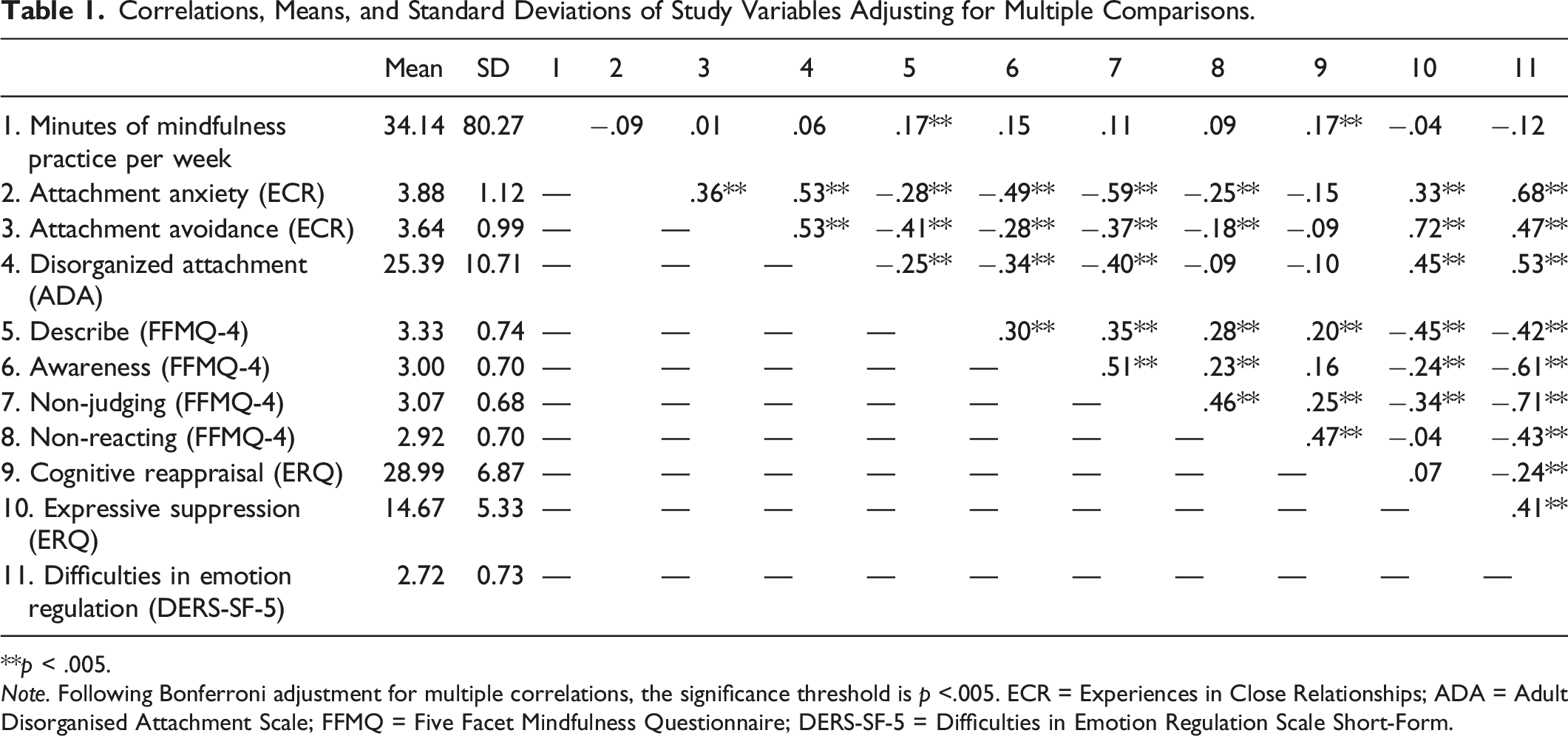
**p < .005.
Note. Following Bonferroni adjustment for multiple correlations, the significance threshold is p <.005. ECR = Experiences in Close Relationships; ADA = Adult Disorganised Attachment Scale; FFMQ = Five Facet Mindfulness Questionnaire; DERS-SF-5 = Difficulties in Emotion Regulation Scale Short-Form.
Mediating Effects of Dispositional Mindfulness
PMM Analyses with Mindfulness (FFMQ-4) Subscales as Mediators.
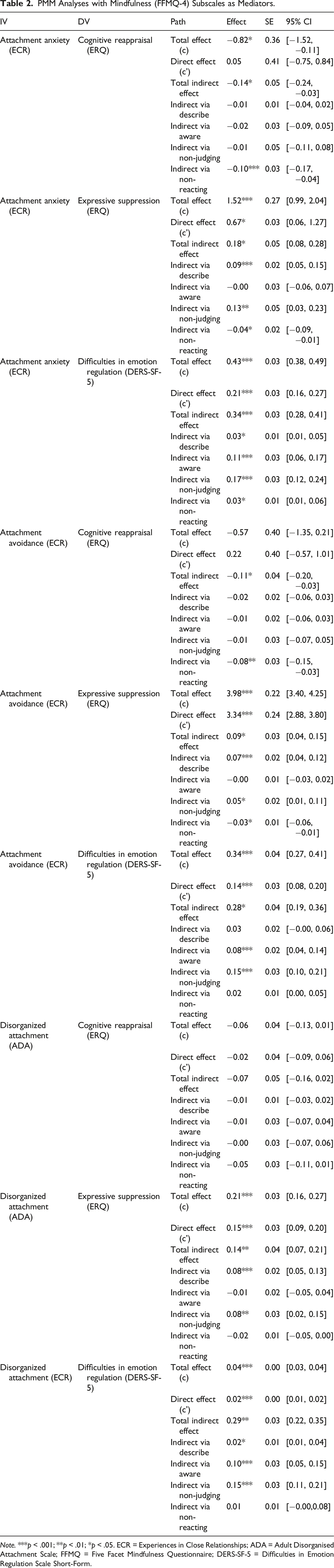
Note. ***p < .001; **p < .01; *p < .05. ECR = Experiences in Close Relationships; ADA = Adult Disorganised Attachment Scale; FFMQ = Five Facet Mindfulness Questionnaire; DERS-SF-5 = Difficulties in Emotion Regulation Scale Short-Form.
Results from the PPMA for attachment anxiety are shown in Supplementary Figures 1-3. Non-reacting (FFMQ-4) mediates the association between attachment anxiety and cognitive reappraisal (ERQ).The association between attachment anxiety and expressive suppression was partially mediated by describe, non-judging, and non-reacting. The association between attachment anxiety and difficulties in emotion regulation (the DERS-SF-5 total score) was partially mediated by all four of the mindfulness facets (describe, aware, non-judging, and non-reacting).
Results from the PMMA for attachment avoidance are shown in Supplementary Figures 4-6. No significant total or direct effects were reported between attachment avoidance and cognitive reappraisal. Table 2 details the partial mediation between both expressive suppression and difficulties in emotion regulation through mindfulness. Specifically, the association between attachment avoidance and expressive suppression was partially mediated by describe, non-judging, and non-reacting, whereas the association between attachment avoidance and difficulties in emotion regulation was partially mediated by act with awareness and non-judging.
Finally, the PMMA for disorganized attachment are shown in Supplementary Figures 7-9. No significant total or direct effects were reported between disorganized attachment and cognitive reappraisal. However, the association between disorganized attachment and expressive suppression was partially mediated by describe and non-judging, while the association between disorganized attachment and difficulties in emotion regulation was partially mediated by describe, aware, and non-judging.
Discussion
The present results confirm the associations between the dimensions of attachment insecurity and maladaptive ER strategies (expressive suppression) and difficulties in ER. While attachment anxiety, avoidance, and disorganization were all associated with greater expressive suppression (ER), only attachment anxiety was associated with decreased cognitive reappraisal (ER). This finding suggests that those high in attachment anxiety are not only more likely to utilize maladaptive ER strategies but significantly less likely to utilize adaptive ER strategies compared than those low in attachment anxiety.
Mindfulness facets describe, non-judging, and non-reacting mediated the associations between attachment anxiety and both expressive suppression and difficulties in ER. Specifically, higher levels of attachment anxiety were associated with lower levels of each of these three mindfulness facets, which, in turn, were related to higher levels of expressive suppression and difficulties in ER. These results provide further support for the associations between increased attachment anxiety and reduced access to or use of adaptive ER strategies. Additionally, the indirect path from attachment anxiety to cognitive reappraisal via non-reacting was significant in the absence of any direct effect. The present findings mirror similar associations documented by Stevenson et al. (2019), in which the scales of non-judging, non-reacting, attachment anxiety, and cognitive reappraisal loaded together and uniquely onto a factor labelled ‘resilient mental functioning’. When an individual has low attachment anxiety, fewer mental resources are required by the attachment system, allowing individuals to engage in non-judging and non-reacting behaviours akin to the self-soothing nature of cognitive reappraisal.
The current finding that attachment anxiety was associated with the maladaptive ER strategy expressive suppression may be explained by an increased sensitivity to signs of rejection and a hyperactivation of the attachment system (Mikulincer & Shaver, 2007). This propensity towards the hyperactivation of the attachment system may reduce the availability of attentional resources, subsequently diminishing the capacity to be mindfully aware (i.e. to approach experiences in a non-judgmental and non-reactive manner, and to describe one’s experiences). In this manner, attention may be focused primarily on buffering against threats and away from exploration of the present moment (Mikulincer & Shaver, 2007).
The present study highlights the role of act with awareness and non-judging in the context of ER difficulties as well as the role of describe, non-judging, and non-reacting when employing maladaptive ER strategies. These findings support previous research that indicates a relationship between negative relationship between mindfulness facets and difficulties in emotion regulation (MacDonald, 2021). In relation to attachment, those exhibiting greater attachment avoidance tend to rely on a deactivation of the attachment system, which, in turn, reduces the attentional resources to engage in mindful awareness (i.e. attentional awareness, describing one’s experiences, acting in a non-judgmental and non-reactive manner; Mikulincer et al., 2004; Ochsner & Gross, 2005). These findings are consistent with Stevenson et al. (2019), which indicated that the scales of attachment avoidance and disorganization, expressive suppression, act with awareness, and describing load together and uniquely on a factor labelled ‘disorganized emotional functioning’ (Stevenson et al., 2019).
The present results extend our understanding of disorganized attachment and indicate similarity with attachment avoidance in relation to mindfulness and ER. Consistent with Stevenson et al. (2019), these findings support the link between attachment disorganization and deficits in mindfulness (act with awareness and describe) and a reliance on maladaptive ER strategies. The unresolved fear and intense negative affect characteristic of attachment disorganization are representative of a fundamental dysregulation of emotion (DeOliveira et al., 2004), which indicates an increased propensity for deficits in mindfulness. Specifically, unresolved fear may result in constant vigilance towards perceived threats, ultimately draining attentional resources. This not only limits one’s capacity to stay in the present moment, but is also the antithesis of non-judgmental awareness of present moment experiences. Disorganized attachment is proposed to coexist alongside both traditional dimensions of attachment insecurity (anxiety and avoidance) rather than act as a standalone classification (Paetzold et al., 2015); however, the current findings support previous research that presents the idea that of the two attachment insecurity dimensions, disorganization shares a greater overlap with attachment avoidance than anxiety (Stevenson et al., 2019)
The facet-level analysis of dispositional mindfulness in the current study extends previous findings (Jaurequi et al., 2021) by providing a more nuanced understanding of the relationships with attachment and ER. Mindfulness facets of act with awareness and non-judging consistently emerged as significant mediators of the relationship between all three dimensions of attachment insecurity and difficulties in ER. However, non-judging repeatedly emerged as a significant mediator in the associations between the dimensions of attachment insecurity and maladaptive ER (i.e., expressive suppression). This may indicate a potential shared mechanism, such as one’s ability to suspend judgment of internal experiences of both thought and emotion. A diminished capacity of non-judgment in individuals with greater attachment insecurity may lead to the execution of situationally inappropriate or maladaptive strategies, due to limitations in their emotional resources to accurately assess current emotions. Previous research has documented the associations between attachment insecurity, emotion dysregulation, and depression and anxiety symptoms (Marganska et al., 2013). Those individuals exhibiting greater attachment insecurity are at a greater risk for mental health problems through emotion dysregulation as a result of the inability to suspend judgement of experiences (characteristic of attachment anxiety [negative view of self] and avoidance [negative view of others]; Bartholomew & Horowitz, 1991). Identification of such mechanisms could inform the application of mindfulness-based interventions to promote adaptive ER in insecurely attached individuals. A burgeoning literature highlights the benefits of mindfulness-based interventions for promoting adaptive ER and alleviating difficulties in ER (Roemer et al., 2015).
Limitations and Future Directions
The nonclinical, primarily female sample of university students limits the generalizability of the present findings to the general or clinical populations, which indicates a direction for future replications. However, the present sample exhibited higher levels of attachment insecurity compared to the general population (Paetzold et al., 2015) and higher levels of ER difficulties when compared to both a clinical sample of individuals diagnosed with an emotional disorder (Hallion et al., 2018), and another university sample (Kaufman et al., 2016), rendering their difficulties of clinical interest, despite not being a clinical sample.
The present study was cross-sectional in nature, which limits causal conclusions. This is particularly challenging for interpreting the direction of effects identifies here, given the know relationships between attachment, emotion regulation, and mindfulness (Stevenson et al., 2019). However, trait mindfulness is thought to afford a more nuanced emotional awareness and experience (Hill & Updegraff, 2012) and enhanced emotional recovery (Roemer et al., 2015), indicating better emotion regulation abilities, so the model we have tested is congruent with previous literature focusing solely on these two constructs. Future longitudinal research is needed to assess the role of mindfulness in the relationship between adult attachment and ER over time. It is entirely possible that such data may identify bidirectionality, whereby trait mindfulness affords greater ER capacity in the short term, but the ongoing enactment of improved ER also feeds back into a longer-term increase in mindfulness abilities. It is hoped that the current research can provide a foundation from which future longitudinal studies can explore these possibilities.
Supplemental Material
Supplemental Material - Facets of Mindfulness Mediate the Relationship Between Attachment Orientation and Emotion Regulation in University Students
Supplemental Material for Facets of Mindfulness Mediate the Relationship Between Attachment Orientation and Emotion Regulation in University Students by Jodie C. Stevenson, Lisa Marie Emerson, Kathleen McKinnon, Abigail Millings in Psychological Reports
Footnotes
Acknowledgments
We would like to thank Joel Wilson for his assistance with data collection.
Contributors
JCS, LME, KM, AM.
Declaration of Conflicting Interests
The author(s) declared no potential conflicts of interest with respect to the research, authorship, and/or publication of this article.
Funding
The author(s) received no financial support for the research, authorship, and/or publication of this article.

Supplementary Material
Supplementary material for this article is available online.
Author Biographies
References
Supplementary Material
Please find the following supplemental material available below.
For Open Access articles published under a Creative Commons License, all supplemental material carries the same license as the article it is associated with.
For non-Open Access articles published, all supplemental material carries a non-exclusive license, and permission requests for re-use of supplemental material or any part of supplemental material shall be sent directly to the copyright owner as specified in the copyright notice associated with the article.
