



Abstract
Several studies have shown that exposure to colors affects cognitive and affective processes. In this paper, we tried to find if colors affect the perception of political messages and activate partisan biases. We focus our study on the Spanish cultural environment. In a prestudy (n = 991), participants identified red as progressive, blue as conservative, and gray as neutral. In two subsequent experiments (n = 840; n = 938), we analyzed how these three colors influenced the interpretation of political messages and confronted them with issues ownership. The results show that the colors can activate partisan biases but do not have the same strength as issues ownership.
Cognitive Shortcuts, Political Colors, and Partisan Bias
Besides the rational models, the partisan bias appears as one of the soundest cognitive shortcuts in political decision making (Carver, 2001; Simon et al., 2004; Westen et al., 2006). For this reason, partisan identification has received the most attention since the seminal works of Campbell et al. (1960), and its multiple reviews (for example, Dalton & Weldon, 2005, or Miller, 2011). Later, a set of studies have presented evidence of the existence of partisan biases and its effects on political behavior (Lodge & Taber, 2000; Taber & Lodge, 2006; Westen et al., 2006).
There is a direct relationship between partisan identification and how we process political information. Research focuses on the selection of sources as a strategy to reinforce previous positions (Iyengar & Hahn, 2009). Other studies analyze how, in an uncertainty scenario, individuals process that information differently (Gaines et al., 2007; Lodge & Taber, 2000; Redlawsk, 2002; Taber & Lodge, 2006). The differences in the way in which we handle political information are mainly due to the characteristics of partisan bias as cognitive construction that is capable of producing asymmetric behaviors according to the individual’s progressive and conservative affiliation (Eichmeier & Stenhouse, 2019; Jerit & Barabas, 2012; Jost, 2017; Jost et al. 2003). This asymmetry is a dominant dynamic force that shapes the perceptions of the political world (Bartels, 2002). Therefore, the individual can process information incoherent with their thinking and adapt it to be coherent with their stored records (Lodge & Taber, 2000).
The perception of the political world through these biases reinforces prior ideas. We build a thick network of meanings about what belonging to a political party means. That network includes the assignment of issues or policies to partisan spaces (issues ownership) (Budge & Farlie, 1983; Petrocik, 1996) that is permanent over time (Seeberg, 2017) and set a direct link between a particular problem and a particular party (Dolezal et al., 2014; Petrocik, 1996; Whiteley et al, 2013; Wright, 2012). Such stability also defines parties through a set of criteria other than their ideology. As Green-Pedersen (2007) said, we could define political parties through the problems they are associated with. Citizens use this shortcut as a key source about how these organizations (Seeberg, 2017) and even the candidates are (Goggin and Theodoridis, 2017, 2018).
The ideological or partisan delimitation of problems also affect how we receive the information the parties send (Kam, 2007; Wright, 2012). The assignment of issues allows the individual to anticipate the ownership of the problem and link it to their previous experiences. Its predictive nature facilitates the activation of partisan bias and, consequently, trigger coherent behavior.
Color may be one of those cognitive shortcuts. For instance, in the USA, states are identified as red or blue depending on the party they vote for (Burriss & McComb, 2001; Damron, 2004; Schloss & Palmer, 2014). Sawer (2007) affirms, for example, that the use of colors in politics dates back to the first political parties of ancient Greece and Rome. This association has linked red to revolutionary movements and workers' parties, blue to conservatives, and green to environmentalists ones (Sawer, 2007; Sorokowski & Wrembel, 2014). Other colors also possess these sociopolitical characteristics, for example, pink, used as a marker of gender stereotypes (Cunningham & Macrae, 2011; Koller, 2008).
Associations between colors and their meanings, political or otherwise, are culturally dependent (Aslam, 2006; Chebat & Morrin, 2007; Fine et al., 1998; Labrecque & Milne, 2013; Lakens, 2011), contribute to creating and maintaining collective identities and illustrate the role of affective processes in political life (Sawer, 2007). In other geographical areas, such as Europe, the use of red and blue may differ from American reality. In the scope of this research, Spain, red is associated with parties located on the left of the ideological spectrum. Blue, on the other hand, is associated with conservative or right-wing parties. Therefore, we do not expect all colors to have the same predictive ability. We expected stronger results from red and blue, due to their historical relationship with politics (Sawer, 2007; Sorokowski & Wrembel, 2014), and because the research has been carried out in Spain, where those two colors were chosen by the two main parties since the establishment of the democratic system in late 70s after the fall of the Francoist dictatorship.
The importance of colors in politics stems from their ability to activate prior stereotypes (Burkitt et al., 2007; Gebauer et al., 2016; Palmer & Schloss, 2010). This is because, as with other political objects, color provides information to the receiver of a message. This information can be very obvious, such as allowing us to classify a state as Democratic or Republican based on the color with which it has been represented on a map (Burriss & McComb, 2001; Rutchick et al., 2009), or operate at a more complex, but equally effective, level of processing. For example, we can modify the opinion about Russia in the readers of a news article if we recreate the colors that were used to represent the Cold War blocs (Gebauer et al., 2016). That is, negative stereotypes can be activated through the association of, for example, the color red to a country. This association can also occur in a positive sense, for example, with the linking of national colors to positive ideas, as in the case of the Netherlands (Lakens, 2011) or Finland (Burkitt et al., 2007). In both cases, this response is not random. Color is capable of activating a stereotype, a previously stored information and, consequently, giving rise to a behavior consistent with it (Schloss & Palmer, 2010).
Several experiments have attempted to test the attribution of political meanings to colors, their effects on political judgments or ideological identification, etc. For example, the association of the Democratic and Republican Parties in the press through blue and red (Burriss & McComb, 2001; Jung Yun, Farrar and Jasperson, 2016: Schloss & Palmer, 2014); the relationship between color and ideology (Sassoon, 1989) or candidate assessment (Rubinoff & Marsh, 1980), or increase polarization (Rutchick et al., 2009). Similarly, with a more applied character, there is research on the appropriation of colors of ethno religious symbolism by the political parties in Mauritius (Couacaud, 2016), or the impact on the consumption of young people of products that have the colors of the protagonist parties of the Arab Spring (Yaacoub et al., 2014). Other researchers analyze the effects of colors on the behavior and opinions of citizens (Rutchick et al., 2009) or study the mechanisms of the political significance of non-political objects through the use of red and blue (Seyle & Newman, 2006).
We can consider colors as objects of non-conscious perception that can shape our behavior in the same way that others political objects whose effects have been analyzed: national flags (Chan, 2017; Dumitrescu & Popa, 2016), polling place (Rutchick, 2010), or candidates' faces (Laustsen & Petersen, 2016; Olivola & Todorov, 2010).
It seems pertinent, therefore, to ask whether within the spaces of partisan competition, colors have an informative character and whether they can activate the biases associated with that identification (Bartels, 2002; Eichmeier & Stenhouse, 2019; Wright, 2012). Does color have sufficient capacity to activate partisan cognitive biases and modify our opinions about specific political objects? If so, how effective is this activation of confirmation bias? We try to answer these questions with the experiments described below.
For activating an automatic response, a series of requirements must be met: In addition to (1) considering the object as a political one, (2) the process must be spontaneous and unconscious, (3) the response must be uncontrollable and (4) must require a low cost of cognitive resources (Bargh, 1992; Bargh et al., 1996). Colors meet the three last requirements (Elliot, 2019; Garber & Hyatt, 2003; Hergenhahn and Henley, 2019; Kauppinen-Räisänen, 2014, 2018). We will test in the prestudy and experiments shown in this paper if they also meet the first one.
The following is a description of the prestudy and experiments developed to test the effect of colors in politics. After that we include a general discussion of the results.
The Current Research: A Prestudy and Two Experiments to Test the Influence of Colors in the Responses to Political Objects
Prestudy: Colors and Ideologies or Partisan Competition Spaces
Methods
Participants
We recruited all participants via social networks and it was done through an online platform. All participants had Spanish nationality, so they all had the right to vote, and received a link to the survey. They had to access the online platform to complete it. Informed consent was obtained from all participants. They were presented with 10 questions about politics, use of social networks, information sources, and the level of monitoring of political news. Finally, all participants had to answer a questionnaire about the experiment. The participants considered that experiment was a research about the use of social networks, the effects of information on political behavior or the general situation of the country. None of them declared that it was an analysis of the effects of the colors. The remaining details of the samples are in the section of each experiment.
We eliminated the answers of two participants that answered mistakenly to the achromatopsia test (we showed a picture of two vehicles, one red and one green, going in opposite directions and asked which direction the red vehicle was going). The study included the rest of the participants' answers (n = 989). The answers were distributed among the different colored logos as follows: red (n = 158), blue (n = 179), purple (n = 163), orange (n = 163), green (n = 164), and gray (n = 162). There was a homogeneous distribution between men (n = 490) and women (n = 471). Some participants chose a non-binary sex (n = 15) or preferred not to declare it (n = 13). The average ideological self-placement along the conventional one-to-ten L-R scale was 5.46 (SD = 2.19).
The post-experimental observed power (using G*-Power software, version 3.1.6), in Prestudy, was one and the effect size observed was f = 1.375.
Design/Procedure
We designed the prestudy to test the attribution of colors to ideologies or partisan competition spaces (progressive-conservative). We expected participants to establish an association between red and blue and progressive and conservative spaces, respectively. They are the colors of the two traditionally most important political parties in Spain (the red color of the progressive Spanish Socialist Workers' Party and the blue color of the conservative People’s Party). We also proceeded to check if other colors of political life, such as purple or green, could set a relationship as robust as that expected from red or blue. Besides, we hoped to identify a neutral color to facilitate the tests presented in Experiments 1 and 2.
We created an online survey. Participants see only one of the randomly assigned mono-color logos. They have to indicate the number on the ideological scale (1–10, far-left to far-right) where they would place a party with that kind of logo. Participants have to indicate their gender, age, and ideological self-placement in that ideological scale. We included a question that allows us to eliminate participants that suffered from achromatopsia.
To avoid biases and an indirect identification with political objects attributed to existing political parties (for example, a rose or a fist), we chose a geometric logo (see Annex I). Geometric design avoids secondary interpretations and diminishes affective load, also focusing attention on color (Henderson & Cote, 1998). Besides, in Spain there are no parties that employ angular shapes in their logos.
The logo we showed was monochromatic (red, blue, purple, orange, green, or gray). We used only basic web colors to obtain a homogeneous visualization for all the participants. All the colors we used in the three experiments had the same saturation and brightness (S = 100; B = 100). We changed hue exclusively (Elliot & Maier, 2014).
Although there are regionalist political parties in Spain, such as ERC (Republican Left of Catalonia), which have an important representation in the national parliament, we chose only statewide parties since the research sample was composed of residents of Madrid, who cannot vote for regionalist parties. The Spanish Socialist Workers' Party (PSOE), the main center-left party, uses red (Pantone 485 - RBG 218, 41, 28); People’s Party (PP), main conservative party, identifies with blue (PANTONE 2925 C - RBG 0, 170, 222); Citizens–Party of the Citizenry, liberal and center party, uses orange (Pantone 1585 - RBG - 255, 106, 19); Podemos, left-wing party, uses purple as an identity color (Pantone 265- RBG 144, 99, 205); VOX, ultra-conservative party, identifies with green (Pantone 368 - RBG 120, 190, 32).
Results
Participants have recognized the color red (M = 3.31 SD = 1.41) and blue (M = 7.44 SD = 1.28) as predictors of progressive and conservative parties respectively.
As we can see in Figure 1, participants placed the colors of the sample in the progressive-conservative axis as expected. The placement of the green logo in 7.39 of the scale (SD = 2.18) deserves an explanation. Although green color helps traditionally to identify green parties, mostly placed on the left of the ideological axis (Rignall et al. 2016), the presence in Spain, for a few years now, of a party qualified as alt-right with a green logo, may have contaminated the field of study. Color logos, ideological distribution (1–10).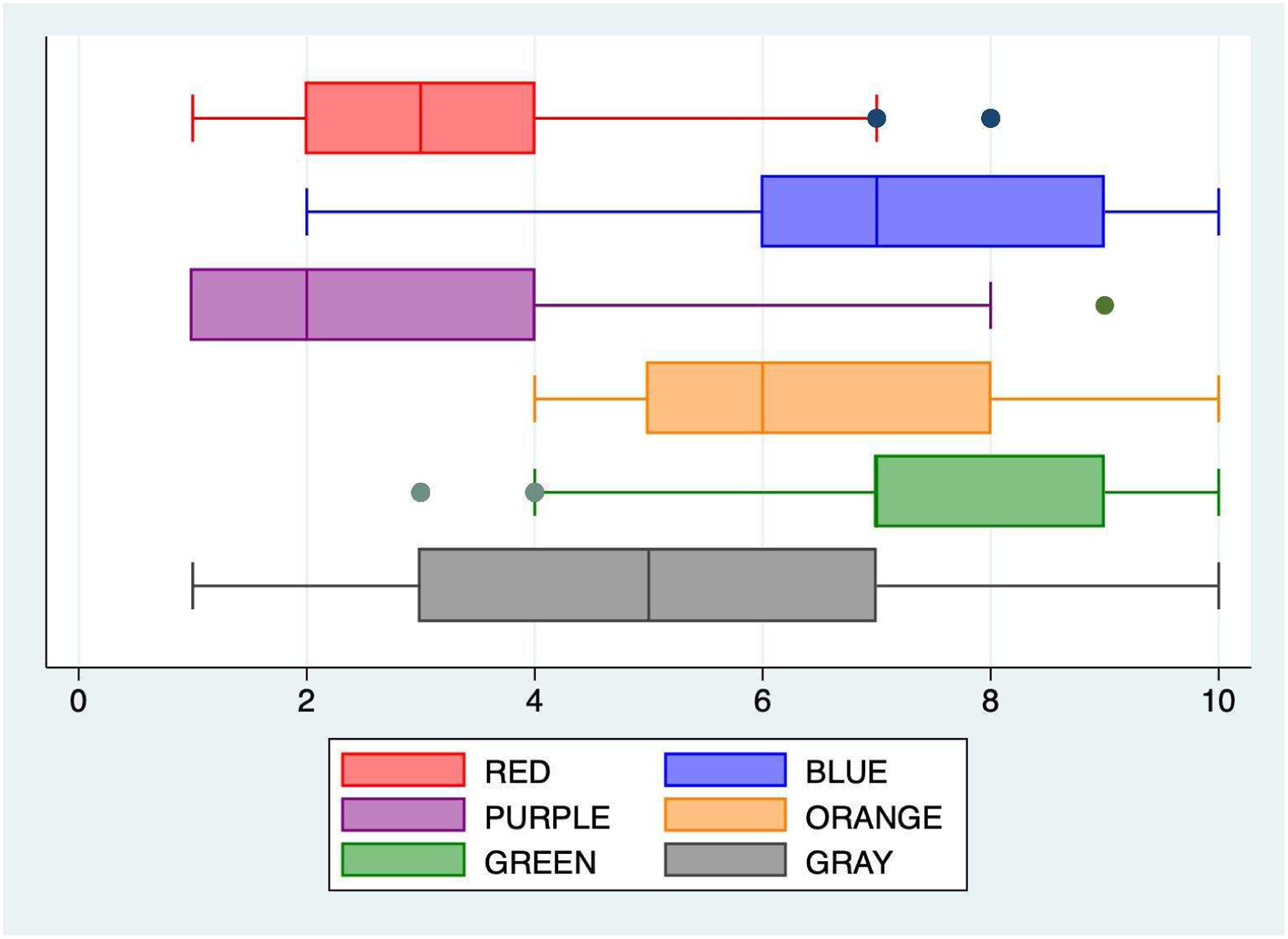
The results we obtained prove the difficulties regarding the ideological meaning of gray color. The participants place it in the 5.20 of the axis, which gives it a very central position, with a high dispersion (SD = 2.26). In the Spanish context, there are no parties that use gray in their logos or visual supports. This absence has probably made it difficult to identify this color as partisan or ideological. This fact facilitates the use of gray as a “control color” in the following experiments.
Experiment 1: Color and Partisan Biases in Uncertainty Scenarios
Method
Participants
We eliminated the answers of two participants that answered mistakenly to the achromatopsia test. The study included the rest of the participants' answers (n = 838), that are distributed as follows: blue (n = 270), red (n = 290), and grey (n = 278). There was a homogeneous distribution between men (n = 490) and women (n = 419). Some participants choose a non-binary sex or preferred not to declare it (n = 10). The average ideological self-placement along the conventional one-to-ten L-R scale was 4.51 (SD = 1.94).
A priori power calculations, for a small effect (f = .15) would provide a power of .90, α = .05, and equal N across groups, G*Power analysis (version 3.1.6; Faul et al., 2007) specifies 576 participants per six conditions (colors) to assess our hypotheses. Because we planned to oversample to account for people who chose not to answer all questions or do not pass the achromatopsia test, we planned to end data collection after collecting responses above 900 participants who reached the end of the study. In total, 851 participants opened Experiment 1 link. In Experiment 1, 840 of those participants have completed the questionnaire and pass the achromatopsia test. The post-experimental observed power, Experiment 1 reported an effect size f = .5678 and power observed was .99.
Design/Procedure
We analyzed if colors can activate partisan biases in uncertainty scenarios. We used a political proposal that was not unquestionably attached to any partisan competition space to find out if the color gives a clue to the participants about its ideology. We used red and blue as predictors of progressive and conservative ideology, respectively, and gray as a control color. We tried to find out if colors, as stimuli of non-conscious perception, are capable of activating cognitive biases that modify participants’ political behavior.
We opted for between subject design with each participant rating just one message because once the partisan bias is activated, its effect could contaminate the visualization of new messages and colors. Moreover, it is the easiest way to access hot cognition and determine the degree of influence that the emotional response has on their behavior and opinions (Lodge & Taber, 2000). Even more important, participants in the experiment are unaware of the research objectives, so we avoided that they can consciously control their responses.
Expected Interaction Between Color and Ideology.
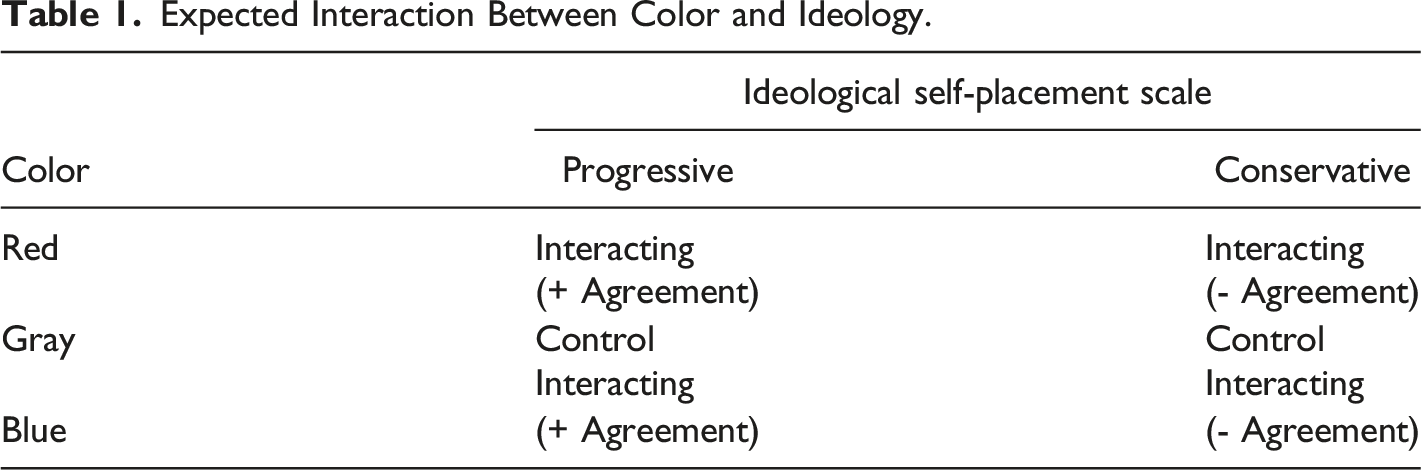
The experiment was an online survey that showed a political proposal in a white typo above a blue, red, or gray background. Each participant saw only one of the three randomly assigned colors. The message was always the same and occupied a central place in the ideological distribution of issues (Seeberg, 2017). We extracted that message of the two main political parties (center-left and center-right) platforms to ensure its nonproprietary nature, offering a minimal amount of information about its partisan ascription. Likewise, since it is an issue on which both the majority conservative party and the majority progressive party fully agree, it can be considered to have become a point of view that could currently be identified with the political center in Spain.
Participants saw the proposal over the background color randomly assigned (see Annex 2), and they had to, first, place it on the ideological scale (1–10) and, second, show their degree of agreement with it.
Results
The data obtained in the three groups, have a normal distribution and have passed the usual hypothesis tests.
As in the prestudy, participants identified the ideology of the political proposal by the color over which it appeared. Although the proposal did not belong to the issue ownership of any party, on a scale of 1–10, participants placed the one with a blue background on 5.20 (SD = 1.67), with a red one on 3.82 (SD = 1.20), and with a gray one on 4.40 (SD = 1.30). The differences in the means are significant in all the interactions established in the post hoc analysis (To check the results of the Bonferroni test, see Annex 4).
Ideological Identification of the Proposal by Color and Degree of Agreement.
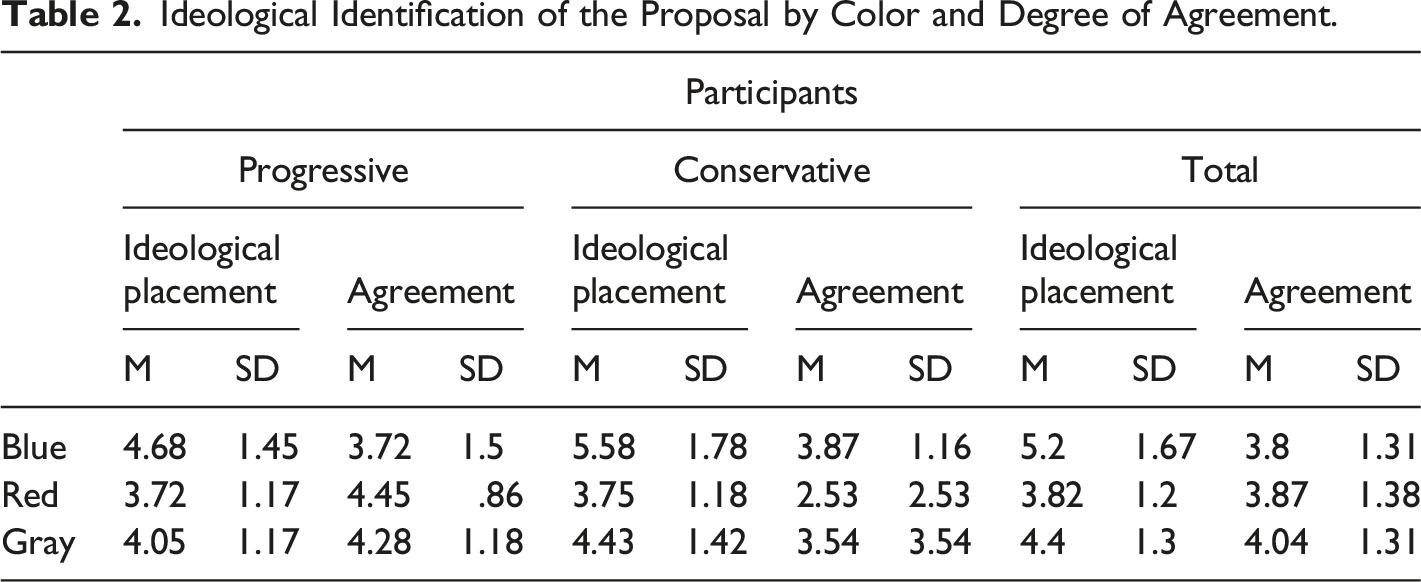
The degree of agreement of the participants who identify themselves as progressive varies depending on the background color of the proposal. This circumstance is relevant in the valuation they make of it. As anticipated, participants identify the blue background proposal as more conservative [F (2,456) = 13,908 p .000 η2p = .057]. Bonferroni test shows that blue and red significantly differed from each other, but it is not significant for gray (To check the results of the Bonferroni test, see Annex 4).
This effect is similar to what we saw among right-wing participants. These can identify the proposal as more conservative if there is a blue background. They place it at 5.58 (SD = 1.78): more at right than when the background is red (M = 3.73 SD = 1.18) or gray (M = 4.93 SD = 1.42). The background color affects the degree of the agreement they show with this proposal. The blue color shows a higher level of acceptance 3.87 (SD = 1.16) than the red color, which obtains a lower score (M = 2.53 SD = 1.47). The gray color, however, obtains an average rating of 3.54 (SD = 1.43) [F (2,272) = 23,003 p .000 η2p = .145], which could suggest the activation of a conservative bias with this color. In terms of standardized mean difference, the effect size of d Cohen = 1.05 indicates a great effect of the blue color in the valuation of the proposal among conservatives. Finally, Bonferroni test establishes a significant relationship between blue and red in obtaining a different degree of approval by both proposals (see Annex 4).
The effect of the gray background on the participants is not significant. The achromatic character of this color could explain the absence of effect even if we can appreciate some conservative bias. Conversely, the blue and red backgrounds seem to offer relevant information to participants when they have to evaluate the proposal as conservative or progressive. This visual information arouses the participants' partisan biases as the analysis of the differences in the degree of approval of the proposals shows. Color arouses an affective response, similar as the ones produced with food (Cardello & Sawyer, 1992; Deliza & MacFie, 1996; Shankar et al., 2009), capable of meeting the requirements to stimulate confirmation biases (Bargh, 1992; Bargh et al., 1996) and compels participants to offer a response coherent with the network of meanings set in his memory (Lodge & Taber, 2013; Morris et al., 2003; Redlawsk, 2002; Taber & Lodge, 2006).
Color, in scenarios with low information, can be used as a predictor of the ideology or partisan identification of a political proposal. Once the viewer ascribes that proposal to a space of partisan competition, she processes the information according to partisan biases. However, we do not know how effective color is in activating confirmation biases in other scenarios.
Experiment 2: Colors Versus Issue Ownership
Methods
Participants
We obtained a total of 938 valid responses distributed among the six proposals: the conservative one (blue n = 147, red n = 158, and gray = 155), and the progressive one (blue n = 156, red n = 162, and gray n = 160). We rejected the responses of six participants who cannot prove the correct viewing of the test colors. Of the total sample, 489 were men and 446 were women. Three participants declared non-binary sex or preferred not to declare it. The age of the participants in the test is as expected when we use an online questionnaire: the age groups of 55–64 years (12.7%) and +65 (8.3%) have the lowest participation. Finally, the participants place themselves in the 4.57 (SD = 2.01) of the ideological scale on average.
A priori power calculations, for a small effect (f = .15) would provide a power of .90, α = .05, and equal N across groups, G*Power analysis (version 3.1.6; Faul et al., 2007) specifies 432 per three conditions (colors) to assess our hypotheses. Because we planned to oversample to account for people who chose not to answer all questions or do not pass the achromatopsia test, we planned to end data collection after collecting responses above 750 participants who reached the end of the study. In total, 983 participants opened Experiment 2 link. In Experiment 2, 938 of those participants have completed the questionnaire and pass the achromatopsia test. The post-experimental observed power, Experiment 2 reported an effect size f = .1631 and power observed was .98.
Designe/Procedure
We explored which factor offers a greater degree of coherence with the behaviors arisen from the activation of confirmation bias: the color or the issue ownership. The findings of the previous experiments showed the importance of color in uncertainty scenarios. It is essential to analyze if the color has the same effect with proposals with distinct ideological content that gives enough information to place them on an ideological scale.
Expected Interaction Between Issue Ownership, Color, and Ideology.
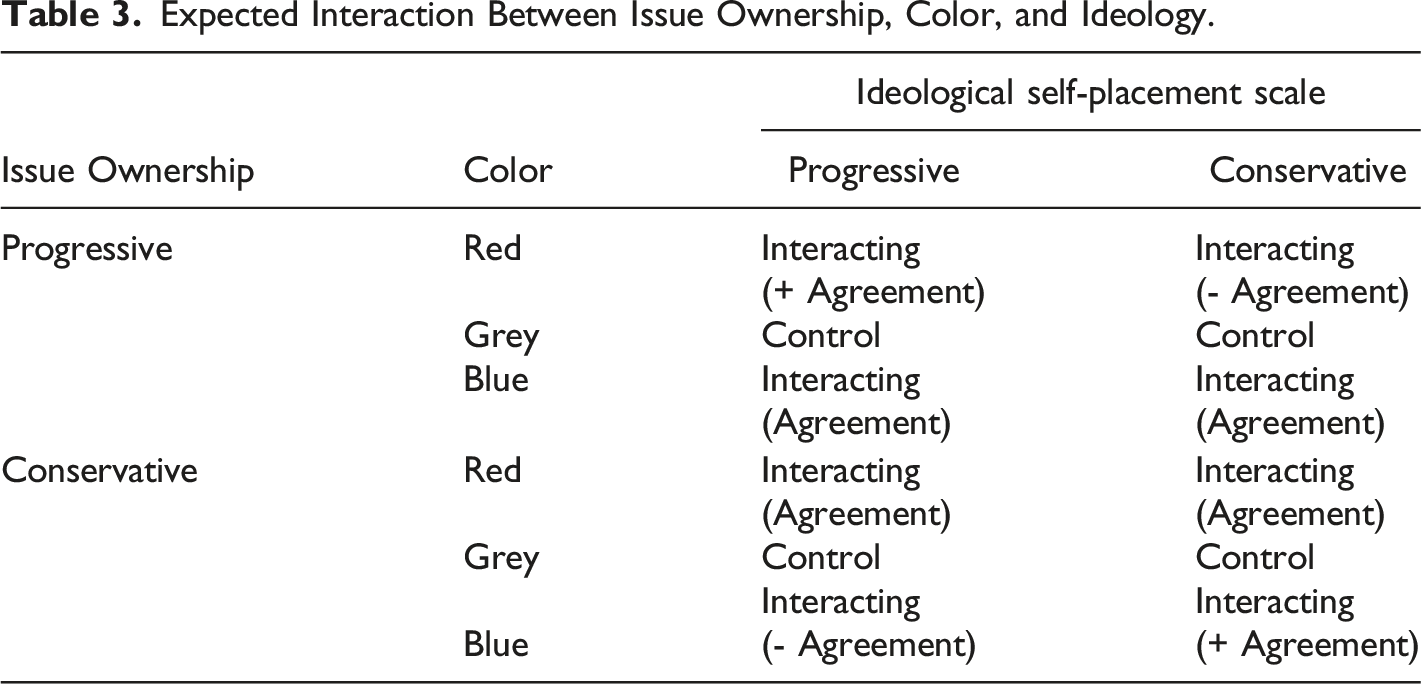
The experiment was an online survey that showed a political proposal in a white typo above a blue, red, or gray background. We took two real proposals from the electoral platforms of the two main political parties (center-left and center-right). To ensure the success of the test, we chose two issues that traditionally belong to each ideological spectrum. Following the works of Seeberg (2017), Petrocik (1996), Budge and Farlie (1983), we used a proposal about women and equality as a progressive proposal and another about public spending cut as a conservative one (see Annex 3). Both proposals appear over blue, red, and gray backgrounds, thus obtaining a total of six possibilities. The participants saw one of the proposals over the randomly assigned background color and had to assess their degree of agreement with it (Likert scale 1–7).
Results
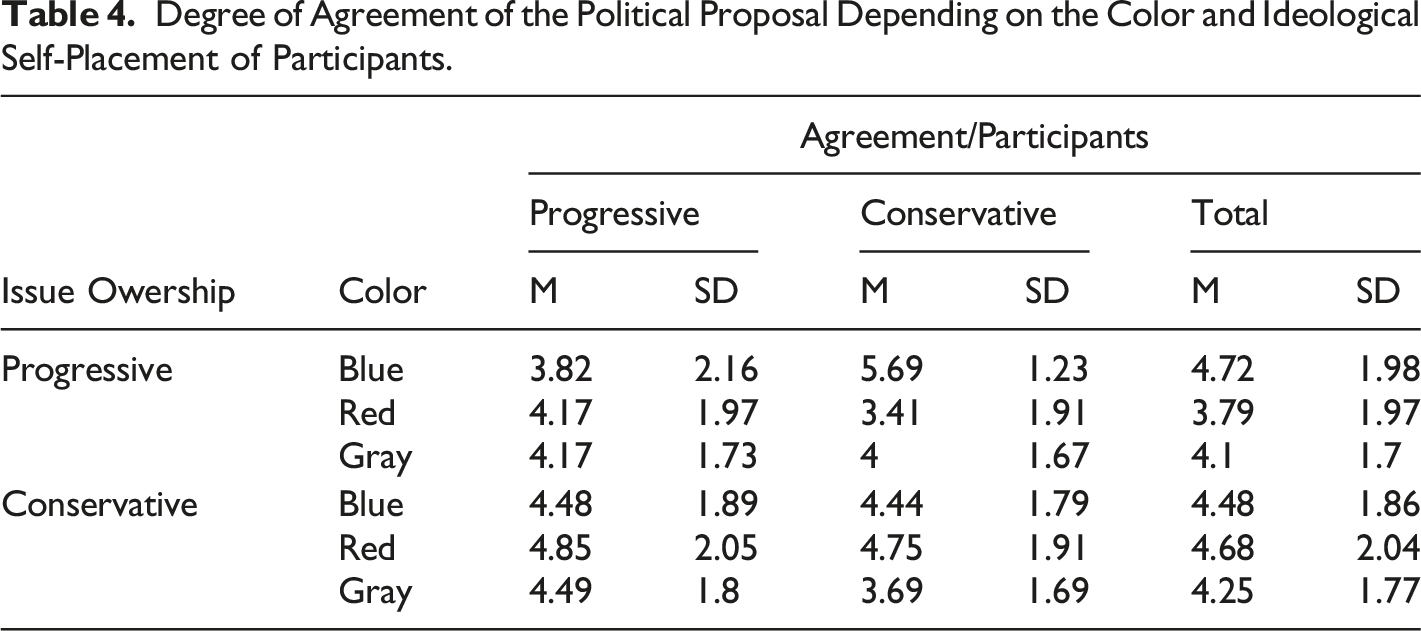
The data obtained from the experiment allow us to observe different degrees of approval of the proposals. On a scale 1–7, the conservative proposal obtains greater approval when presented over a blue background (M = 4.72 SD = 1.98) than when it is showed over a red one (M = 3.79 SD = 1.97), or in gray (M = 4.10 SD = 1.70), which obtains central values, as we expected. Despite this, the ANOVA is not significant, although the Welch test and the Games-Howell analysis indicate a significant difference between blue and red.
We analyzed the results of the conservative issue regarding the ideology of the participants. Among the progressive participants, we found a lower level of approval when the conservative proposal has a blue background (M = 3.82 SD = 2.16) than when it has the red one (M = 4.17 SD = 1.73). Although the results of the Bonferroni test are not significant, it is possible to assume that blue activated the partisan biases of these participants. In the opposite direction, the red background seems to slightly improve (+0.5) the degree of agreement with the conservative proposal.
Conservative participants offer the answer foreseen in the theoretical model. The proposal with a blue background gets more agreement (M = 5.60 SD = 1.23) gets a much greater agreement than when it is presented with a red one (M = 3.41 SD = 1.91), or with a gray one (M = 4.00 SD = 1.67) (which works as a neutral color). It is a strong effect that may suggest the activation of partisan biases, especially among the most ideological related colors, such as blue and red.
The behavior of the participants in their assessment of the progressive proposal is similar. That proposal gets a higher approval, on average, with a red background (M = 4.68 SD = 1.86) than with a blue one (M = 4.48 SD = 1.86), or with a gray one (M = 4.25 SD = 1.91) [F (2,420) = 3,428 p <.003]. Bonferroni test shows that some of those differences are more salient: between blue and red and between red and gray (see Annex 4).
We anticipated a positive relation between the red background, the progressive proposal, and the progressive participants. The degree of approval of the proposal does not vary excessively among those who are placed on the left of the ideological scale. Although the red background gets a greater degree of agreement (M = 4.85 SD = 1.89), it is only .40 greater than the one obtained with the blue one (M = 4.48 SD = 2.05), or with the gray one (M = 4.49 SD = 1.80). ANOVA and a Welch test show that it is not a significant relation. Nor are the slightest fluctuations that happen between colors. This fact may be due to the importance of issue ownership as a bias trigger. A left owned issue is more effective among the participants of this ideology than the background color.
Degree of Agreement of the Political Proposal Depending on the Color and Ideological Self-Placement of Participants.
The oddity that appears when conservative participants assess more favorably the progressive proposal with a red background is not significant. Notwithstanding, this fact may be due to systematic differences in cognitive style and information processing between liberals and conservatives (Deppe et al., 2015; Eidelman et al., 2012; Pacini & Epstein, 1999). One of the explanations offered to account for these differences is that conservatism is a motivated social cognition, and stems from urges to avoid threat and uncertainty (Jost et al., 2003). So the conservative participant thinks that the progressive issue, related to gender policy, represents the majority position in the society and wishes to avoid a sense of isolation or threat (Brownback & Novotny, 2018; Carney et al., 2008; Powell, 2013).
In scenarios with low information, color has been able to activate partisan identification biases and modify participants' opinions. However, color has not been able to reduce or counteract the activation capacity that issues ownership has.
Discussion
Our experiments show that in the same way that preference for names (Cichocka et al., 2016) or the use of auxiliary modal verbs (Abney et al., 2019) can predict the ideology of a text, colors could be considered as predictors of the ideology of a political object. Despite the limitations of color as a cognitive shortcut (Elliot, 2019; Greiner & Stephanides, 2020), even with a brief display, color causes effects on the psychological and affective processes of citizens (Eisemann, 2000, Elliot et al., 2007, 2008).
Therefore, colors could be a valuable source of knowledge (Graber et al., 2001; Lavin & Lawless, 1998; Shankar et al., 2009) about our political environment. They would be able to activate prior stereotypes (Burkitt et al., 2007; Gebauer et al., 2016; Palmer & Schloss, 2010), and partisan biases that, as shown in several previous researches (Carver, 2001; Lodge & Taber, 2000; Simon et al., 2004; Taber & Lodge, 2006; Westen et al., 2006), and can modify the political behavior of citizens.
In the prestudy and the two experiments described above, we replicated two scenarios that citizens usually meet with: scenarios with certain and uncertain information about their ideological content. In Prestudy and Experiment 1, participants had to classify and assess a political object from an unknown ideological source.
Results showed that colors provide a useful heuristic to find a possible ideological significance of a political object of this kind. We avoided any additional ideological information choosing a geometric logo (Prestudy) and thus achieving a more affective approach to the phenomenon (Henderson & Cote, 1998). Therefore, we could verify that color appeared as a predictor of the logo’s political ideology.
Experiment 1 offered comparable results. The participants did not have extra information about the ideological content of the proposal, so they had to use color as a way to place themselves before it. Once they classified the proposal with a blue background as a conservative one and the proposal with the red background as a progressive one, the color and not the proposal’s content excited the partisan bias. Therefore, the color aroused partisan biases in scenarios with little information or uncertainty regarding their ideological content. This result is similar to what happens in other environments and with other political objects where we can observe how the citizens adopt a behavior coherent with their aroused partisan biases (Eichmeier & Stenhouse, 2019; Gaines et al., 2007; Jerit & Barabas, 2012; Lodge & Taber, 2000; Redlawsk, 2002; Taber & Lodge, 2006).
In Experiment 2, we have reproduced a scenario with greater certainty regarding its ideological content. The choice of two issues owned by progressives and conservatives respectively allowed us to examine the impact that color has on the assessment of political proposals. Although the results do not show a very marked effect., we could observe the activation of partisan biases. The information that the issue provides is not only sufficient to activate those biases but also has a more powerful effect than color. Therefore, among the progressive participants confronted with the progressive proposal, the issue gave way to a homogeneous assessment of the proposal regardless of its background color.
The oddity appears when conservative participants assess more favorably the progressive proposal with a red background. Although it is beyond the scope of this article, we can tentatively attribute the phenomenon to several reasons. This fact may be due to systematic differences in cognitive style and information processing between liberals and conservatives (Deppe et al., 2015; Eidelman et al., 2012; Pacini & Epstein, 1999): conservatism is a motivated social cognition, and stems from urges to avoid threat and uncertainty (Jost et al., 2003). So the conservative participant might think that the progressive issue, related to gender policy, represents the majority position in the society and wishes to avoid a sense of isolation or threat (Brownback & Novotny, 2018; Carney et al., 2008; Powell, 2013).
As in previous research (Gebauer et al., 2016; Palmer & Schloss, 2010; Schloss et al., 2011), political colors have shown their ability to produce consistent behavior. But they have only succeeded in scenarios of uncertainty. When the authorship of a message is unknown, or the ideological orientation of a proposal is ignored, color becomes the main unconscious source of political information. This information makes it possible to classify the message ideologically and activate the receiver’s confirmation biases. However, when the political object is clearly defined, as is the case of issue ownership (Dolezal et al., 2014; Green-Perdensen, 2007; Kam, 2007; Whiteley et al., 2013), colors’ capacity to activate partisan biases is lessened. That is, the issue ownership is more powerful as a cognitive shortcut (Goggin and Theodoridis, 2016) than color, both regarding the information it offers and its ability to allow a behavior coherent with the participants' worldview (Bartels, 2002; Janssen & Verheggen, 1997; Lodge & Taber, 2000). These results suggest that subjects can hierarchically order political objects according to their ability to reduce uncertainty. That is, their ability to provide relevant information about their political and/or ideological content. For this reason, partisan identification would be placed higher in this hierarchy with respect to color.
These findings confirm the strength of the theoretical approach that analyzes the importance of emotional reactions in politics. Even if the color of political objects has not received much attention, the background of the electoral posters, the format of the government programs or the stages of the rallies can condition the political perception of the citizenry.
Moreover, our findings open new ways to understand how political objects condition political behavior through the use of such a common, and sometimes overlooked, element as color. Colors could be considered as a crucial element to arouse affective responses in the same way as flags, faces, voice, or polling places.
Supplemental Material
Supplemental Material - Color War. Does Color Influence the Perception of Political Messages?
Supplemental Material for Color War. Does Color Influence the Perception of Political Messages? by Roberto Losada Maestre, and Rubén Sánchez Medero in Psychological Reports
Footnotes
Declaration of Conflicting Interests
The author(s) declared no potential conflicts of interest with respect to the research, authorship, and/or publication of this article.
Funding
The author(s) received no financial support for the research, authorship, and/or publication of this article.
Ethical Approval
All procedures performed in studies involving human participants were in accordance with the ethical standards of the institutional and/or national research committee and with the Helsinki Declaration and its later amendments or comparable ethical standards.
Informed Consent
Informed consent was obtained from all individual participants included in the study.
Data Accessibility
Data available at Open Science Framework: https://osf.io/yjzkf/. The link to the data also has a DOI is “10.17605/OSF.IO/YJZKF”.

Supplemental Material
Supplemental material for this article is available online.
References
Supplementary Material
Please find the following supplemental material available below.
For Open Access articles published under a Creative Commons License, all supplemental material carries the same license as the article it is associated with.
For non-Open Access articles published, all supplemental material carries a non-exclusive license, and permission requests for re-use of supplemental material or any part of supplemental material shall be sent directly to the copyright owner as specified in the copyright notice associated with the article.
