




Abstract
The present study validated the bifactor model of the Material Values Scale (MVS) and examined the association between materialism and subjective well-being (SWB). Study 1 utilized a material values questionnaire that 1673 college students completed. Confirmatory factor analysis results indicated that the bifactor model of the MVS had a better fit than other models. Likewise, the findings were replicated in Study 2 using a larger sample size (N = 2627). Through structural equation modeling, only the general and specific factors of success were found to be negative predictors of SWB. Our study both provides a methodological reference for measuring the MVS and compensates for the limitations of MVS measurement results.
Introduction
Materialism, a value system that emphasizes the importance of material possessions in life, has received much attention from psychologists and sociologists (Hurst et al., 2013; Kasser, 2016; Norris et al., 2012). People are surrounded by messages about material wealth and pursuits from television and newspapers to the Internet. The concept of consumption, promoted through advertisements and the fashion industry, encourages individuals to obtain and consume unnecessary products to improve their happiness (Dittmar et al., 2014). However, the self-determination theory (SDT; Ryan & Deci, 2000) and goal contents theory (GCT; Grouzet et al., 2005) have proposed that materialistic values jeopardize well-being (Burroughs & Rindfleisch, 2002; Joshanloo, 2019; Yoo et al., 2021) and mental health (Muñiz-Velázquez et al., 2017; Wang et al., 2017). Whether more material wealth can increase happiness remains controversial in academic research and daily experience. This study further clarifies the underlying structure of materialism and its association with subjective well-being (SWB).
The Bifactor Model of the Material Values Scale
Researchers interpret the concept of materialism in two ways. The first is that material interests, such as money and wealth, are more important than all others (e.g., Pfeffer & DeVoe, 2009). The second extends the first, stating materialism is a value that promotes success, power, status, and other benefits (Pandelaere, 2016). Most studies have followed the definition proposed by Richins and Dawson (1992), building on the second interpretation. They simultaneously conceptualize material values as encompassing three domains: success—the use of possessions to judge success; centrality—the centrality of possessions in life; and happiness the belief that acquiring possessions leads to happiness. For the sake of brevity, these domains have been referred to as centrality, happiness, and success, respectively, in previous studies (Richins, 2004; Zhang & Shi, 2022). We will use these terms in the present study.
The Material Values Scale (MVS) was developed to measure of materialism in terms of the three dimensions by assessing components of centrality, happiness, and success (Richins & Dawson, 1992). Its psychometric properties have been widely measured and validated (Flynn et al., 2016; Gupta & Singh, 2019; Hu & Liu, 2020). First, different versions of the MVS (α range = 0.87–0.88; Niesiobędzka, 2018; Sun et al., 2020) have shown satisfactory internal consistency. Second, the three dimensions also demonstrate effective stability in many studies (α > 0.7; Poraj-Weder et al., 2020; Wang et al., 2020). Third, the unidimensional or second-order model of the MVS has been verified in a variety of contexts and populations, including China (Ren et al., 2017), Germany (Müller et al., 2013), and Turkey (Karabati & Cemalcilar, 2010).
Multidimensional conceptualization is widely used to study complex psychological phenomena or characteristics. It is the decomposition of an entire multidimensional conceptualization into the different dimensions, reflecting their individual components (Ge, 2021; Gu & Wen, 2017; Lui & Fernando, 2018). Compared with the unidimensional model, the multidimensional model reflects both the overall situation of the construal and its different aspects through multiple dimensions (Lai, 2019). However, many researchers tend to ignore the data’s multi-dimensionality in the actual analysis by, for example, directly using a single-dimensional model for fitting. This strategy creates a mismatch between the measurement model and the data dimensions (Bonifay et al., 2015). Previous studies have consistently focused on the unidimensional model of the MVS, neglecting the multidimensionality of materialistic tendencies (Perveen & Yasin, 2017). In these versions, the items merely reflect the characteristics of various concept dimensions. They cannot provide an overall picture of materialistic values (Reise et al., 2013; Rodriguez et al., 2016). These models require totaling the scores of all dimensions and are therefore easy to use. However, they ignore the differences among dimensions (Górnik-Durose & Pilch, 2016; Teng et al., 2017; Wang et al., 2017).
A multidimensional conceptualization of the MVS may better explain the complex psychological phenomenon of materialism.Some research suggests that, compared to other multidimensional models, a bifactor model is better for examining the common effects of all dimensions of the test and the unique effects of each. (Reise, 2012; Rodriguez et al., 2016). Cucina and Byle (2017) found that bifactor models are more appropriate than higher-order ones in more than 90% of comparisons of mental ability tests. However, bifactor models are methodologically controversial due to their difficult interpretability and tendency to overfit data (Bonifay & Cai, 2017; Bonifay et al., 2017). At the same time, the bifactor model is acceptable, as it offers the advantages of directly reflecting complex psychological concepts and applying innovative statistical assessment methods (Chen et al., 2012; Gu et al., 2014). Additionally, the model includes global and local factors. Global factors are common variations of the topic, while local ones are the unique dimension variations under investigation (Wen et al., 2019). With the expansion of applications such as intelligence tests, personality measures, psychopathology assessments, and others, the bifactor model is recommended for appropriate research scenarios (Bai et al., 2021; Gignac, 2016). Therefore, the MVS is a candidate for a bifactor model; all of the items of MVS are loaded as general factors, and the three subscales are loaded as specific factors. However, to the best of our knowledge, no existing research has adopted the bifactor model to verify the MVS. Therefore, the present study aims to examine the bifactor structure of the MVS among the Chinese population.
Materialism and Subjective Well-Being
Subjective well-being is an important indicator of mental health. It is assessed using a comprehensive psychological examination of people’s satisfaction and happiness with their lives overall (Diener, 2009; Diener et al., 2017). There are three main components of SWB: life satisfaction, positive influence, and negative influence. Since Belk (1983) offered an initial proposition about an inverse correlation between materialistic orientation and well-being, many empirical studies have replicated these findings (e.g., Kasser, 2016; Martos & Kopp, 2012). Although most people are aware that considerable negative psychological and physical effects accompany an obsession with financial success, societal enthusiasm for financial success remains alive and popular. Behind this contradiction, partly due to economic pressure, may also be a need to base self-worth on financial success (Park et al., 2017). Thus, an emphasis on material acquisition and possession works to undermine rather than increase people’s happiness. That is, the relentless pursuit of material goods may diminish life satisfaction.
Ryan and Deci’s (2000) SDT has influenced the relationship between materialism and SWB in different ways. The theory’s dominant idea relies on the fact that the basic psychological needs of autonomy, competence, and relatedness should be satisfied to experience well-being. Nevertheless, as an external motive, materialism may impede satisfaction of psychological needs and diminish happiness (Wang et al., 2017). Concurrently, some scholars have proposed a branch theory of human goal pursuit, based on the SDT, known as GCT (Grouzet et al., 2005). According to GCT, the excessive pursuit of external objectives (such as wealth, fame, and appearance) causes individuals to pay more attention to rewards and praise, neglecting internal goals that reflect self-actualization and growth (Kasser & Ryan, 1996). Furthermore, individuals who have external motives or goals prefer to make upward social comparisons. Therefore, they pay less attention to interpersonal relationships, exacerbating conflicts and competition and undermining individuals’ basic and healthier psychological needs (Kasser & Ryan, 2001).
However, materialism, as a value of socio-historical concern for its own sake, has great importance for the survival and development of humanity (Wang et al., 2019). Studies from Turkey, Canada, and Germany have found similar results, notably related to the positive association between materialism and self-enhancement motives (Karabati & Cemalcilar, 2010; Kilbourne et al., 2005). For example, the person-environment value congruence hypothesis (Sagiv & Schwartz, 2000) emphasizes that environmental factors play an important role in the relationship between individual values and SWB. Materialistic consumers wish to buy more luxury goods and acquire them in a relatively short period of time (Hudders & Pandelaere, 2012). Therefore, materialism, aimed at pursuing material enjoyment, may not conflict with subjective happiness and may even increase it (e.g., Rijavec et al., 2011).
While various meta-analyses (Dittmar et al., 2014; Zhou et al., 2018) have provided new knowledge about the relationship between materialism and SWB, the current study has yet to address certain aspects. First, few studies about the relationship between materialism and SWB that take into consideration its specific cultural context have been conducted in China. Although the general emphasis on collectivism is declining, it still impacts mainstream culture in Chinese society (Cai et al., 2020). The value conflict theory suggests that materialistic values may lead to conflict (egoism vs. collectivism), causing psychological tension that hinders well-being (Burroughs & Rindfleisch, 2002; Kasser, 2016). In one experiment, when Chinese college students responded to the values choice dilemma question, those who had both high levels of materialism and traditional Confucian values registered higher electrical skin strength indicating that they experienced more psychological conflict (Li & Guo, 2012). Second, studies have shown that materialism is rampant in China, especially among young consumers (Ma et al., 2020). These findings call attention to materialistic values and their impact on mental health. Third, previous studies have conceptualized materialism as one-dimensional. Thus, the independent effects of its components remain unclear. Therefore, the current study explores the influence of the bifactor of materialism on SWB in young Chinese adults.
The Present Study
We believe that the MVS should be investigated with a bifactor modeling approach to compensate for the limitations of MVS measurement results. In Supplemental Material Study 1, the fitting index differences of the three models—bifactor, unidimensional, and second-order models of MVS, using confirmatory factor analysis (CFA) were compared and discussed. Given the advantages of bifactor modeling, we hypothesize that the bifactor model could be a suitable model for the MVS. Furthermore, the findings were replicated based on a larger sample size in Supplemental Material Study 2. The second objective of this research is to employ the predictive effect of the general factor (MV) and the three specific factors (centrality, happiness, and success) of the MVS on SWB. We can only infer the general factor of MVS would negatively predict SWB, which is consistent with previous research. Relatively few studies have explored the links between the three specific factors of MVS and SWB. Thus, a stable relationship between them has yet to be found. Therefore, we made no specific assumptions about the association of the three specific factors with SWB.
Study 1
Participants and Procedure
A power analysis was conducted using the G*Power software 3.1.9.7 (http://www.ats.ucla.edu/stat/gpower/), with the following settings: r = 0.20, α = .05, and 1 - β = .9, and it was found that 207 participants were needed (Faul et al., 2009). Using a convenient sampling method, we recruited 1698 students from a university in “XXX.” The participants signed a declaration of consent and completed the questionnaires individually on Questionnaire Star, a professional online questionnaire platform (Leng et al., 2020; Ma, Liu et al., 2020; Wu et al., 2020). We excluded 25 individuals due to missing data and obtained a final sample size of 1673 (valid response rate = 98.52%). Participants were 16–24 years old, with a mean age of 19.04 ± 1.40 years, and included 966 women and 707 men. As an incentive to complete the questionnaires, participants received a gift as a token of appreciation. In addition, ethical approval was obtained from the XXX institutional ethical committee prior to the commencement of this study.
Measures
Materialism
Referring to the questionnaire presented by Richins and Dawson (1992), the revised Chinese version of the MVS was a 13-point questionnaire used to measure trait materialism (Li & Guo, 2009). The structure of the revised scale is similar to that of the original scale and incorporates three dimensions: centrality, happiness, and success. For example, “Some of the most important achievements in life include acquiring material possessions.” Five of the original items were removed in the revised text because of cultural differences and language barriers. Items are rated on a 5-point Likert scale [(1) very dissatisfied, (2) dissatisfied, (3) neutral, (4) satisfied, and (5) very satisfied]. This questionnaire is broadly used in China and shows good validity and reliability (Li et al., 2018). In this study, alpha reliability was good, with α = 0.884.
Statistical Analysis
All statistical analyses, including descriptive statistics, CFA, dimensionality analysis, reliability estimation, and structural equation model (SEM), were performed using Lavaan and semTools in R (http://www.R-project.org/).
Figure 1 presents three alternative MVS models: unidimensional (MU), second-order (MS), and bifactor (MB). All items exhibited normality with skewness less than 2 and kurtosis less than 7 (see the Supplementary Excel spreadsheet for details). However, the data did not follow normal multivariate kurtosis by Mardia’s normalized statistic. Therefore, robust maximum likelihood is used when conducting CFA (Li, 2016). Three alternative Material Values Scale (MVS) models.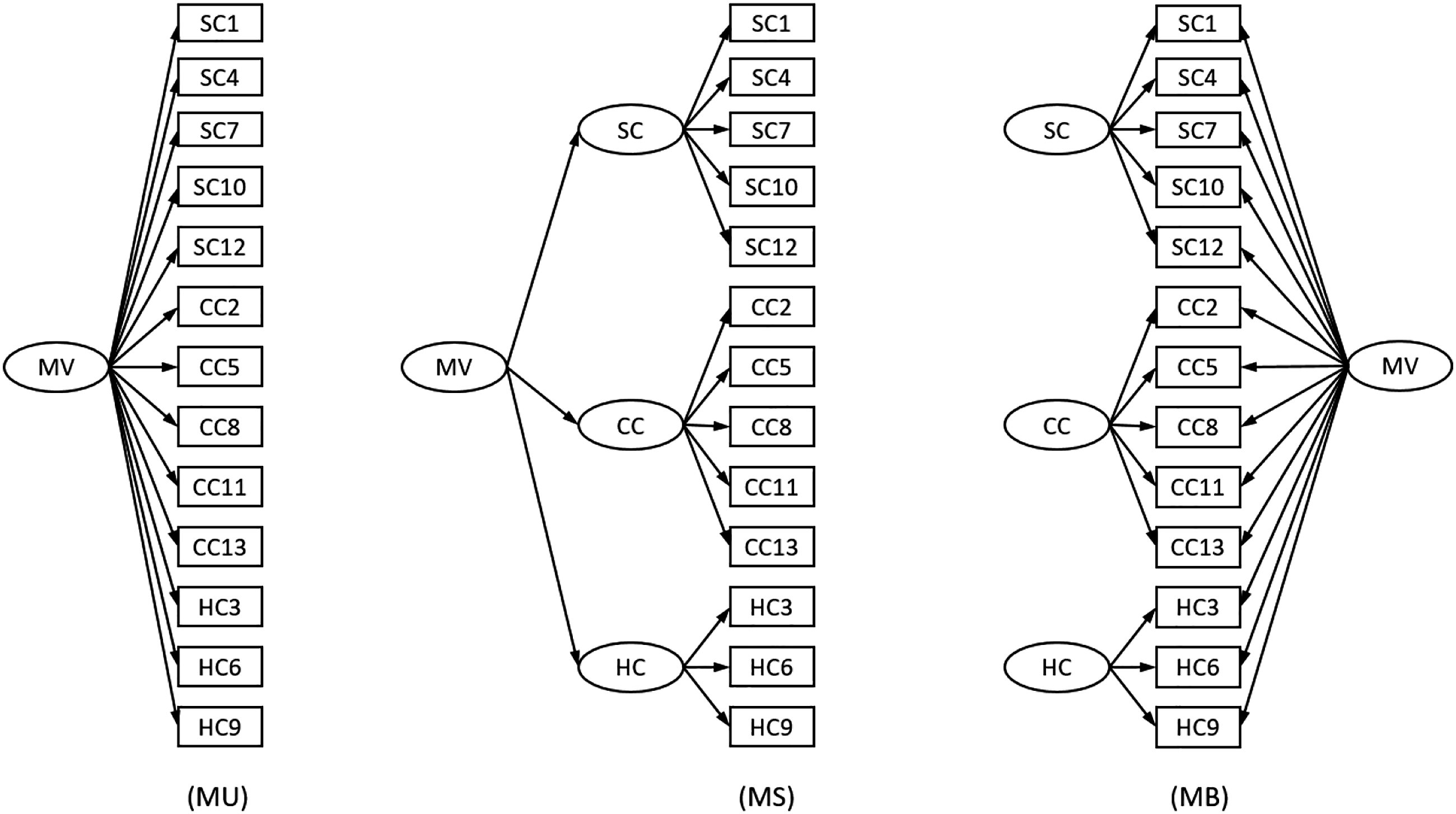
This study selects the optimal model mainly by considering various evaluation indexes of goodness of fit referring to previous studies. These values include the comparative fit index (CFI), Tucker–Lewis index (TLI), root mean square error of approximation (RMSEA), and standardized root mean square residual (SRMR). If the measurement index of CFI and TLI is close to 0.95, the measurement index of SRMR is close to 0.08, and the cut-off value of RMSEA is close to 0.06, it indicates that the fitting degree between the hypothesis model and the observed data is acceptable (Hu & Bentler, 1998; Kline, 2016). Meanwhile,
Results
Descriptive Statistics
The Descriptive Statistics of the Material Values Scale (MVS) (N = 1673).
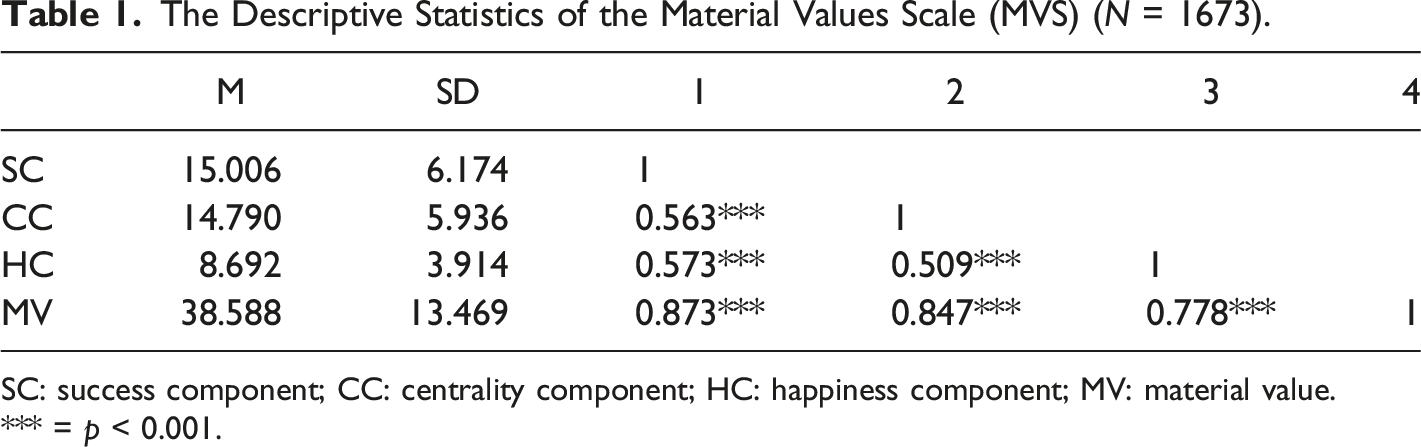
SC: success component; CC: centrality component; HC: happiness component; MV: material value.
*** = p < 0.001.
Confirmatory Factor Analysis
Fitting Values of Three Models (MU, MS, and MB) for the MVS.
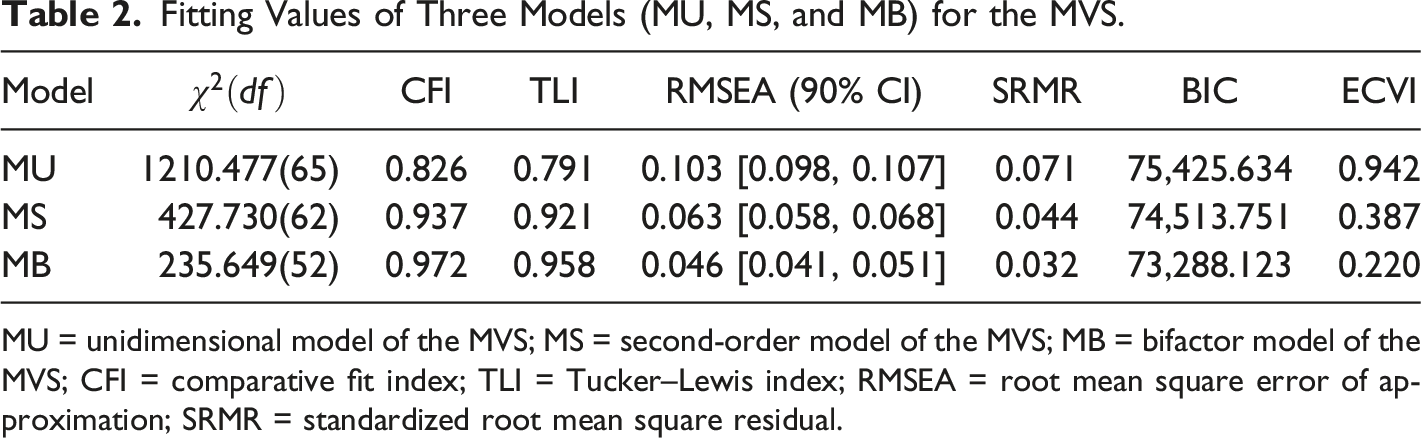
MU = unidimensional model of the MVS; MS = second-order model of the MVS; MB = bifactor model of the MVS; CFI = comparative fit index; TLI = Tucker–Lewis index; RMSEA = root mean square error of approximation; SRMR = standardized root mean square residual.
Dimensionality and Reliability of the Bifactor Model of the MVS
Standardized Factor Loadings of the Bifactor Model of the MVS and its Additional Indicators.
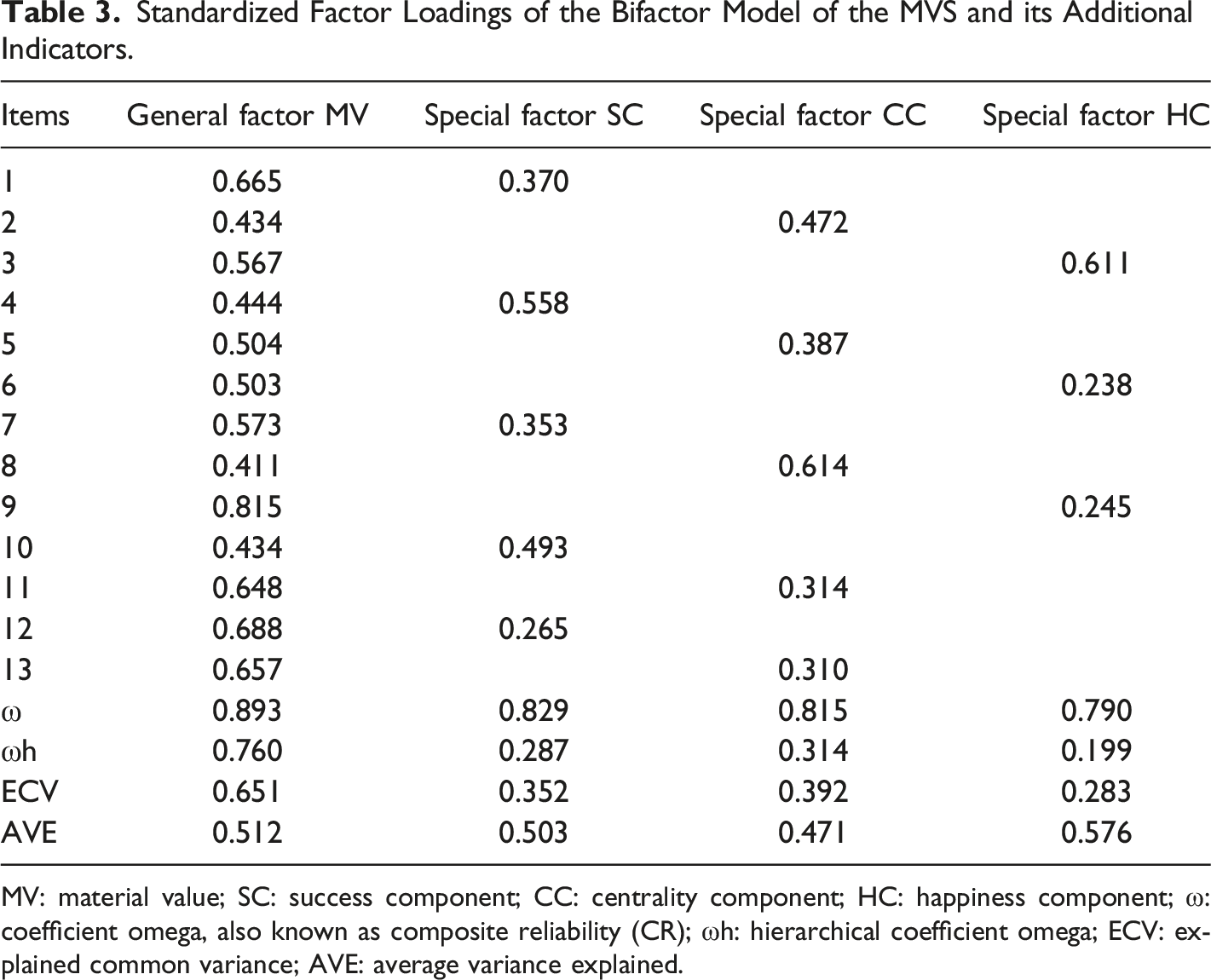
MV: material value; SC: success component; CC: centrality component; HC: happiness component;
MB should be confirmed as an essentially tau-equivalent model, which implies that all items have equal slope (i.e., factor loadings) relating the latent variable to observed responses before calculating its reliability. As the established essentially tau-equivalent model exhibited a less desirable fit, with
At the same time, the observed total scores may be interpretable,
Study 2
Participants and Procedure
Referring to the sample size of Supplemental Material Study 1 using G*power analysis and considering the needs of this study, we recruited 2696 students from another university in “XXX” to complete the second questionnaire; since 69 responses were excluded due to incomplete information (97.44% recovery rate), we obtained 2627 responses. The participants were 18–24 years old (Mean = 20.87, SD = 1.46) and included 1428 women and 1199 men. All participants were informed about the voluntary nature of their study participation and provided their written consent prior to participating. After completing the questionnaire, each participant received a small gift as compensation. They were thanked for their participation.
Measures
Materialism
The questionnaire assessing materialistic values was similar to that used in Supplemental Material Study 1. The Cronbach α was 0.88 for the MVS, which is an acceptable value.
Subjective Well-Being
Two additional instruments were used to measure SWB in Supplemental Material Study 2. The Satisfaction with Life Scale (SWLS) is a 5-item scale that evaluates an individual’s satisfaction with their life in general (Diener et al., 1985). The participants were asked to report how much they agreed or disagreed with each item using a 7-point scale ranging from 1 (strongly disagree) to 7 (strongly agree). The higher the total SWLS score, the higher the level of individual’s life satisfaction was interpreted to be in the current study. The reliability and validity of the tests administered have been well established in the literature (Kong et al., 2021; Liu et al., 2020). In this study, Cronbach’s α for the SWLS was 0.906.
The Scale of Positive and Negative Experiences (SPANE; Diener et al., 2010) has 12 items. Each item is scored on a five-point Likert scale (1 = not at all to 5 = always), reflecting the affective component of SWB. It contains six items for positive emotion (e.g., “positive” and “joyful”) and six for negative emotion (e.g., “negative” and “sad”). The total score of the positive dimension items minus the total score of the negative dimension items represents the overall emotional state of the participants. It has shown satisfactory reliability and validity in prior research (Jia et al., 2021; Yang et al., 2021). In this sample, it had acceptable internal consistency (Cronbach’s α = 0.922).
Statistical Analysis
First, we referred to the statistical analysis of Supplemental Material Study 1 to verify whether the bifactor structure model of the MVS remained valid in Supplemental Material Study 2. Then, the relationships between the bifactor model of the MVS and SWB were explored using SEM. Finally, the same model fit indices used in the CFA were also adopted to assess the model fit of SEM: TLI, CFI, SRMR, and RMSEA.
Results
Bifactor Model of the MVS
Similar to Supplemental Material Study 1, MB demonstrated a good fit with the data:
As in Supplemental Material Study 1,
Association Between the MVS and SWB
The structural equation modeling for the relationship between MVS and SWB (Figure 2) demonstrated a good fit to the data: The structural equation modeling for the relationship between the MVS and SWB. SWB = subjective well-being; MVS = material values scale.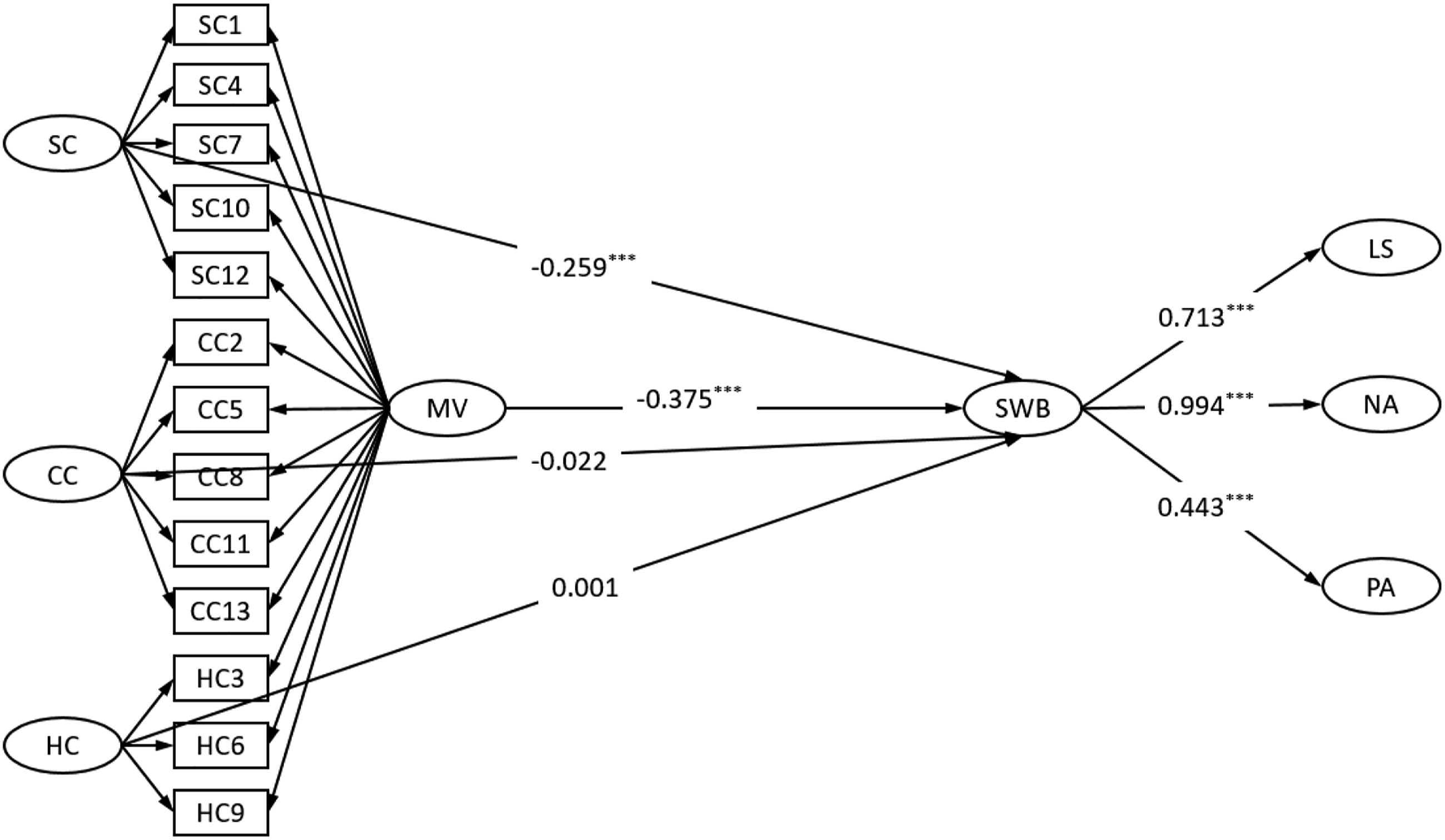
Discussion
The bifactor model is widely recognized as an appropriate model that could be the preferred approach to represent the multidimensional structure of individual mental characteristics (e.g., Arias et al., 2018; Seong et al., 2021). However, there is no evidence to validate a bifactor model of materialistic values using the MVS. Therefore, to clarify the underlying structure of the three components of the MVS, namely centrality, happiness, and success, Studies 1 and 2 examined a bifactor MVS model in which 12 items were loaded on a general MV factor together with their respective specific dimensions in two samples.
First, the results for the CFA revealed that the bifactor model of the MVS fit the data better than the unidimensional model or the second-order model, based on two different samples of Chinese university students. Second, the data successfully fit the bifactor model in our study. Additional indexes, such as EVC and PUC, suggested that the common variance of the MVS could be captured by the general factor MV and the three dimensions. These findings imply that materialistic values are essential multidimensional constructs. Moreover, the general and specific factors had adequate reliability coefficients (>0.70). This high reliability provides valid information, indicating that a bifactor modeling method is suitable for representing the structure of the MVS. Despite the controversy surrounding the model itself (Bonifay & Cai, 2017; Bonifay et al., 2017), the bifactor model of the MVS is considered the best choice due to three advantages: (1) its theoretical value, especially considering that the three aspects (domains) of materialistic values are components of the materialistic intention dimension rather than three related factors; (2) the clear rationale for the total score calculation; and (3) its greater goodness of fit.
Apart from examining the measurement of the bifactor model of the MVS, we further investigated the relationship between the utility of a bifactor model of the MVS and SWB. This association has not been investigated in previous studies. Specifically, a SEM evaluated the association between the general and three latent specific factors of MVS and SWB. The results demonstrate that the general factor MV is a negative predictor of SWB. Success is a negative predictor of SWB, and centrality and happiness do not predict SWB. Therefore, the higher an individual’s level of materialistic values, the lower their happiness and quality of life. These findings are consistent with those from previous studies that consider the total score an indicator of MVS (e.g., Teng et al., 2017). Furthermore, as a significant contribution to our study, we included three specific factors of the MVS that have unique effects on SWB. For example, when individuals use material wealth as a measure of success, it can lead to lower levels of SWB, possibly because defining people’s worth in relation to their material possessions is likely to lead to negative self-evaluation.
In comparison, centrality and happiness have a less notable influence on SWB. Our study is partially consistent with previous findings. For example, Li (2011) and Zhou et al. (2018) observed that SWB was negatively correlated with success and centrality but not with HC. Górnik-Durose (2020) showed that happiness and success had a relatively strong association with well-being. In contrast, centrality had a weak correlation with it. Based on the association of variance sources of each indicator in a multidimensional construct with total and specific scores, as demonstrated in previous studies (Di et al., 2021), our results showed that the bifactor model of the MVS is more suitable for our sample compared to other models. Moreover, Supplemental Material Study 2 suggested that only success plays a predictor role for SWB, which indicated that individuals with high levels of success are often accompanied by lower levels of satisfaction with life and positive experiences.
Our findings suggest that the bifactor modeling approach is suitable for representing the structure of the MVS and highlights the powerful predictor of the general and specific factors of the MVS on SWB. Some of the main contributions of this research are listed below. First, this study provides an effective tool to analyze the structural characteristics of the MVS for subsequent studies, which makes up for the measurement conductivity defects. Second, the current findings are novel since this was the first study to repeatedly analyze the MVS structure using a bifactor approach in different samples to robustly test the stability and reliability of the bifactor model of the MVS scale. Third, and more importantly, the current study examined the association between the bifactor structure of the MVS and SWB. More broadly, understanding and intervening in the relationship between materialism and SWB may yield better outcomes than focusing on only one or a handful of specific constructs.
Despite the strengths of the present study, some limitations should be mentioned. First, the present study used a relatively large sample from China, representing a homogenous culture. Thus, whether the conclusions can be generalized in other cultural contexts remains unclear. The bifactor model of the MVS could be tested using different regional samples to generalize these findings. Second, our sample comprised only selected college students, further limiting generalizability since the display of materialism across different life stages is not wholly consistent (Jaspers & Pieters, 2016). Therefore, future research should test our hypotheses with a broader range of participants of all ages from the general population. Third, our study only examined the relationship between the bifactor model of the MVS and SWB. Future research could compare the magnitude of the relationship between materialism and SWB using the general materialism factor extracted from the different models. Fourth, the causality of the relationships between the MVS and SWB could not be investigated thoroughly because the present study adopted a cross-sectional design. Future longitudinal tracing research should be conducted to fully capture the bifactor model of the relationship between materialism and SWB.
Supplemental Material
Supplemental Material - Bifactor Modelling, Reliability, and Validity of the Material Values Scale of in Chinese Youth
Supplemental Material for Bifactor Modelling, Reliability, and Validity of the Material Values Scale of in Chinese Youth by Jing Wang, Xiaoyang Xin, Yongquan Huo, Ying Li, Yue Han, and Feng Kong in Psychological Reports
Supplemental Material
Supplemental Material - Bifactor Modelling, Reliability, and Validity of the Material Values Scale of in Chinese Youth
Supplemental Material for Bifactor Modelling, Reliability, and Validity of the Material Values Scale of in Chinese Youth by Jing Wang, Xiaoyang Xin, Yongquan Huo, Ying Li, Yue Han, and Feng Kong in Psychological Reports
Footnotes
Declaration of Conflicting Interests
The author(s) declared no potential conflicts of interest with respect to the research, authorship, and/or publication of this article.
Funding
The author(s) disclosed receipt of the following financial support for the research, authorship, and/or publication of this article: This work was supported by the Fundamental Research Funds For the Central Universities [grant number 2019TS139].
Ethics Approval
The study was conducted according to the Declaration of Helsinki.
Informed Consent
The informed consent was obtained from the participants prior to the study. The publication consent was obtained from the all individual participants included in the study.
Data Availability
Additional data and details from this study can be obtained by contacting us.

Supplemental Material
Supplemental material for this article is available online.
Author Biographies
References
Supplementary Material
Please find the following supplemental material available below.
For Open Access articles published under a Creative Commons License, all supplemental material carries the same license as the article it is associated with.
For non-Open Access articles published, all supplemental material carries a non-exclusive license, and permission requests for re-use of supplemental material or any part of supplemental material shall be sent directly to the copyright owner as specified in the copyright notice associated with the article.
