




Abstract
This study, based on the integrative model of commitment and motivation and organizational support theory, examined the mechanism of intrinsic and extrinsic enlistment motivation on three facets of organizational commitment. A three-wave field questionnaire survey was conducted among 1606 Reserve Officers’ Training Corps cadets from Chinese universities. The results showed that both intrinsic and extrinsic motivation positively predicted affective commitment, normative commitment, and continuous commitment. The positive effect of intrinsic motivation was stronger than extrinsic motivation. However, the interactive effect of intrinsic and extrinsic motivation negatively predicted the three aspects of organizational commitment. Career identity mediated all the direct effects above. Moreover, organizational support moderated the effects of intrinsic and extrinsic motivation on career identity. When organizational support was low, the positive effect of intrinsic motivation on career identity was stronger; whereas, when organizational support was high, the positive effect of extrinsic motivation on career identity was stronger. Furthermore, extrinsic motivation and organizational support jointly moderated the effect of intrinsic motivation on career identity and the mediating effects between intrinsic motivation and the three facets of organizational commitment. Specifically, when extrinsic motivation and organizational support were low, the direct and mediating effects above were stronger.
Keywords
Introduction
Since the 1960s, organizational commitment (OC) has gained attention in enterprise psychology, organizational behavior, and human resource management for its positive influence on workplace outcomes (Al-Jabari & Ghazzawi, 2019; Kim et al., 2017; Klein & Park, 2015; Rivkin et al., 2018). These include enhanced organizational citizenship behaviors (Ng & Feldman, 2011), higher job performance (Zhang et al., 2021), and lower turnover intentions (Rajabi et al., 2021). Similarly, researchers in the military context have applied OC research findings to the operational military environment for valued outcomes in national defense (Allen, 2003; Gade, 2003; Gade et al., 2003; Karrasch, 2003; Wrzesniewski et al., 2014). However, military practitioners and scholars have questioned why some officers engage in a lifelong commitment to the military, while others only commit for a limited period (Tresch & Bill, 2011), especially amidst the current situation of high attrition rates among military cadets (Raabe et al., 2020). Thus, researchers in various fields have endeavored to identify factors to improve OC from the perspective of individual characteristics (Allen & Meyer, 1993; Gagné et al., 2008; Griffith, 2008; Liu et al., 2021; Ngaruiya et al., 2014; Vandenberghe et al., 2021; Woodruff et al., 2006; Wrzesniewski et al., 2014), job characteristics (Mathieu & Zajac, 1990; Rubenstein et al., 2019), and organizational (Kim & Park, 2020; Muller et al., 2014) and environmental (Devece et al., 2016; Sokal et al., 2021) factors.
Among these predictors, work motivation has attracted considerable attention (Cheema & Din, 2014; Gagné et al., 2004, 2008; Ly et al., 2021; Meyer & Parfyonova, 2010; Wrzesniewski et al., 2014), and is defined as “a set of energetic forces that originates both within as well as beyond an individual’s being, to initiate work-related behavior, and to determine its form, direction, intensity, and duration” (Pinder, 1998, p. 11). Work motivation comprises intrinsic and extrinsic motivation. Intrinsic motivation relates to the state of interest and enjoyment (Deci, et al., 1989), while extrinsic motivation involves instrumental goals (Gagné et al., 2010), such as obtaining visible incentives (Kuvass et al., 2017) and avoiding negative consequences (Deci & Ryan, 2000). Previous studies have shown that intrinsic and extrinsic motivation are significantly related to OC and its facets (Gagné et al., 2010; Johnson et al., 2010; Kuvass et al., 2017; Ly et al., 2021; Meyer et al., 2012; Ngaruiya et al., 2014; Wrzesniewski et al., 2014); however, several limitations remain unaddressed.
First, inconsistent views exist regarding the effects of intrinsic and extrinsic motivation on affective commitment (AC; i.e., the individuals’ emotional attachment to, identification with, and involvement in the organization); normative commitment (NC; i.e., the individuals’ feeling of obligation to remain in the organization); and continuous commitment (CC; i.e., the individuals’ awareness of the costs associated with leaving the organization, Meyer & Allen, 1991, p. 67). For instance, various studies confirmed that intrinsic motivation was positively linked with AC (Gagné et al., 2004, 2008; Greguras & Diefendorff, 2009; Meyer et al., 2012) and NC (Gagne et al., 2010; Krajcsak, 2019), but negatively linked with CC (Kuvass et al., 2017). However, some researchers have identified a positive association between intrinsic motivation and CC (Ahluwalia & Preet, 2017). Meanwhile, other studies revealed that extrinsic motivation was negatively related to AC (Kuvass et al., 2017) and NC (Erdurmazli, 2019), but positively linked with CC (Gagné et al., 2010; Kuvass et al., 2017). Conversely, a positive relationship between extrinsic motivation and AC (Ertürk & Aydin, 2016) and NC (Krajcsák, 2019) has also been proposed. Based on these conflicting findings, empirical research regarding the relationship between both intrinsic and extrinsic motivation and the three facets of OC in different cultural contexts is necessary.
Furthermore, the interactive effect of intrinsic and extrinsic motivation on OC and its three facets remains unclear. Most motivation studies posit that intrinsic and extrinsic motivation can be combined; however, it is controversial whether extrinsic motivation promotes or weakens the impact of intrinsic motivation on individual outcomes (Collins & Amabile, 1999). Moreover, some studies have indicated that extrinsic motivation undermined the relationship between intrinsic motivation and commitment in the workplace (Fehr & Falk, 1999; Gneezy & Rustichini, 2000; Wrzesniewski et al., 2014). However, whether extrinsic motivation undermines the effect of intrinsic motivation on the three facets of OC should be further examined, particularly across cultures and in the military context.
Knowledge about the underlying processes and boundary mechanisms of multiple motivations on the three facets of OC is also limited. According to the integrative model of commitment and motivation (Locke, 1997), career identity reflects individuals’ cognition value regarding specific careers (such as military service), which is fueled by motivation and, subsequently, contributes to improved OC (Gu, Lim, & Lee, 2017; Yao et al., 2019). Nevertheless, studies have not addressed the potential process regarding the independent and combined effects of intrinsic and extrinsic motivation on career identity and the three facets of OC. In addition, various studies have revealed that organizational support is a motivator for individuals’ career outcomes, such as career commitment and OC (Eisenberger et al., 2020; Matusik et al., 2021). However, it is unclear whether a higher level of organizational support is necessarily better. Some social support researchers have indicated that excessive support was linked with detrimental outcomes, including threatening individuals’ autonomy, confidence, and self-esteem; and negative emotions, attitudes, and behaviors (Brock & Lawrence, 2009; Lindorff, 2000; Williamson et al., 2019). Furthermore, previous studies have researched the effect of organizational support on career identity (Guan et al., 2016) and OC (Gutierrez et al., 2012; Kim & Park, 2020; McGuire & McLaren, 2009; Ozge et al., 2021). However, the jointly moderated mediating mechanism of extrinsic motivation and organizational support on the link between intrinsic motivation and the three facets of OC remains under-researched.
Therefore, the present study, drawing upon the integrative model of commitment and motivation (Meyer et al., 2004) and organizational support theory, aimed to explore the direct and interactive effects of intrinsic and extrinsic motivation on three aspects of OC and to reveal the mediating role of career identity. This study also investigated the moderating effect of organizational support in the direct relationships between intrinsic and extrinsic motivation and career identity, as well as the joint moderating effect in the mediating effect of career identity. Elucidating these issues contributes to clarifying the relationships between intrinsic and extrinsic motivation and the three facets of OC, as well as advancing current knowledge regarding how and when this effect occurs in the Chinese military context, and expands extant motivation and OC literature. The theoretical model is shown in Figure 1. Theoretical model.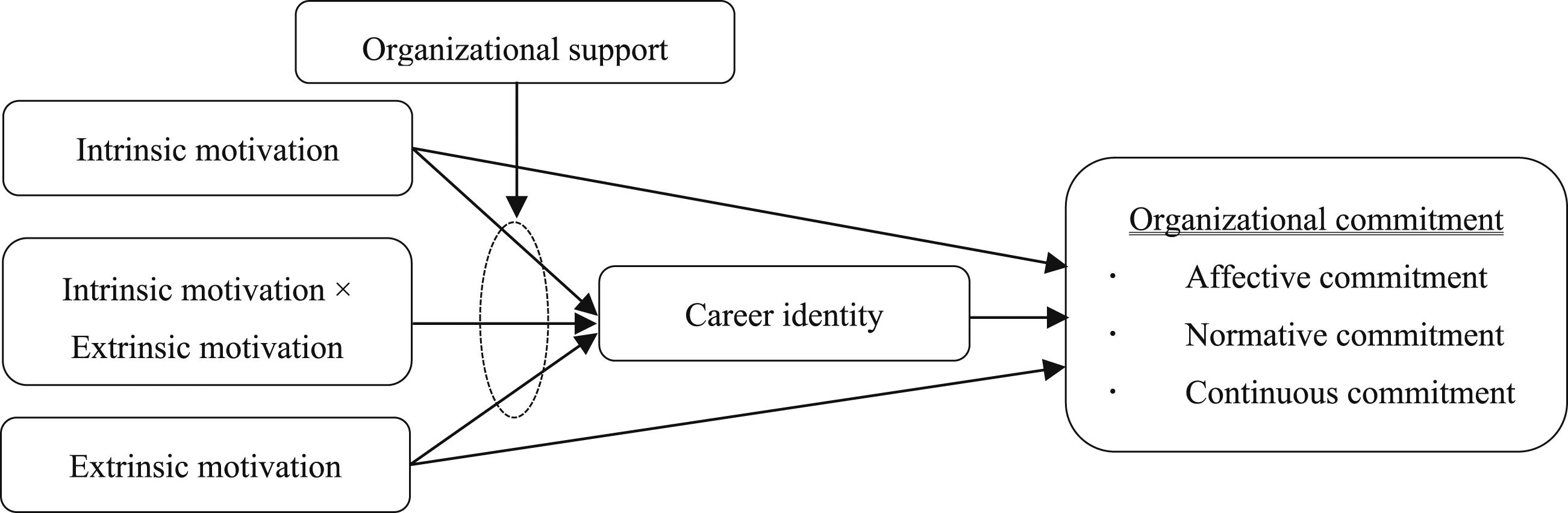
Theoretical Background and Hypothesis Development
Theoretical Background
Integrative Model of Commitment and Motivation
The integrative model of commitment and motivation (Meyer et al., 2004) is based on the motivation process model (Locke, 1997), which provides a logic map on how psychological human needs influence OC. Furthermore, it reveals the underlying and boundary mechanisms in the link between multidimensional motivation and OC. Goal regulation is posited as a key concept in the integrative model; moreover, basic human needs, values, personality, incentives, and self-efficacy are proposed to powerfully impact individuals’ goal regulation. Goal regulation is a motivational mindset which refers to individuals’ beliefs about why they are pursuing a particular goal. Furthermore, it reflects the reasons for, and purpose of, a course of action being contemplated or conducted, including an assessment of the reasons for (Buss, 1978), or locus of causality of (De Charms, 1968), a course of action. It considers intrinsic and extrinsic motivation as multidimensional concepts from external regulation (external and introjected) to internal regulation (intrinsic, integrated, and identified; Deci & Ryan, 2004). Specifically, external regulation refers to behaviors aimed at satisfying an external demand or reward contingency and is associated with feelings of being in control. Introjected regulation involves individuals’ self-worth; that is, behaving in a socially acceptable manner to avoid guilt or anxiety, or to gain others’ respect, which also gives individuals a sense of control. Identified regulation results from a conscious evaluation of the action and its intended consequences and experience as an internal motivation. Integrated regulation refers to behaviors guided by fully accepted values that are integrated with other needs and defining one’s self-concept; however, the behavior is not necessarily enjoyable. Intrinsic regulation reflects individuals’ behaviors that are driven by interest in the activity itself and is completely autonomous. The model emphasizes that all forms of goal regulation can be motivated by individual and environmental factors. Moreover, it results in three facets of OC through the causal chain, from goal choice (i.e., difficulty and specificity); goal mechanisms (i.e., direction, effort, persistence, and task strategies); and behavior (i.e., non-discretionary and discretionary); to bases of commitment (including identification, value congruence, involvement, socialization, reciprocity norm, investments, and lack of alternatives).
Organizational Support Theory
Organizational support theory posits that individuals develop varying beliefs regarding their organization’s concern for their wellbeing and recognition of their contributions (Eisenberger et al., 1986). Organizational support is considered an index of the quality of the individual–organization exchange relationship (Cropanzano et al., 2017). A high level of organizational support is often reciprocated by employees through various desirable attitudes and behaviors, such as OC, turnover intention, and actual turnover behavior (Kurtessis et al., 2017; Raabe et al., 2020; Riggle et al., 2009). These outcomes are attributed to the reciprocation of social exchange, and they serve to maintain exchange relationships between individuals and organizations (Eisenberger et al., 2001). Moreover, extant empirical studies have revealed that organizational support plays an important boundary role in the process of identity and commitment to an organization (Eisenberger et al., 2020; Matusik et al., 2021). In this study, we proposed a hypothetical chain from enlistment motivation (intrinsic and extrinsic), to career identity, and, ultimately, to the three facets of OC under the boundary condition of organizational support, which fits the logic framework of organizational support theory.
Hypothesis Development
Relationship between Enlistment Motivation and Organizational Commitment
Although cadets enlist in the military for complex reasons, including tangible and intangible factors (Griffith, 2008; Woodruff et al., 2006), motivation is an important contributor to their ongoing service in the military (Ngaruiya et al., 2014; Raabe et al., 2020). According to the intrinsic-extrinsic motivation dualism, intrinsic motivation reflects “the inherent tendency to seek out novelty and challenges, to extend and exercise one’s capacities, to explore, and to learn” (Ryan & Deci, 2000, p. 70). This includes curiosity, competence, and autonomy. Conversely, extrinsic motivation is defined as “the performance of an activity in order to attain some separable outcome” (Ryan & Deci, 2000, p. 71) and exists for more positive consequences, such as incentives. These classifications and concepts can also be applied to military cadets. For example, Tresch and Bill (2011) surveyed 18 motivating factors (e.g., leadership, interest in the military, job security, and pay) of Swiss military cadets to become professional officers. The factors could be reduced to intrinsic (e.g., self-improvement, patriotic duty, and becoming disciplined and confident) and extrinsic (e.g., salary, benefits, enlistment bonus, funding for education, parents’ expectations, and employment guarantee; Woodruff et al., 2006; Ngaruiya et al., 2014) motivation. Moreover, intrinsic and extrinsic motivation significantly impact their propensity and commitment to the military, particularly when economic and societal conditions cause decreased enlistment and increased attrition (Griffith, 2008; Ngaruiya et al., 2014). Moreover, Wrzesniewski et al. (2014) proposed five types of military enlistment motivation, including family influence, financial need, instrumental motives, internal motives, and professional advice. In summary, cadets are motivated by different factors which can satisfy their psychological needs to some extent, such as self-improvement and job opportunities. Based on self-determination theory (Deci & Ryan, 2000) and the integrative model of commitment and motivation (Meyer et al., 2004), the satisfaction of cadets’ inherent psychological needs will activate their intrinsic and extrinsic motivation to enhance their OC (Ly et al., 2021). Previous studies also revealed that motivation is a vital contributor to cadets’ commitment to the military (Ngaruiya et al., 2014; Wrzesniewski et al., 2014).
First, AC emphasizes cadets’ identification with and emotional attachment to the military organization (Gade, 2003). When organizations satisfy cadets’ basic psychological needs (including autonomy, relatedness, and competence), individuals – especially intrinsically motivated individuals – are more likely to experience increased emotional attachment to and involvement in the organization, as well as enhanced AC (Bono & Judge, 2003; Gagné et al., 2004, 2008; Greguras & Diefendorff, 2009; Meyer et al., 2012). In addition, the military also provides some tangible rewards, such as job opportunity, salary, and other external rewards, that can satisfy extrinsically motivated cadets’ psychological needs (Berk, 2018; Ngaruiya et al., 2014). This subsequently improves their AC.
Second, NC represents cadets’ obligation or calling to remain within the military organization and consider their role as more than just a job (Gade, 2003). It contains two facets: an NC that is dominated by moral duty from social life versus indebted obligation, which correlates more strongly with AC and CC, respectively (Meyer & Parfyonova, 2010). Specifically, if cadets elect to enlist in the military, their needs for autonomy and competence will be satisfied, and they will experience more moral-based obligations. Conversely, if the military actively selects cadets, their needs for relatedness will be satisfied and they will experience more debt-based obligations (Al-Jubari et al., 2019). Therefore, when individuals obtain a certain role in the military, based on the reciprocity and fairness rules of the social exchange theory, both intrinsically and extrinsically motivated individuals’ moral duties (Meyer et al., 2012) and indebted obligations (Gagné et al., 2008) require them to behave appropriately for their role. Under such circumstances, they will establish social and economic exchange relations with the organization and return to their organization with a higher level of NC (Krajcsák, 2019).
Third, CC emphasizes cadets’ feelings that they must continue in the military because it would be difficult to find another job, or because they had invested too many years in the military (Gade, 2003). Even though cadets perceive less autonomic needs, satisfying their needs for competence and relatedness can also increase their engagement in the military. Specifically, when cadets’ needs for competence and relatedness are satisfied in the military, they may have concerns regarding obtaining the same resources, competence, recognition, and care from other organizations; thus, the potential risk of leaving the military heightens CC (Neubert & Halbesleben, 2015). Moreover, extrinsically motivated cadets may calculate the cost of leaving the organization and may be fearful of the sacrifices and few job options that they are presented with (Gagné et al., 2010).
As argued above, intrinsic and extrinsic motivation are positively associated with the three facets of OC. Compared with extrinsically motivated individuals, intrinsically motivated individuals put more effort into and have a stronger commitment to their organization (Gagné et al., 2004, 2008, 2010; Iverson & Buttigieg, 1999; Kuvass et al., 2017), implying that intrinsic motivation is more critical for enhancing the three facets of OC (Kim & Park, 2020). Thus, most scholars have confirmed that intrinsic motivation dominates extrinsic rewards (Deci & Ryan, 2008; Gagné & Deci, 2005) in shaping OC (Jones & Lloyd, 2005; Kuvass et al., 2017; Moon, 2000; Tremblay et al., 2009). Accordingly, we hypothesize the following:
Both intrinsic and extrinsic motivation are positively related to the three facets of OC, but the effect of intrinsic motivation is stronger than that of extrinsic motivation. Moreover, although intrinsic and extrinsic motivations are separate motivational dimensions, they can coexist for individuals in a specific activity (Deci & Ryan, 2008; Gagné & Deci, 2005; Wrzesniewski et al., 2014). Thus, what happens to the three facets of OC when intrinsic and extrinsic motivation are combined should be elucidated. For example, the “motivation crowding-out effect” (Frey & Oberholzer-Gee, 1997) posits that extrinsic motivation can undermine whatever intrinsic motivation may have existed, thereby decreasing overall motivation, persistence, and different types of OC (Deci et al., 1999), thus causing people to pursue external incentives (Meyer et al., 2004) over altruistic values and civil duty (Frey & Oberholzer-Gee, 1997). This effect has been confirmed in various experimental (Frey & Jegen, 2001) and field studies (Bowles & Polanía-Reyes, 2012; Lepper & Henderlong, 2000). For instance, external incentives can destroy individuals’ free-choice intrinsic motivation (Deci et al., 1999) and contingent rewards will decrease job satisfaction (Cho & Perry, 2012; Dysvik et al., 2013). In the military context, Wrzesniewski et al. (2014) conducted a 14-year longitudinal study and found that over 10,000 cadets with both intrinsic and extrinsic motivations for applying to the West Point demonstrated decreased military occupational commitment and performance. Thus, this study argues that extrinsic motivation can also crowd out the positive effect of intrinsic motivation on the three facets of OC, because individuals are more likely to perceive external interventions as reducing their self-determination. This thereby results in extrinsic control for intrinsic motivation to participate in and complete their military service. Accordingly, we hypothesize the following:
Extrinsic motivation undermines the positive effects of intrinsic motivation on the three facets of OC.
Mediating Role of Career Identity
Career identity is defined as “a structure of meanings in which the individual links their motivation, interests, and competencies with acceptable career roles” (Meijers, 1998, p. 191). It reflects an individual’s definition of themselves in a specific career context and acts as a “cognitive compass” to navigate career opportunities (Fugate et al., 2004). According to the integrative model of commitment and motivation, intrinsically motivated cadets’ positive career value and their psychological needs to enlist in the military will stimulate their intrinsic motivation to serve their country (Ngaruiya et al., 2014; Raabe et al., 2020). Specifically, autonomous cadets have more choices in making decisions to align with their own values. Competent cadets are more confident in their ability to successfully accomplish the tasks that are demanded of them in the military. Finally, cadets with a high sense of relatedness experience belongingness to the group, which helps them to positively connect with the organization and to feel comfortable in their specific role (Deci & Ryan, 2000). Thus, their career identity may be improved through strong intrinsic motivation and by thriving in their career. Furthermore, extrinsically motivated cadets who enlist in the military are more likely to link their career identity with tangible extrinsic motivators (Woodruff et al., 2006). When these tangible factors satisfy cadets’ extrinsic needs, such as salary, enlistment bonus, funding for their education, and employment guarantees, their extrinsic motivation can be activated (Ngaruiya et al., 2014; Woodruff et al., 2006). This may also strengthen their extrinsic meaning and career identity as a military cadet who serves the military and their country.
However, according to the “motivation crowding-out effect” (Frey & Oberholzer-Gee, 1997), the salient instrumental incentives will trigger cadets’ extrinsic motivation and undermine their intrinsic motivation to identify with the military profession and serve the military (Wrzesniewski et al., 2014). That is, the external motivation of cadets with multiple motivations will limit their intrinsic interest in the military and crowd out intrinsic motivation by introducing external incentives (Zhang et al., 2016; Zhang & Guo, 2003). Under such circumstances, the “motivation crowding-out effect” may reduce their positive perception of the military and negatively influence their ability to identify with the career and organization (Wrzesniewski et al., 2014). Hence, we hypothesize the following:
Both intrinsic and extrinsic motivation are positively related to career identity.
The interactive term of intrinsic and extrinsic motivation is negatively related to career identity. Additionally, according to the integrative model of commitment and motivation, career identity as a “cognitive compass” is also a key contributor to cadets’ commitment to an organization. That is, cadets with high career identity can understand their career goals, competence, and direction more explicitly (Praskova et al., 2015). This positive cognition will impact their attitude and behavior in the organization, including turnover intention (Jesus et al., 2021) and OC (Meyer et al., 2004). Specifically, cadets’ career identity prior to enlistment is positively related to their affective embeddedness (i.e., affective connections and match between oneself and the military); reciprocity norm (i.e., responsibility and obligation to provide feedback to the military); and sacrifice (i.e., costs and benefits associated with leaving the military). Previous studies demonstrate that a stronger career identity contributes to enhancing individuals’ satisfaction and embeddedness within the organization (Burleson et al., 2021), thus improving their OC (Yao et al., 2019). Therefore, career identity may be positively related to the three facets of OC. Finally, based on the above inferences and Hypotheses 1 and 2, we hypothesize the following:
Career identity mediates the effect of intrinsic and extrinsic motivation on AC, NC, and CC, respectively.
Career identity mediates the interactive effect of intrinsic and extrinsic motivation on AC, NC, and CC, respectively.
Moderating Role of Organizational Support
Organizational support refers to individuals’ “beliefs concerning the extent to which the organization values their unique and aggregate contributions, and cares about their individual and collective well-being” (Eisenberger et al., 1986). Numerous studies have demonstrated that organizational support, which is a typical situational factor, involves members’ experience of mutual benefit and social exchange with the organization, and has an important impact on individuals’ motivation, cognition, attitude, and behavior (Aldabbas et al., 2021; Thompson et al., 2020). When military cadets’ motivation shapes their career identity and OC, the combined influences of personal, family, and organizational factors are crucial (Ngaruiya et al., 2014). As cadets’ relationship with the organization is a predominant factor which strengthens their commitment to pursuing a career in the military (Card, 1976), the synergistic support from the academy, military, and family units with different goals (Tresch & Bill, 2011) should be considered. Notably, family support cannot be overlooked, because in the Chinese context, families play a prominent role in individuals’ career choice and self-development by sharing their values regarding what constitutes a meaningful occupation, thus influencing their children’s calling and commitment to the occupation. Therefore, according to the integrative model of commitment and motivation and organizational support theory, we theorize that the combined support from the academy, military, and family can produce direct and interactive effects on cadets’ internal factors, which subsequently affect their career identity and OC.
We assume that organizational support moderates the relationship between intrinsic motivation and career identity. Specifically, the positive effect of intrinsic motivation on career identity is weaker when organizational support is high. The positive effect of organizational support has received much attention; however, individuals with unique support requirements and granting excessive support are not always preferable (Matusik et al., 2021). This is because excessive support suggests that the provider lacks trust and confidence in the recipient and threatens the recipients’ autonomy, competence, and self-esteem, resulting in inequity, disrespect, and other negative feelings (Brock & Lawrence, 2009; Cutrona et al., 1990; Cutrona & Suhr, 1992; Lindorff, 2000; Matusik et al., 2021; Williamson et al., 2019). For example, previous studies found that excessive support is associated with depressive symptoms (Buunk et al., 1993) and negative affect (Williamson et al., 2019). Moreover, it is an even greater risk factor for marital decline than providing inadequate support (Brock & Lawrence, 2009). Additionally, based on the strong situation hypothesis (Cooper & Withey, 2009; Mischel & Shoda, 1995), for intrinsically motivated cadets, an excessive situational factor (organizational support) may dominate the effect of intrinsic motivation on their cognition (career identity) and attitude (OC). Moreover, it may obscure their inner desire (Gagné & Deci, 2005; Lindorff, 2000; Matusik et al., 2021) to enlist in the military and dampen their strong patriotic duty. Thus, the positive effect of intrinsic motivation on career identity is weaker. However, intrinsically motivated cadets enlisting in the military because of patriotism follow orders more willingly and are more autonomous (Meyer et al., 2004). Further, when organizational support is adequate – but not excessive – individuals’ sense of control, pressure, and over indebtedness to their organization is weaker; however, equity, respect, and self-esteem is stronger than when organizational support is too high (Brock & Lawrence, 2009; Williamson et al., 2019; Wong et al., 2000). Hence, we hypothesize the following:
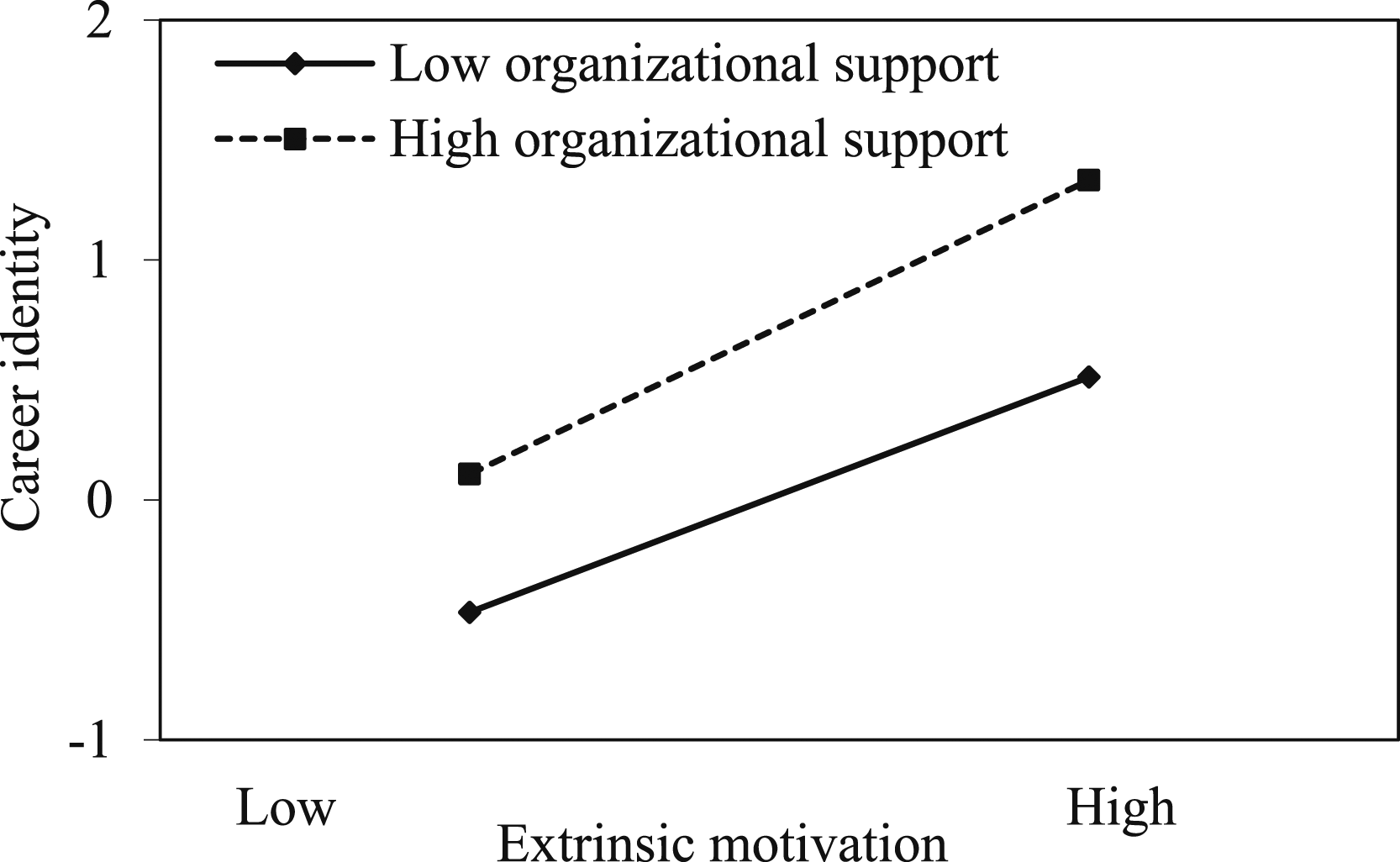
Organizational support moderates the link between intrinsic motivation and career identity, such that when organizational support is low, the relationship is stronger. Moreover, we propose that organizational support moderates the link between extrinsic motivation and career identity. Specifically, extrinsically motivated cadets may perceive a high level of organizational support from the military, academy, and family as more tangible, symbolic, and as a socioemotional resource support. When individuals’ instrumental needs are satisfied, they are more likely to evaluate themselves using the qualities, beliefs, values, and norms of the career and organization (Woodruff, 2017). This will construct a stronger emotional and cognitive connection to their organization (Matusik et al., 2021) and produce a stronger career identity and commitment to the organization (Allen & Meyer, 1990; Susskind et al., 2000). Thus, the high extrinsic motivation and organizational support will produce a “spillover effect” to incorporate cadets’ membership and roles into their career identity (Rhoades & Eisenberger, 2002). Conversely, low levels of organizational support cannot fulfill cadets’ instrumental needs, and subsequently, their extrinsic motivation cannot be fully activated (Tett et al., 2021). It can thus be inferred that the positive relationship between extrinsic motivation and career identity is weaker when organizational support is high. Therefore, we hypothesize the following:
Organizational support moderates the link between extrinsic motivation and career identity, such that when organizational support is high, the relationship is stronger. Furthermore, we infer that organizational support jointly interacts with extrinsic motivation to influence the relationship between intrinsic motivation and career identity. Specifically, when organizational support and extrinsic motivation are low, the link between intrinsic motivation and career identity is stronger. This is because less organizational support cannot fully stimulate cadets’ extrinsic motivation (Tett et al., 2021). Thus, lower extrinsic motivation will not obscure the positive effect of intrinsic motivation on career identity; subsequently, less obligation and indebtedness to their organization will not seriously threaten their sense of patriotic duty (Wrzesniewski et al., 2014), self-confidence, autonomy, competence, and relatedness (Matusik et al., 2021; Williamson et al., 2019) for enlisting in the military. Conversely, when extrinsic motivation and organizational support are high, the link between intrinsic motivation and career identity is the weaker. This is because high organizational support implies that the provider lacks confidence in the recipient and often places excess emphasis on extrinsic factors (Brock & Lawrence, 2009). Both these factors may produce a stronger sense of over-indebtedness to the organization (Williamson et al., 2019) and result in the “crowding-out effect,” thereby weakening or stifling the positive link between intrinsic motivation (Gagné & Deci, 2005; Ryan & Deci, 2000) and career identity. Similarly, according to the trait activation theory (Tett et al., 2021), despite high extrinsic motivation, weaker environmental stimulation (organizational support) cannot drive individuals’ extrinsic motivation and obligation and indebtedness to their college, military, and family. This lessens the “crowding-out effect” of extrinsic motivation on intrinsic motivation and career identity. Therefore, when organizational support is low and extrinsic motivation is high, the link between intrinsic motivation and career identity is weaker. Conversely, when organizational support is high and extrinsic motivation is low, although heightened obligation and indebtedness to the military will increase cadets’ psychological stress, extrinsically motivated cadets are less likely to believe that organizational support is based on what they can contribute to the military and whether the organization cares for their interests and well-being. Therefore, cadets will likely extrapolate deeper meanings from their support, looking beyond any extrinsic value it offers (Matusik et al., 2021). Moreover, to some extent, cadets may perceive more autonomy, competence, and relatedness, which subsequently heightens their intrinsic motivation (Cheval et al., 2017; Gagne et al., 2003). Consequently, this will strengthen the positive link between intrinsic motivation and career identity; however, the effect is weaker. According to the above, we hypothesize the following:
Organizational support and extrinsic motivation jointly moderate the link between intrinsic motivation and career identity, such that when organizational support and extrinsic motivation are low, the positive relationship is stronger. Finally, based on
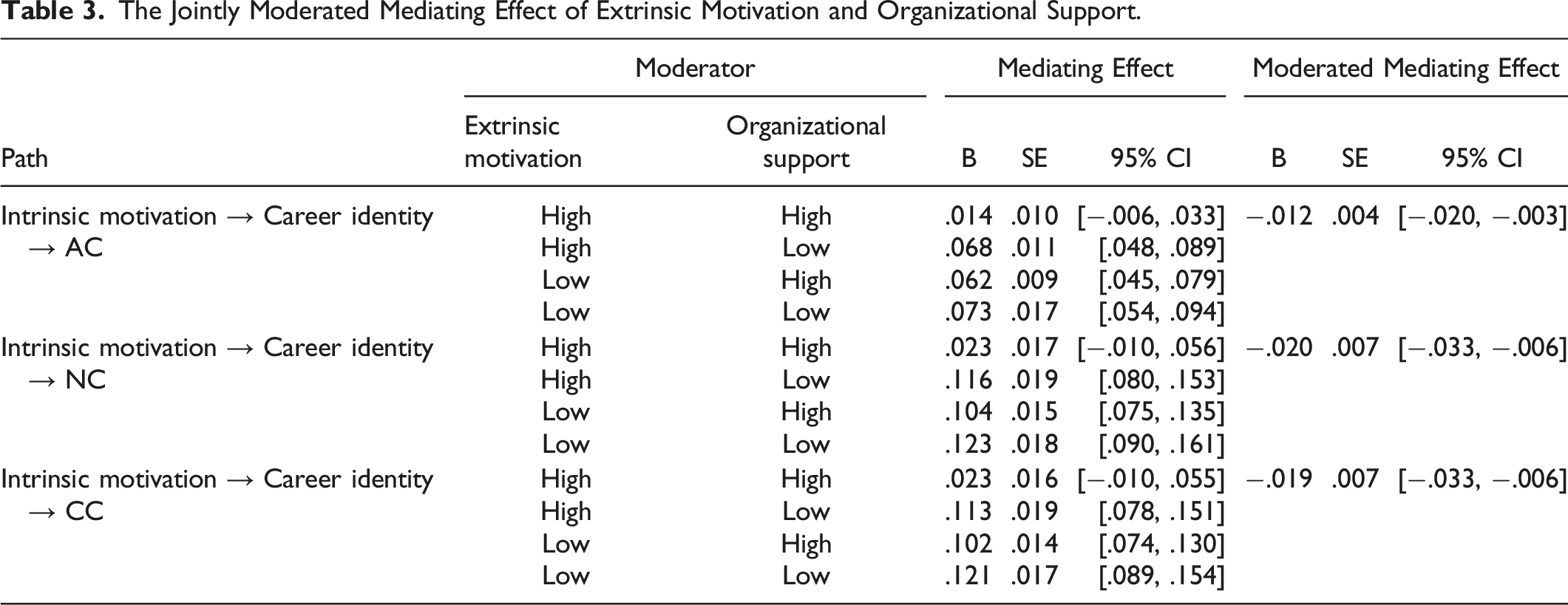
Organizational support and extrinsic motivation jointly moderate the mediating effect of career identity in the relationship between intrinsic motivation and AC (5a), NC (5b), and CC (5c), such that when organizational support and extrinsic motivation are low, the mediating effects are stronger.
Method
Participants and Procedure
Preliminary Test
The enlistment motivation and organizational support scales in this study were adapted from existing scales. Thus, to ensure the revised scales were reliable and valid, a preliminary test, separate from the formal data collection, was conducted among 960 Chinese Reserve Officers’ Training Corps (ROTC) cadets from four universities in China. Of these, 929 participants (96.7%) were male and 31 (3.2%) were female, with 321 aged under 21 years (33.4%), 634 were 21–25 years (66.0%), and 5 were above 26 years (0.5%). Regarding grade distribution, there were 107 (11.1%), 305 (31.8%), 314 (32.7%), and 234 (24.4%) participants in grades 1, 2, 3, and 4, respectively. As enlistment motivation and organizational support scales in this study were adapted from existing scales, we ran an exploratory factor analysis for each scale. Results revealed that all factors in each scale were loaded on the specific dimensions and factor loadings were above 0.41. Additionally, the measurement details and the reliability and validity were reported in the formal test.
Formal Test
A cluster sampling method was utilized in this study in which Chinese Army ROTC cadets were recruited from 11 Chinese universities. Before our survey, we first contacted the director of the ROTC office, who is responsible for leading and training enlisted cadets, planning missions, and organizing internal and external affairs. After obtaining their approbation and support, cadets were gathered at an auditorium. Before the survey, cadets were informed that a three-time points design will be used in this study. Data were collected at one-month intervals to reduce common method deviation (Ostroff et al., 2002; Podsakoff et al., 2012). Participation was voluntary and anonymous, and data were only used for scientific research. After obtaining participants’ informed consent, the researchers began the formal survey. To match questionnaires thrice, cadets were asked to write their universities’ names and student numbers on the right of the cover page. At time 1, demographic variables, enlistment motivation, and person–organization fit were measured. At time 2, career identity and organizational support were measured, and OC was measured at time 3, using the same procedure as time 1.
A total of 1709 questionnaires were collected, after excluding 103 questionnaires that had mismatched or incomplete responses. Finally, we obtained 1606 questionnaires, yielding a valid response rate of 93.97%. Males represented 98.4% (1581) and females 1.6% (25) of the sample. Those aged 20 years and below, 21–25, and 25 years and above accounted for 39.1% (628), 60.5% (972), and 0.4% (6) of the participants, respectively. Freshmen, sophomores, juniors, seniors, and postgraduates respectively composed 0.9% (14), 32.2% (517), 31.3% (502), 35.2% (566), and 0.4% (7) of the participants.
Measures
Enlistment Motivation
The enlistment motivation scale, including intrinsic and extrinsic motivation, was originally developed by Wrzesniewski et al. (2014). The enlistment motivation of incoming cadets at West Point was divided into six facets: family influence, financial need, professional advice, self-improvement, intrinsic motivation, and instrumental motivation. It demonstrated a good model fit in their study (CFI = .953, TLI = .961, RMSEA = .042). We selected two subscales – intrinsic (Cronbach’s α = .75) and extrinsic (Cronbach’s α = .78) motivation – with five items each in the pretest, which exhibited an acceptable reliability and model fit (α = .75; χ2/df = 4.056, GFI = .973, TLI = .942, CFI = .956, RMSEA = .056). Participants rated the extent to which factors influenced their decision to enlist in the ROTC on a five-point scale, ranging from 1 (never influenced) to 5 (strongly influenced). Sample items of intrinsic and extrinsic motivation were “Desire to be an army officer” and “To be able to get a better job,” respectively. In this study, the reliability (Cronbach’s α = .78) and the model fit for enlistment motivation (χ2/df = 7.045, GFI = .972, TLI = .958, CFI = .968, RMSEA=.061) were acceptable, and the Cronbach’s α for intrinsic and extrinsic motivation was .87 and .83 respectively.
Organizational Commitment
The OC scale was originally developed by Meyer et al. (1993) and comprised three dimensions – AC, NC, and CC – with six items for each dimension. This scale has been used to test the OC of military personnel and showed good reliability and validity (Meyer et al., 2017). It was rated on a five-point scale (1 = strongly disagree, 5 = strongly agree). Sample items for AC, NC, and CC were “I would be very happy to spend the rest of my career with military,” “Too much of my life would be disrupted if I decided I wanted to leave military now,” and “The military deserves my loyalty,” respectively. In this study, the Cronbach’s α for the full scale was 0.94 and Cronbach’s α for AC, NC, and CC was .87, .83, and .87, respectively. The three-dimensional model indices (χ2/df = 9.118, GFI = .916, TLI = .918, CFI = .929, RMSEA = .071) were acceptable.
Career Identity
A six-item career identity scale from Pan (2014) that was previously used to measure Chinese college teachers’ career identity demonstrated good reliability (α = .89) and model fit (χ2/df = 1.863, GFI = .963, NFI = .957, IFI = .963). It was rated on a five-point scale (1 = strongly disagree, 5 = strongly agree). A sample item was “I am proud of myself for being a reserve officer.” In this study, Cronbach’s α for this scale was 0.85 and the model indices (χ2/df = 11.263, GFI = .979, TLI = .959, CFI = .975, RMSEA = .080) were acceptable.
Organizational Support
The organizational support scale was originally developed by Eisenberger et al. (1986) and modified according to the Chinese context. It comprised three dimensions: military support, academy support, and family support, each dimension with five items. In the pretest, the three-factor model had a good fit (χ2/df = 5.907, GFI = .933, TLI = .925, CFI = .938, RMSEA = .072). Total Cronbach’s α was 0.90; and .90, .81, and .80 for military support, academy support, and family support, respectively. It was rated on a five-point scale ranging from 1 (strongly disagree) to 5 (strongly agree). Sample items for military, college, and family support were, “The reserve officer training office provides us with exclusive military training place and equipment;” “My family respects my thoughts and feelings;” and “When I have difficulties in my studies, training, or life, my teachers at the academy will help me;” respectively. In this study, Cronbach’s α for this scale was .92, and .87, .84; and .81 for military, college, and family support, respectively. The three-dimensional model indices (χ2/df = 8.868, GFI = .940, TLI = .929, CFI = .941, RMSEA = .070) fitted the standard.
Control Variables
Previous studies have demonstrated that gender (female = 0, male = 1); age (under 21 years = 1, 21–25 = 2, above 25 years = 3); grade (freshman = 1, sophomore = 2, junior = 3, senior = 4, postgraduate = 5); and person–organization fit are significantly related to OC (Greguras & Diefendorff, 2009; Peng, 2018). Thus, these variables were controlled for in this study. A person–organization fit scale rating from 1 (strongly disagree) to 5 (strongly agree), developed by Harold et al. (2016), was used in the present study. This scale was originally used to evaluate applicants in the United States who aspired to engage in military service. It included two items (α=.81): “This organization’s values and culture provide a good fit with the things I value in life” and “My values in life are consistent with the things this organization values.” In this study, Cronbach’s α for this scale was .82.
Results
Preliminary Analysis
Common Method Deviation Test and Descriptive Analysis
Means, Standardized Deviation, and Coefficients for Variables.
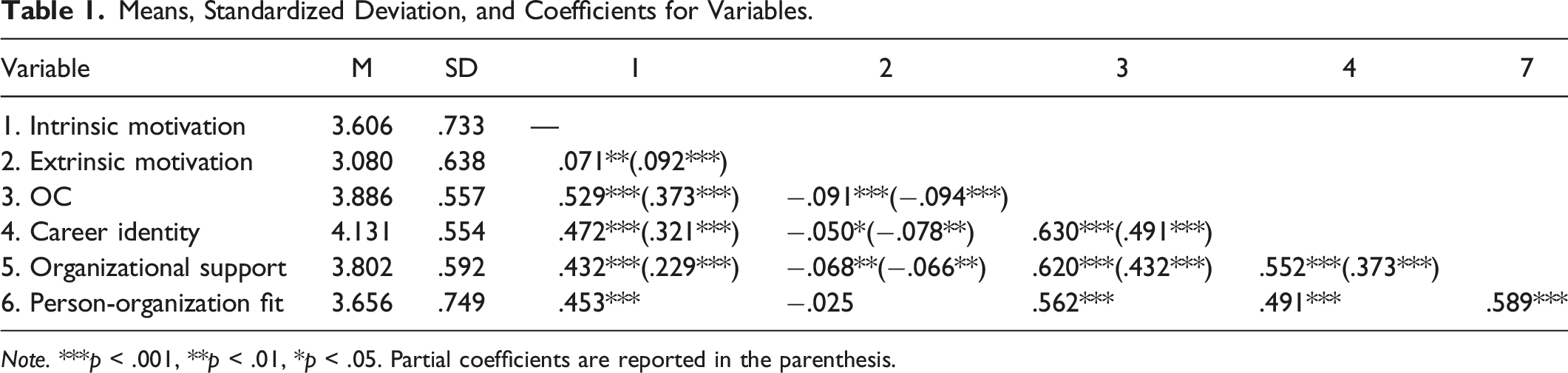
Note. ***p < .001, **p < .01, *p < .05. Partial coefficients are reported in the parenthesis.
Discriminate Validity
Furthermore, CFA results also revealed that the research model had a good fit (χ2/df = 3.692, GFI = .900, TLI = .922, CFI = .927, RMSEA = .041) compared to the alternative models. The AVE and CR values for intrinsic motivation (AVE = .57, CR = .87), extrinsic motivation (AVE = .50, CR = .83), OC (AVE = .50, CR = .95), organizational support (AVE = .52, CR = .94), and career identity (AVE = .51, CR = .86) were also acceptable. Moreover, the standardized factor loading values were greater than .50. These results demonstrated that all variables had a good discriminate validity.
Hypothesis Testing
We used the PROCESS macro from Hayes (2013) for hypothesis testing. In the model templates, model 11 assumed that the first stage of the mediating effect was jointly moderated by W (extrinsic motivation) and Z (organizational support), consistent with the theoretical hypotheses. All variables were standardized in the analysis, and demographic variables and person–organization fit were controlled for throughout the analysis.
The Regression Analysis Results of the Moderated Mediating Effect.
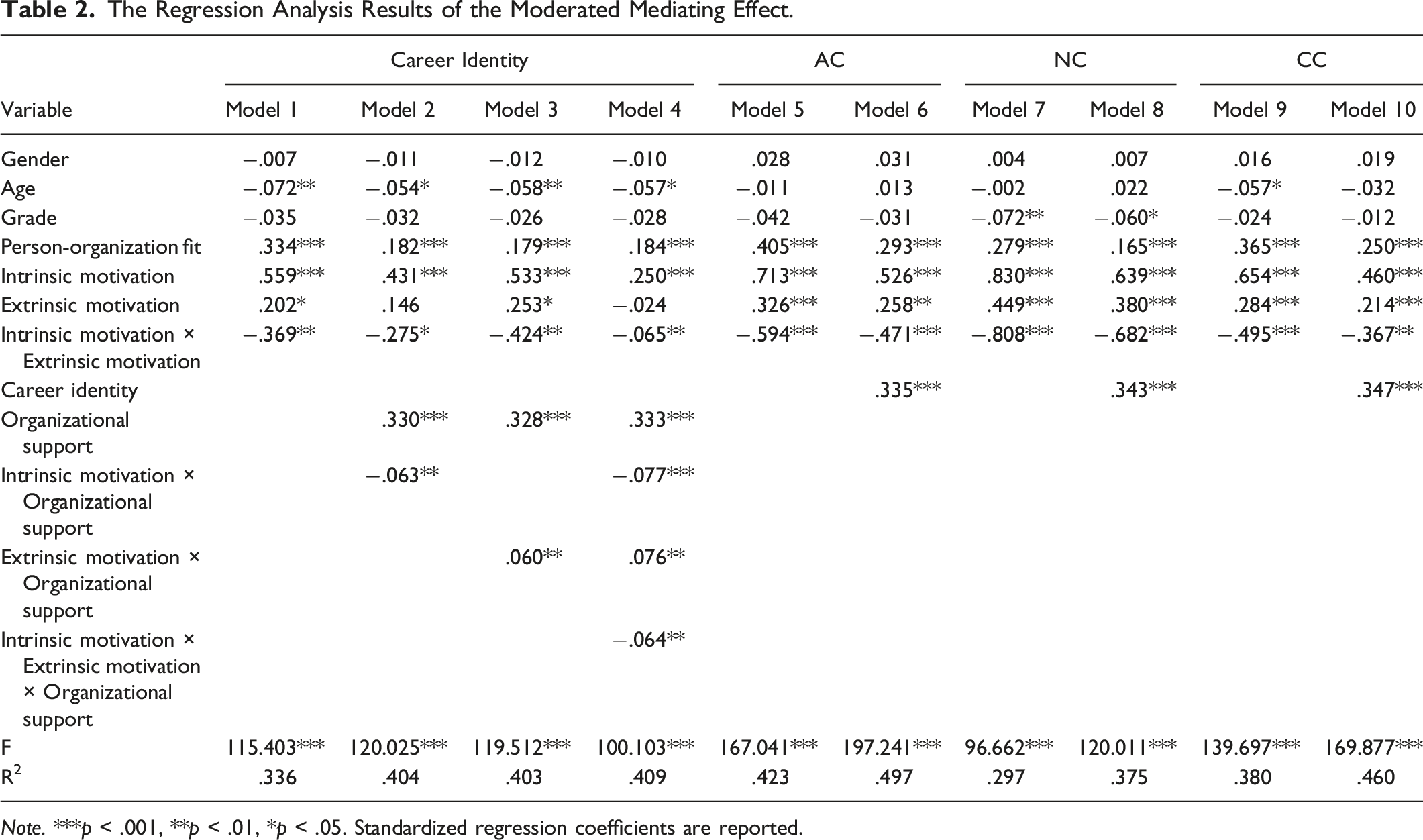
Note. ***p < .001, **p < .01, *p < .05. Standardized regression coefficients are reported.
Moreover, as shown by models 6, 8, and 10 in Table 2, when career identity was considered as a mediator in the relationship between enlistment motivation and the three facets of OC, the positive effects of intrinsic motivation and extrinsic motivation on AC (β = .526, p < .001; β = .258, p < .01), NC (β = .639, p < .001; β = .380, p < .001) and CC (β = .460, p < .001; β = .214, p < .001) were significant, supporting
In addition, as shown by model 2 in Table 2, when the main effect of extrinsic motivation and the interactive term of intrinsic and extrinsic motivation were controlled for, the interactive term of intrinsic motivation and organizational support significantly and negatively predicted career identity (β = −.063, p < .01). When the organizational support was low (slope low = .446, t = 4.949, p < .001), the positive relationship between intrinsic motivation and career identity was stronger than when organizational support was high (slope high = .399, t = 3.990, p < .001) (see Figure 2), supporting The moderating effect of organizational support on the relationship between intrinsic motivation and career identity. The moderating effect of organizational support on the relationship between extrinsic motivation and career identity.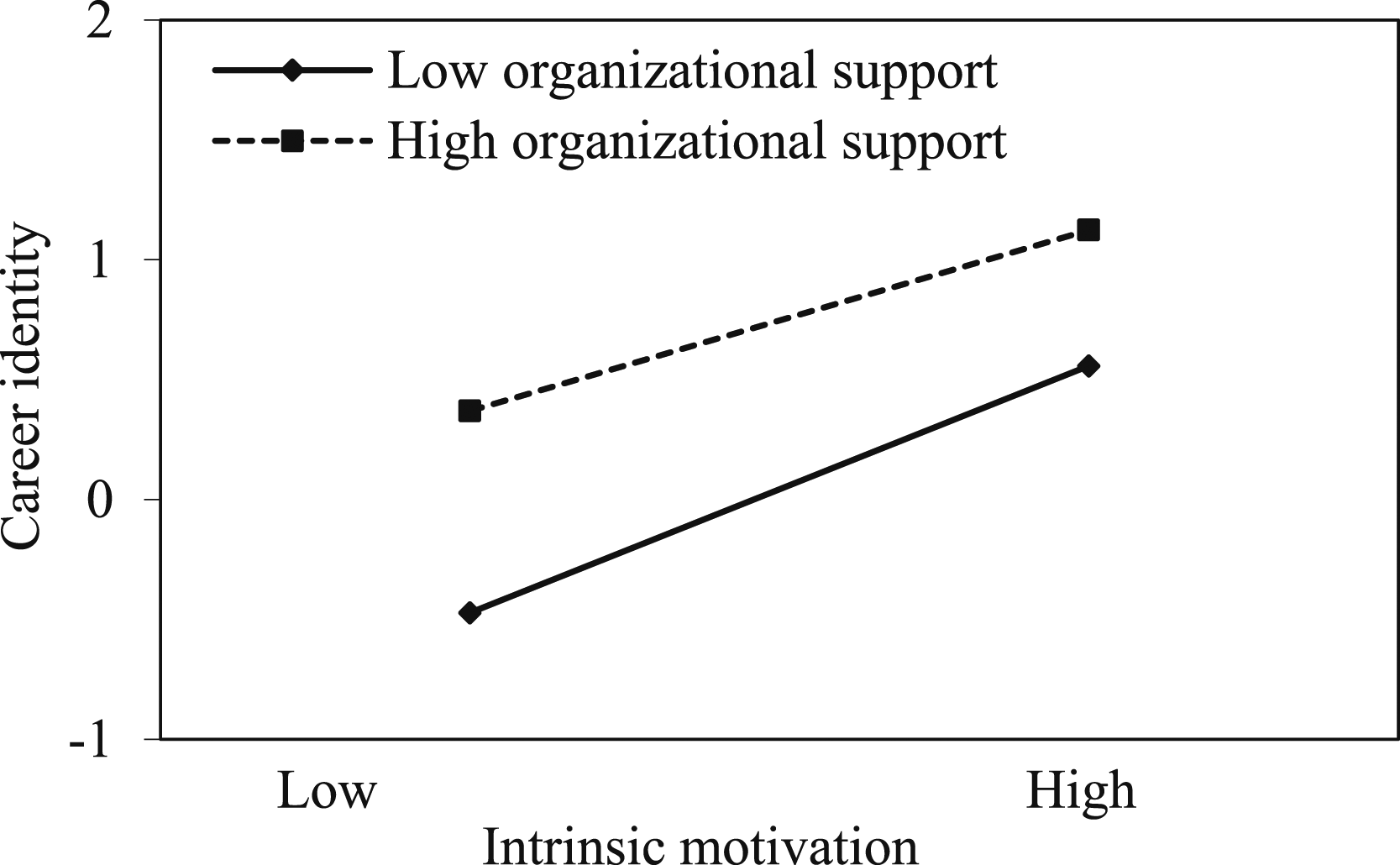
Furthermore, model 4 in Table 2 demonstrated that the interactive term of intrinsic motivation, extrinsic motivation, and organizational support significantly and negatively predicted career identity (β = −.064, p < .01). Figure 4 shows that when extrinsic motivation and organizational support were low (slope low-low = .347, t = 8.396, p < .001), the positive relationship between intrinsic motivation and career identity was stronger compared to when extrinsic motivation was high and organizational support was low (slope high-low = .335, t = 7.016, p < .001), extrinsic motivation was low and organizational support was high (slope low-high = .291, t = 7.544, p < .001), and extrinsic motivation and organizational support were both high (slope high-high = .059, t = 1.243, p > .05). Furthermore, the slope differences were significant between the group with high extrinsic motivation and high organizational support compared to when there was high extrinsic motivation and low organizational support (slope = −.276, t = −3.916, p < .001), low extrinsic motivation and high organizational support (slope = −.232, t = −4.014, p < .001), and low extrinsic motivation and low organizational support (slope = −.288, t = −4.645, p < .001). In addition, the slope differences were insignificant between the group with high extrinsic motivation and low organizational support (slope = .044, t = −.732, p > .05), low extrinsic motivation and low organizational support (slope = −.012, t = −.199, p > .05), and between the group with low extrinsic motivation and high organizational support, and low extrinsic motivation and low organizational support (slope = −.056, t = −1.075, p > .05). These results demonstrate that extrinsic motivation and organizational support jointly moderated the link between intrinsic motivation and career identity, supporting The joint moderating effect of extrinsic motivation and organizational support on the relationship between intrinsic motivation and career identity.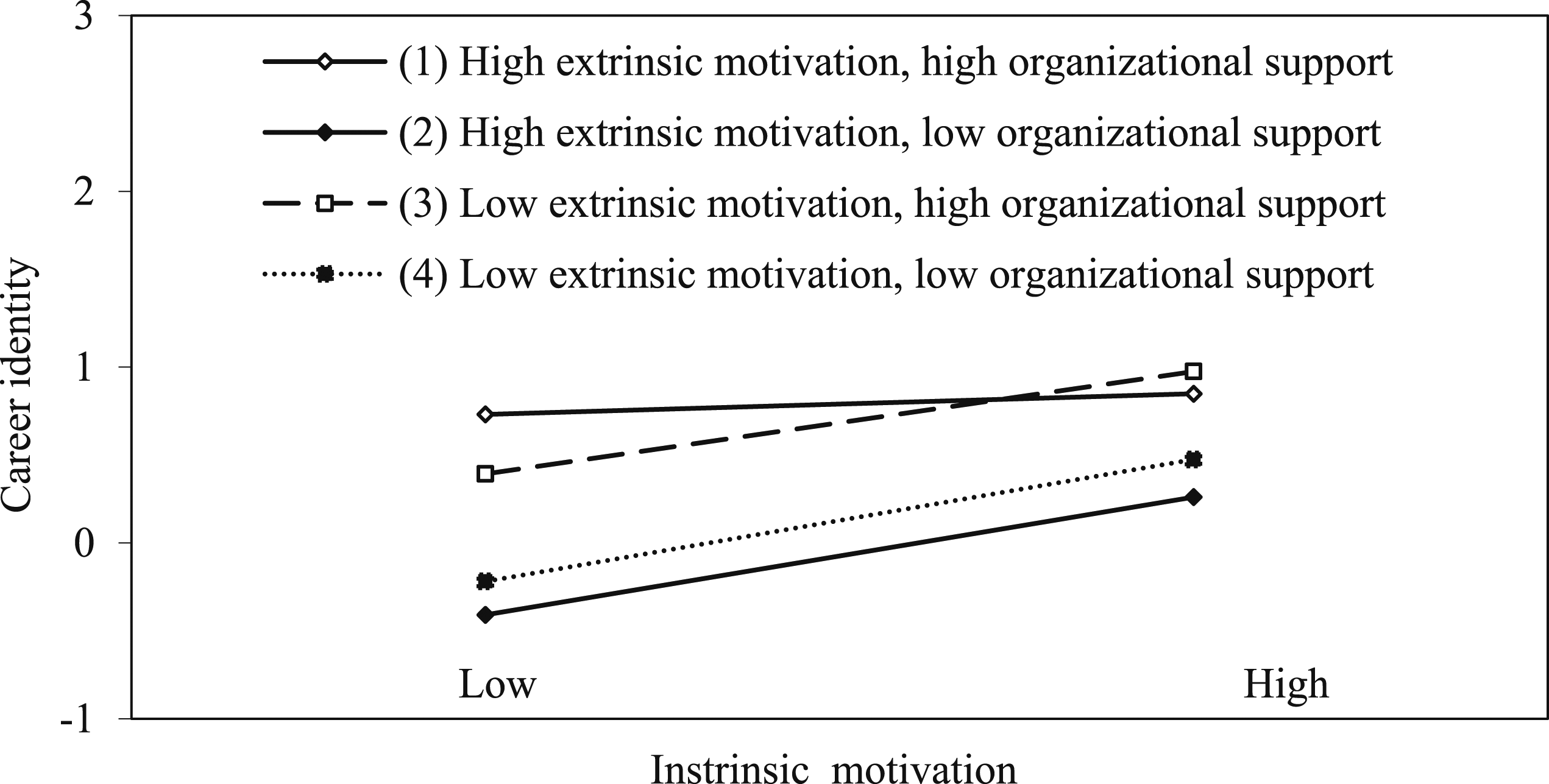
The Jointly Moderated Mediating Effect of Extrinsic Motivation and Organizational Support.
Discussion
The present study, following tenets of the integrative model of commitment and motivation, explored how and when two types of enlistment motivation influenced OC by constructing moderated mediating models. This study revealed the positive effect of intrinsic motivation and the negative interactive effect of intrinsic and extrinsic motivation on the three facets of OC. This because when cadets are intrinsically motivated, they experience a higher quality of participation and enjoyment in the military itself (Raabe et al., 2020), which is significantly related to higher levels of commitment to the military (Ngaruiya et al., 2014). Additionally, extrinsic motivation negated cadets’ autonomous motivation, altruistic values, and sense of civic duty, and obscured the positive effect of intrinsic motivation on OC (Deci et al., 1999; Frey & Oberholzer-Gee, 1997; Wrzesniewski et al., 2014). Moreover, this study demonstrated that extrinsic motivation was positively correlated with the three facets of OC; however, the effect was weaker than intrinsic motivation. The integrative model of commitment and motivation, and self-determination theory, provide theoretical support for the finding that extrinsic incentives (e.g., free tuition, job opportunities, and social status) can satisfy cadets’ psychological needs (Berk, 2018; Ngaruiya et al., 2014). This subsequently improves their sense of attachment and responsibility to the military and heightens their risk associated with leaving.
Furthermore, career identity mediated the direct relationships mentioned above, which is consistent with the integrative model of commitment and motivation. Specifically, intrinsically motivated cadets, such as those who enlist in the military for self-improvement and patriotic duty, identify more strongly with their career. Additionally, extrinsically motivated cadets who enlist for salary, benefits, and job opportunities are more likely to be satisfied with these extrinsic incentives, which can also motivate their career identity. Moreover, previous studies have demonstrated that when individuals strongly identify with their organization and career, it positively predicts their OC (Thompson, Bergeron, & Bolino, 2020).
Additionally, organizational support moderated the relationship between intrinsic and extrinsic motivation and career identity. Specifically, when organizational support was low, the positive relationship between intrinsic motivation and career identity was stronger, whereas the positive link between extrinsic motivation and career identity was stronger when organizational support was high. Additionally, organizational support and extrinsic motivation jointly moderated the effect of intrinsic motivation on career identity, and these effects were stronger at the first stage of the mediating effects between intrinsic motivation and the three facets of OC, when organizational support and extrinsic motivation were low. These findings can be explained by the “too-much-of-a-good-thing effect” (Pierce & Aguinis, 2013). Specifically, intrinsically motivated cadets may perceive distrust and lack of confidence when they receive excessive support from the academy, the military, and their family. This can undermine their need for autonomy and their self-esteem, leading to unrespect and other negative feelings (Buunk et al., 1993; Matusik et al., 2021; Williamson et al., 2019); moreover, it can decrease their identity with their career and organization. Additionally, drawing from the strong situation hypothesis (Cooper & Withey, 2009; Mischel & Shoda, 1995), excessive organizational support may diminish and mask the positive role of intrinsic motivation (Gagné & Deci, 2005; Matusik et al., 2021), and decline individuals’ career identity, especially when extrinsic motivation is high. However, extrinsically motivated cadets may perceive more social exchanges when they receive stronger organizational support, thereby strengthening their role and identity with their career and organization (Allen & Meyer, 1990; Matusik et al., 2021; Rhoades & Eisenberger, 2002; Susskind et al., 2000).
Theoretical Contributions
First, this study confirms the relationship between intrinsic and extrinsic motivation, as well as the positive effects motivation on the three facets of OC. Given that extrinsic motivation is rarely measured, few researchers have stringently tested how extrinsic and intrinsic motivation are related, and extant research on the relationship between extrinsic and intrinsic motivation and OC is usually independent and dissociated (Din et al., 2014). Further, it remains controversial whether extrinsic and intrinsic motivation positively or negatively influence, or have differential effects, on OC and its dimensions (Altindis, 2011; Vallerand et al., 1989). However, cadets may have both high and low intrinsic and extrinsic motivations for military enlistment, and their respective influences on attitudes and behaviors may either offset each other or collaborate to produce a “spillover effect” (Wrzesniewski et al., 2014). However, the interactive effect of extrinsic and intrinsic motivation on the three facets of OC has been largely overlooked. This study, with the integrative model of commitment and motivation as its theoretical basis, explored the individual and interactive effects of intrinsic and extrinsic motivation on the three facets of OC. It thus contributes to the theoretical research of motivation and OC by clarifying the positive effect of extrinsic motivation and filling gaps in the knowledge from previous research.
Second, this study further elucidates the mechanism of ROTC cadets’ intrinsic and extrinsic enlistment motivation on the three facets of OC by introducing career identity as a key process from a cognitive perspective, which addresses the unknowns regarding the underlying mechanism of motivation on OC. Previous researchers predominantly focused on the mediating role of goal choice, goal and efficacy mechanisms, performance, and satisfaction between motivation and OC (Meyer et al., 2004). Thus, the cognitive process of career identity was seldomly addressed. The current study transcends previous research limitations and reveals career identity as a potential mediator in the above relationship. Therefore, this study indicates that combining career identity may provide a more holistic framework of cadets’ military enlistment motivation and OC. Further, it contributes to enriching the integrative model of commitment and motivation by providing support for the mediating role of career identity, and provides a platform for further exploring the mechanisms of motivation and OC from various perspectives.
Third, the current study further expands extant motivation and OC literature by revealing when and how intrinsic motivation, extrinsic motivation, and their interactions, influence the three facets of OC by examining the moderating role of organizational support under the framework of integrative model of commitment and motivation. Most previous studies have demonstrated that organizational support as a situational factor strengthened individuals’ motivation and identity regarding their career and organization (Matusik et al., 2021; Rhoades & Eisenberger, 2002). However, the ways in which organizational support affects these two types of motivation and their interactive terms have been largely overlooked. This study systematically examined the moderating role of organizational support in the above relationships and found it to be negative under certain circumstances, supporting the views of Brock and Lawrence (2009) and Matusik et al. (2021). Specifically, low organizational support alone was an overt accelerator; moreover, when combined with low extrinsic motivation, it exerted a direct effect on the influence of intrinsic motivation on career identity. It was also a weak accelerator in the link between extrinsic motivation and career identity, and moderated the mediating effects. These findings provide a more definitive answer to the questions of when and how cadets’ intrinsic and extrinsic enlistment motivation are related to career identity and three facets of OC than given by previous research, which further enhances our understanding of the moderating role of organizational support.
Practical Implications
Our study also has important practical implications for military recruitment, education, and management. First, the military should consider whom they want to recruit as a reserve officer based on their motivation to serve their country. Given the positive effect of intrinsic and extrinsic motivation on career identity and OC, and the greater effect of intrinsic motivation, the ROTC and military should focus on candidates’ enlistment motivation when recruiting. Particularly, intrinsically motivated candidates should be encouraged to enlist; otherwise, the ROTC and military may miss opportunities to recruit such individuals to serve the military. A negative effect of the interactive term of intrinsic and extrinsic motivation on career identity and OC was also found. This suggests that, when candidates experience both enlistment motivations simultaneously, it stimulates their patriotic responsibility, self-improvement, and interests in the military. Moreover, reducing the “crowding-out effect” of their need for salary, employment guarantees, and enlistment bonus on intrinsic motivation should be emphasized during military career choice and education.
Moreover, this study revealed that career identity was positively linked with the three facets of OC; therefore, strengthening cadets’ career identity is also an effective way to improve their commitment to the military organization. During their military career education and training, the military organization should set relative theoretical courses for cadets, provide military training programs during the summer and winter vacations, and provide daily exercises and some military emergency tasks. They should also invite military veterans to give testimonies to strengthen cadets’ self-cognition of being an officer in the future, and foster their perceptions of competence, autonomy, and relatedness (Cheval et al., 2017; Raabe et al., 2020). Furthermore, military cadres of important individuals should also foster optimal interactions and relationships with cadets (Raabe et al., 2020) and provide more specific career guidance for them before they begin serving the military. Finally, cadets themselves should strengthen their self-career definition, increase individual career management, and engage in all the military activities in the ROTC.
The disparate moderating effect of organizational support on cadets with different motivations should also be considered. More specifically, higher levels of organizational support may convey the message that providers lack confidence in the recipient, thus threatening cadets’ autonomy, confidence, and self-esteem (Matusik et al., 2021), subsequently weakening their career identity and OC. In addition, the excessive provision of support can occasionally be as harmful as the under-provision of support (Brock & Lawrence, 2009). Hence, a lower level of organizational support should be provided for intrinsically motivated cadets, which could reduce cadets’ depressive symptoms, negative affect, and undesirable outcomes for their organization. In contrast, a higher level of organizational support should be provided for extrinsically motivated cadets, such as more career training opportunities and tangible rewards. Nevertheless, for cadets with intrinsic and extrinsic motivation, a lower level of extrinsic motivation should be activated. Additionally, less organizational support should be provided to reduce their psychological stress and the overt “crowding-out effect,” and to heighten their career identity and OC.
Limitations and Future Research
This study had several limitations. First, the data were self-reported; hence, a degree of common method deviation was inevitable (Podsakoff et al., 2012). Multi-source data should be used in the future; for example, OC may be rated by the cadets’ directors or team leaders; and organizational support by their college, military leaders, and families. Second, a three-wave field survey was utilized in this study. This is less powerful than a cross-lagged panel model in assessing real effects (Mitchell & Maxwell, 2013; O’Laughlin et al., 2018); thus, a cross-lagged design should be encouraged for future studies. In addition, as the sample included ROTC students, they had not yet actually joined in the military at the time of the study. Military incumbents would be a more suitable sample for addressing the research question. Third, this study only explored the mechanism of enlistment motivation on OC at an individual level; however, each cadet is nested in the organization as part of a battalion, company, and platoon. These organizational and leadership factors may influence their career identity and OC. Therefore, it is necessary to conduct nesting research in the future. Moreover, only the interaction effect of organizational support and extrinsic motivation on the relationship between intrinsic motivation and career identity was examined. More research is necessary regarding the joint moderating effect of organizational support and intrinsic motivation on the link between extrinsic motivation and career identity.
Footnotes
Declaration of Conflicting Interests
The author(s) declared no potential conflicts of interest with respect to the research, authorship, and/or publication of this article.
Funding
The author(s) disclosed receipt of the following financial support for the research, authorship, and/or publication of this article: This work was supported by the Sichuan Science and Technology Program of China in 2022 (2022JDR0282), National Natural Science Foundation of China (72074024), the Key Project of National Social Science Foundation of China (22AZD026) and the Self-Raised Project of Sichuan Psychological Society of China (SCSXLXH2021019).
Availability of Data and Material
The datasets generated for this study are available upon request from the corresponding author.
Ethics Statement
This study involving human participants was reviewed and approved by the Beijing Institute of Technology Ethics Committee. The participants provided their informed consent to participate in this study.