



Abstract
Previous research has shown that intellectual humility (IH) could predict important academic outcomes. This study explores the associations between IH, four different types of academic motivation (intrinsic motivation-to know and -to accomplish, extrinsic motivation-external regulation, amotivation) and academic self-efficacy. Undergraduate students (N = 261) from a Hispanic majority institution completed validated measures assessing these variables. Multiple regression showed that IH positively predicted intrinsic motivation-to know and -to accomplish, and academic self-efficacy. Results also showed no association between IH and extrinsic motivation-external regulation and a negative association with amotivation. These findings extend previous research by showing that IH is not only positively linked to a desire to learn for knowledge’s sake, but also to the process of learning. They suggest that intellectual humility could, with further research, be leveraged to enhance students’ intrinsic motivation and academic self-efficacy, thereby contributing to improved academic performance and well-being.
Introduction
Intellectual humility is regarded as an epistemic virtue (Brady & Pritchard, 2003; Krumrei-Mancuso & Rouse, 2016; Stafford, 2010). Therefore, it may lead people to pursue knowledge for the sake of knowing (Krumrei-Mancuso et al., 2020) as opposed to acquiring knowledge to achieve some other means (e.g., higher status, income). Supporting this view, Wong and Wong (2021) found a direct correlation between intellectual humility and intrinsic motivation in college students using an adapted questionnaire previously used to measure seventh graders’ intrinsic value. Additionally, Krumrei-Mancuso and colleagues (2020) found that intellectual humility positively predicted mastery-approach goal-orientation for college students and not mastery-avoidance, suggesting that intellectual humility predicted a desire to learn for the sake of learning, as opposed to trying to earn or avoid a specific grade.
In the current study, we attempted to replicate and extend these findings to further elucidate the potential function that intellectual humility performs in predicting academic motivation in college students. Specifically, we directly examined the correlation between intellectual humility and intrinsic motivation using a measure specifically designed to assess academic motivation in college students (Vallerand et al., 1992). Additionally, we examined academic intrinsic motivation (two types: -to know and -to accomplish), extrinsic motivation-external regulation, and amotivation, which aligns with the self-determination theory framework for motivation (Deci & Ryan, 2000; Howard et al., 2020). Moreover, we also assessed the relationship between intellectual humility and academic self-efficacy. Together, this study provides a more complete understanding of intellectual humility and academic motivation and self-efficacy for college students from diverse and underrepresented backgrounds who attend a Hispanic Majority Institution (HMI; Huynh et al., 2023, 2024).
Academic Motivation
Surprisingly, intelligence explains only about 25% of the variance in academic achievement (Kuncel et al., 2004). Academic motivation may explain a significant portion of school performance variance not accounted for by intelligence (Steinmayr & Spinath, 2009). Research shows that academic motivation predicts academic achievement (Amrai et al., 2011), even when controlling for prior achievement (Steinmayr & Spinath, 2009). Reflecting on the critical role of academic motivation in shaping educational outcomes, our study conceptualizes academic motivation within the Self-Determination Theory framework (Ryan & Deci, 2000), which proposes that conducive motivation spans from amotivation, to extrinsic motivation, to intrinsic motivation.
Amotivation refers to when people do not see a connection between their actions and the resulting outcomes (Deci & Ryan, 2013). They are neither driven by intrinsic nor extrinsic motivations. Such people often feel incompetent and perceive their situation as uncontrollable, attributing their behavior to external forces beyond their influence. Amotivation typically manifests in feelings of disillusionment and a lack of purpose. For instance, amotivated students might question the value of their educational pursuits. Therefore, amotivated students may withdraw from activities, such as not participating in academic tasks, because they see no real impact or relevance of these activities in their lives. Studies have found that academic amotivation consistently and negatively predicts academic achievement (Ilter, 2021; Norvilitis et al., 2022).
Extrinsic motivation describes engaging in behaviors as a means to achieve some external reward or to avoid a negative outcome, rather than for the inherent pleasure or gratification resulting from the activity itself (Deci, 1975). In this study, we focus specifically on external regulation, the most prototypical form of extrinsic motivation, in which behavior is regulated through external methods such as punishments or rewards. External regulation is most often discussed in research when referring to externally controlled behaviors (Deci, 1975). For instance, a student may study intensively on the eve of an exam, not due to interest in the material, but because of promised rewards or fear of punishment from their parents. External regulation represents the least autonomous, driven purely by external pressures without personal endorsement of the behavior (Deci & Ryan, 2000).
Research has shown that extrinsic motivation can be helpful at improving students’ academic performance when they have low intrinsic motivation, but potentially harmful to scholastic performance for students who are highly intrinsically motivated. Additionally, the impact of extrinsic motivation on academic performance varies depending on the cultural context or environment. For instance, a study found extrinsic motivation had a negative effect on academic performance for Indian immigrant adolescents in Canada (Areepattamannil et al., 2011). In contrast, for Indian adolescents in India, extrinsic motivation did not predict academic achievement. These findings suggest that the influence of extrinsic motivation can differ across cultural settings, with it potentially undermining academic outcomes in some contexts while having no noticeable effect in others (Areepattamannil et al., 2011).
Intrinsic motivation (IM) refers to when a person wishes to do an activity for the activity itself, and the satisfaction and joy gained from doing it (Deci, 1975; Deci & Ryan, 2013). For instance, a student motivated intrinsically would study because they find the act of learning both enjoyable and intellectually stimulating. This form of motivation is frequently highlighted as pivotal within educational research, with numerous studies demonstrating a stronger association between intrinsic motivation and positive educational and general wellbeing outcomes than that observed with extrinsic motivation (Bailey & Phillips, 2016; Lazowski & Hulleman, 2016). Such findings underscore the significant impact that intrinsic motivation can have on enhancing student performance and overall educational success. Over the years, researchers have expanded the framework of Self-Determination theory to differentiate different types of intrinsic motivation (Vallerand et al., 1992). For the purpose of this paper, two are relevant: Intrinsic motivation-to know (IM-to know) and Intrinsic motivation-to accomplish (IM-to accomplish). These more nuanced categories allow researchers to explore how these motivational types interact with intellectual humility, thereby offering insights into their collective impact on student success and engagement within the academic context.
Intrinsic motivation to know (IM-to know) can be defined as doing an activity for the pleasure and satisfaction derived from the learning and discovery process itself (Vallerand et al., 1992). It is that epistemic need, wanting to learn, explore, and search for meaning (Vallerand & O’Connor, 1989). For example, students demonstrate IM-to-know when they read a book not because it is required, but because they enjoy the process of uncovering new knowledge and insights, appreciating the intrinsic value of learning. This type of motivation reflects a pure interest in the acquisition of knowledge, where the act of learning itself is gratifying.
Intrinsic motivation to accomplish (IM-to accomplish) refers to engaging in an endeavor for the satisfaction and joy derived from the process of striving for and achieving goals (Vallerand et al., 1992). IM-to accomplish is characterized by a emphasis on the process of achievement rather than merely the outcome. It encompasses the enjoyment found in the challenge of surpassing personal standards or creating something novel. For example, a student who goes beyond the basic requirements of a term paper to refine their arguments and incorporate additional research exhibits IM-to accomplish. They do so not just to meet an external standard, but for the personal satisfaction and growth derived from pushing their boundaries and enhancing their work. Empirical evidence has shown that both IM-to accomplish and IM-to know are good predictors of positive student-related outcomes (Howard et al., 2020). In addition to academic motivation, academic self-efficacy may also influence academic outcomes.
Academic Self-Efficacy
Academic self-efficacy reflects students’ perceptions about their capability to achieve educational goals (Elias & MacDonald, 2007). Academic self-efficacy belongs to the broader idea of self-concept, which describes people’s broad self-evaluations formed through their personal experiences with and perceptions of the environment and is affected by feedback and evaluations by others (e.g., Social Cognitive theory; Bandura & Adams, 1977, 1986; Shavelson & Bolus, 1982). Researchers typically study this concept alongside academic motivation. Honicke and Broadbent (2016)’s review showed that academic self-efficacy positively correlates with scholastic performance. Additionally, this positive correlation was present for different age groups (i.e., elementary, high school, and university students), ethnic and culture backgrounds from 30 nations, as well as subjects (math, science, English relevant; Allen et al., 2022; Joët et al., 2011; Williams & Williams, 2010). Given that academic motivation and academic self-efficacy relate to various forms of self-perception and orientation toward learning, they should also be related to intellectual humility.
Intellectual Humility
Over the last decade, researchers have become increasingly interested in intellectual humility (IH; e.g., Huynh et al., 2023; Senger & Huynh, 2021). Scholars agree that IH is different from general humility (Davis et al., 2016). Although various definitions exist (e.g., Krumrei-Mancuso & Rouse, 2016; Samuelson et al., 2015), we subscribed to Leary and colleagues' (2017) conceptualization that IH be perceived as a trait, meaning that it is relatively consistent across situations (Leary, 2018). They relied on a definition drafted by a panel of interdisciplinary experts to claim that IH involves “recognizing that a particular personal belief may be fallible, accompanied by an appropriate attentiveness to limitations in the evidentiary basis of that belief and to one’s own limitations in obtaining and evaluating relevant information” (Leary et al., 2017, p. 1). Therefore, IH means being aware that one’s beliefs and knowledge are limited by factors such as experience and may not be perfectly accurate. As such, people with high IH actively seek to correct their biases (Huynh et al., 2024; Schmitt & Huynh, 2025 ), misunderstandings, and misinformation without necessarily feeling threatened by new, sometimes contradictory, facts or opinions, and are able to reevaluate their position.
Leary (2018) proposed that factors such as genetics, parenting, culture, education, threat or ideological motivations could all influence the foundation of IH. Although we approach IH as a trait, we acknowledge that others have proposed that IH could be altered by situations. For example, during disagreements, people may feel intellectually threatened and be more defensive of their views (Tjosvold et al., 1980) and may therefore display less intellectual humility in this specific context. However, other works have suggested that people with higher levels of IH may still be more open to others’ views during disagreements (Porter & Schumann, 2018), supporting the trait approach.
There are several reasons why higher IH has been connected to better academic outcomes. For example, people with higher IH tend to display more curiosity about opposing views and were more open-minded about discussing them than people with lower IH (Porter & Schumann, 2018). As such, students who are more open and curious about new ideas or viewpoints may be able to have more productive conversations with their peers and strengthen or change their opinions or correct their biases. This openness extends to the ability to receive feedback as people with higher IH tend to be more receptive to constructive criticism (Wong & Wong, 2021). The ability to receive feedback and discuss ideas would be paramount to improving performance on academic work.
Further, people with high IH are more aware of their own cognitive capacities and knowledge limitations (Huynh & Bayles, 2022). Krumrei-Mancuso et al. (2020) conducted five studies to understand the links between cognitive capacities, IH, and knowledge. In their third study, they presented adult participants with real and fictitious concepts and asked them to rate their knowledge on the topic. They used the Overclaiming Foil Scale (Bing et al., 2011) to assess how people would rate themselves. The results showed that people with higher IH tended to be more cautious about claiming knowledge on the fictious topics, showing some awareness around their own limitations. On the other hand, people with lower IH tended to claim to have more knowledge about these fictitious topics. Further, Samuelson and colleagues (2015) highlight that IH is linked to specific traits such as curiosity.
Notably, intellectually humble people may seek knowledge for knowledge’s sake, for the love of learning, and for addressing discomfort they feel toward their own limitations (Haggard et al., 2018; Krumrei-Mancuso et al., 2020). Particularly, researchers agree that the intention behind actions is important (Roberts & Cleveland, 2016). A student trying to be the “best student” to brag and feel better than others is not humble, but a student seeking to be “the best” student may be because what they seek is elevation. This demonstrates that IH may play an important role in knowledge seeking and may be linked to intrinsic motivation “to know” and intrinsic motivation “to perform”.
Intellectual humility tends to predict mastery-focused behaviors. For example, Porter and colleagues (2020) showed that adults with higher IH put more work to make up for their lack of knowledge in areas they were lacking mastery than adults with lower IH. Furthermore, they studied a group of adolescents and found that the higher students’ IH, the more the students would say that they would engage in mastery-oriented behaviors. The researchers also showed that higher IH was related to higher mastery-oriented behavior following feedback. Taken together, their studies suggest that people high in IH tend to have an intrinsic motivation to acquire knowledge and grow. However, there is no evidence that amotivation and external motivation are related to IH.
Summary and Hypotheses
Intellectual humility involves an openness to recognizing and accepting one’s limitations and errors, which can enhance self-awareness by making people more attuned to self-standard discrepancies without defensiveness. Additionally, intellectual humility allows for a more accurate self-assessment and a willingness to address personal shortcomings. Therefore, students with intellectual humility may be more motivated to learn by recognizing their areas of growth, fostering intrinsic motivation to align their actions with personal standards and values. In short, intellectual humility may be associated with academic motivation and academic self-efficacy. As such, the goals of this paper were to: (1) directly assess the association between intellectual humility and two types of academic intrinsic motivation (to know and to perform), extrinsic motivation-external regulation, and amotivation, in line with self-determination theory; (2) assess the association between intellectual humility and academic self-efficacy; (3) compare the association between intellectual humility and intrinsic motivation in our study against those in previous research.
We hypothesized that intellectual humility would be positively associated with intrinsic motivation-to know, and intrinsic motivation-to perform. We also hypothesized that intellectual humility would be negatively associated with extrinsic motivation-external regulation, and that intellectual humility would be unrelated to amotivation. Lastly, we hypothesized that intellectual humility would be positively associated with academic self-efficacy.
Method
Participants
We used the previous effects from Wong and Wong (2021) to calculate the necessary sample size using G*Power. Based on r = .20, alpha = .05, and power = .80, it was determined that 153 participants would be a good benchmark. Our resources allowed us to collect data from additional participants, which allowed us to have some flexibility in our estimates.
Undergraduate students attending Texas A&M University-San Antonio received a recruitment email sent to their university address. Students (N = 405) opened the survey link, 261 provided complete responses and were included in the final analysis. Of the complete responses, 138 self-identified as Hispanic/Latino, 45 as White, 6 as Black/African American, 3 as Asian/Pacific Islander, 2 as Middle Eastern, 1 as Native American, and 1 as Native Hawaiian singularly; the remaining participants did not respond to this question. Additionally, 53 self-identified as male, 198 as female, 6 as non-binary, and 3 selected “prefer not to say.” The average age was 27.42 years (SD = 9.93; range = 18–65).
Measures
Descriptives and Bivariate Correlations.
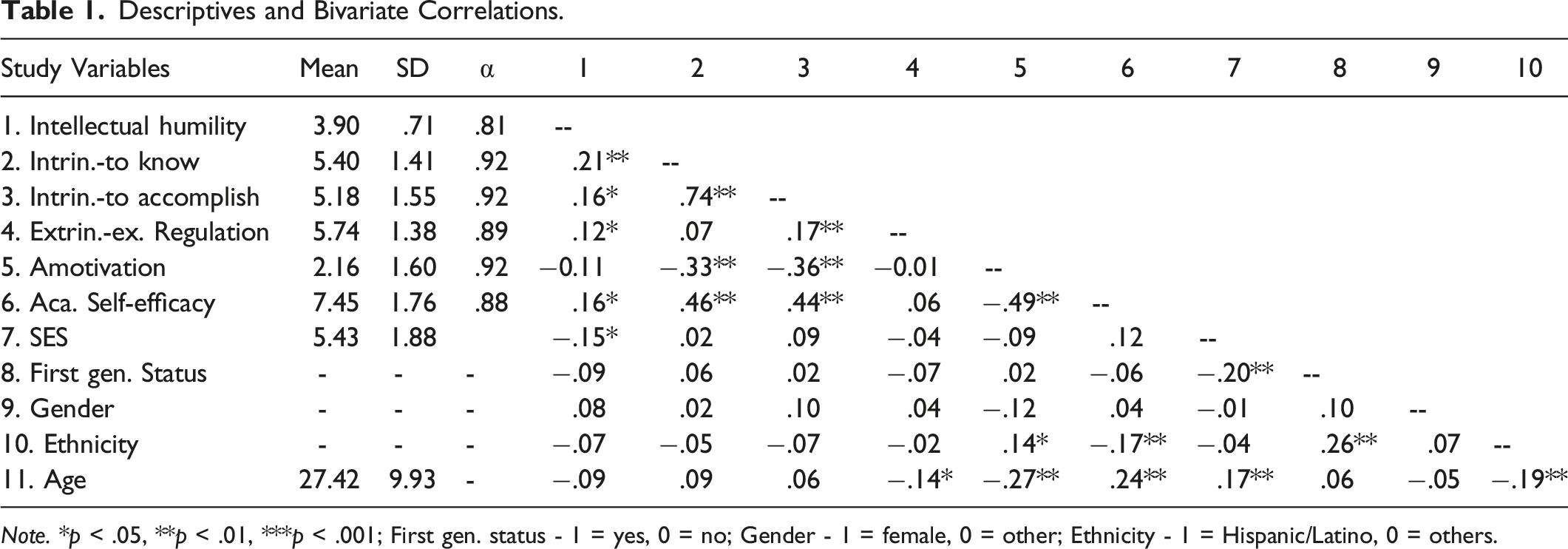
Note. *p < .05, **p < .01, ***p < .001; First gen. status - 1 = yes, 0 = no; Gender - 1 = female, 0 = other; Ethnicity - 1 = Hispanic/Latino, 0 = others.
Intellectual Humility
Intellectual humility was measured using the Unidimensional Intellectual Humility Scale developed by Leary and colleagues (2017). This scale consists of six items designed to evaluate various aspects of intellectual humility. Participants rated their (dis)agreement with statements such as “I question my own opinions, positions, and viewpoints because they could be wrong,” “I reconsider my opinions when presented with new evidence,” and “I recognize the value in opinions that are different from my own.” Responses were recorded on a 5-point scale, 1 - not at all like me, 5 - very much like me. Higher scores indicate greater intellectual humility.
Academic Motivation
Academic Motivation was assessed with the Academic Motivation Scale (AMS-C 28; Vallerand et al., 1992). For this study, we focused on four types of motivation: intrinsic motivation-to know, intrinsic motivation-to accomplish, extrinsic motivation-external regulation, and amotivation. Participants were asked, “Why do you go to college?” and instructed to indicate the extent to which each of the 16 items corresponded to their reasons for attending college. Responses were recorded on a 7-point scale, 1 - does not correspond at all, 4 - corresponds moderately, and 7 - corresponds exactly. A sample item for intrinsic motivation-to know is “Because I experience pleasure and satisfaction while learning new things.” An example of intrinsic motivation-to accomplish is “For the pleasure that I experience while I am surpassing myself in one of my personal accomplishments.”
Self-Efficacy
Self-efficacy was measured with the College Self-Efficacy Instrument (Solberg et al., 1993). For this study, we focused exclusively on course/academic self-efficacy, utilizing items 1–7 from the original scale. Participants were asked, “How confident are you that you could successfully complete the following tasks?” The tasks included in this section are “Research a term paper,” “Write course papers,” and “Do well on your exams.” Responses ranged from zero - not at all confident to 10 - extremely confident.
Demographics
Demographics questions were included to control for their potential influence in the tested associations. Subjective social economic status (SES) was measured using the MacArthur Scale (Adler et al., 2000). Participants were presented with a picture of a ladder with numbers 1 through 10, with information showing 1 represents people who are worst off in society and 10 represents the best off. Participants were asked to indicate their standing by selecting a number. Participants also indicated their first-generation college student status, defined as neither parents having a bachelor’s degree, and reported gender, ethnicity, and age.
Procedures
Participants completed all procedures online using Qualtrics. Participants were recruited via an email to all undergraduate students at Texas A&M University-San Antonio. The email explained the study and provided a Qualtrics link for those who volunteered to participate. After reading the information page and providing their consent, participants answered the current study measures, which were presented in random order to minimize order effects. Participants then provided demographic information and read a debriefing statement. Participants were given the ability to skip any questions and end the study at any time. After completing the survey, a separate link was presented to participants so that they could provide their email address to enter a drawing for one of eighteen $50 gift cards. All study materials and procedures were approved by Texas A&M University-San Antonio’s Institutional Review Board (IRB) Protocol # 2022-23. The variables reported in the study are from a large data collection effort; all study information are available on the Open Science Framework (OSF; Huynh et al., 2024).
Results
Bivariate correlations showed that intellectual humility was positively related to intrinsic motivation-to know, r = .21, p < .001 and intrinsic motivation-to accomplish, r = .16, p = .010. Additionally, we found that intellectual humility was positively associated with extrinsic motivation-external regulation, r = .12, p = .046, and that intellectual humility was unrelated to amotivation r = −.11, p = .070. Moreover, intellectual humility was positively associated with academic self-efficacy, r = .16, p = .010. Although not part of the focus of the study, the results also showed a positive relation between academic self-efficacy and intrinsic motivation-to know, r = .45, p < .001, and intrinsic motivation-to accomplish, r = .44, p < .001. Moreover, academic self-efficacy was unrelated to external motivation-external regulation, r = .06, p = .370, and was negatively related with amotivation, r = −.49, p < .001.
Using Fisher’s r to z transformation, we compared our correlations between intellectual humility and intrinsic motivation to that found by Wong and Wong (2021) to see if they are significantly different. We found that our correlations between intellectual humility and the two types of intrinsic motivation were not different than the correlation between intellectually humility and intrinsic motivation found in Wong and Wong (r = .20, N = 251); for intrinsic motivation-to know, z = .11, p = .460; for intrinsic motivation-to accomplish, z = .46, p = .330.
Again, using Fisher’s r to Z transformation, we compared the correlations with intellectual humility between the different types of motivation in our study. We found that the correlations between the two types of intrinsic motivation were not different from each other, z = .59, p = .280, but were different from the correlation between intellectual humility and amotivation, (z = 3.66, p = <.001, for to accomplish; z = 3.07, p = .001 for to know; z = 2.61).
Results of Multiple Regression With all Predictors Included.
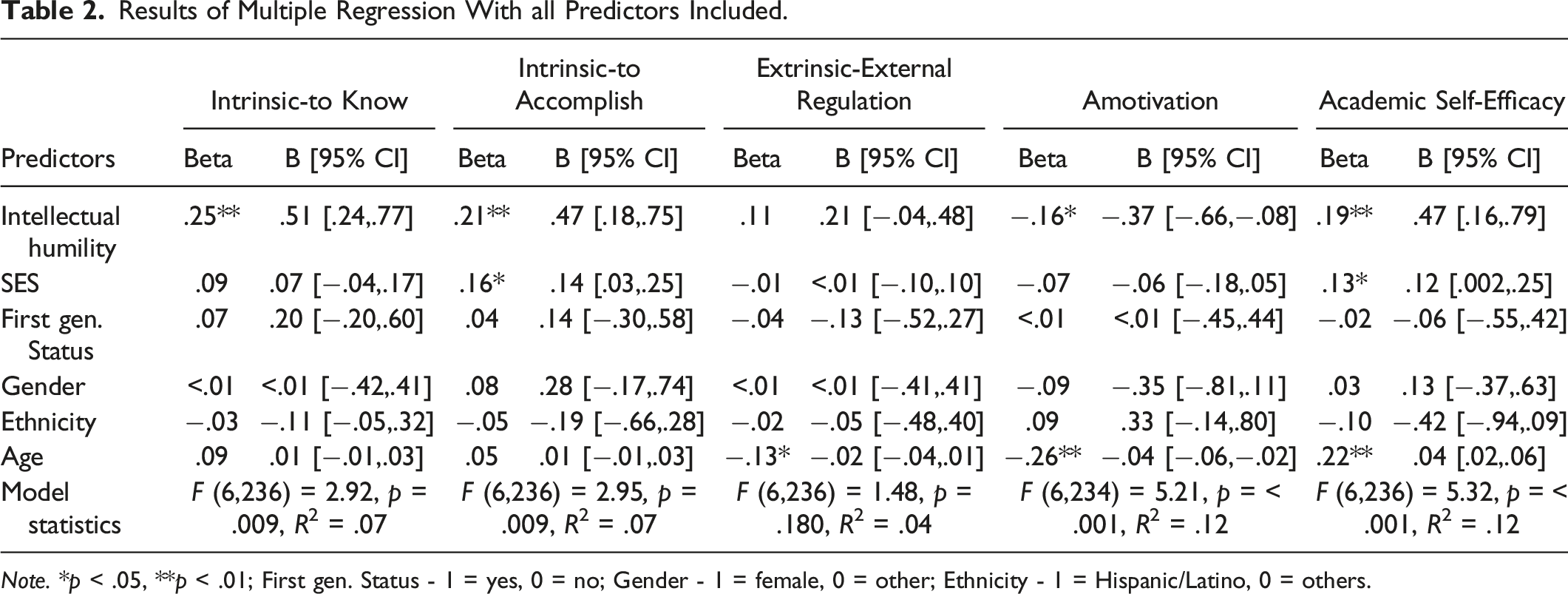
Note. *p < .05, **p < .01; First gen. Status - 1 = yes, 0 = no; Gender - 1 = female, 0 = other; Ethnicity - 1 = Hispanic/Latino, 0 = others.
Discussion
We found mixed support for our hypotheses. Intellectual humility was positively associated with both types of intrinsic motivation, and academic self-efficacy. Although bivariate correlations showed a weak positive association between intellectual humility and extrinsic motivation-external regulation, after controlling for demographic factors through multiple regression, this association became nonsignificant. Similarly, whereas bivariate correlations showed no significant association between intellectual humility and amotivation, after accounting for participant demographics, intellectual humility negatively predicted amotivation. All significant associations were modest in strength; however, they are well within the range of what would be considered consequential and of explanatory and pragmatic value in the long run (Funder & Ozer, 2019).
Overall, these findings extend previous research by showing that intellectual humility is not only linked to a desire to learn for knowledge’s sake (Haggard et al., 2018; Krumrei-Mancuso et al., 2020), but also to learning performance (i.e., the process of learning). As previous research has shown that intrinsic motivation-to know and intrinsic motivation-to accomplish were both moderately strong predictors of academic performance (Howard et al., 2020), our results suggest that intellectual humility may predict improved academic performance not only through a desire to acquire knowledge, which was previously known, but also by the enjoyment of the process through which that knowledge is acquired. Given that academic intrinsic motivation has been demonstrated to correlate with scholastic performance and general wellbeing (Bailey & Phillips, 2016; Lazowski & Hulleman, 2016), this finding indicates that intellectual humility may play a broader role in academic success than previously understood, potentially fostering both a love for learning and the means to achieve it.
Additionally, we replicated previous research by Wong and Wong (2021) and showed that the correlations between intellectual humility and general intrinsic motivation are similar in strength despite using different measures for both concepts, and from very different participant samples. As such, these results allude to the potential enduring nature of intellectual humility and intrinsic motivation across measurement strategies and across cultures (i.e., Hong Kong and Hispanic-majority U.S. students). This is particularly noteworthy because Wong and Wong’s (2021) research was conducted in a Hong Kong student sample, where cultural values rooted in Confucian traditions emphasize self-cultivation and respect for authority in learning (Li, 2016). Replicating these findings in a culturally varied sample suggests that intellectual humility may play a universally relevant role in fostering intrinsic motivation. With further research, this may highlight the importance of fostering intellectual humility in educational settings regardless of cultural differences.
Our findings showed that external motivation and intellectual humility do not necessarily have a meaningful relationship with each other, which supports previous works (Krumrei-Manusco et al., 2020). However, we extended this course of inquiry in line with self-determination theory (Deci & Ryan, 2000; Howard et al., 2020) to show that intellectual humility could also negatively predict amotivation. This finding suggests that intellectual humility not only has the potential to promote intrinsic motivation, but also to temper counterproductive amotivation inclinations.
The significant findings regarding the relationships between intellectual humility and intrinsic motivation-to know, intrinsic motivation-to accomplish, and academic self-efficacy may have practical implications in real-world settings. As Wong and Wong (2021) noted, in an education system increasingly focused on measurable results and performance, virtues like intellectual humility might seem counterintuitive to cultivate. However, our findings demonstrate that intellectual humility can help students learn out of genuine interest, enjoy the learning process for its own sake, and feel confident in their ability to successfully achieve educational goals. Because these qualities are all positively linked to academic performance (Honicke & Broadbent, 2016; Howard et al., 2020), our findings can demonstrate to parents, teachers, and students that intellectual humility is not impractical or irrelevant in the real world, but rather, it can be powerful force for good, enhancing both capability and success.
Limitations and Future Directions
It should be noted that our study design was cross-sectional and correlational in nature; as such, it can only reveal associations between our study variables but cannot determine the direction of causality. Although we suggest in the discussion that intellectual humility may promote factors related to academic success, it is also theoretically possible that academic success, higher intrinsic motivation, or strong self-efficacy, in turn, foster the development of intellectual humility (i.e., reverse causality). Alternatively, there might be a complex bidirectional relationship (reciprocal influence) where intellectual humility and academic success factors mutually influence each other. With the current data, it is not possible to clearly distinguish between these possibilities.
Additionally, the presence of statistically significant correlations does not rule out the possibility that unmeasured third variables could simultaneously influence those associations. For example, a family environment that is highly supportive, values education, and encourages open communication and reflection might simultaneously foster children’s intellectual humility (through modeling and encouragement of introspection) and positive academic attitudes (by providing resources and emotional support). Moreover, students with a growth mindset tend to believe that abilities can be developed through effort. This belief leads them to be more willing to admit current deficiencies (reflecting intellectual humility) and more actively engage in learning and challenges (reflecting high motivation and self-efficacy). A growth mindset might be a fundamental factor driving both intellectual humility and academic engagement (Porter et al., 2020). These potential confounding factors are difficult to rule out with the current research design. Future works could bolster the current findings by employing more rigorous methodology as such as experiments or longitudinal designs to limit the potential influence of confounding variables and to clarify the causal direction between intellectual humility, academic motivation, and academic self-efficacy.
Furthermore, our sample was mainly composed of Hispanic students. Although it is worth noting that the findings are consistent with previous research with different college students, these findings may not generalize to all other cultures or educational settings. Moreover, further research is needed to understand the potential impact of early education and the uses of reinforcement for learning on the relationship between intellectual humility and academic motivation and self-efficacy. Additionally, we focused on academic-related outcomes in this study. Future research could explore how intellectual humility correlates with intrinsic motivation and self-efficacy in other domains such as arts and athletics, where learning and performance are required.
Conclusion
Our study showed that students who are higher in intellectual humility are also more likely to be intrinsically motivated to pursue their studies. We demonstrated that not only is intellectual humility related to increased desire to learn for learning’s sake (intrinsic motivation-to learn), but also that it is related to enjoyment of the process of learning (intrinsic motivation-to accomplish). Additionally, intellectual humility is associated with more positive self-evaluations about one’s academic ability (academic self-efficacy). Together, these findings help to color in the contours of how intellectual humility may be leveraged to motivate students to pursuit their studies with vigor and enjoyment.
Footnotes
Declaration of Conflicting Interests
The authors declared no potential conflicts of interest with respect to the research, authorship, and/or publication of this article.
Funding
The authors disclosed receipt of the following financial support for the research, authorship, and/or publication of this article: This project was supported by funding from the National Science Foundation Grant: 2222219. Any opinions, findings, and conclusions or recommendations expressed in this material are those of the authors and do not necessarily reflect the views of the National Science Foundation.
Ethical Statement

Data Availability Statement
The data that support the findings of this study are available upon reasonable request from the corresponding author.