




Abstract
What is the place of the market in society? Polanyi's answer derives from institutional separation and the self-regulating mechanism of supply and demand. In this article, I offer an alternative approach. Following Aristotle, I suggest that commodity fiction follows from the fictitious nature of valuation in the market economy. I then combine this broader definition of commodity fiction with Aristotle's ideas on means and ends of human action, which leads to a framework relating the uniform standard of value in the market economy to commodity fiction and market imperialism. This framework, like Polanyi, underlines the market's subordination of society, but it explains such domination with how the market subverts political deliberation on the allocation of time and resources to distinct objectives in society. The result is a theoretical framework that goes beyond the embeddedness-disembeddedness dichotomy and that emphasizes how the place of the market in society is inextricably a political phenomenon.
What is the place of the market in society? How does the market relate to other social institutions? Apart from mainstream economics, Polanyi's work provides the most influential perspective on these questions. The notions of embeddedness, institutional separation, and the self-regulation of the market through a supply-and-demand mechanism lie at the heart of the Polanyian approach. Polanyi's argument is powerful and elegant. As the market economy became increasingly preponderant, it submerged society in the economy, which stands in stark contrast to all other economic systems in history, where the market was submerged in society. 1 This argument does not withstand scrutiny, mainly because the causal processes that Polanyi offers to substantiate his thesis—embeddedness, the self-regulation mechanism of the market economy, fictitious commodities, and institutional separation—are not entirely sound. The main problem is the notion of institutional separation and thus the idea of embeddedness. 2 As Block argues, all economies are embedded. 3 To suppose that any social institution has its own internal mechanism—cut off from the effects of culture, religion, and politics, among other social institutions—is not justified. Furthermore, these notions contradict Polanyi's own methodological proposition on the economy being instituted. 4 Nonetheless, the lack of internal theoretical consistency does not necessarily imply that Polanyi's thesis on the subordination of society to the market is false. In this article, I show why Polanyi was right in his arguments on the market economy, and I develop multiple propositions on the subordination of society to the market. These propositions rest on a causal mechanism that Polanyi himself discusses in great detail: commodity fiction. However, I diverge from Polanyi in conceptualizing this key mechanism, which leads to a theoretical perspective that differs from Polanyi in terms of its causal structure.
For Polanyi, the market subordinates society primarily because it operates according to its own endogenous mechanism that is indifferent to any concern other than the balancing of supply and demand quantities through fluctuating prices. 5 In the approach offered here, the market subordinates society because it crowds out how a community deliberates between distinct objectives in social life. The market does not dominate institutional domains such as education and health because it has a self-regulation mechanism. It dominates them because the outcomes of social action in distinct domains can be measured in the market's uniform and potentially limitless standard of value. As Zelizer argues, this does not erase the meaning of activities in distinct domains of social life. 6 Nor does it prevent the market exchange itself acquiring meanings other than what is measured by the market's uniform standard of value. However, it implies loss of autonomy over how a society allocates resources to distinct ends. The market mechanism robs a political community of the power to deliberate on the allocation of resources by shifting such determination to the opaque operations of the market and to the dominant actors in the market economy.
In both formulations, commodity fiction plays a key role. But the conceptualization of commodity fiction used here diverges from Polanyi's notion. For Polanyi, commodity fiction follows from subjecting things that are not produced for sale to the supply-and-demand mechanism. In the approach offered in this article, commodity fiction applies without exception to any entity, tangible or intangible, that circulates in a market economy, be it capitalist or socialist. This perspective follows from Aristotle's argument that the commensurability at the foundation of market exchange is a collective fiction in the first place. Accordingly, self-regulation is irrelevant to the place of the market in society. What matters is the reach of commodity fiction. The greater the extent of commodity fiction in society, the greater the extent to which the market becomes the arbiter of human activities, rather than just a means. And this proposition holds true without the market erasing diverse meanings and practices in distinct domains of social life. The market economy does not flatten. To the contrary, it embraces proliferation but overwhelmingly in favor of practices that are conducive to wealth measured in the market economy's uniform standard of value.
To develop these arguments, I begin by examining the notions of institutional separation and embeddedness. I then offer a brief discussion of Aristotle on market exchange, in particular, Aristotle's ideas on commensurability and the effects of the market becoming the arbiter of human activities. The next section on the place of the market is the core of the article, and it outlines the relationships among the market economy's uniform standard of value, commodity fiction, institutional domination, and politics. Before concluding, I compare the framework in this article to alternative approaches and I briefly discuss the ramifications of the arguments I advance.
Institutional Separation and Embeddedness
Institutional separation is a term that appears frequently in Polanyi's writings on the market. 7 In fact, it is a concept that Polanyi uses more frequently than embeddedness. For instance, although embeddedness and the related term “submerged” appear eight times in The Great Transformation, institutional separation is used thirteen times, and it is discussed in a more extensive fashion compared to the often fleeting passages on embeddedness. 8 Similarly, Polanyi discusses institutional separation in virtually all his intellectual output from the 1930s onward, including his unpublished notes 9 and published works. 10
A holistic evaluation of institutional separation and embeddedness as central concepts in Polanyi's writings on the market economy leads to the view that the two terms are interchangeable. It is quite reasonable to suggest that institutional separation is a concept that explains what embeddedness is about. 11 Such a view finds strong support in The Great Transformation, 12 in Polanyi's later articulations on the economy as instituted process, 13 and in the posthumously published The Livelihood of Man. 14 In the canonical formulation of The Great Transformation, Polanyi suggests that as supply and demand emerge as the dominant allocation mechanism in society, the market becomes institutionally separated from other social institutions. 15 Such institutional separation distinguishes the market economy from other economic systems in history (household, reciprocity, and redistribution), which are all integrated into society through distinct institutional arrangements. 16
Unfortunately, Polanyi does not offer much theoretical clarity on the notion of institutional separation, as he does not define the term explicitly. In particular, “separation” is not discussed as a theoretical category, although one can find a discussion of the term “institution” in Polanyi's comparative works on economic systems in history. 17 The most explicit definition is found in a comparative analysis of economic institutions in antiquity as “physical operations,” 18 which is in line with the discussion of household, reciprocity, redistribution, and exchange found in The Great Transformation. 19 Hence, Polanyi defines economic institutions primarily in terms of spatial-organizational patterns of allocation: household (self-sufficiency), reciprocity (symmetrical movement of goods and services), redistribution (center-periphery circulation of goods and services), and market exchange (decentralized movement of goods and services). 20 Such a narrow approach to institutions does not directly explain what Polanyi means by institutional separation. 21
One can argue that Polanyi's studies of the market economy and allocation systems in history inductively provide a precise notion of institutional separation, and thus an explicit theoretical articulation is not a must. In The Great Transformation and in his later comparative studies, Polanyi develops a nuanced historical contrast between the market and other allocation systems. 22 This contrast yields the following analytical schema as the key to understanding the market as opposed to other economic systems in history (see Table 1): (1) contract rather than status becomes the main modality of social relations; 23 (2) the motives of gain and hunger replace other motives; 24 (3) the exchange of goods and services is organized through fluctuating prices that balance supply and demand, as opposed to being organized through set rates (“non-price making market”) aiming to maintain existing social relations in a community; 25 (4) markets, previously local places of exchange, become connected over large territories; 26 (5) market exchange, as opposed to household, reciprocity, and redistribution, emerges as the mechanism that links the different parts of an economy; 27 (6) land, labor, and money are turned into commodities subject to supply and demand, whereas they are regulated by noneconomic institutions in economic systems other than the market; 28 and (7) the market dominates “the whole of society” once land, labor, and money are commodified, 29 whereas markets are a means to noneconomic ends under household, reciprocity, and redistribution. 30
The Elements of Institutional Separation.
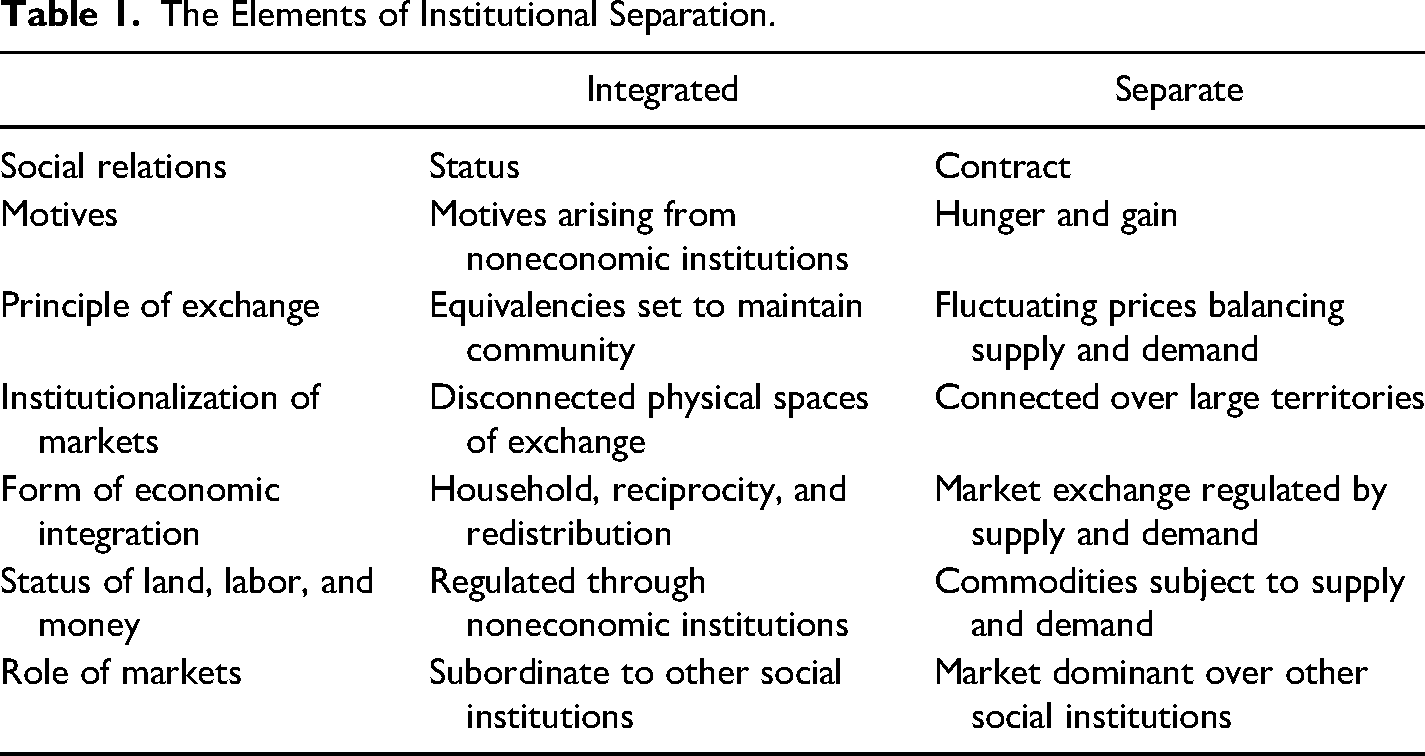
For Polanyi's proposition on the institutional separation of the market to hold true, either one or a combination of the above elements (see Table 1) should imply that the market becomes separate from other social institutions. Polanyi places the greatest weight on the third element, the supply-and-demand mechanism that finds a balance through fluctuating prices. 31 In fact, Polanyi argues that as land, labor, and money—fictitious commodities—are commodified, the market becomes an “automaton,” 32 a self-regulating system that dominates all social life. 33 As a result, he suggests, using the nineteenth century as the historical case that illustrates his arguments, instead of the economy being embedded in society, “the whole of society was embedded in the economic system.” 34
However, from a sociological standpoint, the argument that the above historical processes (see Table 1) culminate in the institutional separation of the market is certainly specious. As Block argues, the market system rests on “elaborate rules and institutional structures” and Polanyi's own work shows in the first place that “there can never be a self-regulating market system.” 35 On the one hand, the historical processes that Polanyi takes as indicative of institutional separation, for instance, the increasing preponderance of contractual social relations, do not imply institutional separation since contracts themselves have noncontractual social foundations. 36 On the other hand, the notion of self-regulation—the analytical factor that Polanyi overwhelmingly emphasizes—is rejected by myriad studies on the market. 37 Furthermore, the notion of self-regulation contradicts one of Polanyi's own methodological propositions, that the economy is an instituted process. 38
Thus, as many authors note, 39 the institutional separation of market, and hence the proposition that the embeddedness of the market economy changes historically, runs into significant theoretical hurdles. However, the above notion of institutional separation does not exhaust Polanyi's discussion of the relationship between the economy and society. Parallel to the notion of institutional separation, Polanyi repeatedly emphasizes the separation of politics and the economy 40 and he explicitly mentions “a gap between politics and economics” created by the rise of the market economy. 41 He further summarizes this separation with reference to Montesquieu's Spirit of the Laws: “The separation of powers, which Montesquieu (1748) had meanwhile invented, was now used to separate the people from power over their economic life.” 42
One way of interpreting this emphasis is that the political sphere is just another sphere, such as the cultural sphere, that gets separated from the economy with the increasing preponderance of markets. However, such an interpretation is not entirely in line with Polanyi's own formulation referring to the notion of the loss of power over economic life. Nor is it necessary. That is because the market can dominate lives without being autonomous from other social institutions. All that is required, as Aristotle recognized twenty-four hundred years ago, is that the market becomes the end rather than a means.
The Market as Means and the End
Aristotle's works that discuss economic activities consist of a few pages in Book V of the Nicomachean Ethics and a slightly longer discussion in Book I of the Politics. 43 Yet these few passages contain ideas that had a profound impact on the history of economic thought, including the thought of Marx and Polanyi. 44 The first of these ideas is the distinction between use and exchange. The second is the notion of commensurability. The third is the analysis of forms of exchange in relation to modes of acquisition. The background to the examination of these ideas is Aristotle's political analysis of the two modes of acquisition, acquisition from the environment to meet concrete needs and acquisition for exchange, in both a household and a self-governing community. At the core of Aristotle's argument is his starkly negative view of acquisition for exchange, particularly when it is mediated with money. The reason for this negative view is that acquisition for exchange inevitably leads to monetary wealth becoming an end in itself. Aristotle suggests that unlike acquisition for concrete use, such an end admits no limit. It thus carries the risk of crowding out all other objectives that a household and a self-governing community should pursue for their welfare and flourishing. Aristotle does not offer a recipe for balancing the different objectives. Nor does he give a precise list of what objectives any community should pursue. That is because he sees the determination of such objectives as the subject matter of politics and democratic deliberation.
Aristotle notes that all possessions have a twofold use. They can either be used for meeting a particular need or for exchange. The exchange of a possession for another possession (i.e., barter) or for money (i.e., monetary exchange) is not its “proper use” because, as he illustrates with the concrete case of a shoe, a shoe satisfies a particular need such as covering the foot. 45 The management of a household or political community through production for particular use, 46 the dominant form of economic activity in the ancient Greek economy, forms the background of Aristotle's negative view of exchange. Such production is oriented toward concrete activities necessary for subsistence as well as for activities that contribute to individual and communal flourishing. Hence Aristotle defines wealth in a manner markedly different from its modern definition: “a collection of tools for use in the administration of a household or a state.” 47
It is not that exchange does not have a role to play for subsistence and for a good life. Aristotle recognizes that the exchange of possessions develops naturally and is inevitable for both subsistence and a good life. 48 However, he is quick to observe the peculiar nature of exchange. Exchange requires commensurability, that “all that is exchanged must somehow be capable of being compared,” which in turn implies that possessions of different nature and qualities “be measured by some one thing.” 49 However, Aristotle states that “it is impossible for things that differ greatly from one another to become commensurable.” 50 Thus, he suggests that the commensurability at the foundation of exchange is “based on a hypothesis.” 51 This is a crucial point, because Aristotle emphasizes that commensurability is a convention (nomos), an institutional fact supported by the shared assumption that things that differ from each other in qualities and use cases can be measured by the same standard. Strictly speaking, money is not necessary for this shared assumption to be effective, since exchange in kind is based on the same shared presupposition. However, money, which was already well integrated into the economy of ancient Greece in Aristotle's time, is a legal convention that effectively embodies the assumption of commensurability. 52
Although Aristotle's terminology is terse, what he says on commensurability is unambiguous. Translated into the terminology prevalent since the beginning of the nineteenth century, Aristotle portrays a uniform standard of value as the foundation of market exchange. 53 From a logical viewpoint, a uniform standard of value represented by money—a positive quantity—is an isomorphism to the positive real line. 54 That is, a uniform standard of value implies an additive mapping from heterogeneous goods to positive numbers. Once the mapping is in effect, it enables the total ordering of any objects or collection of objects, since any two objects are either equal in value or one of them has more value than the other. This much is well-understood and expected from a sociological standpoint on valuation. 55 What is interesting is that for Aristotle, if we can interpret his economic ideas from a contemporary sociological standpoint, this mapping is a working assumption akin to Schutz's general thesis of reciprocal perspectives, 56 which is crucial to the construction of a shared social world even though the perceptions and assumptions of each party in social exchange often differ significantly. And similar to Schutz, Aristotle is keen to observe the concrete practical consequence of this collective presupposition: it enables the social exchange of heterogeneous objects. Figure 1 offers a schematic view of Aristotle's argument regarding uniform value and market exchange.
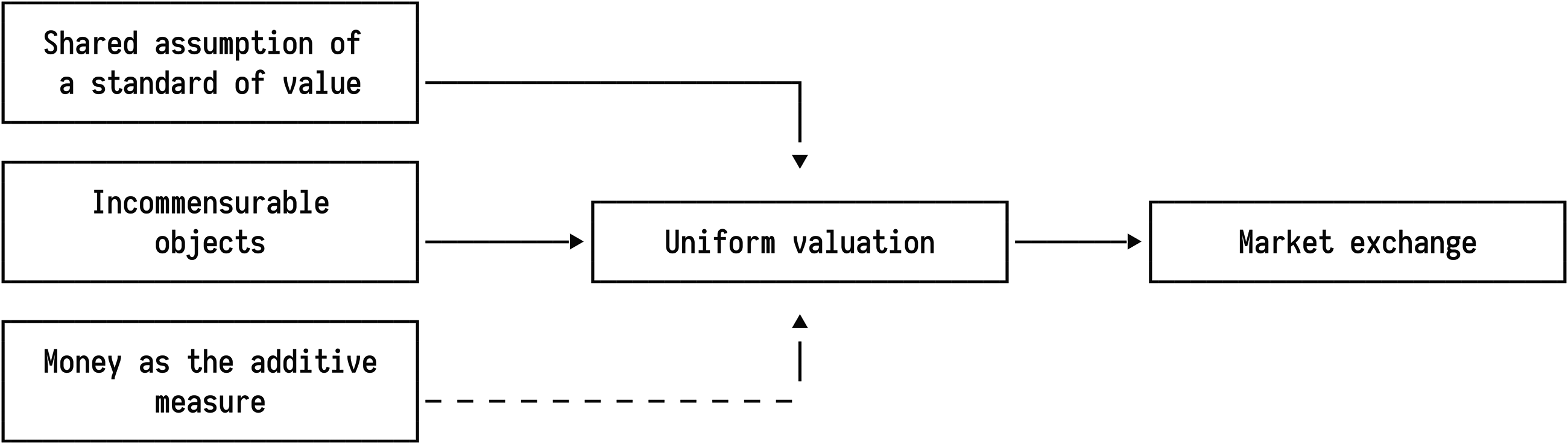
Uniform valuation and market exchange.
The crucial issue for Aristotle is that uniform value implies a different view of wealth, because wealth becomes associated “with a large quantity of coin.” 57 In other words, exchange entails a transformation in the very definition of wealth, one from a heterogeneous assemblage of qualitatively different tools serving concrete purposes to one of homogeneous and abstract quantity. Aristotle calls the different tools the true wealth. 58
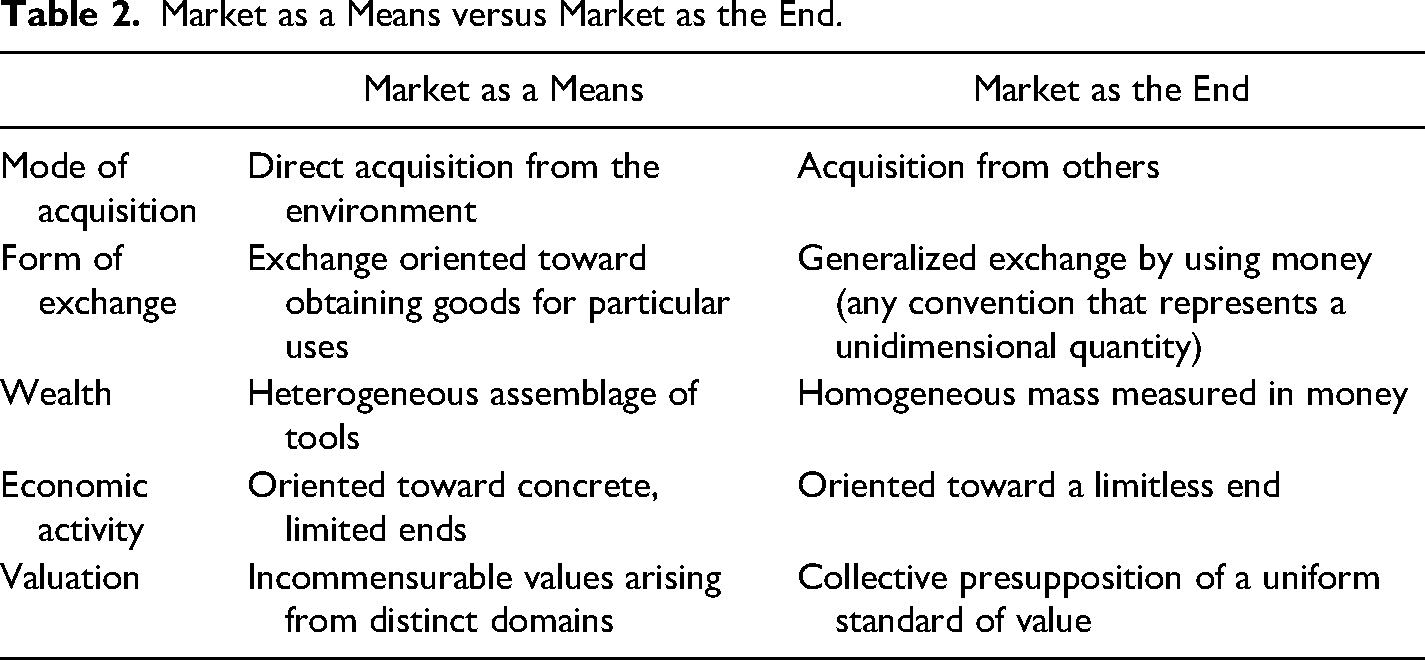
For Aristotle, how wealth is perceived and what type of wealth people pursue have to do with forms of exchange and modes of acquisition. He argues that the most direct manner to meet needs is to acquire things from the environment for particular ends, such as agriculture for food. 59 Acquiring things through exchange for particular needs is closely related to the first mode of acquisition, in the sense that it is oriented toward a concrete use. 60 However, acquiring things through exchange for amassing wealth measured in money gives acquisition and exchange an entirely new character. Aristotle emphasizes that when the end goal is a particular use, “the means towards the end are not unlimited, the end itself setting the limit.” In contrast, when the end goal is moneymaking, there is no limit: heterogeneous ends are fused in the notion of wealth measured in money, which is potentially limitless. 61 Table 2 summarizes Aristotle's contrast between market as a means to and market as the end of human activities.
Market as a Means versus Market as the End.
The point of this rich analysis is not simply economic, although Aristotle's discussion pertains to economic matters. 62 In contrast, Aristotle's main concerns are political and ethical. Aristotle notes that associations such as a state are formed not just out of necessity or historical accident but also for pursuing particular ends such as the health and welfare of its citizens. 63 The balancing of such ends is the very subject matter of politics. 64 This view follows from Aristotle's anthropology and the often misunderstood statement that “man is a political animal.” 65 What Aristotle means is not that human beings are political because they live in cities. Nor is it the case that human beings are political because they seek power. Rather, human beings are political because they have the capacity to discern the good from the bad by using reason, and politics is the art of managing a state by using such capacity. In other words, politics is a technique. But it is also an ethical pursuit because it inevitably involves value judgments. As Kullmann argues concerning Aristotle's distinction between animals and human beings, “The greater degree to which man is political is due to the fact that as a being endowed with reason he has a perception of the beneficial and harmful and hence, as Aristotle infers, also of the just and unjust.” 66 Hence, after observing that human beings differ from animals in their capacity for judging good and evil, Aristotle argues that “it is the sharing of a common view in these matters that makes a household and a state.” 67
Thus we arrive at the crux of the matter. For Aristotle the economic cannot be separated from the political, because the economic is a means, one among many, to reach particular ends that a self-governing community, be it a household or a state, pursues. Particular ends admit limits imposed by the existing techniques and societal conditions, because “none of them have any tools which are unlimited in size or number.” 68 The same cannot be said of exchange oriented toward the potentially limitless wealth measured in an abstract manner. Limitless wealth in market exchange poses a threat, because it risks crowding out all the other objectives that individuals and a self-governing community should pursue for their well-being. In other words, the perils of the market economy arise when the market as an institution becomes the dominant arbiter of distinct objectives. Note that this is a conditional statement: the market is perilous if and when it becomes a dominant institution in society, and Aristotle's argument is not hostile to the substantial benefits of market exchange as long as it is a means to other objectives in a political community. It is for this reason that Polanyi's inquiry into the place of the market is fundamentally Aristotelian, because it asks under which conditions the market ceases being just another means and instead becomes a central institution in society.
The Place of the Market: Commodity Fiction and the Uniform Standard of Value
For Polanyi, the place of the market has to do with institutional separation and the self-regulation mechanism. Aristotle's analysis of market exchange suggests a different thesis. The place of the market is a function of whether the market is a means or the arbiter of distinct objectives in society. And whether the market is a means or the arbiter follows from the extent to which the universal standard of value presupposed in market exchange is applicable in different arenas of social life. Aristotle does not answer the question of how a uniform standard of value becomes the dominant measure of the outcome of human activities. With the notion of commodity fiction, Polanyi does precisely that. However, Polanyi's notion of commodity fiction is tied to the idea of self-regulation, which indirectly reproduces his thesis on institutional separation. Following Aristotle, the notion of commodity fiction can instead be defined with respect to the market economy's uniform standard of value and valuation practices. Such conceptualization of commodity fiction encompasses Polanyi's notion and avoids the theoretical conundrums posed by postulating the market economy as institutionally separate. It also offers a relatively novel theoretical approach to the place of the market in society—relatively novel in that the causal structure of the theory differs in important aspects from the one found in Polanyi, although many of the elements are the same.
Polanyi defines commodities as “objects produced for sale on the market.” “Production for sale” implies being “subject to the supply-and-demand mechanism interacting with price.” 69 The fictional aspect of the market society is then conceptualized with respect to being subject to the self-regulating mechanism of the market without being produced for sale: “Labor, land, and money are obviously not commodities; the postulate that anything that is bought and sold must have been produced for sale is emphatically untrue in regard to them.” 70 The market economy is self-referential and thus institutionally separate, in the sense that exogenous factors influence the mechanism of the market only if they are mediated by quantity (supply and demand) and prices. Consequently, the regulation of land, labor, and money through demand, supply, and prices is indifferent to the fact that land is nature, labor is human life, and money is purchasing power. 71 Figure 2 presents a simplified view of Polanyi's arguments on commodity fiction, self-regulation, and institutional separation.
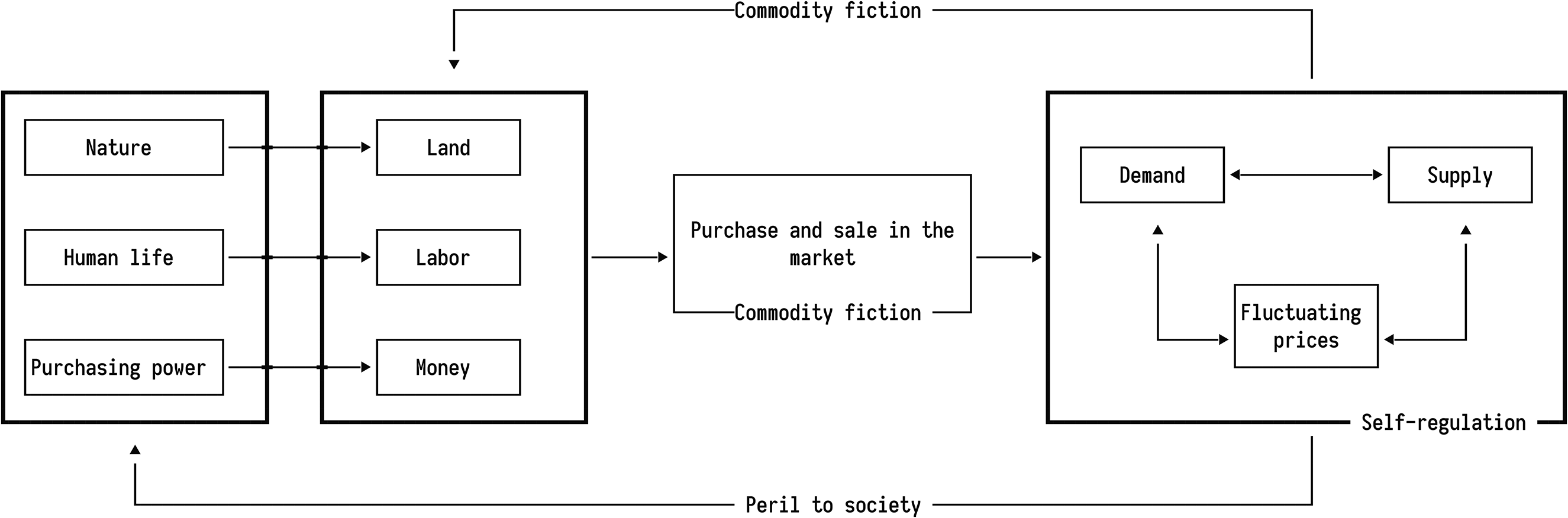
Commodity fiction, self-regulation, and institutional separation.
A crucial aspect of the schema involving commodity fiction (see Figure 2) is the implicit distinction between real and fictitious commodities that Fred Block identifies. 72 This distinction incorporates both normative and factual aspects. The normative aspect is that “it is simply wrong to treat nature and human beings as objects whose price will be determined by the market.” 73 The factual aspect is that the self-regulation mechanism does not function for land, labor, and money, and the state has to constantly manage demand and supply in fictitious commodities.
This is a very incisive diagnosis of the inner structure of Polanyi's notion, and it also gives a clue as to why Polanyi's notion of commodity fiction continues to inspire and guide research and thinking on the market economy. But note the following. A distinction between real and fictitious commodities leads to the argument that there is a vast domain of real commodities where the market economy is institutionally separate because it functions through demand and supply. 74 In other words, if taken to its logical conclusion, Polanyi's definition implies that commodity fiction does not apply to objects such as vaccines or housing, because they are subject to demand and supply, and they are produced for sale. Hence, Polanyi's definition unnecessarily restricts the applicability of commodity fiction, because it implicitly relies on the idea of institutional separation. The empirical research inspired by Polanyi points out that the intuition underlying the notion of commodity fiction is much more general than Polanyi's own theoretical articulation. 75
The notion of commodity fiction, as Polanyi articulates it, suffers from three interrelated problems:
Commodity: Polanyi defines commodity with respect to “production for sale.” This definition is equivocal, and the ambiguity stems from what Polanyi means by “production for sale.” This issue can be addressed by starting from Marx's encompassing definition of production in the Grundrisse: “In production the members of society appropriate (create, shape) the products of nature in accord with human needs.”
76
Thus production has two analytical elements, appropriation and transformation. Then Polanyi's argument that land “being produced for sale is emphatically untrue” is open to two interpretations.
77
Land is nature that is not appropriated or transformed. That is hard to defend, since all land used for human needs is by definition appropriated and transformed, however minimally.
78
Or land is nature appropriated and transformed, but it has other use cases for human beings that are more important than circulation through market exchange. This is the more reasonable interpretation. The problem is that one can make this argument for anything that circulates through market exchange. Every tangible or intangible object that circulates in a market economy, from the most mundane commodity such as a wooden table to cryptocurrencies, comes from nature (trees for the former, electricity as well as silicon for the latter). The notion of self-regulation: The mechanism of self-regulation that Polanyi assumes to characterize the market economy is more fiction than reality. The issue is not the existence of demand and supply quantities being responsive to fluctuating prices. It is whether there is a closed loop between demand, supply, and prices that can be expressed as “laws” capturing constant conjunctions. That is precisely how Alfred Marshall articulated the matter, as the “all-ruling law of demand and supply.”
79
It is also how demand, supply, and market equilibrium find their way into economics textbooks: as “laws,” in a way that is little changed since Marshall's Principles of Economics.
80
A wealth of rigorous empirical research and theoretical arguments contradict the notion of demand and supply finding an equilibrium through prices—a voluminous body of work that underlines that the lawlike regularity of market equilibrium through demand and supply is fictitious.
81
Instead of the ahistorical law of demand and supply, what we find are highly complex relationships that are historically contingent—relationships that are mediated by factors such as social networks,
82
power dynamics,
83
political institutions,
84
and culture.
85
None of this should come as a surprise, as it is clear, as early as Aristotle's economic writings, that shared assumptions about valuation underlie market exchange in the first place. The fictional aspect of the market economy: As indicated above, for Polanyi the fictional aspect of the market economy is a consequence of turning objects that are not produced for sale into commodities that are subject to the self-regulation mechanism. If we follow Aristotle on the fundamental presupposition underlying market exchange, the fictional aspect of the market economy is more general and fundamental, and it has nothing to do with the alleged mechanism of self-regulation. The fiction in market exchange follows from two shared assumptions, commensurability and uniform standard of value. In other words, market exchange has an incontrovertibly fictitious aspect because it rests on presupposing that (1) objects of different qualities and thus used for incommensurable purposes are commensurate to each other, and (2) the worth of such objects are measured on a uniform and universal scale. Polanyi's definition of commodity is rather idiosyncratic. The prevalent meaning of the term in social sciences is quite broad,
86
reflecting the common sense of the word to denote useful items “of due measure”—a sense that comes from its Latin origin.
87
Hence, commodity should be defined as tangible and intangible entities that meet human needs and that are exchanged for a quantitative value.
88
Commodity fiction applies to any object that is exchanged through a uniform measure of value, because such exchange presupposes that there is a universal standard of value, a “general equivalent” in Marx's terminology.
89
Commodity fiction follows from the leap of faith that underlies market exchange: the shared assumption that incommensurable objects can be ranked unequivocally on an additive scale. If commodity fiction is defined in this general manner, we can see why Polanyi insists that the notion of commodity fiction is different from fetishism of commodities, although he fails to explain why that is the case.
90
Fetishism of commodities is about the mystification of the social nature of exchange value.
91
Commodity fiction, in contrast, is about how the universalizing presupposition of exchange value is a fiction in the first place. These notions are not orthogonal to each other; they are instead complementary. Strictly speaking, the shared assumption of commensurability is fictitious, since from a logical standpoint objects of distinct qualities and uses cannot be compared to each other.
92
Yet, as Aristotle observes, such incommensurability is not a hindrance to market exchange because in exchange parties are willing to act as if worth can be measured uniformly.
93
Nonetheless, that does not change the fact that every act of exchange violates the distinct qualities and uses of objects by reducing them to a unidimensional quantity. This reduction is problematic because it leads social actors to pursue potentially limitless monetary wealth even if such pursuit clashes with other objectives in human life. Hence, commodity fiction and the violation inherent in market exchange go hand in hand, because they both follow from the assumption of commensurability and are analytically independent from “production for sale.” For instance, COVID-19 vaccines are produced for sale, but the fiction that is fundamental to their commodification is that the value of the immunity against a lethal virus can be captured and adjudicated predominantly by market value.
94
A general definition of commodity fiction is an immediate result of combining Polanyi's ideas with Aristotle's analysis of market exchange. Recognizing that commodity fiction is an irreplaceable element of market exchange, regardless of the commodities that are being exchanged, has important implications for understanding the place of the market in society. Most importantly, commodity fiction as a constitutive element of market exchange implies that the place of the market in society is not a problem of institutional separation. It is a problem of institutional domination. The market economy is not institutionally separate, it is rather institutionally imperialist.
95
The market economy is imperialist because it subordinates social action in distinct arenas of society—art, education, politics, or religion, to name a few—to the end goal of wealth measured in an abstract quantity. Such domination does not require the overt conversion of the meaning, categories of action, and rationality in an institutional domain to the ones imposed by the quantifying measure of the market economy. All it requires is to increase the prevalence of the types of activities conducive to the uniform standard of value of the market economy, as opposed to activities that the market economy does not favor. If commodity fiction is defined without reference to production, it immediately underlines the importance of Polanyi's contrast between market exchange and other allocation systems in history. Every allocation system in history other than the market—be it household, reciprocity, and redistribution—organizes the circulation of tangible and intangible objects without the mechanism of exchange values establishing a chain of equivalences. The chain of equivalences does not emerge because a uniform measure of value does not mediate the circulation of objects.
The above arguments have important corollaries for analyzing the place of the market in society.
Hence, following Aristotle's analysis of market exchange leads to a theoretical approach to the market economy that is faithful to the analytical problem posed by Polanyi, in the sense that it takes the place of the market in society as the central puzzle. However, it differs from Polanyi's theory in the causal processes it highlights to explain the place of the market in society. Namely, in explaining the place of the market in society it points toward (1) how market exchange's uniform standard of value interacts with other valuation practices in society, (2) the extent to which the market is a means or the arbiter of human activities, and (3) the institutionalization of commodity fiction as a driver of both (1) and (2). Note that this theoretical approach follows Polanyi in seeing commodity fiction as the main determinant of the place of the market in society. However, commodity fiction is conceptualized with reference to the uniform valuation of market exchange. Furthermore, the causal arrow from commodity fiction to the place of the market goes through how market exchange alters the allocation of time and resources to distinct objectives in society. Hence, the approach developed here can be summarized with the proposition that the market is perilous precisely because it takes the allocation of time and resources to distinct objectives out of the domain of political deliberation and into the domain of economic action.
Relation to Alternative Perspectives and Ramifications
The place of the market in society is arguably the most fundamental question that Polanyi poses. As outlined above, he offers a historical thesis to answer this question, one that is predicated on the notion of institutional separation: the place of the market changes over time, from embedded to disembedded economies, although full separation—he contends—is not possible. 96 It is this thesis that found its way to notions like embedded liberalism and to Granovetter's Parsons-tinted take on embeddedness. 97 And it is this historical thesis that I propose to modify. The place of the market is not a question of embeddedness. It is a question of institutional domination. Market's subordination of society arises from the fact that commodity fiction and the accompanying uniform standard of value shape the distribution of activities among different objectives in society. This thesis, for want of space, is abstract. A first step in making it concrete is to compare it to prevalent approaches on the relationship between the economy and society. Given that the theoretical approach outlined above suggests particular causal relations among uniform measure of value, commodity fiction, and the place of the market in society, I examine the approach developed here in the context of Marx's labor theory of value, of neoclassical economics, of Simmel as well as of Zelizer, and of Walzer's theory of distributive justice.
Marx's approach to value under capitalism views commodities as incommensurate use values that circulate based on commensurate exchange values. Exchange values are expressed in money, the uniform general equivalent. Commodities are produced by a combination of means of production and labor-power, which are themselves commodities acquired from the market based on their prevailing exchange value. The exchange value of a commodity, in turn, is the sum of the exchange values of means of production and of labor-power, plus surplus value, 98 all measured in labor time. 99
Hence, Marx's labor theory of value solves the problem of commensuration by treating labor as the “value-creating substance . . . measured by its duration [labor time].” 100 However, this fundamental proposition of the labor theory of value rests on a distinction between heterogeneous (concrete, useful) and homogeneous (simple, abstract) labor. Useful, heterogeneous labor is “productive activity of a definite kind and exercised with a definite aim.” 101 Such labor produces concrete use values that are incommensurate. Abstract labor, in contrast, is labor “reduced to . . . uniform quality, whose only difference . . . is quantity.” 102 Given that types of concrete labor are incommensurate, Marx offers the logical argument that only abstract labor “creates exchange value.” 103
Much ink has been spilled on whether exchange values observed in a market economy, prices, are determined by labor time embodied in commodities, as Marx claims. 104 But note that, regardless of the veracity of the labor theory of value, Marx does not address the problem raised by Aristotle and Polanyi on the place of the market in society. To see this, suppose the labor theory of value is scientifically accurate and suppose further that we can determine the conversion ratio between different types of concrete labor and homogeneous abstract labor time. Hence, it is possible to determine how much abstract labor one obtains from concrete productive activities such as producing homes and providing health care.
Then it is possible to determine the allocation of different types of labor based on exchange values of goods that materialize in a capitalist market economy. That is because capitalist entrepreneurs will be able to calculate the surplus value that a productive activity such as health care provision yields. They will thus be able to allocate their capital to hiring specific amounts of labor-power and investing in specific amounts of capital goods, all measured in abstract labor. However, observe that such allocation is indifferent to the substantive values of concrete productive activities, since those use values are incommensurate in the first place. In other words, the allocation of resources to concrete activities such as home production and health care provision occurs independently of the substantive use values of homes and health care to the members of society. Marx himself is emphatic on this point, 105 as he argues that “use value . . . lies outside the sphere of investigation of political economy.” 106 In other words, the market and its commensuration mechanism dictate the allocation of productive activities in society in a manner that is blind to the importance of those activities. However, that is precisely the problem raised by Aristotle. The market becomes the arbiter of ends in society, even if one assumes that the labor theory of value holds true.
The neoclassical theory of value presents, in contrast, a stark contradiction to the argument that the place of the market in society rests on commensuration through commodity fiction. The reason is not hard to discern. The thesis that the market becomes a dominant arbiter of human activities through commodity fiction implies loss of power and autonomy over activities. Orthodox economic theory after the marginalist revolution does not admit the possibility of such loss. 107 That is because the neoclassical theory of value is built on the assumptions of rationality and utility maximization, which yield a theoretical framework where distinct objectives are matched to quantitative values that materialize in the market economy. 108 Walrasian analysis that puts equilibrium at the center of economic inquiry depicts a world where market price is determined by the final increments of utility that exchange parties obtain. 109 Thus, in the neoclassical theory of value, commensuration reflects the needs and desires of economic actors. As such, the neoclassical theory of value rejects the notion of commodity fiction and any form of market subordination based on commodity fiction.
If neoclassical economics takes commodity and uniform standard of value as natural and self-evident categories, Simmel goes to the other extreme. For Simmel, money, the embodiment of a uniform standard of value, creates the risk of a unidimensional world “recognizable by amount and number.” It is thus the perfect form of reducing “quality to quantity.” 110 From an Aristotelian viewpoint, that is a non sequitur. The flattening of quality to quantity is a practical achievement based on a collective presupposition. Aristotle recognizes that this practical effect obtains in market exchange, but he does not jump to the conclusion that the uniform measure of value might flatten other areas of social life. In fact, he argues the opposite since he suggests, in the first place, that distinct activities have concrete ends that are not commensurate with each other.
Hence, the Aristotelian viewpoint is remarkably in line with Zelizer's analysis of market exchange. 111 For Aristotle, the main effect of market exchange is not a flat world of amount and number. It is rather a social world where heterogeneous activities and objectives are not weighed for their distinct contributions to individuals and society. They are weighed for what they contribute to the potentially limitless end of homogeneous wealth. That is a form of institutional domination: one institution, the market, becomes the end and yardstick for action originating in other domains, be it art, education, or religion. However, the uniform standard of value is just a fiction, in the sense that it is effective through a shared presupposition and only in the context of market exchange. It is thus erroneous to reach the conclusion that the market's uniform standard of value flattens the distinct qualities in different domains of human action. To the contrary, one of the consequences of Aristotle's analysis is that the proliferation of distinct valuation practices based on incommensurable qualities is compatible with market exchange and should thrive under a market economy. All that is required is that these qualities contribute to the pursuit of wealth measured in a uniform metric, which enables the market to shape the means and ends of practical action in different areas of social life.
By this token, the market is not hostile to other social institutions, as Zelizer and much of contemporary economic sociology underlines. 112 What is at stake is not the corruption of other social institutions like education and religion. It is rather the market's remarkable power to shape and structure these institutions regardless of the consequences. In the age of neoliberalism, it is easy to provide cases of this astonishing power in one of the richest and most democratic—at least in theory—countries in history, the United States: the commodification of homes leading to the Great Recession, the commodification of student loans that has been burdening an entire generation, and the commodification of health care that makes ordinary people avoid medical help. These massive transformations have drastic consequences on the life choices and trajectories of ordinary people. Yet they are rarely accountable to the people affected by such structuring. That is a form of colonization, imperialism, and domination.
As such, the thesis advanced here suggests an empirical research program on (1) how the place of the market changes historically and how it varies among cases, (2) under which conditions the market subordinates other social institutions, (3) how the market's uniform standard of value structures both the means and ends of practical action in diverse domains of life, and (4) the social consequences of such structuring. Note that this empirical research program has considerable overlap with the Marxist political economy and contemporary economic sociology. But it also differs from them in formulating the place of the market as a question of domination and power that is linked inextricably to how valuation practices in society shape the means and ends of practical action.
Finally, this research program, with its emphasis on how one institution, the market, dominates other institutions, has a direct affinity to Walzer's influential arguments on distributive justice. 113 Walzer views society as a distributive community characterized by a plurality of distributional arrangements. His fundamental thesis is that the circulation of goods in a distinct sphere of society such as education depends on the meanings and values internal to that particular sphere. In other words, distinct meanings of goods lead to distinct principles of distribution. Given the existence of distinct sets of meanings in society, Walzer argues that “when meanings are distinct, distributions must be autonomous.” 114 This approach to distribution in society, which Walzer develops through a combination of historical examples and prescriptive reasoning, constitutes the ground for a theory of distributive justice that embraces plurality. The mark of this theory is that Walzer accepts inequalities that emerge from the “principles internal to each distributive sphere.” 115 What he advocates is the elimination of domination arising from the fact that in most societies goods in a particular sphere determine “value in all the spheres of distribution.” 116 The conversion of a good or a set of goods in a particular sphere into the dominant goods in all the spheres of distribution, which happens in most societies, is a form of tyranny for Walzer. His argument for distinct distributional principles in distinct spheres of society aims to address such tyranny.
Given Walzer's arguments on conversion of a particular good into an instrument of domination in society, the affinity to the theoretical framework developed in this article follows immediately. In fact, Walzer identifies the market as one of the primary threats to distributive justice. 117 Furthermore, Walzer's discussion of money and commodities, with its emphasis on money as underlying domination in multiple spheres of society, reaches conclusions quite similar to the arguments developed here on the perils of the market.
However, note that Walzer's theory of distributive justice is predicated on the separation of society into distinct spheres. Each sphere of society is seen as an autonomous domain with its own meanings, values, and principle of distribution. In other words, Walzer, like Polanyi, assumes the institutional separation of market and society. As a result, his theory of distributive justice is vulnerable to the same set of problems that characterizes Polanyi's approach, at least on the relationship between market and society. Take, for instance, the sphere of education. Where to draw its boundaries against the market? Walzer argues, sensibly, that “teaching positions, student places . . . grades and promotions . . . have to be distributed, and the distributive patterns cannot simply mirror the patterns of the economy.” 118 But consider a rather simple case illustrating the tensions in Walzer's argument. Suppose there are good and mediocre schools, and thus good and mediocre student places. Suppose that good places lead on average to better employment opportunities and that some prior training is necessary to obtain such places. Now, if there is a market for private training, there is nothing preventing families with greater financial means to acquire superior training for their children in this market, which would inevitably affect the distribution of student places in the domain of education. The point is that every commodity in the sphere of education affects not only the distribution of educational outcomes but also the principle of distribution effective in this sphere.
Therefore, the autonomy of spheres vis-à-vis the market is elusive in any society where goods circulate as commodities. The weakness in Walzer's approach is not its elegant diagnosis of market imperialism and of the tyranny that ensues from the market. It is the failure to theorize the market's particular mechanisms of domination that hinders the recognition of the remarkable efficacy and reach of the market's uniform valuation when things circulate as commodities in society. As argued above, the market's uniform valuation exists alongside the meanings that characterize a sphere such as education, while simultaneously shaping the ends that are pursued in that sphere. This fact implies, in turn, that the greater the degree of commodification, the greater the perils of the market to the autonomy of distinct human activities.
Hence, the analysis presented here diverges from Walzer on the relationship between market and society. Walzer suggests that reorganizing the distribution of goods according to the meanings and values in a particular social sphere is a prescriptive solution to the problem of domination. The Aristotelian analysis developed in this article does not admit such a solution in societies where markets play a role in the circulation of tangible and intangible objects. That is because the commodity fiction of the market operates through the social convention of commensuration in every sphere of society that it reaches. Hence, the antidote to market's imperialism lies in confronting the reach and degree of commodification in society and thus confronting commodity fiction itself. However, commodity fiction is inevitably a political phenomenon because it requires addressing to which extent the market is a means or the end—a problem with no easy solutions, a problem that both Aristotle and Polanyi consider to be of vital importance for a community. 119 It is a political phenomenon also because the reach and degree of commodification affect interests and power relations in society. That is particularly the case in capitalist societies where commodity production is one of the most fundamental determinants of the distribution of social status and power. It is for these reasons that Polanyi's Montesquieu-inspired observation on the separation of politics and the economy is the starting point for the theoretical framework developed in this article.
Conclusion
Market exchange existed in ancient Mesopotamia, 120 in the city-states of ancient Greece, 121 in Qing China, 122 in the Maurya Empire, 123 and in several other premodern agrarian societies, as an increasing volume of archaeological research shows. 124 Yet the market became a central institution in society only in the last five hundred years. And it became the key institution structuring social action in most parts of the world only in the twentieth century. Polanyi recognized the monumental nature of this transformation in the place of the market, a transformation where the market was engulfing society, and a transformation that was perilous to nature, human life, and freedom. Polanyi portrayed this transformation with the dichotomy of embedded and disembedded economies. He suggested that the engine behind the transformation was the market's self-regulation through supply, demand, and fluctuating prices. He further argued that once this self-regulating automaton engulfs land, labor, and money—fictitious commodities because they are not produced for sale—the market tends to separate itself from the rest of society.
In the current age of vast inequalities and the long shadow of neoliberalism, after more than seventy-five years since the publication of The Great Transformation, Polanyi's ideas resonate stronger than in the time when his magnum opus first appeared in print. However, the market is not separate from society. Nor does it function in a closed loop of quantity and price fluctuations. The market is a social institution. It is fundamentally shaped by other social institutions such as politics. And it in turn shapes almost all institutions in contemporary societies.
The fact that the market is not institutionally separate from other social institutions necessitates a critical look into and a revision of the central problem in Polanyi's work, the place of the market in contemporary societies. It is interesting that the key to this revision lies in Aristotle, who, after all, wrote at an age when markets existed in an embryonic state, and industrial production as well as capitalist relations of production lay some two thousand years in the future. However, Polanyi, like Marx, 125 recognized the importance of Aristotle's ideas on market exchange, and he himself referred to Aristotle on market exchange in numerous places but always in the context of his own framework of institutional separation. 126
In this article, I have relied on Aristotle's analysis of market exchange to broaden Polanyi's definition of commodity fiction, and to articulate the relationship between commodity fiction and the market's uniform standard of value. Such an articulation paves the way for a theoretical framework that is, I believe, fundamentally faithful to the spirit of Polanyian research, which I take to be one of the most pressing research agendas in today's world, mainly because we live, yet again, in an age bedeviled by vast inequalities and liberal ideology. Most importantly, the theoretical framework developed here reveals why the place of the market in society is not a binary matter of embeddedness and disembeddedness. The place of the market in society changes because it is driven by commodity fiction. And commodity fiction is not a destiny. It is rather a matter of politics, it is a site of political contention and compromises, as contemporary struggles over the commodification of nature, labor, land, housing, medical drugs, and vaccines demonstrate. 127 I hope that the theoretical perspective outlined here will broaden the horizon of a Polanyian research agenda on the market economy, in particular on the fundamental relation between politics and social struggles over the commodity fiction.
Footnotes
Acknowledgments
I am grateful to Hüseyin Çınar Öztürk for help with the Greek original of key passages in Aristotle and to the editorial board of Politics & Society for very valuable suggestions. The usual disclaimer applies.
Declaration of Conflicting Interests
The author(s) declared no potential conflicts of interest with respect to the research, authorship, and/or publication of this article.
Funding
The author(s) received no financial support for the research, authorship, and/or publication of this article.