



Abstract
The many contradictory interpretations of neoliberalism raise doubts about the value of this concept. This article discusses the literature on neoliberalism for identifying a “minimum common core” that warrants preserving this concept. I argue that neoliberalism entails an ideology and a political practice that aim to subordinate the state and all social domains to the market—to its logic and to the economic powers within it—thereby undermining democracy. This conceptualization emerges as a “common lowest denominator” among many otherwise incompatible scholarly definitions of neoliberalism, reflects central neoliberal ideas (despite their own inconsistencies), and illuminates crucial features of contemporary neoliberal society. I discuss the implications of this interpretation for established democracies and for those countries that experienced democratization processes during the neoliberal era, for the debates on postneoliberalism, and for the political identity of the Left.
Neoliberalism has become a key concept for understanding contemporary life across different disciplines, including political theory, sociology, anthropology, geography, and political economy. 1 Yet, the growing number of diverse and conflicting definitions of neoliberalism has led scholars to question the analytical value and the (political) usefulness of this concept. 2 Neoliberalism is often left undefined—even when it is a key independent or dependent variable in empirical research—and, when it is defined, neoliberalism is used in so many different ways “that its appearance in any given article offers little clue as to what it actually means.” 3 It is worse than that: neoliberalism is used to describe processes “that are not just different, but stand in contradiction to one another.” 4 Moreover, neoliberalism is theorized and deployed mainly by those who explicitly oppose it. Hence, neoliberalism is not a concept but an “artifice” used by its critics, which is “cut to shape to fit whichever conceptual variant serves their purpose.” 5
Given its many contradictory definitions and the fact that today it is used mainly by its critics, is the concept of neoliberalism still useful? This article proposes an interpretation of neoliberalism focusing on the “minimal set of defining common characteristics that would warrant preserving” this concept. 6 Following Rajesh Venugopal, there are three possible approaches to the definition of neoliberalism. The first takes neoliberalism as a given doctrine, articulated by its key thinkers, and involves studying the trajectory of neoliberal ideas. The second identifies neoliberalism in terms of real-world processes, describing and explaining their dynamics. Finally, the third approach is the one used by Venugopal himself and consists in “interrogating neoliberalism as a signifier and exploring its conceptual landscape.” Rather than taking neoliberalism “as a given body of textual knowledge in need of interpretation, or as a self-evident real-world phenomenon or field of practice in need of abstraction,” this approach “examines what the word has come to mean” within academic debates and especially how it is used and defined by its critics. 7
While this article too focuses on the scholarly literature on neoliberalism, it should be noted that all academic definitions of neoliberalism (third definitional approach) tend to converge on two substantial points. First, scholars agree on the intellectual roots of neoliberalism (which links to the first definitional approach). Thus, neoliberalism emerges in the 1930s as a renewal of classical liberalism in response to the capitalist crisis and to the rise of collectivism and totalitarianism. In this context, scholars also recognize the importance of key neoliberal thinkers such as Friedrich von Hayek and Milton Friedman. Second, scholars agree on the fact that neoliberalism starts becoming influential as a political practice in the 1970s with the “Chicago Boys” in Pinochet's Chile and then in the 1980s with the victory of Margaret Thatcher in the United Kingdom and Ronald Reagan in the United States and that it has eventually become the dominant ideology at the global level since the collapse of the Soviet Union: neoliberalism then describes a historical period and thus social phenomena in the real world (which involves the second definitional approach).
My aim is to identify a minimum common core that different scholarly definitions of neoliberalism share—independently of the fact that in other aspects they contradict each other—showing its relevance for understanding the contemporary social world. Throughout the article, I adopt a specific theoretical-epistemological perspective, which, drawing from Polanyi's work, 8 involves two assumptions. The first is that all economies—no matter how (neo)liberal—are always embedded in social, cultural, and political institutions. 9 The second is that the degree to which society is subordinated to the market—that is, the extent to which the market becomes the arbiter of social activities and an end rather than just a means—may vary across time and space: the market comes to dominate the whole society when it evaluates all spheres of social life according to its own standard of value, thereby undermining political autonomy and how a society deliberates between different social purposes. 10
On this basis, I argue that neoliberalism entails a worldview and a political practice that aim to subordinate the state and all social domains to the market—to its logic and to the economic powers within it—thereby undermining democracy. 11 This conceptualization emerges as a “common core” among many otherwise incompatible scholarly definitions of neoliberalism, reflects central neoliberal ideas (despite their own inconsistencies), and illuminates crucial features of contemporary neoliberal society. Crucially, in this article I use the concept of democracy to refer not only to the presence of formal institutions (e.g., free elections in the context of an open competition among different political parties) but also to some of its social, cultural, and economic preconditions. These include, for example, a lively associational life, participatory institutions, and a generous welfare state supporting political equality. 12
The article is structured in three main parts. The first part discusses different understandings of neoliberalism in terms of four dichotomies. This way of displaying the debate allows me to show that even conflicting conceptualizations of neoliberalism still share a minimum common core, which is relevant for understanding contemporary real-world phenomena. While other dichotomies could have been identified, these four dichotomies highlight the most relevant tensions in the scholarly literature on neoliberalism as well as in neoliberal thought itself. Indeed, the inconsistencies that characterize scholars’ definitions of neoliberalism very often reflect contradictions in the thought of neoliberals themselves—as well as the tension between neoliberal “theory” (and rhetoric) and neoliberal “practice.” 13 Moreover, these four dichotomies allow discussing the main elements of neoliberalism: the neoliberal state, neoliberal politics, the neoliberal citizen, and the neoliberal economy.
The second part of the article builds on the common core shared by the four dichotomies for proposing a sufficiently coherent understanding of neoliberalism that illuminates crucial aspects of the contemporary world. I thus suggest to interpret the neoliberal ideal in terms of “market citizenship” as a substitute for democracy, distinguishing the implications of this conceptualization for the “West”—where neoliberalism is associated with processes of dedemocratization—and for the countries that experienced the transition to democracy during the neoliberal era—where neoliberalism is linked to formal democratization processes that leave little democratic control over the economy.
Finally, the third part addresses the question of whether the “neoliberal era” has ended with the emergence of the “post–Washington Consensus” and progressive social policy agendas and of nationalistic-protectionist populism, which seems to put an end to neoliberal globalization. This part also elaborates on the implications of this interpretation of neoliberalism for the political identity of the Left and on the role of progressive academics.
Overall then, this article offers three distinct contributions. First, it summarizes and discusses the vast academic literature on neoliberalism, showing that even contradictory understandings still share a common core that helps illuminate crucial features of contemporary society. Second, it addresses the question of whether we are moving to a postneoliberal era, specifying some analytical criteria for framing the debate on this issue. Third, it makes explicit the implications of this interpretation of neoliberalism for the Left.
The Neoliberal State: Strong versus Minimal
As a set of political ideas, neoliberalism emerged in the 1930s in the context of the crisis of liberal modernity and mass society. Neoliberals argued that the rise of democracy and mass parties implied the politicization of the state, which became the target of increasing popular demands. The rise of authoritarianism in Europe, in their view, confirmed the liberal-elitist thesis that the masses cannot be trusted. 14 Thus, contra Gramsci and Polanyi—who saw the emergence of fascism as a capitalist response to the socialist threat—neoliberals such as Hayek interpreted fascism as the result of the spreading of the socialist ideology. In this view, there is no difference between communism and fascism: both are the expression of the same collectivistic ideology—while the New Deal and Keynesian state interventionism potentially lead to totalitarianism as well. 15 The emergence of collectivist ideologies was linked to the rise of nationalism and protectionism, which led to increasing tensions between countries and ultimately to war. Neoliberalism then emerged as a reaction to the spread of “collectivism” in its socialist, fascist, and liberal-Keynesian variants.
Against this background, neoliberals’ main goal consisted in specifying the appropriate role of the state. In particular, self-defined neoliberals formulated the hypothesis that the state should go beyond “laissez-faire.” 16 In their views, classical liberals were wrong in assuming that the role of the state should be limited to that of the night-watchman: recognizing that markets are social institutions that need to be actively constructed, neoliberals accorded a positive role to the state in establishing and sustaining markets. 17
Thus, historians of ideas have shown that neoliberal thinkers tried to elaborate an alternative to both socialism (and Keynesianism) and classical liberalism. 18 In particular, while classical liberalism interprets the market as the site of spontaneous exchanges, neoliberalism sees it as the sphere of competition, which only an activist and interventionist government can promote. 19 As Michel Foucault famously put it, neoliberalism “should not be identified with laissez-faire, but rather with permanent vigilance, activity and intervention.” 20 Hence, neoliberalism is often seen in the scholarly literature as implying a “strong state.” The latter should work for the market, actively making the economy “free.” 21 It should impose the principles of competition, utility maximization, and efficiency to all areas of human activity, thereby transforming the entire social world into a market-friendly environment—while the state itself is reframed as a market actor and restructured according to market principles and logics. 22
In contrast to those distinguishing the “strong state” of neoliberalism from the “minimal state” of classical liberalism, other scholars emphasize the similarities and continuities between classical liberalism and neoliberalism. In this view, neoliberalism entails essentially the rebirth of the “liberal creed”—a “market fundamentalism,” which implies an almost religious faith in market self-regulation. 23 Indeed, Hayek's critique of central planning is in line with much liberal thought: rather than trying to collectively and consciously direct social forces to “deliberately chosen goals” (e.g., the common good), the market is seen as the “impersonal and anonymous mechanism” that produces “unforeseen results,” allowing it to efficiently coordinate individuals’ freedom in a coherent and cooperative social order. The common good emerges from free interactions within the “spontaneous order” of the market. 24 In particular, neoliberals justify the use of markets for governing socioeconomic affairs referring to libertarian, 25 epistemic, 26 and utilitarian arguments. 27 Despite important tensions between these arguments (libertarianism and utilitarianism especially are hardly reconcilable), they all tend to reject an “interventionist” state, which is seen as illegitimate and inefficient or ignorant, whereas the market is interpreted as a sphere of freedom or as the most efficient mechanism for allocating resources in society or as the most effective information processor. This suggests that neoliberals too support a “minimal” state.
Clearly, defining neoliberalism in terms of a strong state that extends the economic logic to all dimensions of human life is very different from conceiving it as the ideology of the minimal state. However, this contradiction in the scholarly literature on neoliberalism reflects ambiguities within neoliberalism itself. This inconsistency not only reveals a tension between neoliberal antistate rhetoric (and ideology) and the political practice of using the state to implement the neoliberal project; it also reflects political-ideological differences within the broader neoliberal family. 28 Moreover, while scholars that criticize neoliberalism for promoting the minimal state and those that criticize it for promoting a strong economic state obviously contradict each other, they also share a fundamental common ground in the critique of the marginalization of democracy in neoliberal thought and practice. 29 More importantly, observing that markets are political constructions that always require state intervention suggests that the debate on the neoliberal state needs to be reformulated. 30
On the one hand, since the state is necessary for establishing and sustaining a market society, neoliberalism redefines the functions of the state rather than minimizing them. 31 To a closer look, the object of the neoliberal critique of government is not state power per se but democratic governance. For neoliberals, the democratic influence on economic decision-making generates “distortions” and threatens the confidence of investors in future profits and thus the health of capitalist economies. Since the tension between the needs of investors and the aims of voters must be resolved in favor of investors, the neoliberal solution is that of insulating economic decision-making from democratic pressures through the imposition of constitutional limits on popular power and the depoliticization of the economy, that is, the displacement of economic issues from the realm of political contestation to the sphere of experts’ deliberation. 32 Thus, “techno-managerial governance” keeps democracy “relatively impotent, so that citizen initiatives rarely change much of anything”: neoliberals’ ideal is a “constrained democracy” in which market-enhancing state interventions take technocratic forms. 33 But in order to depoliticize the economy, neoliberals could even support authoritarian regimes and dictatorships, as the case of Pinochet's Chile demonstrates.
On the other hand, the fact that the state is necessary to establish and promote markets implies that the differences between classical liberalism and neoliberalism should not be exaggerated. Indeed, taking neoliberals’ interpretation of classical liberalism as a form of “naive” laissez-faire ideology at its face value fails to recognize that nineteenth-century liberalism too assigned a key role to the power of the state and the law in fostering markets. 34 Thus, much of the continuity between classical liberalism and neoliberalism lies in the rejection of democratic principles for governing the economy, whereby collective will formation through political participation and state interventions aimed at achieving democratically determined goals are discarded. As Foucault notes, already Adam Smith's metaphor of the “invisible hand” actually disqualifies democracy and deliberate political actions in favor of the spontaneous market as a way of governing society. 35 The central difference between classical liberalism and neoliberalism then is that while the former flourished in predemocratic times, the latter has to deal with the affirmation of democracy worldwide. From this perspective, neoliberalism involves the political project of using the state to defend market society against the popular demands that characterize mass democracies, promoting a “liberalism fit for mass society.” 36
This discussion points to some central paradoxes: the neoliberal critique of planning based on the assumption of human ignorance paradoxically leads to the empowerment of “experts” and the neoliberal attempt to minimize or eliminate politics from public life requires the use of maximalist or even authoritarian politics. Neoliberalism “promises spontaneity but cannot avoid constructivism”: it is a utopian project in that it seeks to eradicate politics, to eliminate the “collective” and the “social,” but it requires politics and collective institutions to do so. 37 Neoliberalism claims that both freedom and efficiency are generated by the “spontaneous” market, but also recognizes that this entails a project that “designs and constructs the marketization of society” and that this project has to be carried out by the state. While the latter too is “increasingly marketized,” a gap remains “between the neoliberal project to marketize society, and the reality that neoliberalism will always have to rely on non-market mechanisms to do so.” 38 In short, while much of the attractiveness of (neo)liberalism lies in the promise of radically reducing the role of politics in social life through the limitation of the power of coercive states as self-regulating markets become the central institutions governing society, this utopia is impossible to be realized and, in practice, it implies the implementation of “anti-democratic measures that limit what citizens are able to accomplish in the political sphere.” 39
Neoliberal Politics: Governmentality versus Dominant Ideology
If neoliberalism can be considered in many aspects as a revival of classical liberalism, a key difference is that while the latter assumes the existence of different spheres, the former extends the market logic beyond the economic sphere, for colonizing all domains of society. 40 Hence, in particular for scholars following Foucault's interpretation, neoliberalism is understood as a project of economization, whereby market-driven calculations, the logic of “optimization,” and the economic rationality of competition and efficiency are extended to the whole society. In this perspective, neoliberalism entails an ensemble of techniques and rationalities that allow it to produce and govern free subjects, influencing their behavior and self-understanding, shaping their subjectivities. 41 Neoliberalism then involves a specific “governmentality”—the Foucauldian concept that combines the ideas of “government” and “mentality.” Neoliberalism is above all a rationality of governance centered on the economization of the social.
The extension of the economic analysis to the social is most evident in the work of Gary Becker—whom Foucault considers “the most radical of the American neoliberals.” 42 Indeed, Becker's theory of “human capital” implies that domains previously thought to be noneconomic such as education and the family are reinterpreted in economic terms. As Foucault puts it, the “economic model” of “investment-costs-profit” becomes “a model of social relations and of existence itself”: a form of relationship of the individual to herself, to time, and to other persons. 43 With neoliberalism, economics then is no longer confined to the study of a specific object (i.e., the “economic domain” or the “economic action”): it becomes an approach, a way of seeing the world, and a science of human behavior in general, thereby extending the rationale of utility maximization to all spheres of life. 44 Thus, while Polanyi saw already in the emergence of liberalism the domination of the market over society, 45 neoliberalism further radicalizes the liberal project, extending the market—and market logics—to all social domains. 46
Crucially, according to the Foucauldian literature, neoliberal governmentality does not involve authority and coercion but above all technologies of government such as benchmarking, performance indicators, and rankings. Indeed, rather than providing neutral descriptions of reality, these techniques are productive tools that indirectly shape how actors behave, for instance, encouraging competition. While the market is a central instrument for governing free subjects in neoliberalism—and both individuals and the state are reconceptualized as market actors under this governmental regime—economization does not necessarily require the effective marketization of all social spheres. The key institution of neoliberalism is not the market as such but market-based forms of calculation, measurement, and valuation. 47 Neoliberalism then implies a depoliticized epistemology for policymaking, which encourages governments to think “like an economist.” 48 According to this view, neoliberalism marginalizes a political understanding of the state: not in the sense that its consequences are nonpolitical—processes of economization have profound political consequences—but in the sense that governing is treated as a depoliticized, technocratic, and nonideological task. Neoliberalism replaces normative political reasoning and ethical-moral judgments with the economic-technocratic logic of efficiency and competition. 49
In contrast to this literature, scholars in the (neo-)Marxist political economy traditions challenge the view that the neoliberal state pursues a depoliticized-technocratic agenda, rooted in economic principles of efficiency and competition. In this alternative perspective, neoliberalism is the dominant ideology of the ruling class and thus an explicit political project aimed to reassert capitalists’ power after the postwar social democratic compromise. 50 In this case, the state is subordinated to economic powers and actively promotes the interests of the capitalist class: 51 neoliberalism is associated with a mode of regulation, whereby capital accumulation is sustained in the context of a post-Fordist and globalized economy, and thus with the transformation of the welfare state into a “competition state”; 52 with a shift in the balance of class power toward capital at the expense of labor; 53 with the rise in power of giant (multinational) corporations and global financial elites that substantially narrow the space for democratic choice; 54 and with the commodification and financialization of the whole society. 55
In the neo-Marxist perspective too, economics plays a central role—but an ideological one: economics is portrayed as scientifically neutral whereas it actually covers the promotion of capitalists’ material interests. While “privatization,” “liberalization,” “deregulation,” and “marketization” are presented as ways to enhance efficiency and improve the quality of goods and services, they actually benefit above all capitalist actors, increasing their profits. 56 This suggests some compatibility between the Foucauldian and the Marxist literature on neoliberalism, as the technocratic extension of economic logics to new domains (economization) may create new opportunities for profit making, for example, once new markets are established in these domains. 57
The link between economic theories and the interests of the capitalists, however, is not always straightforward. The most obvious example is that of monopolies, which are often economically inefficient but highly profitable for their owners. Hence, the view equating neoliberalism with a depoliticized-technocratic agenda aimed at maximizing efficiency and competition is not fully reconcilable with the interpretation of neoliberalism as a political project of the capitalist class. Yet, these contradictory critiques of neoliberalism reflect inconsistencies and shifts within neoliberal thought, whereby rather than on competition as a feature of markets, emphasis is increasingly put on an “ethos” of competitiveness as a trait of individuals (and states). 58
Moreover, the tension between the interpretation of neoliberalism as a technocratic-depoliticized project and as a class-based project appears less relevant if one considers that the market in the real world is not the one emptied of power relations described in economic textbooks. Thus, the technocratic project of promoting the “market” may often coincide with the promotion of powerful economic interests within the market. It is therefore better to conceive neoliberalism in terms of the promotion of capitalist markets (rather than of markets in general) in order to capture important aspects of the type of market that neoliberalism involves: one characterized by the concentration of private property and thus of economic and political power. 59 Hence, capitalist markets are usually not the realm of freedom in which equal partners voluntarily exchange goods for their mutual benefits: more often than not capitalist markets can be considered as spheres dominated by hierarchical asymmetries, coercion, and disciplinary power. Emphasizing the centrality of corporations in neoliberalism also reflects this idea. 60 Rather than the “market” logic, neoliberalism then extends the “corporate” logic. 61
From this perspective, the “technocratic” and the “political” dimensions of neoliberalism largely converge. For example, with the establishment of global markets, the interests of international capital have increasingly become “rationalist assumptions.” 62 In this context, the discourse of competitiveness—while presented in technical-scientific terms—actually governs states in accordance with a specific rationality: the framework of competitiveness not only constructs states as market subjects and technocratic agencies driven by external standards of conduct rather than by internal sociopolitical processes; it also shapes state actions in a particular direction, namely, that of providing favorable conditions for mobile capital. 63
Finally, it should be noted that the two opposing critiques of neoliberalism—as too technocratic and as too politically biased in favor of the capitalist class—share a common core. In both cases, neoliberalism is criticized for marginalizing democratic citizenship in governing public affairs. Either because political choices are said to be delegated to the “experts” and “technocrats” of independent regulatory authorities, rating agencies, and international organizations insulated from popular demands or because the economic elites are said to shape political choices—or because of a mixture of these two—neoliberalism is criticized for disempowering democracy. 64
In concluding this section, I shall highlight that the interpretation of neoliberalism as a technocratic agenda tends to emphasize the power of “ideas” whereas the definition of neoliberalism as the political project of the ruling class stresses the role of “interests” in determining political decisions. However, not only ideas and interests interact with each other (ideas are used instrumentally to promote specific interests and ideas help actors to form the very conceptualization of their interests) but also institutions shape the policies effectively implemented, leading to distinctive outcomes in different contexts even in the presence of a common ideology and similar interest constellations. This also explains the variety of policies that it is possible to observe in reality, which are never the direct outcome of ideas or interests. This requires emphasizing the varieties of neoliberal formations 65 —opposing a monolithic understanding of neoliberalism as a coherent technocratic and capitalist project.
Top-Down versus Bottom-Up: On the Neoliberal Citizen
Rejecting monolithic views of neoliberalism also implies refusing to interpret neoliberalism as a political project imposed in a top-down way by a powerful economic and technocratic elite on passive populations. It is right to point out that the rise of neoliberal capitalism in the late 1970s and early 1980s was actively supported by “big business” and that neoliberal governments (such as Reagan's and Thatcher's) forcefully attacked trade unions (thereby undermining collective bargaining), deregulated both the industrial and the financial sector, privatized public services, and reduced social spending, while cutting taxes for business and wealthy households 66 —and the literature clearly shows how these policy measures resulted in a sharp increase in wealth and income inequalities and in a concentration of economic and political power on the top. 67 Yet, it is equally important to recognize how neoliberalism emerged also through bottom-up dynamics. For example, the welfare state has not only been contested from the conservative forces and the capitalist classes but also from progressive social movements already in the 1960s. 68 Hence, social movements focused on the values of difference, autonomy, identity, and authenticity formulated the “artistic critique” of post-1945 welfare capitalism, providing the cultural basis for neoliberal capitalism and progressive movements such as feminism, antiracism, and multiculturalism, and those fighting for LGBTQ+ rights have been co-opted in the neoliberal project. 69 The values of diversity, women's emancipation, and antidiscrimination have been reframed in a way that makes them compatible with neoliberal principles: the structural critique of the dominant socioeconomic order and the aims of a profound transformation and radical reforms have been replaced by a commitment to individualism and “meritocracy,” where individual merit is identified with success in the market. 70 In this context, paid work is reinterpreted as the sphere of emancipation, self-realization, and empowerment, rather than a site characterized by inequality, exploitation, and alienation: a matter of “identity, self-fulfillment, and respect” essential for realizing citizenship. 71 Rather than aiming at abolishing all forms of hierarchy and domination, many progressive movements now aim at increasing the “diversity” of the dominant classes, empowering underrepresented groups such as women, people of color, and sexual minorities to “rise to the top.” 72
However, the fact that neoliberalism also involves bottom-up processes does not necessarily challenge the definitions of neoliberalism presented in the previous section. On the one hand, the literature on governmentality emphasizes that neoliberalism involves governing through freedom, shaping subjectivities: individuals are not passive “victims” of neoliberalism but tend to actively adhere to the neoliberal values of competition and rampant individualism. On the other hand, within the neo-Marxist tradition, scholars usually refer to Gramsci and to the notions of “hegemony” and “common sense” in order to grasp the complexity of neoliberalism, highlighting how domination often involves the consensus of the dominated. At this level, the neo-Marxist and the Foucauldian literatures on neoliberalism can be reconciled: 73 neoliberalism is then a hegemonic discursive ideology, which shapes individuals’ identities and self-understanding and how they think of society as a whole in a way that accommodates capitalist powers. 74
In particular, an important body of literature suggests that neoliberalism promotes the subjectivity of “human capital,” whereby all life aspects are subordinated to the logic of performance and optimization. 75 In this view, a neoliberal society is not a “supermarket society” but an “enterprise society” in which each individual is not “the consumer” but the person “of enterprise and production.” 76 This diagnosis is in conflict with other readings of contemporary global society that emphasize consumerism and the identity of the consumer as its defining elements. 77 Nevertheless, while the anthropology of human capital is not necessarily compatible with that of the consumer, in both cases neoliberalism can be associated with the market citizen and the marginalization of the political subjectivity of the democratic citizen: in a neoliberal society, individuals think of themselves primarily as market actors (workers-entrepreneurs and consumers) rather than as political beings.
Production and consumption can be thus considered part of the same ideology that devalues citizens’ active involvement in politics and the government of common affairs through deliberation in the public sphere. 78 The search for self-actualization through paid work and consumption involves an economic and private-individualistic understanding of freedom, which marginalizes a political or “republican” interpretation of freedom centered on collective self-determination. Hence, neoliberal freedom is about self-governed individuals seeking to improve their life chances by engaging in the market whereas the notion of freedom as exercise of political participation in political decisions is marginalized. 79 Similarly, equality in neoliberalism is interpreted narrowly as equality before the law instead of adopting a more comprehensive understanding that includes equality in the making of laws through political participation. 80
The condition whereby political decisions are less responsive to citizens than to economic powers is thus brought about not only top-down by powerful corporations but also bottom-up by disengaged citizens. At a cultural-anthropological level, the neoliberal values of competition and individualism may have implied a decline of interest in politics and participation, an erosion of collective identities, trust, and social solidarity and thus a weakening of institutions articulating collective interests, especially trade unions and political parties. But beyond this “demand side” perspective focused on citizens’ attitudes, scholars have emphasized the relevance of the “supply side” in understanding the decline in participation. The supply-side view assumes that “democratic polities get the levels of political participation they deserve” and that the “normalization and institutionalization” of neoliberalism—involving the dedemocratization of economic policymaking—has contributed to the contemporary condition of disaffection and disengagement. 81
Independently of the reasons behind it, the fact remains: during the neoliberal era political participation and stable collective identities (e.g., membership in political parties or trade unions) have dramatically declined in Western countries. 82 In this context, neoliberalism re-creates a situation similar to the predemocratic era where people worked and paid taxes but did not have the power to shape the political agenda. 83
The Neoliberal Economy: Embedded versus Disembedded
A final source of confusion in the literature on neoliberalism originates from the contradictory use of the Polanyian concept of “embeddedness.” In particular, a first group of scholars identifies neoliberalism with the “disembedding” of the economy. For example, according to Jacqueline Best, the liberalization of capital markets and the removal of capital controls since the collapse of Bretton Woods worked to “disembed” finance “from its political and social contexts” so that within neoliberalism “economic relations have been disembedded from domestic contexts and control.” 84 Starting from a similar perspective, other scholars propose the concept of “embedded neoliberalism” for describing those attempts to promote more social-oriented versions of neoliberalism. For example, Cornel Ban defines “embedded neoliberalism” as a hybrid agenda in which the state partially alleviates the dislocations caused by market competition through robust public services and social protection measures without challenging the core features of neoliberalism, such as the promotion of the interests of capital. In contrast, “disembedded neoliberalism” is interpreted as a radical free market agenda in which the state actively intervenes in order to promote the interests of capital and redistribute resources from the bottom to the top. 85
In contrast to this literature, Damien Cahill argues that neoliberalism—like any other sociopolitical and economic arrangement—is always “embedded,” that is, rooted in a broader set of institutions, cultural values, and interests. In particular, neoliberalism is “embedded” in formal institutional rules (regulations that constitutionalize neoliberalism limiting the freedom of states to move in nonneoliberal directions); in transformed social relations (especially in a changed balance of class forces, i.e., the weakening of labor and the strengthening of capital); and in ideological norms (the convergence between conservative and social democratic parties on neoliberal ideology that transformed the latter into a rational “common sense”). This understanding of neoliberalism emphasizes the fact that economies are always sociopolitical constructions and supports this theoretical argument with the empirical evidence showing that during the “neoliberal era” there has not been a decline in the size of the state neither in terms of government expenditures nor in terms of regulatory interventions. 86
Using similar arguments but referring to another interpretation of Polanyi's work, Quinn Slobodian argues that one of the obstacles to understanding neoliberalism is the “excessive reliance” on the “Polanyian language,” as the latter wrongly suggests that neoliberals seek to “disembed” the market from society for realizing their utopia of a “self-regulating market.” Instead, Slobodian rejects the notion of “unfettered” markets and the view that “the goal of neoliberals is to liberate markets or set them free” because these metaphors convey the idea that the market is “a thing capable of being liberated by agents, instead of being, as neoliberals themselves believed, a set of relationships that rely on an institutional framework.” 87 Indeed, the emergence of the neoliberal world order is connected to the establishment of new legal instruments, new institutions, and new regulations. Rather than deregulation, neoliberalism then involves a particular form of regulation. Hence, according to Slobodian, “the real focus of neoliberal proposals is not on the market per se but on redesigning states, laws, and other institutions to protect the market.” Neoliberalism is thus best understood in term of the “encasement” of the market, that is, the creation of an economic space “kept safe from mass demands for social justice and redistributive equality by the guardians of the economic constitution.” 88
These contradictions in the literature partly reflect Polanyi's own inconsistencies in using the concept of “embeddedness.” 89 More importantly for the purpose of this article is the possibility that—behind the diverging use of the concept of “embeddedness”—scholars may fundamentally agree on the nature of neoliberalism. Indeed, when using the concept of a “disembedded” economy, scholars do not mean that economic processes are no longer sociocultural processes or that the state and other political-institutional or ideational factors do not play a role in shaping those processes. What they are emphasizing is the fact that neoliberal economies (largely) escape democratic control. For example, Ban explicitly refuses to equate neoliberalism with the “minimalist night watchman of libertarian mythology” and argues that neoliberalism entails an “interventionist state” actively promoting the interests of capital at the expenses of the broader interests of society. 90 Similarly, Dorothee Bohle and Béla Greskovits describe as “disembedded” those economies characterized by “low union density, decentralised, uncoordinated wage bargaining and low coverage rates of collective agreements.” 91 And in arguing that the discourse of competitiveness entails the “dis-embedding” of the national economy, Lukas Linsi makes clear that this does not mean that nation-states are irrelevant or unimportant actors: the point is rather to highlight that the framework of competitiveness subordinates the nation-state to the economic logic of global markets, thereby involving a conceptualization of the social purpose of nation-states in strictly economic terms. 92 This in turn clearly undermines a democratic understanding of the state as a political entity responsive to society. A disembedded economy then actually describes a state-mediated regulation of the economy, which is unresponsive to broad sections of society or the common good and which tends instead to reflect powerful economic interests in the (global) market.
On this basis, scholars who see neoliberalism as the political project of disembedding the economy, those who argue that it is possible to distinguish between “disembedded” and “embedded” varieties of neoliberalism according to the level of regulation aimed at defending the interests of society at large vis-à-vis capitalists’ power, and those who claim that neoliberalism is always embedded in sociopolitical and cultural institutions may actually agree that neoliberalism is rooted in concrete ways of governing the economy (including through state action) and that in neoliberalism the government of the economy is—for different degrees in different contexts—less responsive to the public sphere and civil society (organized in trade unions, political parties, and various citizens’ associations) than to economic powers and globally mobile capital.
This discussion implies that simplistic understandings of neoliberalism based on the state-market dichotomy should be rejected. This dichotomy not only overlooks the fact that the state always plays a fundamental role in constructing and maintaining markets, but it also obscures the importance of “civil society” in shaping state-market relationships. Hence, neoliberalism should be analyzed in terms of the type of state-market-society relations that it promotes. 93 The neoliberal ideal—never fully realized in practice but partially realized during the neoliberal era for different degrees in different contexts—is one in which “civil society” resembles a marketplace populated by producers-consumers rather than citizens, and this depoliticization of civil society makes the state less accountable to the “public sphere” than to the economic powers that populate the (global) market. In this way, the economy largely escapes democratic control: the economy is regulated by the state (and by other institutions, such as international organizations) in a way that is less responsive to the democratically defined interest of “society” than to private economic interests.
The Neoliberal Ideal: Replacing Democracy with Market Citizenship
The discussion until now confirms the fact that academic efforts to theorize neoliberalism are characterized by many contradictions—even if these are partly due to inconsistencies among neoliberals’ ideas themselves. Yet, despite these contradictions, different understandings of neoliberalism still share a common core. Hence, the previous sections have shown that the promotion of capitalist markets and their logic to the whole society—and the marginalization of democratic power in governing the economy that this implies—constitute a kind of “least common denominator” among otherwise conflicting interpretations of neoliberalism, that is, among different social processes in the real world labeled as “neoliberal” by scholarly definitions (Table 1).
The Dichotomies of Neoliberalism and Their Common Core.
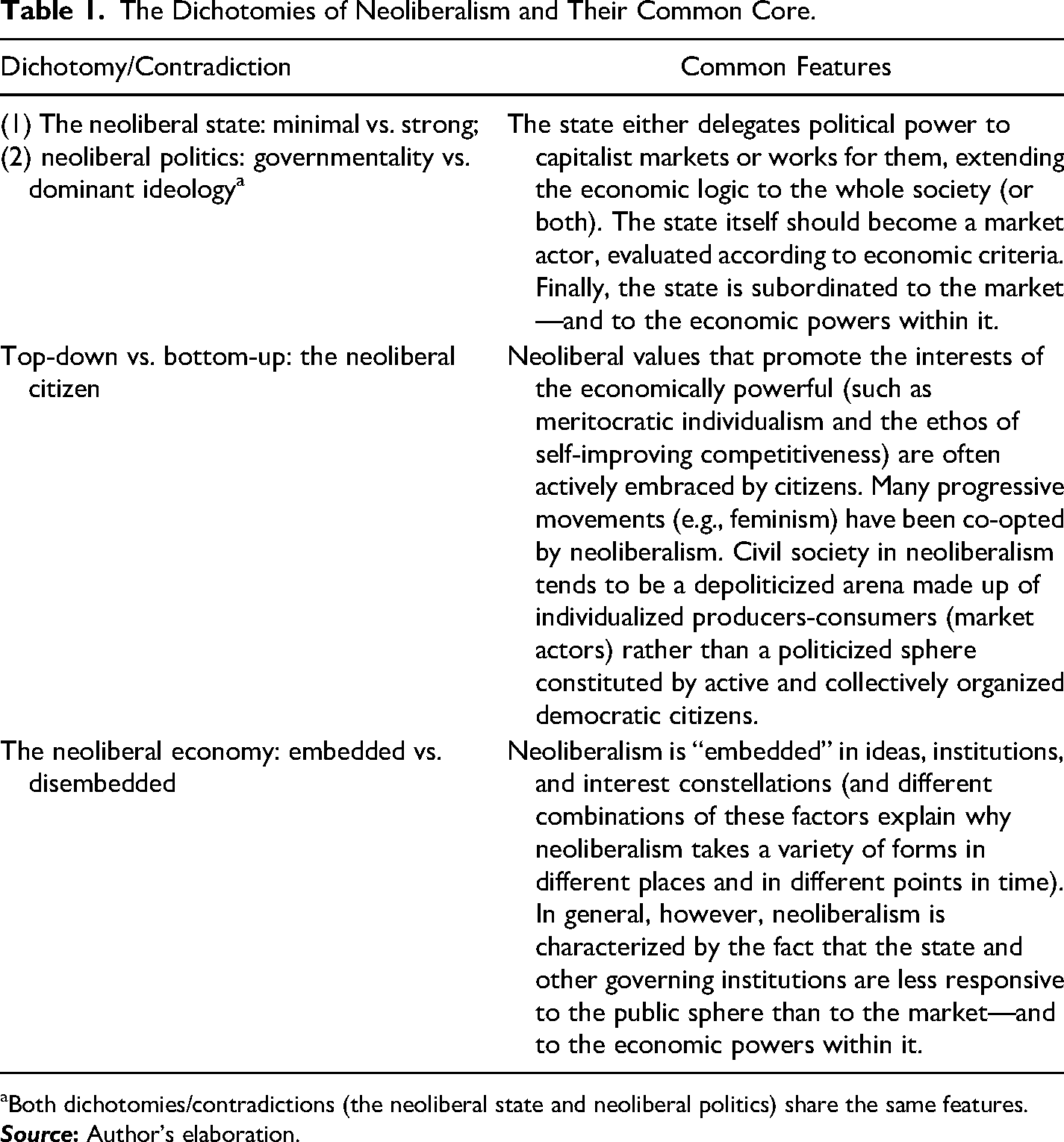
Both dichotomies/contradictions (the neoliberal state and neoliberal politics) share the same features.
To be sure, the tension between neoliberalism and democracy is well established in the literature and it is highlighted by a great number of scholars—even when they start from very different theoretical perspectives and epistemological-methodological assumptions. 94 However, the previous discussion shows not only that this tension is explicitly addressed by various scholars—even if they understand neoliberalism differently—but also that it implicitly informs many theories of neoliberalism despite the fact that the latter are unreconcilable in other dimensions.
I argue that these common features form a “central core” that highlights the analytical value of the concept of neoliberalism, as the latter is both sufficiently coherent and relevant for understanding the contemporary world. In particular, the concept of neoliberalism allows theorizing the dynamic by which both states and societies tend to be subordinated to capitalist markets—and to economic powers within them—as well as to market logics, establishing a kind of “market totalitarianism.” 95 On the one hand, neoliberal globalization compels states to compete for internationally mobile capital so that they tend to be governed by international (financial) markets: the “neo-liberal citizenship” 96 thus implies that the economic constitution overrides the political constitution. 97 On the other hand, neoliberalism also involves a project of society: 98 it is a “market civilization” 99 in which market logics dominate society and shape individuals’ identities and values. Through the discourse of competitiveness, both states and entire societies are reframed as corporations that compete to attract globally mobile capital—whereas individuals within neoliberal societies also become “enterprising selves.”
Neoliberalism then articulates state, economy, and civil society in a way that marginalizes the democratic control over the economy in favor of capitalist markets and of the powers that inhabit them: within this form of “managed democracy” ordinary citizens are largely disempowered to shape the political agenda and economic powers become tendentially totalitarian. 100 Through “market-conforming state crafting,” neoliberalism articulates “state,” “market,” and “citizenship” in a way that “harnesses the first to impose the stamp of the second onto the third.” 101 Hence, the neoliberal ideal would be to replace democratic citizenship with what may be called a “market citizenship” or “economic citizenship.” 102
Understanding neoliberalism through the lenses of citizenship allows highlighting the kind of relationships among citizens and between citizens and governing institutions (and especially the state) that neoliberalism promotes. Neoliberal citizenship is linked to participation in the market rather than to the status of the members of a political community; citizenship is reframed in economic terms (it can even be sold); 103 autonomy is mainly interpreted as private autonomy, overlooking collective self-determination; governing institutions (including the state) tend to be insulated from democratic-popular demands, disconnected from civil society and subordinated to economic powers within the market; civil society is largely depoliticized and similar to a marketplace of individualized producers-consumers; and the market—rather than democratic politics—is the central mechanism of governance and the key process for coordinating and governing individuals’ freedom.
To be sure, market citizenship is a theoretical abstraction, and it is thus both a “caricature” of neoliberalism as an ideology and an ideal-type never fully materialized in the real world—also because a society entirely governed by markets remains a “stark utopia.” 104 Thus, neoliberalism describes various real-world formations that come more or less close to this ideal. Indeed, neoliberal formations vary according to the prevailing culture/ideology and dominant state-market and state-society relationships in specific contexts. 105 Moreover, not only is there a variety of different neoliberal systems (across time and space) but neoliberalism is never the only relevant concept for understanding those systems. Even when it is argued that neoliberalism is the hegemonic ideology, the dominant approach to policymaking or the prevailing feature of contemporary capitalism, in the real world there is always room for other ideologies, for other political approaches, and for other ways of organizing the economy. 106
Neoliberal Globalization between Dedemocratization and Formal Democratization
The concept of neoliberalism is particularly useful for theorizing the reemergence of a liberalized world order after the social-democratic compromise that characterized the “West” in the three decades after the Second World War. During that period, capitalism and democracy were partially reconciled, as international trade and the circulation of capital were regulated in a way that allowed states to autonomously pursue social and economic policies, making them responsive to “society.” The partial democratization of the economy was made possible, on the one hand, by the strength of politicized civil society organizations, especially trade unions and mass parties and, on the other hand, by the fact that the economy remained mainly a national economy that the state could independently manage. The state could thus effectively steer economic processes in line with the political will emerging in the public sphere. 107 In neoliberalism, these two conditions are undermined. On the one hand, trade unions are weak, citizens’ involvement in public affairs has declined, and parties are less and less able to link society to the political sphere. On the other hand, the economy has been globalized. The freedom of (financial) capital to move across national borders disciplines state-actions: in the globalized economy—insulated from the democratic demands that largely remain expressed at the national level—the market controls the state rather than the contrary.
From this perspective, contemporary globalization resembles the global capitalism of the period before the First World War. At that time, the stability of the international monetary system (based on the gold standard) took precedence over domestic concerns because democratic institutions were weak or inexistent and trade unions were repressed or illegal so that economic commitments to the stability of the national currencies (i.e., their convertibility in gold) and to international trade were not counterbalanced by other political goals, such as securing employment and workers’ income. Global market forces were unconstrained by political-democratic factors, allowing prices and wages to “freely” fluctuate. 108
This first liberal globalization ended when societies in the Global North started to protect themselves against markets through a “countermovement” aimed at subordinating the economy to politics. Thus, the rise of representative democracy and the increased political strength of the labor movement made employment levels, wages, and prices more “rigid.” Governments were now more responsive to their citizens’ needs for income security and price stability than to the needs of global capital, which was strictly regulated, especially through capital control. In the Bretton Woods system that characterizes this phase, international economic integration was thus made compatible with states’ autonomy in pursuing social and economic policies. This form of liberalism was sustained politically by the compromise between capital and labor and economically through the Keynesian-Fordist model based on a virtuous circle between mass production and mass consumption, that is, between economic growth (profits) and increasing living standards for the population.
The postwar historical period is often described as the phase of “embedded liberalism” 109 or “democratic capitalism.” 110 Yet, in the context of this article the concept of “embedded liberalism” is confusing since all economies are always embedded. Moreover, while in the age of “embedded liberalism” the economy was partially regulated in the public interest, this does not probably amount to the democratization of the economy envisioned by Polanyi. 111 Thus, the social-democratic compromise does not represent the “golden age of democracy and social justice” since “serious gender- and race-based oppressions” sustained that order. 112 For the same reasons, also the expression “democratic capitalism” is inaccurate (it is actually an oxymoron): the postwar period is characterized at best by a partial democratization of the economy, as a fully democratized economy would no longer be capitalist. 113
Nevertheless, on the continuum between the socialist ideal and the neoliberal utopia, the varieties of postwar social democracy entailed higher degrees of democratization with respect to the contemporary varieties of neoliberalism. Indeed, the rise of neoliberal globalization in the early 1980s implied in the Global North the return to a situation in which the exigencies of global capital take precedence over democratic responsiveness. The liberalization of international trade and financial markets—that is, the suppression of capital controls—and the rise of monetarism implied the reemergence of a global market order that limits the autonomy of nation states in pursuing their economic and social policies while constraining monetary policy in a way similar to the gold standard. The globalized economic sphere tends to collide with the democratic-political sphere bounded at the national level. Hence, a situation of “post-democracy” emerges: 114 as in predemocratic times, under neoliberalism economic powers within (global) markets determine the political agendas and the “economic” comes to rule over the “social” and the “political.” 115
Thus, in the countries of the “West” characterized by established democratic regimes, the rise of neoliberalism is linked with the decline of democratic quality after the postwar social-democratic compromise, that is, with processes of “dedemocratization,” with the decline of democratic control over the economy and with the emergence of “postdemocracy.” To the extent that democratic progresses have been mainly realized at the national level, the globalization of the economy and the delegation of power to international organizations largely unaccountable to citizens—together with the decline of those national organizations (such as trade unions and mass parties) that articulated collective interests—severely undermined the basis of democratic citizenship.
However, adopting a global perspective, the “neoliberal era” has been characterized by a diffusion of democracy through the so-called third wave of democratization that involved, in the 1980s and 1990s, countries of the Global South (e.g., Latin America) and Eastern Europe. Thus, it is important to distinguish between established and new democracies. In the newly established democracies of the Global South, which have been largely excluded from the benefits of the social-democratic compromise and instead “have been disproportionally subject to the orthodox stabilization measures of the IMF,” 116 neoliberalism is associated with the rise of formal democracies and thus with the continued lack of democratic control over the economy. Thus, many of the newly established democracies remain democratic only in the formal sense, resembling the postdemocracies of the North. As Barry Gills and Joel Rocamora have argued, what we see is the spread of a “low-intensity democracy” or elite-dominated democracy, which does not challenge the unequal distribution of power in society. 117 In this context, neoliberalism represents less a break than a continuity: the unbroken asymmetry of power between the Global North and South, the predominance of the interests of foreign capital over those of the domestic population, and the continued lack of democratic control over the economy.
This may explain also the paradox for which the “third wave” of democratization in the 1980s and 1990s in countries for example of Latin America and Eastern Europe is accompanied by an increase of economic inequality in these countries. 118 Democracy has been promoted but the kind of democracy that has become dominant during the neoliberal era—and that has been established in these countries—is a depoliticized democracy, in which central economic decisions remained insulated from democratic control. 119 Hence, under neoliberalism, both dedemocratization in the Global North and formal democratization in the Global South and Eastern Europe have implied higher inequalities because (among other reasons) governments are less responsive to citizens than to (global) capital and accordingly regulate the economy in the interest of the latter rather than for the common good. To the extent that growing inequality is the result of political choices, making policies less responsive to “society” than to (global) economic powers sustains a self-reinforcing process where economic resources are translated into political resources and vice versa. 120
In short, the concept of neoliberalism appears useful for theorizing the reemergence of a liberal world order under formally democratic conditions. Today, like in the nineteenth century, economic forces tend to be insulated from democratic rule and popular accountability. Yet, in contrast to the liberalism of those predemocratic times, contemporary neoliberalism “must confront the fact that formal democracy is ever-more institutionalized on a world scale.” Thus, what is novel about neoliberalism is that it “requires not simply suppressing, but attenuating, coopting and channeling democratic forces.” 121 Neoliberalism then allows describing the era started in the late 1970s and early 1980s in terms of the declining democratic quality in the North, the establishment of largely formal democracies in the South, and the rise of inequalities on a global scale (even if democracies—both “old” and “new”—continue to differ in their degree of democratic quality).
Postneoliberalism?
While scholars agree on when the neoliberal era starts, they disagree whether and when it has ended. 122 For example, after the financial collapse in 2008 many observers thought that this crisis would have marked the end of neoliberalism but subsequent work had rather to explain the resilience of neoliberalism, as the latter has proven to be highly adaptive, transforming itself to withstand to crises and challenges. 123 The concept of “postneoliberalism” had already been discussed in response to the electoral victories of new left governments across Latin America starting in the late 1990s. 124 More recently, the rise of “populism,” the COVID-19 pandemic, and the emergence of various versions of a “Green Deal” aimed at planning the social-ecological transition have generated a stimulating discussion on the end of neoliberalism. 125 This section develops some analytical criteria that help frame this debate.
A first aspect of the dispute concerns the emergence of progressive policy agendas, that is, whether these policy paradigms amount to alternatives to neoliberalism or not. For example, many scholars consider generous social policy approaches such as “social investment”—whereby social policy improves people's skills, enhances work-life balance, and prevents the emergence of social problems through the promotion of children's “human capital”—as providing an alternative to neoliberalism. 126 However, from the perspective developed in this article, these efforts to ameliorate social outcomes do not amount to providing an alternative to neoliberalism because they do not challenge the ideal of “market citizenship”: they do not aim to expand democratic control over the economy, questioning the political condition of the “competition state” but they rather emphasize the positive role of social policy in enhancing international competitiveness. Moreover, these social policies generally aim at including individuals in the economy, empowering workers-consumers for the market rather than citizens for democracy. 127
Thus, the arguments developed so far support the thesis that generous policy agendas constitute “social” or “inclusive” versions of neoliberalism in which social policy helps individuals to be included in the labor market, mitigates the most negative consequences of market imperatives, and promotes equality of opportunity through investments in people's skills. 128 Similarly, in the field of development policies, the end of the “Washington Consensus” in the 1990s—which involved a move away from fiscal discipline toward an emphasis on the positive economic role of the state and on “social capital” (whereby trust and civic culture are reinterpreted as drivers for economic prosperity), as well as a focus on promoting “good governance,” the quality of institutions, “poverty reduction,” and “gender equality”—may be understood as a transformation of neoliberalism into more socially oriented, “feminist,” and “inclusive” forms. 129
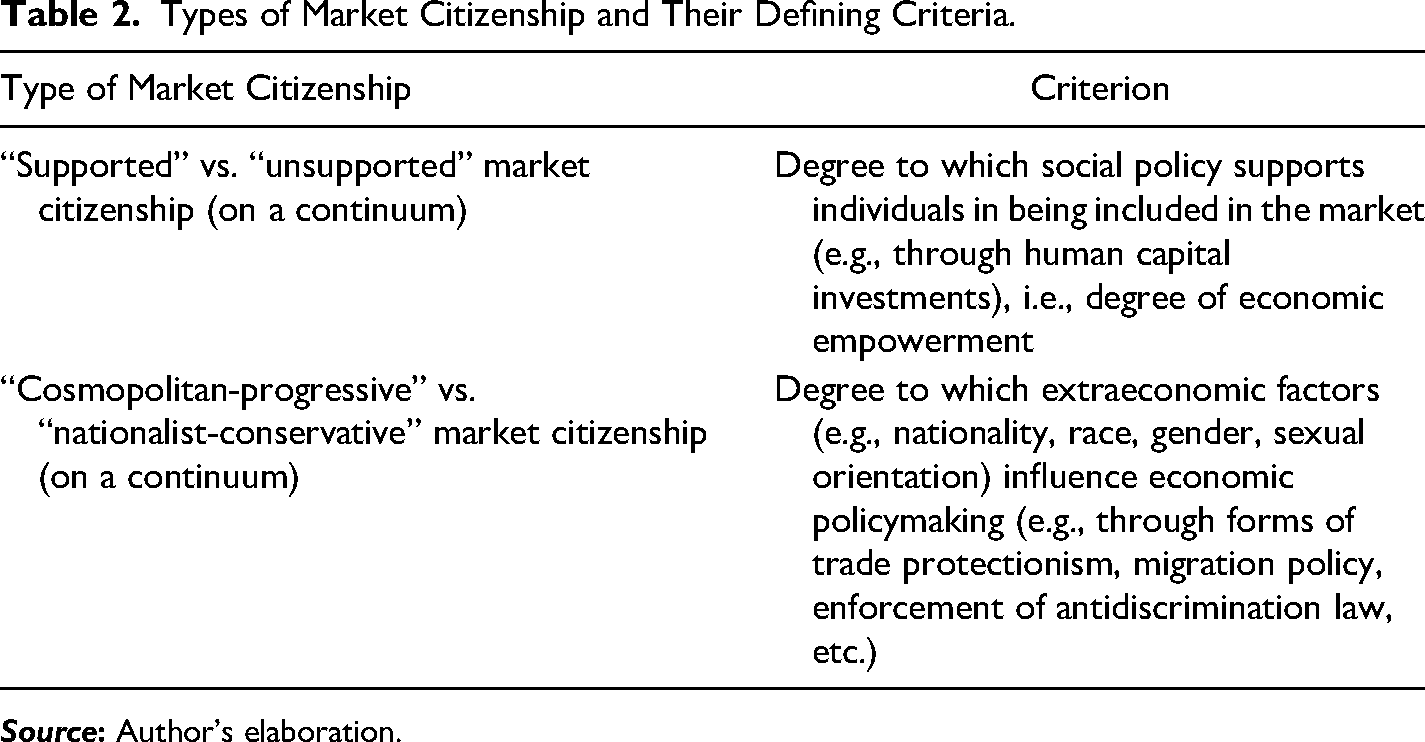
Yet, these progressive policy approaches do differ in important ways from other neoliberal measures such as austerity, welfare retrenchment, and fiscal consolidation. Hence, it may be useful to distinguish between “unsupported” and “supported” versions of market citizenship: the former describes forms of social policy that leave market citizens alone with their responsibility for taking part in the market whereas the latter indicates more generous social policy approaches that support market citizens through, for example, the improvement of their “human capital.”
Another crucial aspect of the debate on postneoliberalism concerns the emergence of nationalist protectionism and “populism.” Since neoliberalism is associated with free-trade globalization, the election of Trump, Brexit, and the rise of other nationalist-protectionist and populist forces around the world seem to put an end to the neoliberal era. To some extent, the conceptual framework developed in this article would also support this thesis. Thus, the slogan of the Brexit campaign, “Taking back control,” expresses precisely the idea of regaining democratic control over the direction of social change—a possibility that neoliberalism has severely undermined. Similarly, “populist” parties in the Global North have been the only political forces that seem to have broken the “neoliberal consensus” among center-right and center-left parties, promising to offer an alternative to the status quo and claiming to represent the interest of the “people” rather than of the “elite.” Hence, after decades of decline, voter participation has increased again in many Western democracies, especially among the lower classes. 130 At first glance, it thus seems that populism reconnects “society” with the political system, making the state accountable to citizens rather than to economic powers within the market.
Yet, this nationalist turn may not entail the end of neoliberalism but its transformation into what has been variously called “national”/“nationalist” neoliberalism or “neoliberal nationalism.” 131 For example, while the victory of Brexit clearly showed a popular malcontent with the neoliberal status quo and a politicization against normalized and depoliticized neoliberalism, it was not a vote on being “in” or “out” of neoliberalism. 132 Similarly, despite the rhetoric of opposing the elites, many right-wing populist and authoritarian governments have actually retrenched the welfare state and decreased taxation for the wealthy, promoting the interests of the financial elites. Thus, as Nancy Fraser argues, right-wing populism does not challenge the economic side of neoliberalism and its “plutocratic” core, channeling popular malcontent with the status quo against immigrants and LGBT+: it rejects “progressive neoliberalism” and “multiculturalism” and proposes instead a form of “hyperreactionary neoliberalism,” that, while sticking to “financialization,” is characterized by “ethnonationalism” and by “overtly racist,” “patriarchal,” and “homophobic” attitudes. 133 The Far Right then form an “internal opposition” within neoliberalism that contests its cultural side without challenging its political-economic dimension. 134
Therefore, here again, it is possible to differentiate between two ideal-types of neoliberalism. On the one hand, a “cosmopolitan-progressive market citizenship,” which is relatively indifferent to race, gender, and sexual orientation since it is informed by liberal-individualistic and meritocratic values that are compatible with international competition in the global market. On the other hand, a “nationalist-conservative market citizenship” promoted by contemporary right-wing populism, which explicitly uses noneconomic criteria such as race and sexual orientation for influencing economic processes without, however, challenging the asymmetry between economic powers and democratic powers (even if this form of market citizenship may partially entail the promotion of the interests of domestic—as opposed to international—capitalists).
The four models of market citizenship described above are ideal-types and real-world realizations of these types may occur at different “degrees.” Thus, the two criteria that allow identifying the four different models—that is, the degree of economic empowerment and social policy generosity on the one hand, and the degree to which extraeconomic factors play a role in economic policymaking on the other—imply that the ideal-types should be thought on a continuum (Table 2). Also, the types can interact along the two dimensions/criteria so that it is possible to have different combinations, that is, unsupported and nationalist or supported and nationalist market citizenship; supported and cosmopolitan or unsupported and cosmopolitan market citizenship.
Types of Market Citizenship and Their Defining Criteria.
Despite the fact that in many cases right-wing populism represents a nationalist and illiberal-authoritarian version of neoliberalism rather than an alternative to the latter, it is clear that the current historical phase involves what can be described in Gramscian terms the “hegemonic crisis” of neoliberalism: a crisis of moral, intellectual, and political leadership of the dominant classes, which continue to rule but increasingly lack the consensus of the dominated. 135 Indeed, the political rhetoric adopted by the “populists”—whereby they claim to represent the interests of the “people” against those of the elites—reflects the historical reality of a society largely disconnected from the political elite 136 and dominated by a “new oligarchy,” 137 which attempts to reclaim citizenship and popular sovereignty. The support for populism can then be interpreted as a reaction to the isolation of the economy from democratic control and as the attempt to reestablish “sovereignty”—as opposed to technocratic and depoliticized neoliberal government. 138
The neoliberal consensus, supported by both the center-right and the center-left since the 1990s, 139 has created a crisis of representation and thus a space for new political forces that challenge this postpolitical condition—a space now mostly occupied by right-wing populism but that could be potentially conquered by the Left. 140 Indeed, there is a plurality of competing strategies to overcome the instability and incertitude that characterize the hegemonic crisis. From this perspective, also the socially oriented versions of neoliberalism—the “supported market citizenship” model described above—can be interpreted as a response to the hegemonic crisis of neoliberalism and an attempt to revitalize its legitimacy. But the hegemonic crisis of neoliberalism also opens the way to both progressive and authoritarian alternatives to neoliberalism. Hence, as in the 1920s and 1930s, in Gramsci's and Polanyi's day, we face today a political crisis characterized by the growing tension between capitalism and democracy, which propose again a choice between democratization and authoritarianism. 141 Indeed, the “countermovement” whereby society tries to protect itself from the globalized economy can take progressive or authoritarian forms: the political discourse of “sovereignty,” “protection” (or “security”), and “control” can be articulated in progressive terms—as part of a democratic renewal—but also in authoritarian-conservative and nationalist-xenophobic terms. 142
A Useful Concept for the Left?
In this section, I want to highlight the usefulness of the concept of neoliberalism for the Left, starting with the role that critical and progressive scholars that employ this concept can play in clarifying the present condition. Indeed, I agree with Fred Block when he argues that it is essential that social theorists develop concepts that help to illuminate “the kind of historical era in which we live,” to define “the nature of contemporary societies and to delineate their major dynamics.” Failing to do so has serious consequences because “individuals cannot do without some kind of conception of the type of society in which they live” and while there are “complex mediations” between social theory and “everyday ‘common sense,’ the two are connected in important ways.” I argue that the concept of neoliberalism can offer such a “roadmap to our social environment,” which illuminates “our present political and social circumstances.” Bridging social theory and common sense, neoliberalism is thus relevant not only at the analytical but also at the “political” level, helping individual and collective actors to make sense of society. Indeed, Block also notes that in “those periods when social theory fails to define the nature of our society, other ideas tend to fill the void of popular understanding.” 143 In the current historical conjuncture, the risk is that interpretative frameworks promoted by right-wing populism become the hegemonic self-understanding of contemporary societies, whereby, instead of blaming neoliberalism for the increase of inequalities, economic insecurity, and social dislocation, the discourse of the Far Right accuses immigrants and minorities.
Hence, while the concept of neoliberalism is perhaps “not a satisfactory one,” naming neoliberalism “is politically necessary to give the resistance to its onward march content, focus and a cutting edge.” 144 Progressive social scientists use neoliberalism for proposing other conceptualizations of the origins of social problems—and for formulating solutions. Thus, in the context of its hegemonic crisis, the concept of neoliberalism may be especially useful for the political left for imagining how social phenomena labeled as neoliberal “might be rearticulated as part of a coherent anti-neoliberal politics.” 145 Neoliberalism may thus constitute the “Other” that contributes both to define the political identity of the Left and to unify its different struggles, creating “an enemy common to each left faction and therein the possibility of their articulation into an alliance”: the different critiques of neoliberalism act as a “connective tissue” that ties in an overarching critique “the various struggles characterizing the left.” 146 Moreover, as I have shown, critiques of neoliberalism converge on the idea that neoliberalism undermines a real democracy. Symmetrically, behind the different critiques of neoliberalism there is “a common desire for democratic life.” 147
Against this background, framing neoliberalism in terms of “market citizenship” may further clarify the political identity of the Left around the ideal of a strong and inclusive democracy. This ideal can be conceived in terms of some form of democratic socialism 148 or republicanism, 149 but it broadly entails the vision of a society in which the economy is subordinated to democratically defined social needs and where democratic principles and values are extended to all spheres of society—including the economy itself. 150 Precisely like “market citizenship,” this concept of a strong and inclusive democracy also involves an internally heterogeneous rather than a coherent political project and it consists in a utopia never fully achieved in the real world. Thus, it is possible to imagine a continuum of democratization 151 —between the neoliberal ideal of market citizenship and the socialist/republican ideal of “real” democracy—with the various social-democratic compromises achieved in the West after the Second World War entailing higher degrees of democratization with respect to the contemporary varieties of neoliberalism, without, however, fully realizing the democratic ideal (Fig. 1). On this basis, the political project of the Left should focus on recovering, deepening, and extending democratic principles and values with a view to building a more democratic order after neoliberalism. In order to do so, it is essential to reimagine the relation between individual freedom and social solidarity and to go beyond class-based demands, articulating the latter with emancipatory-democratic demands that originate from other forms of oppression based on gender, race, and sexual orientation, and from struggles around the protection of the natural environment. 152
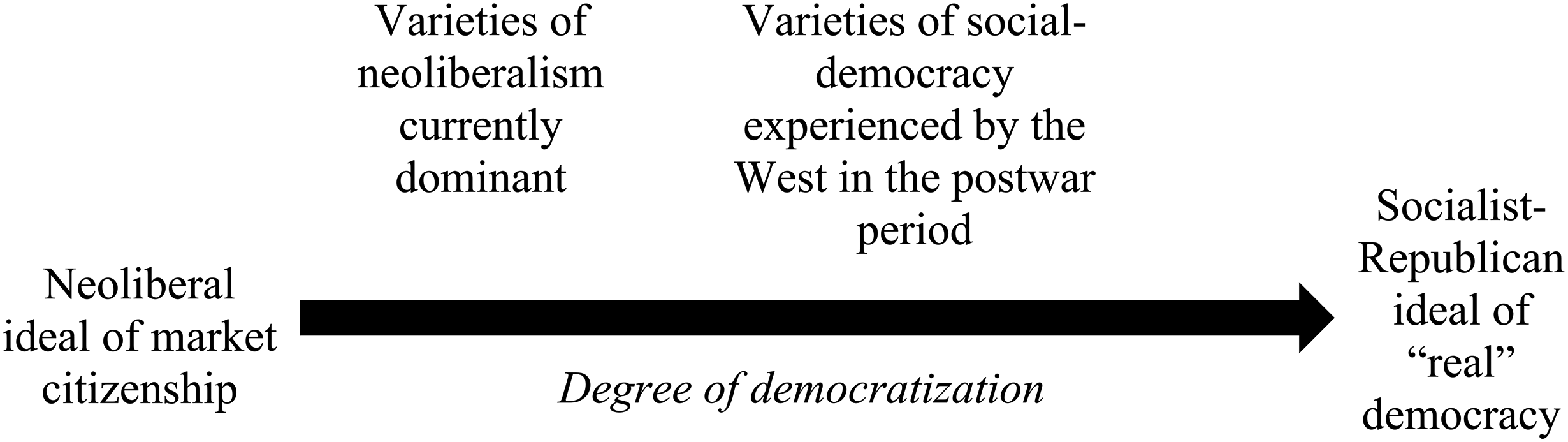
The democratization continuum between neoliberalism and democratic socialism.
Clearly this political project has to involve different levels, as the democratization of the nation-states requires an enabling international order. 153 Yet, this multilevel dimension generates a dilemma. Indeed, some parts of the Left—including some prominent social theorists—now embrace left-nationalist positions. The critique of neoliberal globalization leads to a rejection of globalization as such with the argument that the latter cannot be democratized and that the national level is the only level that can be effectively democratized. 154 However, this position could be criticized for ignoring issues of global justice and international solidarity. 155 Similarly, it is not entirely clear how “reclaiming the state”—alone—can address problems such as climate change, global inequality, wars, and forced migration: the inward-oriented neostatist “endopolitics” oriented toward issues of sovereignty, protection, and control—which is potentially replacing the neoliberal “exopolitics” of freedom, flexibility, and opportunity 156 —is thus possibly unsatisfactory, even if it is articulated in terms of a progressive democratic renewal, since major contemporary challenges can only be addressed at the international level, promoting global responses. 157
Perhaps what is problematic about neoliberalism is not that the international level limits the autonomy of the states: 158 in matters such as overexploitation of natural resources and human rights violation, constraining states’ freedom can be seen as a progressive measure. The problem is rather that under neoliberalism, the constraints imposed on democratic politics derive from international financial markets—which are notoriously indifferent to the “common good” (however defined). Hence, the point is to find ways that allow us to democratize international institutions, making them responsive to the interests of global society instead of global capital. Thus, while the democratization of the national states is necessary, it is probably not sufficient: what progressives need is a countermovement of global proportions focused on the promotion of global justice and on the protection of the environment driven not only by democratic—and increasingly democratized—nation-states but also by a global civil society. 159 Rather than deglobalization, the challenge is to build a postneoliberal globalization that reorients the latter to serving society within ecological limits. 160
Conclusion
Neoliberalism has come to mean different things to different people. However, it is possible to identify a common core among otherwise conflicting interpretations of neoliberalism. In particular, what emerges from the discussion of the literature is that neoliberalism can be conceived as a political ideology (articulated by key neoliberal thinkers) and as a political practice (become dominant since the 1980s), which embrace the utopia of a “market citizenship” as a substitute for democratic citizenship. This ideal is then more or less realized in the real world—and in various degrees in different contexts. In the ideal of market citizenship, both the state and society are subordinated to capitalist (corporations-dominated) markets and their logics. Civil society is reduced to a marketplace of individualized and depoliticized market citizens (producers-consumers), and this weakens the connection between society and the political sphere of the state and other governing institutions. The disconnection between civil society and government in turn makes the regulation of the economy less responsive to the public sphere—and thus to the public interest—than to economic powers within the market.
The neoliberal promotion of markets (and of market-based logics) may be undertaken for different reasons: for enhancing efficiency and competition (as a technocratic-utilitarian project), for creating new potential sources of profitability (as a political project of the capitalist-financial class), for expanding the realm of (formally) noncoercive and free relations in society (as a libertarian project), and for better coordinating information dispersed in society in an unplanned, spontaneous way (as an epistemological project). The consequences of market promotion—and of the promotion of market-based logics—are also different, as these processes do not occur in a vacuum but through social practices in contexts that vary in terms of institutions, ideological-cultural frameworks, and interest constellations. Hence, neoliberalism should not be understood in monolithic terms. Just as postwar “Keynesianism” did not involve the systematic application of Keynes's ideas and was heterogeneously implemented, policies and socioeconomic arrangements labeled as “neoliberal” are not causally linked to neoliberals’ ideas: as a theoretical abstraction, neoliberalism should be understood as a broad historical trajectory, which takes different forms in different cultural-ideological, geographical, sociopolitical, and economic settings. Also, as a generalization of the dominant tendency in society, neoliberalism can never be used as the sole relevant concept for describing current sociocultural and political-economic formations, as they always also refer to “non-neoliberal” principles and values.
However, the concept of neoliberalism allows us to theorize the reemergence of a liberal world order based on global capitalism and “free” international markets (and especially capital mobility) after the social-democratic compromise experienced by Western democracies. While this compromise did not represent the realization of the democratic ideal, neoliberalism involved a process of dedemocratization in these countries, that is, a decline of democratic control over economic processes and—given the centrality of the latter for society in general—over the direction of social change and the collective destiny. For those countries that were excluded from the benefits of the social-democratic compromise and that experienced the transition to democracy during the neoliberal era, neoliberalism implied the promotion of formal democracies, which—with their limited political autonomy in economic matters—resemble the postdemocracies of the West. In both cases, neoliberalism entails the marginalization of collective self-determination and the limited capacity to shape the economy—and thus society—according to the democratic will. Thus, the economy is insulated from democratic politics and is instead influenced by economic powers within the market and delegated to technocratic agencies at the international level, where democratic accountability is weak.
While in many ways then neoliberalism can be considered a return of classical liberalism, two differences are particularly evident. The first is that when classical liberalism was hegemonic, mass democracy did not yet exist, whereas neoliberalism had to find ways to disempower, depoliticize, co-opt, and constrain democratic forces for imposing its economic imperatives. The second is that classical liberalism at least formally recognized the existence of different social spheres—with each sphere functioning according to its own logic. With the rise of neoliberalism, in contrast, the capitalistic-economizing logics of investment, profit maximization, and efficiency are extended to all domains of social life, including the state, the family, and the individual identity—which is reformulated in terms of “human capital” and “enterprising self”—whereas the discourse of “competitiveness” reframes entire societies as corporations. Hence, while the degree to which society is subordinated to the market was already high in liberal market societies analyzed by Polanyi, it is even higher under neoliberalism. Within the latter, the market is not only the dominant institution governing society but—through even greater levels of marketization and commodification—effectively shapes almost all spheres of social life, including intimate relationships and individuals’ self-conception.
At the time of writing, we are in the middle of the hegemonic crisis of neoliberalism, which has lost popular legitimacy. It is still unclear whether neoliberalism will end and how. With a view to reestablishing its legitimacy, there are attempts to make neoliberalism more social and inclusive through the promotion of various forms of “supported market citizenship” in which social policy helps individuals to be included in the economy. We can also observe the rise of right-wing “populism” promoting a nationalist-conservative variant of market citizenship, which opposes the cultural openness of the cosmopolitan version that dominated neoliberal globalization over the last few decades, without substantially challenging its economic dimension. Finally, alternatives to neoliberalism may also emerge. Yet, these Polanyian “countermovements” aimed at subordinating the economy to political control may take progressive-democratic forms but also degenerate into authoritarian and fascist regimes. Sadly, as in Polanyi's times, also today we see that the crisis of the liberal-capitalist world economy is accompanied by the rise of nationalist-authoritarian regimes, by increasing international tensions, and even war. Against this background, it is urgent that we develop emancipatory responses to the many—and interconnected—crises of our time. It is in this context that the concept of neoliberalism may be especially useful for the Left: for imagining a politics centered on the radicalization and deepening of democratic practice, struggling for emancipatory alternatives to both neoliberalism and nationalist authoritarianism.
Footnotes
Acknowledgments
I am grateful to Jean-Michel Bonvin, Lavinia Bifulco, Matteo Gianni, Barbara Lucas, and Frédéric Varone for their valuable comments on earlier drafts of this article. A previous version of this article was presented at the “Political Economy Workshop” of the University of Bremen, and I wish to thank all the participants for their insightful and constructive feedback. I am particularly grateful to Frank Nullmeier and Dieter Plehwe for sending me very rich written comments on the paper. I also thank the members of the editorial board of Politics & Society (and especially Fred Block) for their very helpful suggestions that improved the article. Finally, I thank the Swiss National Science Foundation for its financial support.
Declaration of Conflicting Interests
The author declared no potential conflicts of interest with respect to the research, authorship, and/or publication of this article.
Funding
The author disclosed receipt of the following financial support for the research, authorship, and/or publication of this article: The author acknowledges that his research is financially supported by a “PostDoc.Mobility” Fellowship of the Swiss National Science Foundation, research project “Beyond Inclusion: Rethinking Work and Welfare for a Post-neoliberal Socio-Ecological Transformation.”