




Abstract
Political parties expect youth wings to recruit and socialize young people into the norms and values of the party, nurturing aligned future grassroots members, officials, and candidates. However, embeddedness in youth wings – understood in terms of membership length and activity levels – may not necessarily deliver this. In our study, we examine whether youth wings nurture the members parties want using YOUMEM survey data from over 5000 members of 12 youth wings in six countries. Specifically, we assess whether embeddedness is associated with greater ideological alignment and desire for long-term party engagement. We find that active members are more ideologically aligned and inclined to remain in the party, while passive members display the opposite trend. However, length of membership is associated with reduced aspirations among all for intra-party and public office. Our findings suggest that the added value of youth wings as future-oriented socialization vehicles for parties is less than generally assumed.
Keywords
Introduction
Most parties have youth wings that welcome politically interested young people into their ranks (Allern and Verge, 2017: 119). 1 From the party’s perspective, the youth wing primarily serves as a future-oriented auxiliary organization, providing new members, whom the youth wing is expected to socialize into the norms and cultures of the party (De Roon, 2020; Hooghe et al., 2004; Martínez-Cantó and Verge, 2023; Mycock and Tonge, 2012). Indeed, while youth wings from different countries and/or party families enjoy varying degrees of autonomy from their parties, the latter articulate similar expectations regarding the roles of these organizations. Their supporting function is not only commonly discussed in the literature (De Roon, 2020; Mycock and Tonge, 2012) but is also set out in parties’ and youth wings’ official documents. For example, parties refer to youth wings promoting ‘the principles of the [senior party] within their spheres of influence’ (Christlich Demokratische Union Deutschlands, 2024), along with the need for them to ‘comply with the program’ (Partido Socialista Obrero Español, 2024) and ‘promote the goals’ (Österreichischen Volkspartei, 2022) of the party. Such documents also emphasize how youth wings should ‘actively encourage party membership among young people’ (Western Australian Young Labor, 2024), arrange ‘training of members in areas that serve the goals’ of the party (Nuevas Generaciones, 2021), and ‘provide members with knowledge about the ideas and political ambitions’ of the party (Socialdemokratiska Ungdomsförbundet, 2023). Moreover, youth wings are tasked not only with socializing a new generation of grassroots members, but ‘training tomorrow’s leaders’ (Young Liberals, 2024). Their ‘added value’, that is, the increased benefit that youth wings are supposed to deliver for their parties, lies thus in recruiting young people who feel an affinity with the party, and moulding them into loyal members, officials, candidates, and representatives.
However, there are at least two reasons why youth wings might not be as successful at nurturing loyal future grassroots members, officials, and candidates as parties would like. First, youth wings often enjoy a degree of independence vis-à-vis the senior party, which means that there may be differences of opinion regarding both the youth wing’s primary purpose and its positions on political issues. In other words, youth wings not only prepare their members for a future in the senior party but are also political platforms for young people who wish to make their voices heard and influence policies in the present (Weber, 2017). At the same time, the extent of such autonomy can vary both across and within national contexts, reflecting differences in organizational arrangements and institutional traditions. As such, some youth wings may be more effective at fulfilling the party’s needs than others. Second, and relatedly, members’ engagement in youth wings is usually driven primarily by political motives in the here-and-now rather than by the desire to become good members who can fulfil the various future needs of the senior party (Bolin, 2025; Bolin et al., 2023; Weber, 2020). Given that there has been no research on the topic, we do not know, however, whether youth wings indeed provide the added value parties desire by creating an environment that shapes as many of their members as possible for future party engagement. In this article, we therefore ask: Do youth wings nurture the kinds of members their senior parties want?
To answer it, we utilize original data from the YOUMEM project – the largest cross-national survey of youth wings to date (McDonnell et al., 2025a) – comprising more than 5000 respondents from the 12 main centre–left and centre–right parties in Australia, Austria, Germany, Italy, Spain, and Sweden. 2 Specifically, we analyze the extent to which a young person’s ‘embeddedness’ (which we conceive of as duration of youth wing membership, levels of activity, and the interaction of these two factors) is associated with an increased degree of attitudes desired by the senior party, namely greater ideological congruence and willingness to be involved in future party engagement, whether as grassroots members, officials, or candidates. Somewhat surprisingly, we find that active members are only slightly more ideologically aligned and inclined to remain in the senior party, while passive members show the opposite trend. Moreover, length of membership negatively affects both groups’ willingness to seek senior party roles or political positions. Our findings thus provide an important alternative perspective to how scholars have tended to characterize youth wings. While the added value of the latter is generally seen by scholars (De Roon, 2020; Mycock and Tonge, 2012; Ødegård, 2014) (just as it is by parties) in their role as a future-focused and supporting organization for the senior party, our study indicates that this view needs to be nuanced. It is true that many youth wing members will go on to become loyal grassroots members, officials, and representatives. But, crucially, our study shows that this is not necessarily because of their embeddedness in the youth wing. Moreover, those who do not have such attitudes when they begin in the youth wing appear unlikely to develop them, no matter how long they stay or how much they get involved in the organization’s activities. We therefore conclude that, although youth wings undoubtedly fulfil many vital functions for parties, their nurturing role is not as extensive as previously thought.
The article proceeds as follows. In the next section, we look at how youth wings, through socialization and education, might fulfil the nurturing role outlined above. This leads into a discussion of our three guiding hypotheses. We then explain the study’s data and method before presenting the results of the analysis. The article concludes with a summary of our findings and a discussion of the main implications.
How embeddedness in youth wings can nurture members
Although the extent to which grassroots members are still relevant to political parties has been called into question (see e.g. Katz and Mair, 1995), elites from a wide range of parties and countries remain conscious that they need members to achieve their objectives (Albertazzi and van Kessel, 2024; Bale et al., 2020; Cross and Gauja, 2014). Members are valued because they are perceived as being loyal supporters who subscribe to the party ideology, and can thus spread the party’s ideas in their social circles (Scarrow, 1994). Moreover, members are central to party organizational development and survival, since they represent the main pool of candidates from which party elites recruit candidates and officials (Hazan and Rahat, 2010; Scarrow, 2015). Therefore, it is in parties’ interests to have a steady supply of members who are socialized into the party’s ideology, values, and norms.
Youth wings are considered a particularly important source of political socialization for future party activists (De Roon, 2020). These organizations not only serve as communities unified by shared beliefs and a collective vision (Bolin and Jungar, 2024), but their membership period typically coincides with the ‘impressionable years’, when individuals are most susceptible to external influences in their socialization (Neundorf and Smets, 2017). According to one study commissioned by the European Parliament’s Committee on Civil Liberties, Justice and Home Affairs, youth wings ‘have the common task of serving the needs of the party by reaching out to the young electorate and the role of socialisation agents, familiarising young members with the party’s traditions, important networks and culture’ (Deželan, 2023: 63). Similarly, Mycock and Tonge (2012: 144) argue that youth wings ‘act as recruiters for the party [and] educate and train young people in key party functions such as campaigning, fund-raising, political communication and party organisation’. Youth wings are therefore intended to provide an ‘added value’ for their parties: in other words, just like an item whose worth increases from one stage of production to the other, the young people who join youth wings should develop into the kind of members political parties want and need, thanks to their embeddedness in those organizations. Through spending time and participating in the youth wing, they are expected to adopt views and behaviours more in line with those promoted by the senior party.
Socialization occurs both informally and formally. Regarding the former, studies highlight how everyday political talk, that is, ‘nonpurposive, informal, casual, and spontaneous political conversation’ (Kim and Kim, 2008: 53), can be important as a way for young people to shape and articulate opinions and identities (Ekström, 2016). This is extremely relevant to party youth wings. Although young people have multiple types of motivations for signing up to a youth wing (Bolin et al., 2023), one of the key reasons is the opportunity to meet new friends and like-minded individuals (Bruter and Harrison, 2009; Weber, 2020). In practice, youth wings also foster informal socialization through recurring social activities and gatherings, ranging from local meet-ups to larger events, where members build friendships and networks and experience a sense of community and belonging (Bolin and Jungar, 2024). Through such interactions, the conditions are created for developing common values and norms regarding what can be considered desirable behaviour within the organization.
Besides offering these informal venues for socializing with fellow youth wing members, parties and their youth wings regularly organize formal internal training. While this type of educational function is widely regarded to be one of the main activities conducted within parties and their youth wings, there is relatively little research on the topic. Educational activities are commonly referred to by scholars in general terms such as how they are designed to teach new members about key party activities like campaigning, fund-raising, and political communication (Mycock and Tonge, 2012). A few recent studies, however, have specifically focused on intra-party education, examining both its purposes and contents, as well as the outcomes expected from training. Although the educational initiatives of different parties may have a variety of purposes, the aim is always to provide members with concrete knowledge and skills, along with instilling in them a common identity and internal cohesion (Pastuhov, 2024). Training programmes seek to achieve these objectives in two main, inter-related, ways. First, they are based on the specific party’s ideology and values, and try to enhance members’ competence in concrete party-related activities, such as leading meetings and communicating with the media (Bladh, 2022a). Second, they seek to construct a common identity by using study materials on the party’s organization, history, and ideology (Arriaza Hult, 2020). Intra-party education thus contributes to the nurturing of the types of members parties want by embedding them in the prevailing culture and norms within the organization and fostering internal coherence (Bladh, 2022b).
Our argument in this article follows on from the above. Namely, the more someone is embedded into the youth wing organization, the greater their chance of being shaped by the beliefs, values, and behaviours promoted by the senior party. Consequently, if youth wings are successful in nurturing the members that their senior parties want, this should be visible if we compare the attitudes of individuals who are extensively embedded in the youth wing with the attitudes of those who are less embedded. We understand embeddedness in terms of how long individuals have been members and how active they are. Regarding attitudes, as mentioned earlier, there is a variety of these that can be considered desirable from a senior party perspective (Scarrow, 2015; see, e.g. Bale et al., 2020). We focus on three key ones: youth wing members’ degrees of alignment, affiliation, and aspirations. We then consider whether these attitudes change according to an individual’s level of embeddedness in the youth wing. These three attitudes form the basis for our three hypotheses, which we present below.
First, a core function for members is to promote the party’s politics externally. By being an ambassador for the party’s policies, the member can spread the party’s message to family, friends, and colleagues (Scarrow, 2015). From the point of view of the senior party, it is therefore important that the member’s opinions align with the party’s official line. There are often explicit formulations, for example in the party’s statutes, stating that the youth wing should support and promote the party’s political platform. The Australian Liberals, for example, state that the goals of the Young Liberal Movement are ‘to promote the objectives, policy and platform of the Party amongst young people’, whereas the youth wing of Forza Italia, according to the party’s description, ‘operates in accordance with the political line of the Movement’ (for more examples, see the Introduction and Supplemental Appendix A).
At the same time, people in youth wings have traditionally been considered among the most radical members of their parties (Russell, 2005: 566; Weber, 2017: 387). For example, the members of youth organizations on the left like the Jusos (youth wing of the German Social Democrats) and on the right like the UK Young Conservatives have been viewed as closer to the extremes than their parties (Braunthal, 1984: 47; Pickard, 2019: 202). Recent research reinforces this view, suggesting that youth wings in some national contexts may function as arenas where political idealism and more radical positions persist or even intensify rather than being moderated over time (Kolltveit and Karlsen, 2025; McDonnell et al., 2025b). Importantly, however, this work focuses either on elite trajectories or on formal membership duration when assessing these dynamics. For instance, McDonnell et al. (2025b) show that youth wing members who perceive themselves as more radical tend to have spent longer time in the organization. While this finding is noteworthy, length of membership alone may provide an incomplete picture of organizational socialization. After all, many members remain formally affiliated over extended periods but with limited engagement, thus potentially diluting the socializing effects of organizational exposure. In this article, we therefore not only consider how long individuals have been members, but also how actively they participate in youth wing activities. By looking at both duration and intensity of involvement, we are better able to assess the extent to which youth wings shape members’ ideological orientations in line, or at odds, with the senior party. This approach also complements recent work focusing on narrower empirical domains. While Kolltveit and Karlsen (2025) provide valuable insights into the persistence of ideological idealism among youth wing elites in the case of Norway, our study extends the analysis to a broader set of members across multiple countries, allowing us to examine how different forms of engagement relate to ideological alignment with the senior party more generally.
Notwithstanding the above studies, therefore, we have reason to believe that embeddedness in the youth wing – understood as both time spent in the organization and active participation – may foster ideological alignment with the senior party. Research on intra-party socialization suggests that prolonged involvement in party organizations facilitates the internalization of official party positions (De Vet et al., 2019) At the same time, alignment may also reflect strategic considerations, since members with political ambitions may have incentives to signal loyalty to the party line in anticipation of future careers (Rehmert, 2022). Given the ideological proximity between the youth wing and the senior party, and the opportunities provided to members for education in the party’s programmes and policies, we therefore expect that longer membership tenures and higher levels of activism in the youth wing will be associated with member attitudes which are more in line with those desired by the senior party. This gives rise to our first hypothesis:
Alignment hypothesis (H1): The more that members are embedded within the youth wing, the more ideologically aligned they are with the senior party.
Second, while it is in the interests of the senior party that youth wing embeddedness goes hand-in-hand with members being more ideologically aligned, it is even more fundamental for them that young people remain in the party after their time in the youth wing is over. Members are important for many reasons, not least as they provide the party with volunteer labour (Scarrow, 2015). Youth wings are commonly considered to be a key provider of members. In particular, it has been suggested that youth wings ‘first and foremost are important as recruiters of members and future elected representatives to their senior parties’ (Ødegård, 2014: 135) and are ‘underpinned by the dual objectives of retaining existing members and activists [and] contributing to the parent party’s attraction of new members and activists’ (Berry, 2008: 370). Successful youth wing nurturing should, therefore, shape members’ behaviour, leading to an increased inclination to engage in the senior party. There is also some existing empirical evidence that young party members over time do become more inclined to take part in party activities. This may be due, first, to the fact that it can take a while for a new member to feel comfortable with the organization and to familiarize themselves with the various opportunities to be active and, second, that longer membership in itself is an indication of how someone has been integrated into the organization (Cross and Young, 2008). Based on the above, we formulate our second hypothesis:
Affiliation hypothesis (H2): The more that members are embedded within the youth wing, the more likely they are to continue as members of the senior party in the future.
Third, and as an extension of our previous hypothesis, the senior party relies on the youth wing to foster members who can, in the future, take on responsibilities as employees within the party and/or as election candidates. From the senior party’s perspective, a supportive youth wing is expected to ‘identify and nurture future elected representatives, policy researchers or party organizers and administration’ (Mycock and Tonge, 2012: 144). Nurturing means that the youth wing should encourage and promote the political aspirations of its members. Empirically, it has been shown that a large share of leading politicians indeed started their careers as members of youth wings (Hooghe et al., 2004; Martínez-Cantó and Verge, 2023; Ohmura et al., 2018). For example, Hooghe et al. (2004) found that 41% of all city councillors in Flanders had been members of their parties’ youth wings. Similarly, Ohmura et al. (2018: 178) document how more than a quarter of German MPs between 1998 and 2014 had held positions in their party youth wings. 3 The expectation that the experience of being in a youth wing will boost political ambitions among members thus leads to our third hypothesis:
Aspiration hypothesis (H3): The more that members are embedded within the youth wing, the more likely they are to aspire to electoral and party office in the future.
In sum, as Trimithiotis (2015: 167) puts it, youth wings can ‘spearhead efforts to renew the membership base of their parties, by bringing young people into their fold, socialising and educating them in both ideological and practical terms, before promoting them to the party ranks’. This implies a key role for the youth wing in aligning young members with the party, encouraging their sense of affiliation so that they will stay as senior party members after their youth wing experience, and fostering their political career aspirations. In the next section we discuss how we will test our alignment, affiliation, and aspiration hypotheses.
Data and method
To investigate the extent to which youth wings nurture the members that senior parties want, we draw upon YOUMEM survey data from 5382 youth wing members of the 12 main centre–left and centre–right parties in Australia, Austria, Germany, Italy, Spain, and Sweden (see Table 1 below and Supplemental Appendix A for an overview of the official roles of the youth wings included in this study). Its number of respondents and cases makes YOUMEM the largest comparative survey of youth wing members conducted to date. 4 Moreover, it is one of the few that specifically focuses on youth wing members, in contrast to previous studies based on surveys of young party members in general (for exceptions see, Alarcón González and Real-Dato, 2021; Kolltveit et al., 2022; Kosiara-Pedersen, 2016).
Youth wings in survey.
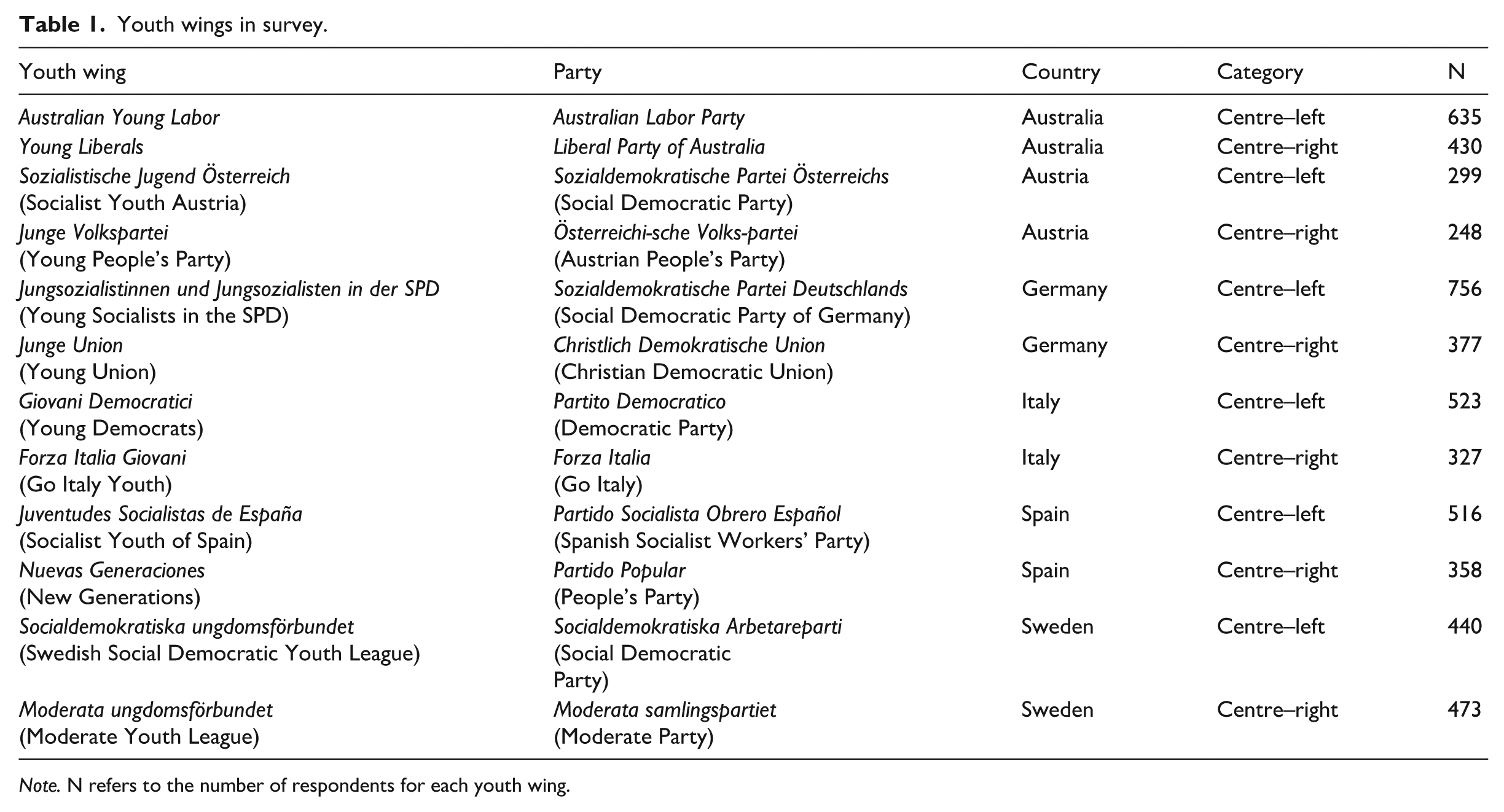
Note. N refers to the number of respondents for each youth wing.
The YOUMEM surveys were conducted with the 12 youth wings between 2018 and 2022 (see Table 1). The questionnaire was available in English, German, Italian, and Spanish on the online platform LimeSurvey and in Swedish on the Qualtrics system. The Australian survey began in March 2018 and ended in November of the same year. The Spanish and Italian surveys were conducted from March 2020 to April 2021, while the Swedish survey was carried out in September and October 2020. The Austrian and German surveys took place in the second half of 2021 and the first half of 2022. Most surveys spanned a long timeframe due to difficulties in distributing them among youth wing members, except in Sweden. In Australia, Italy, and Spain, national-level distribution was either impractical or yielded few results, so we asked youth wing leaders in all states (Australia), regions (Italy), and autonomous communities (Spain) to share the survey link with their local members. In Austria and Germany, despite better cooperation from national youth wing leaders, it still took considerable time to distribute the survey effectively among state-level branches. For the Swedish survey, we initially contacted the national leadership of each youth wing, who then distributed the survey link via email to all members who had provided their email addresses.
Although our study is the most comprehensive to date on youth wings, some caution is needed when generalizing our findings. First, we only surveyed centre–left and centre–right youth wing members. Although the results are likely relevant to other party families, one can expect that members of youth wings with less independence from their senior party, such as those of some radical right parties (Bolin et al., 2023), may be more responsive to the norms of the senior party. Second, most youth wings were unwilling to disclose precise membership numbers or how many people received the survey link, leaving us uncertain about the proportion of members that participated. 5 Based on available information about youth wing and senior party members, however, our sample appears representative, as our respondents are typically male, well-educated, and come from families with a background in political parties (Bruter and Harrison, 2009; Heidar and Wauters, 2019; McDonnell et al., 2025a). Third, our sample is non-random, given that parties are not willing to disclose their full membership lists. Nonetheless, it is worth noting that we achieved substantial geographical coverage, with at least three-quarters of all regions, states, and counties represented across the six countries.
Our analytical strategy is based on the expectation that members who are more embedded in the youth wing will display more of the attitudes that the senior party wants. To capture embeddedness, we use two independent variables. The first is length of membership, measured as the number of years since the member joined the youth wing at the time of the survey. As explained, however, this may tell us little on its own given that many grassroots members are passive for years, participating little beyond paying their annual membership fee (Heidar, 2006; van Haute and Gauja, 2015). To address this, we include a second independent variable measuring members’ activity levels. The active variable is a dummy variable indicating whether the member is active or passive. It is coded 1 if the member reports devoting more than 6 hours per week and 0 if the member responds devoting 5 hours a week or less to party activities. Given the absence of a standard definition for an active or passive member, as well as the difficulty people have in accurately estimating the time they devote to activities (Lisi and Cancela, 2019), we also create an alternative dichotomous measure where active is coded as 1 if the member reports devoting at least 1 hour per week to party activities and as 0 if the member reports devoting less than 1 hour per week to party activities. We report the results from the analyses with the alternative measure in Tables B1–B4 in the Supplemental Appendix.
In our analysis, we treat the length of membership and activity levels as separate indicators. Nevertheless, since they might reinforce one another, we also run a second set of models incorporating interaction effects between these two variables. Given that embeddedness should be seen as an effect of both time and scope, we argue that it is particularly the interaction effect that is central to investigate to understand the extent to which youth wings are successful in nurturing their members in the ways we have discussed. This approach allows us to explore not only the two variables’ individual contributions but also their combined impact on shaping members’ attitudes and future engagement.
To test our hypotheses, we have three sets of dependent variables. To test H1, stating the more that members are embedded in the youth wing, the more ideologically aligned they are with the senior party, we construct a variable congruence that measures the absolute subjective distance between a respondent’s self-placement on a 1–10 left–right scale and the position of the senior party as estimated by the same respondent on the same scale. A negative association, meaning that greater embeddedness in the youth wing leads to decreased ideological distance, would indicate that youth wings nurture the type of members whom senior parties desire.
It is worth acknowledging here that ideological congruence may vary across policy dimensions, and that incongruence is often found to be higher on issue-specific dimensions than on the more abstract left–right scale (Ibenskas and Polk, 2022; Louwerse and Andeweg, 2020). To be sure, our measure does not capture all facets of ideological disagreement between youth wing members and senior parties. At the same time, left–right self-placement is a widely used indicator of overall ideological orientation and our approach follows established practices in party membership research, where self-placement on a continuous left–right scale is commonly employed to assess ideological positioning among party members and activists (Bale et al., 2020; van Haute and Gauja, 2015). Given our interest in general ideological alignment and the cross-national scope of the study, we consider this measure appropriate.
H2, which posits that the more members are embedded within the youth wing, the more likely they are to continue as members of the senior party in the future, is tested by a survey question that asks: ‘Do you plan to continue as a member of the senior party when you are no longer in the youth wing?’ The variable future member is coded 1 if respondents are planning to go on in the senior party, and 0 if they are not. A positive correlation between embeddedness and this variable would count as evidence of youth wings’ successful nurturing.
Finally, H3, which suggests that the more the members are embedded within the youth wing, the more likely they are to aspire to electoral and party office in the future, is tested by two indicators, candidate and party office. These indicators gauge whether the member agrees with the statements ‘In the future, I would like to stand as a candidate for the senior party’ and ‘In the future, I would like to work for the senior party (e.g. as an official, advisor, campaign manager, etc.)’. 6 The two questions were answered by respondents on a 4-point scale: strongly disagree; disagree; agree; strongly agree. The responses have been recoded into binary indicators where 0 indicates disagreement and 1 indicates agreement. 7 If we were to find a positive association between embeddedness in the youth wings and these variables, it would indicate that youth wings indeed do provide the ‘added value’ that they are said to have.
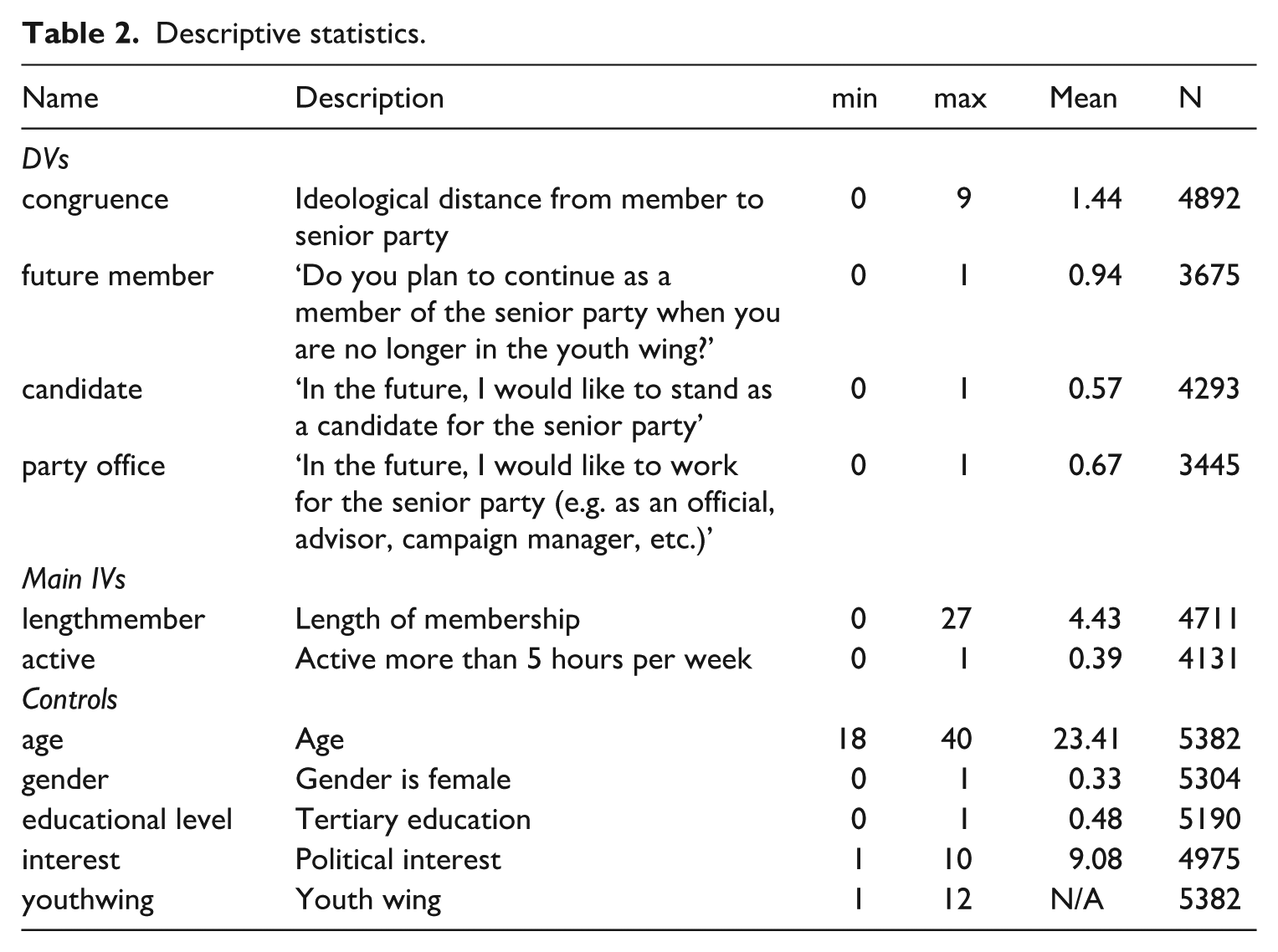
In addition to the main independent variables – length of membership and the indicator for activity level – we also control for a host of factors that previous research has shown to influence our dependent variables. To ensure that any potential effect of length of membership is not actually an age effect, we include age as a control. We also include gender as a control, since previous studies have found that men are more likely to be ideologically incongruent (van Haute and Carty, 2011) and to hold political ambitions (Ammassari et al., 2023). Furthermore, we include education level as a binary variable which distinguishes between tertiary education and below-tertiary education. While there is no consensus in recent research, there is some evidence that more highly educated people tend to be more ideologically aligned (Kölln and Polk, 2017) and somewhat more active (Bale et al., 2020) than party members with lower levels of education. We also include a control for political interest, since this has been shown to be highly correlated with both the propensity to be politically active (Levy and Akiva, 2019) and the propensity to have future political ambitions (Bolin et al., 2023). Finally, we control for potentially important omitted youth wing specific factors by including youth wing dummies. Table 2 displays descriptive statistics for all variables used in the main analyses (see Table C1 in Supplemental Appendix for overview of the variables and survey questions).
Descriptive statistics.
Despite the ordinal nature of the dependent variables that are employed to test H1, we opted to use OLS regression. Previous studies have shown that when ordinal variables have seven or more categories, methods assuming continuous data can yield valid results (Allen and Seaman, 2007; Rhemtulla et al., 2012). Since the dependent variable has 10 scale steps, it can therefore be considered approximately continuous. H2 is tested with a binary dependent variable indicating whether the member will continue as a member in the senior party and is tested using a binary logistic regression. Similarly, H3 is tested with two binary dependent variables that indicate whether, in the future, respondents would like to stand as a candidate and/or work for the senior party. We therefore use two binary logistic regressions. All models include robust standard errors clustered at the youth wing level.
Results
We run two models for each dependent variable, one without and one with interaction effects of length of membership and activity level. The main results are presented in the form of regression tables and marginal plots. These plots illustrate the marginal effects for passive and active members based on the models where interaction effects are included. In this way, the predicted levels and probabilities are shown to be influenced by a person’s length of membership, moderated by whether they are active or not.
We start with H1 and the expectation that the more a member is embedded within the youth wing, the more ideologically congruent they are with the senior party. As shown in Table 2, the average distance between respondents and their placement of the senior party is just under one and a half steps on a 10-point scale (1.44).
Beginning with the model without interaction effect (model 1) in Table 3, we note a non-significant but positive association between length of membership and incongruence, while the degree of activity is negatively associated with incongruence.
Linear regression predicting ideological incongruence.
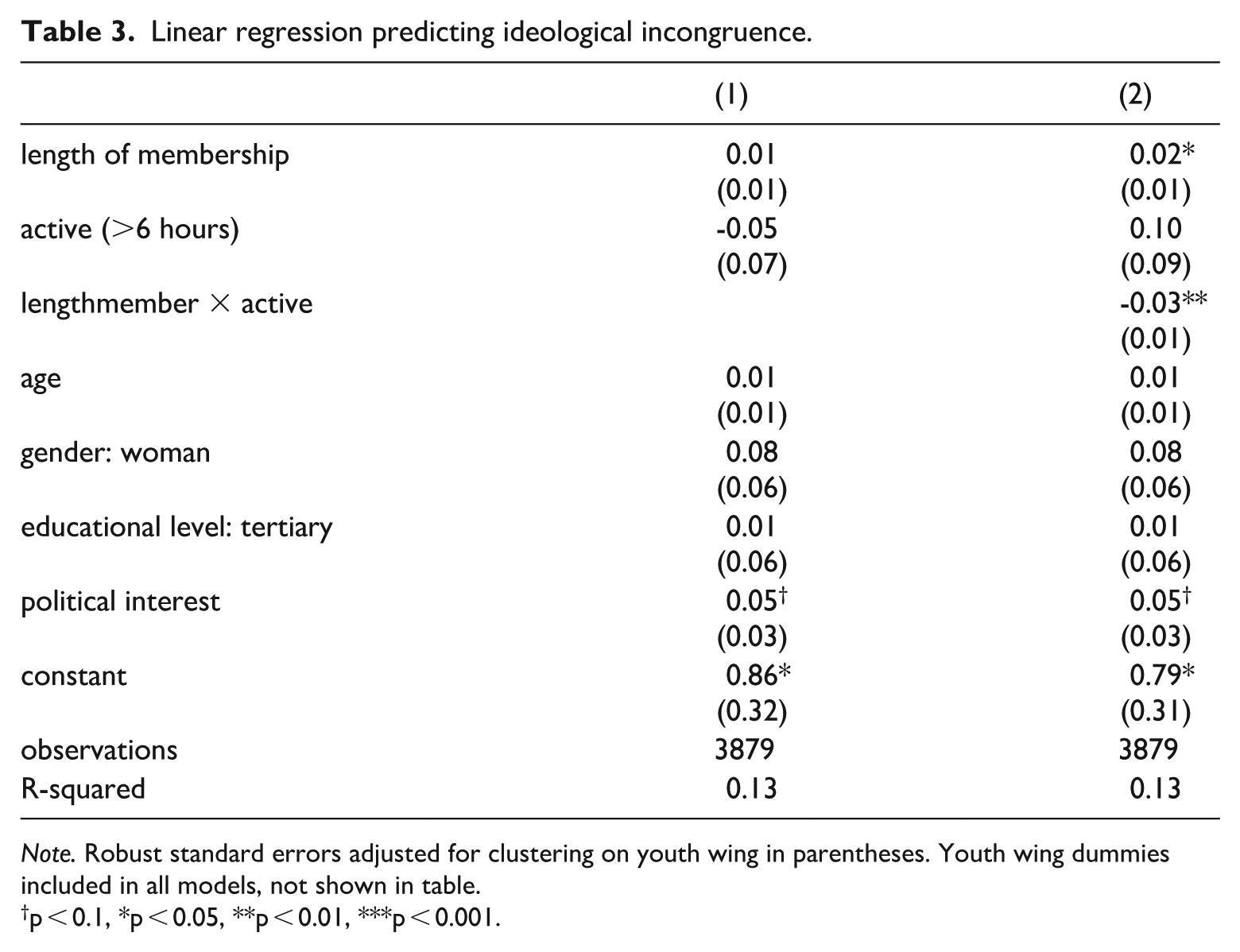
Note. Robust standard errors adjusted for clustering on youth wing in parentheses. Youth wing dummies included in all models, not shown in table.
p < 0.1, *p < 0.05, **p < 0.01, ***p < 0.001.
When we introduce interaction effects between length of membership and level of activity (model 2), the main effect of membership length becomes positive and statistically significant, while the interaction term is negative and significant. Taken together, this indicates that among members with low levels of activity, longer membership duration is associated with higher ideological incongruence. As depicted in Figure 1 (based on model 2), we thus find partial evidence of a nurturing effect. While passive members are significantly more incongruent the longer they spend time in the youth wing, members who report spending more than 6 hours per week on party activities – that is, those who are most embedded in the youth wing – are more ideologically congruent the longer they have been enrolled. Our analysis, therefore, provides some support for the idea that increased embeddedness in the youth wing is associated with members being more aligned to their senior parties. As such, it adds an important corrective to the finding by McDonnell et al. (2025b) that time spent in youth wings is associated with greater incongruence. While that may be the case, our results suggest it is driven by inactive members rather than by those who are most committed.
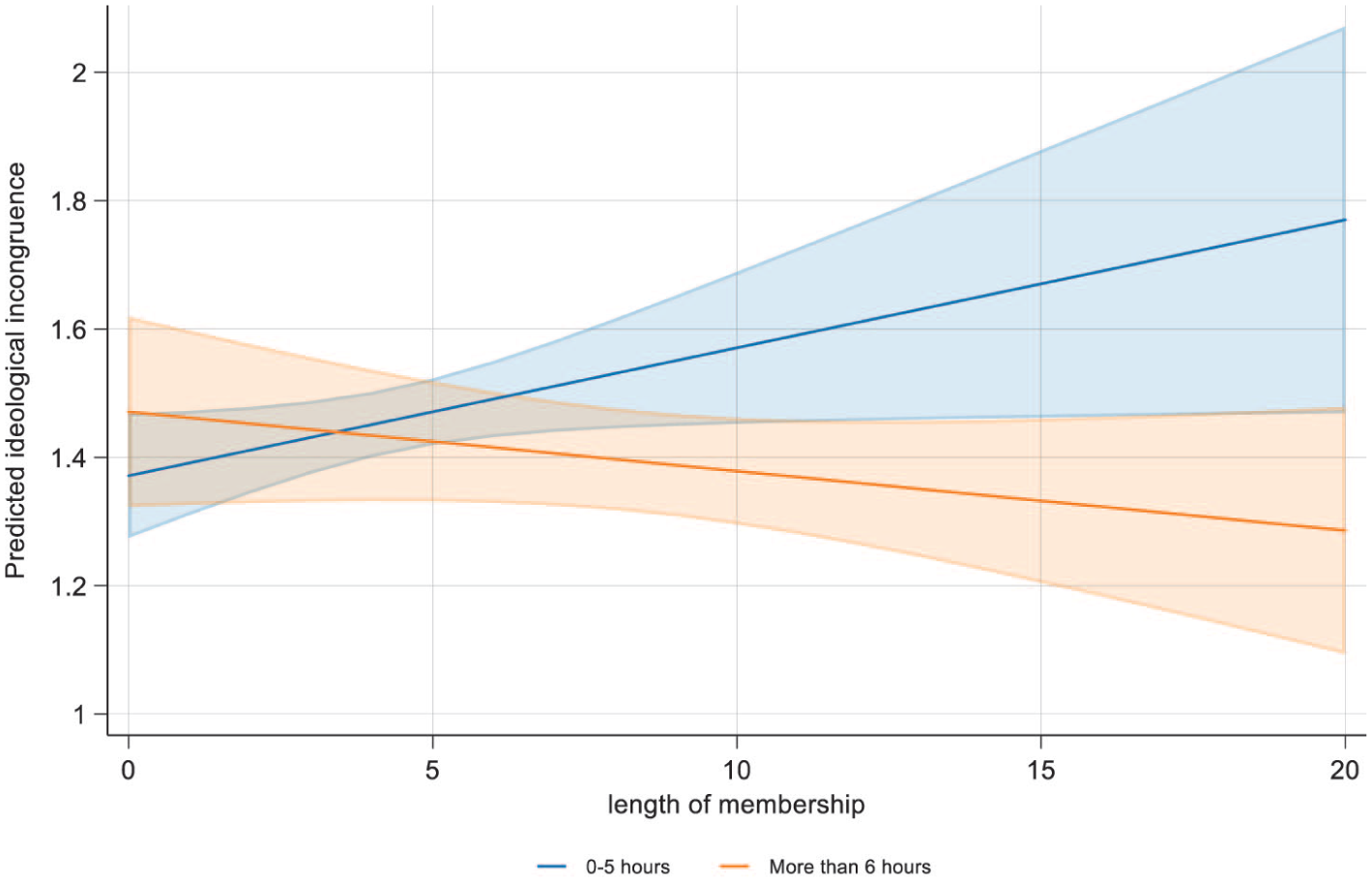
Marginal effects of length of membership and activity level on ideological incongruence.
H2 proposes that the more members are embedded in the youth wing, the more likely they are to continue as members of the senior party in the future. The first thing to note, as shown by the descriptive statistics in Table 2, is that a large majority (94%) of all respondents report that they plan to continue as members of the senior party. However, the general picture that emerges is that this inclination is not dependent on the degree of embeddedness in the youth wing. As shown in Table 4, in the model without interaction (model 3), there is a weak, non-significant negative relationship between length of membership and plans to continue as a member of the senior party, while there is a strong positive relationship with the level of activity. This indicates that engagement in the youth wing, rather than time spent as a formal member, is more closely related to members’ willingness to remain in the senior party.
Binary logistic regression predicting probability of planning to continue as member of party.

Note. Robust standard errors adjusted for clustering on youth wing in parentheses. Youth wing dummies included in all models, not shown in table.
p < 0.1, *p < 0.05, **p < 0.01, ***p < 0.001.
When the interaction effect is introduced in model 4, it appears that more active members are slightly more inclined to plan for a future as party members – providing some support for the idea that embeddedness in the youth wing can be nurturing. It should be noted, however, that this effect is small – the predicted probability of wanting to continue in the senior party increases by less than 3 percentage points when going from a new active member to an active member who has been in the youth wing for 20 years. Among the passive members, there is a negative effect, with the corresponding probability decreasing by about 5 percentage points (from 94% to 89%). While the interaction effect displayed in Figure 2 is not significant at the conventional 95% confidence level, it is nonetheless significant at the 90% one, pointing to a noteworthy trend. Overall, therefore, we find some support for H2 and the expectation that more embedded members are willing to continue as members of the senior party, but the effect is not substantial.
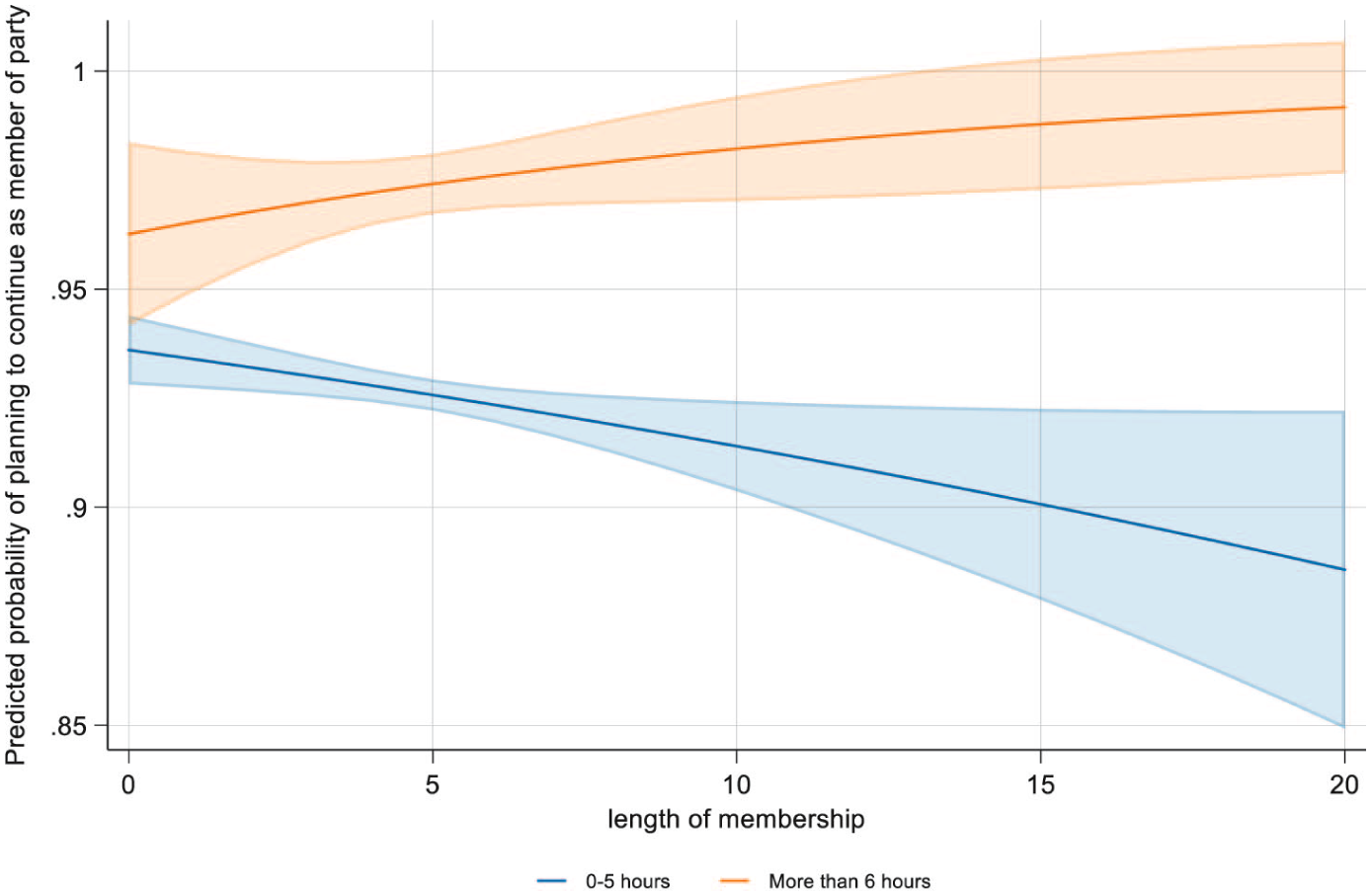
Marginal effects of length of membership and activity level on probability of planning to continue as member of party.
H3, finally, suggests that the more members are embedded within the youth wing, the more likely they are to aspire to electoral and party office in the future. We first examine to what extent it is possible to identify a nurturing effect of the youth wing on members regarding their willingness to run for public office. About 57% of respondents state that they would like to do this. As shown in model 5 in Table 5, there is a significant negative effect of length of membership, whereas the negative association for activity level is not significant. This indicates that longer membership duration, in itself, is associated with lower candidate aspirations.
Binary logistic regression predicting probability of electoral office-seeking.

Note. Robust standard errors adjusted for clustering on youth wing in parentheses. Youth wing dummies included in all models, not shown in table.
p < 0.1, *p < 0.05, **p < 0.01, ***p < 0.001.
When the interaction term is introduced (model 6), the interaction effect is not statistically significant, suggesting that the negative association between membership length and office-seeking does not differ between passive and active members. This is also displayed in Figure 3 below, which shows that the curves for the two types of members are nearly identical. Notably, the curves are declining, indicating that embeddedness in the youth wings does not encourage members to stand for public office. As far as candidate aspirations are concerned, therefore, we find no support for H3.
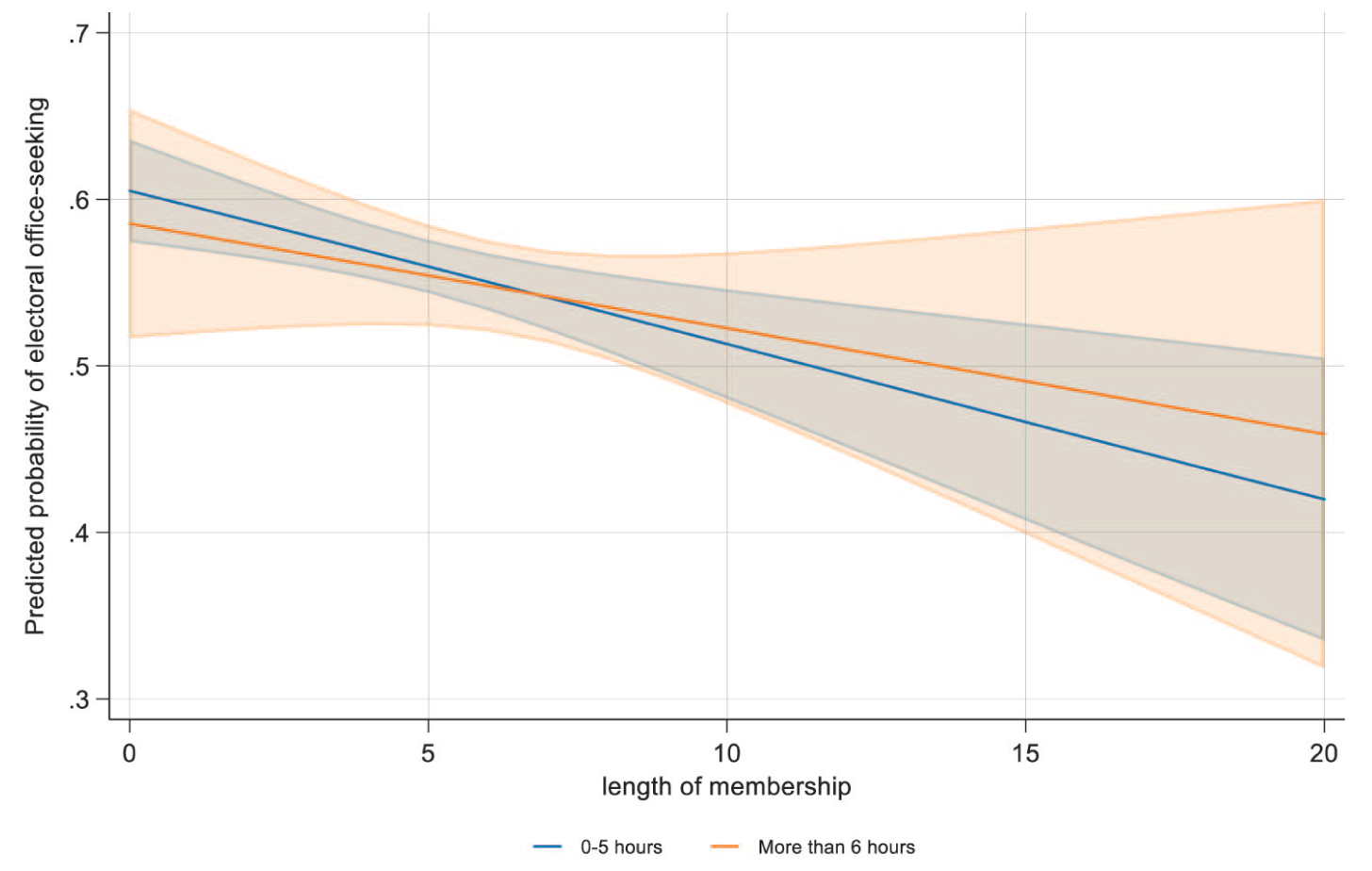
Marginal effects of length of membership and activity level on probability of electoral office-seeking.
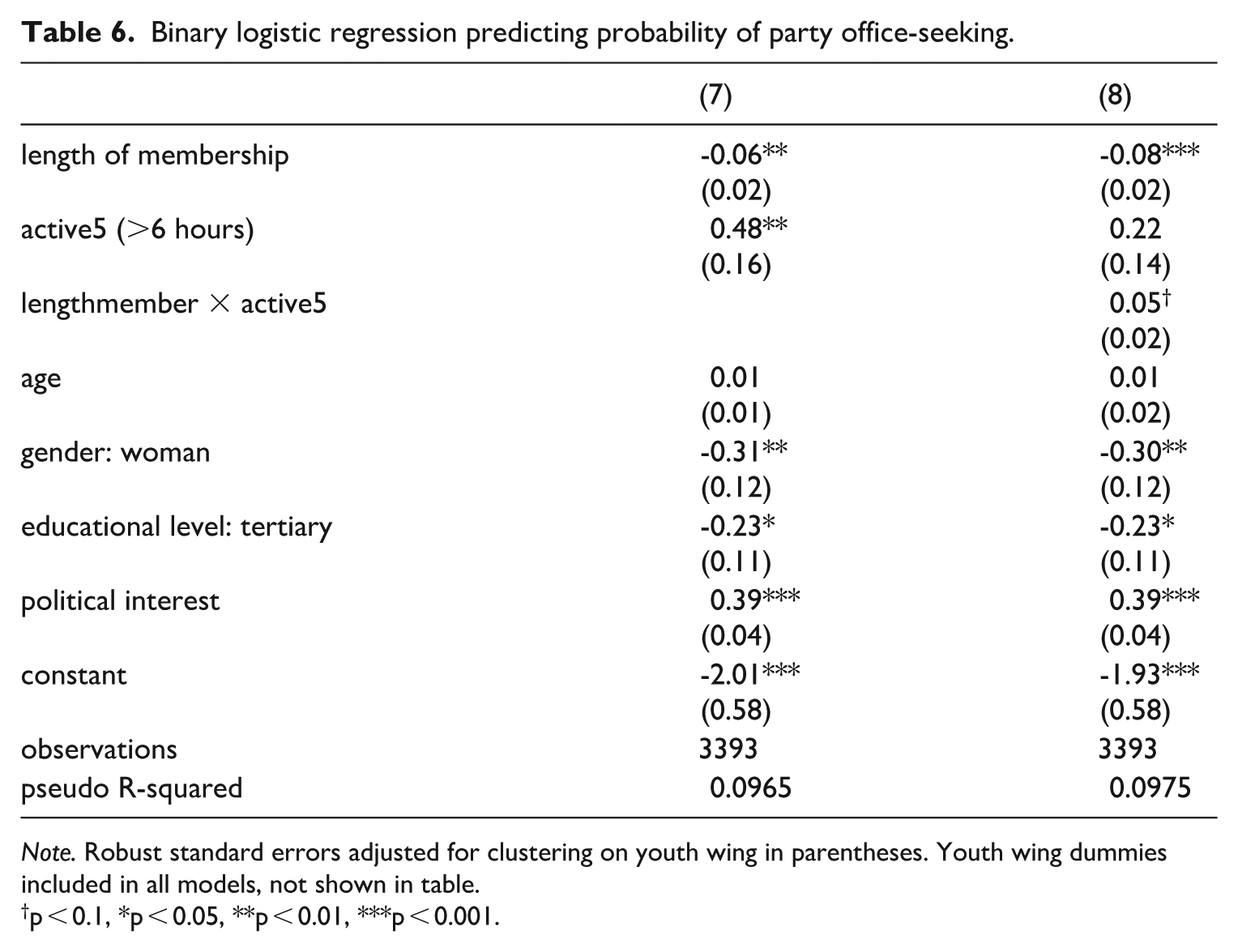
Finally, about 67% of respondents would like to work for the senior party in the future. As shown in model 7 in Table 6, length of membership is negatively and significantly correlated with the desire to hold this type of office, while party activism is strongly and positively associated with it. This suggests that engagement rather than time spent as a member is more closely related to members’ willingness to take on roles within the senior party.
Binary logistic regression predicting probability of party office-seeking.
Note. Robust standard errors adjusted for clustering on youth wing in parentheses. Youth wing dummies included in all models, not shown in table.
p < 0.1, *p < 0.05, **p < 0.01, ***p < 0.001.
The interaction term introduced in model 8 just fails to reach the conventional 95% confidence level (significant at the 90% confidence level). Importantly, however, the negative effect of length of membership does not vary between active and passive members. As illustrated in Figure 4, although the curve for active members declines less steeply, the probability of wanting to hold an intra-party office is less for both groups the more time they have spent in the youth wing. We can therefore conclude that the youth wing is not providing an added value in leading more members to think about working for the senior party. Based on this evidence, and what we observed as regards candidate aspirations, we reject H3.
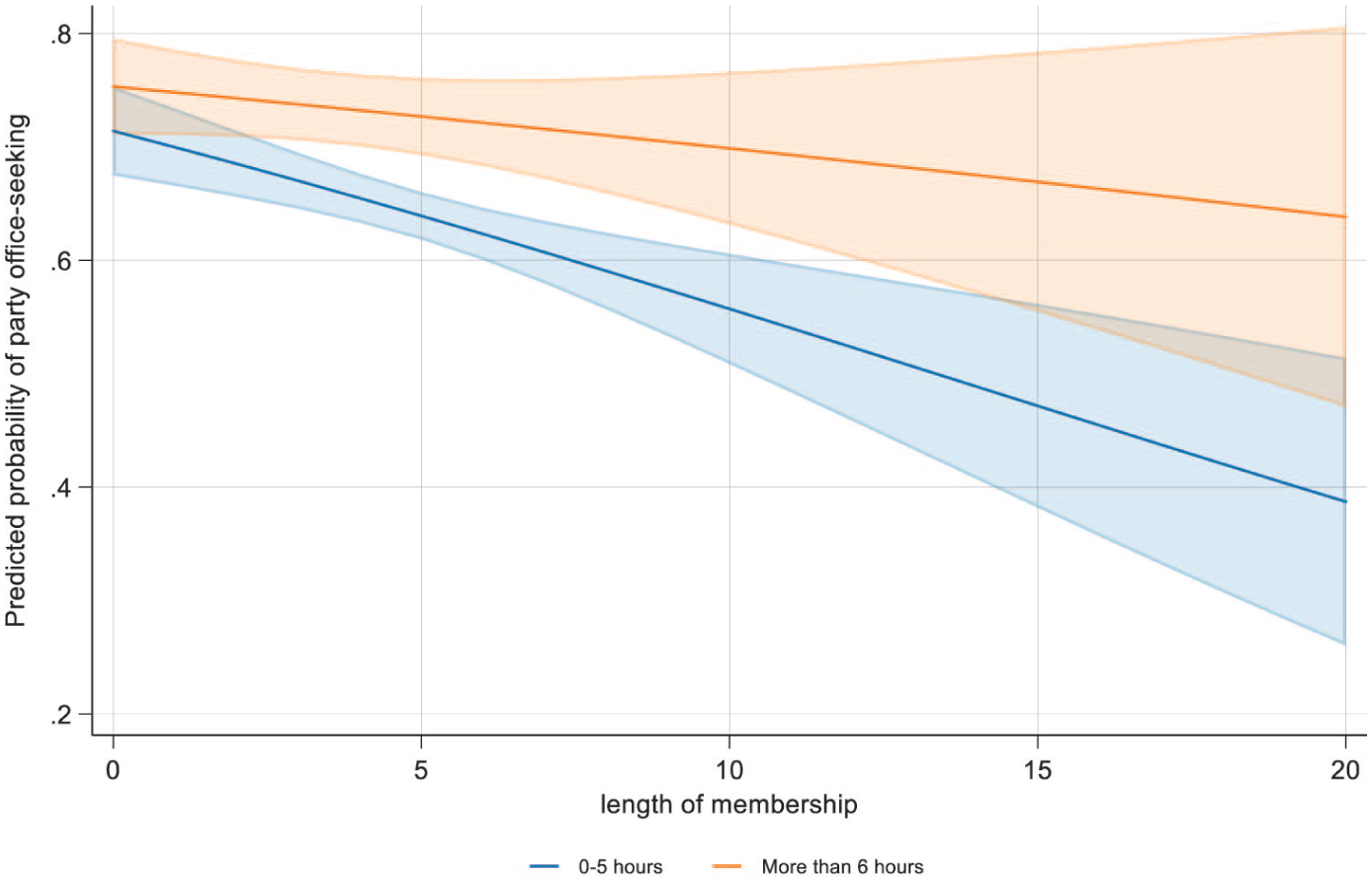
Marginal effects of length of membership and activity level on probability of party office-seeking.
In addition to the patterns reported above, some of the control variables exhibit recurring associations with members’ ambitions. Most notably, gender is significantly associated with both electoral and intra-party office aspirations, with women being less likely than men to report such ambitions. While gender differences are present for both outcomes, the gap is substantially larger for electoral office-seeking. This pattern resonates with recent research on party youth wings showing that gendered ambition gaps tend to be most pronounced as regards standing for public office, while differences in non-electoral career aspirations are more limited (Ammassari et al., 2023; Kolltveit, 2022). As expected, and in line with previous research (Bolin et al., 2023; Levy and Akiva, 2019), political interest is positively associated with continued party membership as well as with both types of political ambition examined.
To test the robustness of our results, we run several additional analyses presented in the Supplemental Appendix. If we focus on the interaction between membership length and activity level, we observe only a few deviations from the effects found in the main analyses.
To account for the lack of a standard definition of what constitutes an active member, we rerun the main models using an alternative measure of the active variable. In this specification, a member is coded as active if they report spending at least 1 hour per week on party-related activities. The results are presented in Tables B1–B4 in the Supplemental Appendix. If anything, the analysis using the alternative measure provides even weaker evidence that youth wings nurture the types of members their parties desire. The finding that active members are more ideologically congruent the longer they have been in the youth wing is not present in the alternative analysis (Table B1, model 2). When it comes to the willingness to remain a party member, the alternative analysis further undermines the hypothesis, as the interaction effect shifts from being borderline significant (p < 0.10) to falling entirely short of statistical significance (Table B2, model 4).
We also run the main analyses for different subsets of the dataset. First, we checked whether our main results are consistent across youth wings. As suggested by Tables B5–B8 in the Supplemental Appendix the results are, with a few exceptions, generally similar across all youth wings. First, the interaction effect in the main model indicating that active members are slightly more congruent the longer they have been enrolled fails to reach the level of significance when modelling each youth wing at a time (Table B5 in Supplemental Appendix). Second, in contrast to the weak significant effect in the main models, there is a strong significant effect on planning to continue as a party member for the Spanish Socialist Youth (Table B6 in Supplemental Appendix). Third, while the main models indicate no effect, we find a positive significant effect of embeddedness on candidate aspirations in the Austrian Socialist Youth (Table B7 in Supplemental Appendix). Furthermore, while the main models just fail to reach the standard statistical significance (95% confidence interval) for party office-seeking, the analyses by youth wing reveal a positive significant effect in both German youth wings (Table B8 in Supplemental Appendix).
To ensure that the results are not driven by any single youth wing, we replicate the main models while excluding one youth wing at a time (Tables B9–B12 in the Supplemental Appendix). These additional analyses largely corroborate the findings from the main models. However, for two of the dependent variables, there are some indications that specific youth wings may influence the overall results. In the analysis of planning to continue as a member of the party (Table B10 in the Supplemental Appendix), the exclusion of the Italian Young Democrats or the Spanish Socialist Youth causes the borderline significant effect (p < 0.10) to drop below the threshold of statistical significance. Similarly, excluding the Spanish Socialist Youth or either of the German youth wings produces a comparable effect in the analysis of the desire to pursue party office (Table B12 in the Supplemental Appendix).
Finally, as an additional robustness check, we split the sample based on youth wing autonomy. Given the lack of a standard definition of organizational autonomy, we use as a proxy the possibility of joining the youth wing without having to also be a member of the senior party. This yields two equal groups: six youth wings that allow independent membership (JSE, JU, JUSOS, JVP, SJÖ, SSU) and six that do not (ALP, FIG, GD, MYL, NG, YL). The results of these split-sample analyses, reported in Table B13 in the Supplemental Appendix, largely mirror those from the main models. While there are some differences in individual coefficients – most notably for party office aspirations, where the interaction between membership length and activity is significant only among autonomous youth wings – there are no systematic differences suggesting that the degree of youth wing autonomy fundamentally alters the relationships examined in the article. In sum, the minor deviations from the main results identified in the robustness checks do not lend further support to the broader expectation that youth wings nurture the types of members their parties desire in terms of attitudes and future engagement.
Conclusion
The literature on youth wings (De Roon, 2020; Mycock and Tonge, 2012), along with statements in parties’ and youth wings’ official documents, underlines their role as supporting organizations for the senior party. Youth wings are seen as providing an ‘added value’ for parties: they should recruit young people who sympathize with the party and they should nurture them both ideologically and behaviourally, motivating them to be loyal future party members, candidates, officials, and representatives. However, we do not know whether youth wings actually fulfil this role that parties and scholars have long ascribed to them. In this article, we therefore tested whether embeddedness in the youth wing (understood as length of membership and activism) goes hand-in-hand with higher levels of ideological alignment, sense of affiliation, and public and intra-party office aspirations among members. Drawing on data from the YOUMEM project – the largest cross-national survey of youth wing members conducted to date – we found mixed results. On the one hand, there are differences in terms of the effects of length of membership on active and passive members. While the former are slightly more ideologically aligned and more inclined to continue as members of the senior party after their time in the youth wing is up, we find the opposite trends among the latter. Moreover, when it comes to the desire to stand for intra-party and public office in the future, the negative effect of length of membership is similar for both active and passive members. These results have a number of implications for party organization scholars, which we discuss below.
First and foremost, our article calls into question what researchers and parties think is the ‘added value’ of youth wings. It is true that the vast majority of youth wing members who responded to our survey intend to remain in the party. However, our findings show that embeddedness in the youth wing does not provide an added value in nurturing this attitude for all members, but only for those who are extremely active (and, even then, the effect is small). Second, we find that, while the most active youth wing members are slightly more ideologically aligned with the party, the opposite is true of more passive ones. Third, and perhaps most importantly, if youth wings are supposed to be the incubators for future candidates, officials, and representatives, then their added value is even less clear. Although many members would like to stand one day as a candidate and/or work for the party, this is not correlated with their embeddedness in the youth wing (something which is true regardless of the levels of activism). In sum, while the ‘leaders of tomorrow’ (Young Liberals, 2024) may well come from youth wings, embeddedness in youth wings does not seem to be resulting in more of these being produced compared to the initial intake. Rather, our findings suggest that there is a self-selection process at work by which those who join youth wings are already very clear about what they want to get out of the experience in terms of their future engagement with the senior party. And embeddedness does little to change that.
There are at least two possible explanations for why youth wings do not nurture more of the members that their parties want. One is that youth wings are ineffective at achieving this objective. While they may try to foster members’ ideological alignment, sense of affiliation, and office aspirations, members may not be receptive to this effort. After all, we know that many young people join primarily in order to express their ideological beliefs and to meet like-minded people (Bolin and Jungar, 2024; Bolin et al., 2023). In that scenario, it could be the case that the efforts of youth wing elites to nurture more loyal, aligned, and aspirational members fall on deaf ears as many young people have not signed up in order to be drilled into shape but to enjoy themselves in the here-and-now. Alternatively, our results may indicate that, rather than being an issue of failure, it is an issue of choice: youth wing elites may simply not prioritize these future-oriented goals of the senior party, preferring instead to focus on other objectives more relevant to the present and to their own interests. For example, rather than acting as nursery managers for the senior party, youth wing leaders may be more interested in mobilizing young people politically on contemporary issues that they care about and ensuring members enjoy their time in the organization. Future qualitative work, such as interviews with both youth wing elites and ordinary members, would help us understand which of the above two scenarios is the case. Either way, our study speaks to the view that youth wings may not be just ‘future-focused’ organizations, but ‘Janus-faced’ ones that look to both the present and future (McDonnell et al., 2026). They have their own organizational lives and their own actors that deserve to be examined not just in terms of what they provide for the senior party. We hope our work in this article will help encourage that.
Supplemental Material
sj-docx-1-psx-10.1177_00323217261444654 – Supplemental material for The added value of youth wings: Do they nurture the members their parties want?
Supplemental material, sj-docx-1-psx-10.1177_00323217261444654 for The added value of youth wings: Do they nurture the members their parties want? by Niklas Bolin, Duncan McDonnell, Sofia Ammassari, Annika Werner, Marco Valbruzzi, Reinhard Heinisch, Ann-Cathrine Jungar and Carsten Wegscheider in Political Studies
Footnotes
Acknowledgements
The authors would like to thank the participants at the ‘Generational Politics: Participation, Representation, and Policy’ workshop at the 2024 NoPSA Conference in Bergen, the ‘Political Behaviour and Parties’ workshop at the 2024 SWEPSA Conference in Umeå, and the 2024 ‘Youth Politics Workshop’ in Aarhus for their valuable comments on earlier versions of this paper.
ORCID iDs

Funding
The authors disclosed receipt of the following financial support for the research, authorship, and/or publication of this article: This work was partly funded by the Swedish Agency for Youth and Civil Society (MUCF) [grant number dnr: 0671/19].
Declaration of conflicting interests
The authors declared no potential conflicts of interest with respect to the research, authorship, and/or publication of this article.
Supplemental material
Supplemental material for this article is available online.
Notes
Author biographies
References
Supplementary Material
Please find the following supplemental material available below.
For Open Access articles published under a Creative Commons License, all supplemental material carries the same license as the article it is associated with.
For non-Open Access articles published, all supplemental material carries a non-exclusive license, and permission requests for re-use of supplemental material or any part of supplemental material shall be sent directly to the copyright owner as specified in the copyright notice associated with the article.
