




Abstract
This article revisits the climate-conflict-displacement nexus by analyzing the Syrian Civil War as a case of climate-exacerbated state collapse. Rejecting linear causality, it asks: how does climate-induced stress contribute to armed conflict and forced migration, and how might these dynamics be understood through ecocide? Drawing on international relations, legal studies, and environmental studies, we develop a framework positioning environmental refugeedom and ecocide as concepts revealing international legal categories’ insufficiencies. Examining Syria, we show how drought, environmental mismanagement, and authoritarian governance intensified grievances, fueling conflict and mass displacement. Rather than presenting climate change as a singular cause, we argue for its role as a threat multiplier within authoritarian rule, developmental failure, and global inequality structures. The article contributes by proposing expanded conceptual vocabulary to capture environmental collapse’s political violence. It calls for rethinking state responsibility, legal protection frameworks, and human rights paradigms under planetary crisis—especially in authoritarian regimes facing ecological breakdown.
Introduction
In the twenty-first century, the convergence of global warming and armed conflict has caused unprecedented human suffering, leading to environmental refugeedom, which has been insufficiently studied. Environmental destruction, or “ecocide,” is recognized for its catastrophic impacts to human populations. Since the Syrian Civil War began in 2011, over 230,000 lives have been lost and 14 million people displaced, largely due to environmental neglect by the regime (OCHA, 2023). This article examines how the climate crisis contributes to armed conflict and mass refugee flows, constituting ecocide. Focusing on Syria, it explores the interplay between climate change, armed conflict, environmental refugees, and ecocide. The link between climate and armed conflict is critically debated among scholars, including political and natural scientists, who analyze the Neo-Malthusian perspective that environmental degradation heightens human insecurity by increasing resource competition and social tensions (Bernauer et al., 2012; Wirkus and Schure, 2008). Historical and political analyses underscore how environmental collapse destabilizes societies, fostering conditions that exacerbate conflict, including scarcity-driven violence, migration crises, and even state instability (Abel et al., 2019; Brundtland, 1987; Council of Europe, 2022; European Parliament, 2022; Galtung, 1982; Gleditsch, 2015; Gleditsch and Dalby, 1997; Hatami and Gleick, 1994; Institute for Economics & Peace, 2020; Kaplan, 1994; Koubi, 2019; Mach et al., 2019; McMichael, 1993; Renner et al., 1991; Theisen et al., 2013; Westing, 1986; Wirkus and Schure, 2008; Wolf, 2007; Yoffe et al., 2003).
By the late twentieth century, scholars recognized that the prolonged degradation of natural resources could exacerbate political and social instability, thereby worsening economic stagnation and rural poverty. This sequence of events further limits future socioeconomic development (Gleditsch and Dalby, 1997; Hatami and Gleick, 1994; Homer-Dixon, 1991; Leonard, 1989; Westing, 1986). For instance, Homer-Dixon (1991) analyzed the social impacts of environmental change, such as reduced agricultural production, economic decline, population displacement, and the disruption of social relations. This study uniquely explores how individual frustration, group identity violence, and systemic structures contribute to acute conflicts. Dixon’s (1991) study investigates how reduced agricultural production, economic decline, population displacement, and disrupted social relations lead to conflict, emphasizing these factors. Gleditsch and Dalby’s (1997) work, based on NATO workshops in the late 1990s, marked a shift in the military’s view of environmental factors as catalysts for conflict.
Resource scarcity and conflict are intertwined due to insufficient resources for a growing population, causing environmental degradation and increased competition, which elevates the risk of violence (Abel et al., 2019; Council of Europe, 2022; Gleditsch, 2015; Institute for Economics & Peace, 2020). Wirkus and Schure (2008) contend that environmental changes worsen resource availability, heightening vulnerability and insecurity. Political science literature indicates that extreme resource inequalities and insecurities disrupt political order, leading to social unrest and state repression (Brownlee, 2013; Lautensach and Lautensach, 2020; Mildner et al., 2011; Regilme, 2014a, 2014b, 2024). Humanitarian perspectives highlight the adverse impacts of crises and societal vulnerabilities (Churruca-Muguruza, 2018). Percival and Homer-Dixon (1996) categorize resource scarcity into three types: supply-induced (environmental degradation), demand-induced (population growth), and structural (inequality).
Recent quantitative studies support the climate-conflict link, emphasizing the need for empirical testing and incorporating political and economic factors (Bernauer et al., 2012; Gleditsch, 2015; Homer-Dixon, 1991; Koubi, 2019). Hsiang et al. (2013) found that weather anomalies affecting temperature or rainfall could increase intergroup conflict risk by 11.1%, while a 1ºC temperature increase boosts civil war risk by 4.5% (Bernauer et al., 2012; Theisen et al., 2013). Climatological changes are consistently linked to conflict across all regions (Hsiang & Burke, 2014). Water scarcity, particularly in drought-prone areas, significantly drives conflict, with historical and projected data showing a correlation between droughts and civil conflict (European Parliament, 2022; IPCC, 2022; Koubi, 2019). As current and future societies might respond similarly to environmental degradation and change, potentially leading to (inter)national violence, further investigation of this complex nexus is crucial (Buhaug et al., 2014). These insights advocate for integrated research approaches to comprehensively grasp the intricate dynamics linking climate change and armed conflicts.
Another strand of the literature pertains to environmental refugees. The concept of environmental refugees has evolved amid critiques and expanding recognition within international discourse. Originally defined under the UNHCR’s 1951 Convention solely in terms of persecution, contemporary discussions highlight climate change as a significant driver of displacement, though not yet formally enshrined in international law (UNHCR, n.d.a). Scholars have debated the inclusion of climate-induced migration within the refugee framework, emphasizing environmental degradation’s role in undermining livelihoods and exacerbating vulnerabilities (Ayazi and Elsheikh, 2019). Early definitions in the 1980s by Trimarchi and Gleim (2020) laid foundational groundwork, while subsequent categorizations by the IOM delineated emergency and slow-onset movements (International Organisation for Migration and Refugee Policy Group (IOM/RPG), 1992). Recent studies underscore the complexities of climate migration, forecasting substantial increases in displaced populations due to factors like water scarcity, extreme weather events, and sea-level rise (European Parliament, 2022; IPCC, 2022). Despite methodological challenges in quantifying environmental refugees, ongoing research urges interdisciplinary approaches to address this pressing humanitarian and environmental issue (Abel et al., 2019; Institute for Economics & Peace, 2020; Lister, 2014; McLeman, 2019; The Guardian, 2020).
Since its emergence, the concept of ecocide, focusing on environmental destruction’s effects on human health and sustainability, has significantly developed. In 1970, biologist Arthur Galston coined the term to highlight the severe ecological impact of chemical warfare, notably Agent Orange in the Vietnam War (Shamloo and Gholipour, 2022; Zierler, 2011). Galston proposed banning such herbicides, recognizing ecocide as a potential crime against humanity connecting ecosystem degradation to ethical and bioethical issues (Zierler, 2011). Initially scientific, the term gained political traction at the 1972 United Nations Conference on the Human Environment in Stockholm, relating to environmental responsibility and international law (Stop Ecocide, n.d.a). Efforts to incorporate ecocide into international law have since faced challenges, with debates over its scope and legal applicability (Ecocide Law, n.d.; Prevent Genocide International, 1985). Recently, Stop Ecocide International and similar groups have gained momentum, advocating for domestic ecocide laws and its recognition as a crime under the International Criminal Court (European Parliament, 2022; Stop Ecocide, n.d.b). Increasing global awareness of ecocide has driven efforts to establish ecocide law, underscoring the vital link between environmental sustainability and international justice.
The substantial literature recognizes the connection between resource scarcity and environmental degradation or natural disasters, potentially leading to armed conflict and forced displacement. There is growing agreement on broadening the definition of refugeedom to include climate crisis victims and acknowledging “ecocide.” However, comprehensive research on the mechanisms linking climate-conflict nexus, environmental refugeedom, and ecocide, particularly in the Southwest Asia and North Africa (SWANA) region, is lacking.
This article offers a conceptual innovation by critically reconceptualizing environmental refugeedom and ecocide as analytical tools to interpret the political consequences of environmental collapse under authoritarian governance. Rather than treating these terms as purely legal or descriptive, the article deploys them to illuminate how state violence, ecological mismanagement, and climate-induced stress converge to produce mass displacement and systemic harm. This article asks: Under what political and ecological conditions can climate-induced environmental stress exacerbate violent conflict and mass displacement, and how might these dynamics be productively conceptualized as ecocide? Rather than presuming a deterministic link, it critically examines how authoritarian environmental mismanagement, and prolonged drought interacted to produce one of the largest humanitarian crises of the twenty-first century. Through the Syrian case, the article advances a conceptual framework that captures the entangled political, ecological, and legal dimensions of the climate-conflict-displacement nexus. The case study examines the factors leading to Syria’s civil war and refugee crisis, including pre-war political and environmental conditions, socioeconomic instability, water scarcity, and conflict escalation. The conclusion advocates for global recognition of “ecocide” and environmental refugeedom in international politics and law, emphasizing their lethal threats.
This article makes a theoretical contribution to the study of global politics by reframing climate-induced mass displacement not only as a humanitarian crisis but as a crisis of sovereignty and legitimacy. Through the Syrian case, it interrogates how ecological collapse—when compounded by authoritarian governance—generates forms of political violence that escape conventional legal and normative frameworks. By conceptualizing environmental refugeedom and ecocide as analytical tools, the article extends debates in political theory and international relations on the limits of state responsibility, the erosion of political authority under environmental stress, and the urgent need to rethink accountability in the Anthropocene.
Theory and Methods
This article investigates how a complex interplay of prolonged ecological stress, authoritarian environmental mismanagement, and geopolitical instability contributed to mass displacement and violence in Syria—processes which this article conceptualizes as ecocide. Rather than presuming linear causality, it explores the synergistic configuration of climate vulnerability and political structures that shaped the Syrian crisis. The central argument posits that the climate crisis deteriorates living conditions, thereby intensifying socioeconomic tensions that ignite armed conflicts. These conflicts, in turn, compel populations to flee, resulting in significant refugee flows. This chain of events, driven by the large-scale destruction of ecosystems and human displacement, constitutes ecocide, as it reflects severe and widespread environmental and human harm. Figure 1 below illustrates how the climate crisis triggers armed conflicts, leading to large-scale forced displacement and potentially constituting ecocide. Environmental degradation driven by the climate crisis systemically worsens living standards, thereby heightening socioeconomic and political tensions. These tensions often ignite armed conflicts, forcing populations to migrate and creating environmental refugees. The mass migration stems from both the decline of ecosystems and conflicts intensified by resource shortages. As a result, the climate crisis inflicts extensive and lasting damage on ecosystems and human communities, aligning with the definition of ecocide. Recognizing this causal chain highlights the necessity for global governance to address the ecological and humanitarian impacts of climate-induced conflicts.
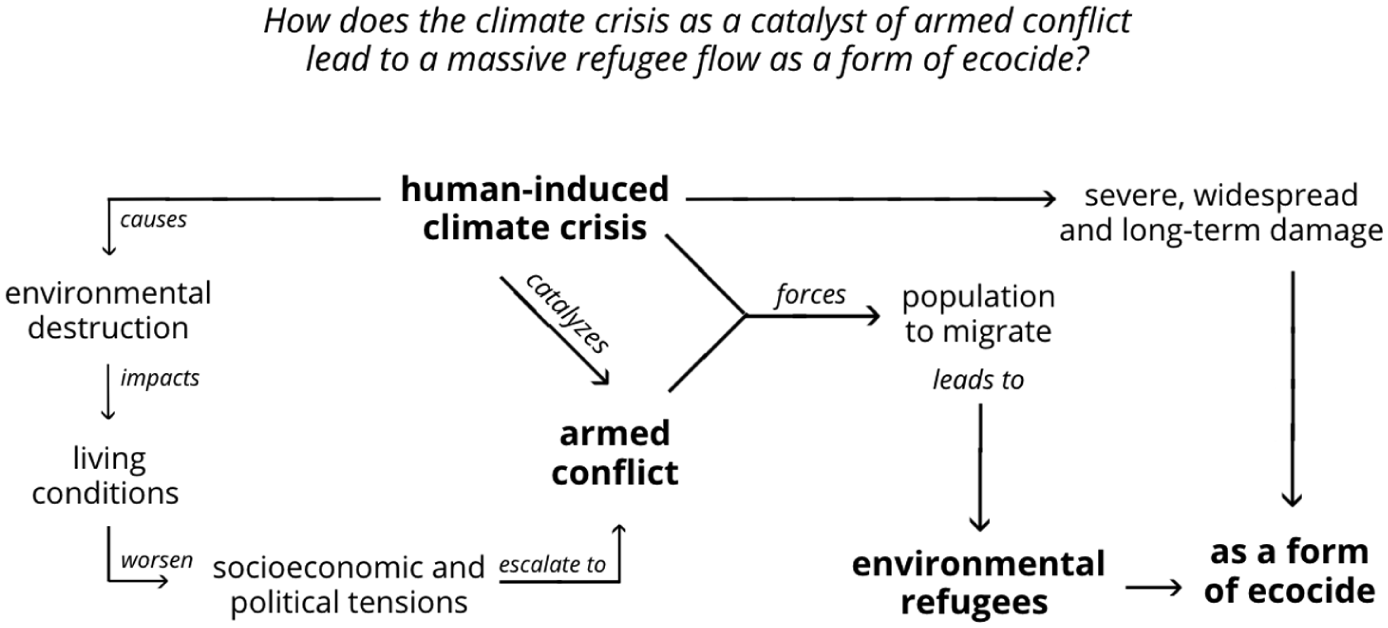
Explanatory Framework of Environmental Refugees and Ecocide Due to Human-Induced Climate Crisis.
This article rejects deterministic accounts of the climate-conflict-displacement nexus. Instead, it aligns with critical scholarship that challenges linear causal models in climate security debates (Boas et al., 2019; Buhaug et al., 2014). Rather than treating environmental stress as a direct trigger of violence, it theorizes vulnerability as co-produced—arising from the interaction of climate-induced degradation, authoritarian governance, institutional neglect, and deep-rooted socioeconomic inequalities. In the Syrian case, prolonged drought was not a singular cause but one element in a relational and contingent configuration of crisis. Syria thus exemplifies how environmental stress becomes politically explosive under specific governance failures and international conditions.
This article primarily uses “climate crisis” rather than “climate change” or “global warming.” The recently published Climate Dictionary defines “climate crisis” as “the serious problems caused or likely to be caused by changes in the planet’s climate, including weather extremes, natural disasters, ocean acidification, sea-level rise, loss of biodiversity, food and water insecurity, health risks, economic disruption, displacement, and violent conflict” (UNDP, 2023: 21). The term “climate crisis” is preferred because “climate change” does not adequately capture the societal, public health, migration, and security impacts of global warming (Zeldin-O’Neill, 2019). In addition, “change” may imply a mere shift in weather, ignoring its “human-induced” nature. This article emphasizes the impact of human activity on the planet, affecting all species, including humans. Given that two-thirds of the Earth’s average temperature has increased by 1.2°C since the 1800s, it is evident that the contemporary global capitalist production model has led to the Anthropocene (Waters et al., 2016; Zeldin-O’Neill, 2019). Finally, “crisis” or “emergency” (Zeldin-O’Neill, 2019) underscores the urgency and escalating danger of these events. This article defines “armed conflict” as violence among organized groups, rather than war or military struggle. The Geneva Conventions, central to international humanitarian law, regulate the conduct of armed conflict and aim to limit its effects (International Committee of the Red Cross, 2014). Article 3 of the Conventions covers civil wars, including non-international armed conflicts where non-state actors engage in military hostilities with government forces (International Humanitarian Law Database, 2016). The Syrian Civil War is classified under this category due to its government versus non-state nature, prolonged duration, organized hostility, and international recognition (OHCHR, 2022a). The term “environmental refugees” remains conceptually and legally contested. While institutions such as the International Organization for Migration (IOM, n.d.: para. 4) and the Intergovernmental Panel on Climate Change (IPCC) have used and acknowledged the term to describe persons displaced, at least in part, by environmental factors, these definitions remain politically non-binding and lack legal status under the 1951 Refugee Convention. Scholars warn that the label risks oversimplifying complex migration drivers and obscuring the structural and political conditions that shape displacement (Bettini, 2013; Boas et al., 2019). In this article, the term “environmental refugees” is used not as a definitive legal category but as a normative and analytical concept that foregrounds the intersection of ecological degradation, authoritarian governance, and forced mobility. This conceptualization calls attention to the limits of existing legal frameworks and the urgent need to reconceptualize displacement linked to systemic environmental harm—particularly when state inaction or mismanagement contributes to crisis.
The term “ecocide” signifies systemic environmental destruction and damage caused by human activities, highlighting their anthropogenic nature. Stop Ecocide, an international foundation advocating for its legal and political recognition, published a detailed definition. In 2021, a panel of experts from politics, law, humanitarian work, science, and indigenous groups defined it as “unlawful or wanton acts committed with knowledge that there is a substantial likelihood of severe and either widespread or long-term damage to the environment being caused by those acts” (Stop Ecocide, 2021: para. 2). Beyond its ecological impact, “ecocide” encompasses adverse effects on human societies, including health risks, food and water insecurity, and forced displacement. This article uses the concept to underscore the anthropogenic aspect of the climate crisis and its threat to human existence. The criteria for identifying “ecocide” align with Stop Ecocide’s 2021 definition, overlapping with the 1972 ENMOD Convention (International Committee of the Red Cross, 1976). “Unlawful or wanton acts” refer to neglecting environmental consequences, particularly in addressing the climate crisis and within governmental policies. The “severe and either widespread or long-term damage” aspect is evident in the lethal, exponential, and prolonged environmental impacts, forcing displacement for years, even across national borders.
This article follows the premise that the human-induced climate crisis triggers armed conflict, resulting in environmental refugees as a form of ecocide. Human-induced climate crisis, surpassing safe greenhouse gas emission levels, leads to environmental degradation, including global warming, ecosystem damage, rising sea levels, droughts, floods, extreme weather events, and natural disasters such as hurricanes, earthquakes, or tsunamis (IPCC, 2014; IPCC, 2022; IPCC, 2007; UNDP, 2023). These structural conditions and macro-processes cause crop failure, resource scarcity, food insecurity, water stress, and loss of habitability. Consequently, these deteriorating conditions lead to socioeconomic and political tension, increasing poverty and inequality, fostering intense competition for very limited resources, and territorial disputes, potentially escalating into long-term armed conflict (idem; Abel et al., 2019; Council of Europe, 2022; European Parliament, 2022; Gleditsch, 2015; Gleditsch and Dalby, 1997; Homer-Dixon, 1991; IOM, 1996; Institute for Economics & Peace, 2020; Theisen et al., 2013; Wolf, 2007; Yoffe et al., 2003). Environmental degradation and ensuing armed conflict force populations to migrate in search of survival, consequently constituting ecocide (Jowit, 2010). The following sections of the article will illustrate how Syria’s population moved from environmental neglect and destruction to social instability, political tension, and eventually, a deadly civil war and refugee crisis.
The Syrian Civil War serves as a primary case study to demonstrate the connection between the climate crisis and armed conflict, as well as the emergence of environmental refugees. The severe and prolonged drought of the mid-2000s played a role in triggering the war in 2011. This analysis spans from Hafez al-Assad’s ascent to power in 1970 to around 2015, the height of the Syrian refugee crisis. This context highlights the effects of deteriorating environmental conditions, an overlooked climate crisis, socioeconomic disparities, and political instabilities within a fragile authoritarian state. The war has led to one of the highest rates of forced displacements, resulting in a significant and ongoing refugee crisis for over a decade (UNHCR, 2023). As one of the longest armed conflicts in recent decades, characterized by environmental degradation and a substantial refugee flow, it exemplifies refugees fleeing from intersecting threats. This study employs qualitative data collection and analysis, utilizing primary and secondary sources, including eyewitness testimonies and expert interpretations. Through a qualitative social science research approach, the analysis aims to understand complex phenomena using an interdisciplinary perspective (Schwartz-Shea and Yanow, 2013). The article utilizes data triangulation by incorporating archival research from open-access policy documents, historical archives, and governmental and scientific records to evaluate long-term impacts. It ensures a comprehensive understanding of Syria’s political, historical, geographical, and environmental context. This approach includes content analysis of contemporary newspaper articles and academic publications, offering diverse insights in line with social science standards (Van Evera, 1997). The single case study of the Syrian Civil War is examined in depth within its unique context (George and Bennett, 2005), with the empirical richness from diverse sources and disciplines enhancing the documentation of this distinctive case study.
Analyzing the Syrian Civil War demonstrates the explanatory power of a theoretical framework when applied to a well-documented empirical case, thereby revealing patterns and causal mechanisms (George and Bennett, 2005; Van Evera, 1997). Given the conflict’s duration of over a decade and its origins several decades ago, a broad temporal focus is crucial. This case study employs a plausibility probe to ensure analytic coherence, specifically by testing and showcasing the explanatory power of the analytic framework on ecocide (see Figure 1) (Van Evera, 1997). The analysis evaluates the hypothesis’s credibility based on the available evidence. All sources, whether in English or translated from Arabic or French, are meticulously selected, verified, cited, and listed at the article’s end to uphold methodological rigor (George and Bennett, 2005; Van Evera, 1997).
This analysis builds upon critical traditions in political theory and international relations that examine the interconnections of violence, sovereignty, and human disposability. Drawing on Agamben’s (2005) concept of the state of exception and Mbembe’s (2003, 2019; Regilme, 2023) theory of necropolitics, the article redefines ecocide not merely as environmental destruction but as a form of sovereign abandonment—a mode of power where state inaction or deliberate neglect leads to death and displacement. It also incorporates Sassen’s (2014) insights on expulsions and Burke et al.’s (2016) work on planetary security, while contributing to the growing body of international relations scholarship on dehumanization as a key mechanism of exclusion and global injustice (Regilme, 2023; 2026). By situating Syria within this conceptual framework, the analysis allows for a more thorough examination of how ecological collapse serves as a site of political contestation in the Anthropocene.
Case Study of Syria: Drought, Despair, and Displacement
This section illustrates how environmental degradation and violence, influenced by ecological, socioeconomic, political, and demographic factors, result in significant cross-border refugee movements. The Syrian Civil War and refugee crisis exemplify a climate-driven conflict causing forced displacement, aligning with literature on the interdisciplinary intersection of the climate crisis and armed conflict.
The Tale of Environmental Degradation within an Authoritarian Regime
Historical and Political Context of Syria
To comprehend the ongoing Syrian Civil War, one must reflect on Syria’s history of prolonged dictatorship and state repression. Following Ottoman rule and the French colonial mandate (1923–1946), modern Syria emerged as a constitutional republic in 1947 (Khan and Khan, 2017; Zahler, 2009). However, post-independence, Syria experienced political instability (1949–1971), characterized by military coups and frequent government changes (idem). This tumultuous period paved the way for the rise of the pan-Arab nationalist socialist Ba’ath Party. The 1963 coup established a one-party state, which gradually evolved into a personalist regime (Dhalla, 2017; Hinnebusch, 2015; Zahler, 2009). In 1970, military officer Hafez al-Assad seized control and remained President until his death in 2000. As an Alawi, he strategically placed loyalists in key positions, establishing an Alawi-Assad dynasty under the guise of a presidential republic in predominantly Sunni Syria. Assad’s rule was characterized by authoritarianism, systematically suppressing political opposition and dissent (idem). After al-Assad’s death in 2000, his son Bashar al-Assad inherited Syria’s presidential rule (Hinnebusch, 2015; Khan and Khan, 2017; Yassin-Kassab and Al-Shami, 2018; Zahler, 2009). Initially, the new millennium brought hope for political and economic reforms and an end to the state of emergency that had suspended constitutional rights since 1963 (Yassin-Kassab and Al-Shami, 2018). Despite early optimism for freedom and a degree of liberalization and tolerance of democratic organizations in the early 2000s, the Assad authoritarian regime maintained a violent and firm grip on power, continuing to stifle opposition movements, ethnic groups, and perpetuate numerous human rights violations (Human Rights Watch, 2010; Yassin-Kassab and Al-Shami, 2018).
Environmental Circumstances and Water Scarcity
Water can catalyze armed conflict, especially in economically poor countries and regions with regular droughts and difficult access to water. Syria’s wide range of geological elements and climate zones presents varied water resources, agriculture, and ecosystems (Daher, 2022; FAO, 2021). The biggest river Euphrates has historically provided freshwater for irrigation and domestic and industrial purposes (Fanack, 2019a). The country depends on it to grow wheat for its domestic consumption and key economic value (Fanack, 2019a; Aw-Hassan et al., 2014; Institute for Economics & Peace, 2020; Saleeby, 2012).
The 1998–2012 drought epoch in the SWANA region was the worst of the past 900 years (Cook et al., 2016; Tharoor, 2016). The climate crisis was the main driver of worsening the environmental conditions, inducing droughts in the SWANA area (Gleick, 2014; Kelley et al., 2015) and highly jeopardizing available freshwater resources (Daher, 2022). Within the SWANA region—an ecological hotspot susceptible to collapse explicitly labeled as “the most water stressed region globally” (Institute for Economics & Peace, 2020, 16)—Syria is among one of the world’s most ecologically threatened countries (Daher, 2022; Institute for Economics & Peace, 2020).
Syria has historically faced significant water scarcity due to overall low annual precipitations and groundwater over-extraction for agriculture (Fanack, 2019a). Agriculture accounts for about 87% of withdrawn water, severely drying out the groundwater resources (Aw-Hassan et al., 2014; FAO AQUASTAT, 2012). Especially the arid areas in the Center and South have suffered from low availability and uneven distribution. Moreover, for decades, water resources available per capita have been below the internationally set standard, particularly in rural areas (idem; Aw-Hassan et al., 2014; Daher, 2022; FAO AQUASTAT, 2012). The “most severe, widespread droughts occurred during the agricultural seasons of 1998/99, 1999/00, 2007/08 and 2008/09,” often extending during consecutive seasons (FAO, 2021: 2; Institute for Economics & Peace, 2020).
The late 2000s multi-season and multiyear drought was the worst ever recorded in Syrian history (idem; Cook et al., 2016; Daher, 2022; Gleick, 2014; Tharoor, 2016). Precipitation lows reached historic records, especially in the governorates in the North-East and South-West (FAO, 2021; Femia and Werrell, 2012). The severity of these droughts impeded the production of wheat in 2007 and 2008, and induced a loss of up to 85% of livestock (Femia and Werrell, 2012; Institute for Economics & Peace, 2020; Kelley et al., 2015; Saleeby, 2012).
The global climate crisis and the Assads’ long-term regional mismanagement intensified the existing drought tendency (Daher, 2022; De Châtel, 2014; Femia and Werrell, 2012; Gleick, 2014; Hegre et al., 2016; Kelley et al., 2015; Koubi, 2019). Prior to 2011, Syrian policies drove water scarcity and pollution through three phases of irrigated agriculture expansion (Aw-Hassan et al., 2014). From 1966 to 1984, policies focused on food security, agriculture, and rural development expanded irrigation systems (Aw-Hassan et al., 2014; Saleeby, 2012; Wakil, 1993). Investments in infrastructure such as dams, irrigation systems, and wastewater treatment plants were made (Daher, 2022; Femia and Werrell, 2012). These policies, seeking self-sufficiency, led to groundwater overexploitation, freshwater shortages, and land desertification in the following decades (Femia and Werrell, 2012; Kelley et al., 2015).
From 1985 to 2000, the government annually adjusted agricultural production plans to meet targets and ensured prices for key crops like wheat and cotton (Aw-Hassan et al., 2014; Forsythe, 2017). Farmers adhering to these plans received subsidies such as diesel fuel, encouraging participation and allowing the government to obtain well licenses and bypass drilling restrictions (idem; Varela-Ortega and Sagardoy, 2001). Consequently, despite the international oil crisis, about 75% of Syrian groundwater drilling and well deepening were government-funded. This led to a rapid expansion of groundwater-irrigated areas and wells, shifting toward irrigation-based agriculture and significantly depleting natural resources (idem).
These decade-long water management decisions, followed by Bashar al-Assad’s poor planning and policy errors (Daher, 2022; Femia and Werrell, 2012; Gleick, 2014; Kelley et al., 2015) sentenced Syria by “poor governance and unsustainable agricultural and environmental policies” (Tharoor, 2016: para. 7). Although the entire area of the Fertile Crescent experienced a drought period, Syria was alone in experiencing a humanitarian crisis and a civil war (Femia and Werrell, 2012; Gleick, 2014; Wendle, 2015), which poses the question of why this state underwent such socioeconomic and political tension and ultimately long-lasting armed conflict.
Socioeconomic and Political Deterioration in Syria
This section delves into the broader patterns of hardships faced by the Syrian population during Bashar al-Assad’s presidency, encompassing socioeconomic and political challenges, water scarcity, and agricultural failure—all of which have led to deteriorating livelihoods and growing social dissatisfaction.
Worsening Socioeconomic Conditions and Political Tension
In President Bashar al-Assad’s first decade, “the revolutionary seeds were sown and slowly sprouted up” (Brownlee, 2013: para. 2). The Assad dynasty’s regime strategically divided Syrians to thwart collective revolts against its unjust rule (Ziadeh, 2015). Social frustration, economic despair, political dissent, and struggles for livelihood, coupled with environmental degradation and resource scarcity, eventually escalated into armed conflict. These factors interact in a non-linear, mutually causative manner.
Assad missed three opportunities to address popular political demands (Brownlee, 2013). First, upon his succession in 2000, he failed to allow a peaceful and transparent transition, despite initial hopes for democracy and human rights (Brownlee, 2013; Human Rights Watch, 2010; Yassin-Kassab and Al-Shami, 2018; Ziadeh, 2015). The brief “Damascus Spring” saw political debates but ended quickly as Assad’s forces resumed arresting opposition leaders, journalists, and activists (Ziadeh, 2015; Zisser, 2003). The state of emergency and corruption permitted sentencing without fair trials and torture by security agencies, while the Ba’ath Party censored news to silence dissent (Brownlee, 2013; Human Rights Watch, 2010; Zisser, 2003). Second, he ignored the 2005 “Damascus Declaration,” which called for peaceful reform and democratic transition (Brownlee, 2013; Human Rights Watch, 2010). Third, from the mid-2000s onward, he dismissed democracy demands from human rights groups (Brownlee, 2013; Wieland, 2012).
In the 2000s, Syria faced significant foreign policy challenges due to two major events. The 2003 US invasion of Iraq resulted in 1.2 million refugees arriving by 2007, straining limited resources such as water (Al-Miqdad, 2007; Forsythe, 2017; Kelley et al., 2017; Wilkes, 2010). In addition, the Iraq war reportedly drove up oil prices, exacerbating poverty (Brown and Crawford, 2009; Brownlee, 2013; Ziadeh, 2015). The 2005 political crisis in Lebanon led to Syria’s withdrawal, causing a loss of political influence, international isolation, economic sanctions, and increased domestic dissent (idem; Harris, 2007). Assad justified the absence of political reform by citing economic needs, stability, and security (Human Rights Watch, 2010; Ziadeh, 2015). Efforts to liberalize Syria’s economy failed to stimulate economic growth, reduce unemployment, or enhance transparency. The country’s heavy reliance on the declining oil sector in the 2000s strained state finances and limited Assad’s ability to address economic issues, worsening living conditions and socioeconomic discontent, which fueled significant socioeconomic and political frustration (Human Rights Watch, 2010; Ziadeh, 2015).
Drought and Thirsty Population
Drought-related factors like agricultural failure, water shortages and mismanagement are described as contributors to social deterioration and violence in Syria (Aw-Hassan et al., 2014; Daher, 2022; Femia and Werrell, 2012; Forsythe, 2017; Gleick, 2014; Haddad et al., 2008; Kelley et al., 2017). The policies of two successive presidents exacerbated severe water scarcity and pollution, further aggravated by recurring droughts and increasing water demands (Daher, 2022). During the third phase of the dynasty’s water mismanagement, from 2001 to 2010, Bashar al-Assad grappled with groundwater depletion while attempting to ensure food security for the growing population (Aw-Hassan et al., 2014; Brown and Crawford, 2009; Forsythe, 2017), ultimately deepening existing social and economic disparities (Gleick, 2014). In pursuit of economic development goals, self-sufficiency, and farm income stabilization, the government allocated 70% of its total agricultural budget to irrigation subsidies (Haddad et al., 2008). The expansion of groundwater-irrigated areas, particularly wells, continued as farmers anticipated water extraction levels and agricultural production similar to the past. This led to the depletion of aquifers and land desertification (Femia and Werrell, 2012), culminating in four decades of unsustainable water policies.
Assad’s short-term groundwater policies did achieve food policy objectives, however, governmental fuel subsidies and crop procurement price supports further incentivized such unsustainable use of groundwater (Aw-Hassan et al., 2014; Femia and Werrell, 2012; Forsythe, 2017; Kelley et al., 2017). The rapid decline in groundwater availability revealed that Assad’s agricultural strategy ignored long-term impacts on natural resources and farm productivity. The increased agricultural water usage was underestimated by scholars, who prioritized income and food security over resource sustainability. Assad’s governance neglected the climate crisis and exacerbated water scarcity. By subsidizing water-intensive crops such as wheat and cotton and promoting inefficient irrigation methods, the government mismanaged and wasted water resources (idem).
Due to water shortages triggered by the global climate crisis and regional neglect, farmers increasingly relied on groundwater, depleting wells and aquifers. The number of wells tapping aquifers rose from 135,000 in 1999 to over 213,000 by 2007 (Femia and Werrell, 2012). This extensive water extraction significantly reduced groundwater levels and raised concerns about the quality of remaining aquifer stocks (Femia and Werrell, 2012). The government’s continued subsidization of fuel enabled this intense water pumping. Despite the 2011 surge in world oil prices, diesel subsidies persisted, accounting for 5% of the annual GDP (Aw-Hassan et al., 2014; The Economist, 2011). Although over 90% of Syrians had reliable water access before 2011, significant disparities existed between urban and rural communities. Rural areas had 6% less water access, a lower per capita consumption by over 40 liters a day, and a 20% lower connection to sewage networks. Only 7% of rural regions, compared to 71% of urban areas, were connected to wastewater treatment plants (Daher, 2022; Fanack, 2019b; International Committee of the Red Cross, 2021). This water scarcity severely impacted Syrians, exacerbating socioeconomic tensions and living conditions by undermining economic growth, prompting illegal migration, straining urban infrastructure and services, driving social instability, and worsening health and education (International Committee of the Red Cross, 2009).
The drought and water mismanagement affected up to 60% of Syria’s land and 1.3 million people, led to over 800.000 people and over 75.000 households losing their entire livelihoods in 2009 (Femia and Werrell, 2012; International Committee of the Red Cross, 2009; OCHA, 2009; Wodon et al., 2014). Comparing the geological conditions of Syria and the administrative governorates, it becomes evident that rural populations were the most affected. In 2011, out of various SWANA countries, Syrian households were the most climate-crisis-affected, perceiving detriments in agriculture, whereas the other countries presented indexes of not even a third stating these effects (Wodon et al., 2014).
By 2011, approximately 1 million Syrians were severely “food insecure,” and between 2 and 3 million had been plunged into extreme poverty (Femia and Werrell, 2012). In addition, Syria’s population had grown significantly, increasing from 16.3 million in 2000 to 22.7 million in 2011 (Our World In Data, n.d.), a demographic shift for which the state failed to adequately plan in terms of education, employment, healthcare, and services. The uneven distribution of resources, rising unemployment rates, and overall living costs escalated (Brown and Crawford, 2009; Our World In Data, n.d.). Essential resources became scarcer, resulting in malnutrition, increased indebtedness, and children leaving school to contribute financially (Institute for Economics & Peace, 2020). Furthermore, the widening gap in inequality, particularly between urban and rural populations, exacerbated socioeconomic frustration (Brown and Crawford, 2009). In rural areas, which comprised about 44% of the total population, agriculture employed roughly 15% of the labor force and contributed 17% to the GDP (Aw-Hassan et al., 2014; FAO, 2013). Agricultural failures and the economic crisis hit farmers hard, prompting a migration to urban centers (Gleick, 2014). Young people, in particular, faced challenges in finding better livelihood opportunities (Forsythe, 2017). This section has highlighted the repercussions of Bashar al-Assad’s inadequate governance on socioeconomic issues and environmental neglect. These complex and interconnected socioeconomic, political, and environmental changes “eroded the social contract between citizen and government in the country” (Femia and Werrell, 2012, 2).
Escalation to Armed Conflict and Forced Displacement
This section examines interconnected dynamics between environmental degradation, armed conflict, and migration in Syria. Violence and refugeedom exist in a feedback loop where changes in one trigger and result from changes in the other. The section explores the Syrian Civil War outbreak, followed by discussion of resulting internal and external refugee flow. The analysis concludes with environmental refugeedom, the final stage of this phenomenon due to international spillover.
Climate Conflict-Migration Nexus
In the late 2000s, scholars cautioned that the previously mentioned social and economic conditions, indirectly stemming from the climate crisis, could undermine the government’s capacity to support its population, potentially leading to violence and societal breakdown (Brown and Crawford, 2009). Assad’s water policies brought Syria to the brink of becoming a failed state, vulnerable to internal violence (Forsythe, 2017). Like its SWANA neighbors, Syria is among the most volatile countries concerning armed conflict, compounded by ecological threats, making it “more likely to experience civil unrest, political instability, social fragmentation, and economic collapse” (Forsythe, 2017: 181). The Syrian Civil War exemplifies “how ecological risks can intensify existing social and political grievances” (Institute for Economics & Peace, 2020: 69; European Parliament, 2022; Gleditsch et al., 2007; Reuveny, 2007; Theisen et al., 2013). While this study treats armed conflict as a precursor to forced displacement for methodological and chronological clarity in the case study, it is essential to acknowledge that these phenomena are deeply intertwined. They occur simultaneously, each acting as both a cause and an effect of the other (Abel et al., 2019; Ash and Obradovich, 2019; Brown and Crawford, 2009; Institute for Economics & Peace, 2020; Reuveny, 2007; Richards et al., 2021). In examining the feedback loop between migration and conflict driven by climate change, Abel et al. (2019) found that, although regional circumstances significantly influence individual cases, causing slight variations in the order and impact of variables, increasing drought episodes can drive migration by exacerbating conflict in countries with a certain level of democracy (Abel et al., 2019). The Syrian Civil War, spurred by droughts, serves as a practical example of this phenomenon.
Outbreak of the Syrian Civil War
The Arab Spring was a series of pro-democracy uprisings across the Arabic world in 2010 and 2011, that also inspired protests in Syria (Alsaleh and Sluglett, 2015; Lynch et al., 2014; Żuber and Moussa, 2018). The Arab Spring, aiming to overthrow long-lasting violent regimes, emerged as a response to corruption and economic stagnation and was led by the youth’s demands for democracy and freedom (idem; Hassan & Dyer, 2017). The Tunisian transition to constitutional democratic governance influenced other Arab countries to rise as well, including Syria (idem; Femia and Werrell, 2012; Yassin-Kassab and Al-Shami, 2018).
Protests in Syria began in March 2011 the so-called “Day of Rage” in Dara’a, the first city to collectively protest against the Ba’athist government (Khan and Khan, 2017; Yassin-Kassab and Al-Shami, 2018; Żuber and Moussa, 2018). Although traditionally supportive of Assad, the city was primed for unrest and adopted the slogans of the Arab Spring demonstrations. The violent arrest and treatment of protesters in Dara’a, amplified by social media, fueled further protests. Outrage grew when Assad’s security forces fired on peaceful demonstrators, resulting in several civilian deaths and injuries (Ash and Obradovich, 2019). Within weeks, the toll of dead, injured, and arrested individuals reached several hundred, with a nationwide demand for prisoner release, the repeal of the state of emergency, and a new parties law (Yassin-Kassab and Al-Shami, 2018). The government responded with mere economic measures while continuing to target civilians (Alsaleh and Sluglett, 2015). Soon after, thousands of demonstrations erupted across Syria, uniting people across religious, sectarian, and ethnic lines in the pursuit of political rights (Alsaleh and Sluglett, 2015; Ash and Obradovich, 2019; Wodon et al., 2014; Yassin-Kassab and Al-Shami, 2018; Żuber and Moussa, 2018).
The Syrian Arab Spring’s emergence in Dara’a was not coincidental (Alsaleh and Sluglett, 2015; Yassin-Kassab and Al-Shami, 2018). Dara’a, historically known as Syria’s “bread basket,” was among the cities most severely affected by recent droughts, crippling the livelihoods of its residents and serving as a crucial source of financial income (Saleeby, 2012, para. 18). The southwestern city experienced a significant influx of farmers and young unemployed men who were displaced from their lands due to crop failures (Brown and Crawford, 2009; Gleick, 2014; Yassin-Kassab and Al-Shami, 2018). Although the protests did not explicitly cite “droughts” as a grievance, these conditions clearly fueled issues such as socioeconomic inequality, rising prices, youth unemployment, and forced displacement (Brown and Crawford, 2009; Kelley et al., 2015; Ziadeh, 2015). In retrospect, citizens described the revolution’s inception as being about water and land (Wendle, 2015). The Assad regimes’ inability to economically mitigate the droughts spurred massive mobilizations (Brown and Crawford, 2009). Similar correlations between demonstrations and droughts were observed in the cities of Deir ez-Zor and Hama (Ash and Obradovich, 2019; Saleeby, 2012). These three hotspots of social unrest and political instability underscore the close connection between popular uprisings driven by environmental degradation, lost livelihoods, forced displacement, and escalating conflict.
By early June, approximately 1,000 people had been killed and at least 3,000 arrested since the uprising began, according to the UN (OCHA, 2011). The country soon found itself trapped in a relentless cycle of violence, where “protests were met by gunfire which led to funerals, which led to larger protests” (Yassin-Kassab and Al-Shami, 2018, 56). In July, the government announced political reforms, but as these were not implemented and Assad’s violence against civilians escalated, the mobilizations persisted. The regime’s brutal response ignited the final spark needed to exacerbate existing tensions, transforming peaceful protests into a broader anti-government movement, marking the onset of the civil war. By the end of 2011, armed conflict erupted between government forces and opposition rebels. Violent battles engulfed the capital, Damascus, and the country’s second-largest city, Aleppo (Żuber and Moussa, 2018). A significant turning point occurred in August 2013, when Assad’s chemical weapons massacre killed over a thousand civilians in Damascus, prompting a massive international response and drawing in political involvement from the US and Russia. In early 2014, UN-brokered peace talks aimed at ending the armed conflict and establishing a transitional government failed, indicating that the civil war might become a protracted conflict (Alsaleh and Sluglett, 2015). Although the wave of Arab Spring protests subsided by mid-2012 due to violent government responses, the Syrian Civil War has persisted, witnessing international management attempts, such as monitoring missions, failed ceasefires, chemical attacks, and airstrikes, for over a decade now (The Editors of Encyclopaedia Britannica, 2023; Yassin-Kassab and Al-Shami, 2018).
Over the years, the war chessboard has become dispersed and complex, evolving into a stalemate among various (inter)national actors, involving multiple countries, armies, and terrorist groups. The reckless violence and collective slaughter employed by all involved parties have placed Syria, enduring over a decade of war, among the top five most fragile countries for the past seven years (Fragile States Index, 2023). The Syrian Civil War has been described as the “longest and bloodiest conflict resulting from the Arab Spring” (Żuber and Moussa, 2018, 248). According to the UN, over 300,000 civilians were killed in the first decade of the civil war (OHCHR, 2022b). Reports indicate that around two-thirds of the Syrian population live in extreme poverty (World Bank, 2017), and about 12 million people suffer from food insecurity (UN News, 2022a). The Syrian Civil War is characterized as being trapped in a “vicious cycle where competition for scarce resources creates conflict and conflict in turn leads to further resource depletion” (Institute for Economics & Peace, 2020, 2). Furthermore, it has been identified as an armed conflict that further damages the environment, creating another feedback loop (Abel et al., 2019).
Refugees from a Climate Change-Induced War
The first groups forced to relocate, well before the war, were primarily farm families moving from rural to urban areas. Their internal migration in the late 2000s and 2010s was distinct from the typical seasonal labor migrations or the rural-to-urban migration of previous years (Kelley et al., 2017: 2; Daher, 2022; Erian et al., 2010; Gleick, 2014; Tharoor, 2016). Moreover, higher levels of migration were linked to an increased likelihood of protest, as the receiving regions faced unprecedented stress (Ash and Obradovich, 2019; Saleeby, 2012). Urban areas receiving these migrants already harbored frustrations about the repressive regime, high youth unemployment rates (idem; Brown and Crawford, 2009; Gleick, 2014; Tharoor, 2016), and the prior influx of Iraqi refugees (Femia and Werrell, 2012). This social dissatisfaction and competition between rural and urban communities were exacerbated by rising crime rates driven by resource rivalry, scarce employment, and limited space—all consequences of both the drought and population displacement (Brown and Crawford, 2009; Erian et al., 2010; Kelley et al., 2015; OCHA, 2009; Reuveny, 2007; Wendle, 2015). Empirically, it is extremely challenging to fully measure the reasons for migration due to overlapping and interrelated environmental, political, and socioeconomic factors (Ash and Obradovich, 2019).
Before the war, approximately 50,000 families migrated due to the drought (OCHA, 2009; Wodon et al., 2014). The water shortage, both a cause and consequence of land desertification, combined with rapid population growth, left farmers and herders with “no choice but to move elsewhere, starve, or demand change” (Femia and Werrell, 2012: para. 9; Institute for Economics & Peace, 2020). The drying of wells forced the abandonment of between 160 and 220 villages (Ababsa, 2015; Brown and Crawford, 2009). By 2010, around 300,000 families had been driven to major cities, marking one of the largest internal displacements in SWANA in recent years (Ababsa, 2015; Kelley et al., 2017). By 2011, a total of approximately 1.5 million people had migrated to urban centers (Gleick, 2014; Institute for Economics & Peace, 2020), primarily to Aleppo, Damascus, Dara’a, Deir ez-Zour, Hama, and Homs (Gleick, 2014). In 2011, among all the adaptive strategies employed by households in various SWANA countries to cope with the climate crisis, 85.25% of Syria’s main strategies involved migrating elsewhere (Wodon et al., 2014, 26; Institute for Economics & Peace, 2020). This coping mechanism starkly contrasted with those of their SWANA counterparts. In addition, at refugee camps on Europe’s doorstep, numerous Syrian farmers and former business owners cited the drought as a key reason for their displacement (Wendle, 2015), indicating a consensus that the exceptionally severe drought contributed to the initial social turmoil and instigated mass migration, both within and beyond Syrian borders (Kelley et al., 2017). Over 11% cited escaping the droughts as a first or second and as the overall third most prevalent reason for migrating (Wodon et al., 2014).
By the end of 2013, over 2.4 million Syrians were displaced externally (UNHCR, n.d.b), and by 2015, approximately 2 million Syrians, along with Iraqis who had lived in Syria for years, fled to Europe (Institute for Economics & Peace, 2020; Trimarchi and Gleim, 2020). In 2015, Syrians constituted the largest group of refugees arriving via the Mediterranean Sea (Ayazi and Elsheikh, 2019). The Syrian Civil War has been characterized as the twenty-first century’s most prolonged and second-deadliest conflict, resulting in over 230,000 deaths between March 2011 and 2023 (OCHA, 2023). This “world’s largest refugee crisis” has forced an estimated 14 million Syrians to flee their homes (OCHA, 2023; UNHCR, 2023). Between 6.6 and 7 million people have been, and continue to be, internally displaced (Mandic, 2023; UN News, 2022b). Currently, around 70% of Syria’s internal population, more than 15.3 million people, require humanitarian assistance, and 90% live below the poverty line (UNHCR, 2023).
Approximately 5.5 million Syrian refugees are currently residing in neighboring countries, with over 850,000 in Germany, the largest non-neighboring host country (UNHCR, 2023; Institute for Economics & Peace, 2020). The phenomenon of environmental refugees places additional pressure on neighboring countries and government resources, thereby contributing to socioeconomic instability and political tension, and increasing the likelihood of conflict (Conflict and Environment Observatory, 2021; Zawahri, 2017). The influx of over 500,000 Syrian refugees into Jordan between 2011 and 2014 (Susskind, 2017) exacerbated water scarcity, challenging the government’s capacity to meet domestic needs and sparking social protests over inadequate water supplies (Susskind, 2017: 152; Institute for Economics & Peace, 2020; Lenton, 2017; Zawahri, 2017), a pattern observed in other host countries (Weinthal et al., 2015; Zawahri, 2017). The Syrian refugee crisis, extending into the SWANA region and Europe, highlighted the connection between environmental destruction, political unrest, and refugee flows—both in regions of origin and destination (Institute for Economics & Peace, 2020; Lenton, 2017; Trimarchi and Gleim, 2020; Zawahri, 2017). The climate crisis was recognized as a co-catalyst of the armed conflict outbreak in Syria and was acknowledged to have “played a significant role as an explanatory factor for asylum seeking in the period 2011–2015” (Abel et al., 2019: 239).
The Syrian case study exemplifies potential future scenarios that connect the climate crisis, governmental neglect of the environment, social unrest, authoritarian regimes, armed conflict, and refugee flows (Koubi, 2019). While it was anticipated that Syria would reach the “absolute water scarcity threshold (500 m3/capita/year) by 2050,” the climate crisis and the repercussions of the civil war have intensified and accelerated existing water scarcity and pollution issues (Daher, 2022, 6). Syria is identified as an “ecological hotspot,” where environmental and humanitarian crises spill over through armed conflict and refugee flows (Institute for Economics & Peace, 2020). Climatologists describe Syria as a “grim preview” of potential developments in the SWANA region and other parts of the world, emphasizing the clear causal link between the climate crisis and government-induced drought that displaces millions (Wendle, 2015: para. 3). Asylum-seeking related to the climate crisis is expected to increase, particularly in countries “undergoing political transformation where conflict represents a form of population discontent towards inefficient government responses to climate impacts” (Abel et al., 2019: 239), highlighting the need for international recognition of this emerging trend. This case study identifies Syria’s prolonged dictatorship as a period characterized by ecological risks and mismanagement, culminating in protracted war and forced displacement. It explores the climate-conflict hypothesis related to environmental migration, interconnected through a complex chain of water scarcity, drought, governmental neglect, agricultural failure, socioeconomic decline, political oppression, rural-urban competition, internal displacement, civil unrest, and the involvement of regional and global actors.
Conclusion
This article demonstrates that Syria’s humanitarian catastrophe cannot be understood through simplistic models of climate-induced conflict. Instead, it presents an account of ecocide—defined here not just as environmental destruction, but as a form of political violence where authoritarian governance, ecological collapse, and international neglect intersect to cause mass displacement and systemic human suffering. Viewing Syria’s crisis through the lens of ecocide highlights the structural conditions that allow environmental harm to be used as a tool of oppression and calls for a reevaluation of accountability in the era of climate collapse. By using the Syrian Civil War as a case study, the article shows how environmental degradation, exacerbated by governmental mismanagement, fundamentally ignites conflict and leads to large-scale displacement. Through an interdisciplinary theoretical framework, the research illustrates how climate-induced environmental degradation undermines social, economic, and political stability, creating conditions ripe for conflict. The Syrian example vividly demonstrates this climate-conflict connection, where prolonged drought, mismanaged by the Assad regime, intensified socioeconomic grievances and triggered mass migration from rural to urban areas. The resulting violent conflict led to an unprecedented refugee crisis and widespread environmental destruction, which this article frames as ecocide.
The article contributes to International Relations (IR) theory and practice by addressing how environmental factors are linked to political violence and instability, extending beyond traditional resource scarcity arguments. The analysis here incorporates the less-studied concepts of environmental refugeedom and ecocide into the climate-conflict discourse. This shift broadens the focus from resource competition to the complex interactions between environmental degradation, governance failures, and violent conflict. Second, this article offers a pioneering analytical framework that integrates concepts from environmental science, politics, sociology, and humanitarian studies, consequently enhancing our interdisciplinary understanding of the climate-conflict nexus by bridging traditionally isolated fields. The framework’s explanatory power is illustrated in the Syrian case, where droughts catalyzed conflict, heightened socio-political tensions, and triggered the largest contemporary refugee crisis. By framing mass displacement of human populations as ecocide, this article introduces a novel perspective on how environmental destruction, driven by human neglect and authoritarian governance, devastates both ecosystems and communities. Third, the study calls for revisiting the relationship between international law and climate-induced displacement of populations. Scholarly and political discourses must reconsider the possibility of recognizing ecocide as an international crime and including environmental refugees within the legal definition of refugee status. The 1951 Refugee Convention inadequately protects individuals displaced by environmental disasters, even as climate change increasingly drives forced migration. In addition, the Rome Statute, which functions as the legal basis of the International Criminal Court, does not prosecute key perpetrators of ecocide, thereby allowing state and private actors to evade accountability for environmental harm and its human impact. Recognizing climate refugees and criminalizing ecocide would hold these actors accountable, representing a significant step in addressing the root causes of conflict and displacement. This article contributes to IR theory by challenging traditional security paradigms. By showcasing climate change as one of the core drivers of armed conflict with transnational repercussions, the analysis here calls for more scholarly efforts in understanding the link between political order, natural ecosystems, and humanitarian crises. The Syrian Civil War, where drought emerged as a background condition to the conflict’s outbreak, exemplifies how climate crises can exacerbate existing social and political tensions, destabilizing regions.
Policymakers must integrate climate adaptation and mitigation with conflict prevention. Overlooking human security in climate policies, especially concerning the displacement of vulnerable populations, can lead to transnational crises. The Syrian case illustrates how poor management of environmental degradation in politically unstable contexts can escalate into armed conflict with severe humanitarian consequences, necessitating integrated approaches that address both ecological and socio-political dimensions. This requires investment in sustainable water management, agricultural resilience, and early warning systems, particularly in the global South, where the impacts of climate change are most severe.
The Syrian case prompts a broader reflection on the nature of political violence in an era of planetary crisis. It challenges prevailing assumptions about state sovereignty as protective, instead revealing how regimes may weaponize environmental collapse or abdicate responsibility, resulting in mass suffering. In doing so, the article contributes to rethinking foundational concepts in international relations and political theory—sovereignty, legitimacy, and accountability—through the lens of ecocide and displacement. It urges scholars and policymakers to confront the structural conditions under which climate catastrophe becomes a tool for coercive governance and human disposability.
Footnotes
Declaration of conflicting interests
The authors declared no potential conflicts of interest with respect to the research, authorship, and/or publication of this article.
Funding
The authors received no financial support for the research, authorship, and/or publication of this article.
