




Abstract
Affective polarization is a central characteristic of political competition, but high levels are seen as potentially harmful. In this article, we link the study of affective polarization to that of coalition politics, expecting that by signalling the willingness to cooperate in a coalition, political elites can reduce mutual dislike between political camps. We argue, first, that the impact of coalition formation should depend on the information content (‘surprisingness’) of this signal, and, second, that its effect should spill over to parties outside of the coalition. Combining 20 years of monthly voter-level data from Germany with data on national and regional coalitions, we show that coalitions are most likely to reduce affective distance when participating parties are ideologically distant and when the signals are still recent. Moreover, coalitions have a system-wide impact beyond the specific parties involved. We discuss the implications for the role of political elites in shaping affective polarization.
Introduction
Affective polarization has emerged as an important lens through which to understand the nature of political competition (Iyengar et al., 2019). Though precise definitions differ, the term generally refers to the extent to which party supporters feel close to and warmly towards their own party and feel distant from and cold towards (the supporters of) rival parties (Iyengar et al., 2012). One reason affective polarization has been the focus of much recent research is that it is seen as a potential danger for democratic quality and stability (e.g. Kingzette et al., 2021; McCoy and Somer, 2019; cf. Broockman et al., 2022). As a result, various ways of decreasing affective polarization have been proposed and examined (see Hartman et al., 2022; Voelkel et al., 2022).
In this article, we focus on how elite signals can influence levels of affective polarization (Bassan-Nygate and Weiss, 2022; Huddy and Yair, 2021). Elite signals might provide an important account of why affective polarization differs over time and across countries. In time periods or countries where elites signal interparty conflict and the inability to compromise, party supporters may develop higher levels of affective polarization. For example, elite ideological polarization is correlated with voter-level affective polarization (Rogowski and Sutherland, 2016), and affective polarization increases around elections (Bassan-Nygate and Weiss, 2022; Hernandez et al., 2021; Singh and Thornton, 2019). This also means that elite signals could provide a key way of reducing affective polarization. If elites are willing to show that they can and want to work with rivals, this could reduce enmity between rival political camps (Huddy and Yair, 2021). Of course, in highly affectively polarized systems, any cooperation might already be beyond the pale in the first place (think of the scarcity of partisan compromise in the United States). Still, many political systems (especially those with proportional representation) are still characterized by the institutional need, as well as some political willingness, to work together. We argue that whether and how they do so affects citizens’ evaluations of political opponents. Elite signals thus play an important descriptive and normative role in our understanding of affective polarization in multiparty systems.
This is plausible because the literature on coalition signals has established that governing together is a particularly impactful type of elite signal of the willingness to cooperate (Fortunato and Adams, 2015; Fortunato and Stevenson, 2013; Hjermitslev, 2023; Spoon and Klüver, 2017). In multiparty systems, coalition formation is a crucial moment in which parties change the nature of their signals: they show that they can work with rivals, and indeed they generally try to make a case that the coalition will be productive and successful. New coalitions are thus often accompanied by joint press conferences as well as professions of mutual respect and friendship. Continued media coverage over the lifetime of a government may further solidify the sense of common goals and even of a shared fate (Bassan-Nygate and Weiss, 2022). Hence, it is plausible that coalitions shape affective polarization. Indeed, there is recent cross-sectional (Horne et al., 2022) and experimental evidence (Hahm et al., 2024; Wagner and Praprotnik, 2023) for this.
In this article, we draw on both the literature on coalition signals and on affective polarization with an aim to better understand the dynamics and conditionality of how coalition formation affects affective polarization. We do so in two ways. First, we examine whether and how a joint coalition can vary in the information it contains and who it reaches. We thus argue, first, that the affective bonus of co-governing is more pronounced when the coalition is newer and more surprising – specifically, when it formed recently and when it is unprecedented or between distant partners. In such cases, the elite signal will contain more and newer information and will thus be more likely to lead citizens to update their affective evaluations of outparty supporters. Moreover, as a strong signal that is widely publicized, coalitions will be particularly informative to those who follow politics less closely.
Second, we examine how coalitions affect citizens whose party is not part of the coalition. We argue that reactions depend on the nature of the parties in the coalitions. Adopting the bloc logic that is increasingly applied in studies of affective polarization (Bantel, 2021; Kekkonen and Ylä-Anttila, 2021; Reiljan and Ryan, 2021), we argue that if two outparties form a cross-bloc coalition, dislike will decrease for the party outside one’s own bloc and increase for the party in one’s own bloc. Similar arguments have been made in Wagner and Praprotnik (2023) and in Bantel (2021); however, in the case of Praprotnik and Wagner, only a few types of coalitions are examined, while Bantel (2021) looks at the impact of inter-bloc coalitions on affective polarization more generally.
To test our hypotheses, we use repeated cross-sectional evidence from Germany, where the Politbarometer has collected monthly survey data for over 30 years, including in the run up to, and immediately after, coalition agreements and which has asked about affective evaluations in each wave since 1997 (Harteveld and Wagner, 2022; Hudde, 2022). We use this data to study the impact of real coalitions on voter attitudes towards parties. Our approach thus differs from the comparative approach in Horne et al. (2022) and Bantel (2021), who establish that a correlation exists across a wide scope of countries and time. In contrast, our approach has the advantage of allowing us to test expectations concerning coalitions with detailed over-time data from one context. Moreover, cross-sectional evidence does not allow to fully disentangle a coalition effect from differential selection into coalitions, as parties with low affective distance may be more likely to enter government together. Our approach also differs from the experimental approach in Wagner and Praprotnik (2023), who only test the effect of announcing the possibility of a coalition and do not examine the range of signal strength we consider here. Moreover, experiments can provide stronger evidence of a causal effect, but in a highly stylized environment, making it hard to establish typical effect sizes in the real world.
In our analysis, we study how coalitions impact the way respondents evaluate political parties as abstract and elite-level entities. As such, our study is about ‘vertical’ affective polarization (Röllicke, 2023). We acknowledge that much of the interest in and concern about affective polarization relates to the possible deterioration of citizens’ evaluations of each other across political camps (i.e. ‘horizontal’ affective polarization). Arguably, events on the elite level (such as coalition formation) will impact (if anything) ‘vertical’ views towards political parties most directly. However, we argue that our analysis is nevertheless relevant for our understanding of the roots of affective polarization between citizens as well. Vertical and horizontal affective polarization are closely, albeit imperfectly, related (Areal and Harteveld, 2023). If improved relations between political elites (for instance, through coalitions) indeed foster more sympathy towards formerly disliked political parties, this likely also trickles down to warmer relations between citizens supporting these parties (Huddy and Yair, 2021). As such, coalition choices might impact the level of political tensions across society at large.
Our analysis confirms the existence of a coalition effect: immediately prior to signing the coalition agreement, and in particular immediately afterwards, citizens feel more warmly towards the coalition partner. As the novelty of the coalition fades over the course of the first year, however, the ‘affect bonus’ towards the coalition partner fades as well. We also find evidence that the coalition effect is stronger for more ideologically distant partners, but not for particularly so for first-time coalitions, nor is it restricted for those with less political interest. In addition, we find that patterns are not uniform across national and regional coalitions, which we attribute to citizens’ lower engagement with subnational politics.
These findings provide an important step forward in understanding how and when elite cooperation reduces affective polarization. Essentially, we show that elite signals matter more when they provide new, surprising information to citizens, so we should not expect all professions of the willingness to collaborate to lead to equal reductions in affective polarization. However, coalition signals reach a broad range of the population and persist over a period of time (albeit not indefinitely). Moreover, we show that coalitions can even influence evaluations of those who inparties are not involved in the coalition. Hence, our results provide further plausibility to claims that interparty cooperation plays an essential role in shaping how citizens engage with politics and how they treat their fellow citizens. As such, our article adds to the growing literature on affective polarization in multiparty contexts (Reiljan, 2020; Wagner, 2021), where patterns of effects are more complex than in the two-party system of the United States.
Elite Cooperation and Affective Polarization
Elites play an important role in shaping affective polarization. Building on the social psychology of group affect, we know that group leaders play an influential role in determining how group members see each other (Hogg, 2001). In the political realm, the way in which elites interact influences the way in which citizens perceive other partisans. If elites show that they can work together and perhaps even like each other, then this should also positively influence how citizens see party supporters more generally. In contrast, if elites signal that some politicians are beyond the pale and to be treated as enemies, this should increase affective polarization at the citizen level as well. Adams et al. (2021) show that perceptions of ideological distance respond to elite interparty cooperation and conflict. Concerning interparty affect, Gentzkow et al. (2019) show that the partisan tone of elites influences affective polarization. Huddy and Yair (2021) provide further evidence for this: using an experimental approach, they examine what happens when political elites signal that they will compromise on policy and that they can spend time together socially. They find that accounts of warm personal relations between party leaders matter in particular in reducing affective polarization. The relationship between elite ideological polarization and citizen affective polarization (Rogowski and Sutherland, 2016) also implies that elite discourse affects citizen attitudes. Similarly, the robust finding that affective polarization tends to increase around elections and decrease thereafter implies that elite-driven conflict transfers to inter-voter relations (Bassan-Nygate and Weiss, 2022; Hernandez et al., 2021; Michelitch, 2015; Rodríguez et al., 2022).
In a two-party system such as the United States, signalling cooperation means showing that one can reach across the aisle and work with political opponents. In multi-party systems, elite cooperation can go beyond single instances of collaboration on a specific piece of legislation, as parties generally form coalitions together. While these coalitions are often formed between parties that are ideological cousins, parties often decide to enter into government with rivals with whom they previously shared little. With the rise of far right (and to some extent far left) parties that are often a priori excluded from coalition participation by a cordon sanitaire, the remaining parties increasingly need to form coalitions with partners that were previously deemed major opponents. This might mean a shift, or at least reorganization, of the affective landscape. Our study aims to contribute to understanding how.
The effect of such coalitions on affective polarization is likely to be deeper than that of mere ad hoc elite cooperation. Coalitions work together over a longer period of time and want their joint endeavour to be seen as a success. They take common stances, develop joint policies and defend their record and each other in public (Horne et al., 2022; Sagarzazu and Klüver, 2017). They are therefore likely to engender a sense of shared fate among their supporters (Bassan-Nygate and Weiss, 2022). Indeed, coalitions may even generate a ‘superordinate coalition identity’ that complements partisanship (Hahm et al., 2024). Moreover, coalitions provide a particularly strong signal of ideological proximity: coalitions reduce the perceived policy distance between the two parties (Fortunato and Stevenson, 2013, Hjermitslev, 2023). Recent results show that coalitions reduce affective dislike in part due to the decline in perceived policy distance this creates (Wagner and Praprotnik, 2023). Finally, it may be that coalitions reduce affect towards and identification towards the inparty (Lupu, 2013), as a result reducing affective polarization. This effect occurs because coalitions make it harder to categorize other parties as the out-group and the inparty as an exclusive in-group; occasionally, coalitions may even lead to the creation of a superordinate social identity (Bassan-Nygate and Weiss, 2022; Gaertner et al., 1999). Following the framework of Bantel (2021) and Reiljan and Ryan (2021), identification could, for instance, transfer to ideological blocs rather than individual parties. Overall, then, coalitions are a signal, sent by elites, that the rival party and its supporters share many political goals with the inparty and are part of the same team.
There is both observational and experimental evidence that governing together with a rival party reduces affective dislike of the relevant outparty. Observationally, Bantel (2021) shows that coalitions across right and left party blocs reduce affective polarization, while Horne et al. (2022) present evidence that current coalition partners are characterized by lower mutual affective distance, as do parties that have a history of being in government together. In cross-national experimental work, Hahm et al. (2024) show that people show less affective dislike for outpartisans whose party is currently in coalition with one’s inparty. For Israel, Bassan-Nygate and Weiss (2022) show experimentally that citizens view the supporters of parties that are presented as potential coalition partners with less affective dislike; similar findings are presented for Austria by Wagner and Praprotnik (2023). Importantly, these effects are on top of those of ideological proximity, which in itself already is a strong determinant of affective polarization. So, forming coalitions reduces affective dislike even controlling for the fact that ideologically close parties are more likely to form coalitions.
Hence, building on this research, we expect that:
H1 (coalition effect): Affective distance towards an outparty decreases if an individual’s inparty is in coalition with that outparty.
Variation in the Nature of Coalition Signals
We argue that the effect of coalition signals will neither be static nor uniform over the population. Our first main argument is that the extent to which governing together in a coalition will reduce affective polarization will depend on the strength of this signal for citizens. This means that, while coalitions may generally reduce affective distance towards outpartisans, these elite signals should have a greater impact on affective polarization when the information content of this signal is greater. We argue that coalitions contain more information when they are new or surprising. While novelty and surprise are not the only reason why the information content of a coalition will vary, they extend our argument that coalitions are a form of elite signal to voters. From this general expectation, we generate several specific predictions for when coalitions should have a larger impact on affective polarization.
First, coalitions should have a larger effect when they are new, so just after they have been formed. This is the point when these coalitions will be in the news a lot and thus when individuals may particularly update their perceptions of outpartisans. There is evidence that the act of government formation is particularly noted by voters (Plescia, 2022). However, as time in government passes, conflict and disagreement within coalitions may increase (Imre et al., 2022), weakening the cooperation signalled by governing together.
While this first expectation applies to all freshly formed coalitions, we would also expect coalitions between some parties to be more surprising and novel than those between others. Falcó-Gimeno and Fernandez-Vazquez (2020) argue that coalition signals only change perceptions (in their case, of policy positions) if they go against their prior. As they argue, ‘voters only change their perceptions when the choice of coalition partners is at odds with their initial opinions about the party’. This also applies to our context. Hence, affective distance may be reduced in particular for more novel coalitions, so the smaller the co-governing history between the two parties. It is in these contexts that coalitions provide more relevant information to voters. As Horne et al. (2022) find, a history of governing together reduces affective distance, so we expect new types of coalitions to have stronger effects. Of course, some new types of coalitions are heavily signalled by parties themselves or in media commentary prior to the election. Nevertheless, the actual forming of a coalition still contains additional information, even if only confirming earlier speculation.
Next, Falcó-Gimeno and Fernandez-Vazquez (2020) also highlight that coalitions between distant parties are more likely to change what voters think: they find empirical evidence that perceptual updating only occurs for coalitions between more distant partners. This implies that coalitions between ideologically distant parties would constitute a stronger cue for voters to update their affective distance, compared to a situation in which ideologically similar parties do so. Thus, as Bantel (2021) already notes, cross-bloc coalitions reduce affective distance more than within-bloc coalitions. Overall, the effect of coalitions should be larger for governing pacts that are between ideologically distant parties.
Finally, it follows from our expectation that coalitions should have a greater impact on affective polarization among individuals with a lower level of political interest, for whom coalition agreements are more likely to contain new information. Such citizens will be more likely to adjust their perceptions due to coalitions, as simply put, any such co-governing arrangements may be more surprising or novel to such voters, and coalitions may be one of the key pieces of political information such inattentive citizens pick up. This expectation builds on results in Fortunato and Stevenson (2013), who show that individuals with lower levels of political interest are more likely to rely on coalition membership as a heuristic for ideological similarity (see also Martin and Vanberg, 2008).
In short, our argument about information updating leads to the following set of expectations.
H2a (formation): The effect of coalitions on affective distance will be greatest immediately after coalition formation.
H2b (coalition history): The effect of coalitions on affective distance will be greater the shorter the history of co-governing between the two parties.
H2c (distance): The effect of coalitions on affective distance will be greater if the two parties are ideologically distant.
H2d (political interest): The effect of coalitions on affective distance will be greater for individuals with lower levels of political interest.
Outpartisan Reactions to Coalition Formation
So far, we have focused on how coalitions affect those who support one of the two parties who agree to work together. However, in multiparty systems individuals develop affective evaluations towards the supporters of various parties. This is our second main assertion. Many voters will be supporters of parties left outside of government, and it is an open question how these will react to the coalition. This is partly because studies of the United States are of course hampered by the two-party system there (e.g. Huddy and Yair, 2021), but even Bassan-Nygate and Weiss (2022) only examine cooperation between a large range of parties in Israel.
Building on Wagner and Praprotnik (2023), we suggest that multiple patterns of reactions to coalitions between two outparties are possible. On the one hand, such cooperation may have few consequences for supporters of other parties. If two parties that individuals do not support decide to work together, this may not have any impact on how they see these parties. If anything, such cooperation may increase dislike for both parties, as two disliked forces may be seen as joining forces, thereby posing a greater threat. However, in many cases, such cooperation might leave voters cold.
On the other hand, if we see the political space in multiparty systems as composed of ‘affective blocs’, there is reason to expect spill-over of affect in situations of coalition. In such contexts, not all outparties are strongly disliked or ideologically distant. Unlike in the United States, multiple partisanship is possible in many multiparty systems (Garry, 2007; Mayer and Schultze 2019). As Bantel (2021) and Reiljan and Ryan (2021) highlight, voters often see party competition in terms of ideological blocs, so ‘us’ and ‘them’ can refer to ideological groupings and not just political parties (see Bartolini and Mair, 2007 [1990]). Adopting such a ‘bloc approach’ to affective polarization would predict that views of one or more blocs, not only one particular party, might be affected by elite signals. These can, after all, be seen as emerging from an ‘in-bloc’ politician rather than just an inparty politician. Observing such spill-over would in fact be evidence that the affective blocs are so clear in citizens’ minds that they give rise to parallel updating. Applying this framework, Wagner and Praprotnik (2023) provide initial evidence that voters do react to coalitions between two outparties. Specifically, in the scenario of a cross-bloc coalition between the Social Democrats in Austria and a right-wing party, supporters of other left-wing parties decreased their affect towards the Social Democrats and increased their affect towards the right-wing party. 1
Here, we state our expectation in more general terms, arguing for two logics of spill-over: affectively ‘punishing’ bloc partners from working with an opponent, and affectively ‘rewarding’ non-bloc partners who are now working with one’s bloc partner.
H3a (bloc partners): Coalitions between an inparty’s bloc partner and other parties will increase affective distance towards the inparty’s bloc partner.
H3b (non-bloc partners): Coalitions between an inparty’s bloc partner and other parties will decrease affective distance for the other parties.
Data, Design and Measures
To assess the impact of coalition formation on affective polarization, we make use of monthly public opinion data by the Forschungsgruppe Wahlen, a German polling organization. These surveys have been run on a monthly basis since 1988, with varying sample size (ranging from 908 to 7198). Our effective time span starts in 1997 as our key questions are only included from this year onwards.
In addition to the unique data available, Germany has the advantage of having coalitions at the national and regional level, allowing us to test for the effect of a broad range of elite signals. Moreover, there has been coalition between five different parties in Germany, providing variation in the coalition arrangements. These have also occurred across ideological blocs, with the CDU or the FDP entering government with the SPD or the Greens both nationally and regionally. 2
Our main hypothesis is that elite cooperation in the form of coalitions matters. To assess this, we take both national- and regional-level coalition formation into account. Hence, we expect affective distance towards an outparty in government to decrease nationally for supporters of a currently co-governing party, and we also expect similar effects regionally for respondents in the respective Land. The monthly German data and the variation in government arrangements across the 16 Länder thus mean that we have a large number of observed coalitions and a very large number of individual respondents. Of course, citizens will relate differently to national and regional politics, as the former is more salient and widely publicized. Still, in the federal state of Germany, regional elections matter politically and are generally followed to at least some degree by residents. In addition, we do not expect citizens to only be aware of coalitions being formed in their home state (as opposed to other states), and coalitions might still appear less surprising to the extent that they have occurred more often in other states (for instance, citizens’ state of birth). If so, this might weaken some of the associations we study, making them (if anything) conservative.
Our data structure is as follows. Each respondent evaluated all of the available parties, and we take each of these as an observation. In other words, we stack data by outparty, creating respondent-by-outparty ‘dyad’ as repeated observations for individuals. The number of observations therefore equals Nrespondents X Noutparties. This way, we can predict evaluations of a given party by attributes of the individual (their own preferred party), the evaluated party (such as government status) and the relation between the two (such as sharing a coalition). We include fixed effects for individuals, meaning that we control for all time-invariant individual-level predictors of affective polarization. This means that our remaining source of variation is across parties, across time and across Länder. That is, our main coefficient of interest (the effect of sharing a coalition) presents the effect of such a coalition compared to those situations in which an individual would not be in a coalition with a party because it is a different moment in time or (in regional models) they inhabit a different Land, while controlling for an individual’s general level of affect.
Our dependent variable, affective distance towards parties, is measured using a standard like-dislike question. Each month, respondents are asked what they think of the main parties currently competing, using a scale ranging from -5 to +5, with -5 as ‘I don’t like this party at all’ and +5 as ‘I like this party a lot’. This question is similar to the standard thermometer scales used elsewhere (Gidron et al., 2020; Iyengar et al., 2019; Reiljan, 2020; Wagner, 2021). As noted previously, these scales refer to abstract parties, rather than the supporters of these parties, and hence concerns ‘vertical’ affective polarization. No comparable longitudinal data is available to study the impact of coalitions on citizens’ views of each other (i.e. ‘horizontal’ affective polarization), so this is a choice out of necessity. At the same time, research indicates that these (party-focused) thermometer scales correlate (albeit imperfectly) with more extensive measures of affective evaluations of partisans, especially on the aggregate level (between average groups of supporters), which is our main focus (Areal and Harteveld, 2023; Gidron et al., 2022; Iyengar and Westwood, 2015). Every wave includes measures of sympathy towards the CDU, CSU, SPD, FDP, Greens and the PDS/Left party, with the AfD included from 2013 onwards. For the CDU and CSU, we use whichever of the two scores is higher.
We measure our outcome variable, Affective distance, as the difference between the thermometer score for party the respondent supports and the thermometer score for each of the various outparties. Party support is measured using two questions: respondents are first assigned to the party they identify with, asked using the traditional format ( ‘Is there any party you feel close to?’); if this is answered negatively, respondents are assigned the party they would vote for if there was an election on Sunday; if no party is provided here either, then respondents are assigned to the party they said they voted for in the last election. We replicate the main models using outparty dislike (rather than the difference between inparty and outparty like) as the dependent variable and report this in Figures A1 and A2 in Supplemental Appendix.
To assess H1, we include two dummy variables that capture whether the outparty is in a national or regional coalition with the inparty. Note that we thus only consider regional coalitions for the Land in which the respondent lives; to the extent that regional coalitions have effects outside of regional boundaries, this should reduce our likelihood of finding effects. We expect affective distance to be lower for both types of coalition. Because, as noted, coalitions are more likely between parties that are ideologically more similar and/or have experience lower levels of affective distance between them in the first place, we investigate whether the coalition effect is present even controlling for ideological distance (see below) and whether it emerges around the period that the coalition agreement has been signed (rather than much earlier or later).
To assess H2a, the role of coalition formation itself, we measure the time elapsed since the coalition was formed and interact this with the two sets of dummies. We expect that the effect of governing together will decline as the time since the coalition was formed increases. We track the development in some detail, we distinguish between the period before the agreement, the first three months of the coalition, the subsequent three months, the three months after that, the second year, third year and fourth year. To assess H2b, we restrict the analysis on the regional level and focus on whether the parties have ever been in coalition together in that Land before (given that the only novel coalitions on the national level in the period under study is SPD-Greens, which leaves us with too few observations). To assess H2c, the role of ideological distance, we calculate the absolute difference in left–right position between the respondent and the evaluated outparty, deriving the latter by calculating the mean position of supporters of said party. To the extent that coalitions were foreshadowed, this measure makes it more difficult to find effects. As additional control variables for ideological distance, we use policy positions coded based on party manifestos in each regional election. This information is taken from Bräuninger et al. (2020), which build on the coding scheme of the manifesto project to capture regional-level left–right positions in Germany since 1990. To assess H2d, we distinguish between citizens with self-reported low, medium, high, or very high political interest.
H3, finally, is investigated on a case-by-case basis. We argue that the salient blocs in the German context – in voters’ minds – are SPD-Greens and CDU/CSU-FPD. These are each other’s historically most prevalent and politically preferred coalition partners. To assess how ‘defection’ from this pattern impacts coalition partners and bloc partners alike, we look at all three distinct cross-bloc coalitions that appear on the regional level (CDU-Greens; CDU-SPD; CDU-FDP-Greens) and assess how this impacts the evaluations of supporters of the bloc partner of one of the coalition partners. 3 Because on the national level there occurred only one variety of cross-bloc coalition (CDU-SPD, occurring twice in the studied period), we refrain from inferring about this case.
Several control variables are included. First, we control for outparty cultural issue salience, that is, the types of problem supporters of the evaluated party find most important. We code this as the proportion of topics related to cultural (second-dimension) issues that are mentioned as the most important issue. Competition over cultural issues might be associated with affective polarization (Gidron et al., 2021; Harteveld, 2021). This coding was done manually by the authors (see the online Appendix A6). We also control for ideological and social sorting of the outparty, as this makes them appear both more recognizable and by extension threatening. We calculate ideological homogeneity of a party as the standard deviation in left–right positions of party supporters in each wave and social sorting by predicting the vote for each party by a set of socio-demographic variables and subsequently calculating the model fit. The better this fit, the more homogeneously a party’s electorate is defined by socio-demographically defined groups. To this end, we run logistic regression models for all parties in all waves predicting support by age (in 10 categories), gender, education in three levels, urban-rural residence, class (working, middle, upper-middle), public sector employment, self-employment and confession. We then calculate model fit through the expected percentage correctly predicted (ePCP) (Herron, 1999). We also control for party size, using the current popularity of the outparty based on the share of respondents that intends to vote for it in each wave of the survey. As the model uses fixed effects, we introduce no additional control variables at other levels (individuals or waves).
Analysis
Does Sharing a Coalition Reduce Affective Distance?
Nominally – that is, without controls – perceived affective distance is lower (M = 2.14) among national coalition partners than among non-coalition partners (M = 3.17). The same is true for regional coalition partners, which are more liked inside (M = 2.0) than outside (M = 3.2) a coalition. As discussed, this partly reflects selection into coalitions by ideologically similar parties, which experience less affective distance to begin with. Figure 1 presents the effects of coalition sharing controlling for multiple measures of ideological distance as well as the other control variables. After adding these controls, sharing a coalition is still associated with a significant and sizable reduction of affective distance (around a third of a point on the 11-point scale).
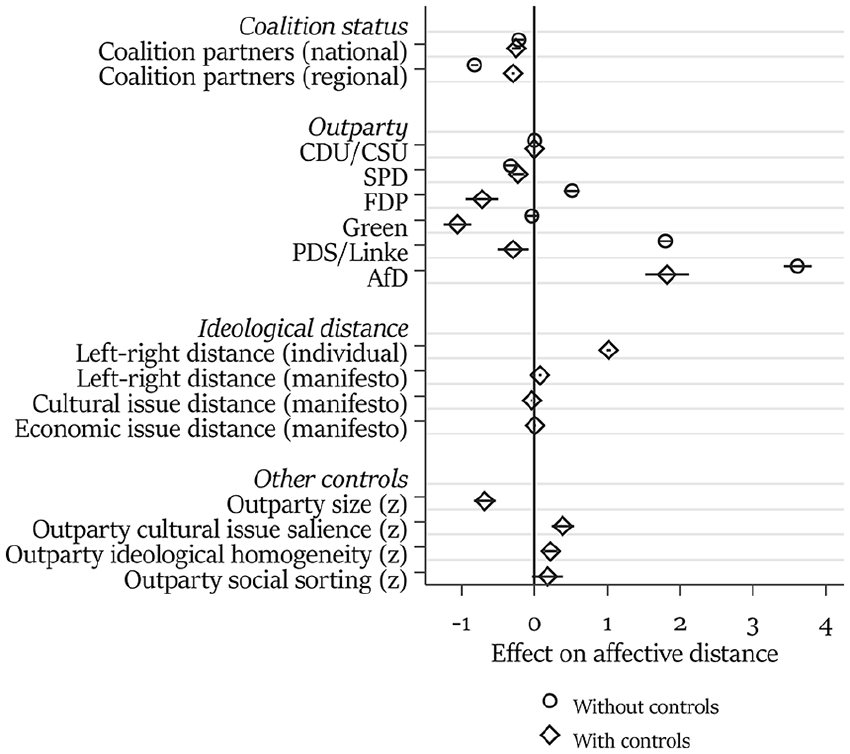
Effects of Coalition Sharing on Affective Distance.
In short, we observe a ‘coalition bonus’ impacting affective distance to a party. This is a function of the evaluation of one’s inparty as well as the outparty. We refrained from formulating any expectations about the relative importance of both components in producing the aggregated effect, but do assess this empirically. Figure A1 in Supplemental Appendix replicates the model with outparty dislike as the dependent variable, producing highly similar results. Hence, the effect on affective distance is mostly due to growing warmer towards the outgroup, rather than growing colder towards one’s own party.
Timing: Changing Affective Distance Between Coalition Partners Over Time
Looking at the development of affective distance between coalitions partners over time is relevant for two reasons. First, to provide a more stringent test of H1 (the main effect): in order to conclude that elite signals matter, we should observe reduced dislike between coalition partners to set in around the period of joining the coalition, or possibly just before it during the negotiation phase. Second, tracking the development of affective distance after the signing of the coalition agreement provides a test of H2a, which stated that the effect should erode over time, as the cooperation no longer provides novel information for voters. Figure 2 provides this dynamic overview of affective distance by predicting affective distance by dummies for different points in time before and after the coalition agreement, controlling for the same variables as Figure 1 (full regression table in Table A2 in Supplemental Appendix).
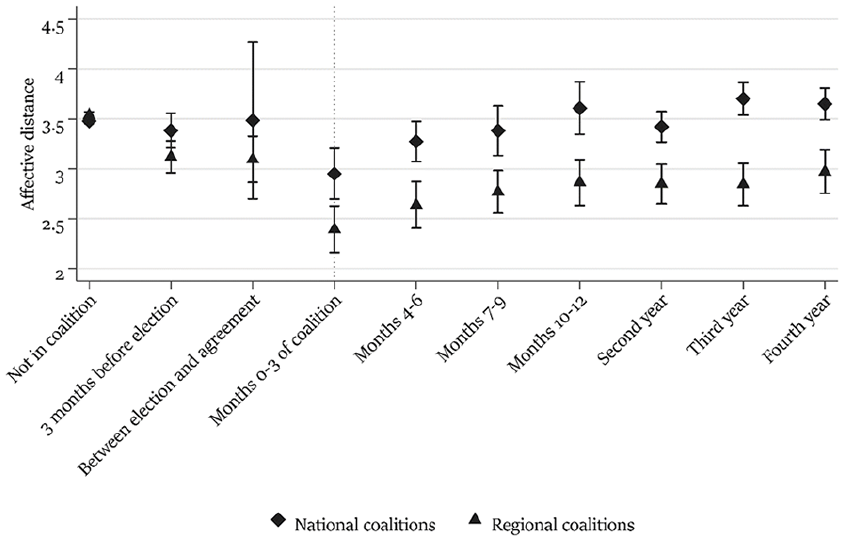
Development of Affective Dislike Before and After Start of Coalition Agreement.
Returning to the main effect (H1), Figure 2 provides evidence that sharing a coalition indeed reduces affective distance towards the coalition partner(s), this time on both the regional and national levels. The figure provides evidence that affective distance drops (to a substantial and significant degree) at the start of a (regional or national) coalition compared to the months immediately preceding the election. In the case of regional elections, we have sufficient observations to observe whether this is already the case during the coalition formation period, and at first sight there indeed appears some evidence that this is the case, but the difference is not significant. In fact, the three months before an election already sees less affective dislike between the future coalition partners (compared to other non-coalition partners). This likely reflects both remaining differential selection into coalitions (beyond our control variables) as well as elite cues, as parties anticipate coalitions based on the polls. Regardless, a very sizable drop in distance remains at the actual start of the coalition, which sends a definitive signal and is also most widely advertised. In short, zooming in on the specific window around the elections does provide evidence for H1 in the case of both national and regional coalitions.
As predicted under H2a, the coalition effect erodes after a while. This erosion occurs relatively quickly, especially on the national level: after about a year, the honeymoon period is clearly over and levels of affective distance have returned to their non-coalition levels. The erosion is also visible for regional governments, at a similar speed, but it does not fully annul the coalition bonus. In light of this evidence, we have increased confidence that a coalition bonus exists on both levels (H1) and conclude that it erodes (H2a) after a while. Figure A2 in Supplemental Appendix replicates this effect in a model with outparty dislike (rather than affective distance) as the dependent variable, again confirming that the effect is mostly driven by an initial (but, at some point, eroding) warming towards the outgroup.
Ideological Distance
Our finding that the coalition effect is subject to erosion is compatible with our expectation that the impact of elite cues depends on their novelty. To explore this further, we test whether coalition sharing has more impact on affective polarization when it happens (relatively surprisingly) between parties that are ideologically distant (H2b).
Figure 3 provides the marginal effect of coalition sharing conditional on the ideological distance towards the coalition partner, measured as the difference between the respondent’s left–right self-positioning and the average left–right self-position of the evaluated party’s supporters. (We model this by interacting both coalition sharing dummies with ideological distance in a single model, including the same control variables as previous models.) Because it is likely that distance moderates the impact of the coalition message in a non-linear way, we follow the procedure proposed by Hainmueller et al. (2019) and additionally estimate the marginal effects for multiple discrete values of the moderator (ideological distance).
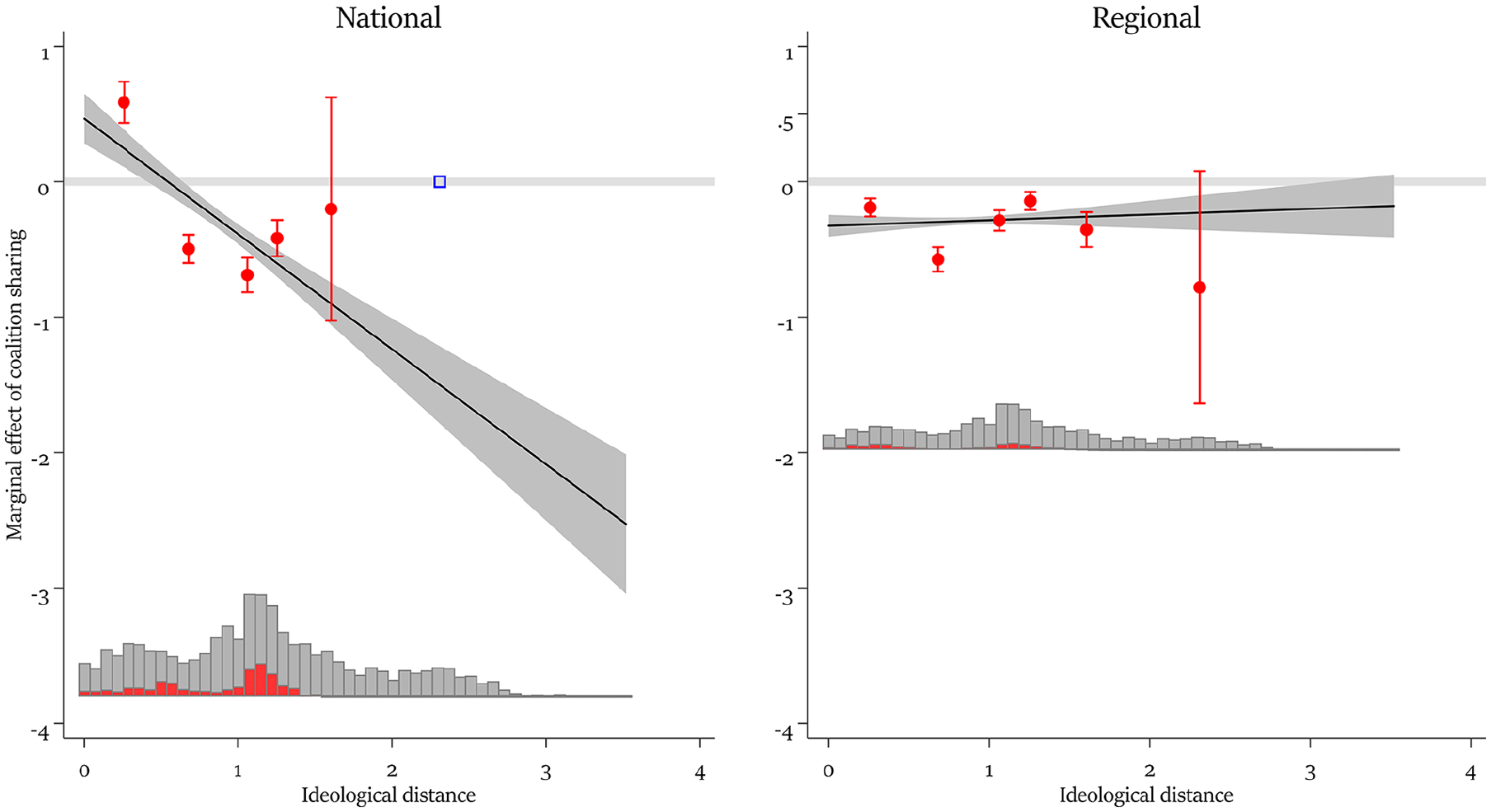
Moderation by Ideological Distance.
For national coalitions, we find a sizable (linear) interaction: the coalition bonus is very weak (or even absent) for coalitions with likeminded parties, and sizable for coalitions between ideologically dissimilar combinations. The pattern of discrete values suggests a nonlinearity: moving from a highly ideological similar to a less similar coalition partner involves a strong reduction in affective distance; having even more dissimilar coalition partners does not involve a further increase in the effect. For very dissimilar parties the estimates are not different from zero, but it should be noted that these are much rarer.
In the case of regional coalitions, by contrast, no linear interaction effect is visible. Indeed, the discrete values suggest that the coalition effect is in fact roughly similar across values of ideological distance. Hence, the impact of regional coalitions appears more consistent, whereas national coalitions are more conditional on the type of coalition. For now, we conclude that we can confirm H2b for national coalitions but not regional ones. In addition, we observed that it matters in particular whether the coalition partner is ideologically very close or not.
Coalition History
Moving on to H2c (history of coalition sharing), Figure 4 visualizes to what extent the effect of regional coalition sharing depends on coalition novelty. The latter is measured using a dummy indicating whether parties have previously shared a coalition in the respective Bundesland or not. As a reminder, because during the election period only one coalition was novel at the national level (SPD-Greens), we restrict this analysis to the regional level. Contrary to expectations, there is a reverse effect for unprecedented coalitions, which are associated with more affective distance. This could suggest voters are not willing to give new coalition partners a pass the first time around. However, we cannot rule out the pattern might reflect the relatively low number of discrete novel coalitions. At any rate, there is no evidence for H2c.
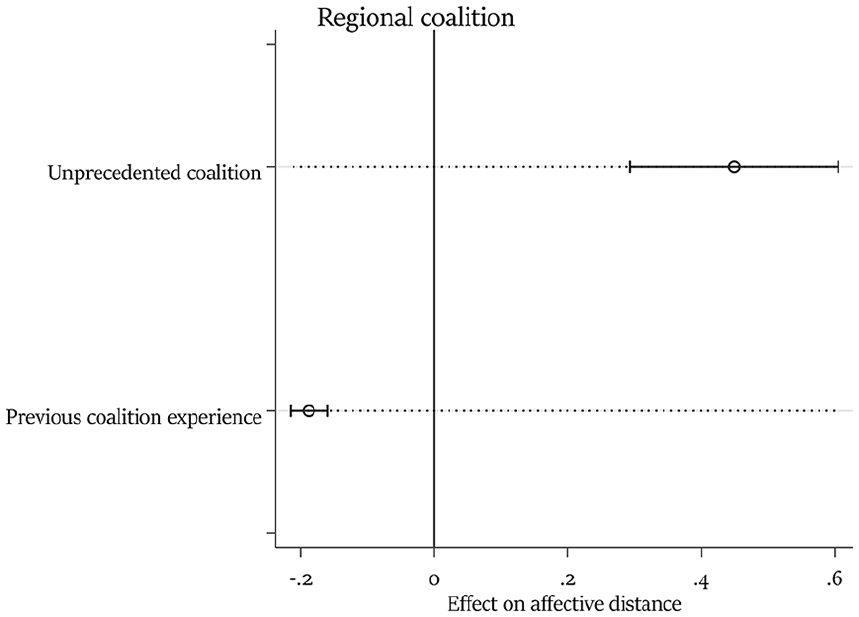
Moderation by Coalition History.
Political Interest
We also expected coalition sharing to make less of an impact among politically interested citizens (H2d). Because such interest is a feature of an individual (rather than a dyad), we cannot include it as a variable in a fixed effects model. Instead, we present separate regressions for those who self-report to have low, medium, high, or very high levels of political interest. Figure 5 presents the effect of coalition participation for each subgroup. The figure does not support our expectations, as there is little evidence that those with lower knowledge are more affected by coalition sharing. If anything, it appears (especially for national coalitions) that the effect is strongest among those most interested in politics. Possibly, the coalition actually posits a stronger information cue for those who follow politics more carefully. Hence, political interest does not clearly condition the coalition bonus, refuting H2d.
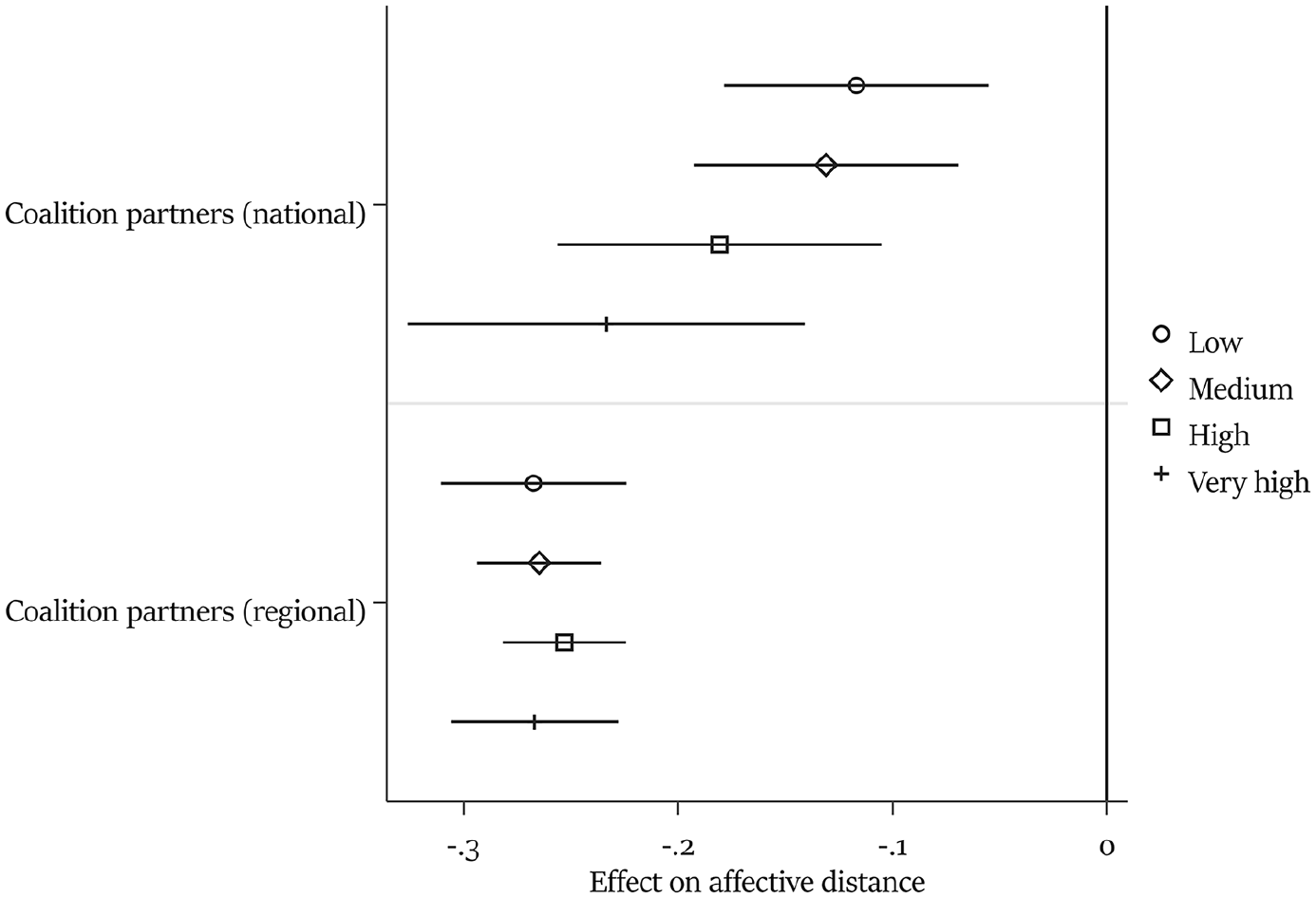
Main Effects by Political Interest (Selection of Variables).
Spill-Over: The Wider Effects of Coalition Sharing on Other Voters
Finally, we expected that citizens whose party is left out of the coalition are also impacted by the signals involved in coalition formation. We expected them to grow more coldly towards a coalition party that is their bloc partner, and more warmly towards a coalition partner that is not their bloc partner. Because of a limited number of discrete coalitions, we explore this on a case-by-case basis, and only for national coalitions. Figure 6 provides the estimated affective distance of partisan groups not included in the coalition towards both their bloc partner and non-bloc partner. 4 Parties that have no bloc partner (AfD, Die Linke) are not included. The models present the average affective distance towards each coalition partner, from the point of view of the bloc partners of each. For instance, the first panel shows how SPD and FDP voters view the Greens and CDU (their respective bloc partner) during CDU-Green coalitions and outside of it. Our expectation is that these evaluations should move towards each other during such a coalition, as views of bloc partners get cooler but their bloc partner’s new coalition partner gets viewed a bit more favourably by association.
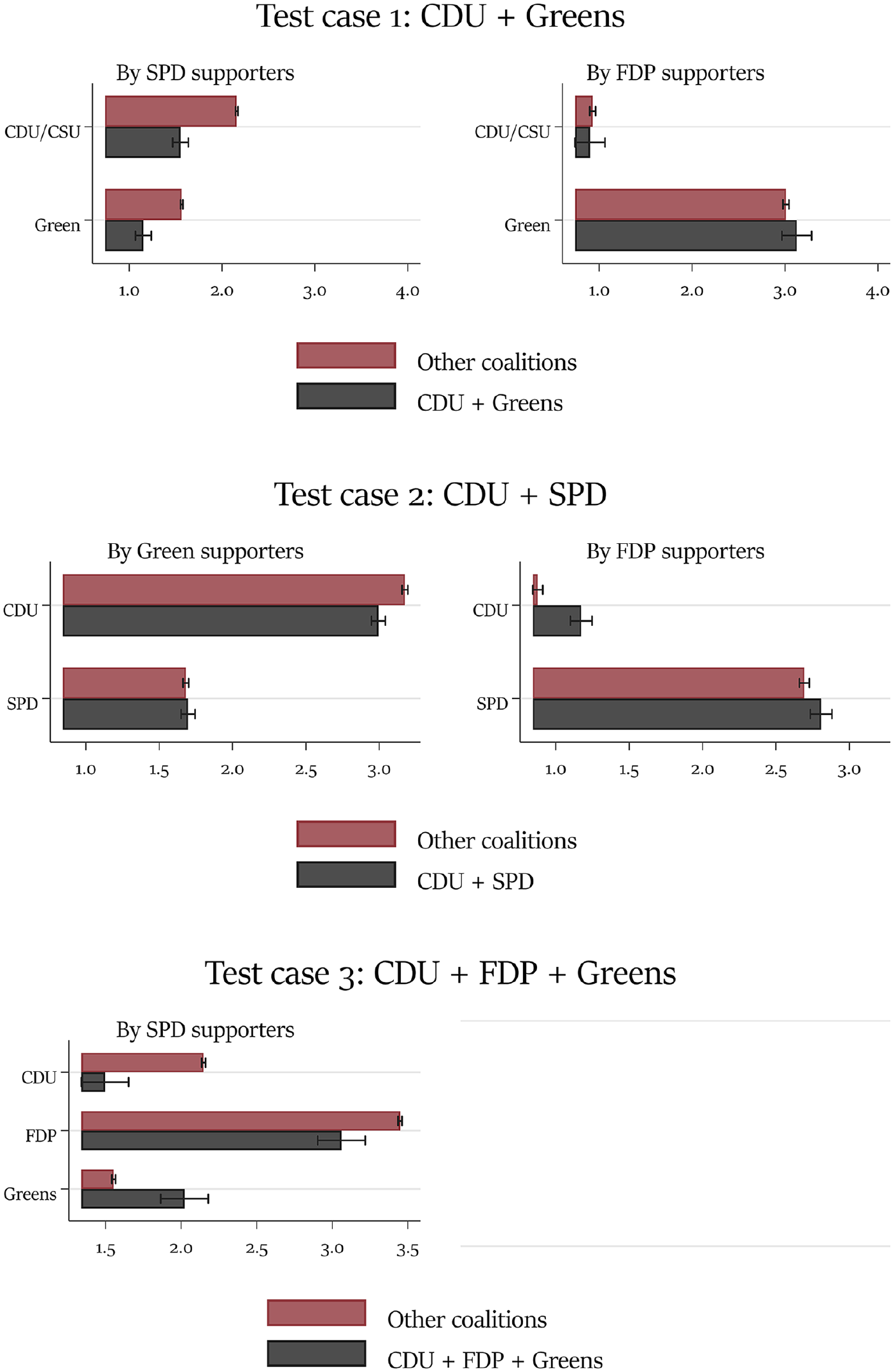
Impact of Coalitions Among Non-partners [Regionally].
The figure provides mixed evidence for the first part of this expectation – that is, H3a, which asserted that respondents grow more distant towards bloc partners that govern with non-bloc partners. This pattern is visible for FDP supporters when it comes to their views of CDU/CSU (when the latter governs with SPD) and SPD supporters’ evaluations of the Greens (when the latter governs with CDU/CSU & FDP, although this is not a very common coalition). In both cases, they ‘punish’ their bloc partner. Still, the pattern does not hold in multiple other cases: for example, we do not see any cooling of feelings of FDP supporters towards CDU/CSU when the latter is in coalitions with the Greens, or by SPD supporters towards the Greens when the latter govern with CDU/CSU. In short, the pattern predicted under H3a does not emerge robustly.
There is more evidence that supporters increase their affect towards non-bloc partners that govern with bloc partners. This is confirmed for SPD’s views towards both CDU/CSU and FDP and for the Greens’ views towards CDU/CSU. It is disconfirmed for the views of FDP supporters towards the Greens. Overall, this pattern emerges more consistently than the other. In line with the main hypothesis, there is evidence that an ‘other’ who suddenly works with ‘us’ is perceived more warmly. While admitting the case-study nature of this analysis, we take this as evidence for H3b.
What to make from this asymmetrical spill-over? Apparently, there is less evidence that bloc partners are ‘punished’ for working with an opponent, while such opponents do get seen in a warmer light. Possibly, in-bloc attachments (which tend to reflect shared ideological identities) might be more resistant to sudden deterioration, while there is some willingness to update views of opponents. The net result is reduced affective distance between blocs but not within blocs. In the concluding section, we reflect on the implications of this finding. 5
Conclusion
Elite signals matter for affective polarization. When politicians show that they can work with other parties, voters reduce their dislike towards these parties and their supporters. Building on previous work that shows the effect of coalitions both observationally (Horne et al., 2022) and experimentally (Wagner and Praprotnik, 2023), we study when elite signals matter.
Our first main expectation was that the coalition bonus should be especially manifest in more ‘surprising’ situations (i.e. situations that invite a stronger updating of priors). Our evidence, based on 20 years of monthly cross-sectional data from Germany, shows that coalitions indeed matter more when they have just been formed and when they are between distant partners. Specifically, we find that Germans already grow somewhat warmer towards future coalition partners in the run-up to regional or national coalition sharing (often a period of overtures). At the start of the coalition, there is a stark drop in negative affect towards the coalition partner. This is compatible with our understanding of coalitions as signals containing information: when starting to govern, elites often demonstrate a strong, positive willingness to work together. The honeymoon effect of coalitions is short-lived. Over time, conflicts between coalition partners may increase, while the fact of cooperation loses its novelty. Slowly, dislike returns, and – in the case of national coalitions – is back at pre-coalition levels after a year. Whether this is a gradual process or one driven by specific events is an interesting question for future research. Another finding that is in line with our expectations is that national coalition signals have a bigger depolarizing impact if they take place between ideologically more distant parties. The ‘affect bonus’ following from regional coalitions, while present, was less conditional on such ideological incongruence, which might reflect citizens’ lower awareness of regional politics. What we could not test is the effect of coalitions with radical-right parties, often the particular target of affective dislike, as no such coalition has yet been formed in Germany; this is a task for comparative research. Neither were we able to investigate the role of specific downstream mechanisms behind the coalition bonus effect, such as a perception of greater ideological closeness towards the coalition partner. This is likely but requires studies that observe changing ideological perceptions of parties, and these questions were not included in the survey we used.
Not all expectations are confirmed in this regard, however. We did not find that the impact was larger for first-time coalitions, that is, among parties that have never governed together before. Possibly, citizens are more hesitant to extend warmth to entirely new cooperation partners, but it is also possible the novelty simply escapes most citizens’ attention. The latter dovetails with our finding that the coalition affect bonus is more clearly visible among the most, rather than the least, politically interested citizens. Rather than reducing the novelty, a measure of political interest might be needed to be aware of and give importance to the cue. Regardless, we take the role of timing and ideological distance to provide evidence for our notion that some coalition signals bear more new information than others, while proposing that we need future research to provide more evidence on the sort of situations update the priors of which groups of voters. For instance, one aspect we have not considered is whether it matters whether a party joins a coalition from the opposition or whether it simply switches coalition partners.
Our second theoretical notion was that coalition signals might spill over to citizens not involved in the coalition itself, building on work by Bantel (2021) and Wagner and Praprotnik (2023). Using the large set of coalitions on the German regional level, we find that citizens actually grow warmer towards parties that are governing with bloc partners. However, we did not find evidence that citizens punish bloc partners for governing with a non-bloc partner. Hence, coalitions not only lead to warm feelings among coalition partners, but also beyond: the friend of my friend is my friend. Given the asymmetry of this finding, we note that this pattern suggests a greater likelihood of cross-bloc vote switching after cross-bloc coalitions (Klüver and Spoon, 2020), although how changes in affect in turn influence electoral outcomes is beyond the scope of this study.
In short, our study shows that, in multiparty systems, coalition formation remains an event of the first order that impacts patterns of affective polarization across society at large. Thus, our findings confirm that an affective coalition bonus exists and is particularly observable around elections and coalition agreements. At about half a unit on the 11-point scales used here, the effect is sizable, also compared to other established factors influencing affective distance. Here, our study allowed for inferential leverage and effect size estimates not possible in cross-sectional studies. Importantly, our study was restricted to ‘vertical’ affective polarization towards parties, which might be particularly impacted by elite events. Still, we argue that such feelings likely have downstream consequences for relations between citizens.
Moreover, our study tells us when elite signals are likely to matter for affective evaluations. The fact that recent coalitions and coalitions between dissimilar parties have a stronger impact shows that coalitions indeed function as signals that update (to a smaller or greater extent) citizens’ existing beliefs. This suggests that other elite signals should also be important in shaping affective polarization, and this could be an important direction of future research. Further research could examine other ways in which elites signal cooperation, for instance, during national crises or when cooperating ad hoc across institutional levels. Comparative research could also be used to study what happens when coalitions disintegrate and fall apart. Our framework helps to develop expectations for the kind of elite signals that will reach voters – and the kind that will not.
Our results also shed light on how affective polarization evolves over time. In multiparty systems, which involve a fragmented space and shifting allegiances, it is helpful to think of citizens as often having an imperfect overview, and hence likely to update their affective evaluations primarily at particularly critical political moments. This perspective also suggests that not all citizens will respond in the same way to changes in the political landscape, especially more subtle ones. Overall, our study sheds further light on the dynamic nature of affective polarization, which could inform future research.
Finally, our study also holds normative implications. Affective polarization is an important characteristic of political systems, with higher levels of such polarization associated with both negative and positive consequences (Harteveld and Wagner, 2022; Iyengar et al., 2019; Kalmoe and Mason, 2022; Kingzette et al., 2021). While some argue reducing affective polarization and interpartisan animosity is an urgent goal in contemporary societies (Hartman et al., 2022), we would also acknowledge arguments that some level of affective polarization is intrinsic to democratic competition, while there is also value in rejecting undemocratic actors (Wagner, 2024). Nevertheless, given the importance of affective polarization as a feature of party politics, it is important to know when elite cooperation can increase or reduce patterns of affect between partisans. Our results show that elite signals strongly shape voter affect, so politicians should be aware of the societal impact of their coalition formation decisions. Moreover, our findings imply that elite cooperation can likely destigmatize extreme parties and their supporters, and that this effect extends to other parties within the same ideological bloc. Given these empirical findings, the question of whether affect towards such parties should indeed be reduced through elite signals is an urgent normative question.
Supplemental Material
sj-docx-1-psx-10.1177_00323217241300993 – Supplemental material for Elite Cooperation and Affective Polarization: Evidence From German Coalitions
Supplemental material, sj-docx-1-psx-10.1177_00323217241300993 for Elite Cooperation and Affective Polarization: Evidence From German Coalitions by Markus Wagner and Eelco Harteveld in Political Studies
Footnotes
Declaration of Conflicting Interests
The author(s) declared no potential conflicts of interest with respect to the research, authorship and/or publication of this article.
Funding
The author(s) disclosed receipt of the following financial support for the research, authorship and/or publication of this article: This research was supported by the Dutch Research Council (grant 016.Veni.195.159) and by the European Research Council (grant 101044069).

Supplemental material
Supplemental material for this article is available online.
Table A1.
Table A2.
Table A3. Moderation by ideological distance (H2b).
Table A4. Moderation by coalition novelty (H2c).
Table A5. Effects by political interest.
Table A6. Classification of Politbarometer codes.
Figure A1.
Figure A2.
Figure A3. Controlling for time trends.
Figure A4. Case study: Baden-Wurttemberg 2016.
Notes
Author Biographies
References
Supplementary Material
Please find the following supplemental material available below.
For Open Access articles published under a Creative Commons License, all supplemental material carries the same license as the article it is associated with.
For non-Open Access articles published, all supplemental material carries a non-exclusive license, and permission requests for re-use of supplemental material or any part of supplemental material shall be sent directly to the copyright owner as specified in the copyright notice associated with the article.
